

ASTM D2343-17(2023)
(Test Method)Standard Test Method for Tensile Properties of Glass Fiber Strands, Yarns, and Rovings Used in Reinforced Plastics
General Information
- Abstract
SIGNIFICANCE AND USE
5.1 Tensile properties determined by this test method are of value for identifying and characterizing materials for control and specification purposes as well as for providing data for research and development studies.
5.2 This test method is intended for use in testing resin-compatible sized glass fiber materials that have been designed specifically for use with certain generic types of plastics. The use of a resin system that is compatible with the reinforcement material under test produces results that are most representative of the actual strength that is available in the material when used as intended in an end item. Premature reinforcement failures occur if the elongation of the resin system is less than that of the reinforcement being tested. It is critical to select a resin system that does not lead to premature reinforcement failure. Use of compatible resin system and complete resin impregnation is recommended to avoid invalid failures and misleading results.
5.3 This test method is useful for testing pretreated specimens for which comparative results are desired. Gage length, gripping system, testing speed, and the resin impregnation ratio of the specimen affects the values obtained by this test method.
SCOPE
1.1 This test method covers the determination of the comparative tensile properties of glass fiber strands, yarns, and rovings in the form of impregnated rod test specimens when tested under defined conditions of pretreatment, temperature, humidity, and tension testing machine speed. This test method is applicable to continuous filament, glass fiber materials that have been coated with a resin compatible sizing. This method is intended for use in quality control and R & D, and is not intended to be used to develop composites design data.
Note 1: This method is technically equivalent to the short method described in ISO 9163.
Note 2: Prime consideration should be given to the use of a polymeric binder that produces specimens that yield the highest consistent values for the glass fiber material under test. Tensile properties vary with specimen preparation, resin impregnation system, and speed and environment of testing. Consider these factors where precise comparative results are desired.
1.2 The values stated in SI units are to be regarded as the standard. The values given in parentheses are for information only.
1.3 This standard does not purport to address all of the safety concerns, if any, associated with its use. It is the responsibility of the user of this standard to establish appropriate safety, health, and environmental practices and determine the applicability of regulatory limitations prior to use.
1.4 This international standard was developed in accordance with internationally recognized principles on standardization established in the Decision on Principles for the Development of International Standards, Guides and Recommendations issued by the World Trade Organization Technical Barriers to Trade (TBT) Committee.
- Status
- Published
- Publication Date
- 31-Jul-2023
- Technical Committee
- D20 - Plastics
- Drafting Committee
- D20.18 - Reinforced Thermosetting Plastics
Overview
ASTM D2343-17(2023) is the globally recognized Standard Test Method for Tensile Properties of Glass Fiber Strands, Yarns, and Rovings Used in Reinforced Plastics. Developed by ASTM International, this standard outlines procedures for measuring the comparative tensile strength and modulus of glass fiber materials in resin-impregnated rod form. The method plays a crucial role for manufacturers and researchers in the reinforced plastics industry by providing consistent, reliable data to characterize, control, and specify glass fiber products.
The test method targets continuous filament glass fibers that are resin-compatible and have undergone specific sizing for integration into plastics. Results generated are primarily used for quality control and research and development (R&D) purposes, rather than for the design of composite structures. Precision in specimen preparation, compatibility between resin and reinforcement, and control of testing conditions are key to obtaining meaningful tensile data.
Key Topics
- Tensile Testing of Glass Fibers: Measures the breaking force and extension of stranded, yarn, or roving glass fibers that are resin-impregnated and prepared under controlled conditions.
- Material Compatibility: Focuses on the importance of using a resin matrix that matches the elongation and cure requirements of the glass fiber reinforcement to prevent premature failure.
- Specimen Preparation: Includes guidelines on specimen conditioning, resin impregnation, tabbing, and the influence of gage length, grip type, and testing speed.
- Test Environment: Specifies atmospheric conditions (temperature and humidity) and test speeds to ensure repeatable and accurate results.
- Comparative Data: Emphasizes relative, not absolute, property values-serving primarily for material identification, quality assurance, and benchmarking during R&D.
- Reporting Requirements: Details information to be included in test reports, such as material source, preparation methods, and observed results.
Applications
ASTM D2343-17(2023) serves a wide spectrum of practical uses across the reinforced plastics and composites industry:
- Quality Control: Manufacturers use the standard to verify the tensile properties of glass fiber batches before integration into composite production, ensuring that only materials meeting specifications progress to manufacturing.
- Material Selection & Specification: Engineers and product designers reference tensile property data when selecting glass fiber yarns or rovings for specific resin systems in new product development.
- Process Development & Optimization: R&D teams utilize test data to assess the effects of changes in resin compositions, fiber sizing agents, or processing parameters on the mechanical performance of reinforced plastics.
- Supplier Benchmarking: Comparative results enable effective evaluation of glass fiber materials from different suppliers, aiding in procurement and quality assurance decisions.
- Academic and Industrial Research: Researchers employ these standardized methods for publishing repeatable, verifiable data on new material configurations and hybrid composites.
Related Standards
The following standards relate closely to ASTM D2343-17(2023) and are often referenced together in procurement and laboratory protocols:
- ASTM D618: Practice for Conditioning Plastics for Testing
- ASTM D883: Terminology Relating to Plastics
- ASTM E4: Practices for Force Calibration and Verification of Testing Machines
- ASTM E6: Terminology Relating to Methods of Mechanical Testing
- ISO 9163: Textile Glass-Rovings-Manufacture of Test Specimens and Determination of Tensile Strength of Impregnated Rovings
By adhering to ASTM D2343-17(2023), organizations ensure globally recognized, reproducible measurement of tensile properties in glass fiber strands, yarns, and rovings, supporting quality and innovation within the reinforced plastics sector.
Relations
- Effective Date
- 01-Feb-2024
- Effective Date
- 01-Nov-2023
- Effective Date
- 01-Jan-2020
- Effective Date
- 01-Aug-2019
- Effective Date
- 15-Apr-2019
- Effective Date
- 01-Feb-2019
- Effective Date
- 01-Dec-2018
- Effective Date
- 01-Nov-2018
- Effective Date
- 15-Aug-2017
- Effective Date
- 01-Jun-2014
- Effective Date
- 15-Nov-2012
- Effective Date
- 15-May-2011
- Effective Date
- 01-Jun-2010
- Effective Date
- 01-Nov-2009
- Effective Date
- 15-May-2009
Get Certified
Connect with accredited certification bodies for this standard

Control Union Certifications
Global certification for agriculture and sustainability.

Hohenstein Institut
Textile testing and certification.

Bureau Veritas Bangladesh
Bureau Veritas certification services in Bangladesh.
Sponsored listings
Frequently Asked Questions
ASTM D2343-17(2023) is a standard published by ASTM International. Its full title is "Standard Test Method for Tensile Properties of Glass Fiber Strands, Yarns, and Rovings Used in Reinforced Plastics". This standard covers: SIGNIFICANCE AND USE 5.1 Tensile properties determined by this test method are of value for identifying and characterizing materials for control and specification purposes as well as for providing data for research and development studies. 5.2 This test method is intended for use in testing resin-compatible sized glass fiber materials that have been designed specifically for use with certain generic types of plastics. The use of a resin system that is compatible with the reinforcement material under test produces results that are most representative of the actual strength that is available in the material when used as intended in an end item. Premature reinforcement failures occur if the elongation of the resin system is less than that of the reinforcement being tested. It is critical to select a resin system that does not lead to premature reinforcement failure. Use of compatible resin system and complete resin impregnation is recommended to avoid invalid failures and misleading results. 5.3 This test method is useful for testing pretreated specimens for which comparative results are desired. Gage length, gripping system, testing speed, and the resin impregnation ratio of the specimen affects the values obtained by this test method. SCOPE 1.1 This test method covers the determination of the comparative tensile properties of glass fiber strands, yarns, and rovings in the form of impregnated rod test specimens when tested under defined conditions of pretreatment, temperature, humidity, and tension testing machine speed. This test method is applicable to continuous filament, glass fiber materials that have been coated with a resin compatible sizing. This method is intended for use in quality control and R & D, and is not intended to be used to develop composites design data. Note 1: This method is technically equivalent to the short method described in ISO 9163. Note 2: Prime consideration should be given to the use of a polymeric binder that produces specimens that yield the highest consistent values for the glass fiber material under test. Tensile properties vary with specimen preparation, resin impregnation system, and speed and environment of testing. Consider these factors where precise comparative results are desired. 1.2 The values stated in SI units are to be regarded as the standard. The values given in parentheses are for information only. 1.3 This standard does not purport to address all of the safety concerns, if any, associated with its use. It is the responsibility of the user of this standard to establish appropriate safety, health, and environmental practices and determine the applicability of regulatory limitations prior to use. 1.4 This international standard was developed in accordance with internationally recognized principles on standardization established in the Decision on Principles for the Development of International Standards, Guides and Recommendations issued by the World Trade Organization Technical Barriers to Trade (TBT) Committee.
SIGNIFICANCE AND USE 5.1 Tensile properties determined by this test method are of value for identifying and characterizing materials for control and specification purposes as well as for providing data for research and development studies. 5.2 This test method is intended for use in testing resin-compatible sized glass fiber materials that have been designed specifically for use with certain generic types of plastics. The use of a resin system that is compatible with the reinforcement material under test produces results that are most representative of the actual strength that is available in the material when used as intended in an end item. Premature reinforcement failures occur if the elongation of the resin system is less than that of the reinforcement being tested. It is critical to select a resin system that does not lead to premature reinforcement failure. Use of compatible resin system and complete resin impregnation is recommended to avoid invalid failures and misleading results. 5.3 This test method is useful for testing pretreated specimens for which comparative results are desired. Gage length, gripping system, testing speed, and the resin impregnation ratio of the specimen affects the values obtained by this test method. SCOPE 1.1 This test method covers the determination of the comparative tensile properties of glass fiber strands, yarns, and rovings in the form of impregnated rod test specimens when tested under defined conditions of pretreatment, temperature, humidity, and tension testing machine speed. This test method is applicable to continuous filament, glass fiber materials that have been coated with a resin compatible sizing. This method is intended for use in quality control and R & D, and is not intended to be used to develop composites design data. Note 1: This method is technically equivalent to the short method described in ISO 9163. Note 2: Prime consideration should be given to the use of a polymeric binder that produces specimens that yield the highest consistent values for the glass fiber material under test. Tensile properties vary with specimen preparation, resin impregnation system, and speed and environment of testing. Consider these factors where precise comparative results are desired. 1.2 The values stated in SI units are to be regarded as the standard. The values given in parentheses are for information only. 1.3 This standard does not purport to address all of the safety concerns, if any, associated with its use. It is the responsibility of the user of this standard to establish appropriate safety, health, and environmental practices and determine the applicability of regulatory limitations prior to use. 1.4 This international standard was developed in accordance with internationally recognized principles on standardization established in the Decision on Principles for the Development of International Standards, Guides and Recommendations issued by the World Trade Organization Technical Barriers to Trade (TBT) Committee.
ASTM D2343-17(2023) is classified under the following ICS (International Classification for Standards) categories: 59.100.10 - Textile glass materials. The ICS classification helps identify the subject area and facilitates finding related standards.
ASTM D2343-17(2023) has the following relationships with other standards: It is inter standard links to ASTM D883-24, ASTM D883-23, ASTM D883-20, ASTM D883-19c, ASTM D883-19a, ASTM D883-19, ASTM D883-18a, ASTM D883-18, ASTM D883-17, ASTM E4-14, ASTM D883-12e1, ASTM D883-11, ASTM E4-10, ASTM E4-09a, ASTM E6-09be1. Understanding these relationships helps ensure you are using the most current and applicable version of the standard.
ASTM D2343-17(2023) is available in PDF format for immediate download after purchase. The document can be added to your cart and obtained through the secure checkout process. Digital delivery ensures instant access to the complete standard document.
Standards Content (Sample)
This international standard was developed in accordance with internationally recognized principles on standardization established in the Decision on Principles for the
Development of International Standards, Guides and Recommendations issued by the World Trade Organization Technical Barriers to Trade (TBT) Committee.
Designation: D2343 − 17 (Reapproved 2023)
Standard Test Method for
Tensile Properties of Glass Fiber Strands, Yarns, and
Rovings Used in Reinforced Plastics
This standard is issued under the fixed designation D2343; the number immediately following the designation indicates the year of
original adoption or, in the case of revision, the year of last revision. A number in parentheses indicates the year of last reapproval. A
superscript epsilon (´) indicates an editorial change since the last revision or reapproval.
This standard has been approved for use by agencies of the U.S. Department of Defense.
1. Scope 2. Referenced Documents
2.1 ASTM Standards:
1.1 This test method covers the determination of the com-
D618 Practice for Conditioning Plastics for Testing
parative tensile properties of glass fiber strands, yarns, and
D883 Terminology Relating to Plastics
rovings in the form of impregnated rod test specimens when
E4 Practices for Force Calibration and Verification of Test-
tested under defined conditions of pretreatment, temperature,
ing Machines
humidity, and tension testing machine speed. This test method
E6 Terminology Relating to Methods of Mechanical Testing
is applicable to continuous filament, glass fiber materials that
2.2 ISO Standard:
have been coated with a resin compatible sizing. This method
ISO 9163 Textile Glass—Rovings—Manufacture of Test
is intended for use in quality control and R & D, and is not
Specimens and Determination of Tensile Strength of
intended to be used to develop composites design data.
Impregnated Rovings
NOTE 1—This method is technically equivalent to the short method
described in ISO 9163. 3. Terminology
NOTE 2—Prime consideration should be given to the use of a polymeric
3.1 Definitions:
binder that produces specimens that yield the highest consistent values for
3.1.1 Definitions of terms and symbols relating to this test
the glass fiber material under test. Tensile properties vary with specimen
method appear in Terminologies E6 and D883.
preparation, resin impregnation system, and speed and environment of
testing. Consider these factors where precise comparative results are
4. Summary of Test Method
desired.
4.1 This test method consists of impregnating glass fiber
1.2 The values stated in SI units are to be regarded as the
strands, yarns, or rovings with a suitable polymeric binder
standard. The values given in parentheses are for information
material and loading the resulting test specimens to failure in a
only.
tension testing machine having a constant-rate-of crosshead
1.3 This standard does not purport to address all of the
movement. The cross sectional area is determined from skeins
safety concerns, if any, associated with its use. It is the
of glass fiber taken before and after each set of test specimens.
responsibility of the user of this standard to establish appro-
After impregnation and curing, the specimens shall either be
priate safety, health, and environmental practices and deter-
tabbed using glass fiber mat or cardboard and tested with
mine the applicability of regulatory limitations prior to use.
standard grips; or the ends shall be sanded with 240 grit
sandpaper or fine emery cloth and tested using rubber faced
1.4 This international standard was developed in accor-
grips.
dance with internationally recognized principles on standard-
ization established in the Decision on Principles for the
5. Significance and Use
Development of International Standards, Guides and Recom-
mendations issued by the World Trade Organization Technical 5.1 Tensile properties determined by this test method are of
Barriers to Trade (TBT) Committee. value for identifying and characterizing materials for control
and specification purposes as well as for providing data for
research and development studies.
This test method is under the jurisdiction of ASTM Committee D20 on Plastics
and is the direct responsibility of Subcommittee D20.18 on Reinforced Thermoset-
ting Plastics. For referenced ASTM standards, visit the ASTM website, www.astm.org, or
Current edition approved Aug. 1, 2023. Published August 2023. Originally contact ASTM Customer Service at service@astm.org. For Annual Book of ASTM
approved in 1965. Last previous edition approved in 2017 as D2343–17. DOI: Standards volume information, refer to the standard’s Document Summary page on
10.1520/D2343-17R23. the ASTM website.
*A Summary of Changes section appears at the end of this standard
Copyright © ASTM International, 100 Barr Harbor Drive, PO Box C700, West Conshohocken, PA 19428-2959. United States
D2343 − 17 (2023)
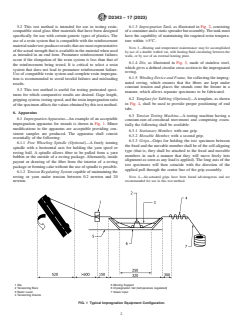
5.2 This test method is intended for use in testing resin- 6.1.3 Impregnation Tank, as illustrated in Fig. 2, consisting
compatible sized glass fiber materials that have been designed of a container and a static spreader bar assembly. The tank must
specifically for use with certain generic types of plastics. The have the capability of maintaining the required resin tempera-
use of a resin system that is compatible with the reinforcement ture within 65°C.
material under test produces results that are most representative
NOTE 3—Heating and temperature maintenance may be accomplished
of the actual strength that is available in the material when used
by use of a double walled vat, with heating fluid circulating between the
as intended in an end item. Premature reinforcement failures
walls, or by use of an external heating plate.
occur if the elongation of the resin system is less than that of
6.1.4 Die, as illustrated in Fig. 3, made of stainless steel,
the reinforcement being tested. It is critical to select a resin
which gives a defined circular cross-section to the impregnated
system that does not lead to premature reinforcement failure.
roving.
Use of compatible resin system and complete resin impregna-
6.1.5 Winding Device and Frame, for collecting the impreg-
tion is recommended to avoid invalid failures and misleading
nated roving, which ensures that the fibers are kept under
results.
constant tension and places the strands onto the fixture in a
5.3 This test method is useful for testing pretreated speci-
manner, which allows separate specimens to be fabricated.
mens for which comparative results are desired. Gage length,
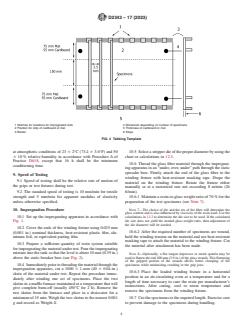
6.2 Template for Tabbing (Optional)—A template, as shown
gripping system, testing speed, and the resin impregnation ratio
in Fig. 4, shall be used to provide proper positioning of end
of the specimen affects the values obtained by this test method.
tabs.
6. Apparatus
6.3 Tension Testing Machine—A testing machine having a
6.1 Impregnation Apparatus—An example of an acceptable
constant-rate-of-crosshead movement and comprising essen-
impregnation apparatus for strands is shown in Fig. 1. Minor
tially the following shall be available:
modifications to the apparatus are acceptable providing con-
6.3.1 Stationary Member, with one grip.
sistent samples are produced. The apparatus shall consist
6.3.2 Movable Member, with a second grip.
essentially of the following:
6.3.3 Grips—Grips for holding the test specimen between
6.1.1 Free Wheeling Spindle (Optional)—A freely turning
the fixed and the movable member shall be of the self-aligning
spindle with a horizontal axis for holding the yarn spool or
type (that is, they shall be attached to the fixed and movable
roving ball. A spindle allows fiber to be pulled from a yarn
members in such a manner that they will move freely into
bobbin or the outside of a roving package. Alternately, inside
alignment as soon as any load is applied). The long axis of the
payout or drawing of the fiber from the interior of a roving
test specimens will then coincide with the direction of the
package or forming cake without the use of spindle is possible.
applied pull through the center line of the grip assembly.
6.1.2 Tension Regulating System capable of maintaining the
roving or yarn under tension between 0.2 newton and 20
NOTE 4—Air-actuated grips have been found advantageous and are
newton. recommended for use in this test method.
1 Die 5 Moving Support
2 Tensioning Bars 6 Impregnation Vat (temperature regulated)
3 Resin Level 7 Glass Input
4 Tensioning Device
FIG. 1 Typical Impregnation Equipment Configuration
D2343 − 17 (2023)
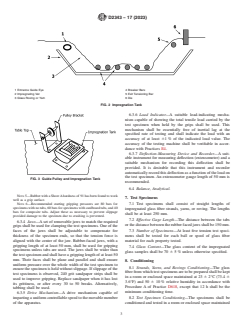
1 Entrance Guide Eye 4 Breaker Bars
2 Impregnating Vat 5 Exit Tensioning Bar
3 Glass Roving or Yarn 6 Die
FIG. 2 Impregnation Tank
6.3.6 Load Indicator—A suitable load-indicating mecha-
nism capable of showing the total tensile load carried by the
test specimen when held by the grips shall be used. This
mechanism shall be essentially free of inertial lag at the
specified rate of testing and shall indicate the load with an
accuracy of at least 61 % of the indicated load value. The
accuracy of the testing machine shall be verifiable in accor-
dance with Practices E4.
6.3.7 Deflection-Measuring Device and Recorder—A suit-
able instrument for measuring deflection (extensometer) and a
suitable mechanism for recording this deflection shall be
provided. It is desirable that this instrument and recorder
automatically record this deflection as a function of the load on
the test specimen. An extensometer gauge length of 50 mm is
FIG. 3 Guide Pulley and Impregnation Tank
recommended.
6.4 Balance, Analytical.
NOTE 5—Rubber with a Shore A hardness of 91 has been found to work
7. Test Specimens
well as a grip surface.
NOTE 6—Recommended starting gripping pressures are 80 bars for
7.1 Test specimens shall consist of straight lengths of
specimens with no tabs, 60 bars for specimens with cardboard tabs, and 40
impregnated glass fiber strands, yarns, or roving. The lengths
bars for composite tabs. Adjust these as necessary to prevent slippage
shall be at least 250 mm.
provided damage to the specimen due to crushing is prevented.
7.2 Effective Gage Length—The distance between the tabs
6.3.4 Jaws—A set of removable jaws to match the required
or the distance between the rubber faced jaws shall be 150 mm.
grips shall be used for clamping the test specimens. One of the
faces of the jaws shall be adjustable to compensate for 7.3 Number of Specimens—At least five tension test speci-
thickness of the specimen ends, so that the tension force is
mens shall be tested for each ball or spool of glass fiber
aligned with the center of the jaw. Rubber-faced jaws, with a material for each property tested.
gripping length of at least 50 mm, shall be used for gripping
7.4 Glass Content—The glass content of the impregnated
specimens unless tabs are used. The jaws shall be wider than
glass samples shall be 70 6 5 % unless otherwise specified.
the test specimen and shall have a gripping length of at least 50
mm. Their faces shall be plane and parallel and shall ensure
8. Conditioning
uniform pressure over the whole width of the test specimen to
8.1 Strands, Yarns, and Rovings Conditioning—The glass
ensure the specimen is held without slippage. If slippage of the
fiber from which test specimens are to be prepared shall be kept
test specimens is observed, 240 grit sandpaper strips shall be
in a room or enclosed space maintained at 23 6 2°C (73.4 6
used to improve gripping. Replace sandpaper when it has lost
3.6°F) and 50 6 10 % relative humidity in accordance with
its grittiness, or after every 30 to 50 breaks. Alternatively,
Procedure A of Practice D618, except that 12 h shall be the
tabbing shall be used.
minimum conditioning time.
6.3.5 Drive Mechanism—A drive mechanism capable of
imparting a uniform controllable speed to the movable member 8.2 Test Specimen Conditioning—The specimens shall be
of the apparatus. conditioned and tested in a room or enclosed space maintained
D2343 − 17 (2023)
1 Notches for locations for impregnated rods 4 Dimension depending on number of specimens
2 Position for strip of cardboard or mat 5 Thickness of cardboard or mat
3 Border 6 Stops
FIG. 4 Tabbing Template
at atmospheric conditions of 23 6 2°C (73.4 6 3.6°F) and 50 10.5 Select a stripper die of the proper diameter by using the
6 10 % relative humidity in accordance with Procedure A of chart or calculations in 12.3.
Practice D618, except that 16 h shall be the minimum
10.6 Thread the glass fi
...