

ASTM F2487-21
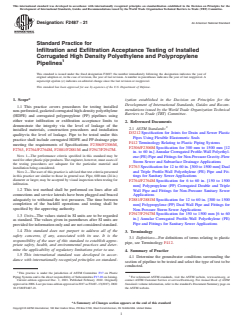
(Practice)Standard Practice for Infiltration and Exfiltration Acceptance Testing of Installed Corrugated High Density Polyethylene and Polypropylene Pipelines
General Information
- Abstract
SIGNIFICANCE AND USE
5.1 This is not a routine test. The values recorded are applicable only to the pipe being tested and at the time of testing.
SCOPE
1.1 This practice covers procedures for testing installed non-perforated, gasketed corrugated high-density polyethylene (HDPE) and corrugated polypropylene (PP) pipelines using either water infiltration or exfiltration acceptance limits to demonstrate the integrity via the level of leakage of the installed materials, construction procedures and installation qualityvia the level of leakage. Pipe to be tested under this practice shall include corrugated HDPE and PP drainage pipe meeting the requirements of Specifications F2306/F2306M, F2763, F2764/F2764M, F2881/F2881M and F2947/F2947M.
Note 1: The performance criteria specified in this standard may be used for other plastic pipe products. The engineer, however, must assess if the testing procedures are adequate for the particular material and installation being considered.
Note 2: The user of this practice is advised that test criteria presented in this practice are similar to those in general use. Pipe, 600 mm (24 in.) diameter or larger, may be accepted by visual inspection when testing for infiltration.
1.2 This test method shall be performed on lines after all connections and service laterals have been plugged and braced adequately to withstand the test pressures. The time between completion of the backfill operations and testing shall be specified by the approving authority.
1.3 Units—The values stated in SI units are to be regarded as standard. The values given in parentheses after SI units are provided for information only and are not considered standard.
1.4 This standard does not purport to address all of the safety concerns, if any, associated with its use. It is the responsibility of the user of this standard to establish appropriate safety, health, and environmental practices and determine the applicability of regulatory limitations prior to use.
1.5 This international standard was developed in accordance with internationally recognized principles on standardization established in the Decision on Principles for the Development of International Standards, Guides and Recommendations issued by the World Trade Organization Technical Barriers to Trade (TBT) Committee.
- Status
- Published
- Publication Date
- 30-Nov-2021
- Technical Committee
- F17 - Plastic Piping Systems
- Drafting Committee
- F17.20 - Joining
Buy Documents


ASTM F2487-21 - Standard Practice for Infiltration and Exfiltration Acceptance Testing of Installed Corrugated High Density Polyethylene and Polypropylene Pipelines

REDLINE ASTM F2487-21 - Standard Practice for Infiltration and Exfiltration Acceptance Testing of Installed Corrugated High Density Polyethylene and Polypropylene Pipelines
Overview
ASTM F2487-21: Standard Practice for Infiltration and Exfiltration Acceptance Testing of Installed Corrugated High Density Polyethylene and Polypropylene Pipelines provides standardized procedures for evaluating the integrity of installed non-perforated, gasketed corrugated high-density polyethylene (HDPE) and polypropylene (PP) pipelines. The standard helps determine the level of leakage in newly installed pipelines, ensuring effective quality control of materials, workmanship, and construction practices for drainage and sanitary systems. This standard is published by ASTM International and is developed under the jurisdiction of Committee F17 on Plastic Piping Systems.
By adopting ASTM F2487-21, project owners, engineers, and contractors can reliably test for water infiltration and exfiltration, verifying that pipelines meet acceptance requirements and maintain long-term system integrity.
Key Topics
- Test Types: The standard outlines two primary acceptance tests:
- Infiltration Testing: Measures water entering the pipeline from the surrounding environment.
- Exfiltration Testing: Measures water lost from the pipeline into the surrounding soil.
- Applicability:
- Focuses on non-perforated, gasketed corrugated HDPE and PP pipes, as specified in standards such as ASTM F2306, F2763, F2764, F2881, and F2947.
- Allows for possible application to other plastic pipe products if deemed appropriate by the design engineer.
- Preparation and Procedures:
- All service laterals and connections are sealed and braced before testing.
- The system must be free of debris, with relevant safety and confined space protocols followed.
- Testing is completed after backfill is in place, timing as set by the approving authority.
- Groundwater conditions assessed to determine the appropriate test (infiltration or exfiltration).
- Tests are typically conducted between manholes with a maximum length of 213 m (700 ft).
- Acceptance Criteria:
- Leakage rates must not exceed limits set by the system owner or regulatory guidelines.
- If a section fails, repairs must be made and the test repeated.
Applications
ASTM F2487-21 is widely utilized in municipal, industrial, and transportation projects to verify the performance of corrugated HDPE and PP drainage and sanitary pipeline installations. Typical applications include:
- Stormwater Management Systems: Ensuring underground drainage pipes are watertight to prevent system failure or environmental contamination.
- Sanitary Sewer Installations: Verifying exfiltration and infiltration rates meet regulatory standards to protect groundwater quality.
- Infrastructure Projects: Used by highway agencies and municipalities for quality assurance of subsurface drainage during project handover.
By following this standard, stakeholders can reduce the risk of future leaks, infiltration, and exfiltration issues, ultimately minimizing costly repairs and environmental impacts.
Related Standards
ASTM F2487-21 references and is directly related to several other standards that define material and performance requirements for corrugated plastic pipes:
- ASTM F2306/F2306M: Specification for annular corrugated profile-wall PE pipes for non-pressure drainage applications.
- ASTM F2763: Specification for dual and triple profile-wall PE pipes for sanitary sewer systems.
- ASTM F2764/F2764M: Specification for corrugated double and triple wall PP pipes for non-pressure sanitary applications.
- ASTM F2881/F2881M: Specification for PP dual wall pipes for non-pressure storm sewer systems.
- ASTM F2947/F2947M: Specification for annular corrugated profile-wall PE pipes for sanitary sewer applications.
- ASTM D3212: Specification for joints for plastic pipes with flexible elastomeric seals.
- ASTM F412: Terminology for plastic piping systems.
When implementing infiltration or exfiltration testing, referencing these related standards ensures full compliance and compatibility throughout the project lifecycle.
Keywords: ASTM F2487-21, HDPE pipeline testing, PP pipeline testing, infiltration testing, exfiltration testing, leakage testing, corrugated pipe acceptance, drainage pipe standards, sanitary sewer quality assurance, ASTM HDPE pipe, ASTM PP pipe.
Relations
- Effective Date
- 01-Apr-2020
- Effective Date
- 01-Jan-2019
- Effective Date
- 01-Jan-2019
- Effective Date
- 01-Nov-2018
- Effective Date
- 01-Nov-2018
- Effective Date
- 01-Oct-2018
- Effective Date
- 01-Oct-2018
- Effective Date
- 01-Apr-2018
- Effective Date
- 01-Aug-2017
- Effective Date
- 01-Apr-2017
- Effective Date
- 01-Apr-2017
- Effective Date
- 01-Feb-2017
- Effective Date
- 15-Nov-2016
- Effective Date
- 01-Aug-2016
- Effective Date
- 01-Aug-2016
Buy Documents
ASTM F2487-21 - Standard Practice for Infiltration and Exfiltration Acceptance Testing of Installed Corrugated High Density Polyethylene and Polypropylene Pipelines
REDLINE ASTM F2487-21 - Standard Practice for Infiltration and Exfiltration Acceptance Testing of Installed Corrugated High Density Polyethylene and Polypropylene Pipelines
Get Certified
Connect with accredited certification bodies for this standard

Institut za varilstvo d.o.o. (Welding Institute)
Slovenia's leading welding institute since 1952. ISO 3834, EN 1090, pressure equipment certification, NDT personnel, welder qualification. Only IIW Au
Sponsored listings
Frequently Asked Questions
ASTM F2487-21 is a standard published by ASTM International. Its full title is "Standard Practice for Infiltration and Exfiltration Acceptance Testing of Installed Corrugated High Density Polyethylene and Polypropylene Pipelines". This standard covers: SIGNIFICANCE AND USE 5.1 This is not a routine test. The values recorded are applicable only to the pipe being tested and at the time of testing. SCOPE 1.1 This practice covers procedures for testing installed non-perforated, gasketed corrugated high-density polyethylene (HDPE) and corrugated polypropylene (PP) pipelines using either water infiltration or exfiltration acceptance limits to demonstrate the integrity via the level of leakage of the installed materials, construction procedures and installation qualityvia the level of leakage. Pipe to be tested under this practice shall include corrugated HDPE and PP drainage pipe meeting the requirements of Specifications F2306/F2306M, F2763, F2764/F2764M, F2881/F2881M and F2947/F2947M. Note 1: The performance criteria specified in this standard may be used for other plastic pipe products. The engineer, however, must assess if the testing procedures are adequate for the particular material and installation being considered. Note 2: The user of this practice is advised that test criteria presented in this practice are similar to those in general use. Pipe, 600 mm (24 in.) diameter or larger, may be accepted by visual inspection when testing for infiltration. 1.2 This test method shall be performed on lines after all connections and service laterals have been plugged and braced adequately to withstand the test pressures. The time between completion of the backfill operations and testing shall be specified by the approving authority. 1.3 Units—The values stated in SI units are to be regarded as standard. The values given in parentheses after SI units are provided for information only and are not considered standard. 1.4 This standard does not purport to address all of the safety concerns, if any, associated with its use. It is the responsibility of the user of this standard to establish appropriate safety, health, and environmental practices and determine the applicability of regulatory limitations prior to use. 1.5 This international standard was developed in accordance with internationally recognized principles on standardization established in the Decision on Principles for the Development of International Standards, Guides and Recommendations issued by the World Trade Organization Technical Barriers to Trade (TBT) Committee.
SIGNIFICANCE AND USE 5.1 This is not a routine test. The values recorded are applicable only to the pipe being tested and at the time of testing. SCOPE 1.1 This practice covers procedures for testing installed non-perforated, gasketed corrugated high-density polyethylene (HDPE) and corrugated polypropylene (PP) pipelines using either water infiltration or exfiltration acceptance limits to demonstrate the integrity via the level of leakage of the installed materials, construction procedures and installation qualityvia the level of leakage. Pipe to be tested under this practice shall include corrugated HDPE and PP drainage pipe meeting the requirements of Specifications F2306/F2306M, F2763, F2764/F2764M, F2881/F2881M and F2947/F2947M. Note 1: The performance criteria specified in this standard may be used for other plastic pipe products. The engineer, however, must assess if the testing procedures are adequate for the particular material and installation being considered. Note 2: The user of this practice is advised that test criteria presented in this practice are similar to those in general use. Pipe, 600 mm (24 in.) diameter or larger, may be accepted by visual inspection when testing for infiltration. 1.2 This test method shall be performed on lines after all connections and service laterals have been plugged and braced adequately to withstand the test pressures. The time between completion of the backfill operations and testing shall be specified by the approving authority. 1.3 Units—The values stated in SI units are to be regarded as standard. The values given in parentheses after SI units are provided for information only and are not considered standard. 1.4 This standard does not purport to address all of the safety concerns, if any, associated with its use. It is the responsibility of the user of this standard to establish appropriate safety, health, and environmental practices and determine the applicability of regulatory limitations prior to use. 1.5 This international standard was developed in accordance with internationally recognized principles on standardization established in the Decision on Principles for the Development of International Standards, Guides and Recommendations issued by the World Trade Organization Technical Barriers to Trade (TBT) Committee.
ASTM F2487-21 is classified under the following ICS (International Classification for Standards) categories: 23.040.20 - Plastics pipes. The ICS classification helps identify the subject area and facilitates finding related standards.
ASTM F2487-21 has the following relationships with other standards: It is inter standard links to ASTM F412-20, ASTM F412-19, ASTM F2947/F2947M-19, ASTM F2764/F2764M-18a, ASTM F2881/F2881M-18a, ASTM F2306/F2306M-18, ASTM F2764/F2764M-18, ASTM F2881/F2881M-18, ASTM F412-17a, ASTM F2764/F2764M-17e1, ASTM F2764/F2764M-17, ASTM F412-17, ASTM F412-16a, ASTM F412-16, ASTM F2764/F2764M-16. Understanding these relationships helps ensure you are using the most current and applicable version of the standard.
ASTM F2487-21 is available in PDF format for immediate download after purchase. The document can be added to your cart and obtained through the secure checkout process. Digital delivery ensures instant access to the complete standard document.
Standards Content (Sample)
This international standard was developed in accordance with internationally recognized principles on standardization established in the Decision on Principles for the
Development of International Standards, Guides and Recommendations issued by the World Trade Organization Technical Barriers to Trade (TBT) Committee.
Designation: F2487 −21 An American National Standard
Standard Practice for
Infiltration and Exfiltration Acceptance Testing of Installed
Corrugated High Density Polyethylene and Polypropylene
Pipelines
This standard is issued under the fixed designation F2487; the number immediately following the designation indicates the year of
original adoption or, in the case of revision, the year of last revision. A number in parentheses indicates the year of last reapproval. A
superscript epsilon (´) indicates an editorial change since the last revision or reapproval.
This standard has been approved for use by agencies of the U.S. Department of Defense.
1. Scope* ization established in the Decision on Principles for the
Development of International Standards, Guides and Recom-
1.1 This practice covers procedures for testing installed
mendations issued by the World Trade Organization Technical
non-perforated, gasketed corrugated high-density polyethylene
Barriers to Trade (TBT) Committee.
(HDPE) and corrugated polypropylene (PP) pipelines using
either water infiltration or exfiltration acceptance limits to
2. Referenced Documents
demonstrate the integrity via the level of leakage of the
2.1 ASTM Standards:
installed materials, construction procedures and installation
D3212 Specification for Joints for Drain and Sewer Plastic
qualityvia the level of leakage. Pipe to be tested under this
Pipes Using Flexible Elastomeric Seals
practice shall include corrugated HDPE and PP drainage pipe
F412 Terminology Relating to Plastic Piping Systems
meeting the requirements of Specifications F2306/F2306M,
F2306/F2306M Specification for 300 mm to 1500 mm [12
F2763, F2764/F2764M, F2881/F2881M and F2947/F2947M.
in. to 60 in.] Annular Corrugated Profile-Wall Polyethyl-
NOTE 1—The performance criteria specified in this standard may be
ene (PE) Pipe and Fittings for Non-Pressure Gravity-Flow
used for other plastic pipe products.The engineer, however, must assess if
Storm Sewer and Subsurface Drainage Applications
the testing procedures are adequate for the particular material and
F2763 Specification for 12 to 60 in. [300 to 1500 mm] Dual
installation being considered.
and Triple Profile-Wall Polyethylene (PE) Pipe and Fit-
NOTE 2—The user of this practice is advised that test criteria presented
in this practice are similar to those in general use. Pipe, 600 mm (24 in.) tings for Sanitary Sewer Applications
diameter or larger, may be accepted by visual inspection when testing for
F2764/F2764M Specification for 6 to 60 in. [150 to 1500
infiltration.
mm] Polypropylene (PP) Corrugated Double and Triple
1.2 This test method shall be performed on lines after all
Wall Pipe and Fittings for Non-Pressure Sanitary Sewer
connections and service laterals have been plugged and braced
Applications
adequately to withstand the test pressures. The time between
F2881/F2881M Specification for 12 to 60 in. [300 to 1500
completion of the backfill operations and testing shall be
mm] Polypropylene (PP) Dual Wall Pipe and Fittings for
specified by the approving authority.
Non-Pressure Storm Sewer Applications
F2947/F2947M Specification for 150 to 1500 mm [6 to 60
1.3 Units—The values stated in SI units are to be regarded
in.] Annular Corrugated Profile-Wall Polyethylene (PE)
as standard. The values given in parentheses after SI units are
Pipe and Fittings for Sanitary Sewer Applications
provided for information only and are not considered standard.
1.4 This standard does not purport to address all of the
3. Terminology
safety concerns, if any, associated with its use. It is the
3.1 Definitions—For definitions of terms relating to plastic
responsibility of the user of this standard to establish appro-
pipe, see Terminology F412.
priate safety, health, and environmental practices and deter-
mine the applicability of regulatory limitations prior to use. 4. Summary of Practice
1.5 This international standard was developed in accor-
4.1 Determine the groundwater conditions surrounding the
dance with internationally recognized principles on standard-
section of pipeline to be tested and select the type of test to be
conducted.
This practice is under the jurisdiction of ASTM Committee F17 on Plastic
Piping Systems and is the direct responsibility of Subcommittee F17.20 on Joining. For referenced ASTM standards, visit the ASTM website, www.astm.org, or
Current edition approved Dec. 1, 2021. Published February 2022. Originally contact ASTM Customer Service at service@astm.org. For Annual Book of ASTM
approvedin2006.Lastpreviouseditionapprovedin2017asF2487–13(2017).DOI: Standards volume information, refer to the standard’s Document Summary page on
10.1520/F2487-21. the ASTM website.
*A Summary of Changes section appears at the end of this standard
Copyright © ASTM International, 100 Barr Harbor Drive, PO Box C700, West Conshohocken, PA 19428-2959. United States
F2487 − 21
4.2 For the infiltration test, the amount of water leaking into 7.1.6 If the measured rate of leakage is less than or equal to
the pipeline is measured, and the rate of infiltration is deter- the allowable leakage in accordance with 8.1, the section of
mined.Iftherateislessthanorequaltotheallowablelimit,the pipeline tested is acceptable.
section of pipe tested is acceptable.
7.1.7 If the test section fails, the line shall be repaired and
retested in accordance with this practice.
4.3 For the exfiltration test, the pipeline is filled with water
to the s
...
This document is not an ASTM standard and is intended only to provide the user of an ASTM standard an indication of what changes have been made to the previous version. Because
it may not be technically possible to adequately depict all changes accurately, ASTM recommends that users consult prior editions as appropriate. In all cases only the current version
of the standard as published by ASTM is to be considered the official document.
Designation: F2487 − 13 (Reapproved 2017) F2487 − 21 An American National Standard
Standard Practice for
Infiltration and Exfiltration Acceptance Testing of Installed
Corrugated High Density Polyethylene and Polypropylene
1,21
Pipelines
This standard is issued under the fixed designation F2487; the number immediately following the designation indicates the year of
original adoption or, in the case of revision, the year of last revision. A number in parentheses indicates the year of last reapproval. A
superscript epsilon (´) indicates an editorial change since the last revision or reapproval.
This standard has been approved for use by agencies of the U.S. Department of Defense.
1. Scope*
1.1 This practice covers procedures for testing installed non-perforated, gasketed corrugated high-density polyethylene (HDPE)
and corrugated polypropylene (PP) pipelines using either water infiltration or exfiltration acceptance limits to demonstrate the
integrity via the level of leakage of the installed materials, construction procedures and installation qualityvia the level of leakage.
Pipe to be tested under this practice shall include corrugated HDPE and PP drainage pipe meeting the requirements of AASHTO
M 252, AASHTO M 294 and Specifications F2306/F2306M, F2736, F2762, F2763, F2764/F2764M, F2881/F2881M and
F2947/F2947M.
NOTE 1—The performance criteria specified in this standard may be used for other plastic pipe products. The engineer, however, must assess if the testing
procedures are adequate for the particular material and installation being considered.
NOTE 2—The user of this practice is advised that test criteria presented in this practice are similar to those in general use. Pipe, 600-mm (24-in.)600 mm
(24 in.) diameter or larger, may be accepted by visual inspection when testing for infiltration.
1.2 The values stated in SI units are to be regarded as the standard. The values in parentheses are mathematical conversions to
inch-pounds, which are provided for informational purposes only and are not considered standard.
1.2 This test method shall be performed on lines after all connections and service laterals have been plugged and braced adequately
to withstand the test pressures. The time between completion of the backfill operations and testing shall be specified by the
approving authority.
1.3 Units—The values stated in SI units are to be regarded as standard. The values given in parentheses after SI units are provided
for information only and are not considered standard.
1.4 This standard does not purport to address all of the safety concerns, if any, associated with its use. It is the responsibility
of the user of this standard to establish appropriate safety, health, and environmental practices and determine the applicability of
regulatory limitations prior to use.
1.5 This international standard was developed in accordance with internationally recognized principles on standardization
established in the Decision on Principles for the Development of International Standards, Guides and Recommendations issued
by the World Trade Organization Technical Barriers to Trade (TBT) Committee.
This practice is under the jurisdiction of ASTM Committee F17 on Plastic Piping Systems and is the direct responsibility of Subcommittee F17.20 on Joining.
Current edition approved Nov. 1, 2017Dec. 1, 2021. Published November 2017February 2022. Originally approved in 2006. Last previous edition approved in 20122017
as F2487–06(2012).F2487–13(2017). DOI: 10.1520/F2487-13.10.1520/F2487-21.
*A Summary of Changes section appears at the end of this standard
Copyright © ASTM International, 100 Barr Harbor Drive, PO Box C700, West Conshohocken, PA 19428-2959. United States
F2487 − 21
2. Referenced Documents
2.1 ASTM Standards:
D3212 Specification for Joints for Drain and Sewer Plastic Pipes Using Flexible Elastomeric Seals
F412 Terminology Relating to Plastic Piping Systems
F2306/F2306M Specification for 300 mm to 1500 mm [12 in. to 60 in.] Annular Corrugated Profile-Wall Polyethylene (PE) Pipe
and Fittings for Non-Pressure Gravity-Flow Storm Sewer and Subsurface Drainage Applications
F2736 Specification for 6 to 30 in. (152 To 762 mm) Polypropylene (PP) Corrugated Single Wall Pipe And Double Wall Pipe
(Withdrawn 2018)
F2762 Specification for 12 to 30 in. (300 to 750 mm) Annular Corrugated Profile-Wall Polyethylene (PE) Pipe and Fittings for
Sanitary Sewer Applications (Withdrawn 2016)
F2763 Specification for 12 to 60 in. [300 to 1500 mm] Dual and Triple Profile-Wall Polyethylene (PE) Pipe and Fittings for
Sanitary Sewer Applications
F2764/F2764M Specification for 6 to 60 in. [150 to 1500 mm] Polypropylene (PP) Corrugated Double and Triple Wall Pipe and
Fittings for Non-Pressure Sanitary Sewer Applications
F2881/F2881M Specification for 12 to 60 in. [300 to 1500 mm] Polypropylene (PP) Dual Wall Pipe and Fittings for
Non-Pressure Storm Sewer Applications
F2947/F2947M Specification for 150 to 1500 mm [6 to 60 in.] Annular Corrugated Profile-Wall Polyethylene (PE) Pipe and
Fittings for Sanitary Sewer Applications
2.2 AASHTO Standards
M 252 Standard Specification for Corrugated Polyethylene Drainage Pipe 75 to 250-mm (3 to 10-inch) Diameter
M 294 Standard Specification for Corrugated Polyethylene Drainage Pipe 300 to 1500-mm (12 to 60-inch) Diameter
3. Terminology
3.1 Definitions—For definitions of terms relating to plastic pipe, see Terminology F412.
4. Summary of Practice
4.1 Determine the groundwater conditions surrounding the section of pipeline to be tested and select the type of test to be
conducted.
4.2 For the infiltration test, the amount of water leaking into the pipeline is measured, and the rate of infiltration is determined.
If the rate is less than or equal to the allowable limit, the section of pipe tested is acceptable.
4.3 For the exfiltration test, the pipeline is filled with water to the specified test head and the rate of water loss is determined. If
the rate is less than or equal to the allowable limit, the section of pipe tested is acceptable.
5. Significance and Use
5.1 This is not a routine test. The values recorded
...