

ASTM F2343-15(2021)
(Test Method)Standard Test Method for Livestock, Meat, and Poultry Evaluation Devices
General Information
- Abstract
SIGNIFICANCE AND USE
4.1 Characteristics of livestock, meat, and poultry can be used to determine value. Devices have been and are currently under development to evaluate these characteristics. The use of this test method will assist manufacturers, users, and regulating authorities to refer to uniform test methods to determine if the devices are accurate.
SCOPE
1.1 This test method covers test methods used to determine the accuracy of electronic devices that evaluate composition or quality constituents of livestock, meat, and poultry.
1.2 The values stated in SI units are to be regarded as the standard. The values given in parentheses are for information only.
1.3 This standard does not purport to address all of the safety concerns, if any, associated with its use. It is the responsibility of the user of this standard to establish appropriate safety, health, and environmental practices and determine the applicability of regulatory limitations prior to use.
1.4 This international standard was developed in accordance with internationally recognized principles on standardization established in the Decision on Principles for the Development of International Standards, Guides and Recommendations issued by the World Trade Organization Technical Barriers to Trade (TBT) Committee.
- Status
- Published
- Publication Date
- 31-May-2021
- Technical Committee
- F10 - Livestock, Meat, and Poultry Evaluation Systems
- Drafting Committee
- F10.20 - Device Performance Criteria

Overview
ASTM F2343-15(2021), developed by ASTM International, is the Standard Test Method for Livestock, Meat, and Poultry Evaluation Devices. This standard provides uniform procedures to determine the accuracy of electronic devices used for assessing the composition or quality constituents of livestock, meat, and poultry. By establishing consistent testing protocols, ASTM F2343-15(2021) supports manufacturers, users, and regulatory authorities in verifying device precision, fostering trust in agricultural product assessments, and promoting global acceptance of evaluation systems.
Key Topics
- Accuracy Determination: The core focus is on methods to verify the accuracy of electronic evaluation devices, ensuring reliable measurements of livestock, meat, and poultry characteristics.
- Reference Materials: Guidelines require using reference materials - such as test blocks or phantom carcasses - that are independently verified, uniquely identified, and periodically calibrated to maintain measurement integrity.
- Testing Procedures: The standard details step-by-step test procedures for different types of devices, including ultrasound scanners, vision systems, and fat measurement tools, emphasizing regular verification, repeatability, and error checking within defined tolerances.
- Calibration and Verification: Periodic recalibration using certified reference materials is mandated to uphold device accuracy, with recommended intervals and detailed documentation protocols.
- Measurement Tolerances: Specific tolerance values are defined for both linear and area measurements, facilitating uniform assessment and comparability across devices.
- Safety and Compliance: Responsibility for safety, health, and environmental practices is assigned to the user, and the standard aligns with international norms as set by the WTO Technical Barriers to Trade (TBT) Committee.
Applications
ASTM F2343-15(2021) is essential for:
- Device Manufacturers: Provides comprehensive guidelines for calibrating and testing electronic evaluation devices prior to market release, supporting quality assurance and regulatory compliance.
- Meat and Poultry Processors: Ensures that devices used in grading, sorting, and quality determination accurately measure key attributes such as fat content, muscle depth, and other quality factors, supporting consistent product valuation.
- Regulatory and Inspection Agencies: Offers a standardized methodology to assess whether evaluation devices meet accuracy requirements for official use in certification and inspection.
- Research and Development: Facilitates innovation by specifying uniform test methods that enable comparative analysis of new device technologies within the meat, livestock, and poultry sectors.
In practical terms, adherence to ASTM F2343-15(2021) minimizes measurement errors in the evaluation of production animals and products, leading to fair pricing, improved quality control, and increased confidence in automated grading systems.
Related Standards
- ASTM F2463: Terminology for Livestock, Meat, and Poultry Evaluation Systems, providing definitions relevant to this domain.
- NIST Handbook 44: Specifications and tolerances for commercial weighing and measuring devices, often referenced for measurement error criteria.
- ISO/IEC International Standards: Many principles align with the WTO TBT Committee’s guidelines for international standardization, helping ensure global compatibility.
- Other ASTM Standards: Various ASTM documents related to quality assurance, calibration, and performance testing in food and agricultural technology.
Keywords: livestock evaluation, meat quality assessment, poultry grading devices, electronic measurement accuracy, reference material calibration, ASTM F2343, food processing standards, device calibration, agricultural product evaluation, regulatory compliance.
Relations
- Effective Date
- 15-Nov-2012
- Effective Date
- 15-Nov-2012
- Effective Date
- 01-Sep-2012
- Effective Date
- 01-Aug-2012
- Effective Date
- 01-Mar-2006
- Effective Date
- 01-Dec-2005
- Effective Date
- 01-May-2005
Get Certified
Connect with accredited certification bodies for this standard

BSI Group
BSI (British Standards Institution) is the business standards company that helps organizations make excellence a habit.

Bureau Veritas
Bureau Veritas is a world leader in laboratory testing, inspection and certification services.

DNV
DNV is an independent assurance and risk management provider.
Sponsored listings
Frequently Asked Questions
ASTM F2343-15(2021) is a standard published by ASTM International. Its full title is "Standard Test Method for Livestock, Meat, and Poultry Evaluation Devices". This standard covers: SIGNIFICANCE AND USE 4.1 Characteristics of livestock, meat, and poultry can be used to determine value. Devices have been and are currently under development to evaluate these characteristics. The use of this test method will assist manufacturers, users, and regulating authorities to refer to uniform test methods to determine if the devices are accurate. SCOPE 1.1 This test method covers test methods used to determine the accuracy of electronic devices that evaluate composition or quality constituents of livestock, meat, and poultry. 1.2 The values stated in SI units are to be regarded as the standard. The values given in parentheses are for information only. 1.3 This standard does not purport to address all of the safety concerns, if any, associated with its use. It is the responsibility of the user of this standard to establish appropriate safety, health, and environmental practices and determine the applicability of regulatory limitations prior to use. 1.4 This international standard was developed in accordance with internationally recognized principles on standardization established in the Decision on Principles for the Development of International Standards, Guides and Recommendations issued by the World Trade Organization Technical Barriers to Trade (TBT) Committee.
SIGNIFICANCE AND USE 4.1 Characteristics of livestock, meat, and poultry can be used to determine value. Devices have been and are currently under development to evaluate these characteristics. The use of this test method will assist manufacturers, users, and regulating authorities to refer to uniform test methods to determine if the devices are accurate. SCOPE 1.1 This test method covers test methods used to determine the accuracy of electronic devices that evaluate composition or quality constituents of livestock, meat, and poultry. 1.2 The values stated in SI units are to be regarded as the standard. The values given in parentheses are for information only. 1.3 This standard does not purport to address all of the safety concerns, if any, associated with its use. It is the responsibility of the user of this standard to establish appropriate safety, health, and environmental practices and determine the applicability of regulatory limitations prior to use. 1.4 This international standard was developed in accordance with internationally recognized principles on standardization established in the Decision on Principles for the Development of International Standards, Guides and Recommendations issued by the World Trade Organization Technical Barriers to Trade (TBT) Committee.
ASTM F2343-15(2021) is classified under the following ICS (International Classification for Standards) categories: 67.120.01 - Animal produce in general. The ICS classification helps identify the subject area and facilitates finding related standards.
ASTM F2343-15(2021) has the following relationships with other standards: It is inter standard links to ASTM F2463-12b, ASTM F2463-12be1, ASTM F2463-12a, ASTM F2463-12, ASTM F2463-06, ASTM F2463-05a, ASTM F2463-05. Understanding these relationships helps ensure you are using the most current and applicable version of the standard.
ASTM F2343-15(2021) is available in PDF format for immediate download after purchase. The document can be added to your cart and obtained through the secure checkout process. Digital delivery ensures instant access to the complete standard document.
Standards Content (Sample)
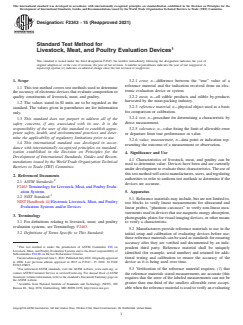
This international standard was developed in accordance with internationally recognized principles on standardization established in the Decision on Principles for the
Development of International Standards, Guides and Recommendations issued by the World Trade Organization Technical Barriers to Trade (TBT) Committee.
Designation: F2343 − 15 (Reapproved 2021)
Standard Test Method for
Livestock, Meat, and Poultry Evaluation Devices
This standard is issued under the fixed designation F2343; the number immediately following the designation indicates the year of
original adoption or, in the case of revision, the year of last revision.Anumber in parentheses indicates the year of last reapproval.A
superscript epsilon (´) indicates an editorial change since the last revision or reapproval.
1. Scope 3.2.1 error, n—difference between the “true” value of a
reference material and the indication received from an elec-
1.1 This test method covers test methods used to determine
tronic evaluation device or system.
theaccuracyofelectronicdevicesthatevaluatecompositionor
3.2.2 meat, n—all edible products and edible by-products
quality constituents of livestock, meat, and poultry.
harvested by the meat-packing industry.
1.2 The values stated in SI units are to be regarded as the
3.2.3 reference material, n—physical object used as a basis
standard. The values given in parentheses are for information
for comparison or calibration.
only.
3.2.4 test, n—procedure for determining a characteristic by
1.3 This standard does not purport to address all of the
direct measurement.
safety concerns, if any, associated with its use. It is the
responsibility of the user of this standard to establish appro-
3.2.5 tolerance, n—value fixing the limit of allowable error
priate safety, health, and environmental practices and deter-
or departure from true performance or value.
mine the applicability of regulatory limitations prior to use.
3.2.6 value, measurement, n—data point or indication rep-
1.4 This international standard was developed in accor-
resenting the outcome of a measurement or observation.
dance with internationally recognized principles on standard-
ization established in the Decision on Principles for the
4. Significance and Use
Development of International Standards, Guides and Recom-
4.1 Characteristics of livestock, meat, and poultry can be
mendations issued by the World Trade Organization Technical
used to determine value. Devices have been and are currently
Barriers to Trade (TBT) Committee.
underdevelopmenttoevaluatethesecharacteristics.Theuseof
thistestmethodwillassistmanufacturers,users,andregulating
2. Referenced Documents
authorities to refer to uniform test methods to determine if the
2.1 ASTM Standards:
devices are accurate.
F2463Terminology for Livestock, Meat, and Poultry Evalu-
ation Systems
5. Apparatus
2.2 NIST Standard:
5.1 Reference materials may include, but are not limited to,
NISTHandbook 44Electronic Livestock, Meat, and Poultry
test blocks to verify linear measurements for ultrasound and
Evaluation Systems and/or Devices
linear probes, “phantom carcasses” to verify non-linear mea-
surementsusedindevicesthatusemagneticenergyabsorption,
3. Terminology
photographicplatesforvisualimagingdevices,orothermeans
3.1 For definitions relating to livestock, meat, and poultry
to verify a characteristic.
evaluation systems, see Terminology F2463.
5.2 Manufacturers provide reference materials to use in the
3.2 Definitions of Terms Specific to This Standard:
initial setup and calibration of evaluating devices before use;
these reference materials can be used as standards for ensuring
accuracy after they are verified and documented by an inde-
This test method is under the jurisdiction of ASTM Committee F10 on
pendent third party. Reference material shall be uniquely
Livestock, Meat, and Poultry Evaluation Systems and is the direct responsibility of
identified (for example, serial number) and retained for addi-
Subcommittee F10.20 on Device Performance Criteria.
tional testing and calibration to ensure the accuracy of the
CurrenteditionapprovedJune1,2021.PublishedJuly2021.Originallyapproved
in 2004. Last previous edition approved in 2015 as F2343–15. DOI: 10.1520/
device as it is being used over time.
F2343-15R21.
5.3 Verification of the reference material requires: (1) that
For referenced ASTM standards, visit the ASTM website, www.astm.org, or
contact ASTM Customer Service at service@astm.org. For Annual Book of ASTM
the reference materials stated measurements are accurate (this
Standards volume information, refer to the standard’s Document Summary page on
requires that the error of the labeled measurements can not be
the ASTM website.
greater than one-third of the smallest allowable error accept-
Available from National Institute of Standards and Technology (NIST), 100
Bureau Dr., Stop 1070, Gaithersburg, MD 20899-1070, http://www.nist.gov. ablewhenthereferencematerialisusedtoverifyanevaluating
Copyright © ASTM International, 100 Barr Harbor Drive, PO Box C700, West Conshohocken, PA 19428-2959. United States
F2343 − 15 (2021)
device), and (2) the reference material is an appropriate proxy button on the terminal. When the morning control button is
for the characteristic being evaluated by the device or system activated, no transmission is sent to the scale terminal.
(the reference material is considered appropriate if it is has
7.3.5 Verify that all measurement errors are within NIST
been designed to be used as a reference material, and it is Handbook 44 or this test method, as applicable.
constructed to retain its characteristics for a reasonable period
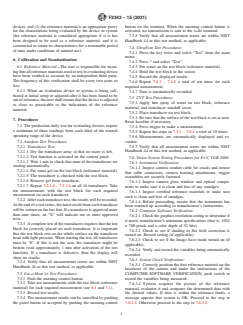
7.4 UltraFom Test Procedures:
of time under conditions of normal use).
7.4.1 Press the key twice and select “Test” from the main
menu.
6. Calibration and Standardization
7.4.2 Press * and select “Test”.
6.1 Reference Material—The user is responsible for ensur-
7.4.3 Put water on the test block (reference material).
ingthatallreferencematerialsusedtotestitsevaluatingdevice
7.4.4 Hold the test block to the sensor.
have been verified as accurate by an independent third party.
7.4.5 Record the displayed results.
The frequency of this verification shall be every two years or
7.4.6 Repeat 7.4.3 – 7.4.5 a total of ten times for each
less.
required measurement.
6.1.1 When an evaluation device or system is being cali-
7.4.7 Data is automatically recorded.
brated at initial setup or adjusted after it has been found to be
7.5 CVT Test Procedures:
outoftolerance,theusershallensurethatthedeviceisadjusted
7.5.1 Apply fine spray of water on test block, reference
as close as practicable to the indications of the reference
material, and transducer standoff cover.
material.
7.5.2 Place transducer on test block.
7.5.3 Be sure that the surface of the test block is set at zero.
7. Procedures
Reset baseline if necessary.
7.1 The production daily test for evaluating devices require
7.5.4 Press trigger to make a measurement.
a minimum of three readings from each third of the normal
7.5.5 Repeat the steps in 7.5.1 – 7.5.4 a total of 10 times.
operating range of the device.
7.5.6 Measurements are automatically displayed and re-
corded.
7.2 Autofom Test Procedures:
7.5.7 Verify that all measurement errors are within NIST
7.2.1 Transducer Test:
Handbook 44 or this test method, as applicable.
7.2.1.1 Dry the transducer array so that no water is left.
7.2.1.2 Test function is activated on the control panel.
7.6 Vision System Testing Procedures for E+V, VGB 2000:
7.2.1.3 Wait 1 min to check that none of the transducers are
7.6.1 Instrument Verification:
starting automatically.
7.6.1.1 Inspect camera conduit cable for cracks and ensure
7.2.1.4 Put some gel on the test block (reference material).
that cable connectors, camera housing attachments, trigger
7.2.1.5 The transducer is checked with the test block.
assemblies are securely fastened.
7.2.1.6 Remove gel from transducer.
7.6.1.2 Inspect camera glass window and optical compo-
7.2.1.7 Repeat 7.2.1.4 – 7.2.1.6 on all 16 transducers. Take
nents to make sure it is clean and free of any smudges.
ten measurements with the test block for each required
7.6.1.3 Inspect certified reference materials to make sure
measurement on each transducer.
each is clean and free of smudges.
7.2.2 Aftereachtransducertest,theresultswillberecorded.
7.6.1.4 Before proceeding, ensure that the instrument has
Attheendofatestseries,thelatestresultfromeac
...