

ASTM F1606-19
(Practice)Standard Practice for Rehabilitation of Existing Sewers and Conduits with Deformed Polyethylene (PE) Liner
General Information
- Abstract
SIGNIFICANCE AND USE
4.1 This practice is to provide guidance for designers and specifiers, regulatory agencies, owners, and inspection organizations who are involved in the rehabilitation of conduits. Modifications may be required depending on specific job conditions to establish a project specification. The manufacturer of the product should be consulted for design and installation information.
SCOPE
1.1 This practice covers the requirements for the installation of deformed polyethylene (PE) liner for pipeline rehabilitation.
1.2 This practice describes a method by which the PE liner may be installed with little or no excavation.
1.3 This practice applies to the rehabilitation of 3 to 18 in. (76 to 457 mm) diameter pipe in terms of installation. The specifier determines what DR is used based on conditions of the specific application.
1.4 This standard does not purport to address all of the safety concerns, if any, associated with its use. It is the responsibility of the user of this standard to establish appropriate safety, health, and environmental practices and determine the applicability of regulatory limitations prior to use.
1.5 This international standard was developed in accordance with internationally recognized principles on standardization established in the Decision on Principles for the Development of International Standards, Guides and Recommendations issued by the World Trade Organization Technical Barriers to Trade (TBT) Committee.
- Status
- Published
- Publication Date
- 31-Oct-2019
- Technical Committee
- F17 - Plastic Piping Systems
- Drafting Committee
- F17.67 - Trenchless Plastic Pipeline Technology
Buy Documents
ASTM F1606-19 - Standard Practice for Rehabilitation of Existing Sewers and Conduits with Deformed Polyethylene (PE) Liner
REDLINE ASTM F1606-19 - Standard Practice for Rehabilitation of Existing Sewers and Conduits with Deformed Polyethylene (PE) Liner
Overview
ASTM F1606-19 is the standard practice published by ASTM International for the rehabilitation of existing sewers and conduits using deformed polyethylene (PE) liner. This standard serves as a key reference for designers, specifiers, regulatory agencies, owners, and inspection organizations involved in pipeline rehabilitation. It establishes a consistent methodology for installing deformed PE liners with minimal or no excavation, making it suitable for the renewal of pipelines with diameters from 3 to 18 inches (76 to 457 mm). Compliance with this standard ensures that projects benefit from a recognized best-practice framework, promoting safety, performance, and the long-term integrity of rehabilitated sewer systems.
Key Topics
- Scope and Application: Defines requirements for installing deformed polyethylene liners in existing pipelines, focusing on trenchless rehabilitation methods.
- Deformed PE Liner Installation: Describes procedures for cleaning, inspection, liner insertion, reforming, and reconnection of service connections, all designed to minimize surface disturbance.
- Project Planning: Emphasizes the importance of job-specific modifications and collaboration with the product manufacturer to ensure successful project delivery.
- Material Guidelines: Outlines quality requirements for deformed PE liner materials, including reference to industry specifications.
- Inspection and Quality Assurance: Details inspection procedures, including visual review, leakage testing (water or air), and dimensional verification to ensure watertightness and proper expansion.
- Safety and Regulatory Considerations: Advises users to establish and maintain relevant health, safety, and environmental practices, adhering to applicable regulatory limitations.
Applications
The use of ASTM F1606-19 is recommended for the following practical applications in pipeline rehabilitation:
- Municipal Sewer Rehabilitation: Trenchless renewal of aging or deteriorated urban sewer lines with minimal disruption to surface infrastructure.
- Industrial Conduit Renewal: Rehabilitation of pipelines in industrial environments, where excavation may be challenging or undesirable.
- Infrastructure Upgrades: Restoration of structural integrity and flow capacity for pipelines affected by cracks, corrosion, or deformation.
- Environmental Protection: Reducing groundwater infiltration and exfiltration to prevent contamination and improve the sustainability of sewer networks.
- Cost-effective Maintenance: Provides an alternative to full pipe replacement, resulting in reduced project timelines, lower costs, and minimized impact on communities.
Related Standards
- ASTM D638: Test Method for Tensile Properties of Plastics
- ASTM D790: Test Methods for Flexural Properties of Unreinforced and Reinforced Plastics and Electrical Insulating Materials
- ASTM D1600: Terminology for Abbreviated Terms Relating to Plastics
- ASTM D2122: Test Method for Determining Dimensions of Thermoplastic Pipe and Fittings
- ASTM D3350: Specification for Polyethylene Plastics Pipe and Fittings Materials
- ASTM F1417: Practice for Installation Acceptance of Plastic Non-pressure Sewer Lines Using Low-Pressure Air
- ASTM F412: Terminology Relating to Plastic Piping Systems
- NASSCO Recommended Specifications: For Sewer Collection System Rehabilitation
By adhering to ASTM F1606-19, stakeholders ensure that pipeline rehabilitation projects optimize structural performance, extend service life, and contribute to resilient infrastructure systems. Incorporating deformed PE liner installation according to this standard supports sustainable and reliable sewer and conduit renewal across diverse applications.
Relations
- Effective Date
- 01-Jun-2020
- Effective Date
- 01-Apr-2020
- Effective Date
- 01-Aug-2019
- Effective Date
- 01-Aug-2019
- Effective Date
- 01-Jan-2019
- Refers
ASTM D1600-18 - Standard Terminology for Abbreviated Terms Relating to Plastics (Withdrawn 2024) - Effective Date
- 01-Jan-2018
- Effective Date
- 01-Aug-2017
- Effective Date
- 01-Jul-2017
- Effective Date
- 01-Feb-2017
- Effective Date
- 15-Nov-2016
- Effective Date
- 01-Aug-2016
- Effective Date
- 01-Dec-2015
- Effective Date
- 01-Dec-2015
- Effective Date
- 01-Aug-2015
- Effective Date
- 01-Jun-2015
Buy Documents
ASTM F1606-19 - Standard Practice for Rehabilitation of Existing Sewers and Conduits with Deformed Polyethylene (PE) Liner
REDLINE ASTM F1606-19 - Standard Practice for Rehabilitation of Existing Sewers and Conduits with Deformed Polyethylene (PE) Liner
Get Certified
Connect with accredited certification bodies for this standard

Institut za varilstvo d.o.o. (Welding Institute)
Slovenia's leading welding institute since 1952. ISO 3834, EN 1090, pressure equipment certification, NDT personnel, welder qualification. Only IIW Au
Sponsored listings
Frequently Asked Questions
ASTM F1606-19 is a standard published by ASTM International. Its full title is "Standard Practice for Rehabilitation of Existing Sewers and Conduits with Deformed Polyethylene (PE) Liner". This standard covers: SIGNIFICANCE AND USE 4.1 This practice is to provide guidance for designers and specifiers, regulatory agencies, owners, and inspection organizations who are involved in the rehabilitation of conduits. Modifications may be required depending on specific job conditions to establish a project specification. The manufacturer of the product should be consulted for design and installation information. SCOPE 1.1 This practice covers the requirements for the installation of deformed polyethylene (PE) liner for pipeline rehabilitation. 1.2 This practice describes a method by which the PE liner may be installed with little or no excavation. 1.3 This practice applies to the rehabilitation of 3 to 18 in. (76 to 457 mm) diameter pipe in terms of installation. The specifier determines what DR is used based on conditions of the specific application. 1.4 This standard does not purport to address all of the safety concerns, if any, associated with its use. It is the responsibility of the user of this standard to establish appropriate safety, health, and environmental practices and determine the applicability of regulatory limitations prior to use. 1.5 This international standard was developed in accordance with internationally recognized principles on standardization established in the Decision on Principles for the Development of International Standards, Guides and Recommendations issued by the World Trade Organization Technical Barriers to Trade (TBT) Committee.
SIGNIFICANCE AND USE 4.1 This practice is to provide guidance for designers and specifiers, regulatory agencies, owners, and inspection organizations who are involved in the rehabilitation of conduits. Modifications may be required depending on specific job conditions to establish a project specification. The manufacturer of the product should be consulted for design and installation information. SCOPE 1.1 This practice covers the requirements for the installation of deformed polyethylene (PE) liner for pipeline rehabilitation. 1.2 This practice describes a method by which the PE liner may be installed with little or no excavation. 1.3 This practice applies to the rehabilitation of 3 to 18 in. (76 to 457 mm) diameter pipe in terms of installation. The specifier determines what DR is used based on conditions of the specific application. 1.4 This standard does not purport to address all of the safety concerns, if any, associated with its use. It is the responsibility of the user of this standard to establish appropriate safety, health, and environmental practices and determine the applicability of regulatory limitations prior to use. 1.5 This international standard was developed in accordance with internationally recognized principles on standardization established in the Decision on Principles for the Development of International Standards, Guides and Recommendations issued by the World Trade Organization Technical Barriers to Trade (TBT) Committee.
ASTM F1606-19 is classified under the following ICS (International Classification for Standards) categories: 23.040.20 - Plastics pipes. The ICS classification helps identify the subject area and facilitates finding related standards.
ASTM F1606-19 has the following relationships with other standards: It is inter standard links to ASTM F1533-20, ASTM F412-20, ASTM F1417-11A(2019)e1, ASTM F1417-11a(2019), ASTM F412-19, ASTM D1600-18, ASTM F412-17a, ASTM D790-17, ASTM F412-17, ASTM F412-16a, ASTM F412-16, ASTM D790-15e1, ASTM D790-15, ASTM F1417-11a(2015), ASTM F412-15. Understanding these relationships helps ensure you are using the most current and applicable version of the standard.
ASTM F1606-19 is available in PDF format for immediate download after purchase. The document can be added to your cart and obtained through the secure checkout process. Digital delivery ensures instant access to the complete standard document.
Standards Content (Sample)
This international standard was developed in accordance with internationally recognized principles on standardization established in the Decision on Principles for the
Development of International Standards, Guides and Recommendations issued by the World Trade Organization Technical Barriers to Trade (TBT) Committee.
Designation: F1606 − 19
Standard Practice for
Rehabilitation of Existing Sewers and Conduits with
Deformed Polyethylene (PE) Liner
This standard is issued under the fixed designation F1606; the number immediately following the designation indicates the year of
original adoption or, in the case of revision, the year of last revision.Anumber in parentheses indicates the year of last reapproval.A
superscript epsilon (´) indicates an editorial change since the last revision or reapproval.
1. Scope* D3350Specification for Polyethylene Plastics Pipe and Fit-
tings Materials
1.1 Thispracticecoverstherequirementsfortheinstallation
F412Terminology Relating to Plastic Piping Systems
ofdeformedpolyethylene(PE)linerforpipelinerehabilitation.
F1417Practice for Installation Acceptance of Plastic Non-
1.2 This practice describes a method by which the PE liner
pressure Sewer Lines Using Low-Pressure Air
may be installed with little or no excavation.
F1533Specification for Deformed Polyethylene (PE) Liner
1.3 This practice applies to the rehabilitation of 3 to 18in.
2.2 NASSCO Standard:
(76 to 457mm) diameter pipe in terms of installation. The
Recommended Specifications for Sewer Collection System
specifier determines what DR is used based on conditions of 3
Rehabilitation
the specific application.
1.4 This standard does not purport to address all of the
3. Terminology
safety concerns, if any, associated with its use. It is the
3.1 General—Abbreviations used in this practice are in
responsibility of the user of this standard to establish appro-
accordance with Terminology D1600, and definitions are in
priate safety, health, and environmental practices and deter-
accordance with Terminology F412, unless otherwise indi-
mine the applicability of regulatory limitations prior to use.
cated.
1.5 This international standard was developed in accor-
3.2 Definitions of Terms Specific to This Standard:
dance with internationally recognized principles on standard-
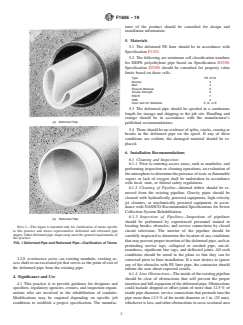
3.2.1 deformed pipe—HDPE or MDPE pipe manufactured
ization established in the Decision on Principles for the
in deformed shape with a reduced cross-sectional area that
Development of International Standards, Guides and Recom-
includesthemostcommonu-geometricformforuseinexisting
mendations issued by the World Trade Organization Technical
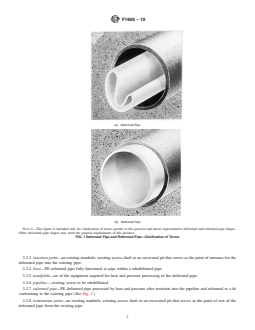
sewer and conduit rehabilitation. (See Fig. 1.)
Barriers to Trade (TBT) Committee.
3.2.2 dimpling—a localized deformation resulting from
2. Referenced Documents
expansion, during rounding of a thermoplastic deformed PE
pipe, into space where a side connector meets an existing
2.1 ASTM Standards:
conduit and where there is no support for the deformed PE
D638Test Method for Tensile Properties of Plastics
pipe.
D790Test Methods for Flexural Properties of Unreinforced
and Reinforced Plastics and Electrical Insulating Materi- 3.2.3 insertion point—an existing manhole, existing access
als shaftoranexcavatedpitthatservesasthepointofentrancefor
D1600TerminologyforAbbreviatedTermsRelatingtoPlas- the deformed pipe into the existing pipe.
tics
3.2.4 liner—PE reformed pipe fully functional as pipe
D2122Test Method for Determining Dimensions of Ther-
within a rehabilitated pipe.
moplastic Pipe and Fittings
3.2.5 manifolds—set of the equipment required for heat and
pressure processing of the deformed pipe.
3.2.6 pipeline— existing sewer to be rehabilitated.
This practice is under the jurisdiction of ASTM Committee F17 on Plastic
Piping Systems and is the direct responsibility of Subcommittee F17.67 on
3.2.7 reformed pipe—PE deformed pipe processed by heat
Trenchless Plastic Pipeline Technology.
and pressure after insertion into the pipeline and reformed to a
Current edition approved Nov. 1, 2019. Published December 2019. Originally
fit conforming to the existing pipe (See Fig. 1.)
approvedin1995.Lastpreviouseditionapprovedin2014asF1606–05(2014).DOI:
10.1520/F1606-19.
For referenced ASTM standards, visit the ASTM website, www.astm.org, or
contact ASTM Customer Service at service@astm.org. For Annual Book of ASTM
Standards volume information, refer to the standard’s Document Summary page on NASSCO, Inc. 2470 Longstone Lane, Suite M, Marriottsville, MD 21104.
the ASTM website. http://nassco.org/
*A Summary of Changes section appears at the end of this standard
Copyright © ASTM International, 100 Barr Harbor Drive, PO Box C700, West Conshohocken, PA 19428-2959. United States
F1606 − 19
turer of the product should be consulted for design and
installation information.
5. Materials
5.1 The deformed PE liner should be in accordance with
Specification F1533.
5.2 The following are minimum cell classification numbers
for HDPE polyethylene pipe based on Specification D3350.
Specification D3350 should be consulted for property value
limits based on these cells.
Type PE 4710
Density 4
Melt 4
Flexural Modulus 5
Tensile Strength 5
ESCR 7
HDB 4
Color and UV Stabilizer C, D, or E
5.3 The deformed pipe should be spooled in a continuous
length for storage and shipping to the job site. Handling and
storage should be in accordance with the manufacturer’s
(a) Deformed Pipe
published recommendations.
5.4 Thereshouldbenoevidenceofsplits,cracks,crazingor
breaks in the deformed pipe on the spool. If any of these
conditions are evident, the damaged material should be re-
placed.
6. Installation Recommendations
6.1 Cleaning and Inspection:
6.1.1 Prior to entering access areas, such as manholes, and
performing inspection or cleaning operations, an evaluation of
theatmospheretodeterminethepresenceoftoxicorflammable
vapors or lack of oxygen shall be undertaken in accordance
with local, state, or federal safety regulations.
6.1.2 Cleaning of Pipeline—Internal debris should be re-
moved from the existing pipeline. Gravity pipes should be
cleaned with hydraulically powered equipment, high-velocity
jet cleaners, or mechanically powered equipment, in accor-
dance with NASSCO Recommended Specifications for Sewer
Collection System Rehabilitation.
6.1.3 Inspection of Pipelines—Inspection of pipelines
(b) Reformed Pipe
should be performed by experienced personnel trained in
locating breaks, obstacles, and service connections by closed
NOTE 1—This figure is intended only for clarification of terms specific
to this practice and shows representative deformed and reformed pipe
circuit television. The interior of the pipeline should be
shapes.Otherdeformedpipeshapesmaymeetthegeneralrequirementsof
carefully inspected to determine the location of any conditions
this practice.
thatmaypreventproperinsertionofthedeformedpipe,suchas
FIG. 1 Deformed Pipe and Reformed Pipe—Clarification of Terms
protruding service taps, collapsed or crushed pipe, out-of-
roundness, significant line sags, and deflected joints. All such
conditions should be noted in the plans so that they can be
3.2.8 termination point—an existing manhole, existing ac-
corrected prior to liner installation. If a user desires to ignore
cess shaft or an excavated pit that serves as the point of exit of
any of the obstacles with PE liner pipe, the contractor should
the deformed pipe from the existing pipe.
inform the user about expected results.
6.1.4 Line Obstructions—Theinsideoftheexistingpipeline
4. Significance and Use
should be clear of obstructions that will prevent the proper
4.1 This practice is to provide guidance for designers and insertionandfullexpansionofthedeformedpipe.Obstructions
specifiers, regulatory agencies, owners, and inspection organi- could include dropped or offset joints of more than 12.5% of
zations who are involved in the rehabilitation of conduits. insidepipediameter;serviceconnectionsthatprotrudeintothe
Modifications may be required depending on specific job pipe more than 12.5% of the inside diameter or 1in. (25 mm),
conditions to establish a project specification. The manufac- whicheverisless;andotherobstructionsincross-sectionalarea
F1606 − 19
of more than 14% based on the inside diameter of the existing 6.4.3 The reforming pressure should be maintained to en-
pipe. If inspection reveals an obstruction that cannot be sure complete expansion of the pipe and to allow for dimpling
removedbycleaningorrodding,thenapointrepairexcavation at side connections.
should be made to uncover and remove or repair the obstruc-
6.5 Cool Down—The reformed pipe should be cooled to a
tion. Typically, bends along the pipe length in excess of 30°
temperature of 100°F (38°C). The pressure should then be
and changes in pipe size cannot be accommodated. Such
slowly increased to approximately 33 psig (227.7 kPa), while
conditions require access at these points for termination and
applying air or water for continued cooling. The equipment
start of a new insertion.
should be disconnected after ambient temperature is attained.
6.2 Bypassing—If flow cannot be interrupted for the neces-
6.6 After the reformed pipe has cooled down, the terminat-
saryduration,bypassingofflowisrequiredaroundthesections
ing ends should be trimmed to a minimum of 3 in. (76.2 mm)
of the existing pipeline designated for rehabilitation. The
beyond the existing pipe to account for possible shrinkage
bypass should be made by plugging the line at the point
during cooling to ground temperatures.
upstreamofthepipetobereconstructedandbypassingtheflow
6.7 Service Connections—After the liner has been reformed
to a downstream point or adjacent system. The bypass lines,
and stabilized, the existing active service connections should
pump, and pump-sump pit dimensions, if required, should be
be reconnected. This should be done without excavation from
of adequate capacity and size to handle the flow during the
theinteriorofthepipelinebymeansofatelevisioncameraand
installation period. Services within this work area will be
a remote control cutting device unless otherwise specified by
temporarily out of service.
the owner.
NOTE 1—Public advisory services will be required to notify all parties
NOTE 2—In many cases, a good seal is provided where the formed pipe
whose service laterals will be out of commission and to advise against
dimples at service connections. However, this practice should not be
water usage until the main line is back in service.
construed to provide a 100% watertight seal at all service connections. If
total elimination of infiltration and inflow is desired, other means, which
6.3 Insertion:
are beyond the scope of this practice, may be necessary to seal service
6.3.1 The spool of deformed pipe should be positioned near
connections and to rehabilitate service lines and manholes.
the insertion point. A cable should be strung through the
6.8 Thenumericinformationgivenfortheprocessingofthe
existing conduit and attached to the deformed pipe. The
liner are the standard practical information. Where the specific
deformed pipe should be pulled (with a power winch and the
cases require, such as long pipelines, unusually difficult
cable) directly through the insertion point to the termination
conditions, extremely fragile pipelines and unique jobs, the
point. Pulling forces should be limited so as not to exceed the
processing parameters may vary. The final outcome of the
axial strain limits of the deformed pipe. The measured pulling
processing should comply with this practice. The design
operation limits pulling force to allowable tensile stress (1500
engineer should determine the applicable processing param-
psi or 50% of the yield) times the pipe wall cross sectional
eters in accordance with the manufacturer’s specific specifica-
area.
tions and instructions.
6.3.2 After the insertion is complete, the tension from the
winch should be relieved and the deformed pipe should be
7. Inspection and Acceptance
cutoff at the insertion point and restrained at the termination
7.1 The installation may be inspected by closed-circuit
point. Allowances for pipe length normalization should be
television. The reformed pipe should be continuous over the
made to attain correct length.
entire length of the insertion and conform to the walls of the
6.4 Reforming:
existing pipe evidenced by
...
This document is not an ASTM standard and is intended only to provide the user of an ASTM standard an indication of what changes have been made to the previous version. Because
it may not be technically possible to adequately depict all changes accurately, ASTM recommends that users consult prior editions as appropriate. In all cases only the current version
of the standard as published by ASTM is to be considered the official document.
Designation: F1606 − 05 (2014) F1606 − 19
Standard Practice for
Rehabilitation of Existing Sewers and Conduits with
Deformed Polyethylene (PE) Liner
This standard is issued under the fixed designation F1606; the number immediately following the designation indicates the year of
original adoption or, in the case of revision, the year of last revision. A number in parentheses indicates the year of last reapproval. A
superscript epsilon (´) indicates an editorial change since the last revision or reapproval.
1. Scope Scope*
1.1 This practice covers the requirements for the installation of deformed polyethylene (PE) liner for pipeline rehabilitation.
1.2 This practice describes a method by which the PE liner may be installed with little or no excavation.
1.3 This practice applies to the rehabilitation of 3 to 18- in. 18 in. (76 to 457-mm)457 mm) diameter pipe in terms of installation.
The specifier determines what DR is used based on conditions of the specific application.
1.4 This standard does not purport to address all of the safety concerns, if any, associated with its use. It is the responsibility
of the user of this standard to establish appropriate safety safety, health, and healthenvironmental practices and determine the
applicability of regulatory limitations prior to use.
1.5 This international standard was developed in accordance with internationally recognized principles on standardization
established in the Decision on Principles for the Development of International Standards, Guides and Recommendations issued
by the World Trade Organization Technical Barriers to Trade (TBT) Committee.
2. Referenced Documents
2.1 ASTM Standards:
D638 Test Method for Tensile Properties of Plastics
D790 Test Methods for Flexural Properties of Unreinforced and Reinforced Plastics and Electrical Insulating Materials
D1600 Terminology for Abbreviated Terms Relating to Plastics
D2122 Test Method for Determining Dimensions of Thermoplastic Pipe and Fittings
D3350 Specification for Polyethylene Plastics Pipe and Fittings Materials
F412 Terminology Relating to Plastic Piping Systems
F1417 Practice for Installation Acceptance of Plastic Non-pressure Sewer Lines Using Low-Pressure Air
F1533 Specification for Deformed Polyethylene (PE) Liner (Withdrawn 2018)
2.2 NASSCO Standard:
Recommended Specifications for Sewer Collection System Rehabilitation
3. Terminology
3.1 General—Abbreviations used in this practice are in accordance with Terminology D1600, and definitions are in accordance
with Terminology F412, unless otherwise indicated.
3.2 Definitions of Terms Specific to This Standard:
3.2.1 deformed pipe—HDPE or MDPE pipe manufactured in deformed shape with a reduced cross-sectional area that includes
the most common u-geometric form for use in existing sewer and conduit rehabilitation. (See Fig. 1.)
3.2.2 dimpling—a localized deformation resulting from expansion, during rounding of a thermoplastic deformed PE pipe, into
space where a side connector meets an existing conduit and where there is no support for the deformed PE pipe.
This practice is under the jurisdiction of ASTM Committee F17 on Plastic Piping Systems and is the direct responsibility of Subcommittee F17.67 on Trenchless Plastic
Pipeline Technology.
Current edition approved March 1, 2014Nov. 1, 2019. Published October 2014December 2019. Originally approved in 1995. Last previous edition approved in 20052014
as F1606F1606–05(2014).–05. DOI: 10.1520/F1606-05R14.
For referenced ASTM standards, visit the ASTM website, www.astm.org, or contact ASTM Customer Service at service@astm.org. For Annual Book of ASTM Standards
volume information, refer to the standard’s Document Summary page on the ASTM website.
The last approved version of this historical standard is referenced on www.astm.org.
NASSCO, Inc. 2470 Longstone Lane, Suite M, Marriottsville, MD 21104. http://nassco.org/
*A Summary of Changes section appears at the end of this standard
Copyright © ASTM International, 100 Barr Harbor Drive, PO Box C700, West Conshohocken, PA 19428-2959. United States
F1606 − 19
(a) Deformed Pipe
(b) Reformed Pipe
NOTE 1—This figure is intended only for clarification of terms specific to this practice and shows representative deformed and reformed pipe shapes.
Other deformed pipe shapes may meet the general requirements of this practice.
FIG. 1 Deformed Pipe and Reformed Pipe—Clarification of Terms
3.2.3 insertion point—an existing manhole, existing access shaft or an excavated pit that serves as the point of entrance for the
deformed pipe into the existing pipe.
3.2.4 liner—PE reformed pipe fully functional as pipe within a rehabilitated pipe.
3.2.5 manifolds—set of the equipment required for heat and pressure processing of the deformed pipe.
3.2.6 pipeline— existing sewer to be rehabilitated.
3.2.7 reformed pipe—PE deformed pipe processed by heat and pressure after insertion into the pipeline and reformed to a fit
conforming to the existing pipe (See Fig. 1.)
3.2.8 termination point—an existing manhole, existing access shaft or an excavated pit that serves as the point of exit of the
deformed pipe from the existing pipe.
F1606 − 19
4. Significance and Use
4.1 This practice is to provide guidance for designers and specifiers, regulatory agencies, owners, and inspection organizations
who are involved in the rehabilitation of conduits. Modifications may be required depending on specific job conditions to establish
a project specification. The manufacturer of the product should be consulted for design and installation information.
5. Materials
5.1 The deformed PE liner should be in accordance with Specification F1533.
5.2 The following are minimum cell classification numbers for HDPE polyethylene pipe based on Specification D3350.
Specification D3350 should be consulted for property value limits based on these cells.
Type PE 2406
Density 2
Melt 3
Flexural Modulus 4
Tensile Strength 3
ESCR 3
HDB 3
Color and UV Stabilizer C, D, or E
Type PE 4710
Density 4
Melt 4
Flexural Modulus 5
Tensile Strength 5
ESCR 7
HDB 4
Color and UV Stabilizer C, D, or E
5.3 The deformed pipe should be spooled in a continuous length for storage and shipping to the job site. Handling and storage
should be in accordance with the manufacturer’s published recommendations.
5.4 There should be no evidence of splits, cracks, crazing or breaks in the deformed pipe on the spool. If any of these conditions
are evident, the damaged material should be replaced.
6. Installation Recommendations
6.1 Cleaning and Inspection:
6.1.1 Prior to entering access areas, such as manholes, and performing inspection or cleaning operations, an evaluation of the
atmosphere to determine the presence of toxic or flammable vapors or lack of oxygen shall be undertaken in accordance with local,
state, or federal safety regulations.
6.1.2 Cleaning of Pipeline—Internal debris should be removed from the existing pipeline. Gravity pipes should be cleaned with
hydraulically powered equipment, high-velocity jet cleaners, or mechanically powered equipment, in accordance with NASSCO
Recommended Specifications for Sewer Collection System Rehabilitation.
6.1.3 Inspection of Pipelines—Inspection of pipelines should be performed by experienced personnel trained in locating breaks,
obstacles, and service connections by closed circuit television. The interior of the pipeline should be carefully inspected to
determine the location of any conditions that may prevent proper insertion of the deformed pipe, such as protruding service taps,
collapsed or crushed pipe, out-of-roundness, significant line sags, and deflected joints. All such conditions should be noted in the
plans so that they can be corrected prior to liner installation. If a user desires to ignore any of the obstacles with PE liner pipe,
the contractor should inform the user about expected results.
6.1.4 Line Obstructions—The inside of the existing pipeline should be clear of obstructions that will prevent the proper insertion
and full expansion of the deformed pipe. Obstructions could include dropped or offset joints of more than 12.5 % of inside pipe
diameter; service connections that protrude into the pipe more than 12.5 % of the inside diameter or 1-in.1 in. (25 mm), whichever
is less; and other obstructions in cross-sectional area of more than 14 % based on the inside diameter of the existing pipe. If
inspection reveals an obstruction that cannot be removed by cleaning or rodding, then a point repair excavation should be made
to uncover and remove or repair the obstruction. Typically, bends along the pipe length in excess of 30° and changes in pipe size
cannot be accommodated. Such conditions require access at these points for termination and start of a new insertion.
6.2 Bypassing—If flow cannot be interrupted for the necessary duration, bypassing of flow is required around the sections of
the existing pipeline designated for rehabilitation. The bypass should be made by plugging the line at the point upstream of the
pipe to be reconstructed and bypassing the flow to a downstream point or adjacent system. The bypass lines, pump, and pump-sump
pit dimensions, if required, should be of adequate capacity and size to handle the flow during the installation period. Services
within this work area will be temporarily out of service.
NOTE 1—Public advisory services will be required to notify all parties whose service laterals will be out of commission and to advise against water
usage until the main line is back in service.
6.3 Insertion:
F1606 − 19
6.3.1 The spool of deformed pipe should be positioned near the insertion point. A cable should be strung through the existing
conduit and attached to the deformed pipe. The deformed pipe should be pulled (with a power winch and the cable) directly through
the insertion point to the termination point. Pulling forces should be limited so as not to exceed the axial strain limits of the
deformed pipe. The measured pulling operation limits pulling force to allowable tensile stress (1500 psi or 50 % of the yield) times
the pipe wall cross sectional area.
6.3.2 After the insertion is complete, the tension from the winch should be relieved and the deformed pipe should be cutoff at
the insertion point and restrained at the termination point. Allowances for pipe length normalization should be made to attain
correct length.
6.4 Reforming:
6.4.1 Temperatures and pressures should be monitored and recorded throughout the installation process to ensure that each
phase of the process is achieved at the required levels. Temperature gages should be placed near the upstream and downstream
manholes to measure the liner’s outside temperature.
6.4.2 Steam and air pressure are applied through the inlet manifold and the deformed pipe should be reformed to conform to
the existing pipe wall. The deformed pipe shall be pressurized up to 14.5 psig (100 kPa) max, at a steam temperature in excess
of 235°F (112.8°C),235 °F (112.8 °C), and less than 260°F (126.7°C),260 °F (126.7 °C), while the termination point valves,
located at the outlet manifold, are kept open to provide heat flow. The minimum temperature needed at the outside of the HDPE
pipe should be 185 6 9°F9 °F (85 6 5°C).5 °C). The pressure should then be increased in increments up to a maximum of 26 psig
(179.4 kPa). Maximum pressure may be lower, depending on DR and condition of the pipeline.
6.4.3 The reforming pressure should be maintained to ensure complete expansion of the pipe and to allow for dimpling at side
connections.
6.5 Cool Down—The reformed pipe should be cooled to a temperature of 100°F (38°C).100 °F (38 °C). The pressure should
then be slowly increased to approximately 33 psig (227.7 kPa), while applying air or water for continued cooling. The equipment
should be disconnected after ambient temperature is attained.
6.6 After the reformed pipe has cooled down, the terminating ends should be trimmed to a minimum of 3 in. (76.2 mm) beyond
the existing pipe to account for possible shrinkage during cooling to ground temperatures.
6.7 Service Connections—After the liner has been reformed and stabilized, the existing active service connections should be
reconnected. This should be done without excavation from the interior of the p
...