


ASTM E2556/E2556M-10(2016)
(Specification)Standard Specification for Vapor Permeable Flexible Sheet Water-Resistive Barriers Intended for Mechanical Attachment
Standard Specification for Vapor Permeable Flexible Sheet Water-Resistive Barriers Intended for Mechanical Attachment
SCOPE
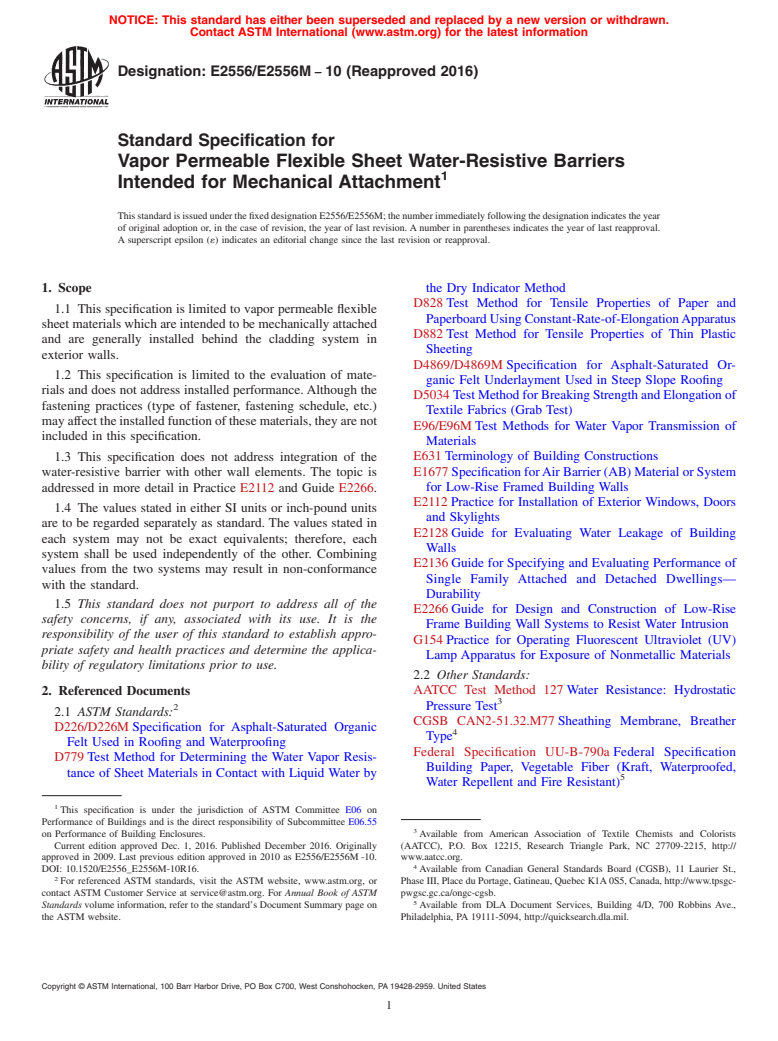
1.1 This specification is limited to vapor permeable flexible sheet materials which are intended to be mechanically attached and are generally installed behind the cladding system in exterior walls.
1.2 This specification is limited to the evaluation of materials and does not address installed performance. Although the fastening practices (type of fastener, fastening schedule, etc.) may affect the installed function of these materials, they are not included in this specification.
1.3 This specification does not address integration of the water-resistive barrier with other wall elements. The topic is addressed in more detail in Practice E2112 and Guide E2266.
1.4 The values stated in either SI units or inch-pound units are to be regarded separately as standard. The values stated in each system may not be exact equivalents; therefore, each system shall be used independently of the other. Combining values from the two systems may result in non-conformance with the standard.
1.5 This standard does not purport to address all of the safety concerns, if any, associated with its use. It is the responsibility of the user of this standard to establish appropriate safety and health practices and determine the applicability of regulatory limitations prior to use.
General Information
Buy Standard
Standards Content (Sample)
NOTICE: This standard has either been superseded and replaced by a new version or withdrawn.
Contact ASTM International (www.astm.org) for the latest information
Designation:E2556/E2556M −10 (Reapproved 2016)
Standard Specification for
Vapor Permeable Flexible Sheet Water-Resistive Barriers
Intended for Mechanical Attachment
ThisstandardisissuedunderthefixeddesignationE2556/E2556M;thenumberimmediatelyfollowingthedesignationindicatestheyear
of original adoption or, in the case of revision, the year of last revision. A number in parentheses indicates the year of last reapproval.
A superscript epsilon (´) indicates an editorial change since the last revision or reapproval.
1. Scope the Dry Indicator Method
D828 Test Method for Tensile Properties of Paper and
1.1 This specification is limited to vapor permeable flexible
PaperboardUsingConstant-Rate-of-ElongationApparatus
sheet materials which are intended to be mechanically attached
D882 Test Method for Tensile Properties of Thin Plastic
and are generally installed behind the cladding system in
Sheeting
exterior walls.
D4869/D4869M Specification for Asphalt-Saturated Or-
1.2 This specification is limited to the evaluation of mate-
ganic Felt Underlayment Used in Steep Slope Roofing
rials and does not address installed performance.Although the
D5034 TestMethodforBreakingStrengthandElongationof
fastening practices (type of fastener, fastening schedule, etc.)
Textile Fabrics (Grab Test)
mayaffecttheinstalledfunctionofthesematerials,theyarenot
E96/E96M Test Methods for Water Vapor Transmission of
included in this specification.
Materials
E631 Terminology of Building Constructions
1.3 This specification does not address integration of the
water-resistive barrier with other wall elements. The topic is E1677 Specification forAir Barrier (AB) Material or System
for Low-Rise Framed Building Walls
addressed in more detail in Practice E2112 and Guide E2266.
E2112 Practice for Installation of Exterior Windows, Doors
1.4 The values stated in either SI units or inch-pound units
and Skylights
are to be regarded separately as standard. The values stated in
E2128 Guide for Evaluating Water Leakage of Building
each system may not be exact equivalents; therefore, each
Walls
system shall be used independently of the other. Combining
E2136 Guide for Specifying and Evaluating Performance of
values from the two systems may result in non-conformance
Single Family Attached and Detached Dwellings—
with the standard.
Durability
1.5 This standard does not purport to address all of the
E2266 Guide for Design and Construction of Low-Rise
safety concerns, if any, associated with its use. It is the
Frame Building Wall Systems to Resist Water Intrusion
responsibility of the user of this standard to establish appro-
G154 Practice for Operating Fluorescent Ultraviolet (UV)
priate safety and health practices and determine the applica-
Lamp Apparatus for Exposure of Nonmetallic Materials
bility of regulatory limitations prior to use.
2.2 Other Standards:
2. Referenced Documents AATCC Test Method 127 Water Resistance: Hydrostatic
Pressure Test
2.1 ASTM Standards:
CGSB CAN2-51.32.M77 Sheathing Membrane, Breather
D226/D226M Specification for Asphalt-Saturated Organic
Type
Felt Used in Roofing and Waterproofing
Federal Specification UU-B-790a Federal Specification
D779 Test Method for Determining the Water Vapor Resis-
Building Paper, Vegetable Fiber (Kraft, Waterproofed,
tance of Sheet Materials in Contact with Liquid Water by
Water Repellent and Fire Resistant)
This specification is under the jurisdiction of ASTM Committee E06 on
Performance of Buildings and is the direct responsibility of Subcommittee E06.55
on Performance of Building Enclosures. Available from American Association of Textile Chemists and Colorists
Current edition approved Dec. 1, 2016. Published December 2016. Originally (AATCC), P.O. Box 12215, Research Triangle Park, NC 27709-2215, http://
approved in 2009. Last previous edition approved in 2010 as E2556/E2556M -10. www.aatcc.org.
DOI: 10.1520/E2556_E2556M-10R16. Available from Canadian General Standards Board (CGSB), 11 Laurier St.,
For referenced ASTM standards, visit the ASTM website, www.astm.org, or Phase III, Place du Portage, Gatineau, Quebec K1A0S5, Canada, http://www.tpsgc-
contact ASTM Customer Service at service@astm.org. For Annual Book of ASTM pwgsc.gc.ca/ongc-cgsb.
Standards volume information, refer to the standard’s Document Summary page on Available from DLA Document Services, Building 4/D, 700 Robbins Ave.,
the ASTM website. Philadelphia, PA 19111-5094, http://quicksearch.dla.mil.
Copyright © ASTM International, 100 Barr Harbor Drive, PO Box C700, West Conshohocken, PA 19428-2959. United States
E2556/E2556M−10 (2016)
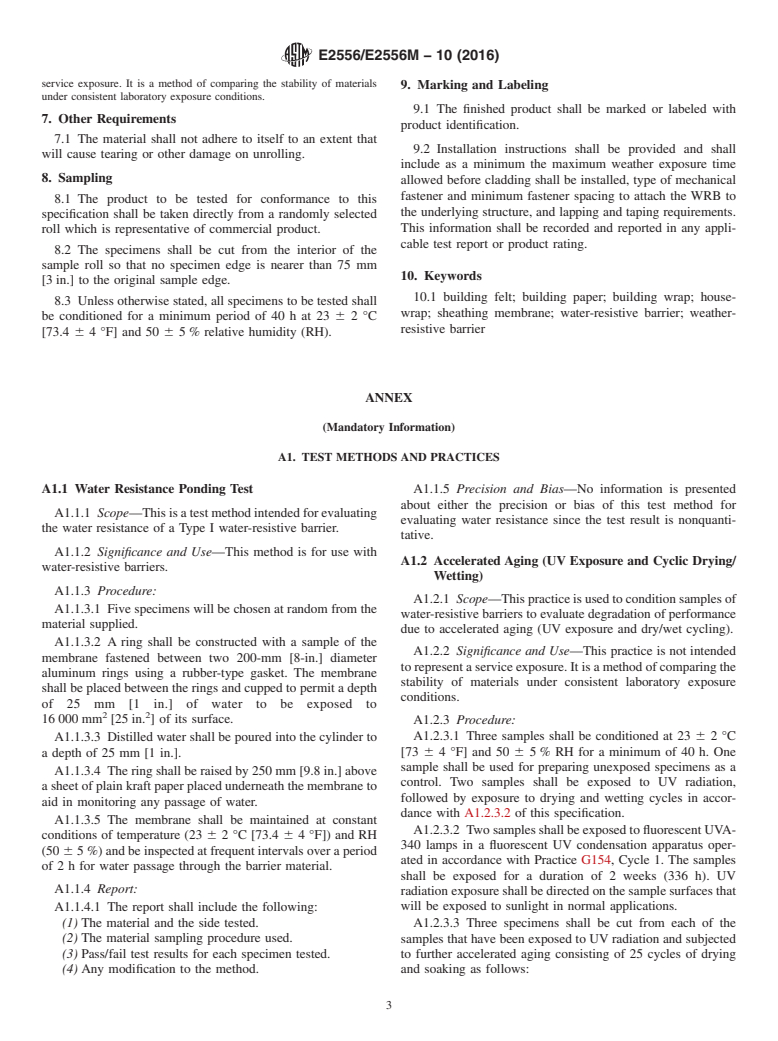
TABLE 1 Requirements for Water Resistive Barriers
Minimum Performance Requirements
Test Requirement Specimen Type Test Method
Type I Type II
Dry tensile strength (1) as manufactured Test Method D828 for paper 3500 N/m [20 lb/in.] minimum (machine and cross direction)
or dry breaking and and felt materials, or
force (choose 1) (2) aged in accordance Test Method D882 for 3500 N/m [20 lb/in.] minimum (machine and cross direction)
with A1.2 polymeric materials, or
Test Method D5034 (Grab 178 N [40 lbf] minimum (machine direction)
Method)
156 N [35 lbf] minimum (cross direction)
Water resistance (1) as manufactured Test Method D779, or 10 min minimum 60 min minimum
test (choose 1) and Water Resistance Ponding No water shall penetrate through not applicable
(2) aged in accordance Test (A1.1), or the membrane in 120 min
with A1.2 AATCC Test Method 127 not applicable No leakage is permitted to the underside
except that the specimens of any specimen in 5 h
shall be held at a
hydrostatic head of
55 cm [21.6 in.]
Water vapor as received Test Methods E96/E96M 290 ng/(Pa · s · m ) (5 perms) minimum
transmission test (Dessicant Method)
Pliability test as received see A1.3 The material shall not crack when bent over a 1.6 mm [ ⁄16-in.]
diameter mandrel at a temperature of 0 °C [32 °F]
TAPPI T-410 Test Method for Grammage of Paper and 3.2.6 Water-Resistive Barrier (WRB), n—a material that is
Paperboard (Weight Per Unit Area) intended to resist liquid water that has penetrated the cladding
UBC Standard 14-1 Kraft Waterproof Building Paper system.
UBC Standard 32-1 Asphalt Saturated Rag Felt
NOTE 1—Wall assemblies often include two lines of defense against
ICC-ES Acceptance Criteria AC38 for Water-Resistive Bar-
rain water ingress. The cladding serves as the first line of defense and the
riers
water-resistive barrier as the second line of defense
NOTE 2—Water-resistive barriers are sometimes referred to as weather
3. Terminology resistant barriers or sheathing membranes.
3.1 Definitions—For definitions of general terms related to
4. Classification
building construction used in this specification, refer to Termi-
4.1 This specification covers vapor permeable flexible sheet
nology E631.
materials that are classified as Type I and Type II, which are
3.2 Definitions of Terms Specific to This Standard:
determined by the degree of water resistance. The water-
3.2.1 felt-based barrier, n—asphalt-saturated organic felts
resistive barrier material composition shall determine the
that comply with Specification D226/D226M and are intended
specific test method used to measure physical and mechanical
for use as water-resistive barriers.
properties (see Table 1). Appendix X1 provides explanatory
information on the physical and mechanical property test
3.2.2 paper-based barrier, n—building papers composed
methods.
predominantly of sulfate pulp fibers that comply with Federal
Specification UU-B-790a and that are intended for use as
5. Materials and Manufacture
water-resistive barriers.
5.1 Description of the material composition and structure
3.2.3 polymer-based barrier, n—plastic sheet materials for
shall be made available upon request.
use as water-resistive barriers. These materials are generally
5.1.1 Descriptions of the materials shall include roll weight
referred to as a housewrap or building wrap. These materials
and dimensions.
can be perforated with small holes or may be non-perforated,
5.1.2 Descriptions of the material composition shall include
composed of films or non-woven materials.
linear density (basis weight). Basis weight shall be measured
3.2.4 Type I WRB, n—water-resistive barrier with base-level
using TAPPI T-410.
water resistance (see Table 1).
6. Performance Requirements
3.2.5 Type II WRB, n—water-resistive barrier with enhanced
6.1 All products seeking compliance with this specification
water resistance (see Table 1).
shallconformtotheminimumperformancerequirementslisted
in Table 1. Sampling and specimen size shall be in accordance
Available from Technological Association of the Pulp and Paper Industry
with the referenced test methods. If not otherwise specified in
(TAPPI), 15 Technology Parkway South, Suite 115, Peachtree Corners, GA 30092,
the referenced test method, a minimum of five specimens shall
http://www.tappi.org.
be tested and all specimens shall meet the minimum perfor-
Uniform Building Code (UBC) information is available from International
Code Council (ICC), 500 New JerseyAve., NW, 6th Floor, Washington, DC 20001,
mance requirements.
http://www.iccsafe.org.
Available from the ICC Evaluation Service (ICC-ES), 3060 Saturn Street, Suite NOTE 3—The laboratory accelerated-ultraviolet (UV)/condensation ex-
100, Brea, CA 92821, http://www.icc-es.org. posure procedure specified in A1.2 is not intended to represent a specific
E2556/E2556M−10 (2016)
service exposure. It is a method of comparing the stability of materials
9. Marking and Labeling
under consistent laboratory exposure conditions.
9.1 The finished product shall be marked or labeled with
7. Other Requirements
product identification.
7.1 The material shall not adhere to itself to an extent that
9.2 Installation instructions shall be provided and shall
will cause tearing or other damage on unrolling.
include as a minimum the maximum weather exposure time
8. Sampling
allowed before cladding shall be installed, type of mechanical
fastener and minimum fastener spacing to attach the WRB to
8.1 The product to be tested for conformance to this
the underlying structure, and lapping and taping requirements.
specification shall be taken directly from a randomly selected
This information shall be recorded and reported in any appli-
roll which is representative of commercial product.
cable test report or product rating.
8.2 The specimens shall be cut from the interior of the
sample roll so that no specimen edge is nearer than 75 mm
10. Keywords
[3 in.] to the original sample edge.
10.1 building felt; building paper; building wrap; house-
8.3 Unless otherwise stated, all specimens to be tested shall
wrap; sheathing membrane; water-resistive barrier; weather-
be conditioned for a minimum period of 40 h at 23 62°C
resistive barrier
[73.4 6 4 °F] and 50 6 5 % relative humidity (RH).
ANNEX
(Mandatory Information)
A1. TEST METHODS AND PRACTICES
A1.1 Water Resistance Ponding Test A1.1.5 Precision and Bias—No information is presented
about either the precision or bias of this test method for
A1.1.1 Scope—Thisisatestmethodintendedforevaluating
evaluating water resistance since the test result is nonquanti-
the water resistance of a Type I water-resistive barrier.
tative.
A1.1.2 Significance and Use—This method is for use with
A1.2 Accelerated Aging (UV Exposure and Cyclic Drying/
water-resistive barriers.
Wetting)
A1.1.3 Procedure:
A1.2.1 Scope—Thispracticeisusedtoconditionsamplesof
A1.1.3.1 Five specimens will be chosen at random from the
water-resistive barriers to evaluate degradation of performance
material supplied.
due to accelerated aging (UV exposure and dry/wet cycling).
A1.1.3.2 A ring shall be constructed with a sample of the
A1.2.2 Significance and Use—This practice is not intended
membrane fastened between two 200-mm [8-in.] diameter
torepresentaserviceexposure.Itisamethodofcomparingthe
aluminum rings using a rubber-type gasket. The membrane
stability of materials under consistent laboratory exposure
shall be placed between the rings and cupped to permit a depth
conditions.
of 25 mm [1 in.] of water to be exposed to
2 2
16 000 mm [25 in. ] of its surface. A1.2.3 Procedure:
A1.2.3.1 Three samples shall be conditioned at 23 62°C
A1.1.3.3 Distilled water shall be poured into the cylinder to
[73 6 4 °F] and 50 6 5 % RH for a minimum of 40 h. One
a depth of 25 mm [1 in.].
sample shall be used for preparing unexposed specimens as a
A1.1.3.4 The ring shall be raised by 250 mm [9.8 in.] above
control. Two samples shall be exposed to UV radiation,
a sheet of plain kraft paper placed underneath the membrane to
followed by exposure to drying and wetting cycles in accor-
aid in monitoring any passage of water.
dance with A1.2.3.2 of this specification.
A1.1.3.5 The membrane shall be maintained at constant
A1.2.3.2 TwosamplesshallbeexposedtofluorescentUVA-
conditions of temperature (23 6 2 °C [73.4 6 4 °F]) and RH
340 lamps in a fluorescent UV condensation apparatus oper-
(50 6 5 %) and be inspected at frequent intervals over a period
ated in accordance with Practice G154, Cycle 1. The samples
of 2 h for water passage through the barrier material.
shall be exposed for a duration of 2 weeks (336 h). UV
A1.1.4 Report:
radiation exposure shall be directed on the sample surfaces that
will be exposed to sunlight in normal applications.
A1.1.4.1 The report shall include the following:
(1) The material and the side tested.
A1.2.3.3 Three specimens shall be cut from each of the
(2) The material sampling procedure used. samples that have been exposed to UV radiation and subjected
(3) Pass/fail test results for each specimen tested. to further accelerated aging consisting of 25 cycles of drying
(4) Any modification to the method. and soaking as follows:
E2556/E2556M−10 (2016)
(1) Oven drying at 49 °C [120 °F] for 3 h, with all surfaces A1.3.3.2 Each specimen is bent 180 6 5° over a 1.6 mm
exposed. [ ⁄16 in.] mandrel in 2 61s.
(2) Immersion in room-temperature (23 6 2°C[73 6
A1.3.3.3 The specimen and mandrel shall be maintained at
4 °F]) water for 3 h, with all surfaces submerged.
constant conditions of temperature (0 62°C[32 6 4 °F])
(3) After removal from the water, specimens shall be
during the test procedure.
blotted dry, then air-dried for 18 h at a 23.8 6 2.8 °C [75 6
A1.3.4 Report:
5 °F] room temperature, with all surfaces exposed.
A1.3.4.1 The report shall include the following:
A1.3 Pliability
(1) The material tested.
A1.3.1 Scope—This is the test method intended for evalu-
(2) The material sampling procedure used.
ating the pliability of a water-resistive barrier
(3) Observations of any visual cracking.
(4) Any modification to the method.
A1.3.2 Si
...
This document is not an ASTM standard and is intended only to provide the user of an ASTM standard an indication of what changes have been made to the previous version. Because
it may not be technically possible to adequately depict all changes accurately, ASTM recommends that users consult prior editions as appropriate. In all cases only the current version
of the standard as published by ASTM is to be considered the official document.
Designation: E2556/E2556M − 10 E2556/E2556M − 10 (Reapproved 2016)
Standard Specification for
Vapor Permeable Flexible Sheet Water-Resistive Barriers
Intended for Mechanical Attachment
This standard is issued under the fixed designation E2556/E2556M; the number immediately following the designation indicates the year
of original adoption or, in the case of revision, the year of last revision. A number in parentheses indicates the year of last reapproval.
A superscript epsilon (´) indicates an editorial change since the last revision or reapproval.
1. Scope
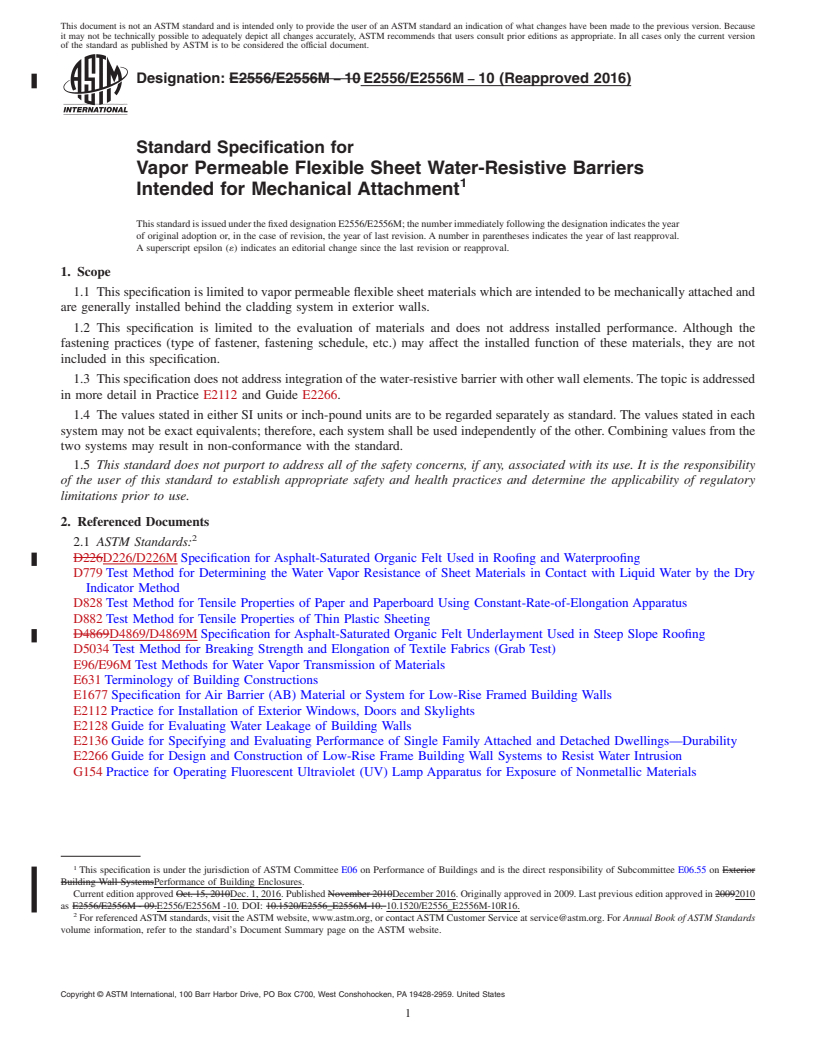
1.1 This specification is limited to vapor permeable flexible sheet materials which are intended to be mechanically attached and
are generally installed behind the cladding system in exterior walls.
1.2 This specification is limited to the evaluation of materials and does not address installed performance. Although the
fastening practices (type of fastener, fastening schedule, etc.) may affect the installed function of these materials, they are not
included in this specification.
1.3 This specification does not address integration of the water-resistive barrier with other wall elements. The topic is addressed
in more detail in Practice E2112 and Guide E2266.
1.4 The values stated in either SI units or inch-pound units are to be regarded separately as standard. The values stated in each
system may not be exact equivalents; therefore, each system shall be used independently of the other. Combining values from the
two systems may result in non-conformance with the standard.
1.5 This standard does not purport to address all of the safety concerns, if any, associated with its use. It is the responsibility
of the user of this standard to establish appropriate safety and health practices and determine the applicability of regulatory
limitations prior to use.
2. Referenced Documents
2.1 ASTM Standards:
D226D226/D226M Specification for Asphalt-Saturated Organic Felt Used in Roofing and Waterproofing
D779 Test Method for Determining the Water Vapor Resistance of Sheet Materials in Contact with Liquid Water by the Dry
Indicator Method
D828 Test Method for Tensile Properties of Paper and Paperboard Using Constant-Rate-of-Elongation Apparatus
D882 Test Method for Tensile Properties of Thin Plastic Sheeting
D4869D4869/D4869M Specification for Asphalt-Saturated Organic Felt Underlayment Used in Steep Slope Roofing
D5034 Test Method for Breaking Strength and Elongation of Textile Fabrics (Grab Test)
E96/E96M Test Methods for Water Vapor Transmission of Materials
E631 Terminology of Building Constructions
E1677 Specification for Air Barrier (AB) Material or System for Low-Rise Framed Building Walls
E2112 Practice for Installation of Exterior Windows, Doors and Skylights
E2128 Guide for Evaluating Water Leakage of Building Walls
E2136 Guide for Specifying and Evaluating Performance of Single Family Attached and Detached Dwellings—Durability
E2266 Guide for Design and Construction of Low-Rise Frame Building Wall Systems to Resist Water Intrusion
G154 Practice for Operating Fluorescent Ultraviolet (UV) Lamp Apparatus for Exposure of Nonmetallic Materials
This specification is under the jurisdiction of ASTM Committee E06 on Performance of Buildings and is the direct responsibility of Subcommittee E06.55 on Exterior
Building Wall SystemsPerformance of Building Enclosures.
Current edition approved Oct. 15, 2010Dec. 1, 2016. Published November 2010December 2016. Originally approved in 2009. Last previous edition approved in 20092010
as E2556/E2556M - 09.E2556/E2556M -10. DOI: 10.1520/E2556_E2556M-10. 10.1520/E2556_E2556M-10R16.
For referenced ASTM standards, visit the ASTM website, www.astm.org, or contact ASTM Customer Service at service@astm.org. For Annual Book of ASTM Standards
volume information, refer to the standard’s Document Summary page on the ASTM website.
Copyright © ASTM International, 100 Barr Harbor Drive, PO Box C700, West Conshohocken, PA 19428-2959. United States
E2556/E2556M − 10 (2016)
2.2 Other Standards:
AATCC Test Method 127 Water Resistance: Hydrostatic Pressure Test
CGSB CAN2-51.32.M77 Sheathing Membrane, Breather Type
Federal Specification UU-B-790a Federal Specification Building Paper, Vegetable Fiber (Kraft, Waterproofed, Water Repellent
and Fire Resistant)
Available from American Association of Textile Chemists and Colorists (AATCC), P.O. Box 12215, Research Triangle Park, NC 27709,27709-2215, http://
www.aatcc.org.
Available from Canadian General Standards Board (CGSB), 11 Laurier St., Phase III, Place du Portage, Gatineau, Quebec K1A 1G6,0S5, Canada, http://www.tpsgc-
pwgsc.gc.ca/cgsb.http://www.tpsgc-pwgsc.gc.ca/ongc-cgsb.
Available from Standardization Documents Order Desk, DODSSP, Bldg. 4, Section D, DLA Document Services, Building 4/D, 700 Robbins Ave., Philadelphia, PA
19111-5098, http://dodssp.daps.dla.mil.19111-5094, http://quicksearch.dla.mil.
E2556/E2556M − 10 (2016)
TAPPI T-410 Test Method for Grammage of Paper and Paperboard (Weight Per Unit Area)
UBC Standard 14-1 Kraft Waterproof Building Paper
UBC Standard 32-1 Asphalt Saturated Rag Felt
ICC-ES Acceptance Criteria AC38 for Water-Resistive Barriers
3. Terminology
3.1 Definitions—For definitions of general terms related to building construction used in this specification, refer to Terminology
E631.
3.2 Definitions of Terms Specific to This Standard:
3.2.1 felt-based barrier, n—asphalt-saturated organic felts that comply with Specification D226D226/D226M and are intended
for use as water-resistive barriers.
3.2.2 paper-based barrier, n—building papers composed predominantly of sulfate pulp fibers that comply with Federal
Specification UU-B-790a and that are intended for use as water-resistive barriers.
3.2.3 polymer-based barrier, n—plastic sheet materials for use as water-resistive barriers. These materials are generally referred
to as a housewrap or building wrap. These materials can be perforated with small holes or may be non-perforated, composed of
films or non-woven materials.
3.2.4 Type I WRB, n—water-resistive barrier with base-level water resistance (see Table 1).
3.2.5 Type II WRB, n—water-resistive barrier with enhanced water resistance (see Table 1).
3.2.6 Water-Resistive Barrier (WRB), n—a material that is intended to resist liquid water that has penetrated the cladding
system.
NOTE 1—Wall assemblies often include two lines of defense against rain water ingress. The cladding serves as the first line of defense and the
water-resistive barrier as the second line of defense
NOTE 2—Water-resistive barriers are sometimes referred to as weather resistant barriers or sheathing membranes.
4. Classification
4.1 This specification covers vapor permeable flexible sheet materials that are classified as Type I and Type II, which are
determined by the degree of water resistance. The water-resistive barrier material composition shall determine the specific test
method used to measure physical and mechanical properties (see Table 1). Appendix X1 provides explanatory information on the
physical and mechanical property test methods.
5. Materials and Manufacture
5.1 Description of the material composition and structure shall be made available upon request.
5.1.1 Descriptions of the materials shall include roll weight and dimensions.
5.1.2 Descriptions of the material composition shall include linear density (basis weight). Basis weight shall be measured using
TAPPI T-410.
6. Performance Requirements
6.1 All products seeking compliance with this specification shall conform to the minimum performance requirements listed in
Table 1. Sampling and specimen size shall be in accordance with the referenced test methods. If not otherwise specified in the
referenced test method, a minimum of five specimens shall be tested and all specimens shall meet the minimum performance
requirements.
NOTE 3—The laboratory accelerated-ultraviolet (UV)/condensation exposure procedure specified in A1.2 is not intended to represent a specific service
exposure. It is a method of comparing the stability of materials under consistent laboratory exposure conditions.
7. Other Requirements
7.1 The material shall not adhere to itself to an extent that will cause tearing or other damage on unrolling.
8. Sampling
8.1 The product to be tested for conformance to this specification shall be taken directly from a randomly selected roll which
is representative of commercial product.
Available from TechnicalTechnological Association of the Pulp and Paper Industry (TAPPI), 15 Technology Parkway South, Norcross, Suite 115, Peachtree Corners, GA
30092, http://www.tappi.org.
Uniform Building Code (UBC) information is available from International Code Council (ICC), 500 New Jersey Ave., NW, 6th Floor, Washington, DC
20001-2070,20001, http://www.iccsafe.org.
Available from the ICC Evaluation Service (ICC-ES), 5360 Workman Mill Road, Whittier, CA 90601,3060 Saturn Street, Suite 100, Brea, CA 92821,
http://www.icc-es.org.
E2556/E2556M − 10 (2016)
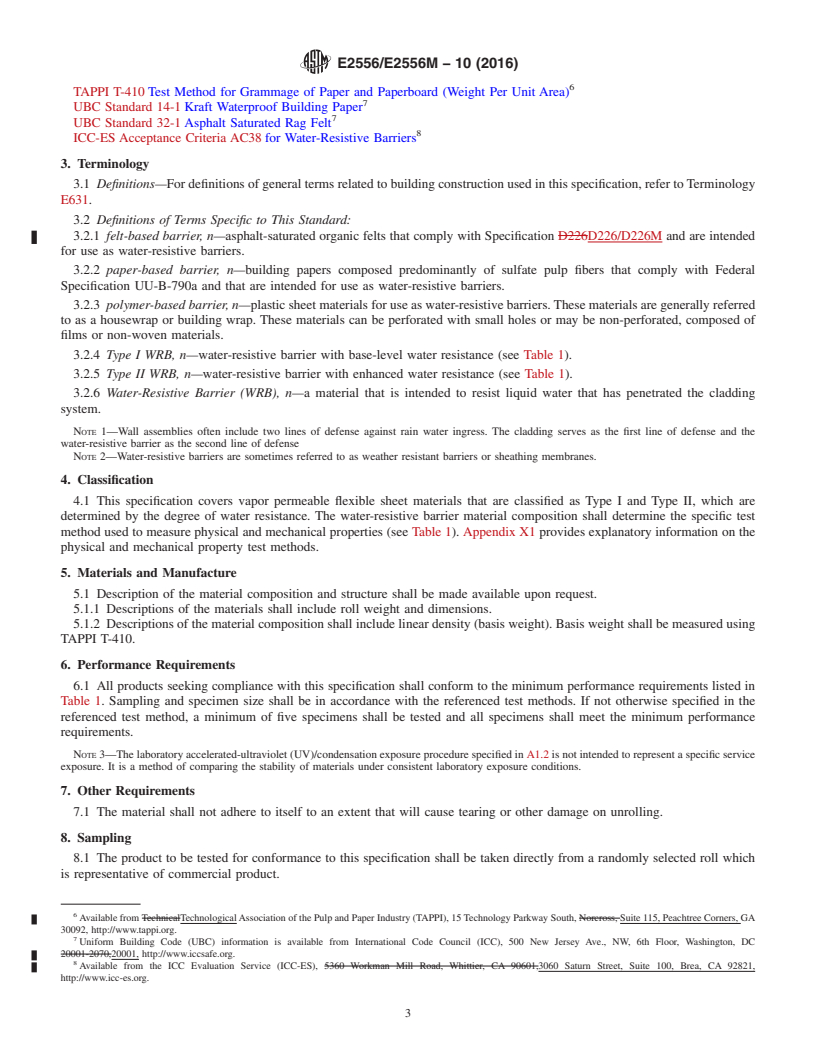
TABLE 1 Requirements for Water Resistive Barriers
Minimum Performance Requirements
Test Requirement Specimen Type Test Method
Type I Type II
Minimum Performance Requirements
Test Requirement Specimen Type Test Method
Type I Type II
Dry tensile (1) as Test Method D828 for paper 3500 N/m (20 lb/in.) minimum (machine and cross direction)
strength or dry manufactured and felt materials, or
breaking force and Dry tensile3500strengthN/m [20 lb/in.](1)minimumas (machine and cross direction)Test Method D828 for paper
(choose 1) (2) aged in or dry breaking manufactured and felt materials, or
accordance force (choose and 3500 N/m (20 lb/in.) minimumTest(machineMethodsandD882crossfordirection)
with A1.2 1) (2) aged in accordance polymeric materials, or
with A1.2 3500 N/m [20 lb/in.] minimumTest(machineMethodandD882crossfor direction)
polymeric materials, or
Test Method D5034 178 N (40 lbf) minimum (machine direction)
(Grab Test Method D5034 178 N [40 lbf] minimum (machine direction)
Method) (Grab 156 N (35 lbf) minimum (cross direction)
Method) 156 N [35 lbf] minimum (cross direction)
Water resistance (1) as Test Method D779, or 10 min minimum 60 min minimum
test (choose 1) manufactured Water resistance (1) as manufactured Test Method D779, or 10 min
and test (choose 1) and Water Resistance Ponding No water shall
(2) aged in (2) aged in accordance Test (A1.1), or the membrane
accordance with A1.2
with A1.2
AATCC Test Method 127 not applicable No leakage is permitted to the underside
except that the speci- of any specimen in 5 h
mens
shall be held at a
hydrostatic head of
55 cm (21.6 in.)
AATCC Test Method 127 not applicable No leakage is permitted to
except that the speci- the underside
mens of any specimen in 5 h
shall be held at a
hydrostatic head of
55 cm [21.6 in.]
Water vapor as received Test Method E96/E96M 290 ng/(Pa · s · m ) (5 perms) minimum
transmission (Dessicant Method)
test
Water vapor as received Test Methods E96/E96M 290 ng/(Pa · s · m ) (5 perms) minimum
transmission (Dessicant Method)
test
Pliability test as received see A1.3 The material shall not crack when bent over a 1.6 mm ( ⁄16-in.)
diameter mandrel at a temperature of 0°C (32°F)
Pliability test as received see A1.3 The material shall not crack when bent over a 1.6 mm [ ⁄16-in.]
diameter mandrel at a temperature of 0 °C [32 °F]
8.2 The specimens shall be cut from the interior of the sample roll so that no specimen edge is nearer than 75 mm (3 in.) [3 in.]
to the original sample edge.
8.3 Unless otherwise stated, all specimens to be tested shall be conditioned for a minimum period of 40 h at 23 6 2°C (73.4
6 4°F) 2 °C [73.4 6 4 °F] and 50 6 5 % relative humidity (RH).
9. Marking and Labeling
9.1 The finished product shall be marked or labeled with product identification.
9.2 Installation instructions shall be provided and shall include as a minimum the maximum weather exposure time allowed
before cladding shall be installed, type of mechanical fastener and minimum fastener spacing to attach the WRB to the underlying
structure, and lapping and taping requirements. This information shall be recorded and reported in any applicable test report or
product rating.
10. Keywords
10.1 building felt; building paper; building wrap; housewrap; sheathing membrane; water-resistive barrier; weather-resistive
barrier
E2556/E2556M − 10 (2016)
ANNEX
(Mandatory Information)
A1. TEST METHODS AND PRACTICES
A1.1 Water Resistance Ponding Test
A1.1.1 Scope—This is a test method intended for evaluating the water resistance of a Type I water-resistive barrier.
A1.1.2 Significance and Use—This method is for use with water-resistive barriers.
A1.1.3 Procedure:
A1.1.3.1 Five specimens will be chosen at random from the material supplied.
A1.1.3.2 A ring shall be constructed with a sample of the membrane fastened between two 200-mm (8-in.)[8-in.] diameter
aluminum rings using a rubber-type gasket. The membrane shall be placed between the rings and cupped to permit a depth of 25
2 2
mm (1 in.)[1 in.] of water to be exposed to 16 000 mm16 000 mm (25 in. [25 in. )] of its surface.
A1.1.3.3 Distilled water shall be poured into the cylinder to a depth of 25 mm (1 in.).[1 in.].
A1.1.3.4 The ring shall be raised by 250 mm (9.8 in.)[9.8 in.] above a sheet of plain kraft paper placed underneath the membrane
to aid in monitoring any passage of water.
A1.1.3.5 The membrane shall be maintained at constant conditions of temperature (23 6 2°C (73.4 6 4°F)) 2 °C [73.4 6 4 °F])
and RH (50 6 5 %) and be inspected at frequent intervals over a period of 2 h for water passage through the barrier material.
A1.1.4 Report:
A1.1.4.1 The report shall include the following:
(1) The material and the side tested.
(2) The material sampling procedure used.
(3) Pass/fail test results for each specimen tested.
(4) Any modification to the method.
A1.1.5 Precision and Bias—No information is presented about either the precision or bias of this test method for evaluating water
resistance since the test result is nonquantitative.
A1.2 Accelerated Aging (UV Exposure and Cyclic Drying/Wetting)
A1.2.1 Scope—This practice is used to condition samples of water-resistive barriers to evaluate degradation of performance due
to accelerated aging (UV exposure and dry/wet cycling).
A1.2.2 Significance and Use—This practice is not intended to represent
...
Questions, Comments and Discussion
Ask us and Technical Secretary will try to provide an answer. You can facilitate discussion about the standard in here.