

ASTM D268-22
(Guide)Standard Guide for Sampling and Testing Volatile Solvents and Chemical Intermediates for Use in Paint and Related Coatings and Material
General Information
- Abstract
SIGNIFICANCE AND USE
3.1 A brief discussion of each test method is given with the intent of helping the user in the selection of the most applicable procedure where more than one is available.
SCOPE
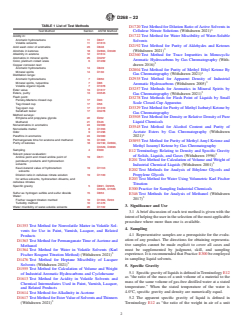
1.1 This guide covers procedures for the sampling and testing of volatile solvents used in the manufacture of paint, lacquer, varnish, and related products. The test methods are listed in Table 1.
1.2 For specific hazard information and guidance, see Suppliers' Material Safety Data Sheet for materials listed in this guide.
1.3 The values stated in SI units are to be regarded as the standard. The values given in parentheses are for information only.
1.4 This standard does not purport to address all of the safety concerns, if any, associated with its use. It is the responsibility of the user of this standard to establish appropriate safety, health, and environmental practices and determine the applicability of regulatory limitations prior to use.
1.5 This international standard was developed in accordance with internationally recognized principles on standardization established in the Decision on Principles for the Development of International Standards, Guides and Recommendations issued by the World Trade Organization Technical Barriers to Trade (TBT) Committee.
- Status
- Published
- Publication Date
- 31-Dec-2021
- Technical Committee
- D01 - Paint and Related Coatings, Materials, and Applications
- Drafting Committee
- D01.35 - Solvents, Plasticizers, and Chemical Intermediates
Overview
ASTM D268-22 - Standard Guide for Sampling and Testing Volatile Solvents and Chemical Intermediates for Use in Paint and Related Coatings and Material - provides procedures and referenced methods for the proper sampling and testing of volatile solvents. These solvents are essential raw materials in the manufacture of paint, lacquer, varnish, and similar surface coatings. The standard includes guidance on selecting the most appropriate testing method when multiple options exist, as well as pointers to best practices for sampling and analysis to ensure reliable results.
Accurate sampling and testing are crucial in the coatings industry to ensure product quality, compliance with specifications, safety, and optimal performance of end products. The standard was developed following internationally recognized principles on standardization, supporting global trade and regulatory acceptance.
Key Topics
- Sampling Procedures: Guidance on obtaining representative samples of liquid solvents, emphasizing the importance of using standardized practices (such as ASTM E300) to secure reliable test results.
- Test Method Selection: Discussion of available ASTM test methods for key properties of solvents, including:
- Specific gravity and density
- Color (Platinum-Cobalt, Saybolt, APHA)
- Distillation range
- Flash point (several test methods, both open and closed cup)
- Acidity and alkalinity
- Odor and nonvolatile residue
- Water content (Karl Fischer, turbidity)
- Hydrogen sulfide and sulfur dioxide content
- Purity of ketones and esters
- Solvent power evaluation (aniline point, kauri-butanol value, dilution ratio)
- Significance of Testing: Each method includes a brief explanation to help users identify the most applicable procedure for their specific solvent and application.
Safety note: Users must consult individual safety data sheets (SDS) from suppliers and establish proper health, safety, and environmental procedures before working with volatile solvents and chemical intermediates.
Applications
ASTM D268-22 is widely used in industries involving paint and coatings, including:
- Manufacturers of Paints, Lacquers, and Varnishes: Ensuring solvents and intermediates meet specifications for optimal curing, film formation, and durability.
- Quality Control Laboratories: Implementing consistent sampling and testing protocols for raw material validation, batch release, and regulatory compliance.
- Suppliers and Distributors of Solvents: Providing evidence of product quality and conformity with customer and regulatory standards.
- Procurement/Technical Buyers: Comparing material data to specifications listed using standard test results as benchmarks.
- R&D and Formulation: Assessing solvent performance and compatibility in new formula development or when sourcing alternative materials.
Commonly tested materials under this standard include mineral spirits, acetone, turpentine, aromatic hydrocarbons, and various chemical intermediates relevant to coatings.
Related Standards
For comprehensive solvent characterization, ASTM D268-22 references numerous related standards, including but not limited to:
- ASTM E300 - Practice for Sampling Industrial Chemicals
- ASTM D86, D1078, D850 - Distillation of Petroleum Products and Solvents
- ASTM D93, D56, D1310, D3278 - Flash Point Determinations
- ASTM D1209, D156 - Color Measurement
- ASTM D891, D3505 - Specific Gravity and Density
- ASTM D847, D848, D849, D853 - Acidity, Corrosiveness, and Sulfur Content Tests
- ASTM D1353, D1363, D1720, D1722 - Nonvolatile Matter, Reducing Substances, Dilution, Water Miscibility
Referencing these standards in conjunction ensures reliable, industry-accepted results and facilitates international communication on solvent quality.
Keywords: ASTM D268-22, volatile solvents, solvent testing, sampling solvents, paint solvents, coatings, quality control, industrial chemicals.
Relations
- Effective Date
- 01-Jan-2024
- Effective Date
- 01-Dec-2023
- Effective Date
- 01-Dec-2023
- Effective Date
- 01-Oct-2023
- Effective Date
- 01-Aug-2020
- Effective Date
- 01-Jun-2019
- Effective Date
- 01-Apr-2019
- Effective Date
- 01-Jul-2016
- Effective Date
- 01-Jun-2016
- Refers
ASTM D849-15 - Standard Test Method for Copper Strip Corrosion by Industrial Aromatic Hydrocarbons - Effective Date
- 01-Oct-2015
- Effective Date
- 01-Aug-2015
- Effective Date
- 01-Feb-2014
- Effective Date
- 01-Nov-2013
- Effective Date
- 15-Jul-2013
- Effective Date
- 15-Jul-2013
Frequently Asked Questions
ASTM D268-22 is a guide published by ASTM International. Its full title is "Standard Guide for Sampling and Testing Volatile Solvents and Chemical Intermediates for Use in Paint and Related Coatings and Material". This standard covers: SIGNIFICANCE AND USE 3.1 A brief discussion of each test method is given with the intent of helping the user in the selection of the most applicable procedure where more than one is available. SCOPE 1.1 This guide covers procedures for the sampling and testing of volatile solvents used in the manufacture of paint, lacquer, varnish, and related products. The test methods are listed in Table 1. 1.2 For specific hazard information and guidance, see Suppliers' Material Safety Data Sheet for materials listed in this guide. 1.3 The values stated in SI units are to be regarded as the standard. The values given in parentheses are for information only. 1.4 This standard does not purport to address all of the safety concerns, if any, associated with its use. It is the responsibility of the user of this standard to establish appropriate safety, health, and environmental practices and determine the applicability of regulatory limitations prior to use. 1.5 This international standard was developed in accordance with internationally recognized principles on standardization established in the Decision on Principles for the Development of International Standards, Guides and Recommendations issued by the World Trade Organization Technical Barriers to Trade (TBT) Committee.
SIGNIFICANCE AND USE 3.1 A brief discussion of each test method is given with the intent of helping the user in the selection of the most applicable procedure where more than one is available. SCOPE 1.1 This guide covers procedures for the sampling and testing of volatile solvents used in the manufacture of paint, lacquer, varnish, and related products. The test methods are listed in Table 1. 1.2 For specific hazard information and guidance, see Suppliers' Material Safety Data Sheet for materials listed in this guide. 1.3 The values stated in SI units are to be regarded as the standard. The values given in parentheses are for information only. 1.4 This standard does not purport to address all of the safety concerns, if any, associated with its use. It is the responsibility of the user of this standard to establish appropriate safety, health, and environmental practices and determine the applicability of regulatory limitations prior to use. 1.5 This international standard was developed in accordance with internationally recognized principles on standardization established in the Decision on Principles for the Development of International Standards, Guides and Recommendations issued by the World Trade Organization Technical Barriers to Trade (TBT) Committee.
ASTM D268-22 is classified under the following ICS (International Classification for Standards) categories: 87.060.30 - Solvents. The ICS classification helps identify the subject area and facilitates finding related standards.
ASTM D268-22 has the following relationships with other standards: It is inter standard links to ASTM E203-24, ASTM D86-23a, ASTM D86-23ae1, ASTM D156-23, ASTM D93-20, ASTM D849-15(2019)e1, ASTM D1363-06(2019), ASTM D86-16, ASTM D56-16, ASTM D849-15, ASTM D847-15, ASTM D848-14, ASTM D233-13, ASTM D93-13e1, ASTM D93-13. Understanding these relationships helps ensure you are using the most current and applicable version of the standard.
ASTM D268-22 is available in PDF format for immediate download after purchase. The document can be added to your cart and obtained through the secure checkout process. Digital delivery ensures instant access to the complete standard document.
Standards Content (Sample)
This international standard was developed in accordance with internationally recognized principles on standardization established in the Decision on Principles for the
Development of International Standards, Guides and Recommendations issued by the World Trade Organization Technical Barriers to Trade (TBT) Committee.
Designation: D268 − 22
Standard Guide for
Sampling and Testing Volatile Solvents and Chemical
Intermediates for Use in Paint and Related Coatings and
Material
This standard is issued under the fixed designation D268; the number immediately following the designation indicates the year of
original adoption or, in the case of revision, the year of last revision.Anumber in parentheses indicates the year of last reapproval.A
superscript epsilon (´) indicates an editorial change since the last revision or reapproval.
This standard has been approved for use by agencies of the U.S. Department of Defense.
1. Scope Liquid Fuels at Atmospheric Pressure
D93Test Methods for Flash Point by Pensky-Martens
1.1 This guide covers procedures for the sampling and
Closed Cup Tester
testing of volatile solvents used in the manufacture of paint,
D130Test Method for Corrosiveness to Copper from Petro-
lacquer, varnish, and related products. The test methods are
leum Products by Copper Strip Test
listed in Table 1.
D156Test Method for Saybolt Color of Petroleum Products
1.2 For specific hazard information and guidance, see Sup-
(Saybolt Chromometer Method)
pliers’ Material Safety Data Sheet for materials listed in this
D233Test Methods of Sampling and Testing Turpentine
guide.
D235Specification for Mineral Spirits (Petroleum Spirits)
(Hydrocarbon Dry Cleaning Solvent) (Withdrawn 2021)
1.3 The values stated in SI units are to be regarded as the
standard. The values given in parentheses are for information D329Specification for Acetone
D611Test Methods for Aniline Point and Mixed Aniline
only.
Point of Petroleum Products and Hydrocarbon Solvents
1.4 This standard does not purport to address all of the
D847 Test Method for Acidity of Benzene, Toluene,
safety concerns, if any, associated with its use. It is the
Xylenes, Solvent Naphthas, and Similar Industrial Aro-
responsibility of the user of this standard to establish appro-
matic Hydrocarbons
priate safety, health, and environmental practices and deter-
D848Test Method for Acid Wash Color of Industrial Aro-
mine the applicability of regulatory limitations prior to use.
matic Hydrocarbons
1.5 This international standard was developed in accor-
D849Test Method for Copper Strip Corrosion by Industrial
dance with internationally recognized principles on standard-
Aromatic Hydrocarbons
ization established in the Decision on Principles for the
D850Test Method for Distillation of Industrial Aromatic
Development of International Standards, Guides and Recom-
Hydrocarbons and Related Materials
mendations issued by the World Trade Organization Technical
D853Test Method for Hydrogen Sulfide and Sulfur Dioxide
Barriers to Trade (TBT) Committee.
Content (Qualitative) of Industrial Aromatic Hydrocar-
bons (Withdrawn 2013)
2. Referenced Documents
D891TestMethodsforSpecificGravity,Apparent,ofLiquid
2.1 ASTM Standards:
Industrial Chemicals
D13Specification for Spirits of Turpentine
D1078Test Method for Distillation Range of Volatile Or-
D56Test Method for Flash Point by Tag Closed Cup Tester
ganic Liquids
D86Test Method for Distillation of Petroleum Products and
D1133Test Method for Kauri-Butanol Value of Hydrocar-
bon Solvents
D1209Test Method for Color of Clear Liquids (Platinum-
This guide is under the jurisdiction of ASTM Committee D01 on Paint and
Cobalt Scale)
Related Coatings, Materials, and Applications and is the direct responsibility of
Subcommittee D01.35 on Solvents, Plasticizers, and Chemical Intermediates.
D1296Test Method for Odor of Volatile Solvents and
Current edition approved Jan. 1, 2022. Published January 2022. Originally
Diluents (Withdrawn 2021)
approved in 1927. Last previous edition approved in 2012 as D268–01 (2012)
D1310TestMethodforFlashPointandFirePointofLiquids
which was withdrawn January 2021 and reinstated in January 2022. DOI: 10.1520/
by Tag Open-Cup Apparatus
D0268-22.
For referenced ASTM standards, visit the ASTM website, www.astm.org, or
contact ASTM Customer Service at service@astm.org. For Annual Book of ASTM
Standards volume information, refer to the standard’s Document Summary page on The last approved version of this historical standard is referenced on
the ASTM website. www.astm.org.
*A Summary of Changes section appears at the end of this standard
Copyright © ASTM International, 100 Barr Harbor Drive, PO Box C700, West Conshohocken, PA 19428-2959. United States
D268 − 22
TABLE 1 List of Test Methods
D1720Test Method for Dilution Ratio ofActive Solvents in
Test Method Section ASTM Method Cellulose Nitrate Solutions (Withdrawn 2021)
Acidity in: D1722Test Method for Water Miscibility of Water-Soluble
Aromatic hydrocarbons 11 D847
Solvents
Volatile solvents 11 D1613
D2192Test Method for Purity of Aldehydes and Ketones
Acid wash color of aromatics 23 D848
Alcohols in ketones 18 D2804, D3329 (Withdrawn 2021)
Alkalinity in acetone 12 D1614
D2360Test Method for Trace Impurities in Monocyclic
Aromatics in mineral spirits 25 D3257
Aromatic Hydrocarbons by Gas Chromatography (With-
Color, platinum cobalt scale 6 D1209
Copper corrosion test: drawn 2016)
Aromatic hydrocarbons 14 D849
D2804Test Method for Purity of Methyl Ethyl Ketone By
Mineral spirits 14 D130
Gas Chromatography (Withdrawn 2021)
Distillation range:
Aromatic hydrocarbons 7 D850
D2935Test Method for Apparent Density of Industrial
Mineral spirits, turpentine 7 D86
Aromatic Hydrocarbons (Withdrawn 2005)
Volatile organic liquids 7 D1078
D3257Test Methods for Aromatics in Mineral Spirits by
Ester value 13 D1617
Esters, purity 13 D3545
Gas Chromatography (Withdrawn 2021)
Flash point:
D3278Test Methods for Flash Point of Liquids by Small
Pensky-Martens closed cup 17 D93
Scale Closed-Cup Apparatus
Tag closed cup 17 D56
Tag open cup 17 D1310 D3329TestMethodforPurityofMethylIsobutylKetoneby
Setaflash tester 17 D3278
Gas Chromatography
Method surveys:
D3505Test Method for Density or Relative Density of Pure
Ethylene and propylene glycols 22 E202
Methanol 21 E346
Liquid Chemicals
Nonaromatics in aromatics 24 D2360
D3545Test Method for Alcohol Content and Purity of
Nonvolatile matter 8 D1353
Acetate Esters by Gas Chromatography (Withdrawn
Odor 9 D1296
Paraffins in aromatics 24 D2360
2021)
Permanganate time for acetone and methanol 16 D1363
D3893Test Method for Purity of Methyl Amyl Ketone and
Purity of ketones 18 D2192, D2804,
Methyl Isoamyl Ketone by Gas Chromatography
D3329, D3893
Sampling 4 E300
E12Terminology Relating to Density and Specific Gravity
Solvent power evaluation: 3
of Solids, Liquids, and Gases (Withdrawn 1996)
Aniline point and mixed aniline point of 19 D611
E201Test Method for Calculation of Volume and Weight of
petroleum products and hydrocarbon
solvents
Industrial Chemical Liquids (Withdrawn 2001)
Kauri-butanol value of hydrocarbon 19 D1133
E202Test Methods for Analysis of Ethylene Glycols and
solvents
Propylene Glycols
Dilution ratio in cellulose nitrate solution 19 D1720
for active solvents, hydrocarbon diluents, and
E203Test Method for Water Using Volumetric Karl Fischer
cellulose nitrates
Titration
Specific gravity 5 D891, D2935,
E300Practice for Sampling Industrial Chemicals
D3505, D1555
Sulfur as hydrogen sulfide and sulfur dioxide 15 D853
E346Test Methods for Analysis of Methanol (Withdrawn
Water:
2017)
Fischer reagent titration method 10 D1364, E203
Turbidity method 10 D1476
3. Significance and Use
Water miscibility of water-soluble solvents 20 D1722
3.1 Abrief discussion of each test method is given with the
intentofhelpingtheuserintheselectionofthemostapplicable
procedure where more than one is available.
D1353Test Method for Nonvolatile Matter in Volatile Sol-
4. Sampling
vents for Use in Paint, Varnish, Lacquer, and Related
4.1 Representative samples are a prerequisite for the evalu-
Products
ation of any product. The directions for obtaining representa-
D1363Test Method for Permanganate Time ofAcetone and
tive samples cannot be made explicit to cover all cases and
Methanol
must be supplemented by judgment, skill, and sampling
D1364Test Method for Water in Volatile Solvents (Karl
experience.ItisrecommendedthatPracticeE300beemployed
Fischer Reagent Titration Method) (Withdrawn 2021)
in sampling liquid solvents.
D1476Test Method for Heptane Miscibility of Lacquer
Solvents (Withdrawn 2021)
5. Specific Gravity
D1555Test Method for Calculation of Volume and Weight
5.1 SpecificgravityofliquidsisdefinedinTerminologyE12
of Industrial Aromatic Hydrocarbons and Cyclohexane
as “the ratio of the mass of a unit volume of a material to the
D1613Test Method for Acidity in Volatile Solvents and
mass of the same volume of gas-free distilled water at a stated
Chemical Intermediates Used in Paint, Varnish, Lacquer,
temperature.” When the stated temperature of the water is
and Related Products
4.0°C, specific gravity and density are numerically equal.
D1614Test Method for Alkalinity in Acetone
D1617TestMethodforEsterValueofSolventsandThinners 5.2 The apparent specific gravity of liquid is defined in
(Withdrawn 2021) Terminology E12 as “the ratio of the weight in air of a unit
D268 − 22
primarily to water, the term “APHA Color” is undesirable. The recom-
volume of material at a stated temperature to the weight in air
mended nomenclature for referring to the color of organic liquids is
of equal density of an equal volume of gas-free, distilled water
“Platinum-Cobalt Color, Test Method D1209.”
at a stated temperature.”
NOTE 3—The petroleum industry uses the Saybolt colorimeter Test
Method D156 for measuring and defining the color of hydrocarbon
NOTE 1—Specific gravity or density is an intrinsic property of all
solvents; however, this system of color measurement is not commonly
substances and can to a degree be used to identify them. When such
employed outside of the petroleum industry. It has been reported by
substances are of high purity, specific gravity may be used in support of
various sources that a Saybolt color of +25 is equivalent to 25 in the
otherpropertiestodefinetheirdegreeofpurity.Theuseofspecificgravity
platinum-cobalt system or to colors produced by masses of potassium
for such purposes, however, is valid only when all components and their
dichromate ranging between 4.8 and 5.6 mg. dissolved in 1 L of distilled
relative effects upon the specific gravity of the system are known.
water. Because of the differences in the spectral characteristics of the
5.3 The choice of test method for determining specific
severalcolorsystemsbeingcomparedandthesubjectivemannerinwhich
gravityislargelydependentonthedegreeofaccuracyrequired. the measurements are made, exact equivalencies are difficult to obtain.
Ingeneral,whentheproductspecificationrequiresanaccuracy
to the third decimal place, the hydrometer or specific gravity 7. Distillation Range
balance method may be employed. When the product specifi-
7.1 The distillation range of an organic solvent is an
cation requires an accuracy to the fourth decimal place, a
empiricalsetofdatapeculiartothesolventunderstudyandthe
pycnometer method should be employed. Test Methods D891
apparatus used giving the purchaser an indication of the
give procedures using all three techniques.
product quality available to him.
5.4 With specific reference to the determination of density
NOTE 4—The distillation range provides information on the initial
or specific gravity of a number of aromatic and cyclic
boiling point, percent distilled at certain temperatures, and the dry point.
hydrocarbon solvents, Test Method D3505 describes a simpli-
These parameters may be affected by improper refining techniques,
impurities inherent in the sample, or contamination. It is absolutely
fied procedure for this measurement.
necessarythatthepurchaserandselleremploythesametypeofapparatus,
5.5 Methods for converting specific gravity data to weight
including thermometers, and follow an identical procedure as agreed
and volume data at various temperatures are given in Test
upon. If these factors are not followed precisely, it is quite possible
disagreement will result between the parties.
Method E201 for oxygenated and chlorinated compounds, and
for aromatic hydrocarbons in Test Method D1555.
7.2 Three test methods are available for determining the
distillation range of solvents.The major differences among the
5.6 The measurement of density of aromatic hydrocarbons
three methods are the size of distillation flasks and type of
at any convenient temperature, and the conversion of the data
thermometers(partialortotalimmersion)employed.Flasksize
to an applicable specification or storage temperature are
has little to no effect on the results obtained between labora-
described in Test Method D2935.
tories beyond the limits of error noted for each test method.
The advantage of the larger size flask is to prevent “boil over”
6. Color
when high-boiling products, processing relatively high coeffi-
6.1 The property of color of a solvent will vary in impor-
cients of expansion are being tested. On the other hand,
tance with the application for which it is intended, the amount
differences between laboratories will be large when one labo-
of color that can be tolerated being dependent on the color
ratory employs a partial immersion thermometer and another a
characteristics of the material in which it is used. The paint,
total immersion instrument. The spread between results will
varnish, and lacquer solvents, or diluents commercially avail-
increase as the boiling range rises above 100°C. Partial
able on today’s market normally have little or no color. The
immersion thermometers are preferred for narrow boiling
presence or absence of color in such material is an indication
products since they require no emergent stem temperature
of the degree of refinement to which the solvent has been
correction. The type of heat source may affect the distillation
subjected or of the cleanliness of the shipping or storage
range of products boiling within 1 or 2°C. This is especially
container in which it is handled, or both (see Test Method
trueforlow-boilingsolventssuchasmethylalcoholoracetone.
D1209).
Alarge electric heater tends to distort the dry point due to the
heating effect of infrared radiation on the bulb of the
NOTE2—Foranumberofyearstheterm“water-white”wasconsidered
sufficient as a measurement of solvent color. Several expressions for
thermometer, while a properly adjusted gas burner minimizes
defining“ water-white” gradually appeared and it became evident that a
this effect. The following test methods are commonly used in
more precise color standard was needed. This was accomplished in 1952
determining distillation ranges:
with the adoption of Test Method D1209 using the platinum cobalt scale.
7.2.1 Test Method D1078, using a 200-mL flask, high-
This method is similar to the description given in the Standard Methods
for the Examination of Water and Waste Water of the American Public precision partial immersion thermometers, and gas or electric
HealthAssn.,14thEd.,p.65andisreferredtobymanyas“APHAColor.”
heat. The latter may be used only after it has proven to give
The preparation of these platinum-cobalt color standards was originally
results comparable to those obtained when using gas heat.The
described by Hazen, A., American Chemical Journal, Vol. XIV, 1892, p.
method was designed specifically for determining the distilla-
300, in which he assigned the nu
...