

ASTM D7000-19a
(Test Method)Standard Test Method for Sweep Test of Emulsified Asphalt Surface Treatment Samples
General Information
- Abstract
SIGNIFICANCE AND USE
4.1 This test method is useful for classifying rapid-setting emulsified asphalt and is applicable to surface treatments that require a quick return to traffic. It has the capability to predict surface treatment performance in the formative stage using construction components. This performance test is intended to evaluate the potential curing characteristics of a binder-aggregate combination to ensure that the surface treatment is sufficiently cured before allowing traffic onto the seal.
Note 1: The quality of the results produced by this standard are dependent on the competence of the personnel performing the procedure and the capability, calibration, and maintenance of the equipment used. Agencies that meet the criteria of Specification D3666 are generally capable of competent and objective testing, sampling, inspection, etc. Users of this standard are cautioned that compliance with Specification D3666 alone does not completely ensure reliable results. Reliable results depend on many factors; following the suggestions of Specification D3666 or some similar acceptable guideline provides a means of evaluating and controlling some of those factors.
SCOPE
1.1 This test method measures the curing performance characteristics of emulsified asphalt and aggregates by simulating the brooming of a surface treatment in the laboratory.
1.2 The values stated in SI units are to be regarded as standard. No other units of measurement are included in this standard.
1.3 The text of this standard references notes and footnotes which provide explanatory material. These notes and footnotes (excluding those in tables and figures) shall not be considered as requirements of the standard.
1.4 This standard does not purport to address all of the safety concerns, if any, associated with its use. It is the responsibility of the user of this standard to establish appropriate safety, health, and environmental practices and determine the applicability of regulatory limitations prior to use.
1.5 This international standard was developed in accordance with internationally recognized principles on standardization established in the Decision on Principles for the Development of International Standards, Guides and Recommendations issued by the World Trade Organization Technical Barriers to Trade (TBT) Committee.
- Status
- Published
- Publication Date
- 14-Dec-2019
- Technical Committee
- D04 - Road and Paving Materials
- Drafting Committee
- D04.24 - Asphalt Surface Treatments
Buy Documents

ASTM D7000-19a - Standard Test Method for Sweep Test of Emulsified Asphalt Surface Treatment Samples
REDLINE ASTM D7000-19a - Standard Test Method for Sweep Test of Emulsified Asphalt Surface Treatment Samples
Overview
ASTM D7000-19a, titled Standard Test Method for Sweep Test of Emulsified Asphalt Surface Treatment Samples, establishes laboratory procedures for measuring the curing performance of emulsified asphalt and aggregate combinations. This sweep test method simulates the mechanical brooming action applied to surface treatments, allowing agencies to evaluate rapid-setting emulsified asphalt before permitting traffic on treated surfaces. The standard, developed by ASTM International, supports quality control and performance prediction in road construction and pavement maintenance.
Key Topics
- Curing Performance Assessment: The test evaluates the potential of a binder-aggregate mix to cure sufficiently, ensuring the surface can quickly withstand traffic loads.
- Sweep Test Simulation: By replicating brooming in the lab, it provides early insight into field performance, calculating aggregate loss to assess material cohesion and stability.
- Applicability: Especially useful for rapid-setting emulsified asphalt surface treatments found in road surfacing, chip sealing, and pavement preservation.
- Standardization: Utilizes SI units exclusively, promoting consistency in international infrastructure projects.
Significance: This ASTM test method is essential for construction teams and material suppliers needing to validate that a surface treatment is robust and sufficiently cured, reducing the risk of premature aggregate loss or surface failures.
Applications
ASTM D7000-19a supports multiple practical uses in the field of civil engineering and infrastructure development:
- Quality Control for Surface Treatments: Enables contractors and specifying agencies to verify that an emulsified asphalt mixture meets required curing and performance criteria before opening roads to traffic.
- Material Comparison: Offers a reliable way to compare the curing performance of different emulsified asphalts and aggregates, supporting informed material selection and procurement.
- Performance Prediction: Assists in forecasting the durability and stability of surface treatments by revealing potential curing and cohesion issues early in the construction process.
- Job Mix and Construction Validation: Ensures that the combination of binder and aggregate performs as expected according to design and specification, reducing the likelihood of on-site failures.
The test method is particularly valuable in projects where rapid surface readiness is critical, such as urban road resurfacing, highway maintenance, and emergency pavement repairs.
Related Standards
Several standards complement and support the implementation of ASTM D7000-19a:
- ASTM D3666: Minimum requirements for agencies testing and inspecting road and paving materials, emphasizing laboratory competency.
- ASTM D977: Specification for emulsified asphalt, providing product requirements.
- ASTM D2397/D2397M: Specification for cationic emulsified asphalt.
- ASTM D8: Terminology relating to materials for roads and pavements, aiding in clarity and standardization.
- ASTM D75/D75M: Practice for sampling aggregates to ensure representative test materials.
- ISSA Technical Bulletin No. 100: Method for wet track abrasion testing of slurry surfaces, offering additional performance evaluation options.
Practical Value
- Rapid Return to Traffic: Facilitates shorter downtime and increased road user satisfaction by verifying the rapid cure performance of surface treatments.
- Consistent Results: Promotes reproducibility and comparability of testing results across laboratories and projects, supporting international best practices for road construction.
- Risk Reduction: Minimizes costly repairs or failures by identifying appropriate curing characteristics before traffic loading.
Keywords: emulsified asphalt, aggregate, sweep test, surface treatment, curing performance, rapid return to traffic, ASTM D7000-19a, binder-aggregate combination, road surface quality, pavement durability, construction standard.
For agencies, engineers, and contractors, ASTM D7000-19a is a critical tool in ensuring safe, efficient, and durable emulsified asphalt surface treatments.
Relations
- Replaces
ASTM D7000-19 - Standard Test Method for Sweep Test of Emulsified Asphalt Surface Treatment Samples - Effective Date
- 15-Dec-2019
- Effective Date
- 01-Nov-2019
- Effective Date
- 01-Oct-2016
- Effective Date
- 15-Dec-2013
- Effective Date
- 01-Dec-2013
- Effective Date
- 01-May-2013
- Effective Date
- 01-Dec-2011
- Effective Date
- 01-Nov-2011
- Effective Date
- 01-Dec-2009
- Effective Date
- 01-Jul-2009
- Effective Date
- 01-Oct-2008
- Effective Date
- 01-Aug-2007
- Effective Date
- 01-Aug-2007
- Effective Date
- 15-Jan-2007
- Effective Date
- 15-Jan-2007
Buy Documents
ASTM D7000-19a - Standard Test Method for Sweep Test of Emulsified Asphalt Surface Treatment Samples
REDLINE ASTM D7000-19a - Standard Test Method for Sweep Test of Emulsified Asphalt Surface Treatment Samples
Get Certified
Connect with accredited certification bodies for this standard

Zavod za gradbeništvo Slovenije (ZAG) - Inšpekcija
ZAG inspection body for construction products, structures, and materials.
Sponsored listings
Frequently Asked Questions
ASTM D7000-19a is a standard published by ASTM International. Its full title is "Standard Test Method for Sweep Test of Emulsified Asphalt Surface Treatment Samples". This standard covers: SIGNIFICANCE AND USE 4.1 This test method is useful for classifying rapid-setting emulsified asphalt and is applicable to surface treatments that require a quick return to traffic. It has the capability to predict surface treatment performance in the formative stage using construction components. This performance test is intended to evaluate the potential curing characteristics of a binder-aggregate combination to ensure that the surface treatment is sufficiently cured before allowing traffic onto the seal. Note 1: The quality of the results produced by this standard are dependent on the competence of the personnel performing the procedure and the capability, calibration, and maintenance of the equipment used. Agencies that meet the criteria of Specification D3666 are generally capable of competent and objective testing, sampling, inspection, etc. Users of this standard are cautioned that compliance with Specification D3666 alone does not completely ensure reliable results. Reliable results depend on many factors; following the suggestions of Specification D3666 or some similar acceptable guideline provides a means of evaluating and controlling some of those factors. SCOPE 1.1 This test method measures the curing performance characteristics of emulsified asphalt and aggregates by simulating the brooming of a surface treatment in the laboratory. 1.2 The values stated in SI units are to be regarded as standard. No other units of measurement are included in this standard. 1.3 The text of this standard references notes and footnotes which provide explanatory material. These notes and footnotes (excluding those in tables and figures) shall not be considered as requirements of the standard. 1.4 This standard does not purport to address all of the safety concerns, if any, associated with its use. It is the responsibility of the user of this standard to establish appropriate safety, health, and environmental practices and determine the applicability of regulatory limitations prior to use. 1.5 This international standard was developed in accordance with internationally recognized principles on standardization established in the Decision on Principles for the Development of International Standards, Guides and Recommendations issued by the World Trade Organization Technical Barriers to Trade (TBT) Committee.
SIGNIFICANCE AND USE 4.1 This test method is useful for classifying rapid-setting emulsified asphalt and is applicable to surface treatments that require a quick return to traffic. It has the capability to predict surface treatment performance in the formative stage using construction components. This performance test is intended to evaluate the potential curing characteristics of a binder-aggregate combination to ensure that the surface treatment is sufficiently cured before allowing traffic onto the seal. Note 1: The quality of the results produced by this standard are dependent on the competence of the personnel performing the procedure and the capability, calibration, and maintenance of the equipment used. Agencies that meet the criteria of Specification D3666 are generally capable of competent and objective testing, sampling, inspection, etc. Users of this standard are cautioned that compliance with Specification D3666 alone does not completely ensure reliable results. Reliable results depend on many factors; following the suggestions of Specification D3666 or some similar acceptable guideline provides a means of evaluating and controlling some of those factors. SCOPE 1.1 This test method measures the curing performance characteristics of emulsified asphalt and aggregates by simulating the brooming of a surface treatment in the laboratory. 1.2 The values stated in SI units are to be regarded as standard. No other units of measurement are included in this standard. 1.3 The text of this standard references notes and footnotes which provide explanatory material. These notes and footnotes (excluding those in tables and figures) shall not be considered as requirements of the standard. 1.4 This standard does not purport to address all of the safety concerns, if any, associated with its use. It is the responsibility of the user of this standard to establish appropriate safety, health, and environmental practices and determine the applicability of regulatory limitations prior to use. 1.5 This international standard was developed in accordance with internationally recognized principles on standardization established in the Decision on Principles for the Development of International Standards, Guides and Recommendations issued by the World Trade Organization Technical Barriers to Trade (TBT) Committee.
ASTM D7000-19a is classified under the following ICS (International Classification for Standards) categories: 93.080.20 - Road construction materials. The ICS classification helps identify the subject area and facilitates finding related standards.
ASTM D7000-19a has the following relationships with other standards: It is inter standard links to ASTM D7000-19, ASTM D75/D75M-19, ASTM D3666-16, ASTM D75/D75M-13, ASTM D3666-13, ASTM E691-13, ASTM D3666-11, ASTM E691-11, ASTM D3666-09a, ASTM D226/D226M-09, ASTM E691-08, ASTM D3666-07ae1, ASTM D3666-07a, ASTM D3666-07e1, ASTM D3666-07e2. Understanding these relationships helps ensure you are using the most current and applicable version of the standard.
ASTM D7000-19a is available in PDF format for immediate download after purchase. The document can be added to your cart and obtained through the secure checkout process. Digital delivery ensures instant access to the complete standard document.
Standards Content (Sample)
This international standard was developed in accordance with internationally recognized principles on standardization established in the Decision on Principles for the
Development of International Standards, Guides and Recommendations issued by the World Trade Organization Technical Barriers to Trade (TBT) Committee.
Designation:D7000 −19a
Standard Test Method for
Sweep Test of Emulsified Asphalt Surface Treatment
Samples
This standard is issued under the fixed designation D7000; the number immediately following the designation indicates the year of
original adoption or, in the case of revision, the year of last revision. A number in parentheses indicates the year of last reapproval. A
superscript epsilon (´) indicates an editorial change since the last revision or reapproval.
1. Scope cies Testing and Inspecting Road and Paving Materials
E691 Practice for Conducting an Interlaboratory Study to
1.1 This test method measures the curing performance
Determine the Precision of a Test Method
characteristics of emulsified asphalt and aggregates by simu-
2.2 ISSA Document:
lating the brooming of a surface treatment in the laboratory.
ISSATechnical Bulletin No. 100 Test Method for Wet Track
1.2 The values stated in SI units are to be regarded as
Abrasion of Slurry Surfaces
standard. No other units of measurement are included in this
standard. 3. Summary of Test Method
1.3 The text of this standard references notes and footnotes
3.1 The sweep test is effective for defining the film forma-
which provide explanatory material. These notes and footnotes tion stage of emulsified asphalt. A brush (designed to closely
(excluding those in tables and figures) shall not be considered
replicate the sweeping action of a broom) exerts a force on the
as requirements of the standard. aggregate used on surface treatments. Emulsified asphalt is
applied to an asphalt felt disk. Aggregate is applied and
1.4 This standard does not purport to address all of the
embedded into the emulsified asphalt. The sample is then
safety concerns, if any, associated with its use. It is the
conditioned at a prescribed temperature and time period before
responsibility of the user of this standard to establish appro-
testing. A mixer abrades the surface of the sample using a
priate safety, health, and environmental practices and deter-
nylon brush. After 1 min of abrasion, the test is stopped, any
mine the applicability of regulatory limitations prior to use.
loose aggregate is removed, and the percent mass loss is
1.5 This international standard was developed in accor-
calculated.
dance with internationally recognized principles on standard-
ization established in the Decision on Principles for the
4. Significance and Use
Development of International Standards, Guides and Recom-
4.1 This test method is useful for classifying rapid-setting
mendations issued by the World Trade Organization Technical
emulsified asphalt and is applicable to surface treatments that
Barriers to Trade (TBT) Committee.
require a quick return to traffic. It has the capability to predict
2. Referenced Documents surface treatment performance in the formative stage using
construction components. This performance test is intended to
2.1 ASTM Standards:
evaluate the potential curing characteristics of a binder-
D75/D75M Practice for Sampling Aggregates
aggregate combination to ensure that the surface treatment is
D226/D226M Specification for Asphalt-Saturated Organic
sufficiently cured before allowing traffic onto the seal.
Felt Used in Roofing and Waterproofing
D3666 Specification for Minimum Requirements for Agen-
NOTE 1—The quality of the results produced by this standard are
dependent on the competence of the personnel performing the procedure
and the capability, calibration, and maintenance of the equipment used.
Agencies that meet the criteria of Specification D3666 are generally
This test method is under the jurisdiction of ASTM Committee D04 on Road
capable of competent and objective testing, sampling, inspection, etc.
and Paving Materials and is the direct responsibility of Subcommittee D04.24 on
Users of this standard are cautioned that compliance with Specification
Asphalt Surface Treatments.
D3666 alone does not completely ensure reliable results. Reliable results
Current edition approved Dec. 15, 2019. Published January 2020. Originally
dependonmanyfactors;followingthesuggestionsofSpecificationD3666
approved in 2004. Last previous edition approved in 2019 as D7000 – 19. DOI:
or some similar acceptable guideline provides a means of evaluating and
10.1520/D7000-19A.
For referenced ASTM standards, visit the ASTM website, www.astm.org, or
contact ASTM Customer Service at service@astm.org. For Annual Book of ASTM
Standards volume information, refer to the standard’s Document Summary page on Available from International Slurry Surfacing Association (ISSA), 3 Church
the ASTM website. Circle, PMB 250, Annapolis, MD 21401, http://www.slurry.org.
Copyright © ASTM International, 100 Barr Harbor Drive, PO Box C700, West Conshohocken, PA 19428-2959. United States
D7000−19a
controlling some of those factors.
5. Apparatus
5.1 Mixer —Use to abrade the sample.
5.2 Quick-Clamp Mounting Base —This base must be an
adequate and level support for clamping the sample in place.
The test sample should not move during abrasion.
5.3 Pan—Anappropriatepanwillcontainthetestsampleon
the mixer and hold dislodged aggregate.
5.4 Oven—The conditioning oven shall be a constant tem-
peratureforced-draftovenmeetingthefollowingrequirements,
containing shelves with at least 65 % voids. The shelves shall
beplacedatleast120mmapartand100mmawayfromthetop
and floor.
Dimensions
Oven Type Forced-draft oven
MinInsideD×W×H 460×460×460mm ID Name mm
Accuracy ±1.0 °C
A Collar diameter 36
B Collar height 76
5.5 Balance—Abalance capable of weighing 800 g or more
C Brush head length 128
to within 60.1 g. A minimum platform length and width of
D Overall brush head height 19
240 mm is required. E Groove height 17
F Groove width 18
5.6 Removable Brush Holder—The brush holder shall be
H Slot height 19
W Slot width 7
attachable to the mixer and capable of a free-floating vertical
movement of 19 6 1 mm having the dimensions listed in Fig.
FIG. 1Brush Holder
1. A drawing of this apparatus can be seen in Fig. 1. The total
weight of the brush head and the attached weight shall weigh
NOTE 2—Emulsion mass may vary according to emulsion viscosity and
1500 6 15 g. The collar and nylon strip brush are not included
applied strike-off pressure. Alternative gages may be necessary for
in this weight. The brush clamping system shall hold the nylon
emulsion mass correction for varying aggregate sizes and shapes.
strip brush in place so that it will not move or dislodge during
5.9 Strike-Off Rod—The 750 6 100-mm rod shall be made
testing.
of 17 to 20-mm electrical conduit for striking off emulsion
5.7 Nylon Strip Brush —The brush shall conform to the
from the template surface.
following specifications.
5.10 Sweep Test Compactor—Asuitable compaction device
Overall Trim 25.4 mm
with a minimum curved surface radius of 550 6 30 mm and
Overall Length 127±1mm
Backing Size #7
shall weigh 7500 6 500 g. A picture of this apparatus can be
Fill Material Crimped black nylon
seen in Fig. 2.
Nylon Type 6.0
Fill Diameter 0.254 mm
Weight 35±2g
5.8 Strike-Off Template—The template should consist of a
flat, stainless steel metal plate. It shall include a 280 6 3-mm
diameter cut-out with a flush edge. A 16-gage U.S. Standard
(plate and sheet metal) will suffice in most cases.
4 1
The sole source of supply of the Hobart Mixer ⁄3 H.P. Fixed Speed Motor,
modelA120, apparatus known to the committee at this time is Hobart Corporation,
701 S. Ridge Ave., Troy, OH 45374, http://www.hobartcorp.com. If you are aware
of alternative suppliers, please provide this information to ASTM International
Headquarters.Your comments will receive careful consideration at a meeting of the FIG. 2Sweep Test Compactor
responsible technical committee, which you may attend.
The sole source of supply of the Wet Track Abrasion Tester (ISSA TB100)
apparatus known to the committee at this time is Mastrad Limited, Finch House, 25
6. Materials
Finch Road, Douglas, United Kingdom IM1 2PS, http://www.mastrad.com. If you
6.1 Emulsified Asphalt—The emulsified asphalt should meet
are aware of alternative suppliers, please provide this information to ASTM
International Headquarters. Your comments will receive careful consideration at a
all applicable specifications for the surface treatment applica-
meeting of the responsible technical committee, which you may attend.
tion. The emulsified asphalt shall be equilibrated to a tempera-
The sole source of supply of the Nylon Strip Brush Part #MB7006 apparatus
ture of 60 °C for sample production.
known to the committee at this time is Tanis Incorporated, 3660 Kettle Court E.,
Delafield, WI 53018, http://www.tanisinc.com. If you are aware of alternative
6.2 Aggregates—The job aggregates should be sampled and
suppliers, please provide this information to ASTM International He
...
This document is not an ASTM standard and is intended only to provide the user of an ASTM standard an indication of what changes have been made to the previous version. Because
it may not be technically possible to adequately depict all changes accurately, ASTM recommends that users consult prior editions as appropriate. In all cases only the current version
of the standard as published by ASTM is to be considered the official document.
Designation: D7000 − 19 D7000 − 19a
Standard Test Method for
Sweep Test of Emulsified Asphalt Surface Treatment
Samples
This standard is issued under the fixed designation D7000; the number immediately following the designation indicates the year of
original adoption or, in the case of revision, the year of last revision. A number in parentheses indicates the year of last reapproval. A
superscript epsilon (´) indicates an editorial change since the last revision or reapproval.
1. Scope
1.1 This test method measures the curing performance characteristics of emulsified asphalt and aggregates by simulating the
brooming of a surface treatment in the laboratory.
1.2 The values stated in SI units are to be regarded as standard. No other units of measurement are included in this standard.
1.3 A precision and bias statement for this standard has not been developed at this time. Therefore, this standard should not be
used for acceptance or rejection of a material for purchasing purposes. The text of this standard references notes and footnotes
which provide explanatory material. These notes and footnotes (excluding those in tables and figures) shall not be considered as
requirements of the standard.
1.4 This standard does not purport to address all of the safety concerns, if any, associated with its use. It is the responsibility
of the user of this standard to establish appropriate safety, health, and environmental practices and determine the applicability of
regulatory limitations prior to use.
1.5 This international standard was developed in accordance with internationally recognized principles on standardization
established in the Decision on Principles for the Development of International Standards, Guides and Recommendations issued
by the World Trade Organization Technical Barriers to Trade (TBT) Committee.
2. Referenced Documents
2.1 ASTM Standards:
C127 Test Method for Relative Density (Specific Gravity) and Absorption of Coarse Aggregate
D8 Terminology Relating to Materials for Roads and Pavements
D75/D75M Practice for Sampling Aggregates
D140/D140M Practice for Sampling Asphalt Materials
D226/D226M Specification for Asphalt-Saturated Organic Felt Used in Roofing and Waterproofing
D977 Specification for Emulsified Asphalt
D2397/D2397M Specification for Cationic Emulsified Asphalt
D3666 Specification for Minimum Requirements for Agencies Testing and Inspecting Road and Paving Materials
E691 Practice for Conducting an Interlaboratory Study to Determine the Precision of a Test Method
2.2 ISSA Document:
ISSA Technical Bulletin No. 100 Test Method for Wet Track Abrasion of Slurry Surfaces
3. Summary of Test Method
3.1 The sweep test is effective for defining the film formation stage of emulsified asphalt. A brush (designed to closely replicate
the sweeping action of a broom) exerts a force on the aggregate used on surface treatments. Emulsified asphalt is applied to an
asphalt felt disk. Aggregate is applied and embedded into the emulsified asphalt. The sample is then conditioned at a prescribed
temperature and time period before testing. A mixer abrades the surface of the sample using a nylon brush. After 1 min of abrasion,
the test is stopped, any loose aggregate is removed, and the percent mass loss is calculated.
This test method is under the jurisdiction of ASTM Committee D04 on Road and Paving Materials and is the direct responsibility of Subcommittee D04.24 on Asphalt
Surface Treatments.
Current edition approved Dec. 1, 2019Dec. 15, 2019. Published December 2019January 2020. Originally approved in 2004. Last previous edition approved in 20172019
as D7000 – 11 (2017).D7000 – 19. DOI: 10.1520/D7000-19.10.1520/D7000-19A.
For referenced ASTM standards, visit the ASTM website, www.astm.org, or contact ASTM Customer Service at service@astm.org. For Annual Book of ASTM Standards
volume information, refer to the standard’s Document Summary page on the ASTM website.
Available from International Slurry Surfacing Association (ISSA), 3 Church Circle, PMB 250, Annapolis, MD 21401, http://www.slurry.org.
Copyright © ASTM International, 100 Barr Harbor Drive, PO Box C700, West Conshohocken, PA 19428-2959. United States
D7000 − 19a
4. Significance and Use
4.1 This test method is useful for classifying rapid-setting emulsified asphalt and is applicable to surface treatments that require
a quick return to traffic. It has the capability to predict surface treatment performance in the formative stage using construction
components. This performance test is intended to evaluate the potential curing characteristics of a binder-aggregate combination
to ensure that the surface treatment is sufficiently cured before allowing traffic onto the seal.
NOTE 1—The quality of the results produced by this standard are dependent on the competence of the personnel performing the procedure and the
capability, calibration, and maintenance of the equipment used. Agencies that meet the criteria of Specification D3666 are generally capable of competent
and objective testing, sampling, inspection, etc. Users of this standard are cautioned that compliance with Specification D3666 alone does not completely
ensure reliable results. Reliable results depend on many factors; following the suggestions of Specification D3666 or some similar acceptable guideline
provides a means of evaluating and controlling some of those factors.
5. Apparatus
5.1 Mixer —Use to abrade the sample.
5.2 Quick-Clamp Mounting Base —This base must be an adequate and level support for clamping the sample in place. The test
sample should not move during abrasion.
5.3 Pan—An appropriate pan will contain the test sample on the mixer and hold dislodged aggregate.
5.4 Oven—The conditioning oven shall be a constant temperature forced-draft oven meeting the following requirements,
containing shelves with at least 65 % voids. The shelves shall be placed at least 120 mm apart and 100 mm away from the top
and floor.
Oven Type Forced-draft oven
Min Inside D × W × H 460 × 460 × 460 mm
Accuracy ±1.0 °C
5.5 Balance—A balance capable of weighing 800 g or more to within 60.1 g. A minimum platform length and width of 240 mm
is required.
5.6 Removable Brush Holder—The brush holder shall be attachable to the mixer and capable of a free-floating vertical
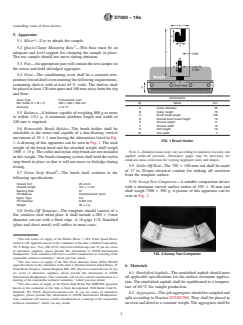
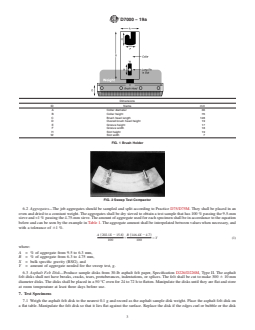
movement of 19 6 1 mm having the dimensions listed in Fig. 1. A drawing of this apparatus can be seen in Fig. 1. The total weight
of the brush head and the attached weight shall weigh 1500 6 15 g. The collar and nylon strip brush are not included in this weight.
The brush clamping system shall hold the nylon strip brush in place so that it will not move or dislodge during testing.
5.7 Nylon Strip Brush —The brush shall conform to the following specifications.
Overall Trim 25.4 mm
Overall Length 127 ± 1 mm
Backing Size #7
Fill Material Crimped black nylon
Nylon Type 6.0
Fill Diameter 0.254 mm
Weight 35 ± 2 g
5.8 Strike-Off Template—The template should consist of a flat, stainless steel metal plate. It shall include a 280 6 3 mm diameter
cut out 3-mm diameter cut-out with a flush edge. A 16-gage U.S. Standard (plate and sheet metal) will suffice in most cases.
NOTE 2—Emulsion mass may vary according to emulsion viscosity and applied strike-off pressure. Alternative gages may be necessary for emulsion
mass correction for varying aggregate sizes and shapes.
5.9 Strike-Off Rod—The 750 6 100 mm 100-mm rod shall be made of 17 to 20 mm 20-mm electrical conduit for striking off
emulsion from the template surface.
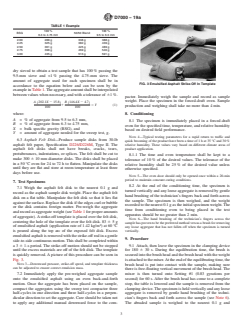
5.10 Sweep Test Compactor—A suitable compaction device with a minimum curved surface radius of 550 6 30 mm and shall
weigh 7500 6 500 g. A picture of this apparatus can be seen in Fig. 2.
6. Materials
6.1 Emulsified Asphalt—The emulsified asphalt should meet all applicable specifications for the surface treatment application.
The emulsified asphalt shall be equilibrated to a temperature of 60 °C for sample production.
4 1
The sole source of supply of the Hobart Mixer ⁄3 H.P. Fixed Speed Motor, model A 120, apparatus known to the committee at this time is Hobart Corporation, 701 S.
Ridge Ave., Troy, OH 45374, http://www.hobartcorp.com. If you are aware of alternative suppliers, please provide this information to ASTM International Headquarters. Your
comments will receive careful consideration at a meeting of the responsible technical committee, which you may attend.
The sole source of supply of the Wet Track Abrasion Tester (ISSA TB100) apparatus known to the committee at this time is Mastrad Limited, Finch House, 25 Finch
Road, Douglas, United Kingdom IM1 2PS, http://www.mastrad.com. If you are aware of alternative suppliers, please provide this information to ASTM International
Headquarters. Your comments will receive careful consideration at a meeting of the responsible technical committee, which you may attend.
The sole source of supply of the Nylon Strip Brush Part #MB7006 apparatus known to the committee at this time is Tanis Incorporated, 3660 Kettle Court E., Delafield,
WI 53018, http://www.tanisinc.com. If you are aware of alternative suppliers, please provide this information to ASTM International Headquarters. Your comments will
receive careful consideration at a meeting of the responsible technical committee, which you may attend.
D7000 − 19a
Dimensions
ID Name mm
A Collar diameter 36
B Collar height 76
C Brush head length 128
D Overall brush head height 19
E Groove height 17
F Groove
...