

ASTM B639-02(2018)
(Specification)Standard Specification for Precipitation Hardening Cobalt-Containing Alloys (UNS R30155 and UNS R30816) Rod, Bar, Forgings, and Forging Stock for High-Temperature Service
General Information
- Abstract
ABSTRACT
This specification covers hot- and cold-worked precipitation hardenable cobalt-containing alloys (UNS R30155 and UNS R30816) rod, bar, forgings, and forging stock for high temperature service. The material shall conform to the required chemical composition for carbon, manganese, silicon, phosphorus, sulfur, chromium, nickel, molybdenum, columbium, tantalum, iron, cobalt, and nitrogen. The materials shall conform to the required tensile and hardness properties such namely tensile strength, yield strength, alongation and Brinell hardness. The alloys shall also conform to the required stress-rupture properties. Dimensions such as diameter, thickness, or width, out-of-round, corners, cut lengths, straightness for cold-worked and hot-worked rod and bar shall be measured.
SCOPE
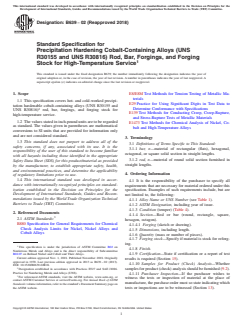
1.1 This specification covers hot- and cold-worked precipitation hardenable cobalt-containing alloys (UNS R30155 and UNS R30816)2 rod, bar, forgings, and forging stock for high-temperature service.
1.2 The values stated in inch-pound units are to be regarded as standard. The values given in parentheses are mathematical conversions to SI units that are provided for information only and are not considered standard.
1.3 This standard does not purport to address all of the safety concerns, if any, associated with its use. It is the responsibility of the user of this standard to become familiar with all hazards including those identified in the appropriate Safety Data Sheet (SDS) for this product/material as provided by the manufacturer, to establish appropriate safety, health, and environmental practices, and determine the applicability of regulatory limitations prior to use.
1.4 This international standard was developed in accordance with internationally recognized principles on standardization established in the Decision on Principles for the Development of International Standards, Guides and Recommendations issued by the World Trade Organization Technical Barriers to Trade (TBT) Committee.
- Status
- Published
- Publication Date
- 31-Oct-2018
- Technical Committee
- B02 - Nonferrous Metals and Alloys
- Drafting Committee
- B02.07 - Refined Nickel and Cobalt and Their Alloys

Overview
ASTM B639-02(2018) is a key international standard from ASTM International covering the requirements for precipitation hardening cobalt-containing alloys, specifically UNS R30155 and UNS R30816. These alloys are supplied as rods, bars, forgings, and forging stock, and are designed for high-temperature service environments. This specification ensures consistent properties in terms of chemical composition, mechanical strength, hardness, and stress-rupture performance-essential for demanding applications where durability and high-temperature integrity are critical.
This standard is governed by ASTM Committee B02 on Nonferrous Metals and Alloys and Subcommittee B02.07 on Refined Nickel and Cobalt and Their Alloys. It addresses both hot- and cold-worked product forms and details testing, inspection, and product marking requirements to ensure material reliability.
Key Topics
- Material Coverage: The standard applies to hot- and cold-worked forms of UNS R30155 and UNS R30816 cobalt-containing alloys, covering rods, bars (rectangular, hexagonal, octagonal, square, and round), forgings, and forging stock.
- Chemical Composition: Detailed limits for elements such as carbon, manganese, silicon, phosphorus, sulfur, chromium, nickel, molybdenum, tungsten, columbium (niobium), tantalum, iron, cobalt, and nitrogen ensure batch consistency.
- Mechanical Properties: Minimum requirements for tensile strength, yield strength, elongation, and Brinell hardness are specified for each alloy and condition.
- Stress-Rupture Requirements: Test conditions and minimum values are provided to guarantee the alloys' performance during prolonged high-temperature exposure.
- Dimensional Tolerances: Precise permissible variations for diameter, thickness, out-of-round, length, and straightness for both hot- and cold-worked products are outlined.
- Testing and Certification: Requirements for sampling, test methods (chemical, tensile, hardness, stress-rupture), and certification of conformity are described.
- Product Marking: Guidance on labeling and identification to ensure traceability.
Applications
ASTM B639-02(2018) cobalt-containing alloys are engineered for high-temperature service, making them ideal for applications where heat, strength, and corrosion resistance are paramount. Typical uses include:
- Aerospace components: Engine parts and structural elements subjected to extreme heat and stress
- Gas turbines: Rotors, blades, and other hot-section components
- Industrial gas and steam turbines: Turbine blades, discs, and fasteners
- Chemical processing equipment: Parts that operate in corrosive and high-temperature environments
- Power generation: Components exposed to thermal cycling and mechanical load
- High-performance forgings: Custom-engineered shapes for specialized high-temperature uses
These alloys' enhanced mechanical properties and precipitation hardening capability make them a top choice for industries requiring long service life and consistent performance under severe conditions.
Related Standards
Organizations frequently use ASTM B639-02(2018) in coordination with other ASTM specifications and industry standards to ensure comprehensive quality control, including:
- ASTM B880: General requirements for chemical check analysis of nickel, nickel alloys, and cobalt alloys
- ASTM E8/E8M: Test methods for tension testing of metallic materials
- ASTM E29: Practice for using significant digits in test data for specification conformance
- ASTM E139: Test methods for conducting creep, creep-rupture, and stress-rupture tests of metallic materials
- ASTM E1473: Test methods for chemical analysis of nickel, cobalt, and high-temperature alloys
These referenced documents provide further guidance and harmonization for chemical analysis, mechanical testing, and product evaluation.
Practical Value
Adhering to ASTM B639-02(2018) assures users and manufacturers of material reliability in high-temperature environments. It supports quality assurance, regulatory compliance, and customer confidence, reducing the risk of material failure in mission-critical applications. The specification promotes consistency across supply chains, helping buyers and suppliers communicate requirements effectively and streamline procurement for demanding industrial sectors.
Relations
- Effective Date
- 01-Nov-2018
- Effective Date
- 01-Jan-2024
- Effective Date
- 15-Jul-2016
- Effective Date
- 01-Feb-2015
- Effective Date
- 01-Jun-2013
- Effective Date
- 01-Dec-2011
- Effective Date
- 01-Jun-2011
- Effective Date
- 01-Oct-2008
- Effective Date
- 01-Mar-2008
- Effective Date
- 15-Nov-2006
- Effective Date
- 15-Sep-2006
- Effective Date
- 01-May-2006
- Effective Date
- 01-May-2006
- Effective Date
- 01-Dec-2004
- Effective Date
- 01-Dec-2003
Get Certified
Connect with accredited certification bodies for this standard

Element Materials Technology
Materials testing and product certification.

Inštitut za kovinske materiale in tehnologije
Institute of Metals and Technology. Materials testing, metallurgical analysis, NDT.
Sponsored listings
Frequently Asked Questions
ASTM B639-02(2018) is a technical specification published by ASTM International. Its full title is "Standard Specification for Precipitation Hardening Cobalt-Containing Alloys (UNS R30155 and UNS R30816) Rod, Bar, Forgings, and Forging Stock for High-Temperature Service". This standard covers: ABSTRACT This specification covers hot- and cold-worked precipitation hardenable cobalt-containing alloys (UNS R30155 and UNS R30816) rod, bar, forgings, and forging stock for high temperature service. The material shall conform to the required chemical composition for carbon, manganese, silicon, phosphorus, sulfur, chromium, nickel, molybdenum, columbium, tantalum, iron, cobalt, and nitrogen. The materials shall conform to the required tensile and hardness properties such namely tensile strength, yield strength, alongation and Brinell hardness. The alloys shall also conform to the required stress-rupture properties. Dimensions such as diameter, thickness, or width, out-of-round, corners, cut lengths, straightness for cold-worked and hot-worked rod and bar shall be measured. SCOPE 1.1 This specification covers hot- and cold-worked precipitation hardenable cobalt-containing alloys (UNS R30155 and UNS R30816)2 rod, bar, forgings, and forging stock for high-temperature service. 1.2 The values stated in inch-pound units are to be regarded as standard. The values given in parentheses are mathematical conversions to SI units that are provided for information only and are not considered standard. 1.3 This standard does not purport to address all of the safety concerns, if any, associated with its use. It is the responsibility of the user of this standard to become familiar with all hazards including those identified in the appropriate Safety Data Sheet (SDS) for this product/material as provided by the manufacturer, to establish appropriate safety, health, and environmental practices, and determine the applicability of regulatory limitations prior to use. 1.4 This international standard was developed in accordance with internationally recognized principles on standardization established in the Decision on Principles for the Development of International Standards, Guides and Recommendations issued by the World Trade Organization Technical Barriers to Trade (TBT) Committee.
ABSTRACT This specification covers hot- and cold-worked precipitation hardenable cobalt-containing alloys (UNS R30155 and UNS R30816) rod, bar, forgings, and forging stock for high temperature service. The material shall conform to the required chemical composition for carbon, manganese, silicon, phosphorus, sulfur, chromium, nickel, molybdenum, columbium, tantalum, iron, cobalt, and nitrogen. The materials shall conform to the required tensile and hardness properties such namely tensile strength, yield strength, alongation and Brinell hardness. The alloys shall also conform to the required stress-rupture properties. Dimensions such as diameter, thickness, or width, out-of-round, corners, cut lengths, straightness for cold-worked and hot-worked rod and bar shall be measured. SCOPE 1.1 This specification covers hot- and cold-worked precipitation hardenable cobalt-containing alloys (UNS R30155 and UNS R30816)2 rod, bar, forgings, and forging stock for high-temperature service. 1.2 The values stated in inch-pound units are to be regarded as standard. The values given in parentheses are mathematical conversions to SI units that are provided for information only and are not considered standard. 1.3 This standard does not purport to address all of the safety concerns, if any, associated with its use. It is the responsibility of the user of this standard to become familiar with all hazards including those identified in the appropriate Safety Data Sheet (SDS) for this product/material as provided by the manufacturer, to establish appropriate safety, health, and environmental practices, and determine the applicability of regulatory limitations prior to use. 1.4 This international standard was developed in accordance with internationally recognized principles on standardization established in the Decision on Principles for the Development of International Standards, Guides and Recommendations issued by the World Trade Organization Technical Barriers to Trade (TBT) Committee.
ASTM B639-02(2018) is classified under the following ICS (International Classification for Standards) categories: 77.140.60 - Steel bars and rods; 77.140.85 - Iron and steel forgings. The ICS classification helps identify the subject area and facilitates finding related standards.
ASTM B639-02(2018) has the following relationships with other standards: It is inter standard links to ASTM B639-02(2013), ASTM E8/E8M-24, ASTM E8/E8M-16, ASTM E8/E8M-15, ASTM E8/E8M-13, ASTM E8/E8M-11, ASTM E139-11, ASTM E29-08, ASTM B880-03(2008), ASTM E29-06b, ASTM E29-06a, ASTM E29-06, ASTM E139-06, ASTM E29-04, ASTM E1473-03. Understanding these relationships helps ensure you are using the most current and applicable version of the standard.
ASTM B639-02(2018) is available in PDF format for immediate download after purchase. The document can be added to your cart and obtained through the secure checkout process. Digital delivery ensures instant access to the complete standard document.
Standards Content (Sample)
This international standard was developed in accordance with internationally recognized principles on standardization established in the Decision on Principles for the
Development of International Standards, Guides and Recommendations issued by the World Trade Organization Technical Barriers to Trade (TBT) Committee.
Designation:B639 −02(Reapproved 2018)
Standard Specification for
Precipitation Hardening Cobalt-Containing Alloys (UNS
R30155 and UNSR30816) Rod, Bar, Forgings, and Forging
Stock for High-Temperature Service
This standard is issued under the fixed designation B639; the number immediately following the designation indicates the year of
original adoption or, in the case of revision, the year of last revision.Anumber in parentheses indicates the year of last reapproval.A
superscript epsilon (´) indicates an editorial change since the last revision or reapproval.
1. Scope E8/E8MTest Methods for Tension Testing of Metallic Ma-
terials
1.1 This specification covers hot- and cold-worked precipi-
E29Practice for Using Significant Digits in Test Data to
tation hardenable cobalt-containing alloys (UNS R30155 and
2 Determine Conformance with Specifications
UNS R30816) rod, bar, forgings, and forging stock for
E139Test Methods for Conducting Creep, Creep-Rupture,
high-temperature service.
and Stress-Rupture Tests of Metallic Materials
1.2 The values stated in inch-pound units are to be regarded
E1473Test Methods for Chemical Analysis of Nickel, Co-
as standard. The values given in parentheses are mathematical
balt and High-Temperature Alloys
conversions to SI units that are provided for information only
and are not considered standard.
3. Terminology
1.3 This standard does not purport to address all of the
3.1 Definitions of Terms Specific to This Standard:
safety concerns, if any, associated with its use. It is the
3.1.1 bar, n—material of rectangular (flats), hexagonal,
responsibility of the user of this standard to become familiar
octagonal, or square solid section in straight lengths.
with all hazards including those identified in the appropriate
3.1.2 rod, n—material of round solid section furnished in
Safety Data Sheet (SDS) for this product/material as provided
straight lengths.
by the manufacturer, to establish appropriate safety, health,
and environmental practices, and determine the applicability
4. Ordering Information
of regulatory limitations prior to use.
1.4 This international standard was developed in accor-
4.1 It is the responsibility of the purchaser to specify all
dance with internationally recognized principles on standard-
requirements that are necessary for material ordered under this
ization established in the Decision on Principles for the
specification. Examples of such requirements include, but are
Development of International Standards, Guides and Recom-
not limited to, the following:
mendations issued by the World Trade Organization Technical
4.1.1 Alloy Name or UNS Number (see Table 1).
Barriers to Trade (TBT) Committee.
4.1.2 ASTM Designation, including year of issue.
4.1.3 Condition (temper) (Table 4).
2. Referenced Documents
4.1.4 Section—Rod or bar (round, rectangle, square,
2.1 ASTM Standards:
hexagon, octagon).
B880Specification for General Requirements for Chemical
4.1.4.1 Forging (sketch or drawing).
Check Analysis Limits for Nickel, Nickel Alloys and
4.1.5 Dimensions, including length.
Cobalt Alloys
4.1.6 Quantity (mass or number of pieces).
4.1.7 Forging stock—Specify if material is stock for reforg-
ing.
This specification is under the jurisdiction of ASTM Committee B02 on
4.1.8 Finish.
Nonferrous Metals and Alloys and is the direct responsibility of Subcommittee
B02.07 on Refined Nickel and Cobalt and Their Alloys. 4.1.9 Certification—State if certification or a report of test
Current edition approved Nov. 1, 2018. Published November 2018. Originally
results is required (Section 15).
approved in 1970. Last previous edition approved in 2013 as B639–02 (2013).
4.1.10 Samples for Product (Check) Analysis—Whether
DOI: 10.1520/B0639-02R18.
samplesforproduct(check)analysisshouldbefurnished(9.2).
Designation established in accordance with Practices E527 and SAE J1086.
Practice for Numbering Metals and Alloys (UNS).
4.1.11 Purchaser Inspection—If the purchaser wishes to
For referenced ASTM standards, visit the ASTM website, www.astm.org, or
witness the tests or inspection of material at the place of
contact ASTM Customer Service at service@astm.org. For Annual Book of ASTM
manufacture,thepurchaseordermustsostateindicatingwhich
Standards volume information, refer to the standard’s Document Summary page on
the ASTM website. tests or inspections are to be witnessed (Section 13).
Copyright © ASTM International, 100 Barr Harbor Drive, PO Box C700, West Conshohocken, PA 19428-2959. United States
B639−02(2018)
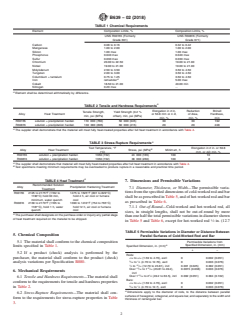
TABLE 1 Chemical Requirements
Element Composition Limits, % Composition Limits, %
UNS R30155 (Formerly UNS R30816 (Formerly
Grade 661) Grade 671)
Carbon 0.08 to 0.16 0.32 to 0.42
Manganese 1.00 to 2.00 1.00 to 2.00
Silicon 1.00 max 1.00 max
Phosphorus 0.040 max 0.040 max
Sulfur 0.030 max 0.030 max
Chromium 20.00 to 22.50 19.00 to 21.00
Nickel 19.00 to 21.00 19.00 to 21.00
Molybdenum 2.50 to 3.50 3.50 to 4.50
Tungsten 2.00 to 3.00 3.50 to 4.50
Columbium + tantalum 0.75 to 1.25 3.50 to 4.50
A
Iron remainder 5.00 max
Cobalt 18.50 to 21.00 40.00 min
Nitrogen 0.20 max .
A
Element shall be determined arithmetically by difference.
A
TABLE 2 Tensile and Hardness Requirements
Elongation in 2 in. Reduction Brinell
Tensile Strength, Yield Strength (0.2 %
Alloy Heat Treatment or 50.8 mm or 4 D, of Area, Hardness,
min, psi (MPa) offset), min, psi (MPa)
min, % min, % min
R30155 solution + precipitation harden 110 000 (760) 50 000 (345) 30 30 192
R30816 solution + precipitation harden 130 000 (895) 60 000 (415) 20 20 248
A
The supplier shall demonstrate that the material will meet fully heat-treated properties after full heat treatment in accordance with Table 4.
A
TABLE 3 Stress-Rupture Requirements
Test Temperature, °F Elongation in 2 in. or 50.8
B
Alloy Heat Treatment Stress, psi (MPa) Minimum, h
(°C) mm, or 4D,min,%
R30155 solution + precipitation harden 1350 (732) 24 000 (165) 100 10
R30816 solution + precipitation harden 1350 (732) 38 000 (260) 100 8
A
The supplier shall demonstrate that material will meet fully heat-treated properties after full heat treatment in accordance with Table 4.
B
Test specimens meeting minimum requirements may be overloaded to produce rupture in a reasonable and practical time period.
A
TABLE 4 Heat Treatment
7. Dimensions and Permissible Variations
Recommended Solution
Alloy Precipitation Hardening Treatment
7.1 Diameter, Thickness, or Width—The permissible varia-
Treatment
R30155 2125 to 2175°F (1162 to 1475 to 1525°F (801 to 829°C) tionsfromthespecifieddimensionsofcold-workedrodandbar
1190°C) hold 30 min, hold 4 h, air cool or furnace
shallbeasprescribedinTable5,andofhot-workedrodandbar
minimum, water quench cool
as prescribed in Table 6.
R30816 2130 to 2170°F (1165 to 1390 to 1410°F (754 to 765°C)
1187°C), hold 1 h, water hold 12 h, air cool or furnace 7.1.1 Out-of-Round—Cold-worked and hot-worked rod, all
quench cool
sizes, in straight lengths, shall not be out-of-round by more
A
The purchaser shall designate on the purchase order or inquiry any partial stage
thanonehalfthetotalpermissiblevariationsindiametershown
of heat treatment required on the material to be shipped.
in Table 5 and Table 6, except for hot-worked rod ⁄2 in. (12.7
TABLE 5 Permissible Variations in Diameter or Distance Between
5. Chemical Composition
Parallel Surfaces of Cold-Worked Rod and Bar
5.1 The material shall conform to the chemical composition Permissible Variations from
A
Specified Dimension, in. (mm)
Specified Dimension, in. (mm)
limits specified in Table 1.
+−
5.2 If a product (check) analysis is performed by the
Rods:
purchaser, the material shall conform to the product (check)
1 3
⁄16 to ⁄16 (1.59 to 4.76), excl 0 0.002 (0.051)
3 1
⁄16 to ⁄2 (4.76 to 12.70), excl 0 0.003 (0.076)
analysis variations per Specification B880.
1 15
⁄2 to ⁄16 (12.70 to 23.81), incl 0.001 (0.025) 0.002 (0.051)
15 15
Over ⁄16 to 1 ⁄16 (23.81 to 49.2), 0.0015 (0.038) 0.003 (0.076)
6. Mechanical Requirements
incl
15 1
Over 1 ⁄16 to 2 ⁄2 (49.2 to 63.5), incl 0.002 (0.051) 0.004 (0.102)
6.1 Tensile and Hardness Requirements—The material shall
Bars:
conformtotherequirementsfortensileandhardnessproperties
1 3
⁄16 to ⁄16 (1.59 to 4.76), excl 0 0.002 (0.051)
3 1
in Table 2. ⁄16 to ⁄2 (4.76 to 12.7), excl 0 0.003 (0.076)
A
Dimensions apply to the diameter of rods, to the distance between parallel
6.
...