

ASTM D3430-95(2021)
(Test Method)Standard Test Method for Clarity and Yellowness of Liquid Water-Based Clear Floor Polishes
General Information
- Abstract
SIGNIFICANCE AND USE
3.1 The laboratory technique described in this test method is used to evaluate the clarity and yellowness of water-based “clear” floor polishes for product development or quality control purposes.
SCOPE
1.1 This test method covers measurement of the degree of clarity and depth of yellowness of water-based clear floor polishes.
1.2 This standard does not purport to address all of the safety concerns, if any, associated with its use. It is the responsibility of the user of this standard to establish appropriate safety, health, and environmental practices and determine the applicability of regulatory limitations prior to use.
1.3 This international standard was developed in accordance with internationally recognized principles on standardization established in the Decision on Principles for the Development of International Standards, Guides and Recommendations issued by the World Trade Organization Technical Barriers to Trade (TBT) Committee.
- Status
- Published
- Publication Date
- 28-Feb-2021
- Technical Committee
- D21 - Polishes
- Drafting Committee
- D21.03 - Chemical and Physical Testing


Overview
ASTM D3430-95(2021): Standard Test Method for Clarity and Yellowness of Liquid Water-Based Clear Floor Polishes is an internationally recognized test method developed by ASTM International. The primary purpose of this standard is to provide a laboratory procedure for measuring the clarity and yellowness of water-based clear floor polishes. These properties are critical for manufacturers and quality control personnel to ensure that floor polish products meet visual and performance expectations for end-users.
The method uses a colorimeter to determine both the clarity (or turbidity) and the degree of yellowness in clear liquid floor polishes. Accurate evaluation of these optical qualities supports product development, enhances quality consistency, and improves customer satisfaction.
Key Topics
- Clarity Measurement: The test method assesses the degree of clarity in water-based polishes by measuring absorbance at 500 nm, indicating the presence of turbidity or haze.
- Yellowness Measurement: Yellowness is measured and corrected at 400 nm using a calibration procedure, allowing clear differentiation between actual yellowing and general loss of clarity.
- Lab Equipment: Colorimeters equipped with matched cells (typically 20-mm or 10-mm) are used for precise optical measurements.
- Sample Preparation: Samples and calibration solutions are prepared with attention to representativeness and dilution accuracy for valid test results.
- Quality Control: Duplicate testing, reporting standards, and correction graphs help ensure measurement repeatability and reliable data across batches.
Applications
ASTM D3430-95(2021) is widely utilized across various stages of the floor polish product lifecycle:
- Product Development: Laboratories and R&D teams use this standard to screen new formulations for optimal optical performance, ensuring products appear clear and meet consumer expectations.
- Manufacturing & Quality Assurance: Regular application of the test method allows production teams to monitor quality and maintain consistency in clarity and color, detecting any deviations from desired product specifications.
- Regulatory Compliance: The use of international standards, including this method, facilitates compliance with global trade requirements and market access according to World Trade Organization (WTO) Technical Barriers to Trade (TBT) guidelines.
- Comparative Testing: Enables manufacturers to benchmark their products against industry standards or competing products based on defined clarity and yellowness criteria.
Related Standards
For comprehensive testing and quality assurance of floor polishes and related products, the following standards are often referenced in conjunction with ASTM D3430-95(2021):
- ASTM D1792 - Standard Test Method for Long-Term Removability Properties of Emulsion Floor Polishes
- ASTM D2047 - Standard Test Method for Static Coefficient of Friction of Polish-Coated Floor Surfaces
- ASTM E313 - Standard Practice for Calculating Yellowness and Whiteness Indices from Instrumentally Measured Color Coordinates
- ASTM D1475 - Standard Test Method for Density of Liquid Coatings, Inks, and Related Products
These related ASTM standards support comprehensive evaluation of floor polish products, ensuring safety, performance, and aesthetic quality in accordance with industry and international requirements.
By adopting ASTM D3430-95(2021), manufacturers and laboratories can ensure their water-based clear floor polishes meet defined clarity and yellowness benchmarks, resulting in higher quality products and greater customer confidence. For more information or to purchase the standard, visit the ASTM International website.
Get Certified
Connect with accredited certification bodies for this standard

ECOCERT
Organic and sustainability certification.

Eurofins Food Testing Global
Global leader in food, environment, and pharmaceutical product testing.

Intertek Bangladesh
Intertek certification and testing services in Bangladesh.
Sponsored listings
Frequently Asked Questions
ASTM D3430-95(2021) is a standard published by ASTM International. Its full title is "Standard Test Method for Clarity and Yellowness of Liquid Water-Based Clear Floor Polishes". This standard covers: SIGNIFICANCE AND USE 3.1 The laboratory technique described in this test method is used to evaluate the clarity and yellowness of water-based “clear” floor polishes for product development or quality control purposes. SCOPE 1.1 This test method covers measurement of the degree of clarity and depth of yellowness of water-based clear floor polishes. 1.2 This standard does not purport to address all of the safety concerns, if any, associated with its use. It is the responsibility of the user of this standard to establish appropriate safety, health, and environmental practices and determine the applicability of regulatory limitations prior to use. 1.3 This international standard was developed in accordance with internationally recognized principles on standardization established in the Decision on Principles for the Development of International Standards, Guides and Recommendations issued by the World Trade Organization Technical Barriers to Trade (TBT) Committee.
SIGNIFICANCE AND USE 3.1 The laboratory technique described in this test method is used to evaluate the clarity and yellowness of water-based “clear” floor polishes for product development or quality control purposes. SCOPE 1.1 This test method covers measurement of the degree of clarity and depth of yellowness of water-based clear floor polishes. 1.2 This standard does not purport to address all of the safety concerns, if any, associated with its use. It is the responsibility of the user of this standard to establish appropriate safety, health, and environmental practices and determine the applicability of regulatory limitations prior to use. 1.3 This international standard was developed in accordance with internationally recognized principles on standardization established in the Decision on Principles for the Development of International Standards, Guides and Recommendations issued by the World Trade Organization Technical Barriers to Trade (TBT) Committee.
ASTM D3430-95(2021) is classified under the following ICS (International Classification for Standards) categories: 71.100.99 - Other products of the chemical industry; 97.080 - Cleaning appliances. The ICS classification helps identify the subject area and facilitates finding related standards.
ASTM D3430-95(2021) is available in PDF format for immediate download after purchase. The document can be added to your cart and obtained through the secure checkout process. Digital delivery ensures instant access to the complete standard document.
Standards Content (Sample)
This international standard was developed in accordance with internationally recognized principles on standardization established in the Decision on Principles for the
Development of International Standards, Guides and Recommendations issued by the World Trade Organization Technical Barriers to Trade (TBT) Committee.
Designation: D3430 − 95 (Reapproved 2021)
Standard Test Method for
Clarity and Yellowness of Liquid Water-Based Clear Floor
Polishes
This standard is issued under the fixed designation D3430; the number immediately following the designation indicates the year of
original adoption or, in the case of revision, the year of last revision. A number in parentheses indicates the year of last reapproval. A
superscript epsilon (´) indicates an editorial change since the last revision or reapproval.
1. Scope 4. Apparatus
1.1 This test method covers measurement of the degree of 4.1 Colorimeter, equipped with cylindrical 20-mm
clarity and depth of yellowness of water-based clear floor matched cells. (If 20-mm cells are not available, 10-mm
polishes. matched cells may be substituted.)
1.2 This standard does not purport to address all of the 4.2 Any colorimeter having equivalent resolution and sen-
safety concerns, if any, associated with its use. It is the
sitivity may be used with the appropriate matched cells.
responsibility of the user of this standard to establish appro-
5. Sampling
priate safety, health, and environmental practices and deter-
5.1 The sample shall be representative of the material to be
mine the applicability of regulatory limitations prior to use.
tested and the portion used for the test shall be representative
1.3 This international standard was developed in accor-
of the sample itself.
dance with internationally recognized principles on standard-
ization established in the Decision on Principles for the
5.2 Calibration Sample—Any emulsion polymer that visu-
Development of International Standards, Guides and Recom-
ally exhibits little or no yellowness, selected for dilution (see
mendations issued by the World Trade Organization Technical
6.1).
Barriers to Trade (TBT) Committee.
6. Preparation of Correction Graph
2. Terminology
6.1 Prepare minimum of five dilutions of the calibration
sample with distilled water so that absorbance reading between
2.1 Definitions:
0.00 and 0.16 at 500 nm are obtained. Measure the absorbance
2.1.1 absorbance—the negative logarithm, to the base 10, of
at both 500 nm and 400 nm for each dilution (see Section 7).
the ratio of the radiant power transmitted through a sample to
the radiant power incident upon the sample. Hence, as the
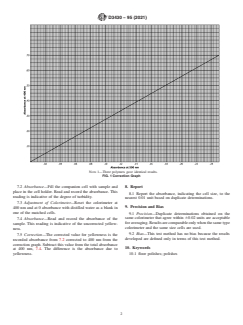
6.2 Plot the absorbance at 500 nm versus that at 400 nm and
clarity decreases or the depth of the yellowness increases the
fit a straight line through the resulting points starting from the
absorbance increases.
origin (see Fig. 1).
6.3 It is necessary to prepare a correction graph only once
3. Significance and Use
for a given instrument and set of cells.
3.1 The laboratory technique described in this test method is
7. Procedure
used to evaluate the clarity and yellowness of water-based
“clear” floor polishes for product development or quality 7.1 Adjustment of Colorimeter—Set the colorimeter at 500
control purposes. nm and at 0 absorbance with distilled water as a blank in one
of the matched cells.
1 2
This test method is under the jurisdiction ofASTM Committee D21 on Polishes Spectronic 70 has been found satisfactory. The sole source of supply of the
and is the direct responsibility of Subcommittee D21.03 on Chemical and Physical apparatus known to the
...