

ASTM E162-22
(Test Method)Standard Test Method for Surface Flammability of Materials Using a Radiant Heat Energy Source
General Information
- Abstract
SIGNIFICANCE AND USE
5.1 This test method provides a laboratory test procedure for measuring and comparing the surface flammability of materials when exposed to a prescribed level of radiant heat energy. It is intended for use in measurements of the surface flammability of materials exposed to fire. The test is conducted using small specimens that are representative, to the extent possible, of the material or assembly being evaluated. (Example: in terms of their thickness, layering, and any potential substrate.)
5.2 The rate at which flames will travel along surfaces depends upon the physical and thermal properties of the material, product or assembly under test, the specimen mounting method and orientation, the type and level of fire or heat exposure, the availability of air, and properties of the surrounding enclosure.4-7
5.3 In this procedure, the specimens are subjected to one or more specific sets of laboratory fire test conditions. If different test conditions are substituted or the end-use conditions are changed, it is not always possible by or from this test to predict changes in the fire-test-response characteristics measured. Therefore, the results are valid only for the fire test exposure conditions described in this procedure.
5.4 If the test results obtained by this test method are to be considered as part of an overall assessment of fire hazard in a building or structure, then the example criteria, concepts and procedures incorporated into Guide E1546 shall be taken into consideration.
SCOPE
1.1 This fire-test-response standard describes the measurement of surface flammability of materials. It is not intended for use as a basis of ratings for building code purposes (see Appendix X1).
1.2 The values stated in inch-pound units are to be regarded as standard. The values given in parentheses are mathematical conversions to SI units that are provided for information only and are not considered standard.
1.3 This standard measures and describes the response of materials, products, or assemblies to heat and flame under controlled conditions, but does not by itself incorporate all factors required for fire hazard or fire risk assessment of the materials, products, or assemblies under actual fire conditions.
1.4 This standard does not purport to address all of the safety concerns, if any, associated with its use. It is the responsibility of the user of this standard to establish appropriate safety, health, and environmental practices and determine the applicability of regulatory limitations prior to use.
1.5 Fire testing of products and materials is inherently hazardous, and adequate safeguards for personnel and property shall be employed in conducting these tests. This test method may involve hazardous materials, operations, and equipment. Specific information about hazard is given in Section .
Note 1: There is no similar or equivalent ISO standard.
1.6 This international standard was developed in accordance with internationally recognized principles on standardization established in the Decision on Principles for the Development of International Standards, Guides and Recommendations issued by the World Trade Organization Technical Barriers to Trade (TBT) Committee.
- Status
- Published
- Publication Date
- 30-Jun-2022
- Technical Committee
- E05 - Fire Standards
- Drafting Committee
- E05.22 - Surface Burning
Buy Documents
ASTM E162-22 - Standard Test Method for Surface Flammability of Materials Using a Radiant Heat Energy Source
REDLINE ASTM E162-22 - Standard Test Method for Surface Flammability of Materials Using a Radiant Heat Energy Source
Overview
ASTM E162-22: Standard Test Method for Surface Flammability of Materials Using a Radiant Heat Energy Source is an authoritative ASTM standard that outlines a laboratory test procedure for evaluating and comparing the surface flammability of materials when exposed to a defined level of radiant heat energy. Targeted at fire safety and materials evaluation professionals, this method focuses on the behavior of materials when surface-exposed to fire, providing essential data for fire testing and materials research. The standard is not intended for building code ratings but serves as a critical tool for understanding the fire-test-response characteristics of various materials under controlled conditions.
Key Topics
ASTM E162-22 covers several important areas regarding surface flammability:
- Surface Flammability Testing: Provides a consistent procedure for testing the flammability of material surfaces using a prescribed radiant heat source.
- Material Representation: Tests are conducted on small specimens representative of the actual material or assembly, accounting for thickness, layering, and substrate.
- Radiant Heat Exposure: Outlines the use of a radiant panel to expose specimens to controlled heat conditions, enabling comparison between materials.
- Rate of Flame Spread: A key measurement, dependent on the material's physical and thermal properties, mounting method, orientation, air availability, and enclosure properties.
- Result Validity: Results only apply to the test conditions described; changes in conditions may alter the fire-test response.
- Fire Hazard Assessment: For broader fire hazard evaluation in buildings, these results should be integrated with criteria in ASTM E1546.
Safety Considerations: The standard details the inherent hazards in fire testing and emphasizes the importance of proper safety, health, and environmental practices. The user must ensure applicable regulatory compliance and implement adequate safety measures during testing.
Applications
ASTM E162-22 is widely used across industries focused on fire safety, product certification, and quality assurance:
- Material Qualification: Used by manufacturers and research labs to rate the surface burning characteristics of products such as fiber-cement panels, interior finishes, insulating materials, surface coatings, tapestries, and wall linings.
- Comparative Analysis: Enables designers, engineers, and fire safety engineers to compare the flammability of different materials under similar radiant heat exposure, assisting in material selection for fire-sensitive environments.
- Product Development: Aids in developing and improving products by identifying weakness in fire performance and guiding material modifications.
- Regulatory Submission Support: Provides standardized test data for voluntary compliance, transportation regulations, or to supplement broader fire safety analysis in projects and facilities.
- Fire Safety Research: Supports academic, scientific, and commercial research on flame spread and fire growth on material surfaces.
Related Standards
ASTM E162-22 references several other standards that are integral to comprehensive fire behavior assessment and terminology:
- ASTM E84: Test Method for Surface Burning Characteristics of Building Materials
- ASTM D3675: Test Method for Surface Flammability of Flexible Cellular Materials Using a Radiant Heat Energy Source
- ASTM E176: Terminology of Fire Standards
- ASTM E1546: Guide for Development of Fire-Hazard-Assessment Standards
- ISO 13943: Fire Safety-Vocabulary (for definitions)
Other key related documents for material specification, such as ASTM C1186 and C1288, ensure that the tested substrates comply with standard material requirements.
Conclusion
ASTM E162-22 is a fundamental tool for laboratories, manufacturers, and safety professionals seeking reliable methods to measure and compare the surface flammability of materials under radiant heat. By enabling precise and repeatable fire-testing, it supports robust safety evaluations, product innovation, and informed decision-making in building materials, transportation, and industrial fire safety. For complete and current testing practices, this standard should be used alongside referenced ASTM documents and applicable safety protocols.
Keywords: ASTM E162-22, surface flammability, radiant heat energy, material testing, fire safety, flame spread, fire-test-response, laboratory fire testing, fire hazard assessment, material qualification.
Relations
- Effective Date
- 01-Jan-2024
- Effective Date
- 01-Dec-2023
- Effective Date
- 01-Sep-2023
- Effective Date
- 01-Jul-2019
- Effective Date
- 15-Apr-2019
- Effective Date
- 01-Mar-2019
- Effective Date
- 15-Dec-2018
- Effective Date
- 01-Oct-2018
- Effective Date
- 01-Jul-2018
- Effective Date
- 01-Mar-2018
- Effective Date
- 01-Mar-2018
- Effective Date
- 01-Nov-2017
- Effective Date
- 01-Aug-2017
- Effective Date
- 01-May-2017
- Effective Date
- 01-Jul-2016
Buy Documents
ASTM E162-22 - Standard Test Method for Surface Flammability of Materials Using a Radiant Heat Energy Source
REDLINE ASTM E162-22 - Standard Test Method for Surface Flammability of Materials Using a Radiant Heat Energy Source
Get Certified
Connect with accredited certification bodies for this standard

CIS Institut d.o.o.
Personal Protective Equipment (PPE) certification body. Notified Body NB-2890 for EU Regulation 2016/425 PPE.

Kiwa BDA Testing
Building and construction product certification.
Kmetijski inštitut Slovenije
Agricultural Institute of Slovenia. Soil testing, plant health, agricultural product analysis.
Sponsored listings
Frequently Asked Questions
ASTM E162-22 is a standard published by ASTM International. Its full title is "Standard Test Method for Surface Flammability of Materials Using a Radiant Heat Energy Source". This standard covers: SIGNIFICANCE AND USE 5.1 This test method provides a laboratory test procedure for measuring and comparing the surface flammability of materials when exposed to a prescribed level of radiant heat energy. It is intended for use in measurements of the surface flammability of materials exposed to fire. The test is conducted using small specimens that are representative, to the extent possible, of the material or assembly being evaluated. (Example: in terms of their thickness, layering, and any potential substrate.) 5.2 The rate at which flames will travel along surfaces depends upon the physical and thermal properties of the material, product or assembly under test, the specimen mounting method and orientation, the type and level of fire or heat exposure, the availability of air, and properties of the surrounding enclosure.4-7 5.3 In this procedure, the specimens are subjected to one or more specific sets of laboratory fire test conditions. If different test conditions are substituted or the end-use conditions are changed, it is not always possible by or from this test to predict changes in the fire-test-response characteristics measured. Therefore, the results are valid only for the fire test exposure conditions described in this procedure. 5.4 If the test results obtained by this test method are to be considered as part of an overall assessment of fire hazard in a building or structure, then the example criteria, concepts and procedures incorporated into Guide E1546 shall be taken into consideration. SCOPE 1.1 This fire-test-response standard describes the measurement of surface flammability of materials. It is not intended for use as a basis of ratings for building code purposes (see Appendix X1). 1.2 The values stated in inch-pound units are to be regarded as standard. The values given in parentheses are mathematical conversions to SI units that are provided for information only and are not considered standard. 1.3 This standard measures and describes the response of materials, products, or assemblies to heat and flame under controlled conditions, but does not by itself incorporate all factors required for fire hazard or fire risk assessment of the materials, products, or assemblies under actual fire conditions. 1.4 This standard does not purport to address all of the safety concerns, if any, associated with its use. It is the responsibility of the user of this standard to establish appropriate safety, health, and environmental practices and determine the applicability of regulatory limitations prior to use. 1.5 Fire testing of products and materials is inherently hazardous, and adequate safeguards for personnel and property shall be employed in conducting these tests. This test method may involve hazardous materials, operations, and equipment. Specific information about hazard is given in Section . Note 1: There is no similar or equivalent ISO standard. 1.6 This international standard was developed in accordance with internationally recognized principles on standardization established in the Decision on Principles for the Development of International Standards, Guides and Recommendations issued by the World Trade Organization Technical Barriers to Trade (TBT) Committee.
SIGNIFICANCE AND USE 5.1 This test method provides a laboratory test procedure for measuring and comparing the surface flammability of materials when exposed to a prescribed level of radiant heat energy. It is intended for use in measurements of the surface flammability of materials exposed to fire. The test is conducted using small specimens that are representative, to the extent possible, of the material or assembly being evaluated. (Example: in terms of their thickness, layering, and any potential substrate.) 5.2 The rate at which flames will travel along surfaces depends upon the physical and thermal properties of the material, product or assembly under test, the specimen mounting method and orientation, the type and level of fire or heat exposure, the availability of air, and properties of the surrounding enclosure.4-7 5.3 In this procedure, the specimens are subjected to one or more specific sets of laboratory fire test conditions. If different test conditions are substituted or the end-use conditions are changed, it is not always possible by or from this test to predict changes in the fire-test-response characteristics measured. Therefore, the results are valid only for the fire test exposure conditions described in this procedure. 5.4 If the test results obtained by this test method are to be considered as part of an overall assessment of fire hazard in a building or structure, then the example criteria, concepts and procedures incorporated into Guide E1546 shall be taken into consideration. SCOPE 1.1 This fire-test-response standard describes the measurement of surface flammability of materials. It is not intended for use as a basis of ratings for building code purposes (see Appendix X1). 1.2 The values stated in inch-pound units are to be regarded as standard. The values given in parentheses are mathematical conversions to SI units that are provided for information only and are not considered standard. 1.3 This standard measures and describes the response of materials, products, or assemblies to heat and flame under controlled conditions, but does not by itself incorporate all factors required for fire hazard or fire risk assessment of the materials, products, or assemblies under actual fire conditions. 1.4 This standard does not purport to address all of the safety concerns, if any, associated with its use. It is the responsibility of the user of this standard to establish appropriate safety, health, and environmental practices and determine the applicability of regulatory limitations prior to use. 1.5 Fire testing of products and materials is inherently hazardous, and adequate safeguards for personnel and property shall be employed in conducting these tests. This test method may involve hazardous materials, operations, and equipment. Specific information about hazard is given in Section . Note 1: There is no similar or equivalent ISO standard. 1.6 This international standard was developed in accordance with internationally recognized principles on standardization established in the Decision on Principles for the Development of International Standards, Guides and Recommendations issued by the World Trade Organization Technical Barriers to Trade (TBT) Committee.
ASTM E162-22 is classified under the following ICS (International Classification for Standards) categories: 13.220.50 - Fire-resistance of building materials and elements. The ICS classification helps identify the subject area and facilitates finding related standards.
ASTM E162-22 has the following relationships with other standards: It is inter standard links to ASTM E176-24, ASTM E84-23d, ASTM E84-23c, ASTM E84-19b, ASTM E84-19a, ASTM E84-19, ASTM E176-18a, ASTM E84-18b, ASTM E84-18a, ASTM E84-18, ASTM E176-18, ASTM E84-17a, ASTM E84-17, ASTM D3675-17, ASTM E84-16. Understanding these relationships helps ensure you are using the most current and applicable version of the standard.
ASTM E162-22 is available in PDF format for immediate download after purchase. The document can be added to your cart and obtained through the secure checkout process. Digital delivery ensures instant access to the complete standard document.
Standards Content (Sample)
This international standard was developed in accordance with internationally recognized principles on standardization established in the Decision on Principles for the
Development of International Standards, Guides and Recommendations issued by the World Trade Organization Technical Barriers to Trade (TBT) Committee.
Designation: E162 − 22 An American National Standard
Standard Test Method for
Surface Flammability of Materials Using a Radiant Heat
Energy Source
This standard is issued under the fixed designation E162; the number immediately following the designation indicates the year of
original adoption or, in the case of revision, the year of last revision.Anumber in parentheses indicates the year of last reapproval.A
superscript epsilon (´) indicates an editorial change since the last revision or reapproval.
This standard has been approved for use by agencies of the U.S. Department of Defense.
1. Scope* 2. Referenced Documents
2.1 ASTM Standards:
1.1 This fire-test-response standard describes the measure-
C1186Specification for Flat Fiber-Cement Sheets
mentofsurfaceflammabilityofmaterials.Itisnotintendedfor
C1288Specification for Fiber-Cement Interior Substrate
use as a basis of ratings for building code purposes (see
Sheets
Appendix X1).
D3675Test Method for Surface Flammability of Flexible
1.2 The values stated in inch-pound units are to be regarded
Cellular Materials Using a Radiant Heat Energy Source
as standard. The values given in parentheses are mathematical
E84Test Method for Surface Burning Characteristics of
conversions to SI units that are provided for information only
Building Materials
and are not considered standard.
E176Terminology of Fire Standards
E1546Guide for Development of Fire-Hazard-Assessment
1.3 This standard measures and describes the response of
Standards
materials, products, or assemblies to heat and flame under
2.2 ISO Standards
controlled conditions, but does not by itself incorporate all
ISO13943Fire Safety—Vocabulary
factors required for fire hazard or fire risk assessment of the
materials, products, or assemblies under actual fire conditions.
3. Terminology
1.4 This standard does not purport to address all of the
3.1 Definitions—For definitions of terms used in this test
safety concerns, if any, associated with its use. It is the
method, refer to the terminology contained in Terminology
responsibility of the user of this standard to establish appro-
E176 and ISO13943. In case of conflict, the definitions given
priate safety, health, and environmental practices and deter-
in Terminology E176 shall prevail.
mine the applicability of regulatory limitations prior to use.
3.2 Definitions of Terms Specific to This Standard:
1.5 Fire testing of products and materials is inherently
3.2.1 flashing, n—flame fronts of 3 seconds or less in
hazardous,andadequatesafeguardsforpersonnelandproperty
duration.
shall be employed in conducting these tests. This test method
3.2.1.1 Discussion—All flame fronts, however temporary,
may involve hazardous materials, operations, and equipment.
are to be taken into account.
Specific information about hazard is given in Section .
3.2.2 radiant panel index, I,n—the radiant panel index is
s
NOTE 1—There is no similar or equivalent ISO standard.
the product of the flame spread factor, F , and the heat
s
evolution factor, Q.
1.6 This international standard was developed in accor-
dance with internationally recognized principles on standard-
4. Summary of Test Method
ization established in the Decision on Principles for the
Development of International Standards, Guides and Recom- 4.1 This test method of measuring surface flammability of
materials employs a radiant heat source consisting of a 12 by
mendations issued by the World Trade Organization Technical
Barriers to Trade (TBT) Committee. 18-in. (305 by 457 mm) panel, in front of which an inclined 6
For referenced ASTM standards, visit the ASTM website, www.astm.org, or
This test method is under the jurisdiction of ASTM Committee E05 on Fire contact ASTM Customer Service at service@astm.org. For Annual Book of ASTM
Standards and is the direct responsibility of Subcommittee E05.22 on Surface Standards volume information, refer to the standard’s Document Summary page on
Burning. the ASTM website.
Current edition approved July 1, 2022. Published August 2022. Originally Available from International Organization for Standardization (ISO), 1, ch. de
approved in 1960. Last previous edition approved in 2021 as E162–21. DOI: la Voie-Creuse, Case postale 56, CH-1211, Geneva 20, Switzerland, http://
10.1520/E0162-22. www.iso.ch.
*A Summary of Changes section appears at the end of this standard
Copyright © ASTM International, 100 Barr Harbor Drive, PO Box C700, West Conshohocken, PA 19428-2959. United States
E162 − 22
by 18-in. (152 by 457 mm) specimen of the material is placed. centrifugal blower, or equivalent, capable of providing 1200
The orientation of the specimen is such that ignition is forced ft /h (9.4 L/s) air at a pressure of 2.8 in. of water (700 Pa); an
near its upper edge and the flame front progresses downward.
air filter to prevent dust from obstructing the panel pores; a
pressure regulator and a control and shut-off valve for the gas
4.2 A factor derived from the rate of progress of the flame
supply.
front and another derived from the rate of heat liberated by the
6.1.2 Specimen Holder—The specimen holder shall con-
material under test are combined to provide a radiant panel
forminshapeanddimensiontoFig.2andbeconstructedfrom
index.
heat-resistantchromiumsteel.Observationmarksshallbefiled
5. Significance and Use
on the surface of the specimen holder to correspond with 3-in.
(76 mm) interval lines on the specimen.
5.1 Thistestmethodprovidesalaboratorytestprocedurefor
measuringandcomparingthesurfaceflammabilityofmaterials
6.1.3 Framework for Support of the Specimen Holder—The
when exposed to a prescribed level of radiant heat energy. It is
framework shall have two transverse rods of stainless steel,
intended for use in measurements of the surface flammability
each 0.50 6 0.13 in. (12.7 6 3.3 mm) in diameter, with a stop
of materials exposed to fire. The test is conducted using small
to center the specimen holder directly in front of the radiant
specimens that are representative, to the extent possible, of the
panel. The support and bracing members shall be constructed
material or assembly being evaluated. (Example: in terms of
from metal stock. Since the angle of the specimen and its
their thickness, layering, and any potential substrate.)
position with respect to the panel are critical, the framework
dimensions specifying these conditions shall be within 0.125
5.2 The rate at which flames will travel along surfaces
in. (3.2 mm) of the values given in Fig. 1.
depends upon the physical and thermal properties of the
material, product or assembly under test, the specimen mount-
6.1.4 Pilot Burner—The pilot burner shall be a length of
ing method and orientation, the type and level of fire or heat
stainless steel tubing approximately 8 in. to 9 in. (203 mm to
exposure,theavailabilityofair,andpropertiesofthesurround-
229 mm) long with nominally 0.125 in. (3.2 mm) inside
4-7
ing enclosure.
diameter by nominally 0.19 in. (4.8 mm) outside diameter.As
anoption,toprolongtheservicelifeofthepilotburner,thepart
5.3 In this procedure, the specimens are subjected to one or
oftheburnerthatisexposedtoradiantenergycanbeprotected
more specific sets of laboratory fire test conditions. If different
with a porcelain tube nominally 0.20 in. (5.2 mm) inside
test conditions are substituted or the end-use conditions are
diameter by nominally 0.28 in. (7.14 mm) outside diameter.
changed,itisnotalwayspossiblebyorfromthistesttopredict
The burner shall be mounted horizontally and at a slight angle
changes in the fire-test-response characteristics measured.
totheintersectionofthehorizontalplaneoftheburnerwiththe
Therefore, the results are valid only for the fire test exposure
plane of the specimen. The burner shall also be capable of
conditions described in this procedure.
being moved out of position when not in use. The pilot shall
5.4 If the test results obtained by this test method are to be
provide a 2 in. to 3 in. (51 mm to 76 mm) flame of acetylene
considered as part of an overall assessment of fire hazard in a
gaspremixedwithairinanaspiratingtypefitting.Theposition
building or structure, then the example criteria, concepts and
of the burner tip shall be such that the pilot flame shall contact
procedures incorporated into Guide E1546 shall be taken into
or shall be within 0.5 in. (12.7 mm) of contacting the upper
consideration.
central surface of the specimen.
6. Apparatus
6.1.5 Stack—The stack shall be made from nominally 0.040
in. (1.0 mm) sheet steel with shape and dimensions as shown
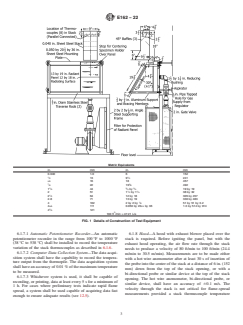
6.1 The apparatus shall be as shown in Fig. 1 and include
inFig.1.Thepositionofthestackwithrespecttothespecimen
the following:
and radiant heat panel shall also comply with the requirements
6.1.1 Radiant Panel with Air and Gas Supply—The radiant
of Fig. 1.
heat energy source shall be a panel of a porous material
6.1.6 Thermocouples—Eight thermocouples of equal resis-
mounted in a cast iron or steel frame, exposing a radiating
tance and connected in parallel shall be mounted in the stack
surface of 12 by 18 in. (305 by 457 mm) and shall be capable
and supported with porcelain insulators as indicated in Fig. 1
ofoperatingattemperaturesupto1500°F(815°C).Thepanel
and Fig. 3. The thermocouples shall be Chromel-Alumel Type
shall be equipped (see Fig. 1) with a venturi-type aspirator for
K, shielded against high heat with insulation resisting up to
mixing gas and air at approximately atmospheric pressure; a
2190 °F (1200 °C), and with wire gauges in the range of 0.014
in. to 0.020 in. (0.36 mm to 0.51 mm; 30 AWG-24 AWG)
Robertson, A. F., “Surface Flammability Measurements by the Radiant Panel
diameter and shall be connected in parallel, or recorded
Method,” Symposium on Fire Test Methods, ASTM STP 344, ASTM, 1962, pp.
33–46. individually and then averaged, such that a mean temperature
Robertson,A. F., Gross, D., and Loftus, J., “AMethod for Measuring Surface
profile of the stack is achieved. The mean stack thermocouple
Flammability of Materials Using a Radiant Energy Source,” Proceedings, ASTM,
temperature rise for unit heat input rate of the calibration
Vol 56, 1956, pp. 1437–1453.
Gross,D.andLoftus,J.J.,“SurfaceFlamePropagationonCellulosicMaterials burner shall be determined periodically for the specific test
Exposed to Thermal Radiation,” Journal of Research, NBS, Vol 67C, 1963, pp.
apparatus, using the procedure in Annex A1.
251–258.
7 6.1.7 Data Collection System—For collecting test data, use
Magee, R. S. and McAlevy III, R. F., “The Mechanism of Flame Spread,”
Journal of Fire and Flammability, Vol 2, 1971, pp. 271–297. one of the following:
E162 − 22
Metric Equivalents
in. mm in. mm
0.040 1.0 6 152
1 1
⁄2 13 9 ⁄2 241
⁄8 16 18 457
7 3
⁄8 22 19 ⁄8 492
3 3 3
1 ⁄4 44 ⁄4 by ⁄4 19 by 19
1 1
251 1 ⁄2 by 1 ⁄4 38 by 32
2 ⁄2 64 12 by 18 305 by 457
2.8 71 13 by 19 330 by 483
4 102 2by2by ⁄8 51 by 51 by 3.2
3 1
4 ⁄8 111 0.050 by 20 ⁄4 by 36 1.3 by 514 by 914
4 ⁄4 121
100 ft /min = 47.21 L/s
FIG. 1 Details of Construction of Test Equipment
6.1.7.1 Automatic Potentiometer Recorder—An automatic 6.1.8 Hood—A hood with exhaust blower placed over the
potentiometer recorder in the range from 100°F to 1000°F stack is required. Before igniting the panel, but with the
(38°C to 538°C) shall be installed to record the temperature
exhaust hood operating, the air flow rate through the stack
variation of the stack thermocouples as described in 6.1.6.
needs to produce a velocity of 80 ft/min to 100 ft/min (24.4
6.1.7.2 Computer Data Collection System—The data acqui-
m/min to 30.5 m/min). Measurements are to be made either
sition system shall have the capability to record the tempera-
with a hot wire anemometer after at least 30 s of insertion of
ture output from the thermopile. The data acquisition system
the probe into the center of the stack at a distance of 6 in. (152
shall have an accuracy of 0.01 % of the maximum temperature
mm) down from the top of the stack opening, or with a
to be measured.
bi-directional probe or similar device at the top of the stack
6.1.7.3 Whichever system is used, it shall be capable of
opening. The hot wire anemometer, bi-directional probe, or
recording, or printing, data at least every 5 s for a minimum of
similar device, shall have an accuracy of 60.1 m/s. The
1 h. For cases where preliminary tests indicate rapid flame
velocity through the stack is not critical for flame-spread
spread, a system shall be used capable of acquiring data fast
measurements provided a stack thermocouple temperature
enough to ensure adequate results (see 12.5).
E162 − 22
Metric Equivalents
in. mm in. mm
3 1
⁄4 19 6 ⁄4 159
125 17 ⁄8 448
1 1
1 ⁄4 32 18 ⁄8 460
1 3
376 ⁄16 by ⁄4 by 21 1.6 by 19 by 533
5 ⁄4 133
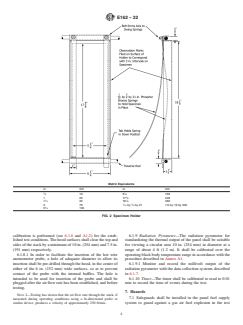
FIG. 2 Specimen Holder
calibration is performed (see 6.1.6 and A1.2) for the estab- 6.1.9 Radiation Pyrometer—The radiation pyrometer for
lishedtestconditions.Thehoodsurfacesshallclearthetopand standardizing the thermal output of the panel shall be suitable
sidesofthestackbyaminimumof10in.(254mm)and7.5in. for viewing a circular area 10 in. (254 mm) in diameter at a
(191 mm) respectively. range of about 4 ft (1.2 m). It shall be calibrated over the
6.1.8.1 In order to facilitate the insertion of the hot wire operatingblackbodytemperaturerangeinaccordancewiththe
anemometer probe, a hole of adequate diameter to allow its procedure described in Annex A1.
insertion shall be pre-drilled through the hood, in the center of 6.1.9.1 Monitor and record the millivolt output of the
either of the 6 in. (152 mm) wide surfaces, so as to prevent radiation pyrometer with the data collection systems described
contact of the probe with the internal baffles. The hole is in 6.1.7.
intended to be used for insertion of the probe and shall be 6.1.10 Timer—The timer shall be calibrated to read to 0.01
plugged after the air flow rate has been established, and before min to record the time of events during the test.
testing.
7. Hazards
NOTE 2—Testing has shown that the air flow rate through the stack, if
7.1 Safeguards shall be installed in the panel fuel supply
measured during operating conditions using a bi-directional probe or
similar device, produces a velocity of approximately 250 ft/min. system to guard against a gas air fuel explosion in the test
E162 − 22
Metric Equivalents
in. mm in. mm in. mm
⁄4 6.4 3 76 9 229
1 3 1
⁄2 13 3 ⁄8 86 9 ⁄2 241
1 25 6 152 9 ⁄4 248
251 6 ⁄4 171 18 457
1 1
2 ⁄2 64 8 ⁄4 210
FIG. 3 Thermocouple Mounting Arrangement
chamber. Potential safeguards include, but are not limited to, 8. Test Specimens
oneormoreofthefollowing:agasfeedcut-offactivatedwhen
8.1 The test specimen shall be 6 in. by 18 in. (152 mm by
theairsupplyfails;aflamesensordirectedatthepanelsurface
457 mm) by the sheet thickness, where this is less than 1 in.
that stops fuel flow when the panel flame goes out; and a heat
(25.4 mm). Materials supplied at a thickness greater than 1 in.
detector mounted in contact with the radiant panel plenum that
(25.4 mm) shall be cut to 1 in. (25.4 mm) for testing. At the
is activated when the panel temperature exceeds safe limits.
request of the sponsor, it is possible to test materials greater
Manual reset is a requirement of any safeguard system used.
than1in.(25.4mm)thicknessbyusinganoversizedspecimen
7.2 The exhaust system must be so designed and operated holder.
that the laboratory environment is protected from smoke and
8.2 Materials intended to be applied to a substrate shall be
gas. The operator shall be instructed on ways to minimize
tested on that substrate.
exposure to combustion products by following sound safety
and industrial hygiene practices. For example, ensure that the 8.3 For comparison tests, or where the intended application
exhaust system is working properly and wear appropriate of a finish material is not specified, the finish material shall be
clothing including gloves, safety glasses, and breathing appa- prepared for test in accordance with 8.4 – 8.6.
ratus (when hazardous fumes are expected).
8.4 Opaquesheetmaterialsupto ⁄16in.(1.6mm)thickness,
7.3 Duringthistest,veryhighheatfluxesandhightempera- and liquid films such as paints, etc. intended for application to
tures are generated that are capable of igniting some clothing combustible base materials, shall be applied to ⁄4 in. (6.4 mm)
following even brief exposures. Precautions shall be taken to thick tempered hardboard using recommended application
avoid ignitions of this type. procedures. The hardboard shall have a mean flame-spread
E162 − 22
index of 130 to 160 based upon a minimum of four tests 8.9 If, in this initial test, any material tends to melt, soften,
performed in accordance with this method. crack,split,orfallfromthespecimenholder,itshallberetested
with a wire support as described in 8.8.2 and the higher of the
8.5 Liquid films and other materials for application to a
two results shall be adopted as the flame spread index.
noncombustible base shall be applied to the smooth surface of
1 3
⁄4 in. (6.4 mm) thick fiber cement board, using specified 8.10 Allspecimensexceptthoseover ⁄4in.(19.0mm)thick
spreadingraterequirements,or,intheabsenceofrequirements, shallbebackedwith ⁄2in.(13mm)millboardof60lb/ft (960
a minimum-coating thickness of 0.030 in. (0.76 mm). Wher- kg/m ) density.
ever fiber cement board is specified, the material shall be as
described in Annex A2.
9. Number of Test Specimens
8.6 A backing of aluminum foil 0.002 in. (0.05 mm) thick, 9.1 Four test specimens of each sample shall be tested. If
with the bright side against the specimen shall be used.
one or more tests are deemed to be invalid, additional tests
shall be conducted until four valid test results have been
8.7 Materials, including fabrics, not applied to a base but
developed (see 11.12).
supported at one or more edges shall be mounted on a special
backingof ⁄2-in.(13mm)thickmillboardofwhichthesurface
10. Conditioning
opposite the test specimen is covered with a sheet of highly
reflective aluminum foil 0.002 in. thick, with the bright side
10.1 Pre-dry specimens for 24 h at 140 °F (60 °C) and then
1 1
against the specimen. Millboard spacers ⁄2 in. by ⁄2 in. (12.7
condition to equilibrium (constant weight) at an ambient
mm by 12.7 mm) shall be used at the perimeter of the
temperature of 73 °F 6 5 °F (23 °C 6 3 °C) and a relative
foil-covered face of the backing to separate the test material
humidity of 50% 65%.
fromthefoil.Flexiblematerialsshallbecutto10mmby22in.
(255 mm by 560 mm) size, folded around the frame and
11. Procedure
fastened to the rear surface of the millboard with tension
11.1 Removecombustionproductdepositsfromthethermo-
sufficient only to remove slack.
couples by brush-cleaning or other effective method after each
NOTE 3—Wherever millboard is specified, the material shall be cement
test.
bound of commercial quality nominal ⁄2-in. (13 mm) thick and density of
3 3 3 3
11.2 During the conduct of the test, control extraneous
60 lb/ft 6 5 lb/ft (960 kg/m 6 80 kg/m ).
drafts by closing windows and doors, stop air-circulating
8.7.1 For cellular elastomers and cellular plastics, whether
devices, and arrange baffles between the apparatus and any
flexible or not, the back and sides of the test specimen shall be
remaining sources of drafts.
wrapped with aluminum foil 0.002 in. (0.05 mm) thick, with
11.3 At the start of each testing day, ignite the gas-air
the bright side against the specimen. High density inorganic
mixture passing through the radiant panel and allow the unit to
reinforced cement board, 0.25 in. (6.4 mm) in thickness, shall
heat for 0.5 h. Before each test, check the radiant output by
be used as backing. The test specimen shall be retained in the
means of the radiation pyrometer. Do this by placing the
specimen holder by a 6 in. by 18 in. (152 mm by 457 mm)
pyrometer in such a manner as to view a central panel area
sheet of nominally 1 in. (25.4 mm) hexagonal steel wire mesh,
about10in.(254mm)indiameter.Adjusttherateofairsupply
20 AWG, placed against the exposed face of the specimen.
3 3
to between 750 ft /h and 800 ft /h (5.9 L/s and 6.3 L/s) and
Molded skin or treated surfaces shall face the exposure.
thenadjustthefuelgassupplyupwardsfromzerountilitisjust
8.7.2 For testing of flexible cellular materials see also Test
sufficienttoproducearadiantoutputequaltothatwhichwould
Method D3675, which uses a different pilot burner.
be obtained from a blackbody of the same dimensions operat-
8.8 Finish materials, including sheet laminates, tiles,
ing at a temperature of 1238 °F 6 7 °F (670 °C 6 4 °C).
fabrics, and others applied to a base material with adhesive as
11.4 Turn on the recording potentiometer for measuring the
well as laminated materials not attached to a base shall be
stack thermocouple temperature.
tested for possible increased flame spread or associated hazard
due to delamination, cracking, peeling, or other separation of
11.5 The adequacy of measures to control drafts shall be
the finish material.An increase in flame spread may be caused
established by ensuring that stack temperature variations be-
by flaming on the reverse face of the test material, or by
fore the specimen is put in place for test (see 11.7)donot
ignition of the adhesive or base material. Determination of the
exceed 69 °F (5 °C).
existence of such effects shall be made as follows:
11.6 Ignite the pilot and adjust it to give a flame 2 in. to 3
8.8.1 Oneormorespecimensofthesamplematerialshallbe
in. (51 mm to 76 mm) long. Move the pilot into operating
testedasreceivedinthemannerprescribedhereinfortheflame
position. The pilot burner shall remain ignit
...
This document is not an ASTM standard and is intended only to provide the user of an ASTM standard an indication of what changes have been made to the previous version. Because
it may not be technically possible to adequately depict all changes accurately, ASTM recommends that users consult prior editions as appropriate. In all cases only the current version
of the standard as published by ASTM is to be considered the official document.
Designation: E162 − 21 E162 − 22 An American National Standard
Standard Test Method for
Surface Flammability of Materials Using a Radiant Heat
Energy Source
This standard is issued under the fixed designation E162; the number immediately following the designation indicates the year of
original adoption or, in the case of revision, the year of last revision. A number in parentheses indicates the year of last reapproval. A
superscript epsilon (´) indicates an editorial change since the last revision or reapproval.
This standard has been approved for use by agencies of the U.S. Department of Defense.
1. Scope*
1.1 This fire-test-response standard describes the measurement of surface flammability of materials. It is not intended for use as
a basis of ratings for building code purposes (see Appendix X1).
1.2 The values stated in inch-pound units are to be regarded as standard. The values given in parentheses are mathematical
conversions to SI units that are provided for information only and are not considered standard.
1.3 This standard measures and describes the response of materials, products, or assemblies to heat and flame under controlled
conditions, but does not by itself incorporate all factors required for fire hazard or fire risk assessment of the materials, products,
or assemblies under actual fire conditions.
1.4 This standard does not purport to address all of the safety concerns, if any, associated with its use. It is the responsibility
of the user of this standard to establish appropriate safety, health, and environmental practices and determine the applicability of
regulatory limitations prior to use.
1.5 Fire testing of products and materials is inherently hazardous, and adequate safeguards for personnel and property shall be
employed in conducting these tests. This test method may involve hazardous materials, operations, and equipment. Specific
information about hazard is given in Section .
NOTE 1—There is no similar or equivalent ISO standard.
1.6 This international standard was developed in accordance with internationally recognized principles on standardization
established in the Decision on Principles for the Development of International Standards, Guides and Recommendations issued
by the World Trade Organization Technical Barriers to Trade (TBT) Committee.
2. Referenced Documents
2.1 ASTM Standards:
C1186 Specification for Flat Fiber-Cement Sheets
C1288 Specification for Fiber-Cement Interior Substrate Sheets
D3675 Test Method for Surface Flammability of Flexible Cellular Materials Using a Radiant Heat Energy Source
This test method is under the jurisdiction of ASTM Committee E05 on Fire Standards and is the direct responsibility of Subcommittee E05.22 on Surface Burning.
Current edition approved July 1, 2021July 1, 2022. Published August 2021August 2022. Originally approved in 1960. Last previous edition approved in 20162021 as
E162 – 16.E162 – 21. DOI: 10.1520/E0162-21.10.1520/E0162-22.
For referenced ASTM standards, visit the ASTM website, www.astm.org, or contact ASTM Customer Service at service@astm.org. For Annual Book of ASTM Standards
volume information, refer to the standard’s Document Summary page on the ASTM website.
*A Summary of Changes section appears at the end of this standard
Copyright © ASTM International, 100 Barr Harbor Drive, PO Box C700, West Conshohocken, PA 19428-2959. United States
E162 − 22
E84 Test Method for Surface Burning Characteristics of Building Materials
E176 Terminology of Fire Standards
E1546 Guide for Development of Fire-Hazard-Assessment Standards
2.2 ISO Standards
ISO 13943 Fire Safety—Vocabulary
3. Terminology
3.1 Definitions—For definitions of terms used in this test method, refer to the terminology contained in Terminology E176 and
ISO 13943. In case of conflict, the definitions given in Terminology E176 shall prevail.
3.2 Definitions of Terms Specific to This Standard:
3.2.1 flashing, n—flame fronts of 3 seconds or less in duration.
3.2.1.1 Discussion—
All flame fronts, however temporary, are to be taken into account.
3.2.2 radiant panel index, I , n—the radiant panel index is the product of the flame spread factor, F , and the heat evolution factor,
s s
Q.
4. Summary of Test Method
4.1 This test method of measuring surface flammability of materials employs a radiant heat source consisting of a 12 by 18-in.
(305 by 457 mm) panel, in front of which an inclined 6 by 18-in. (152 by 457 mm) specimen of the material is placed. The
orientation of the specimen is such that ignition is forced near its upper edge and the flame front progresses downward.
4.2 A factor derived from the rate of progress of the flame front and another derived from the rate of heat liberated by the material
under test are combined to provide a radiant panel index.
5. Significance and Use
5.1 This test method provides a laboratory test procedure for measuring and comparing the surface flammability of materials when
exposed to a prescribed level of radiant heat energy. It is intended for use in measurements of the surface flammability of materials
exposed to fire. The test is conducted using small specimens that are representative, to the extent possible, of the material or
assembly being evaluated. (Example: in terms of their thickness, layering, and any potential substrate.)
5.2 The rate at which flames will travel along surfaces depends upon the physical and thermal properties of the material, product
or assembly under test, the specimen mounting method and orientation, the type and level of fire or heat exposure, the availability
4-7
of air, and properties of the surrounding enclosure.
5.3 In this procedure, the specimens are subjected to one or more specific sets of laboratory fire test conditions. If different test
conditions are substituted or the end-use conditions are changed, it is not always possible by or from this test to predict changes
in the fire-test-response characteristics measured. Therefore, the results are valid only for the fire test exposure conditions described
in this procedure.
5.4 If the test results obtained by this test method are to be considered as part of an overall assessment of fire hazard in a building
or structure, then the example criteria, concepts and procedures incorporated into Guide E1546 shall be taken into consideration.
6. Apparatus
6.1 The apparatus shall be as shown in Fig. 1 and include the following:
Available from International Organization for Standardization (ISO), 1, ch. de la Voie-Creuse, Case postale 56, CH-1211, Geneva 20, Switzerland, http://www.iso.ch.
Robertson, A. F., “Surface Flammability Measurements by the Radiant Panel Method,” Symposium on Fire Test Methods, ASTM STP 344, ASTM, 1962, pp. 33–46.
Robertson, A. F., Gross, D., and Loftus, J., “A Method for Measuring Surface Flammability of Materials Using a Radiant Energy Source,” Proceedings, ASTM, Vol 56,
1956, pp. 1437–1453.
Gross, D. and Loftus, J. J., “Surface Flame Propagation on Cellulosic Materials Exposed to Thermal Radiation,” Journal of Research, NBS, Vol 67C, 1963, pp. 251–258.
Magee, R. S. and McAlevy III, R. F., “The Mechanism of Flame Spread,” Journal of Fire and Flammability, Vol 2, 1971, pp. 271–297.
E162 − 22
Metric Equivalents
in. mm in. mm
0.040 1.0 6 152
1 1
⁄2 13 9 ⁄2 241
⁄8 16 18 457
7 3
⁄8 22 19 ⁄8 492
3 3 3
1 ⁄4 44 ⁄4 by ⁄4 19 by 19
1 1
2 51 1 ⁄2 by 1 ⁄4 38 by 32
2 ⁄2 64 12 by 18 305 by 457
2.8 71 13 by 19 330 by 483
4 102 2 by 2 by ⁄8 51 by 51 by 3.2
3 1
4 ⁄8 111 0.050 by 20 ⁄4 by 36 1.3 by 514 by 914
4 ⁄4 121
100 ft /min = 47.21 L/s
FIG. 1 Details of Construction of Test Equipment
6.1.1 Radiant Panel with Air and Gas Supply—The radiant heat energy source shall be a panel of a porous material mounted in
a cast iron or steel frame, exposing a radiating surface of 12 by 18 in. (305 by 457 mm) and shall be capable of operating at
temperatures up to 1500 °F (815 °C). The panel shall be equipped (see Fig. 1) with a venturi-type aspirator for mixing gas and
air at approximately atmospheric pressure; a centrifugal blower, or equivalent, capable of providing 1200 ft /h (9.4 L/s) air at a
pressure of 2.8 in. of water (700 Pa); an air filter to prevent dust from obstructing the panel pores; a pressure regulator and a control
and shut-off valve for the gas supply.
6.1.2 Specimen Holder—The specimen holder shall conform in shape and dimension to Fig. 2 and be constructed from
heat-resistant chromium steel. Observation marks shall be filed on the surface of the specimen holder to correspond with 3-in. (76
mm) interval lines on the specimen.
6.1.3 Framework for Support of the Specimen Holder—The framework shall have two transverse rods of stainless steel, each 0.50
6 0.13 in. (12.7 6 3.3 mm) in diameter, with a stop to center the specimen holder directly in front of the radiant panel. The support
E162 − 22
Metric Equivalents
in. mm in. mm
3 1
⁄4 19 6 ⁄4 159
1 25 17 ⁄8 448
1 1
1 ⁄4 32 18 ⁄8 460
1 3
3 76 ⁄16 by ⁄4 by 21 1.6 by 19 by 533
5 ⁄4 133
FIG. 2 Specimen Holder
and bracing members shall be constructed from metal stock. Since the angle of the specimen and its position with respect to the
panel are critical, the framework dimensions specifying these conditions shall be within 0.125 in. (3.2 mm) of the values given
in Fig. 1.
6.1.4 Pilot Burner—The pilot burner shall be a length of stainless steel tubing approximately 8 in. to 9 in. (203 mm to 229 mm)
long with nominally 0.125 in. (3.2 mm) inside diameter by nominally 0.19 in. (4.8 mm) outside diameter. As an option, to prolong
the service life of the pilot burner, the part of the burner that is exposed to radiant energy can be protected with a porcelain tube
nominally 0.20 in. (5.2 mm) inside diameter by nominally 0.28 in. (7.14 mm) outside diameter. The burner shall be mounted
horizontally and at a slight angle to the intersection of the horizontal plane of the burner with the plane of the specimen. The burner
shall also be capable of being moved out of position when not in use. The pilot shall provide a 2 in. to 3 in. (51 mm to 76 mm)
flame of acetylene gas premixed with air in an aspirating type fitting. The position of the burner tip shall be such that the pilot flame
shall contact or shall be within 0.5 in. (12.7 mm) of contacting the upper central surface of the specimen.
6.1.5 Stack—The stack shall be made from nominally 0.040 in. (1.0 mm) sheet steel with shape and dimensions as shown in Fig.
1. The position of the stack with respect to the specimen and radiant heat panel shall also comply with the requirements of Fig.
1.
E162 − 22
6.1.6 Thermocouples—Eight thermocouples of equal resistance and connected in parallel shall be mounted in the stack and
supported with porcelain insulators as indicated in Fig. 1 and Fig. 3. The thermocouples shall be Chromel-Alumel Type K, shielded
against high heat with insulation resisting up to 2190 °F (1200 °C), and with wire gauges in the range of 0.014 – in. to 0.020 in.
(0.36 – mm to 0.51 mm; 30 AWG-24 AWG) diameter. diameter and shall be connected in parallel, or recorded individually and
then averaged, such that a mean temperature profile of the stack is achieved. The mean stack thermocouple temperature rise for
unit heat input rate of the calibration burner shall be determined periodically for the specific test apparatus, using the procedure
in Annex A1.
6.1.7 Data Collection System—For collecting test data, use one of the following:
6.1.7.1 Automatic Potentiometer Recorder—An automatic potentiometer recorder in the range from 100 to 1000° F (38 to 538°
C) 100 °F to 1000 °F (38 °C to 538 °C) shall be installed to record the temperature variation of the stack thermocouples as
described in 6.1.6.
6.1.7.2 Computer Data Collection System—The data acquisition system shall have the capability to record the temperature output
from the thermopile. The data acquisition system shall have an accuracy of 0.01% 0.01 % of the maximum temperature to be
measured.
6.1.7.3 Whichever system is used, it shall be capable of recording, or printing, data at least every 5 s for a minimum of 1 h. For
cases where preliminary tests indicate rapid flame spread, a system shall be used capable of acquiring data fast enough to ensure
adequate results (see 12.5).
Metric Equivalents
in. mm in. mm in. mm
⁄4 6.4 3 76 9 229
1 3 1
⁄2 13 3 ⁄8 86 9 ⁄2 241
1 25 6 152 9 ⁄4 248
2 51 6 ⁄4 171 18 457
1 1
2 ⁄2 64 8 ⁄4 210
FIG. 3 Thermocouple Mounting Arrangement
E162 − 22
6.1.8 Hood—A hood with exhaust blower placed over the stack is required. Before igniting the panel, but with the exhaust hood
operating, the air flow rate through the stack needs to produce a velocity of 80 ft/min to 100 ft/min (24.4 m/min to 30.5 m/min).
Measurements are to be made either with a hot wire anemometer after at least 30 s of insertion of the probe into the center of the
stack at a distance of 6 in. (152 mm) down from the top of the stack opening, or with a bi-directional probe or similar device at
the top of the stack opening. The hot wire anemometer, bi-directional probe, or similar device, shall have an accuracy of 60.1 m/s.
The velocity through the stack is not critical for flame-spread measurements provided a stack thermocouple temperature calibration
is performed (see 6.1.6 and A1.2) for the established test conditions. The hood surfaces shall clear the top and sides of the stack
by a minimum of 10 in. (254 mm) and 7.5 in. (191 mm) respectively.
6.1.8.1 In order to facilitate the insertion of the hot wire anemometer probe, a hole of adequate diameter to allow its insertion shall
be pre-drilled through the hood, in the center of either of the 6-in. 6 in. (152 mm) wide surfaces, so as to prevent contact of the
probe with the internal baffles. The hole is intended to be used for insertion of the probe and shall be plugged after the air flow
rate has been established, and before testing.
NOTE 2—Testing has shown that the air flow rate through the stack, if measured during operating conditions using a bi-directional probe or similar device,
produces a velocity of approximately 250 ft/min.
6.1.9 Radiation Pyrometer—The radiation pyrometer for standardizing the thermal output of the panel shall be suitable for viewing
a circular area 10 in. (254 mm) in diameter at a range of about 4 ft (1.2 m). It shall be calibrated over the operating black body
temperature range in accordance with the procedure described in Annex A1.
6.1.9.1 Monitor and record the millivolt output of the radiation pyrometer with the data collection systems described in 6.1.7.
6.1.10 Timer—The timer shall be calibrated to read to 0.01 min to record the time of events during the test.
7. Hazards
7.1 Safeguards shall be installed in the panel fuel supply system to guard against a gas air fuel explosion in the test chamber.
Potential safeguards include, but are not limited to, one or more of the following: a gas feed cut-off activated when the air supply
fails; a flame sensor directed at the panel surface that stops fuel flow when the panel flame goes out; and a heat detector mounted
in contact with the radiant panel plenum that is activated when the panel temperature exceeds safe limits. Manual reset is a
requirement of any safeguard system used.
7.2 The exhaust system must be so designed and operated that the laboratory environment is protected from smoke and gas. The
operator shall be instructed on ways to minimize exposure to combustion products by following sound safety and industrial
hygiene practices. For example, ensure that the exhaust system is working properly and wear appropriate clothing including gloves,
safety glasses, and breathing apparatus (when hazardous fumes are expected).
7.3 During this test, very high heat fluxes and high temperatures are generated that are capable of igniting some clothing following
even brief exposures. Precautions shall be taken to avoid ignitions of this type.
8. Test Specimens
8.1 The test specimen shall be 6 in. by 18 in. (152 mm by 457 mm) by the sheet thickness, where this is less than 1 in. (25.4 mm).
Materials supplied at a thickness greater than 1 in. (25.4 mm) shall be cut to 1 in. (25.4 mm) for testing. At the request of the
sponsor, it is possible to test materials greater than 1 in. (25.4 mm) thickness by using an oversized specimen holder.
8.2 Materials intended to be applied to a substrate shall be tested on that substrate.
8.3 For comparison tests, or where the intended application of a finish material is not specified, the finish material shall be prepared
for test in accordance with 8.4 – 8.6.
8.4 Opaque sheet materials up to ⁄16-in. in. (1.6 mm) thickness, and liquid films such as paints, etc. intended for application to
E162 − 22
combustible base materials, shall be applied to ⁄4-in. in. (6.4 mm) thick tempered hardboard using recommended application
procedures. The hardboard shall have a mean flame-spread index of 130 to 160 based upon a minimum of four tests performed
in accordance with this method.
8.5 Liquid films and other materials for application to a noncombustible base shall be applied to the smooth surface of ⁄4-in. in.
(6.4 mm) thick fiber cement board, using specified spreading rate requirements, or, in the absence of requirements, a
minimum-coating thickness of 0.030 in. (0.76 mm). Wherever fiber cement board is specified, the material shall be as described
in Annex A2.
8.6 A backing of aluminum foil 0.002 in. (0.05 mm) thick, with the bright side against the specimen shall be used.
8.7 Materials, including fabrics, not applied to a base but supported at one or more edges shall be mounted on a special backing
of ⁄2-in. (13 mm) thick millboard of which the surface opposite the test specimen is covered with a sheet of highly reflective
1 1
aluminum foil 0.002 in. thick, with the bright side against the specimen. Millboard spacers ⁄2 in. by ⁄2 in. (12.7 mm by 12.7 mm)
shall be used at the perimeter of the foil-covered face of the backing to separate the test material from the foil. Flexible materials
shall be cut to 10 mm by 22-in. 22 in. (255 mm by 560 mm) size, folded around the frame and fastened to the rear surface of the
millboard with tension sufficient only to remove slack.
NOTE 3—Wherever millboard is specified, the material shall be cement bound of commercial quality nominal ⁄2-in. (13 mm) thick and density of 60 lb/ft
3 3 3
6 5 lb/ft (960 kg/m 6 80 kg/m ).
8.7.1 For cellular elastomers and cellular plastics, whether flexible or not, the back and sides of the test specimen shall be wrapped
with aluminum foil 0.002 in. (0.05 mm) thick, with the bright side against the specimen. High density inorganic reinforced cement
board, 0.25 in. (6.4 mm) in thickness, shall be used as backing. The test specimen shall be retained in the specimen holder by a
6 in. by 18-in. 18 in. (152 mm by 457 mm) sheet of nominally 1-in. 1 in. (25.4 mm) hexagonal steel wire mesh, 20 AWG, placed
against the exposed face of the specimen. Molded skin or treated surfaces shall face the exposure.
8.7.2 For testing of flexible cellular materials see also Test Method D3675, which uses a different pilot burner.
8.8 Finish materials, including sheet laminates, tiles, fabrics, and others applied to a base material with adhesive as well as
laminated materials not attached to a base shall be tested for possible increased flame spread or associated hazard due to
delamination, cracking, peeling, or other separation of the finish material. An increase in flame spread may be caused by flaming
on the reverse face of the test material, or by ignition of the adhesive or base material. Determination of the existence of such
effects shall be made as follows:
8.8.1 One or more specimens of the sample material shall be tested as received in the manner prescribed herein for the flame
spread determination of ordinary materials.
8.8.2 Materials that tend to delaminate or in any way separate from the specimen holder during the above test exposure shall be
retested using one or more specimens in which the material is retained in position by a 6 in. by 18-in. 18 in. (150 mm by 460 mm)
sheet of 1-in. 1 in. (25 mm) hexagonal wire mesh placed in the specimen holder and against the exposed face of the specimen.
8.9 If, in this initial test, any material tends to melt, soften, crack, split, or fall from the specimen holder, it shall be retested with
a wire support as described in 8.8.2 and the higher of the two results shall be adopted as the flame spread index.
3 1
8.10 All specimens except those over ⁄4 in. (19.0 mm) thick shall be backed with ⁄2-in. in. (13 mm) millboard of 60 lb/ft (960
kg/m ) density.
9. Number of Test Specimens
9.1 Four test specimens of each sample shall be tested. If one or more tests are deemed to be invalid, additional tests shall be
conducted until four valid test results have been developed (see 11.12).
E162 − 22
10. Conditioning
10.1 Pre-dry specimens for 24 h at 140 °F (60 °C) and then condition to equilibrium (constant weight) at an ambient temperature
of 73 °F 6 5 °F (23 °C 6 3 °C) and a relative humidity of 5050 % 6 5 %.
11. Procedure
11.1 Remove combustion product deposits from the thermocouples by brush-cleaning or other effective method after each test.
11.2 During the conduct of the test, control extraneous drafts by closing windows and doors, stop air-circulating devices, and
arrange baffles between the apparatus and any remaining sources of drafts.
11.3 At the start of each testing day, ignite the gas-air mixture passing through the radiant panel and allow the unit to heat for 0.5
h. Before each test, check the radiant output by means of the radiation pyrometer. Do this by placing the pyrometer in such a
manner as to view a central panel area about 10 in. (254 mm) in diameter. Adjust the rate of air supply to between 750 ft /h and
800 ft /h (5.9 L/s and 6.3 L/s) and then adjust the fuel gas supply upwards from zero until it is just sufficient to produce a radiant
output equal to that which would be obtained from a blackbody of the same dimensions operating at a temperature of 1238 °F 6
7 °F (670 °C 6 4 °C).
11.4 Turn on the record
...