

ASTM D3753-20
(Specification)Standard Specification for Fiberglass (Glass-Fiber-Reinforced Thermosetting-Resin) Manholes and Wetwells
General Information
- Abstract
ABSTRACT
This specification covers glass fiber-reinforced polyester manholes and wetwells for use primarily in sanitary and storm sewer applications. Manhole and wetwell cylinders, manway reducers, and connectors shall be produced from glass fiber-reinforced polyester resin with construction determined by the particular process of manufacture and configuration. The stiffness, soundness, chemical resistance, compressive strength, flexural strength, modulus, and hardness shall be tested to meet the requirements prescribed.
SCOPE
1.1 This specification covers “fiberglass” (glass fiber-reinforced thermosetting-resin) manholes and wetwells fabricated with polyester, vinyl ester, or epoxy resin for use primarily in sanitary, storm, and industrial sewer applications.
1.2 The values given in inch-pound units are to be regarded as the standard. The values in parentheses are provided for information purposes only.
1.3 The following precautionary caveat pertains only to the test methods portion, Section 8, of this specification: This standard does not purport to address all of the safety concerns, if any, associated with its use. It is the responsibility of the user of this standard to establish appropriate safety, health, and environmental practices and determine the applicability of regulatory limitations prior to use.
Note 1: There is no known ISO equivalent to this standard.
1.4 This international standard was developed in accordance with internationally recognized principles on standardization established in the Decision on Principles for the Development of International Standards, Guides and Recommendations issued by the World Trade Organization Technical Barriers to Trade (TBT) Committee.
- Status
- Published
- Publication Date
- 30-Nov-2020
- Technical Committee
- D20 - Plastics
Buy Documents
ASTM D3753-20 - Standard Specification for Fiberglass (Glass-Fiber-Reinforced Thermosetting-Resin) Manholes and Wetwells
REDLINE ASTM D3753-20 - Standard Specification for Fiberglass (Glass-Fiber-Reinforced Thermosetting-Resin) Manholes and Wetwells
Overview
ASTM D3753-20 is a comprehensive standard specification developed by ASTM International for fiberglass (glass-fiber-reinforced thermosetting-resin) manholes and wetwells. These structures are primarily designed for use in sanitary sewer, stormwater, and certain industrial sewer applications. The standard specifies materials, construction requirements, testing methods, and performance criteria to ensure that fiberglass manholes and wetwells deliver reliable performance, chemical resistance, and long service life in challenging underground environments.
Developed under the jurisdiction of ASTM Committee D20 on Plastics, ASTM D3753-20 covers products fabricated from thermosetting polyester, vinyl ester, or epoxy resins, reinforced with E-type glass fibers. The standard establishes minimum requirements for structural integrity, quality assurance, and installation suitability, ensuring consistent quality and safety for sewer infrastructure applications.
Key Topics
Material Specification
- Covers commercial-grade thermosetting resins: unsaturated polyester, vinyl ester, or epoxy.
- Reinforcement with E-type glass fibers, using mat, continuous roving, or fabric.
- Allows chemical-resistant surfacing mat and inert fillers, with specific requirements for processing agents and additives.
Design and Construction
- Addresses manhole and wetwell cylinders, manway reducers, connectors, tops, and bases.
- Specifies minimum dimensions, load rating, and stiffness requirements to ensure structural performance under load.
- Mandates resin-rich interior surfaces for corrosion resistance and watertight construction.
Testing and Performance
- Details tests for compressive strength, flexural strength, stiffness, soundness (watertightness), hardness, and chemical resistance.
- Requires representative product testing, especially after changes in materials or manufacturing processes.
- Performance testing includes dynamic load, deflection, and chemical immersion tests.
Quality Control and Certification
- Outlines inspection and test reporting protocols, including requirements for marking and labeling.
- Provides for quality control in composition and manufacturing, with periodic checks for resin and glass content.
Applications
ASTM D3753-20 fiberglass manholes and wetwells are critical components in a variety of infrastructure projects, especially:
- Sanitary Sewer Systems: Used as access points and containment structures in municipal and industrial wastewater collection.
- Stormwater Management: Suitable for storm sewer networks where corrosion resistance and structural reliability are essential.
- Industrial Sewer Applications: Deployed in environments requiring enhanced chemical resistance due to exposure to aggressive liquids.
- Infrastructure Upgrades: Ideal for rehabilitation or replacement of traditional concrete or brick manholes, reducing maintenance and increasing lifespan.
- Specialized Containment: Used anywhere watertight, corrosion-resistant access structures are required below grade.
The standard supports designers, manufacturers, and municipal engineers in selecting appropriate products, ensuring compatibility with existing systems and regulatory requirements.
Related Standards
Several other ASTM standards are referenced within ASTM D3753-20 for testing and terminology, enhancing its reliability:
- ASTM C581: Practice for determining chemical resistance of thermosetting resins.
- ASTM D695: Test method for compressive properties of rigid plastics.
- ASTM D790: Methods for measuring flexural properties of plastics.
- ASTM D785 and D2583: Hardness testing methods for plastics.
- ASTM D2412: Loading characteristics of plastic pipes.
- ASTM D3892: Packaging and marking of plastics products.
By aligning with related ASTM standards, ASTM D3753-20 ensures a robust framework for the manufacture, testing, and application of fiberglass-reinforced manholes and wetwells in underground utility systems.
Keywords: ASTM D3753-20, fiberglass manholes, wetwells, glass-fiber-reinforced, thermosetting resin, sanitary sewer, storm sewer, chemical resistance, underground infrastructure, ASTM standards.
Relations
- Effective Date
- 01-Feb-2024
- Effective Date
- 01-Nov-2023
- Effective Date
- 15-Feb-2020
- Effective Date
- 01-Jan-2020
- Effective Date
- 01-Aug-2019
- Effective Date
- 15-Apr-2019
- Effective Date
- 01-Feb-2019
- Effective Date
- 01-Dec-2018
- Effective Date
- 01-Nov-2018
- Effective Date
- 15-Sep-2018
- Refers
ASTM D1600-18 - Standard Terminology for Abbreviated Terms Relating to Plastics (Withdrawn 2024) - Effective Date
- 01-Jan-2018
- Effective Date
- 15-Aug-2017
- Effective Date
- 01-Jul-2017
- Effective Date
- 01-Dec-2015
- Effective Date
- 01-Dec-2015
Buy Documents
ASTM D3753-20 - Standard Specification for Fiberglass (Glass-Fiber-Reinforced Thermosetting-Resin) Manholes and Wetwells
REDLINE ASTM D3753-20 - Standard Specification for Fiberglass (Glass-Fiber-Reinforced Thermosetting-Resin) Manholes and Wetwells
Get Certified
Connect with accredited certification bodies for this standard

CIS Institut d.o.o.
Personal Protective Equipment (PPE) certification body. Notified Body NB-2890 for EU Regulation 2016/425 PPE.

Kiwa BDA Testing
Building and construction product certification.
Kmetijski inštitut Slovenije
Agricultural Institute of Slovenia. Soil testing, plant health, agricultural product analysis.
Sponsored listings
Frequently Asked Questions
ASTM D3753-20 is a technical specification published by ASTM International. Its full title is "Standard Specification for Fiberglass (Glass-Fiber-Reinforced Thermosetting-Resin) Manholes and Wetwells". This standard covers: ABSTRACT This specification covers glass fiber-reinforced polyester manholes and wetwells for use primarily in sanitary and storm sewer applications. Manhole and wetwell cylinders, manway reducers, and connectors shall be produced from glass fiber-reinforced polyester resin with construction determined by the particular process of manufacture and configuration. The stiffness, soundness, chemical resistance, compressive strength, flexural strength, modulus, and hardness shall be tested to meet the requirements prescribed. SCOPE 1.1 This specification covers “fiberglass” (glass fiber-reinforced thermosetting-resin) manholes and wetwells fabricated with polyester, vinyl ester, or epoxy resin for use primarily in sanitary, storm, and industrial sewer applications. 1.2 The values given in inch-pound units are to be regarded as the standard. The values in parentheses are provided for information purposes only. 1.3 The following precautionary caveat pertains only to the test methods portion, Section 8, of this specification: This standard does not purport to address all of the safety concerns, if any, associated with its use. It is the responsibility of the user of this standard to establish appropriate safety, health, and environmental practices and determine the applicability of regulatory limitations prior to use. Note 1: There is no known ISO equivalent to this standard. 1.4 This international standard was developed in accordance with internationally recognized principles on standardization established in the Decision on Principles for the Development of International Standards, Guides and Recommendations issued by the World Trade Organization Technical Barriers to Trade (TBT) Committee.
ABSTRACT This specification covers glass fiber-reinforced polyester manholes and wetwells for use primarily in sanitary and storm sewer applications. Manhole and wetwell cylinders, manway reducers, and connectors shall be produced from glass fiber-reinforced polyester resin with construction determined by the particular process of manufacture and configuration. The stiffness, soundness, chemical resistance, compressive strength, flexural strength, modulus, and hardness shall be tested to meet the requirements prescribed. SCOPE 1.1 This specification covers “fiberglass” (glass fiber-reinforced thermosetting-resin) manholes and wetwells fabricated with polyester, vinyl ester, or epoxy resin for use primarily in sanitary, storm, and industrial sewer applications. 1.2 The values given in inch-pound units are to be regarded as the standard. The values in parentheses are provided for information purposes only. 1.3 The following precautionary caveat pertains only to the test methods portion, Section 8, of this specification: This standard does not purport to address all of the safety concerns, if any, associated with its use. It is the responsibility of the user of this standard to establish appropriate safety, health, and environmental practices and determine the applicability of regulatory limitations prior to use. Note 1: There is no known ISO equivalent to this standard. 1.4 This international standard was developed in accordance with internationally recognized principles on standardization established in the Decision on Principles for the Development of International Standards, Guides and Recommendations issued by the World Trade Organization Technical Barriers to Trade (TBT) Committee.
ASTM D3753-20 is classified under the following ICS (International Classification for Standards) categories: 13.060.30 - Sewage water. The ICS classification helps identify the subject area and facilitates finding related standards.
ASTM D3753-20 has the following relationships with other standards: It is inter standard links to ASTM D883-24, ASTM D883-23, ASTM C581-20, ASTM D883-20, ASTM D883-19c, ASTM D883-19a, ASTM D883-19, ASTM D883-18a, ASTM D883-18, ASTM D2584-18, ASTM D1600-18, ASTM D883-17, ASTM D790-17, ASTM D790-15e1, ASTM D790-15. Understanding these relationships helps ensure you are using the most current and applicable version of the standard.
ASTM D3753-20 is available in PDF format for immediate download after purchase. The document can be added to your cart and obtained through the secure checkout process. Digital delivery ensures instant access to the complete standard document.
Standards Content (Sample)
This international standard was developed in accordance with internationally recognized principles on standardization established in the Decision on Principles for the
Development of International Standards, Guides and Recommendations issued by the World Trade Organization Technical Barriers to Trade (TBT) Committee.
Designation:D3753 −20
Standard Specification for
Fiberglass (Glass-Fiber-Reinforced Thermosetting-Resin)
Manholes and Wetwells
This standard is issued under the fixed designation D3753; the number immediately following the designation indicates the year of
original adoption or, in the case of revision, the year of last revision. A number in parentheses indicates the year of last reapproval. A
superscript epsilon (´) indicates an editorial change since the last revision or reapproval.
1. Scope* Electrical Insulating Materials
D790 Test Methods for Flexural Properties of Unreinforced
1.1 This specification covers “fiberglass” (glass fiber-
and Reinforced Plastics and Electrical Insulating Materi-
reinforced thermosetting-resin) manholes and wetwells fabri-
als
cated with polyester, vinyl ester, or epoxy resin for use
D883 Terminology Relating to Plastics
primarily in sanitary, storm, and industrial sewer applications.
D1600 Terminology forAbbreviatedTerms Relating to Plas-
1.2 The values given in inch-pound units are to be regarded
tics
as the standard. The values in parentheses are provided for
D2412 Test Method for Determination of External Loading
information purposes only.
Characteristics of Plastic Pipe by Parallel-Plate Loading
1.3 The following precautionary caveat pertains only to the D2583 Test Method for Indentation Hardness of Rigid Plas-
test methods portion, Section 8, of this specification: This
tics by Means of a Barcol Impressor
standard does not purport to address all of the safety concerns, D2584 Test Method for Ignition Loss of Cured Reinforced
if any, associated with its use. It is the responsibility of the user
Resins
of this standard to establish appropriate safety, health, and D3892 Practice for Packaging/Packing of Plastics
environmental practices and determine the applicability of
3. Terminology
regulatory limitations prior to use.
3.1 General—Definitions are in accordance with Terminol-
NOTE 1—There is no known ISO equivalent to this standard.
ogy D883 and the abbreviations are in accordance with
1.4 This international standard was developed in accor-
Terminology D1600 unless otherwise indicated.
dance with internationally recognized principles on standard-
3.2 bench and invert, n—internalflowchannelwithasloped
ization established in the Decision on Principles for the
bench extending from the edge of the flow channel to the
Development of International Standards, Guides and Recom-
manhole wall designed to facilitate the flow of liquid through
mendations issued by the World Trade Organization Technical
the manhole between the pipe connectors.
Barriers to Trade (TBT) Committee.
3.3 bottom, n—aflat,domed,dished,orothershapedbottom
2. Referenced Documents
designedtomakethemanholeorwetwellwatertightatitsbase.
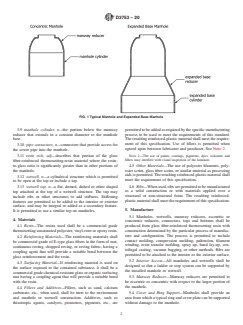
2.1 ASTM Standards: 3.4 expanded base manhole, n—a manhole with a larger
C581 Practice for Determining Chemical Resistance of
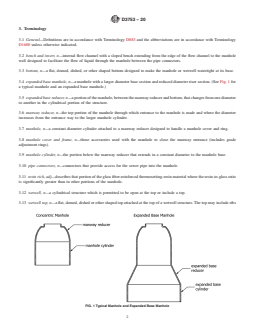
diameter base section and reduced diameter riser section. (See
Thermosetting Resins Used in Glass-Fiber-Reinforced
Fig. 1 for a typical manhole and an expanded base manhole.)
Structures Intended for Liquid Service
3.5 expanded base reducer, n—a portion of the manhole,
D695 Test Method for Compressive Properties of Rigid
between the manway reducer and bottom, that changes from
Plastics
one diameter to another in the cylindrical portion of the
D785 Test Method for Rockwell Hardness of Plastics and
structure.
3.6 manway reducer, n—the top portion of the manhole
through which entrance to the manhole is made and where the
This specification is under the jurisdiction of ASTM Committee D20 on
diameterincreasesfromtheentrancewaytothelargermanhole
Plastics and is the direct responsibility of Subcommittee D20.23 on Reinforced
Thermosetting Resin Piping Systems and Chemical Equipment. cylinder.
Current edition approved Dec. 1, 2020. Published December 2020. Originally
3.7 manhole, n—a constant diameter cylinder attached to a
approved in 1979. Last previous edition approved in 2019 as D3753 – 19. DOI:
manway reducer designed to handle a manhole cover and ring.
10.1520/D3753-20.
For referenced ASTM standards, visit the ASTM website, www.astm.org, or
3.8 manhole cover and frame, n—those accessories used
contact ASTM Customer Service at service@astm.org. For Annual Book of ASTM
withthemanholetoclosethemanwayentrance(includesgrade
Standards volume information, refer to the standard’s Document Summary page on
the ASTM website. adjustment rings).
*A Summary of Changes section appears at the end of this standard
Copyright © ASTM International, 100 Barr Harbor Drive, PO Box C700, West Conshohocken, PA 19428-2959. United States
D3753−20
FIG. 1Typical Manhole and Expanded Base Manhole
3.9 manhole cylinder, n—the portion below the manway permittedtobeaddedasrequiredbythespecificmanufacturing
reducer that extends in a constant diameter to the manhole process to be used to meet the requirements of this standard.
base. Theresultingreinforced-plasticmaterialshallmeettherequire-
ment of this specification. Use of fillers is permitted when
3.10 pipe connectors, n—connectors that provide access for
agreed upon between fabricator and purchaser. See Note 2.
the sewer pipe into the manhole.
NOTE 2—The use of paints, coatings, pigments, dyes, colorants and
3.11 resin rich, adj—describes that portion of the glass
fillers may interfere with visual inspection of the laminate.
fiber-reinforced thermosetting-resin material where the resin-
to-glass ratio is significantly greater than in other portions of 4.5 Other Materials—The use of polyester filaments, poly-
the manhole. ester scrim, glass fiber scrim, or similar material as processing
aidsispermitted.Theresultingreinforced-plasticmaterialshall
3.12 wetwell, n—a cylindrical structure which is permitted
meet the requirement of this specification.
to be open at the top or include a top.
4.6 Ribs—Whenused,ribsarepermittedtobemanufactured
3.13 wetwell top, n—a flat, domed, dished or other shaped
as a solid construction or with materials applied over a
top attached at the top of a wetwell structure. The top may
structural or non-structural form. The resulting reinforced-
include ribs or other structures to add stiffness. Stiffening
plasticmaterialshallmeettherequirementofthisspecification.
features are permitted to be added to the interior or exterior
surface, and may be integral or added as a secondary feature.
5. Manufacture
It is permitted to use a similar top on manholes.
5.1 Manholes, wetwells, manway reducers, eccentric or
4. Materials
concentric reducers, connectors, tops and bottoms shall be
4.1 Resin—The resins used shall be a commercial grade produced from glass fiber-reinforced thermosetting resin with
thermosetting unsaturated polyester, vinyl ester or epoxy resin. construction determined by the particular process of manufac-
ture and configuration. The process is permitted to include
4.2 Reinforcing Materials—The reinforcing materials shall
contact molding, compression molding, pultrusion, filament
be commercial grade of E-type glass fibers in the form of mat,
winding, resin transfer molding, spray up, hand lay-up, cen-
continuous roving, chopped roving, or roving fabric, having a
trifugal casting, vacuum bagging, or other methods. Ribs are
coupling agent that will provide a suitable bond between the
permitted to be attached to the interior or the exterior surface.
glass reinforcement and the resin.
5.2 Interior Access—All manholes and wetwells shall be
4.3 Surfacing Material—If reinforcing material is used on
designed so that a ladder or step system can be supported by
the surface exposed to the contained substance, it shall be a
the installed manhole or wetwell.
commercial grade chemical-resistant glass or organic surfacing
mat having a coupling agent that will provide a suitable bond 5.3 Manway Reducer—Manway reducers are permitted to
with the resin. be eccentric or concentric with respect to the larger portion of
the manhole.
4.4 Fillers and Additives—Fillers, such as sand, calcium
carbonate, etc., when used, shall be inert to the environment 5.4 Cover and Ring Support—Manholes shall provide an
and manhole or wetwell construction. Additives, such as areafromwhichatypicalringandcoverplatecanbesupported
thixotropic agents, catalysts, promoters, pigments, etc., are without damage to the manhole.
D3753−20
5.5 Assembly Joints—Product segments are permitted to be 6.4 Manhole Performance Test—One complete manhole
joined together to form a complete manhole or wetwell. manufactured in a manner consistent in every way with this
specification shall meet the performance criteria in 6.4.1 –
5.6 Manhole or Wetwell Bottom—Bottom shall be designed
6.4.3. If a change in materials or methods of manufacturing is
to be water tight and withstand the external hydraulic pressure
made and that change may affect the results of these tests, then
of water to grade. The bottom design is permitted to include
the testing shall be repeated.These tests are to be conducted on
methods to anchor the bottom to a concrete base or other
a representative manhole to qualify the finished product
external structure to provide the required resistance to external
characteristics. They are not considered to be a quality control
pressure.
procedure and are not required for production parts.
5.7 Bench and Invert—Bench and invert are permitted to be
6.4.1 Load Rating—The complete manhole shall have a
produced from glass fiber-reinforced thermosetting resin or
minimum dynamic-load rating of 16 000 lbf (71 172 N) when
other material suitable for the contents of the manhole. The
tested in accordance with 8.4. To establish this rating, the
bench and invert are permitted to include one or more ⁄2-in.
complete manhole shall not leak, crack, or suffer other damage
diameter ports to allow the equalization of pressure between
when load tested to 40 000 lbf (177 929 N) and shall not
the manhole interior and the cavity under the bench and invert.
deflect vertically downward more than 0.25 in. (6.35 mm) at
Use of larger ports is permitted to allow the field installation of
thepointofloadapplicationwhenloadedto24000lb(106757
concrete or grout in the cavity under the bench and invert.
N).
6.4.2 Stiffness—The manhole cylinder shall have the mini-
6. Requirements
mum pipe-stiffness values shown in Table 1 when tested in
accordance with 8.5. It is permitted to interpolate stiffness
6.1 Workmanship:
requirements for other manhole lengths between the values in
6.1.1 Exterior Surface—The exterior surface shall be rela-
Table 1.
tively smooth with no sharp projections. Hand-work finish is
6.4.3 Soundness—The manholes shall not leak when tested
acceptable if enough resin is present to saturate all fibers. The
in accordance with 8.6.
exterior surface shall be free of blisters larger than 0.5 in. (12.7
mm) in diameter and delamination. Fibers loosely attached
6.5 Wetwell Stiffness—The wetwell cylinder shall have the
(can be removed with wire brush) are allowed if not excessive.
minimum pipe-stiffness value shown in Table 1 when tested in
6.1.2 Exterior Paint or Pigmentation—Use of exterior
accordance with 8.5. It is permitted to interpolate stiffness
paints, coatings, pigments and colorants is permitted when
requirements for other wetwell lengths between the values in
agreed upon between fabricator and purchaser. See Note 2.
Table 1. These tests are to be conducted on a representative
6.1.3 Interior Surface—The interior surface shall be resin
wetwell to qualify the finished product characteristics. They
rich with no exposed fibers. The surface shall be free of
are not considered to be a quality control procedure and are not
crazing, delamination, blisters larger than 0.5 in. (12.7 mm) in
required for production parts.
diameter, and wrinkles of 0.125 in. (3.2 mm) or greater in
2 2
NOTE 3—Table 1 values are based upon a surrounding soil modulus of
depth.Surfacepitsshallbepermittedupto6/ft (60/m )ifthey
750 psi or greater.
are less than 0.75 in. (19 mm) in diameter and less than 0.0625
6.6 Chemical Resistance—Manhole or wetwell samples
in. (1.6 mm) deep. Voids that cannot be broken with finger
manufactured in a manner consistent in every way with this
pressure and that are entirely below the resin surface shall be
2 2
specification shall be tested in accordance with 8.7. The log of
permitted up to 4/ft (40/m ) if they are less than 0.5 in. (12.7
percent retention of each property after immersion testing
mm) in diameter.
when plotted against the log of immersion time, and extrapo-
6.1.4 Interior Paint or Pigmentation—Useofinteriorpaints,
lated to 100 000 h shall assure retention of at least 50 % of
coatings, pigments, and colorants are permitted when agreed
initial properties. If a change is made in the manhole construc-
upon between fabricator and purchaser. See Note 2.
tion and that change may affect the results of the chemical
6.1.5 Indentations—Indentations or other shape imperfec-
resistance testing, then the testing shall be repeated. Chemical
tions that will not affect performance are allowed.
testing is conducted to determine the applicability of the
6.2 Repairs—Any manhole or wetwell is permitted to be
materials used in the manufacture of the manhole to the
repaired to meet all requirements of this specification.
specified use conditions. It is not considered to be a quality
6.3 Dimensions—The dimensions shall be as shown below control procedure.
when measured in accordance with 8.3.1.
6.3.1 Minimumcylinderinternaldiameterofthemanholeor
wetwell shall be 42 in. (1057 mm). The minimum manway
TABLE 1 Stiffness Requirements
reducer inside diameter shall be 21 in. (533 mm).
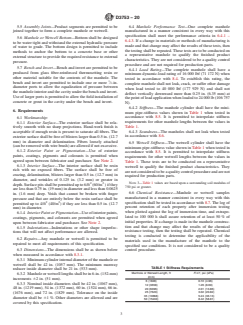
Manhole or Wetwell Length, ft F/∆Y, psi (kPa)
6.3.2 Manholeorwetwelllengthsshallbein6-in.(152-mm)
(mm)
increments 62 in. (51 mm).
6 (1829) 0.72 (4.96)
6.3.3 Nominal inside diameters shall be 42 in. (1067 mm),
12 (3658) 1.26 (8.69)
48 in. (1219 mm), 54 in. (1372 mm), 60 in. (1524 mm), 66 in. 20 (6096) 2.01 (13.86)
25 (7620) 3.02 (20.82)
(1676 mm), and 72 in. (1829 mm). Tolerance on the inside
35 (10668) 5.24 (36.13)
diameter shall be 61 %. Other diameters are allowed and are
50 (15240) 8.42 (58.81)
covered by this specification.
D3753−20
2 2
6.7 Material Properties—The following properties shall be Make a minimum of one thickness reading per 34 ft (3 m )of
established for each type of construction used in the manhole surface in areas of constant thickness. Through regions of wall
or wetwell. If a change in materials or methods of manufac- taper, make sufficient checks to establish the actual thickness.
turing is made and that change may affect the results of the
8.4 Load Rating:
following tests, then the testing shall be repeated. Material
8.4.1 Load Test—The manhole tested shall be long enough
properties tests are conducted to qualify the finished product
to include at least one of all unique or repetitive features of the
characteristics. They are not considered to be a quality control
cylinder wall such as: bonded joints, adhesive seams, gasketed
procedure and are not required for production parts.
joints, etc., except for reducers and cylinder sections of a
6.7.1 Material Composition—The material composition of
different diameter than the manhole. In any case, the minimum
the manhole or wetwell in percent by weight shall be deter-
lengthofthemanholecylindershallnotbelessthan36in.(914
mined in accordance with 8.8.1.
mm) for each cylinder diameter.
6.7.2 Compressive Strength—The compressive strength in
8.4.1.1 Concentric Manholes—The manhole to be tested
the hoop and axial directions of the manhole or wetwell shall
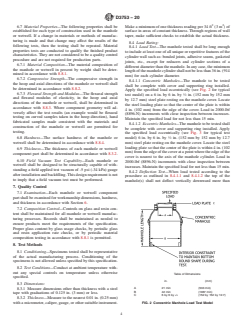
shall be complete with cover and supporting ring installed.
be determined in accordance with 8.8.2.
Apply the specified load eccentrically (see Fig. 2 for typical
6.7.3 Flexural Strength and Modulus—T
...
This document is not an ASTM standard and is intended only to provide the user of an ASTM standard an indication of what changes have been made to the previous version. Because
it may not be technically possible to adequately depict all changes accurately, ASTM recommends that users consult prior editions as appropriate. In all cases only the current version
of the standard as published by ASTM is to be considered the official document.
Designation: D3753 − 19 D3753 − 20
Standard Specification for
Fiberglass (Glass-Fiber-Reinforced Thermosetting-Resin)
Manholes and Wetwells
This standard is issued under the fixed designation D3753; the number immediately following the designation indicates the year of
original adoption or, in the case of revision, the year of last revision. A number in parentheses indicates the year of last reapproval. A
superscript epsilon (´) indicates an editorial change since the last revision or reapproval.
1. Scope*
1.1 This specification covers “fiberglass” (glass fiber-reinforced thermosetting-resin) manholes and wetwells fabricated with
polyester, vinyl ester, or epoxy resin for use primarily in sanitary, storm, and industrial sewer applications.
1.2 The values given in inch-pound units are to be regarded as the standard. The values in parentheses are provided for information
purposes only.
1.3 The following precautionary caveat pertains only to the test methods portion, Section 8, of this specification: This standard
does not purport to address all of the safety concerns, if any, associated with its use. It is the responsibility of the user of this
standard to establish appropriate safety, health, and environmental practices and determine the applicability of regulatory
limitations prior to use.
NOTE 1—There is no known ISO equivalent to this standard.
1.4 This international standard was developed in accordance with internationally recognized principles on standardization
established in the Decision on Principles for the Development of International Standards, Guides and Recommendations issued
by the World Trade Organization Technical Barriers to Trade (TBT) Committee.
2. Referenced Documents
2.1 ASTM Standards:
C581 Practice for Determining Chemical Resistance of Thermosetting Resins Used in Glass-Fiber-Reinforced Structures
Intended for Liquid Service
D695 Test Method for Compressive Properties of Rigid Plastics
D785 Test Method for Rockwell Hardness of Plastics and Electrical Insulating Materials
D790 Test Methods for Flexural Properties of Unreinforced and Reinforced Plastics and Electrical Insulating Materials
D883 Terminology Relating to Plastics
D1600 Terminology for Abbreviated Terms Relating to Plastics
D2412 Test Method for Determination of External Loading Characteristics of Plastic Pipe by Parallel-Plate Loading
D2583 Test Method for Indentation Hardness of Rigid Plastics by Means of a Barcol Impressor
D2584 Test Method for Ignition Loss of Cured Reinforced Resins
D3892 Practice for Packaging/Packing of Plastics
This specification is under the jurisdiction of ASTM Committee D20 on Plastics and is the direct responsibility of Subcommittee D20.23 on Reinforced Plastic
Thermosetting Resin Piping Systems and Chemical Equipment.
Current edition approved Sept. 1, 2019Dec. 1, 2020. Published September 2019December 2020. Originally approved in 1979. Last previous edition approved in 20122019
ε1
as D3753 – 12D3753 – 19. . DOI: 10.1520/D3753-19.10.1520/D3753-20.
For referenced ASTM standards, visit the ASTM website, www.astm.org, or contact ASTM Customer Service at service@astm.org. For Annual Book of ASTM Standards
volume information, refer to the standard’s Document Summary page on the ASTM website.
*A Summary of Changes section appears at the end of this standard
Copyright © ASTM International, 100 Barr Harbor Drive, PO Box C700, West Conshohocken, PA 19428-2959. United States
D3753 − 20
3. Terminology
3.1 General—Definitions are in accordance with Terminology D883 and the abbreviations are in accordance with Terminology
D1600 unless otherwise indicated.
3.2 bench and invert, n—internal flow channel with a sloped bench extending from the edge of the flow channel to the manhole
wall designed to facilitate the flow of liquid through the manhole between the pipe connectors.
3.3 bottom, n—a flat, domed, dished, or other shaped bottom designed to make the manhole or wetwell watertight at its base.
3.4 expanded base manhole, n—a manhole with a larger diameter base section and reduced diameter riser section. (See Fig. 1 for
a typical manhole and an expanded base manhole.)
3.5 expanded base reducer, n—a portion of the manhole, between the manway reducer and bottom, that changes from one diameter
to another in the cylindrical portion of the structure.
3.6 manway reducer, n—the top portion of the manhole through which entrance to the manhole is made and where the diameter
increases from the entrance way to the larger manhole cylinder.
3.7 manhole, n—a constant diameter cylinder attached to a manway reducer designed to handle a manhole cover and ring.
3.8 manhole cover and frame, n—those accessories used with the manhole to close the manway entrance (includes grade
adjustment rings).
3.9 manhole cylinder, n—the portion below the manway reducer that extends in a constant diameter to the manhole base.
3.10 pipe connectors, n—connectors that provide access for the sewer pipe into the manhole.
3.11 resin rich, adj—describes that portion of the glass fiber-reinforced thermosetting-resin material where the resin-to-glass ratio
is significantly greater than in other portions of the manhole.
3.12 wetwell, n—a cylindrical structure which is permitted to be open at the top or include a top.
3.13 wetwell top, n—a flat, domed, dished or other shaped top attached at the top of a wetwell structure. The top may include ribs
FIG. 1 Typical Manhole and Expanded Base Manhole
D3753 − 20
or other structures to add stiffness. Stiffening features are permitted to be added to the interior or exterior surface, and may be
integral or added as a secondary feature. It is permitted to use a similar top on manholes.
4. Materials
4.1 Resin—The resins used shall be a commercial grade thermosetting unsaturated polyester, vinyl ester or epoxy resin.
4.2 Reinforcing Materials—The reinforcing materials shall be commercial grade of E-type glass fibers in the form of mat,
continuous roving, chopped roving, or roving fabric, having a coupling agent that will provide a suitable bond between the glass
reinforcement and the resin.
4.3 Surfacing Material—If reinforcing material is used on the surface exposed to the contained substance, it shall be a commercial
grade chemical-resistant glass or organic surfacing mat having a coupling agent that will provide a suitable bond with the resin.
4.4 Fillers and Additives—Fillers, such as sand, calcium carbonate, etc., when used, shall be inert to the environment and manhole
or wetwell construction. Additives, such as thixotropic agents, catalysts, promoters, pigments, etc., are permitted to be added as
required by the specific manufacturing process to be used to meet the requirements of this standard. The resulting reinforced-plastic
material shall meet the requirement of this specification. Use of fillers is permitted when agreed upon between fabricator and
purchaser. See Note 2.
NOTE 2—The use of paints, coatings, pigments, dyes, colorants and fillers may interfere with visual inspection of the laminate.
4.5 Other Materials—The use of polyester filaments, polyester scrim, glass fiber scrim, or similar material as processing aids is
permitted. The resulting reinforced-plastic material shall meet the requirement of this specification.
4.6 Ribs—When used, ribs are permitted to be manufactured as a solid construction or with materials applied over a structural or
non-structural form. The resulting reinforced-plastic material shall meet the requirement of this specification.
5. Manufacture
5.1 Manholes, wetwells, manway reducers, eccentric or concentric reducers, connectors, tops and bottoms shall be produced from
glass fiber-reinforced thermosetting resin with construction determined by the particular process of manufacture and configuration.
The process is permitted to include contact molding, compression molding, pultrusion, filament winding, resin transfer molding,
spray up, hand lay-up, centrifugal casting, vacuum bagging, or other methods. Ribs are permitted to be attached to the interior or
the exterior surface.
5.2 Interior Access—All manholes and wetwells shall be designed so that a ladder or step system can be supported by the installed
manhole or wetwell.
5.3 Manway Reducer—Manway reducers are permitted to be eccentric or concentric with respect to the larger portion of the
manhole.
5.4 Cover and Ring Support—Manholes shall provide an area from which a typical ring and cover plate can be supported without
damage to the manhole.
5.5 Assembly Joints—Product segments are permitted to be joined together to form a complete manhole or wetwell.
5.6 Manhole or Wetwell Bottom—Bottom shall be designed to be water tight and withstand the external hydraulic pressure of water
to grade. The bottom design is permitted to include methods to anchor the bottom to a concrete base or other external structure
to provide the required resistance to external pressure.
5.7 Bench and Invert—Bench and invert are permitted to be produced from glass fiber-reinforced thermosetting resin or other
material suitable for the contents of the manhole. The bench and invert are permitted to include one or more ⁄2-in. diameter ports
to allow the equalization of pressure between the manhole interior and the cavity under the bench and invert. Use of larger ports
is permitted to allow the field installation of concrete or grout in the cavity under the bench and invert.
D3753 − 20
6. Requirements
6.1 Workmanship:
6.1.1 Exterior Surface—The exterior surface shall be relatively smooth with no sharp projections. Hand-work finish is acceptable
if enough resin is present to saturate all fibers. The exterior surface shall be free of blisters larger than 0.5 in. (12.7 mm) in diameter
and delamination. Fibers loosely attached (can be removed with wire brush) are allowed if not excessive.
6.1.2 Exterior Paint or Pigmentation—Use of exterior paints, coatings, pigments and colorants is permitted when agreed upon
between fabricator and purchaser. See Note 2.
6.1.3 Interior Surface—The interior surface shall be resin rich with no exposed fibers. The surface shall be free of crazing,
delamination, blisters larger than 0.5 in. (12.7 mm) in diameter, and wrinkles of 0.125 in. (3.2 mm) or greater in depth. Surface
2 2
pits shall be permitted up to 6/ft (60/m ) if they are less than 0.75 in. (19 mm) in diameter and less than 0.0625 in. (1.6 mm)
deep. Voids that cannot be broken with finger pressure and that are entirely below the resin surface shall be permitted up to 4/ft
(40/m ) if they are less than 0.5 in. (12.7 mm) in diameter.
6.1.4 Interior Paint or Pigmentation—Use of interior paints, coatings, pigments, and colorants are permitted when agreed upon
between fabricator and purchaser. See Note 2.
6.1.5 Indentations—Indentations or other shape imperfections that will not affect performance are allowed.
6.2 Repairs—Any manhole or wetwell is permitted to be repaired to meet all requirements of this specification.
6.3 Dimensions—The dimensions shall be as shown below when measured in accordance with 8.3.1.
6.3.1 Minimum cylinder internal diameter of the manhole or wetwell shall be 42 in. (1057 mm). The minimum manway reducer
inside diameter shall be 21 in. (533 mm).
6.3.2 Manhole or wetwell lengths shall be in 6-in. (152-mm) increments 62 in. (51 mm).
6.3.3 Nominal inside diameters shall be 42 in. (1067 mm), 48 in. (1219 mm), 54 in. (1372 mm), 60 in. (1524 mm), 66 in. (1676
mm), and 72 in. (1829 mm). Tolerance on the inside diameter shall be 61 %. Other diameters are allowed and are covered by this
specification.
6.4 Manhole Performance Test—One complete manhole manufactured in a manner consistent in every way with this specification
shall meet the performance criteria in 6.4.1 – 6.4.3. If a change in materials or methods of manufacturing is made and that change
may affect the results of these tests, then the testing shall be repeated. These tests are to be conducted on a representative manhole
to qualify the finished product characteristics. They are not considered to be a quality control procedure and are not required for
production parts.
6.4.1 Load Rating—The complete manhole shall have a minimum dynamic-load rating of 16 000 lbf (71 172 N) when tested in
accordance with 8.4. To establish this rating, the complete manhole shall not leak, crack, or suffer other damage when load tested
to 40 000 lbf (177 929 N) and shall not deflect vertically downward more than 0.25 in. (6.35 mm) at the point of load application
when loaded to 24 000 lb (106 757 N).
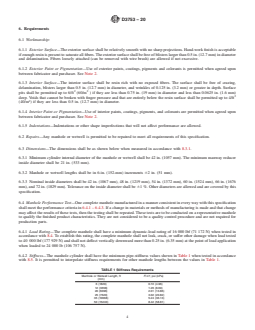
6.4.2 Stiffness—The manhole cylinder shall have the minimum pipe-stiffness values shown in Table 1 when tested in accordance
with 8.5. It is permitted to interpolate stiffness requirements for other manhole lengths between the values in Table 1.
TABLE 1 Stiffness Requirements
Manhole or Wetwell Length, ft F/ΔY, psi (kPa)
(mm)
6 (1829) 0.72 (4.96)
12 (3658) 1.26 (8.69)
20 (6096) 2.01 (13.86)
25 (7620) 3.02 (20.82)
35 (10668) 5.24 (36.13)
50 (15240) 8.42 (58.81)
D3753 − 20
6.4.3 Soundness—The manholes shall not leak when tested in accordance with 8.6.
6.5 Wetwell Stiffness—The wetwell cylinder shall have the minimum pipe-stiffness value shown in Table 1 when tested in
accordance with 8.5. It is permitted to interpolate stiffness requirements for other wetwell lengths between the values in Table 1.
These tests are to be conducted on a representative wetwell to qualify the finished product characteristics. They are not considered
to be a quality control procedure and are not required for production parts.
NOTE 3—Table 1 values are based upon a surrounding soil modulus of 750 psi or greater. This value is representative of moderately compacted fine grain
sand.
6.6 Chemical Resistance—Manhole or wetwell samples manufactured in a manner consistent in every way with this specification
shall be tested in accordance with 8.7. The log of percent retention of each property after immersion testing when plotted against
the log of immersion time, and extrapolated to 100 000 h shall assure retention of at least 50 % of initial properties. If a change
is made in the manhole construction and that change may affect the results of the chemical resistance testing, then the testing shall
be repeated. Chemical testing is conducted to determine the applicability of the materials used in the manufacture of the manhole
to the specified use conditions. It is not considered to be a quality control procedure.
6.7 Material Properties—The following properties shall be established for each type of construction used in the manhole or
wetwell. If a change in materials or methods of manufacturing is made and that change may affect the results of the following tests,
then the testing shall be repeated. Material properties tests are conducted to qualify the finished product characteristics. They are
not considered to be a quality control procedure and are not required for production parts.
6.7.1 Material Composition—The material composition of the manhole or wetwell in percent by weight shall be determined in
accordance with 8.8.1.
6.7.2 Compressive Strength—The compressive strength in the hoop and axial directions of the manhole or wetwell shall be
determined in accordance with 8.8.2.
6.7.3 Flexural Strength and Modulus—The flexural strength and flexural modulus of elasticity, in the hoop and axial directions
of the manhole or wetwell, shall be determined in accordance with 8.8.3. Where component geometry will adversely affect the test
results (an example would be flexural testing on curved samples taken in the hoop direction), hand fabricated samples made
consistent with the materials and construction of the manhole or wetwell are permitted for testing.
6.8 Hardness—The surface hardness of the manhole or wetwell shall be determined in accordance with 8.8.4.
6.9 Thickness—The thickness of each manhole or wetwell component part shall be determined in accordance with 8.3.2.
6.10 Field Vacuum Test Capability—Each
...