

ASTM F2191/F2191M-13(2020)e1
(Specification)Standard Specification for Packing Material, Graphitic or Carbon Braided Yarn
General Information
- Abstract
ABSTRACT
This specification covers staple or continuous filament carbon/graphite yarn valve stem compression packing, suitable for use as end-rings on packing systems for valves. Intended services include steam, hydrocarbons, water and non-oxidizing chemicals. The material shall be of the following types, classes, and grades: Type I, type II, and Type III; Class 1; Class 2; and Class 3; and Grade A and Grade B. The following tests shall be performed: size; mass; carbon assay; ash content; specific gravity; moisture content; detrimental materials tests; analysis of PTFE coating; compression recovery; and braid geometry retention.
SCOPE
1.1 This specification covers staple or continuous filament carbon/graphite yarn valve stem compression packing, suitable for use as end-rings on packing systems for valves. Intended services include steam, hydrocarbons, water, and non-oxidizing chemicals. Where this specification is invoked as ASTM F2191/F2191M, Sections 1 – 18 apply. Where this specification is invoked as ASTM/DoD F2191/F2191M, Sections 1 – 18 and the Supplementary Requirements shall be applicable.
1.2 The values stated in either SI units or inch-pound units are to be regarded separately as standard. The values stated in each system are not necessarily exact equivalents; therefore, to ensure conformance with the standard, each system shall be used independently of the other, and values from the two systems shall not be combined.
1.3 This standard does not purport to address all of the safety concerns, if any, associated with its use. It is the responsibility of the user of this standard to establish appropriate safety, health, and environmental practices and determine the applicability of regulatory limitations prior to use.
1.4 This international standard was developed in accordance with internationally recognized principles on standardization established in the Decision on Principles for the Development of International Standards, Guides and Recommendations issued by the World Trade Organization Technical Barriers to Trade (TBT) Committee.
- Status
- Published
- Publication Date
- 31-Jan-2020
- Technical Committee
- F25 - Ships and Marine Technology
- Drafting Committee
- F25.02 - Insulation/Processes
Overview
ASTM F2191/F2191M-13(2020)e1: Standard Specification for Packing Material, Graphitic or Carbon Braided Yarn is a comprehensive international standard developed by ASTM for the specification and quality assurance of carbon or graphite yarn valve stem compression packing. This packing is intended for use as end-rings in valve packing systems, especially in demanding environments such as steam, hydrocarbons, water, and non-oxidizing chemical service.
The standard addresses both staple and continuous filament carbon/graphite yarns and assesses their suitability through a range of classification types, classes, and grades. Compliance requires robust testing of physical and chemical properties and adherence to specified dimensional and packaging requirements.
Key Topics
Fundamental aspects covered by ASTM F2191/F2191M-13(2020)e1 include:
Material Types and Grades:
- Type I: Continuous carbon or graphite yarn
- Type II: Staple carbon or graphite yarn
- Type III: Braided flexible graphite
- Grades A and B: Based on corrosion inhibitor content
Critical Properties and Performance Criteria:
- Minimum carbon assay requirements
- Maximum allowable ash and moisture content
- Specific gravity ranges
- Compression recovery
- Braid geometry retention
Detrimental Materials Control:
- Limitations on impurities (e.g., mercury, sulfur, halogens) for Class 2
- Prohibition of certain additives (antimony, arsenic, bismuth, lead, tin, etc.)
- Restrictions on PTFE coatings and corrosion inhibitor additives
Test Methods and Inspection:
- Standardized procedures for evaluation (e.g., carbon assay, ash testing, specific gravity, moisture measurement)
- Visual and dimensional inspection requirements
- Packing must be free from defects that could affect serviceability
Product Marking and Packaging:
- Detailed marking to indicate type, class, grade, and corrosion inhibitor
- Packaging in sizes and forms (spool or reel) as specified in purchase documents
Applications
ASTM F2191/F2191M-13(2020)e1 is especially valuable for industries and sectors where valve reliability and longevity are critical:
Power Generation:
Carbon or graphite braided yarn packing provides durable sealing in steam valves exposed to high temperatures and pressures.Oil and Gas Processing:
Reliable valve stem packing helps maintain integrity in hydrocarbon systems, preventing leaks and minimizing downtime.Chemical Plants:
Suitable for water, steam, and non-oxidizing chemicals, offering resistance to aggressive environments.Marine and Naval Engineering:
The standard supports both commercial and military procurement by providing supplementary requirements for shipboard valve applications.
By following this specification, enterprises can ensure the consistent quality and integrity of valve stem packing material, reduce maintenance costs, and maintain regulatory compliance.
Related Standards
For a comprehensive approach to sealing solutions and material characterization, the following related standards and references are commonly cited with ASTM F2191/F2191M:
- ASTM C135: Test Method for True Specific Gravity of Refractory Materials by Water Immersion
- ASTM C561: Test Method for Ash in a Graphite Sample
- ASTM C562: Test Method for Moisture in a Graphite Sample
- ASTM D3951: Practice for Commercial Packaging
- MIL-STD-129: Marking for Shipment and Storage
- MIL-P-24583: Packing Material, Graphitic or Carbon Braided Yarn
- Fluid Sealing Association Handbook: Guidelines for the Use of Compression Packings
Practical Value
Following ASTM F2191/F2191M-13(2020)e1 assures users and buyers of packing material quality, compatibility with demanding service conditions, and repeatable, reliable performance. Its alignment with international trade principles improves supplier acceptance and fulfills both commercial and defense contracting expectations.
Keywords:
graphite packing, carbon braided yarn, valve stem compression packing, industrial sealing solutions, ASTM standards, compression packing material, steam valve packing, chemical resistant packing.
Relations
- Replaces
ASTM F2191/F2191M-13 - Standard Specification for Packing Material, Graphitic or Carbon Braided Yarn - Effective Date
- 01-Feb-2020
- Effective Date
- 01-Oct-2023
- Effective Date
- 01-Sep-2018
- Effective Date
- 01-May-2018
- Effective Date
- 01-Feb-2018
- Effective Date
- 15-May-2017
- Effective Date
- 01-Dec-2015
- Effective Date
- 01-Mar-2014
- Effective Date
- 01-Mar-2014
- Effective Date
- 01-Oct-2013
- Effective Date
- 01-Oct-2013
- Effective Date
- 01-Feb-2012
- Effective Date
- 01-Oct-2011
- Effective Date
- 01-Jun-2011
- Effective Date
- 01-Apr-2011
Get Certified
Connect with accredited certification bodies for this standard

BRCGS (Brand Reputation Compliance Global Standards)
Global food safety and quality standards owner.
Sponsored listings
Frequently Asked Questions
ASTM F2191/F2191M-13(2020)e1 is a technical specification published by ASTM International. Its full title is "Standard Specification for Packing Material, Graphitic or Carbon Braided Yarn". This standard covers: ABSTRACT This specification covers staple or continuous filament carbon/graphite yarn valve stem compression packing, suitable for use as end-rings on packing systems for valves. Intended services include steam, hydrocarbons, water and non-oxidizing chemicals. The material shall be of the following types, classes, and grades: Type I, type II, and Type III; Class 1; Class 2; and Class 3; and Grade A and Grade B. The following tests shall be performed: size; mass; carbon assay; ash content; specific gravity; moisture content; detrimental materials tests; analysis of PTFE coating; compression recovery; and braid geometry retention. SCOPE 1.1 This specification covers staple or continuous filament carbon/graphite yarn valve stem compression packing, suitable for use as end-rings on packing systems for valves. Intended services include steam, hydrocarbons, water, and non-oxidizing chemicals. Where this specification is invoked as ASTM F2191/F2191M, Sections 1 – 18 apply. Where this specification is invoked as ASTM/DoD F2191/F2191M, Sections 1 – 18 and the Supplementary Requirements shall be applicable. 1.2 The values stated in either SI units or inch-pound units are to be regarded separately as standard. The values stated in each system are not necessarily exact equivalents; therefore, to ensure conformance with the standard, each system shall be used independently of the other, and values from the two systems shall not be combined. 1.3 This standard does not purport to address all of the safety concerns, if any, associated with its use. It is the responsibility of the user of this standard to establish appropriate safety, health, and environmental practices and determine the applicability of regulatory limitations prior to use. 1.4 This international standard was developed in accordance with internationally recognized principles on standardization established in the Decision on Principles for the Development of International Standards, Guides and Recommendations issued by the World Trade Organization Technical Barriers to Trade (TBT) Committee.
ABSTRACT This specification covers staple or continuous filament carbon/graphite yarn valve stem compression packing, suitable for use as end-rings on packing systems for valves. Intended services include steam, hydrocarbons, water and non-oxidizing chemicals. The material shall be of the following types, classes, and grades: Type I, type II, and Type III; Class 1; Class 2; and Class 3; and Grade A and Grade B. The following tests shall be performed: size; mass; carbon assay; ash content; specific gravity; moisture content; detrimental materials tests; analysis of PTFE coating; compression recovery; and braid geometry retention. SCOPE 1.1 This specification covers staple or continuous filament carbon/graphite yarn valve stem compression packing, suitable for use as end-rings on packing systems for valves. Intended services include steam, hydrocarbons, water, and non-oxidizing chemicals. Where this specification is invoked as ASTM F2191/F2191M, Sections 1 – 18 apply. Where this specification is invoked as ASTM/DoD F2191/F2191M, Sections 1 – 18 and the Supplementary Requirements shall be applicable. 1.2 The values stated in either SI units or inch-pound units are to be regarded separately as standard. The values stated in each system are not necessarily exact equivalents; therefore, to ensure conformance with the standard, each system shall be used independently of the other, and values from the two systems shall not be combined. 1.3 This standard does not purport to address all of the safety concerns, if any, associated with its use. It is the responsibility of the user of this standard to establish appropriate safety, health, and environmental practices and determine the applicability of regulatory limitations prior to use. 1.4 This international standard was developed in accordance with internationally recognized principles on standardization established in the Decision on Principles for the Development of International Standards, Guides and Recommendations issued by the World Trade Organization Technical Barriers to Trade (TBT) Committee.
ASTM F2191/F2191M-13(2020)e1 is classified under the following ICS (International Classification for Standards) categories: 55.040 - Packaging materials and accessories. The ICS classification helps identify the subject area and facilitates finding related standards.
ASTM F2191/F2191M-13(2020)e1 has the following relationships with other standards: It is inter standard links to ASTM F2191/F2191M-13, ASTM D3951-18(2023), ASTM D4239-18, ASTM D3951-18, ASTM C889-18, ASTM D4239-17, ASTM D3951-15, ASTM D4239-14, ASTM D4239-14e1, ASTM D4239-13e1, ASTM D4239-13, ASTM D4239-12, ASTM D129-11, ASTM C889-11, ASTM D4239-11. Understanding these relationships helps ensure you are using the most current and applicable version of the standard.
ASTM F2191/F2191M-13(2020)e1 is available in PDF format for immediate download after purchase. The document can be added to your cart and obtained through the secure checkout process. Digital delivery ensures instant access to the complete standard document.
Standards Content (Sample)
This international standard was developed in accordance with internationally recognized principles on standardization established in the Decision on Principles for the
Development of International Standards, Guides and Recommendations issued by the World Trade Organization Technical Barriers to Trade (TBT) Committee.
´1
Designation:F2191/F2191M −13 (Reapproved 2020) An American National Standard
Standard Specification for
Packing Material, Graphitic or Carbon Braided Yarn
ThisstandardisissuedunderthefixeddesignationF2191/F2191M;thenumberimmediatelyfollowingthedesignationindicatestheyear
of original adoption or, in the case of revision, the year of last revision.Anumber in parentheses indicates the year of last reapproval.
A superscript epsilon (´) indicates an editorial change since the last revision or reapproval.
ε NOTE—Keywords were added editorially in February 2020.
1. Scope C135Test Method for True Specific Gravity of Refractory
Materials by Water Immersion
1.1 This specification covers staple or continuous filament
C561Test Method for Ash in a Graphite Sample
carbon/graphiteyarnvalvestemcompressionpacking,suitable
C562Test Method for Moisture in a Graphite Sample
for use as end-rings on packing systems for valves. Intended
C816 Test Method for Sulfur Content in Graphite by
services include steam, hydrocarbons, water, and non-
Combustion-Iodometric Titration Method
oxidizing chemicals. Where this specification is invoked as
C889Test Methods for Chemical and Mass Spectrometric
ASTM F2191/F2191M, Sections1–18 apply. Where this
Analysis of Nuclear-Grade Gadolinium Oxide (Gd O )
2 3
specification is invoked as ASTM/DoD F2191/F2191M, Sec-
Powder
tions1–18 and the Supplementary Requirements shall be
D129Test Method for Sulfur in Petroleum Products (Gen-
applicable.
eral High Pressure Decomposition Device Method)
1.2 The values stated in either SI units or inch-pound units
D512Test Methods for Chloride Ion In Water
are to be regarded separately as standard. The values stated in
D1179Test Methods for Fluoride Ion in Water
each system are not necessarily exact equivalents; therefore, to
D1246Test Method for Bromide Ion in Water
ensure conformance with the standard, each system shall be
D3178Test Methods for Carbon and Hydrogen in the
used independently of the other, and values from the two
Analysis Sample of Coal and Coke (Withdrawn 2007)
systems shall not be combined.
D3684Test Method for Total Mercury in Coal by the
1.3 This standard does not purport to address all of the Oxygen Bomb Combustion/Atomic Absorption Method
safety concerns, if any, associated with its use. It is the
(Withdrawn 2014)
responsibility of the user of this standard to establish appro-
D3761Test Method for Total Fluorine in Coal by the
priate safety, health, and environmental practices and deter- Oxygen Bomb Combustion/Ion Selective Electrode
mine the applicability of regulatory limitations prior to use.
Method (Withdrawn 2019)
1.4 This international standard was developed in accor- D3951Practice for Commercial Packaging
dance with internationally recognized principles on standard-
D4239Test Method for Sulfur in the Analysis Sample of
ization established in the Decision on Principles for the Coal and Coke Using High-Temperature Tube Furnace
Development of International Standards, Guides and Recom-
Combustion
mendations issued by the World Trade Organization Technical 2.2 Military Standards:
Barriers to Trade (TBT) Committee.
MIL-STD-129Marking for Shipment and Storage
MIL-P-24583 Packing Material, Graphitic or Carbon
2. Referenced Documents
Braided Yarn
MIL-P-24503Packing Material, Graphitic, Corrugated Rib-
2.1 ASTM Standards:
bon or Textured Tape and Preformed Ring
2.3 Fluid Sealing Association Handbook:
Guidelines for the Use of Compression Packings, Copyright
This specification is under the jurisdiction ofASTM Committee F25 on Ships
and Marine Technology and is the direct responsibility of Subcommittee F25.02 on 1997
Insulation/Processes.
Current edition approved Feb. 1, 2020. Published March 2020. Originally
approved in 2002. Last previous edition approved in 2013 as F2191/F2191M–13. The last approved version of this historical standard is referenced on
DOI: 10.1520/F2191_F2191M-13R20E01. www.astm.org.
2 4
For referenced ASTM standards, visit the ASTM website, www.astm.org, or Available from DLA Document Services, Building 4/D, 700 Robbins Ave.,
contact ASTM Customer Service at service@astm.org. For Annual Book of ASTM Philadelphia, PA 19111-5094, http://quicksearch.dla.mil.
Standards volume information, refer to the standard’s Document Summary page on Available from the Fluid Sealing Association, 994 Old Eagle School Road,
the ASTM website. Suite 1019, Wayne, PA 19087-1866, http://www.fluidsealing.com
Copyright © ASTM International, 100 Barr Harbor Drive, PO Box C700, West Conshohocken, PA 19428-2959. United States
´1
F2191/F2191M−13 (2020)
TABLE 2 Detrimental Materials (Class 2 Only (See 13.8))
3. Terminology
Maximum Allowable
3.1 Definitions:
Total
Element
3.1.1 base fiber density, n—bulk density of the base fiber
Impurity Levels in
parts per million (ppm)
before being coated or impregnated and braided into packing.
Mercury (Hg) 10
3.1.2 braided flexible graphite, n—a braid constructed of
Sulfur (S) 750
Total halogens (chlorine, bromine, and fluorine) 500
continuous strands or strips of expanded flexible graphite tape
Chlorine (Cl) 250
or ribbons, which have been overwrapped or have imbedded
Bromine (Br) 250
reinforcing fibers.
Fluorine (F) 250
3.1.3 carbon fibers, n—fibers used in braided packing are
producedfromviscoserayon,pitch,orpolyacrylonitrile(PAN)
3.1.12 dispersion, n—various coatings or impregnants
andaredefinedasayarnwithacarbonassayoflessthan99%.
addedtothebasefibersorbraidtofacilitatehandling,lubricate
3.1.4 carbon yarns, n—manufactured from continuous or
the fibers, accelerate break-in, or act as blocking agents during
staple carbon fibers that are twisted or plied into continuous use.
individual strands of between 6 and 18 µm in diameter.
3.1.13 graphite fibers, n—fibersusedinbraidedpackingare
producedfromviscoserayon,pitch,orpolyacrylonitrile(PAN)
3.1.5 carbon/graphite fibers, n—carbon/graphite fibers used
in braided packing are produced from viscose rayon, pitch, or andaredefinedasayarnwithacarbonassayof99%orhigher.
polyacrylonitrile (PAN).
3.1.14 graphite yarns, n—manufactured from continuous or
staple graphite fibers that are twisted or plied into continuous
3.1.6 center or corner filler strands, n—strandsoffiber/yarn
individual strands between 6 to 18 µm in diameter.
that run parallel to the longitudinal axis of the braid in the
corners or center to control the internal density and dimen-
3.1.15 lot, n—all finished packing of one size, type, class,
sional stability of the braid.
andgradeproducedinacontinuousrunoratthesametimeand
under essentially the same conditions.
3.1.7 continuous, adj—individual fibers are almost infinite
in length. 3.1.16 PAN—polyacrylonitrile fibers used as precursors to
manufacture carbon/graphite for braided packing.
3.1.8 continuous or staple carbon/graphite, n—continuous
3.1.17 PTFE—polytetrafluoroethylene. (Warning—
or staple defines the length of the individual fibers in the
Graphitic valve packing containing PTFE has been associated
carbonaceous yarn. Continuous means the fibers are infinite in
with accelerated valve stem corrosion.)
lengthandstaplemeanstheindividualfibersareatleast75mm
[3in.] long and preferably150to200mm[6to8in.]long.All
3.1.18 specific gravity, n—the ratio of the mass of a unit
of the fibers are between 6 to 18 µm in diameter and are
volume of a material at a stated temperature to the mass of the
twisted/plied into continuous strands called yarns.
same volume of distilled water at the same temperature.
3.1.9 corrosion inhibitors, n—additives to the yarn or braid
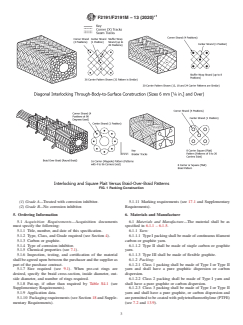
3.1.19 squareplaitbraid,n—thestrandsinthistypeofbraid
tofunctioninapassiveorsacrificialmannertoreducegalvanic interlock in a single plane and do not interlock through the
corrosion such as embedded zinc powder, phosphorus, or
body of the braid (see Fig. 1).
barium molybdate.
3.1.20 staple carbon/graphite, n—individual fibers are at
least 75 mm [3 in.] long and preferably 150 to 200 mm [6 to 8
3.1.10 detrimental materials, n—abrasive or chemically ac-
in.] long.
tive constituents such as abrasive ash particles (in high ash
content foils) or elemental materials as in Table 2.
3.1.21 unraveling, v—a loss of the original braiding shape
or dimensions of the cut end extending from the cut for a
3.1.11 diagonal interlocking braid, n—these strands criss-
distance greater than that specified along the axis of the
crossfromthesurfaceofthebraiddiagonallythroughthebody
packing.
of the braid and each strand is strongly locked by other strands
to form an integral structure (see Fig. 1).
4. Classification
4.1 Classification—The material shall be of the following
types, classes, and grades, as specified (see 5.1):
4.1.1 Type I—Continuous carbon or graphite yarn.
TABLE 1 Chemical and Physical Properties
4.1.2 Type II—Staple carbon or graphite yarn.
Property Value Test
4.1.3 Type III—Braided flexible graphite.
Carbon Assay
4.1.3.1 Class 1—For use where detrimental material and
Graphitic 99 % by mass, min. 13.4
lubricant content of the packing need not be controlled beyond
Carbon 95 % by mass, min. 13.4
Ash 1 % by mass, max. 13.5
normal manufacturing limits.
4.1.3.2 Class 2—For use where detrimental materials con-
Finished Packing
(in as-supplied state): tent must be controlled to limits specified herein.
Specific gravity 1.38 g/cc, min. 13.6
4.1.3.3 Class 3—For use where detrimental materials con-
Moisture content 3 %, max. 13.7
tent need not be controlled beyond normal manufacturing
Compression recovery 25 %, min. 13.10
limits, and media temperatures do not exceed 500°F [260°C].
´1
F2191/F2191M−13 (2020)
FIG. 1 Packing Construction
(1) Grade A—Treated with corrosion inhibitor. 5.1.11 Marking requirements (see 17.1 and Supplementary
(2) Grade B—No corrosion inhibitor. Requirements).
5. Ordering Information 6. Materials and Manufacture
5.1 Acquisition Requirements—Acquisition documents 6.1 Materials and Manufacture—The material shall be as
must specify the following: specified in 6.1.1 – 6.1.5.
5.1.1 Title, number, and date of this specification. 6.1.1 Yarn:
5.1.2 Type, Class, and Grade required (see Section 4). 6.1.1.1 TypeIpackingshallbemadeofcontinuousfilament
5.1.3 Carbon or graphite. carbon or graphite yarn.
5.1.4 Type of corrosion inhibitor. 6.1.1.2 Type II shall be made of staple carbon or graphite
5.1.5 Chemical properties (see 7.1). yarn.
5.1.6 Inspection, testing, and certification of the material 6.1.1.3 Type III shall be made of flexible graphite.
shallbeagreeduponbetweenthepurchaserandthesupplieras 6.1.2 Packing:
part of the purchase contract. 6.1.2.1 Class 1 packing shall be made of Type I or Type II
5.1.7 Size required (see 9.1). When pre-cut rings are yarn and shall have a pure graphitic dispersion or carbon
desired, specify the braid cross-section, inside diameter, out- dispersion.
side diameter, and number of rings required. 6.1.2.2 Class 2 packing shall be made of Type I yarn and
5.1.8 Put-up, if other than required by Table S4.1 (see shall have a pure graphite or carbon dispersion.
Supplementary Requirements). 6.1.2.3 Class 3 packing shall be made of Type I or Type II
5.1.9 Application data. yarn and shall have a pure graphite, or carbon dispersion and
5.1.10 Packaging requirements (see Section 18 and Supple- arepermittedtobecoatedwithpolytetrafluoroethylene(PTFE)
mentary Requirements). (see 7.2 and 13.9).
´1
F2191/F2191M−13 (2020)
6.1.3 Coating and Corrosion Inhibiting Treatments: mately square or rectangular in cross-section (either when
6.1.3.1 Grade A—GradeApacking shall be provided with a straight or when placed about a shaft) within the dimensional
powdered zinc (Zn) active corrosion inhibiting treatment or a tolerances of Table 3. When specified in the purchase docu-
passive inhibiting treatment such as phosphorus or barium ment (see 5.1 and 13.2), the mass per linear foot (or other
molybdate. If required, both active and passive inhibitors shall measure)shallbeinaccordancewiththesizeslistedinTable4.
be used. SizesnotlistedinTable4shallbeasagreedbetweenpurchaser
6.1.3.2 Grade B—Grade B packing shall not contain corro- and manufacturer and specified in Section 5, Ordering Infor-
sion inhibiting additives. mation. Include minimum mass per linear foot as a part of the
6.1.4 Packing Construction (Type I and Type II)—Packing bid and purchase documents.
shall be square (plait) braided for cross-sectional sizes smaller 9.1.1 Tolerance and Measurement Standards—The gener-
1 1
than6mm[ ⁄4 in.]. Cross-sectional sizes of 6 mm [ ⁄4 in.] or ally accepted method of measurements in the packing manu-
greatershalluseadiagonalinterlockingtypeconstruction.The facturing environment is a hand held, direct reading, vernier
diagonal interlocking constructions shall consist of either caliper. To ensure concentricity, the inside diameter is mea-
singleorpliedyarnsbraidedon12,18,20,24,32,or36carrier sured using a ground dimensional plug gauge and the outside
braidingmachines.Additionalaxialcenter,corner,and(stuffer) diameter is measured by the above (caliper) while the plug is
warp yarn(s) can be added within the braid as necessary to inserted. Information regarding tolerance and measurement is
produceadensesquarecross-sectionpackingprofilewithgood available in the Guidelines for the Use of Compression
dimensional stability. Packings published by the FSA.
6.1.5 Mercury Exclusion—During manufacturing,
10. Workmanship, Finish, and Appearance
fabrication, handling, packaging, and packing, the packing
material shall not come in contact with mercury or mercury
10.1 Workmanship—The packing shall be free of defects
containing compounds.
that have the potential to affect its serviceability as defined in
Table 5.
7. Properties
10.2 Construction—The sample shall be visually examined
7.1 Chemical and Physical Properties—Unless otherwise
and confirmed to be of the correct braid construction (square
specified, the properties of the finished packing shall conform
plait braid or diagonal interlocking braid) for the ordered size
to the requirements of Table 1. Class 2 also requires compli-
(see 5.1 and 6.1.4).
ance with Table 2.
11. Quality Assurance
7.2 PTFE Coating (Class 3 only)—If PTFE is used, it shall
not exceed 10% by mass of the packing (see 13.9) unless
11.1 Quality Systems—Manufacturers shall be prepared to
otherwise agreed to by the purchaser. (Warning—Graphitic
document use of a quality system such as compliance with an
valve packing containing PTFE has been associated with
ISO 9000 series program or similar program.
accelerated valve stem corrosion.)
12. Specimen Preparation
7.3 Prohibited Additions—There shall be no intentional
12.1 SpecimenPreparation—Buyerandsellershallagreeon
additionsofanyofthedetrimentalmaterialslistedinTable2or
specimen preparation.
any antimony (Sb), arsenic (As), bismuth (Bi), cadmium (Cd),
gallium(Ga),indium(In),lead(Pb),mercury(Hg),silver(Ag),
13. Test Methods
or tin (Sn), or, in the case of Grade B packing, zinc (Zn).
13.1 Tests—Intheeventthattestingisrequiredaspartofthe
8. Other Requirements
purchasingrequirements5.1,testsshallbemadeinaccordance
with the following or by way of alternate methods of analysis
8.1 Braid Geometry Retention—Untaped, cut ends shall not
with equal to or improved accuracy and precision. The use of
unravel more than 3 mm [ ⁄8 in.] with the packing dry or wet
1 an alternate analytical method requires the prior written con-
(see 13.11). For example, packing 12 mm [ ⁄2-in.] in cross
sentofthepurchasingpartybeforeacceptancewillbeallowed.
section shall not unravel more than 3 mm [ ⁄8 in.] at either end
of the packing.
13.2 Size—Before unbraiding, the size shall be determined
bymeasuringeachsampleselectedforvisualexamination(see
9. Dimensions, Mass, and Permissible Variations
Table 3).Asteel rule with 1 mm [ ⁄32 in.] divisions accurate to
1 1
9.1 Sizes and Mass—Packing shall be furnished in the sizes
1mm[ ⁄32 in.] or a steel slide caliper with 1 mm [ ⁄32 in.] and
showninTable3,orothersize(s)asisorderedbythecustomer, 0.5 mm [ ⁄64 in.] divisions shall be used (see 9.1).
(see Section 5 and 6.1.4). Packing shall be formed approxi-
13.3 Mass—Themassshallbedeterminedusingaspecimen
at least 609.6 mm [2 ft] in length for measurement in
conjunction with the values of Table 4.
TABLE 3 Manufacturing Tolerances by Cross-Sectional Size
Tolerance Tolerance 13.4 CarbonAssay—Thesampleshallbedriedtoaconstant
Cross Section SI Cross Section IP
SI IP
mass at 149 6 3°C [300 6 5°F] before testing. For Grade A
1 1
Upto6mm Upto ⁄4 in. ±0.4 mm ± ⁄64 in.
packing only, the test shall be conducted prior to the corrosion
1 1
6 to 25 mm, incl ⁄4 to 1 in., incl ±0.8 mm ± ⁄32 in.
inhibiting treatment or the added mass of the corrosion
greater than 25 mm greater than 1 in. ±1.6 mm ± ⁄16 in.
inhibitor shall be determined and subtracted from the base
´1
F2191/F2191M−13 (2020)
TABLE 4 Sizes and Mass of Packing
Types I and II Types I and II Type III Type III
Nominal Size Nominal Size
Minimum Mass Minimum Mass Minimum Mass Minimum Mass
(mm) (in.)
(g/linear metre) (lb/linear ft) (g/linear m) (lb/linear ft)
3 ⁄8 6.7 .0045 10.4 .007
3.8 ⁄32 10.4 .007 16.4 .011
4.5 ⁄16 13.4 .009 25.3 .017
5.3 ⁄32 19.4 .013 34.3 .023
6 ⁄4 25.3 .017 44.7 .030
6.8 ⁄32 31.3 .021 55.1 .037
7.6 ⁄16 38.7 .026 64.0 .043
8.4 ⁄32 47.7 .032 76.0 .051
9 ⁄8 56.6 .038 90.9 .061
9.6 ⁄32 65.5 .044 107.2 .072
10.2 ⁄16 77.5 .052 119.2 .080
10.8 ⁄32 87.9 .059 148.9 .100
12 ⁄2 99.8 .067 165.3 .111
12.8 ⁄32 113.2 .076 184.7 .124
13.6 ⁄16 126.6 .085 195.1 .131
14.2 ⁄32 141.5 .095 250.2 .168
15 ⁄8 156.4 .105 238.3 .160
16.5 ⁄16 189.2 .127 311.3 .209
18 ⁄4 226.4 .152 312.8 .210
19.5 ⁄16 265.2 .178 537.7 .361
21 ⁄8 306.8 .206 558.6 .375
22.5 ⁄16 353.0 .237 616.6 .414
24 1 402.2 .270 506.4 .340
30 1 ⁄4 627.1 .421 996.5 .669
TABLE 5 Classification of Visual Defects
inhibiting treatment or the added mass of the corrosion
Areas of loose weave in braid inhibitor shall be determined and subtracted from the base
Frayed braid surface
mass of the sample.
Clumps of yarn fibers protruding from surface
Yarn knots excessively sized or extending beyond the braid surface
13.6 Specific Gravity—This determination shall be made in
Uneven or irregular stitch pattern
accordance with Test Method C135, modified as follows:
Particulate or extraneous matter on surface
(Alternative methods of analysis with equal or improved
Lack of corrosion inhibitor (Grade A only)
accuracy and precision (see Table 1) can be used upon receipt
of prior written consent and approval by the purchaser.)
13.6.1 Preparation for Test Method C135—A 50 g [1.7637
mass of the sample. The percent carbon shall be based upon
oz] sample shall be prepared for grinding by unbraiding,
mass of the dried sample. This determination shall be made in
cutting,orotherwisereducingthebraidedpackingtopiecesnot
accordancewithTestMethodsD3178oranalternatemethodof
larger than 3 mm [ ⁄8 in.].
analysis with equal or improved accuracy and precision (see
...