

ASTM F1826-00(2021)
(Specification)Standard Specification for Live Line and Measuring Telescoping Tools
General Information
- Abstract
ABSTRACT
This specification covers mechanical and electrical testing and acceptance criteria for live line and measuring telescoping tools. It shall be used for design, routine, and acceptance testing. It does not cover multiple section or extendable section clampsticks. Mechanical test methods shall include horizontal bending deflection test, free fall impact test, tension test, and vertical deflection test. Measuring device tool need not to comply with mechanical strength requirements of this specification. Electrical test methods shall include electrical design test and electrical withstand test.
SCOPE
1.1 This specification covers mechanical and electrical testing and acceptance criteria for telescoping live line tools.
1.1.1 A tool designed only for use as a measuring device need not comply with mechanical strength requirements of this specification.
1.2 The use and maintenance of this equipment is beyond the scope of this specification.
1.3 This specification does not cover multiple section or extendable section clampsticks.
1.4 The values stated in SI units are to be regarded as standard. The values given in parentheses after SI units are provided for information only and are not considered standard.
1.5 The following safety hazards caveat pertains to Section 9 only. This standard does not purport to address all of the safety concerns, if any, associated with its use. It is the responsibility of the user of this standard to establish appropriate safety, health, and environmental practices and determine the applicability of regulatory limitations prior to use.
1.6 This international standard was developed in accordance with internationally recognized principles on standardization established in the Decision on Principles for the Development of International Standards, Guides and Recommendations issued by the World Trade Organization Technical Barriers to Trade (TBT) Committee.
- Status
- Published
- Publication Date
- 31-May-2021
- Technical Committee
- F18 - Electrical Protective Equipment for Workers
- Drafting Committee
- F18.35 - Tools & Equipment
Overview
ASTM F1826-00(2021): Standard Specification for Live Line and Measuring Telescoping Tools sets comprehensive requirements for the mechanical and electrical testing, as well as the acceptance criteria, of telescoping tools used for live line work and height measurement in the electrical utility industry. Developed by ASTM International, this standard ensures that such tools meet safety and performance benchmarks for use around energized electrical equipment. The specification covers both the design and routine testing procedures, while also providing acceptance criteria for purchasers.
Key Topics
Scope and Applicability
- Applies to telescoping live line tools and measuring tools based on multiple-section fiber-reinforced plastic (FRP) construction.
- Excludes multiple section or extendable section clampsticks.
- Measuring-only devices are exempt from the mechanical strength requirements.
Mechanical Testing
- Tests Included:
- Horizontal bending deflection test
- Free fall impact test
- Tension test
- Vertical deflection test
- All tools must show resistance to deformation and damage when subjected to specified forces and impacts.
- Tests Included:
Electrical Testing
- Design and Withstand Tests:
- Electrical design test ensures the dielectric integrity of the telescoping tool.
- Electrical withstand test checks performance under high-voltage conditions.
- Leakage current is measured to verify safe operational limits.
- Design and Withstand Tests:
Workmanship and Finish
- Tools must feature hydrophobic surfaces free of abrasions and surface defects.
- Markings, such as measuring units and manufacturer information, must be clear and durable.
Applications
Telescoping live line tools are essential in the electrical utilities sector for performing maintenance, operations, and measurements on energized equipment. Compliance with ASTM F1826-00(2021) assures that:
- Safety: Tools are robust against mechanical and electrical stresses, minimizing the risk to workers during live line work.
- Reliability: Rigorous acceptance and routine testing ensure consistent performance across production batches.
- Quality Assurance: Specified acceptance criteria and visual inspection help eliminate manufacturing defects that may impact dielectric properties or mechanical strength.
- Custom Procurement: Clear testing and marking requirements allow utility companies to confidently specify and order tools suited to their work environments.
Typical users include power utility companies, electrical contractors, and maintenance professionals responsible for live-line techniques or precise height measurements in high-voltage environments.
Related Standards
Organizations seeking further guidance on electrical protective equipment and testing procedures for live line tools may also refer to:
- ASTM D149: Test Method for Dielectric Breakdown Voltage and Dielectric Strength of Solid Electrical Insulating Materials
- ASTM F819: Terminology Relating to Electrical Protective Equipment for Workers
Other related documents may include regional or international standards on personal protective equipment and live working methods.
Keywords: ASTM F1826, live line tools, telescoping tools, measuring devices, mechanical testing, electrical testing, utility safety, dielectric withstand, acceptance criteria, standard specification, electrical industry tools.
Relations
- Effective Date
- 01-Jan-2020
- Effective Date
- 01-Apr-2010
- Effective Date
- 15-May-2008
- Effective Date
- 15-Nov-2006
- Effective Date
- 01-Jan-2005
- Effective Date
- 01-Dec-2004
- Effective Date
- 01-Nov-2004
- Effective Date
- 01-Mar-2004
- Effective Date
- 10-May-2000
- Effective Date
- 01-Jan-1997
Get Certified
Connect with accredited certification bodies for this standard

DVS-ZERT GmbH
German welding certification society.
CARES (UK Certification Authority for Reinforcing Steels)
UK certification for reinforcing steels and construction.
EWF/IIW (European/International Welding Federation)
International welding personnel certification.
Sponsored listings
Frequently Asked Questions
ASTM F1826-00(2021) is a technical specification published by ASTM International. Its full title is "Standard Specification for Live Line and Measuring Telescoping Tools". This standard covers: ABSTRACT This specification covers mechanical and electrical testing and acceptance criteria for live line and measuring telescoping tools. It shall be used for design, routine, and acceptance testing. It does not cover multiple section or extendable section clampsticks. Mechanical test methods shall include horizontal bending deflection test, free fall impact test, tension test, and vertical deflection test. Measuring device tool need not to comply with mechanical strength requirements of this specification. Electrical test methods shall include electrical design test and electrical withstand test. SCOPE 1.1 This specification covers mechanical and electrical testing and acceptance criteria for telescoping live line tools. 1.1.1 A tool designed only for use as a measuring device need not comply with mechanical strength requirements of this specification. 1.2 The use and maintenance of this equipment is beyond the scope of this specification. 1.3 This specification does not cover multiple section or extendable section clampsticks. 1.4 The values stated in SI units are to be regarded as standard. The values given in parentheses after SI units are provided for information only and are not considered standard. 1.5 The following safety hazards caveat pertains to Section 9 only. This standard does not purport to address all of the safety concerns, if any, associated with its use. It is the responsibility of the user of this standard to establish appropriate safety, health, and environmental practices and determine the applicability of regulatory limitations prior to use. 1.6 This international standard was developed in accordance with internationally recognized principles on standardization established in the Decision on Principles for the Development of International Standards, Guides and Recommendations issued by the World Trade Organization Technical Barriers to Trade (TBT) Committee.
ABSTRACT This specification covers mechanical and electrical testing and acceptance criteria for live line and measuring telescoping tools. It shall be used for design, routine, and acceptance testing. It does not cover multiple section or extendable section clampsticks. Mechanical test methods shall include horizontal bending deflection test, free fall impact test, tension test, and vertical deflection test. Measuring device tool need not to comply with mechanical strength requirements of this specification. Electrical test methods shall include electrical design test and electrical withstand test. SCOPE 1.1 This specification covers mechanical and electrical testing and acceptance criteria for telescoping live line tools. 1.1.1 A tool designed only for use as a measuring device need not comply with mechanical strength requirements of this specification. 1.2 The use and maintenance of this equipment is beyond the scope of this specification. 1.3 This specification does not cover multiple section or extendable section clampsticks. 1.4 The values stated in SI units are to be regarded as standard. The values given in parentheses after SI units are provided for information only and are not considered standard. 1.5 The following safety hazards caveat pertains to Section 9 only. This standard does not purport to address all of the safety concerns, if any, associated with its use. It is the responsibility of the user of this standard to establish appropriate safety, health, and environmental practices and determine the applicability of regulatory limitations prior to use. 1.6 This international standard was developed in accordance with internationally recognized principles on standardization established in the Decision on Principles for the Development of International Standards, Guides and Recommendations issued by the World Trade Organization Technical Barriers to Trade (TBT) Committee.
ASTM F1826-00(2021) is classified under the following ICS (International Classification for Standards) categories: 25.140.20 - Electric tools. The ICS classification helps identify the subject area and facilitates finding related standards.
ASTM F1826-00(2021) has the following relationships with other standards: It is inter standard links to ASTM D149-20, ASTM F819-10, ASTM F819-08, ASTM F819-06, ASTM F819-05, ASTM F819-04a, ASTM F819-04, ASTM D149-97a(2004), ASTM F819-00e1, ASTM D149-97a. Understanding these relationships helps ensure you are using the most current and applicable version of the standard.
ASTM F1826-00(2021) is available in PDF format for immediate download after purchase. The document can be added to your cart and obtained through the secure checkout process. Digital delivery ensures instant access to the complete standard document.
Standards Content (Sample)
This international standard was developed in accordance with internationally recognized principles on standardization established in the Decision on Principles for the
Development of International Standards, Guides and Recommendations issued by the World Trade Organization Technical Barriers to Trade (TBT) Committee.
Designation:F1826 −00 (Reapproved 2021)
Standard Specification for
Live Line and Measuring Telescoping Tools
This standard is issued under the fixed designation F1826; the number immediately following the designation indicates the year of
original adoption or, in the case of revision, the year of last revision. A number in parentheses indicates the year of last reapproval. A
superscript epsilon (´) indicates an editorial change since the last revision or reapproval.
1. Scope 3. Terminology
1.1 This specification covers mechanical and electrical test- 3.1 Definitions— Terminology used in this specification is
ing and acceptance criteria for telescoping live line tools.
in accordance with Definitions F819.
1.1.1 A tool designed only for use as a measuring device
3.2 Definitions of Terms Specific to This Standard:
need not comply with mechanical strength requirements of this
3.2.1 acceptance test, n—one made at the option of the
specification.
purchaser to verify that a product meets design criteria.
1.2 The use and maintenance of this equipment is beyond
3.2.2 design test, n—one made on a sample treated as
the scope of this specification.
representative of an industrial product. These tests generally
1.3 This specification does not cover multiple section or
will not be repeated in quantity production.
extendable section clampsticks.
3.2.3 dimensional check, n—measurements made to verify
1.4 The values stated in SI units are to be regarded as that a product complies with the dimension stated by the
standard. The values given in parentheses after SI units are
manufacturer.
provided for information only and are not considered standard.
3.2.4 hydrophobic, adj—lacking affinity for water.
1.5 The following safety hazards caveat pertains to Section
3.2.5 routine test, n—a type of test made regularly on
9 only. This standard does not purport to address all of the
production material.
safety concerns, if any, associated with its use. It is the
3.2.6 telescoping live line tool, n—an extendable multiple
responsibility of the user of this standard to establish appro-
section FRP tool designed to carry an attachment to perform
priate safety, health, and environmental practices and deter-
mechanical tasks.
mine the applicability of regulatory limitations prior to use.
1.6 This international standard was developed in accor-
3.2.7 telescoping measuring tool, n—anextendablemultiple
dance with internationally recognized principles on standard- section FRP tool designed only to measure vertical heights.
ization established in the Decision on Principles for the
3.2.8 visual inspection, n—a visual check made to detect
Development of International Standards, Guides and Recom-
manufacturing defects.
mendations issued by the World Trade Organization Technical
Barriers to Trade (TBT) Committee.
4. Significance and Use
2. Referenced Documents
4.1 This specification shall be used for design, routine, and
acceptance testing of live line and measuring telescoping tools.
2.1 ASTM Standards:
D149 Test Method for Dielectric Breakdown Voltage and
5. Ordering Information
DielectricStrengthofSolidElectricalInsulatingMaterials
at Commercial Power Frequencies
5.1 Include the following information when ordering tele-
F819 Terminology Relating to Electrical Protective Equip-
scoping live line or measuring tools, or both:
ment for Workers
5.1.1 Quantity.
5.1.2 Catalog number.
This specification is under the jurisdiction of ASTM Committee F18 on
NOTE 1—Live line tools may also be designed as a measuring tool.
Electrical Protective Equipment for Workers and is the direct responsibility of
Subcommittee F18.35 on Tools & Equipment.
5.1.3 Tested to meet ASTM Specification F1826 design
Current edition approved June 1, 2021. Published June 2021. Originally
tests.
approvedin1997.Lastpreviouseditionapprovedin2016asF1826–00(2016).DOI:
10.1520/F1826-00R21.
6. Workmanship, Finish, and Appearance
For referenced ASTM standards, visit the ASTM website, www.astm.org, or
contact ASTM Customer Service at service@astm.org. For Annual Book of ASTM
6.1 The external and internal surfaces shall have hydropho-
Standards volume information, refer to the standard’s Document Summary page on
the ASTM website. bic abilities.
Copyright © ASTM International, 100 Barr Harbor Drive, PO Box C700, West Conshohocken, PA 19428-2959. United States
F1826−00 (2021)
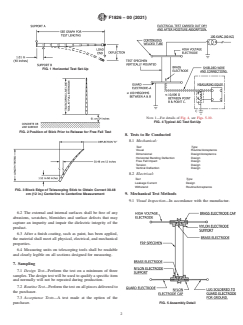
FIG. 1Horizontal Test Set-Up
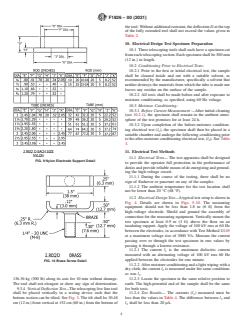
NOTE 1—For details of Fig. 4, see Figs. 5-10.
FIG. 4Typical AC Test Set-Up
FIG. 2Position of Stick Prior to Release for Free Fall Test
8. Tests to Be Conducted
8.1 Mechanical:
Test Type
Visual Routine/Acceptance
Dimensional Design/Acceptance
Horizontal Bending Deflection Design
Free Fall Impact Design
Tension Design
Vertical Deflection Design
8.2 Electrical:
Test Type
Leakage Current Design
Withstand Routine/Acceptance
FIG. 3Block Edge of Telescoping Stick to Obtain Correct 30.48
cm (12 in.) Centerline to Centerline Measurement
9. Mechanical Test Methods
9.1 Visual Inspection—In accordance with the manufactur-
6.2 The external and internal surfaces shall be free of any
abrasions, scratches, blemishes and surface defects that may
capture an impurity and impair the dielectric integrity of the
product.
6.3 After a finish coating, such as paint, has been applied,
the material shall meet all physical, electrical, and mechanical
properties.
6.4 Measuring units on telescoping tools shall be readable
and clearly legible on all sections designed for measuring.
7. Sampling
7.1 Design Test—Perform the test on a minimum of three
samples. The design test will be used to qualify a specific item
and normally will not be repeated during production.
7.2 Routine Test—Perform the test on all pieces delivered to
the purchaser.
7.3 Acceptance Tests—A test made at the option of the
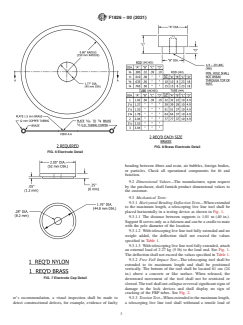
purchaser. FIG. 5Assembly Detail
F1826−00 (2021)
FIG. 8Brass Electrode Detail
FIG. 6Electrode Detail
bonding between fibers and resin, air bubbles, foreign bodies,
or particles. Check all operational components for fit and
function.
9.2 Dimensional Values—The manufacturer, upon request
by the purchaser, shall furnish product dimensional values to
the customer.
9.3 Mechanical Tests:
9.3.1 Horizontal Bending Deflection Tests—When extended
to the maximum length, a telescoping live line tool shall be
placed horizontally in a testing device as shown in Fig. 1.
9.3.1.1 The distance between supports is 1.01 m (40 in.).
Support B serves only as a fulcrum and can be a cradle to mate
with the pole diameter of the location.
9.3.1.2 With telescoping live line tool fully extended and no
weight added, the deflection shall not exceed the values
specified in Table 1.
9.3.1.3 With telescoping live line tool fully extended, attach
an external load of 2.27 kg (5 lb) to the load end. See Fig. 1.
The deflection shall not exceed the values specified in Table 1.
9.3.2 Free Fall Impact Test—The telescoping tool shall be
extended to its maximum length and shall be positioned
vertically. The bottom of the tool shall be located 61 cm (24
in.) above a concrete or like surface. When released, the
FIG. 7Electrode Cap Detail
downward movement of the tool shall not be restricted or
slowed.Thetoolshallnotcollapseorrevealsignificantsignsof
damage to the lock devices and shall display no sign of
cracking of the FRP tubes. See Fig. 2.
er’s recommendation, a visual inspection shall be made to 9.3.3 Tension Test—Whenextendedtothemaximumlength,
detect constructional defects, for example, evidence of faulty a telescoping live line tool shall withstand a tensile load of
F1826−00 (2021)
thetool.Withoutadditionalrestraint,thedeflection Datthetop
of the fully extended tool shall not exceed the values given in
Table 2.
10. Electrical Design Test Specimen Preparation
10.1 Three telescoping tools shall each have a specimen cut
fromeachtelescopingsection.Eachspecimenshallbe300mm
(12 in.) in length.
10.2 Conditioning Prior to Electrical Tests:
10.2.1 Prior to the first or initial electrical test, the sample
shall be cleaned inside and out with a suitable solvent, as
recommended by the manufacturer, specifically a solvent that
neither destroys the materials from which the tube is made nor
leaves any residue on the surface of the sample.
10.2.2 All tests shall be made before and after exposu
...