

ASTM D1004-21
(Test Method)Standard Test Method for Tear Resistance (Graves Tear) of Plastic Film and Sheeting
General Information
- Abstract
SIGNIFICANCE AND USE
5.1 Tear resistance of plastic film or sheeting is a complex function of its ultimate resistance to rupture. The specimen geometry and speed of testing in this test method are controlled to produce tearing in a small area of stress concentration at rates far below those usually encountered in service. Experience has shown the test to have its best reliability for materials which do not have brittle failure or do not elongate greater than two hundred percent during testing.
5.2 The data from this test method furnish comparative information for ranking the tearing resistance of plastic specimens of similar composition. Actual use performance in tearing of some plastics may not necessarily correlate with data from this test method.
5.3 The resistance to tear of plastic film and sheeting, while partly dependent upon thickness, has no simple correlation with specimen thickness. Hence, tearing forces measured in newtons (or pounds-force) cannot be normalized over a wide range of specimen thickness without producing misleading data as to the actual tearing resistance of the material. Data from this test method are comparable only from specimens, which vary by no more than ±10 % from the nominal or average thickness of all specimens tested. Therefore, the tearing resistance is expressed in maximum newtons (or pounds-force) of force to tear the specimen.
5.4 The tear resistance of plastic film may be a specification that requires the use of this test method, but with some procedural modifications that take precedence when adhering to the specification. Therefore, it is advisable to refer to that material specification before using this test method. Table 1 of Classification System D4000 lists the ASTM materials standards that currently exist.
SCOPE
1.1 This test method2 covers the determination of the tear resistance of flexible plastic film and sheeting at very low rates of loading, 51 mm (2 in.)/min. and is designed to measure the force to initiate tearing. The specimen geometry of this test method produces a stress concentration in a small area of the specimen. The maximum stress, usually found near the onset of tearing, is recorded as the tear resistance in newtons (or pounds-force). The method is not applicable for film or sheeting material where brittle failures occur during testing or where maximum extension is greater than 101.6 mm (4 in.).
1.1.1 Although resistance to tear can be expressed in newtons per microns, (pounds-force per mil) of specimen thickness, this is only advisable where correlation for the particular material being tested has been established. In most cases, comparison between films of dissimilar thickness is not valid.
Note 1: Film has been arbitrarily defined as sheeting having nominal thickness not greater than 0.25 mm (0.010 in.).
1.2 Constant-Rate-of-Grip Separation Test—This test method employs a constant rate of separation of the grips holding the test specimen.
1.2.1 Specimen extension shall be measured in this test method by grip separation.
1.3 The values stated in SI units are to be regarded as the standard. The values given in parentheses are provided for information only.
1.4 This standard does not purport to address all of the safety concerns, if any, associated with its use. It is the responsibility of the user of this standard to establish appropriate safety, health, and environmental practices and determine the applicability of regulatory limitations prior to use.
Note 2: There is no known ISO equivalent to this standard.
1.5 This international standard was developed in accordance with internationally recognized principles on standardization established in the Decision on Principles for the Development of International Standards, Guides and Recommendations issued by the World Trade Organization Technical Barriers to Trade (TBT) Committee.
- Status
- Published
- Publication Date
- 14-Jan-2021
- Technical Committee
- D20 - Plastics
- Drafting Committee
- D20.19 - Film, Sheeting, and Molded Products
Buy Documents
ASTM D1004-21 - Standard Test Method for Tear Resistance (Graves Tear) of Plastic Film and Sheeting
REDLINE ASTM D1004-21 - Standard Test Method for Tear Resistance (Graves Tear) of Plastic Film and Sheeting
Overview
ASTM D1004-21: Standard Test Method for Tear Resistance (Graves Tear) of Plastic Film and Sheeting provides a widely recognized procedure for determining the tear resistance of flexible plastic films and sheeting materials. Using the Graves tear method, this ASTM International standard measures the force required to initiate tearing through a designated geometry specimen at a low loading rate. This test method is most reliable for materials that do not fail in a brittle manner and that do not stretch more than 200% during testing. The results deliver comparative data for ranking the tearing resistance of plastic samples of similar composition.
Key Topics
Scope and Applicability
- Addresses tear resistance measurement for plastic films or sheeting with a nominal thickness not exceeding 0.25 mm (0.010 in.).
- Not suitable for materials with brittle failure or with extension beyond 101.6 mm (4 in.) during testing.
Testing Approach
- Utilizes a constant-rate-of-grip separation method (typically 51 mm/min) to measure the force needed to initiate tear.
- Strict controls on specimen geometry and dimensions are required to ensure consistent stress concentration.
Results Expression
- Tear resistance is reported in terms of maximum force (newtons or pounds-force) required to initiate tearing.
- Direct comparisons between films of significantly different thickness are not valid; all tested specimens should be within ±10% of the nominal thickness.
Comparative Use
- Suitable for comparing tear resistance within materials of similar composition but not necessarily predictive of in-use tear performance for every plastic type.
Applications
The ASTM D1004-21 standard is critical for industries relying on flexible plastic films and sheeting, such as:
- Packaging: Evaluating the durability and integrity of films used for food, medical, or industrial packaging.
- Construction: Assessing building films and waterproof membranes for resistance to tearing during installation and service.
- Consumer Goods: Testing films used in bags, liners, and protective wrappings for end-use strength requirements.
- Quality Control and R&D: Comparing formulations, manufacturing methods, or batches to ensure consistent tear resistance.
In procurement and product development, specifying minimum tear resistance as determined by ASTM D1004 helps ensure reliability and performance criteria are met.
Related Standards
For a comprehensive evaluation or when additional properties are of interest, the following related ASTM standards may be referenced in conjunction with ASTM D1004-21:
- ASTM D618: Practice for Conditioning Plastics for Testing
- ASTM D882: Test Method for Tensile Properties of Thin Plastic Sheeting
- ASTM D883: Terminology Relating to Plastics
- ASTM D4000: Classification System for Specifying Plastic Materials
- ASTM D5947: Test Methods for Physical Dimensions of Solid Plastics Specimens
- ASTM D6988: Guide for Determination of Thickness of Plastic Film Test Specimens
- ASTM E4: Practices for Force Verification of Testing Machines
Note: There is currently no known ISO equivalent for ASTM D1004-21, making it the primary international standard for this specific test method.
Practical Value
By following ASTM D1004-21, manufacturers, suppliers, and end-users can achieve:
- Reliable Quality Control: Verify the consistency and durability of plastic films and sheeting.
- Objective Comparisons: Use standardized tear resistance data to rank materials or compare production lots.
- Enhanced Specification Compliance: Satisfy customer or regulatory requirements for tear strength in the plastic film and sheeting market.
In summary, ASTM D1004-21 is an essential standard for evaluating tear resistance in plastic films, strengthening supply chain quality, and ensuring appropriate material selection for performance-critical applications.
Relations
- Effective Date
- 01-Feb-2024
- Effective Date
- 01-Nov-2023
- Effective Date
- 01-Apr-2022
- Effective Date
- 01-Jan-2020
- Effective Date
- 01-Aug-2019
- Effective Date
- 15-Apr-2019
- Effective Date
- 01-Feb-2019
- Effective Date
- 01-Dec-2018
- Effective Date
- 01-Nov-2018
- Effective Date
- 01-Oct-2017
- Effective Date
- 01-Oct-2017
- Refers
ASTM E2935-17 - Standard Practice for Conducting Equivalence Testing in Laboratory Applications - Effective Date
- 01-Oct-2017
- Effective Date
- 15-Aug-2017
- Refers
ASTM E2935-16 - Standard Practice for Conducting Equivalence Testing in Laboratory Applications - Effective Date
- 15-Nov-2016
- Refers
ASTM E2935-15 - Standard Practice for Conducting Equivalence Testing in Laboratory Applications - Effective Date
- 01-Oct-2015
Buy Documents
ASTM D1004-21 - Standard Test Method for Tear Resistance (Graves Tear) of Plastic Film and Sheeting
REDLINE ASTM D1004-21 - Standard Test Method for Tear Resistance (Graves Tear) of Plastic Film and Sheeting
Get Certified
Connect with accredited certification bodies for this standard

DIN CERTCO
DIN Group product certification.

Smithers Quality Assessments
US management systems and product certification.
Sponsored listings
Frequently Asked Questions
ASTM D1004-21 is a standard published by ASTM International. Its full title is "Standard Test Method for Tear Resistance (Graves Tear) of Plastic Film and Sheeting". This standard covers: SIGNIFICANCE AND USE 5.1 Tear resistance of plastic film or sheeting is a complex function of its ultimate resistance to rupture. The specimen geometry and speed of testing in this test method are controlled to produce tearing in a small area of stress concentration at rates far below those usually encountered in service. Experience has shown the test to have its best reliability for materials which do not have brittle failure or do not elongate greater than two hundred percent during testing. 5.2 The data from this test method furnish comparative information for ranking the tearing resistance of plastic specimens of similar composition. Actual use performance in tearing of some plastics may not necessarily correlate with data from this test method. 5.3 The resistance to tear of plastic film and sheeting, while partly dependent upon thickness, has no simple correlation with specimen thickness. Hence, tearing forces measured in newtons (or pounds-force) cannot be normalized over a wide range of specimen thickness without producing misleading data as to the actual tearing resistance of the material. Data from this test method are comparable only from specimens, which vary by no more than ±10 % from the nominal or average thickness of all specimens tested. Therefore, the tearing resistance is expressed in maximum newtons (or pounds-force) of force to tear the specimen. 5.4 The tear resistance of plastic film may be a specification that requires the use of this test method, but with some procedural modifications that take precedence when adhering to the specification. Therefore, it is advisable to refer to that material specification before using this test method. Table 1 of Classification System D4000 lists the ASTM materials standards that currently exist. SCOPE 1.1 This test method2 covers the determination of the tear resistance of flexible plastic film and sheeting at very low rates of loading, 51 mm (2 in.)/min. and is designed to measure the force to initiate tearing. The specimen geometry of this test method produces a stress concentration in a small area of the specimen. The maximum stress, usually found near the onset of tearing, is recorded as the tear resistance in newtons (or pounds-force). The method is not applicable for film or sheeting material where brittle failures occur during testing or where maximum extension is greater than 101.6 mm (4 in.). 1.1.1 Although resistance to tear can be expressed in newtons per microns, (pounds-force per mil) of specimen thickness, this is only advisable where correlation for the particular material being tested has been established. In most cases, comparison between films of dissimilar thickness is not valid. Note 1: Film has been arbitrarily defined as sheeting having nominal thickness not greater than 0.25 mm (0.010 in.). 1.2 Constant-Rate-of-Grip Separation Test—This test method employs a constant rate of separation of the grips holding the test specimen. 1.2.1 Specimen extension shall be measured in this test method by grip separation. 1.3 The values stated in SI units are to be regarded as the standard. The values given in parentheses are provided for information only. 1.4 This standard does not purport to address all of the safety concerns, if any, associated with its use. It is the responsibility of the user of this standard to establish appropriate safety, health, and environmental practices and determine the applicability of regulatory limitations prior to use. Note 2: There is no known ISO equivalent to this standard. 1.5 This international standard was developed in accordance with internationally recognized principles on standardization established in the Decision on Principles for the Development of International Standards, Guides and Recommendations issued by the World Trade Organization Technical Barriers to Trade (TBT) Committee.
SIGNIFICANCE AND USE 5.1 Tear resistance of plastic film or sheeting is a complex function of its ultimate resistance to rupture. The specimen geometry and speed of testing in this test method are controlled to produce tearing in a small area of stress concentration at rates far below those usually encountered in service. Experience has shown the test to have its best reliability for materials which do not have brittle failure or do not elongate greater than two hundred percent during testing. 5.2 The data from this test method furnish comparative information for ranking the tearing resistance of plastic specimens of similar composition. Actual use performance in tearing of some plastics may not necessarily correlate with data from this test method. 5.3 The resistance to tear of plastic film and sheeting, while partly dependent upon thickness, has no simple correlation with specimen thickness. Hence, tearing forces measured in newtons (or pounds-force) cannot be normalized over a wide range of specimen thickness without producing misleading data as to the actual tearing resistance of the material. Data from this test method are comparable only from specimens, which vary by no more than ±10 % from the nominal or average thickness of all specimens tested. Therefore, the tearing resistance is expressed in maximum newtons (or pounds-force) of force to tear the specimen. 5.4 The tear resistance of plastic film may be a specification that requires the use of this test method, but with some procedural modifications that take precedence when adhering to the specification. Therefore, it is advisable to refer to that material specification before using this test method. Table 1 of Classification System D4000 lists the ASTM materials standards that currently exist. SCOPE 1.1 This test method2 covers the determination of the tear resistance of flexible plastic film and sheeting at very low rates of loading, 51 mm (2 in.)/min. and is designed to measure the force to initiate tearing. The specimen geometry of this test method produces a stress concentration in a small area of the specimen. The maximum stress, usually found near the onset of tearing, is recorded as the tear resistance in newtons (or pounds-force). The method is not applicable for film or sheeting material where brittle failures occur during testing or where maximum extension is greater than 101.6 mm (4 in.). 1.1.1 Although resistance to tear can be expressed in newtons per microns, (pounds-force per mil) of specimen thickness, this is only advisable where correlation for the particular material being tested has been established. In most cases, comparison between films of dissimilar thickness is not valid. Note 1: Film has been arbitrarily defined as sheeting having nominal thickness not greater than 0.25 mm (0.010 in.). 1.2 Constant-Rate-of-Grip Separation Test—This test method employs a constant rate of separation of the grips holding the test specimen. 1.2.1 Specimen extension shall be measured in this test method by grip separation. 1.3 The values stated in SI units are to be regarded as the standard. The values given in parentheses are provided for information only. 1.4 This standard does not purport to address all of the safety concerns, if any, associated with its use. It is the responsibility of the user of this standard to establish appropriate safety, health, and environmental practices and determine the applicability of regulatory limitations prior to use. Note 2: There is no known ISO equivalent to this standard. 1.5 This international standard was developed in accordance with internationally recognized principles on standardization established in the Decision on Principles for the Development of International Standards, Guides and Recommendations issued by the World Trade Organization Technical Barriers to Trade (TBT) Committee.
ASTM D1004-21 is classified under the following ICS (International Classification for Standards) categories: 83.140.10 - Films and sheets. The ICS classification helps identify the subject area and facilitates finding related standards.
ASTM D1004-21 has the following relationships with other standards: It is inter standard links to ASTM D883-24, ASTM D883-23, ASTM E456-13a(2022)e1, ASTM D883-20, ASTM D883-19c, ASTM D883-19a, ASTM D883-19, ASTM D883-18a, ASTM D883-18, ASTM E456-13A(2017)e1, ASTM E456-13A(2017)e3, ASTM E2935-17, ASTM D883-17, ASTM E2935-16, ASTM E2935-15. Understanding these relationships helps ensure you are using the most current and applicable version of the standard.
ASTM D1004-21 is available in PDF format for immediate download after purchase. The document can be added to your cart and obtained through the secure checkout process. Digital delivery ensures instant access to the complete standard document.
Standards Content (Sample)
This international standard was developed in accordance with internationally recognized principles on standardization established in the Decision on Principles for the
Development of International Standards, Guides and Recommendations issued by the World Trade Organization Technical Barriers to Trade (TBT) Committee.
Designation: D1004 − 21
Standard Test Method for
Tear Resistance (Graves Tear) of Plastic Film and Sheeting
This standard is issued under the fixed designation D1004; the number immediately following the designation indicates the year of
original adoption or, in the case of revision, the year of last revision. A number in parentheses indicates the year of last reapproval. A
superscript epsilon (´) indicates an editorial change since the last revision or reapproval.
This standard has been approved for use by agencies of the U.S. Department of Defense.
1. Scope* 1.5 This international standard was developed in accor-
2 dance with internationally recognized principles on standard-
1.1 This test method covers the determination of the tear
ization established in the Decision on Principles for the
resistance of flexible plastic film and sheeting at very low rates
Development of International Standards, Guides and Recom-
of loading, 51 mm (2 in.)/min. and is designed to measure the
mendations issued by the World Trade Organization Technical
force to initiate tearing. The specimen geometry of this test
Barriers to Trade (TBT) Committee.
method produces a stress concentration in a small area of the
specimen.Themaximumstress,usuallyfoundneartheonsetof
2. Referenced Documents
tearing, is recorded as the tear resistance in newtons (or
2.1 ASTM Standards:
pounds-force). The method is not applicable for film or
D618 Practice for Conditioning Plastics for Testing
sheeting material where brittle failures occur during testing or
D882 Test Method for Tensile Properties of Thin Plastic
where maximum extension is greater than 101.6 mm (4 in.).
Sheeting
1.1.1 Although resistance to tear can be expressed in new-
D883 Terminology Relating to Plastics
tons per microns, (pounds-force per mil) of specimen
D4000 Classification System for Specifying Plastic Materi-
thickness, this is only advisable where correlation for the
als
particular material being tested has been established. In most
D5947 Test Methods for Physical Dimensions of Solid
cases, comparison between films of dissimilar thickness is not
Plastics Specimens
valid.
D6988 GuideforDeterminationofThicknessofPlasticFilm
NOTE 1—Film has been arbitrarily defined as sheeting having nominal
Test Specimens
thickness not greater than 0.25 mm (0.010 in.).
E4 Practices for Force Verification of Testing Machines
1.2 Constant-Rate-of-Grip Separation Test—This test
E456 Terminology Relating to Quality and Statistics
method employs a constant rate of separation of the grips
E691 Practice for Conducting an Interlaboratory Study to
holding the test specimen.
Determine the Precision of a Test Method
1.2.1 Specimen extension shall be measured in this test
E2935 Practice for Conducting Equivalence Tests for Com-
method by grip separation.
paring Testing Processes
1.3 The values stated in SI units are to be regarded as the
3. Terminology
standard. The values given in parentheses are provided for
information only.
3.1 Definitions—Terms used in this standard are defined in
accordance with Terminology D883, unless otherwise speci-
1.4 This standard does not purport to address all of the
fied. For terms relating to precision and bias and associated
safety concerns, if any, associated with its use. It is the
issues,thetermsusedinthisstandardaredefinedinaccordance
responsibility of the user of this standard to establish appro-
with Terminology E456.
priate safety, health, and environmental practices and deter-
mine the applicability of regulatory limitations prior to use.
4. Summary of Test Method
NOTE 2—There is no known ISO equivalent to this standard.
4.1 The force to initiate tearing across a specific geometry
of a film or sheeting specimen is measured using a constant-
rate-of-grip separation machine. The force necessary to initiate
This test method is under the jurisdiction ofASTM Committee D20 on Plastics
and is the direct responsibility of Subcommittee D20.19 on Film, Sheeting, and
the tear is calculated from the load-time or load-displacement
Molded Products.
data.
Current edition approved Jan. 15, 2021. Published February 2021. Originally
approved in 1949. Last previous edition approved in 2013 as D1004 – 13. DOI:
10.1520/D1004-21. For referenced ASTM standards, visit the ASTM website, www.astm.org, or
The following reference may be of interest in connection with this test method: contact ASTM Customer Service at service@astm.org. For Annual Book of ASTM
Graves, F. L., “The Evaluation of Tear Resistance in Elastomers,” India Rubber Standards volume information, refer to the standard’s Document Summary page on
World, Vol 111, No. 3, December 1944, pp. 305–308. the ASTM website.
*A Summary of Changes section appears at the end of this standard
Copyright ©ASTM International, 100 Barr Harbor Drive, PO Box C700, West Conshohocken, PA19428-2959. United States
D1004 − 21
5. Significance and Use
5.1 Tear resistance of plastic film or sheeting is a complex
function of its ultimate resistance to rupture. The specimen
geometryandspeedoftestinginthistestmethodarecontrolled
to produce tearing in a small area of stress concentration at
rates far below those usually encountered in service. Experi-
ence has shown the test to have its best reliability for materials
whichdonothavebrittlefailureordonotelongategreaterthan
two hundred percent during testing.
Tolerance ± 0.5°
5.2 The data from this test method furnish comparative
Table of Metric Equivalents
information for ranking the tearing resistance of plastic speci-
in. mm
4.0 101.60
mens of similar composition. Actual use performance in
0.750 19.05
tearingofsomeplasticsmaynotnecessarilycorrelatewithdata
1.061 26.95
from this test method.
1.000 25.40
1.118 28.40
5.3 The resistance to tear of plastic film and sheeting, while
2.0 50.80
0.002 0.051
partly dependent upon thickness, has no simple correlation
0.500 12.70
with specimen thickness. Hence, tearing forces measured in
newtons (or pounds-force) cannot be normalized over a wide
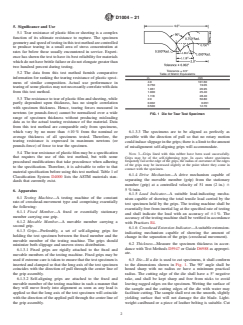
FIG. 1 Die for Tear Test Specimen
range of specimen thickness without producing misleading
data as to the actual tearing resistance of the material. Data
from this test method are comparable only from specimens,
which vary by no more than 610 % from the nominal or
6.1.3.3 The specimens are to be aligned as perfectly as
average thickness of all specimens tested. Therefore, the
possible with the direction of pull so that no rotary motion
tearing resistance is expressed in maximum newtons (or
couldinduceslippageinthegrips;thereisalimittotheamount
pounds-force) of force to tear the specimen.
of misalignment self-aligning grips will accommodate.
5.4 The tear resistance of plastic film may be a specification
NOTE 3—Grips lined with thin rubber have been used successfully.
that requires the use of this test method, but with some Grips may be of the self-tightening type. In cases where specimens
frequently fail at the edge of the grips, the radius of curvature of the edges
procedural modifications that take precedence when adhering
of the grips may be increased slightly at the point where they come in
to the specification. Therefore, it is advisable to refer to that
contact with the specimen.
material specification before using this test method. Table 1 of
6.1.4 Drive Mechanism—A drive mechanism capable of
Classification System D4000 lists the ASTM materials stan-
separating the movable member (grip) from the stationary
dards that currently exist.
member (grip) at a controlled velocity of 51 mm (2 in.) 6
5 %⁄min.
6. Apparatus
6.1.5 Load Indicator—A suitable load-indicating mecha-
6.1 Testing Machine—A testing machine of the constant
nism capable of showing the total tensile load carried by the
rate-of crosshead-movement type and comprising essentially
test specimen held by the grips. The testing machine shall be
the following:
essentially free from inertial lag at the specified rate of testing
6.1.1 Fixed Member—A fixed or essentially stationary
and shall indicate the load with an accuracy of 61 %. The
member carrying one grip.
accuracy of the testing machine shall be verified in accordance
6.1.2 Movable Member—A movable member carrying a
with Practices E4.
second grip.
6.1.6 Crosshead Extension Indicator—Asuitable extension-
6.1.3 Grips—Preferably, a set of self-aligning grips for
indicating mechanism capable of showing the amount of
holding the test specimen between the fixed member and the
change in the separation of the grips (crosshead movement).
movable member of the testing machine. The grips should
6.2 Thickness—Measure the specimen thickness in accor-
minimize both slippage and uneven stress distribution.
dance with Test Methods D5947 or Guide D6988 as appropri-
6.1.3.1 Fixed grips are rigidly attached to the fixed and
ate.
movable members of the testing machine. Fixed grips may be
used if extreme care is taken to ensure that the test specimen is 6.3 Die—If a die is used to cut specimens, it shall conform
inserted and clamped so that the long axis of the test specimen to the dimensions shown in Fig. 1. The 90° angle shall be
coincides with the direction of pull through the center line of honed sharp with no radius or have a minimum practical
the grip assembly. radius. The cutting edge of the die shall have a 5° negative
6.1.3.2 Self-aligning grips are attached to the fixed and rake, and shall be kept sharp and free from nicks to avoid
movable member of the testing machine in such a manner that leaving ragged edges on the specimen. Wetting the surface of
they will move freely into alignment as soon as any load is the sample and the cutting edges of the die with water may
applied so that the long axis of the test specim
...
This document is not an ASTM standard and is intended only to provide the user of an ASTM standard an indication of what changes have been made to the previous version. Because
it may not be technically possible to adequately depict all changes accurately, ASTM recommends that users consult prior editions as appropriate. In all cases only the current version
of the standard as published by ASTM is to be considered the official document.
Designation: D1004 − 13 D1004 − 21
Standard Test Method for
Tear Resistance (Graves Tear) of Plastic Film and Sheeting
This standard is issued under the fixed designation D1004; the number immediately following the designation indicates the year of
original adoption or, in the case of revision, the year of last revision. A number in parentheses indicates the year of last reapproval. A
superscript epsilon (´) indicates an editorial change since the last revision or reapproval.
This standard has been approved for use by agencies of the U.S. Department of Defense.
1. Scope*
1.1 This test method covers the determination of the tear resistance of flexible plastic film and sheeting at very low rates of
loading, 51 mm (2 in.)/min. and is designed to measure the force to initiate tearing. The specimen geometry of this test method
produces a stress concentration in a small area of the specimen. The maximum stress, usually found near the onset of tearing, is
recorded as the tear resistance in newtons (or pounds-force). The method is not applicable for film or sheeting material where brittle
failures occur during testing or where maximum extension is greater than 101.6 mm (4 in.).
1.1.1 Although resistance to tear can be expressed in newtons per microns, (pounds-force per mil) of specimen thickness, this is
only advisable where correlation for the particular material being tested has been established. In most cases, comparison between
films of dissimilar thickness is not valid.
NOTE 1—Film has been arbitrarily defined as sheeting having nominal thickness not greater than 0.25 mm (0.010 in.).
1.2 Constant-Rate-of-Grip Separation Test—This test method employs a constant rate of separation of the grips holding the test
specimen.
1.2.1 Specimen extension mayshall be measured in this test method by grip separation.
1.3 The values stated in SI units are to be regarded as the standard. The values given in parentheses are provided for information
only.
1.4 This standard does not purport to address all of the safety concerns, if any, associated with its use. It is the responsibility
of the user of this standard to establish appropriate safety safety, health, and healthenvironmental practices and determine the
applicability of regulatory limitations prior to use.
NOTE 2—There is no known ISO equivalent to this standard.
1.5 This international standard was developed in accordance with internationally recognized principles on standardization
established in the Decision on Principles for the Development of International Standards, Guides and Recommendations issued
by the World Trade Organization Technical Barriers to Trade (TBT) Committee.
This test method is under the jurisdiction of ASTM Committee D20 on Plastics and is the direct responsibility of Subcommittee D20.19 on Film, Sheeting, and Molded
Products.
Current edition approved April 1, 2013Jan. 15, 2021. Published April 2013February 2021. Originally approved in 1949. Last previous edition approved in 20092013 as
D1004 – 09.D1004 – 13. DOI: 10.1520/D1004-13.10.1520/D1004-21.
The following reference may be of interest in connection with this test method: Graves, F. L., “The Evaluation of Tear Resistance in Elastomers,” India Rubber World,
Vol 111, No. 3, December 1944, pp. 305–308.
*A Summary of Changes section appears at the end of this standard
Copyright © ASTM International, 100 Barr Harbor Drive, PO Box C700, West Conshohocken, PA 19428-2959. United States
D1004 − 21
2. Referenced Documents
2.1 ASTM Standards:
D618 Practice for Conditioning Plastics for Testing
D882 Test Method for Tensile Properties of Thin Plastic Sheeting
D883 Terminology Relating to Plastics
D4000 Classification System for Specifying Plastic Materials
D5947 Test Methods for Physical Dimensions of Solid Plastics Specimens
D6988 Guide for Determination of Thickness of Plastic Film Test Specimens
E4 Practices for Force Verification of Testing Machines
E456 Terminology Relating to Quality and Statistics
E691 Practice for Conducting an Interlaboratory Study to Determine the Precision of a Test Method
E2935 Practice for Conducting Equivalence Tests for Comparing Testing Processes
2.2 ASTM Adjuncts:
Die Drawings
3. Terminology
3.1 Definitions: Definitions—
Definitions of terms applying to this test method appear in Terms used in this standard are defined in accordance with Terminology
D883, unless otherwise specified. For terms relating to precision and bias and associated issues, the terms used in this standard
are defined in accordance with Terminology E456.
4. Summary of Test Method
4.1 The force to initiate tearing across a specific geometry of a film or sheeting specimen is measured using a constant-rate-of-grip
separation machine. The force necessary to initiate the tear is calculated from the load-time or load-displacement data.
5. Significance and Use
5.1 Tear resistance of plastic film or sheeting is a complex function of its ultimate resistance to rupture. The specimen geometry
and speed of testing in this test method are controlled to produce tearing in a small area of stress concentration at rates far below
those usually encountered in service. Experience has shown the test to have its best reliability for materials which do not have
brittle failure or do not elongate greater than two hundred percent during testing.
5.2 The data from this test method furnish comparative information for ranking the tearing resistance of plastic specimens of
similar composition. Actual use performance in tearing of some plastics may not necessarily correlate with data from this test
method.
5.3 The resistance to tear of plastic film and sheeting, while partly dependent upon thickness, has no simple correlation with
specimen thickness. Hence, tearing forces measured in newtons (or pounds-force) cannot be normalized over a wide range of
specimen thickness without producing misleading data as to the actual tearing resistance of the material. Data from this test method
are comparable only from specimens, which vary by no more than 610 % from the nominal or average thickness of all specimens
tested. Therefore, the tearing resistance is expressed in maximum newtons (or pounds-force) of force to tear the specimen.
5.4 The tear resistance of plastic film may be a specification that requires the use of this test method, but with some procedural
modifications that take precedence when adhering to the specification. Therefore, it is advisable to refer to that material
specification before using this test method. Table 1 of Classification System D4000 lists the ASTM materials standards that
currently exist.
6. Apparatus
6.1 Testing Machine—A testing machine of the constant rate-of crosshead-movement type and comprising essentially the
following:
For referenced ASTM standards, visit the ASTM website, www.astm.org, or contact ASTM Customer Service at service@astm.org. For Annual Book of ASTM Standards
volume information, refer to the standard’s Document Summary page on the ASTM website.
D1004 − 21
6.1.1 Fixed Member—A fixed or essentially stationary member carrying one grip.
6.1.2 Movable Member—A movable member carrying a second grip.
6.1.3 Grips—Preferably, a set of self-aligning grips for holding the test specimen between the fixed member and the movable
member of the testing machine. The grips should minimize both slippage and uneven stress distribution.
6.1.3.1 Fixed grips are rigidly attached to the fixed and movable members of the testing machine. Fixed grips may be used if
extreme care is taken to ensure that the test specimen is inserted and clamped so that the long axis of the test specimen coincides
with the direction of pull through the center line of the grip assembly.
6.1.3.2 Self-aligning grips are attached to the fixed and movable member of the testing machine in such a manner that they will
move freely into alignment as soon as any load is applied so that the long axis of the test specimen will coincide with the direction
of the applied pull through the center line of the grip assembly.
NOTE 3—The specimens should be aligned as perfectly as possible with the direction of pull so that no rotary motion that may induce slippage will occur
in the grips; there is a limit to the amount of misalignment self-aligning grips will accommodate.
6.1.3.3 The specimens are to be aligned as perfectly as possible with the direction of pull so that no rotary motion could induce
slippage in the grips; there is a limit to the amount of misalignment self-aligning grips will accommodate.
NOTE 3—Grips lined with thin rubber have been used successfully. Grips may be of the self-tightening type. In cases where specimens frequently fail
at the edge of the grips, the radius of curvature of the edges of the grips may be increased slightly at the point where they come in contact with the
specimen.
6.1.4 Drive Mechanism—A drive mechanism capable of separating the movable member (grip) from the stationary member (grip)
at a controlled velocity of 51 mm (2 in.) 6 5 % ⁄min.
6.1.5 Load Indicator—A suitable load-indicating mechanism capable of showing the total tensile load carried by the test specimen
held by the grips. The testing machine shall be essentially free from inertial lag at the specified rate of testing and shall indicate
the load with an accuracy of 61 %. The accuracy of the testing machine shall be verified in accordance with Practices E4.
6.1.6 Crosshead Extension Indicator—A suitable extension-indicating mechanism capable of showing the amount of change in the
separation of the grips (crosshead movement).
6.2 Thickness—Measure the specimen thickness in accordance with Test Methods D5947 or Guide D6988 as appropriate.
6.3 DieDie——A die having the dimensions shown inIf a die is used to cut specimens, Fig. 1 shall be used to cut all specimens.it
shall conform to the dimensions shown in Fig. 1. The 90° angle shall be honed sharp with no radius or have a minimum practical
radius. The cutting edge of the die shall have a 5° negative rake, and shall be kept sharp and free from nicks to avoid leaving ragged
edges on the specimen. Wetting the surface of the sample and the cutting edges of the die with water may facilitate cutting. The
sample shall rest on the smooth, slightly yielding surface that will not damage the die blade. Lightweight cardboard or a piece of
leather belting is suitable. Care should be taken that the cut Cut edges of the specimen are to be perpendicular to its other surfaces
and that the edges have a minimum of concavity.
7. Test Specimens
7.1 The test specimens shall be cut out with a die conforming to the dimensions shown inusing a die or other appropriate method
so that Fig. 1 and shall not vary by more than 0.5 %the resulting specimens conform to the dimensions shown in Fig. 1from these
dimensions. The cutting edges of the die shall be kept sharp and free of all nicks to avoid leaving ragged edges on the specimens.
NOTE 5—Caution should be used to ensure all samples are the same dimension if multiple specimens are cut at one time by stacking (layering) film.
7.1.1 The cutting method used shall ensure all samples are the same dimension if multiple specimens are cut at one time by
stacking (layering) film.
D1004 − 21
Tolerance ± 0.5°
Table of Metric Equivalents
in. mm
4.0 101.60
0.750 19.05
1.061 26.95
1.000 25.40
1.118 28.40
2.0 50.80
0.002 0.051
0.500 12.70
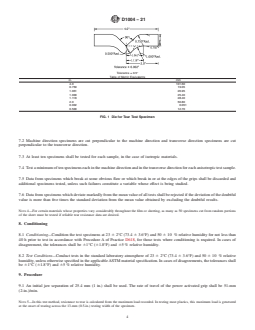
FIG. 1 Die for Tear Test
...