

ASTM C217/C217M-22
(Test Method)Standard Test Methods for Weather Resistance of Slate
General Information
- Abstract
SIGNIFICANCE AND USE
5.1 This test method is useful in indicating the differences in weather resistance between various slates. For comparison of relative slate performance, Specification C406/C406M provides a classification that includes expected service life based on depth of softening. This test method provides one element in the comparison of slates.
SCOPE
1.1 These test methods cover two procedures for weather resistance of slate in all outdoor installations by determining the depth of softening after soaking in 1 % sulfuric acid solution by a shear/scratch tester (Test Method A) or by hand scraping (Test Method B).
Note 1: These tests are based on the fact that slates containing calcium carbonate undergo a chemical weathering which produces gypsum and carbon dioxide. The swelling action that results causes disintegration of the slate. Oxidation of iron sulfides (such as pyrite) may also adversely affect weathering durability of a slate. The extent of such action on various slates in the test has been found to correlate with the durability of the materials in actual weathering.
1.2 The values stated in either SI units or inch-pound units are to be regarded separately as standard. The values stated in each system are not necessarily exact equivalents; therefore, to ensure conformance with the standard, each system shall be used independently of the other, and values from the two systems shall not be combined.
1.3 This standard does not purport to address all of the safety concerns, if any, associated with its use. It is the responsibility of the user of this standard to establish appropriate safety, health, and environmental practices and determine the applicability of regulatory limitations prior to use.
1.4 This international standard was developed in accordance with internationally recognized principles on standardization established in the Decision on Principles for the Development of International Standards, Guides and Recommendations issued by the World Trade Organization Technical Barriers to Trade (TBT) Committee.
- Status
- Published
- Publication Date
- 31-May-2022
- Technical Committee
- C18 - Dimension Stone
- Drafting Committee
- C18.01 - Test Methods
Overview
ASTM C217/C217M-22: Standard Test Methods for Weather Resistance of Slate is an international standard published by ASTM International. This standard outlines two test methods for evaluating the weather resistance of slate used in outdoor environments. By determining the depth of softening after exposing slate specimens to a sulfuric acid solution, ASTM C217/C217M-22 provides a reliable means of comparing the durability and performance of different types of slate. The standard plays a key role in ensuring that slate materials meet durability requirements for applications such as roofing, cladding, and other outdoor installations.
Key Topics
- Test Methods: The standard details two procedures:
- Test Method A: Uses a shear/scratch tester to measure changes in specimen thickness before and after acid exposure.
- Test Method B: Utilizes hand scraping to assess the depth of softening after chemical treatment.
- Evaluation Criteria: Both methods assess the depth of softening, which correlates with the slate's weather resistance and expected service life.
- Chemical Exposure: Specimens are exposed to a 1% sulfuric acid solution for seven days, simulating long-term chemical weathering effects in outdoor conditions.
- Material Considerations: The test accounts for factors such as the presence of calcium carbonate and iron sulfides in slate, which can affect its durability through chemical reactions like the formation of gypsum and oxidation.
- Reporting Requirements: The standard specifies documentation such as test dates, personnel, procedure used, sample identification, and results.
Applications
This standard is widely referenced for:
- Slate Roofing Materials: Ensuring the longevity and resistance of roofing slate to environmental weathering is crucial for both residential and commercial buildings.
- Architectural Stone Projects: Used in the specification phase for building facades, paving, and cladding, where durable, weather-resistant stone is key to project success.
- Product Comparison and Quality Control: Manufacturers, architects, and engineers can use ASTM C217/C217M-22 to compare weather resistance among slate products and to meet performance-based procurement specifications.
- Material Classification: Results from the test methods support the classification of slates by expected service life, as described in associated ASTM specifications.
Related Standards
For broader context and implementation, consider the following related ASTM standards:
- ASTM C406/C406M: Specification for Roofing Slate, which provides classification based on expected service life and depth of softening.
- ASTM C119: Terminology Relating to Dimension Stone, offering definitions and standardized terminology for stone materials.
- ASTM C1799: Guide to Dimension Stone Test Specimen Sampling and Preparation.
These related standards help ensure a comprehensive and consistent approach to the testing, classification, and application of dimension stones, especially slate, in construction and architectural projects.
Keywords: ASTM C217, weather resistance of slate, slate durability, stone testing, roofing slate, outdoor stone materials, acid resistance test, ASTM standards, durability testing, architectural stone.
Relations
- Effective Date
- 01-May-2019
- Effective Date
- 01-May-2016
- Effective Date
- 01-Dec-2014
- Effective Date
- 01-Dec-2014
- Effective Date
- 15-Jun-2011
- Effective Date
- 01-Sep-2010
- Effective Date
- 01-Feb-2008
- Effective Date
- 01-Feb-2008
- Effective Date
- 01-Feb-2008
- Effective Date
- 01-Feb-2008
- Effective Date
- 01-Aug-2007
- Effective Date
- 01-Jun-2007
- Effective Date
- 01-Apr-2006
- Effective Date
- 01-Nov-2005
- Effective Date
- 15-May-2005
Get Certified
Connect with accredited certification bodies for this standard

DIBt (Deutsches Institut für Bautechnik)
German Institute for Building Technology.
DIN CERTCO
DIN Group product certification.

Aboma Certification B.V.
Specialized in construction, metal, and transport sectors.
Sponsored listings
Frequently Asked Questions
ASTM C217/C217M-22 is a standard published by ASTM International. Its full title is "Standard Test Methods for Weather Resistance of Slate". This standard covers: SIGNIFICANCE AND USE 5.1 This test method is useful in indicating the differences in weather resistance between various slates. For comparison of relative slate performance, Specification C406/C406M provides a classification that includes expected service life based on depth of softening. This test method provides one element in the comparison of slates. SCOPE 1.1 These test methods cover two procedures for weather resistance of slate in all outdoor installations by determining the depth of softening after soaking in 1 % sulfuric acid solution by a shear/scratch tester (Test Method A) or by hand scraping (Test Method B). Note 1: These tests are based on the fact that slates containing calcium carbonate undergo a chemical weathering which produces gypsum and carbon dioxide. The swelling action that results causes disintegration of the slate. Oxidation of iron sulfides (such as pyrite) may also adversely affect weathering durability of a slate. The extent of such action on various slates in the test has been found to correlate with the durability of the materials in actual weathering. 1.2 The values stated in either SI units or inch-pound units are to be regarded separately as standard. The values stated in each system are not necessarily exact equivalents; therefore, to ensure conformance with the standard, each system shall be used independently of the other, and values from the two systems shall not be combined. 1.3 This standard does not purport to address all of the safety concerns, if any, associated with its use. It is the responsibility of the user of this standard to establish appropriate safety, health, and environmental practices and determine the applicability of regulatory limitations prior to use. 1.4 This international standard was developed in accordance with internationally recognized principles on standardization established in the Decision on Principles for the Development of International Standards, Guides and Recommendations issued by the World Trade Organization Technical Barriers to Trade (TBT) Committee.
SIGNIFICANCE AND USE 5.1 This test method is useful in indicating the differences in weather resistance between various slates. For comparison of relative slate performance, Specification C406/C406M provides a classification that includes expected service life based on depth of softening. This test method provides one element in the comparison of slates. SCOPE 1.1 These test methods cover two procedures for weather resistance of slate in all outdoor installations by determining the depth of softening after soaking in 1 % sulfuric acid solution by a shear/scratch tester (Test Method A) or by hand scraping (Test Method B). Note 1: These tests are based on the fact that slates containing calcium carbonate undergo a chemical weathering which produces gypsum and carbon dioxide. The swelling action that results causes disintegration of the slate. Oxidation of iron sulfides (such as pyrite) may also adversely affect weathering durability of a slate. The extent of such action on various slates in the test has been found to correlate with the durability of the materials in actual weathering. 1.2 The values stated in either SI units or inch-pound units are to be regarded separately as standard. The values stated in each system are not necessarily exact equivalents; therefore, to ensure conformance with the standard, each system shall be used independently of the other, and values from the two systems shall not be combined. 1.3 This standard does not purport to address all of the safety concerns, if any, associated with its use. It is the responsibility of the user of this standard to establish appropriate safety, health, and environmental practices and determine the applicability of regulatory limitations prior to use. 1.4 This international standard was developed in accordance with internationally recognized principles on standardization established in the Decision on Principles for the Development of International Standards, Guides and Recommendations issued by the World Trade Organization Technical Barriers to Trade (TBT) Committee.
ASTM C217/C217M-22 is classified under the following ICS (International Classification for Standards) categories: 91.100.15 - Mineral materials and products. The ICS classification helps identify the subject area and facilitates finding related standards.
ASTM C217/C217M-22 has the following relationships with other standards: It is inter standard links to ASTM C119-19, ASTM C119-16, ASTM C119-14e1, ASTM C119-14, ASTM C119-11, ASTM C406/C406M-10, ASTM C119-08e1, ASTM C119-08, ASTM C119-08e2, ASTM C119-08e3, ASTM C119-07a, ASTM C119-07, ASTM C119-06, ASTM C119-05a, ASTM C119-05. Understanding these relationships helps ensure you are using the most current and applicable version of the standard.
ASTM C217/C217M-22 is available in PDF format for immediate download after purchase. The document can be added to your cart and obtained through the secure checkout process. Digital delivery ensures instant access to the complete standard document.
Standards Content (Sample)
This international standard was developed in accordance with internationally recognized principles on standardization established in the Decision on Principles for the
Development of International Standards, Guides and Recommendations issued by the World Trade Organization Technical Barriers to Trade (TBT) Committee.
Designation: C217/C217M − 22
Standard Test Methods for
Weather Resistance of Slate
This standard is issued under the fixed designation C217/C217M; the number immediately following the designation indicates the year
of original adoption or, in the case of revision, the year of last revision. A number in parentheses indicates the year of last reapproval.
A superscript epsilon (´) indicates an editorial change since the last revision or reapproval.
1. Scope* C406/C406M Specification for Roofing Slate
C1799 Guide to Dimension Stone Test Specimen Sampling
1.1 These test methods cover two procedures for weather
and Preparation
resistance of slate in all outdoor installations by determining
the depth of softening after soaking in 1 % sulfuric acid
3. Terminology
solution by a shear/scratch tester (Test Method A) or by hand
3.1 Definitions:
scraping (Test Method B).
3.1.1 For definitions of terms used in these test methods,
NOTE1—Thesetestsarebasedonthefactthatslatescontainingcalcium
refer to Terminology C119.
carbonate undergo a chemical weathering which produces gypsum and
carbon dioxide. The swelling action that results causes disintegration of
4. Summary of Test Method
the slate. Oxidation of iron sulfides (such as pyrite) may also adversely
affectweatheringdurabilityofaslate.Theextentofsuchactiononvarious
4.1 After grinding the faces of the test specimens smooth
slates in the test has been found to correlate with the durability of the
and finishing with No. 80 abrasive, the specimen is sheared or
materials in actual weathering.
scraped in a controlled manner and the thickness of the
1.2 The values stated in either SI units or inch-pound units
specimen measured. The specimen is then submerged ina1%
are to be regarded separately as standard. The values stated in
sulfuric acid solution which is replaced with a fresh solution
each system are not necessarily exact equivalents; therefore, to
each day, for a total of 7 days. At the end of 7 days, the
ensure conformance with the standard, each system shall be
specimenisremovedandwashed,andthendriedinanovenfor
used independently of the other, and values from the two
24 h. The opposite face of the specimen is then sheared or
systems shall not be combined.
scrapedandthethicknessofthespecimenmeasured.Thedepth
1.3 This standard does not purport to address all of the of softening is the depth of a groove made by the shearing tool
safety concerns, if any, associated with its use. It is the afteracidtreatmentminusthedepthbeforeacidtreatment(Test
responsibility of the user of this standard to establish appro- MethodA), or the depth of scrape made by the cutting edge of
priate safety, health, and environmental practices and deter-
a hand scraping tool after acid treatment minus the depth
mine the applicability of regulatory limitations prior to use. before acid treatment (Test Method B).
1.4 This international standard was developed in accor-
5. Significance and Use
dance with internationally recognized principles on standard-
ization established in the Decision on Principles for the
5.1 Thistestmethodisusefulinindicatingthedifferencesin
Development of International Standards, Guides and Recom-
weather resistance between various slates. For comparison of
mendations issued by the World Trade Organization Technical
relative slate performance, Specification C406/C406M pro-
Barriers to Trade (TBT) Committee.
vides a classification that includes expected service life based
on depth of softening. This test method provides one element
2. Referenced Documents
in the comparison of slates.
2.1 ASTM Standards:
6. Apparatus
C119 Terminology Relating to Dimension Stone
6.1 Test Method A only:
6.1.1 Shear/Scratch tester, (see Fig. 1) with the shearing
These test methods are under the jurisdiction of ASTM Committee C18 on
tool, Model S-20 , or its equivalent. The apparatus includes a
Dimension Stone and is the direct responsibility of Subcommittee C18.01 on Test
removable scale beam that is mounted on a pivotal shaft
Methods.
CurrenteditionapprovedJune1,2022.PublishedJuly2022.Originallyapproved
in 1948. Last previous edition approved in 2021 as C217/C217M–21. DOI:
10.1520/C0217_C0217M-22. The sole source of supply known to the committee at this time is Taber
For referenced ASTM standards, visit the ASTM website, www.astm.org, or Industries, North Tonawanda, NY. If you are aware of alternative suppliers, please
contact ASTM Customer Service at service@astm.org. For Annual Book of ASTM provide this information toASTM International Headquarters. Your comments will
Standards volume information, refer to the standard’s Document Summary page on receive careful consideration at a meeting of the responsible technical committee,
the ASTM website. which you may attend.
*A Summary of Changes section appears at the end of this standard
Copyright © ASTM International, 100 Barr Harbor Drive, PO Box C700, West Conshohocken, PA 19428-2959. United States
C217/C217M − 22
FIG. 1 Shear/Scratch Tester
projecting from an adjustable gage block that can be raised or such specifications are available. Other grades may be used,
lowered, corresponding with the thickness of a test specimen provided it is first ascertained that the reagent is of sufficiently
upto0.5in.[12.7mm].Thescalebeamissetatanangleof70° high purity to permit its use without lessening the accuracy of
referencing the shaft it pivots on. A calibrated weight and the determination.
sliding weight are mounted on the scale beam to achieve the
7.2 Sulfuric acid (H SO )—1 % solution.
2 4
desired load. Operated by an on/off switch, the motorized
NOTE 2—Example—Aconvenient means of determining the amount of
turntablerotatescounterclockwiseataconstantspeedof0.6 6
H SO required for the test is as follows: Suppose one has 96 % H SO
2 4 2 4
(sp gr 1.84) and the volume of diluted acid necessary for the test is 2000
0.1 r/min.
mL. Let X equal the weight of 96 % H SO required. Then:
2 4
6.1.2 Pencil compass.
0.96X
6.2 Test Method B only:
5 0.01 (1)
X1 2000
6.2.1 Hand Scraping Tool—The scraping tool shall be made
From this equation, X is determined as 21.05 g. The volume of this
by grinding down the square edge blade of a metal putty knife
weight of 96 % H SO is 21.05/1.84 = 11.4 mL. (The error due to as-
2 4
1 3
to a length of 3 6 ⁄8 in. [75 6 3 mm] and a width of ⁄4 in. [20
suming the weight of 1 mL of water as1gisnot appreciable.)
NOTE 3—The 1 % sulfuric acid dilution is dependent on the concen-
mm]. Prior to every test, the end of the blade shall be ground
tration of the stock solution.
to a plane surface perpendicular to the length of the tool to
form a sharp edge with either side of the blade. These sharp
8. Test Specimens
edges are referred to as the “cutting edges.”
8.1 Prepare not less than three specimens, each a minimum
6.2.2 Bench Grinder.
of 2 in. by 4 in. [50 mm by 100 mm] measured along the
6.2.3 Balance (optional), capable of measuring 3 lbf [15 N].
cleavage faces, for determining the depth of softening in a 1 %
6.3 Both Test Methods:
solutionofsulfuricacid.The2in.by4in.[50mmby100mm]
6.3.1 Thickness Measuring Device, such as a point microm- faces shall be ground smooth and finished with No. 80
eter with ratchet stop mechanism, to measure to nearest 0.0001 abrasive. Specimens cut from sheared or punched slate shall
in. [0.002 mm]. have no saw cut nearer than 1 in. [25 mm] from the edges or
nail holes.
6.3.2 Container, such as a glass vessel, which is chemically
NOTE 4—Refer to Guide C1799 for additional information on selecting,
compatible with sulfuric acid solution.
preparing, and conditioning test specimens.
6.3.3 Drying Oven, capable of operation at 221 °F 64°F
[105 °C 6 2 °C], for drying specimens.
9. Conditioning
6.3.4 Chemical Resistant Gloves, for handling test speci-
9.1 Dry the specimens for 48 h in a ventilated oven at a
mens when performing the acid soak.
temperatureof140°F 64°F[60°C 62°C].Atthe46th,47th
7. Reagents
Reagent Chemicals, American Chemical Society Specifications, American
7.1 Purity of Reagents—Reagent grade chemicals shall be
Chemical Society, Washington, DC. For suggestions on the testing of reagents not
used in all tests. Unless otherwise indicated, it is intended that
listed by the American Chemical Society, see Analar Standards for Laboratory
all reagents conform to the specifications of the Committee on
Chemicals, BDH Ltd., Poole, Dorset, U.K., and the United States Pharmacopeia and
Analytical Reagents of the American Chemical Society where National Formulary, U.S. Pharmacopeial Convention, Inc. (USPC), Rockville, MD.
C217/C217M − 22
and 48th hour, weigh the specimens to ensure that the weight containersothattheacidhasfreeaccesstothe2in.by4in.[50
is the same. If the weight continues to drop, continue to dry the mm by 100 mm] faces. Pour off the acid solution each day and
specimens until there are three successive hourly readings with replace with fresh solution. At the end of 7 days remove the
the same weight. specimens from the acid, thoroughly wash with water, and dry
for 24 h at 221 °F 6 4 °F [105 °C 6 2 °C].
10. Procedure – Test Method A (Shear/Scratch Tester)
10.5 When the specimens have c
...
This document is not an ASTM standard and is intended only to provide the user of an ASTM standard an indication of what changes have been made to the previous version. Because
it may not be technically possible to adequately depict all changes accurately, ASTM recommends that users consult prior editions as appropriate. In all cases only the current version
of the standard as published by ASTM is to be considered the official document.
Designation: C217/C217M − 21 C217/C217M − 22
Standard Test Methods for
Weather Resistance of Slate
This standard is issued under the fixed designation C217/C217M; the number immediately following the designation indicates the year
of original adoption or, in the case of revision, the year of last revision. A number in parentheses indicates the year of last reapproval.
A superscript epsilon (´) indicates an editorial change since the last revision or reapproval.
1. Scope*
1.1 These test methods cover two procedures for weather resistance of slate in all outdoor installations by determining the depth
of softening after soaking in 1 % sulfuric acid solution by a shear/scratch tester (Test Method A) or by hand scraping (Test Method
B).
NOTE 1—These tests are based on the fact that slates containing calcium carbonate undergo a chemical weathering which produces gypsum and carbon
dioxide. The swelling action that results causes disintegration of the slate. Oxidation of iron sulfides (such as pyrite) may also adversely affect weathering
durability of a slate. The extent of such action on various slates in the test has been found to correlate with the durability of the materials in actual
weathering.
1.2 The values stated in either SI units or inch-pound units are to be regarded separately as standard. The values stated in each
system are not necessarily exact equivalents; therefore, to ensure conformance with the standard, each system shall be used
independently of the other, and values from the two systems shall not be combined.
1.3 This standard does not purport to address all of the safety concerns, if any, associated with its use. It is the responsibility
of the user of this standard to establish appropriate safety, health, and environmental practices and determine the applicability of
regulatory limitations prior to use.
1.4 This international standard was developed in accordance with internationally recognized principles on standardization
established in the Decision on Principles for the Development of International Standards, Guides and Recommendations issued
by the World Trade Organization Technical Barriers to Trade (TBT) Committee.
2. Referenced Documents
2.1 ASTM Standards:
C119 Terminology Relating to Dimension Stone
C406/C406M Specification for Roofing Slate
C1799 Guide to Dimension Stone Test Specimen Sampling and Preparation
3. Terminology
3.1 Definitions:
3.1.1 For definitions of terms used in these test methods, refer to Terminology C119.
These test methods are under the jurisdiction of ASTM Committee C18 on Dimension Stone and is the direct responsibility of Subcommittee C18.01 on Test Methods.
Current edition approved Nov. 15, 2021June 1, 2022. Published December 2021July 2022. Originally approved in 1948. Last previous edition approved in 20202021 as
C217/C217M–20.–21. DOI: 10.1520/C0217_C0217M-21.10.1520/C0217_C0217M-22.
For referenced ASTM standards, visit the ASTM website, www.astm.org, or contact ASTM Customer Service at service@astm.org. For Annual Book of ASTM Standards
volume information, refer to the standard’s Document Summary page on the ASTM website.
*A Summary of Changes section appears at the end of this standard
Copyright © ASTM International, 100 Barr Harbor Drive, PO Box C700, West Conshohocken, PA 19428-2959. United States
C217/C217M − 22
4. Summary of Test Method
4.1 After grinding the faces of the test specimens smooth and finishing with No. 80 abrasive, the specimen is sheared or scraped
in a controlled manner and the thickness of the specimen measured. The specimen is then submerged in a 1 % sulfuric acid solution
which is replaced with a fresh solution each day, for a total of 7 days. At the end of 7 days, the specimen is removed and washed,
and then dried in an oven for 24 h. The opposite face of the specimen is then sheared or scraped and the thickness of the specimen
measured. The depth of softening is the depth of a groove made by the shearing tool after acid treatment minus the depth before
acid treatment (Test Method A), or the depth of scrape made by the cutting edge of a hand scraping tool after acid treatment minus
the depth before acid treatment (Test Method B).
5. Significance and Use
5.1 This test method is useful in indicating the differences in weather resistance between various slates. For comparison of relative
slate performance, Specification C406/C406M provides a classification that includes expected service life based on depth of
softening. This test method provides one element in the comparison of slates.
6. Apparatus
6.1 Test Method A only:
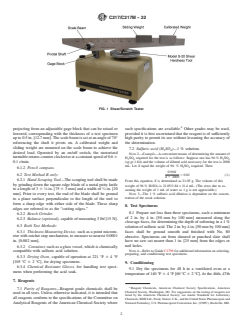
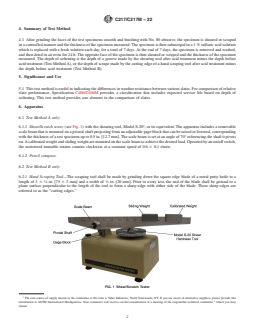
6.1.1 Shear/Scratch tester, (see Fig. 1) with the shearing tool, Model S-20 , or its equivalent. The apparatus includes a removable
scale beam that is mounted on a pivotal shaft projecting from an adjustable gage block that can be raised or lowered, corresponding
with the thickness of a test specimen up to 0.5 in. [12.7 mm]. The scale beam is set at an angle of 70° referencing the shaft it pivots
on. A calibrated weight and sliding weight are mounted on the scale beam to achieve the desired load. Operated by an on/off switch,
the motorized turntable rotates counter clockwise at a constant speed of 0.6 6 0.1 r/min.
6.1.2 Pencil compass.
6.2 Test Method B only:
6.2.1 Hand Scraping Tool—The scraping tool shall be made by grinding down the square edge blade of a metal putty knife to a
1 3
length of 3 6 ⁄8 in. [75 6 3 mm] and a width of ⁄4 in. [20 mm]. Prior to every test, the end of the blade shall be ground to a
plane surface perpendicular to the length of the tool to form a sharp edge with either side of the blade. These sharp edges are
referred to as the “cutting edges.”
FIG. 1 Shear/Scratch Tester
The sole source of supply known to the committee at this time is Taber Industries, North Tonawanda, NY. If you are aware of alternative suppliers, please provide this
information to ASTM International Headquarters. Your comments will receive careful consideration at a meeting of the responsible technical committee, which you may
attend.
C217/C217M − 22
6.2.2 Bench Grinder.
6.2.3 Balance (optional), capable of measuring 3 lbf [15 N].
6.3 Both Test Methods:
6.3.1 Thickness Measuring Device, such as a point micrometer with ratchet stop mechanism, to measure to nearest 0.0001 in.
[0.002 mm].
6.3.2 Container, such as a glass vessel, which is chemically compatible with sulfuric acid solution.
6.3.3 Drying Oven, capable of operation at 221 °F 6 4 °F [105 °C 6 2 °C], for drying specimens.
6.3.4 Chemical Resistant Gloves, for handling test specimens when performing the acid soak.
7. Reagents
7.1 Purity of Reagents—Reagent grade chemicals shall be used in all tests. Unless otherwise indicated, it is intended that all
reagents conform to the specifications of the Committee on Analytical Reagents of the American Chemical Society where such
specifications are available. Other grades may be used, provided it is first ascertained that the reagent is of sufficiently high purity
to permit its use without lessening the accuracy of the determination.
7.2 Sulfuric acid (H SO )—1 % solution.
2 4
NOTE 2—Example—A convenient means of determining the amount of H SO required for the test is as follows: Suppose one has 96 % H SO (sp gr
2 4 2 4
1.84) and the volume of diluted acid necessary for the test is 2000 mL. Let X equal the weight of 96 % H SO required. Then:
2 4
0.96X
5 0.01 (1)
X1 2000
From this equation, X is determined as 21.05 g. The volume of this weight of 96 % H SO is 21.05/1.84 = 11.4 mL. (The error due to assuming the
2 4
weight of 1 mL of water as 1 g is not appreciable.)
NOTE 3—The 1% 1 % sulfuric acid dilution is dependent on the concentration of the stock solution.
8. Test Specimens
8.1 Prepare not less than three specimens, each a minimum of 2 in. by 4 in. [50 mm by 100 mm] measured along the cleavage
faces, for determining the depth of softening in a 1 % solution of sulfuric acid. The 2 in. by 4 in. [50 mm by 100 mm] faces shall
be ground smooth and finished with No. 80 abrasive. Specimens cut from sheared or punched slate shall have no saw cut nearer
than 1 in. [25 mm] from the edges or nail holes.
NOTE 4—Refer to Guide C1799 for additional information on selecting, preparing, and conditioning test specimens.
9. Conditioning
9.1 Dry the specimens for 48 h in a ventilated oven at a temperature of 140 °F 6 4 °F [60 °C 6 2 °C]. At the 46th, 47th and 48th
hour, weigh the specimens to ensure that the weight is the same. If the weight continues to drop, continue to dry the specimens
until there are three successive hourly readings with the same weight.
10. Procedure – Test Method A (Shear/Scratch Tester)
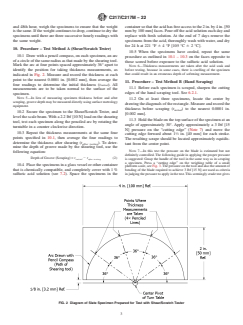
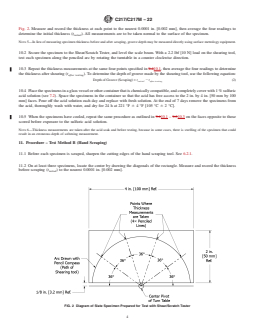
10.1 Draw with a pencil compass, on each specimen, an arc of a circle of the same radius as that made by the shearing tool. Mark
the arc at four points spaced approximately 36° apart to identify the position for taking thickness measurements, as indicated in
Reagent Chemicals, American Chemical Society Specifications, American Chemical Society, Washington, DC. For suggestions on the testing of reagents not listed by
the American Chemical Society, see Analar Standards for Laboratory Chemicals, BDH Ltd., Poole, Dorset, U.K., and the United States Pharmacopeia and National Formulary,
U.S. Pharmacopeial Convention, Inc. (USPC), Rockville, MD.
...