

ASTM E328-21
(Test Method)Standard Test Methods for Stress Relaxation for Materials and Structures
General Information
- Abstract
SIGNIFICANCE AND USE
5.1 Stress-relaxation test data are necessary when designing most mechanically fastened joints to ensure the permanent tightness of bolted or riveted assemblies, press or shrink-fit components, rolled-in tubes, etc. Other applications include predicting the decrease in the tightness of gaskets, in the hoop stress of solderless wrapped connections, in the constraining force of springs, and in the stability of wire tendons in prestressed concrete.
5.2 The ability of a material to relax at high-stress concentrations such as are present at notches, inclusions, cracks, holes, and fillets can be predicted from stress-relaxation data. Such test data are also useful to judge the heat-treatment condition necessary for the thermal relief of residual internal stresses in forgings, castings, weldments, machined or cold-worked surfaces, etc. The tests outlined in these methods are limited to conditions of approximately constant constraint and test environment.
5.3 The general stress-relaxation test is performed by isothermally applying a force to a specimen with fixed value of constraint. The constraint is maintained constant, and the constraining force is determined as a function of time. The major problem in the stress-relaxation test is that constant constraint can be very difficult to maintain. The effects on test results are very significant, and considerable attention shall be given to minimize the constraint variation. Also, experimenters should determine and report the extent of variation in each stress-relaxation test so that this factor can be taken into consideration.
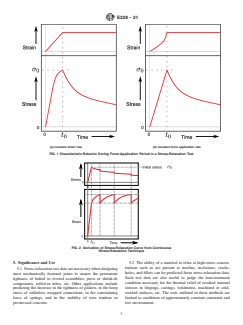
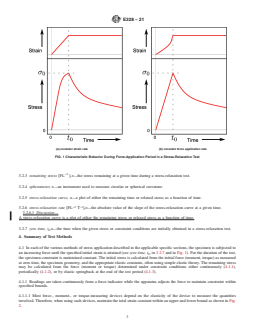
5.4 There are many methods of performing the stress-relaxation test, each with a different starting procedure. However, the constraint is usually obtained initially by the application of an external force at either a specific force-application rate or a specific strain rate. The two methods will produce the characteristic behavior shown in Fig. 1 when the initial stress, σ0, exceeds the proporti...
SCOPE
Note 1: The method of testing for the stress relaxation of plastics has been withdrawn from this standard, and the responsibility has been transferred to Practice D2991.
1.1 These test methods cover the determination of the time dependence of stress (stress relaxation) in materials and structures under conditions of approximately constant constraint, constant test environment, and negligible vibration. In the procedures, the material or structure is initially constrained by externally applied forces, and the change in the external force necessary to maintain this constraint is determined as a function of time.
1.2 Specific methods for conducting stress-relaxation tests on materials subjected to tension, compression, bending and torsion stresses are described in Parts A, B, C, and D, respectively. These test methods also include recommendations for the necessary testing equipment and for the analysis of the test data.
1.3 Bending stress-relaxation tests to determine relaxation properties by using ring-shaped specimens machined from bulk material have been thoroughly developed and widely used to determine stress-relaxation properties (1).2 These tests are outside the scope of these test methods.
1.4 The long time periods required for these types of tests are often unsuited for routine testing or for specification in the purchase of material. However, these tests are valuable tools in obtaining practical design information on the stress relaxation of materials subjected to constant constraint, constant test environment, and negligible vibration, and in investigations of the fundamental behavior of materials.
1.5 Units—The values stated in inch-pound units are to be regarded as standard. The values given in parentheses are mathematical conversions to SI units that are provided for information only and are not considered standard.
1.6 This standard does not purport to address all of the safety concerns, if a...
- Status
- Published
- Publication Date
- 31-Jan-2021
- Technical Committee
- E28 - Mechanical Testing
- Drafting Committee
- E28.04 - Uniaxial Testing
Overview
ASTM E328-21: Standard Test Methods for Stress Relaxation for Materials and Structures outlines accepted procedures for determining how materials and structures reduce internal stresses over time when subjected to constant constraint under controlled environmental conditions. Developed by ASTM Committee E28 on Mechanical Testing, these test methods evaluate the time-dependent decrease in stress, commonly referred to as stress relaxation. Accurate stress relaxation data are critical for engineering applications where the long-term integrity and tightness of mechanically fastened joints, springs, tendons, or other structural components must be assured.
Key Topics
- Stress Relaxation Definition: Stress relaxation is the process by which a material, initially loaded under constraint, gradually decreases its internal stress while the constraint remains constant.
- Test Methods: ASTM E328-21 provides test methods for tension, compression, bending, and torsion stress-relaxation tests, each with specific apparatus and specimen preparation guidelines.
- Environmental Control: Accurate results require a stable, controlled environment (constant temperature and minimal vibration) as temperature fluctuations and vibrations can significantly affect the test outcome.
- Test Specimens: The selection, geometry, and preparation of test specimens are crucial. Uniform cross-section and minimized residual stresses are recommended.
- Data Analysis: The standard recommends plotting initial and remaining stress or relaxed stress versus time to produce stress-relaxation curves. This data provides insights into the material’s long-term performance.
- Reporting: Results should include information on material composition, test specimen dimensions, environmental conditions, initial and final stresses, and a clear presentation of relaxation data.
Applications
Stress relaxation data obtained through ASTM E328-21 are essential in numerous engineering and manufacturing scenarios:
- Mechanical Fastening: Ensuring the long-term tightness of bolted, riveted, or pressed joints in machinery, vehicles, or structures.
- Spring Components: Verifying that springs maintain their force over time, which is critical in load-bearing assemblies or actuators.
- Gaskets and Seals: Predicting the reduction in sealing force, which helps prevent leaks in piping or pressure vessels.
- Electrical Connections: Estimating the decrease in hoop stress in solderless wrapped connections, affecting electrical reliability.
- Prestressed Concrete: Assessing the residual force in wire tendons, informing the stability and safety of concrete structures.
- Material Processing: Guiding heat-treatment schedules for forgings, castings, or weldments to relieve internal stresses and improve component performance.
- Fundamental Research: Investigating the time-dependent behavior of metals and structures for material science studies or long-term design considerations.
Related Standards
Several ASTM and international standards are referenced for specimen preparation, testing, and terminology:
- ASTM E4: Practices for Force Verification of Testing Machines
- ASTM E6: Terminology Relating to Methods of Mechanical Testing
- ASTM E8/E8M: Test Methods for Tension Testing of Metallic Materials
- ASTM E9: Test Methods of Compression Testing of Metallic Materials at Room Temperature
- ASTM E139: Test Methods for Conducting Creep, Creep-Rupture, and Stress-Rupture Tests of Metallic Materials
- ASTM E1012: Practice for Verification of Testing Frame and Specimen Alignment Under Tensile and Compressive Axial Force Application
- ASTM D2991 (for plastics): Test Method for Stress-Relaxation of Plastics (reference only, as plastics are excluded from E328-21)
Practical Value
Adhering to ASTM E328-21 provides engineers, designers, and materials scientists with a reliable framework for stress-relaxation testing, enabling:
- Optimized Material Selection: Informed decisions for selecting materials with favorable stress-relaxation properties for critical applications.
- Improved Product Reliability: Long-term assurance of mechanical performance in safety-critical components.
- Compliance and Quality: Satisfying commercial and regulatory requirements for mechanical test documentation and product qualification.
ASTM E328-21 is an essential resource for anyone involved in mechanical testing, design, and long-term assessment of materials and structures under constant loading conditions.
Relations
- Effective Date
- 01-Jan-2024
- Effective Date
- 15-Jul-2016
- Effective Date
- 01-Feb-2015
- Effective Date
- 01-Jun-2014
- Effective Date
- 01-Jun-2013
- Effective Date
- 01-Jun-2012
- Effective Date
- 01-Jun-2012
- Effective Date
- 01-Dec-2011
- Effective Date
- 01-Jun-2011
- Effective Date
- 01-Jun-2010
- Refers
ASTM E9-09 - Standard Test Methods of Compression Testing of Metallic Materials at Room Temperature - Effective Date
- 01-Nov-2009
- Effective Date
- 01-Nov-2009
- Effective Date
- 15-May-2009
- Effective Date
- 15-May-2009
- Effective Date
- 01-Apr-2009
Get Certified
Connect with accredited certification bodies for this standard

IMP NDT d.o.o.
Non-destructive testing services. Radiography, ultrasonic, magnetic particle, penetrant, visual inspection.
Inštitut za kovinske materiale in tehnologije
Institute of Metals and Technology. Materials testing, metallurgical analysis, NDT.
Q Techna d.o.o.
NDT and quality assurance specialist. 30+ years experience. NDT personnel certification per ISO 9712, nuclear and thermal power plant inspections, QA/
Sponsored listings
Frequently Asked Questions
ASTM E328-21 is a standard published by ASTM International. Its full title is "Standard Test Methods for Stress Relaxation for Materials and Structures". This standard covers: SIGNIFICANCE AND USE 5.1 Stress-relaxation test data are necessary when designing most mechanically fastened joints to ensure the permanent tightness of bolted or riveted assemblies, press or shrink-fit components, rolled-in tubes, etc. Other applications include predicting the decrease in the tightness of gaskets, in the hoop stress of solderless wrapped connections, in the constraining force of springs, and in the stability of wire tendons in prestressed concrete. 5.2 The ability of a material to relax at high-stress concentrations such as are present at notches, inclusions, cracks, holes, and fillets can be predicted from stress-relaxation data. Such test data are also useful to judge the heat-treatment condition necessary for the thermal relief of residual internal stresses in forgings, castings, weldments, machined or cold-worked surfaces, etc. The tests outlined in these methods are limited to conditions of approximately constant constraint and test environment. 5.3 The general stress-relaxation test is performed by isothermally applying a force to a specimen with fixed value of constraint. The constraint is maintained constant, and the constraining force is determined as a function of time. The major problem in the stress-relaxation test is that constant constraint can be very difficult to maintain. The effects on test results are very significant, and considerable attention shall be given to minimize the constraint variation. Also, experimenters should determine and report the extent of variation in each stress-relaxation test so that this factor can be taken into consideration. 5.4 There are many methods of performing the stress-relaxation test, each with a different starting procedure. However, the constraint is usually obtained initially by the application of an external force at either a specific force-application rate or a specific strain rate. The two methods will produce the characteristic behavior shown in Fig. 1 when the initial stress, σ0, exceeds the proporti... SCOPE Note 1: The method of testing for the stress relaxation of plastics has been withdrawn from this standard, and the responsibility has been transferred to Practice D2991. 1.1 These test methods cover the determination of the time dependence of stress (stress relaxation) in materials and structures under conditions of approximately constant constraint, constant test environment, and negligible vibration. In the procedures, the material or structure is initially constrained by externally applied forces, and the change in the external force necessary to maintain this constraint is determined as a function of time. 1.2 Specific methods for conducting stress-relaxation tests on materials subjected to tension, compression, bending and torsion stresses are described in Parts A, B, C, and D, respectively. These test methods also include recommendations for the necessary testing equipment and for the analysis of the test data. 1.3 Bending stress-relaxation tests to determine relaxation properties by using ring-shaped specimens machined from bulk material have been thoroughly developed and widely used to determine stress-relaxation properties (1).2 These tests are outside the scope of these test methods. 1.4 The long time periods required for these types of tests are often unsuited for routine testing or for specification in the purchase of material. However, these tests are valuable tools in obtaining practical design information on the stress relaxation of materials subjected to constant constraint, constant test environment, and negligible vibration, and in investigations of the fundamental behavior of materials. 1.5 Units—The values stated in inch-pound units are to be regarded as standard. The values given in parentheses are mathematical conversions to SI units that are provided for information only and are not considered standard. 1.6 This standard does not purport to address all of the safety concerns, if a...
SIGNIFICANCE AND USE 5.1 Stress-relaxation test data are necessary when designing most mechanically fastened joints to ensure the permanent tightness of bolted or riveted assemblies, press or shrink-fit components, rolled-in tubes, etc. Other applications include predicting the decrease in the tightness of gaskets, in the hoop stress of solderless wrapped connections, in the constraining force of springs, and in the stability of wire tendons in prestressed concrete. 5.2 The ability of a material to relax at high-stress concentrations such as are present at notches, inclusions, cracks, holes, and fillets can be predicted from stress-relaxation data. Such test data are also useful to judge the heat-treatment condition necessary for the thermal relief of residual internal stresses in forgings, castings, weldments, machined or cold-worked surfaces, etc. The tests outlined in these methods are limited to conditions of approximately constant constraint and test environment. 5.3 The general stress-relaxation test is performed by isothermally applying a force to a specimen with fixed value of constraint. The constraint is maintained constant, and the constraining force is determined as a function of time. The major problem in the stress-relaxation test is that constant constraint can be very difficult to maintain. The effects on test results are very significant, and considerable attention shall be given to minimize the constraint variation. Also, experimenters should determine and report the extent of variation in each stress-relaxation test so that this factor can be taken into consideration. 5.4 There are many methods of performing the stress-relaxation test, each with a different starting procedure. However, the constraint is usually obtained initially by the application of an external force at either a specific force-application rate or a specific strain rate. The two methods will produce the characteristic behavior shown in Fig. 1 when the initial stress, σ0, exceeds the proporti... SCOPE Note 1: The method of testing for the stress relaxation of plastics has been withdrawn from this standard, and the responsibility has been transferred to Practice D2991. 1.1 These test methods cover the determination of the time dependence of stress (stress relaxation) in materials and structures under conditions of approximately constant constraint, constant test environment, and negligible vibration. In the procedures, the material or structure is initially constrained by externally applied forces, and the change in the external force necessary to maintain this constraint is determined as a function of time. 1.2 Specific methods for conducting stress-relaxation tests on materials subjected to tension, compression, bending and torsion stresses are described in Parts A, B, C, and D, respectively. These test methods also include recommendations for the necessary testing equipment and for the analysis of the test data. 1.3 Bending stress-relaxation tests to determine relaxation properties by using ring-shaped specimens machined from bulk material have been thoroughly developed and widely used to determine stress-relaxation properties (1).2 These tests are outside the scope of these test methods. 1.4 The long time periods required for these types of tests are often unsuited for routine testing or for specification in the purchase of material. However, these tests are valuable tools in obtaining practical design information on the stress relaxation of materials subjected to constant constraint, constant test environment, and negligible vibration, and in investigations of the fundamental behavior of materials. 1.5 Units—The values stated in inch-pound units are to be regarded as standard. The values given in parentheses are mathematical conversions to SI units that are provided for information only and are not considered standard. 1.6 This standard does not purport to address all of the safety concerns, if a...
ASTM E328-21 is classified under the following ICS (International Classification for Standards) categories: 19.020 - Test conditions and procedures in general. The ICS classification helps identify the subject area and facilitates finding related standards.
ASTM E328-21 has the following relationships with other standards: It is inter standard links to ASTM E8/E8M-24, ASTM E8/E8M-16, ASTM E8/E8M-15, ASTM E4-14, ASTM E8/E8M-13, ASTM E1012-12, ASTM E1012-12e1, ASTM E8/E8M-11, ASTM E139-11, ASTM E4-10, ASTM E9-09, ASTM E4-09a, ASTM E6-09be1, ASTM E6-09b, ASTM E4-09. Understanding these relationships helps ensure you are using the most current and applicable version of the standard.
ASTM E328-21 is available in PDF format for immediate download after purchase. The document can be added to your cart and obtained through the secure checkout process. Digital delivery ensures instant access to the complete standard document.
Standards Content (Sample)
This international standard was developed in accordance with internationally recognized principles on standardization established in the Decision on Principles for the
Development of International Standards, Guides and Recommendations issued by the World Trade Organization Technical Barriers to Trade (TBT) Committee.
Designation: E328 − 21
Standard Test Methods for
Stress Relaxation for Materials and Structures
This standard is issued under the fixed designation E328; the number immediately following the designation indicates the year of
original adoption or, in the case of revision, the year of last revision.Anumber in parentheses indicates the year of last reapproval.A
superscript epsilon (´) indicates an editorial change since the last revision or reapproval.
INTRODUCTION
These test methods cover a broad range of testing activities. To aid in locating the subject matter
pertinent to a particular test, the standard is divided into a general section, which applies to all
stress-relaxationtestsformaterialsandstructures.Thisgeneralsectionisfollowedbyletter-designated
parts that apply to tests for material characteristics when subjected to specific, simple stresses, such
as uniform tension, uniform compression, bending or torsion. To choose from among these types of
stress, three factors should be considered:
(1)Whenthematerialdataaretobeappliedtothedesignofaparticularclassofcomponent,thestress
during the stress-relaxation test should be similar to that imposed on the component. For example,
tension tests are suitable for bolting applications and bending tests for leaf springs.
(2) Tension and compression stress-relaxation tests have the advantage that the stress can be reported
simply and unequivocally. During bending stress-relaxation tests, the state of stress is complex, but
can be accurately determined when the initial strains are elastic. If plastic strains occur on application
of force, stresses can usually be determined within a bounded range only. Tension stress-relaxation
tests, when compared to compression stress-relaxation tests, have the advantage that it is unnecessary
toguardagainstbuckling.Therefore,whenthetestmethodisnotrestrictedbythetypeofstressinthe
component, tension stress-relaxation testing should be used.
(3)Bendingstress-relaxationtests,whencomparedtotensionandcompressionstress-relaxationtests,
have the advantage of using lighter and simpler apparatus for specimens of the same cross-sectional
area. Strains are usually calculated from deflection or curvature measurements. Since the specimens
canusuallybedesignedsothatthesequantitiesaremuchgreaterthantheaxialdeformationinadirect
stress test, strain is more easily measured and more readily used for machine control in bending
stress-relaxation tests. Due to the small forces normally required and the simplicity of the apparatus
whenstaticfixturesaresufficient,manyspecimenscanbeplacedinasingleovenorfurnacewhentests
are made at elevated temperatures.
1. Scope* external force necessary to maintain this constraint is deter-
NOTE 1—The method of testing for the stress relaxation of plastics has mined as a function of time.
been withdrawn from this standard, and the responsibility has been
1.2 Specific methods for conducting stress-relaxation tests
transferred to Practice D2991.
on materials subjected to tension, compression, bending and
1.1 These test methods cover the determination of the time
torsion stresses are described in Parts A, B, C, and D,
dependence of stress (stress relaxation) in materials and
respectively.Thesetestmethodsalsoincluderecommendations
structures under conditions of approximately constant
for the necessary testing equipment and for the analysis of the
constraint, constant test environment, and negligible vibration.
test data.
In the procedures, the material or structure is initially con-
1.3 Bending stress-relaxation tests to determine relaxation
strained by externally applied forces, and the change in the
propertiesbyusingring-shapedspecimensmachinedfrombulk
material have been thoroughly developed and widely used to
determine stress-relaxation properties (1). These tests are
These test methods are under the jurisdiction of ASTM Committee E28 on
outside the scope of these test methods.
Mechanical Testing and is the direct responsibility of Subcommittee E28.04 on
Uniaxial Testing.
Current edition approved Feb. 1, 2021. Published February 2021. Originally
approved in 1967. Last previous approved in 2020 as E328–20. DOI: 10.1520/ The boldface numbers in parentheses refer to a list of references at the end of
E0328-21. this standard.
*A Summary of Changes section appears at the end of this standard
Copyright © ASTM International, 100 Barr Harbor Drive, PO Box C700, West Conshohocken, PA 19428-2959. United States
E328 − 21
−2
1.4 The long time periods required for these types of tests 3.2.1 initial stress, σ , [FL ],n—the stress introduced into
are often unsuited for routine testing or for specification in the a specimen by imposing the given constraint conditions before
purchaseofmaterial.However,thesetestsarevaluabletoolsin stress relaxation begins.
obtaining practical design information on the stress relaxation 3.2.1.1 Discussion—This is sometimes called instantaneous
of materials subjected to constant constraint, constant test stress.
−2
environment, and negligible vibration, and in investigations of
3.2.2 relaxed stress [FL ],n—the initial stress minus the
the fundamental behavior of materials.
remaining stress at a given time during a stress-relaxation test.
−2
1.5 Units—The values stated in inch-pound units are to be
3.2.3 remaining stress [FL ],n—the stress remaining at a
regarded as standard. The values given in parentheses are
given time during a stress-relaxation test.
mathematical conversions to SI units that are provided for
3.2.4 spherometer, n—an instrument used to measure circu-
information only and are not considered standard.
lar or spherical curvature.
1.6 This standard does not purport to address all of the
3.2.5 stress-relaxation curve, n—aplotofeithertheremain-
safety concerns, if any, associated with its use. It is the
ing time or relaxed stress as a function of time.
responsibility of the user of this standard to establish appro-
−2 –1
3.2.6 stress-relaxation rate [FL T ],n—the absolute
priate safety, health, and environmental practices and deter-
valueoftheslopeofthestress-relaxationcurveatagiventime.
mine the applicability of regulatory limitations prior to use.
3.2.6.1 Discussion—A stress-relaxation curve is a plot of
1.7 This international standard was developed in accor-
either the remaining stress or relaxed stress as a function of
dance with internationally recognized principles on standard-
time.
ization established in the Decision on Principles for the
3.2.7 zero time, t ,n—the time when the given stress or
Development of International Standards, Guides and Recom- 0
constraintconditionsareinitiallyobtainedinastress-relaxation
mendations issued by the World Trade Organization Technical
test.
Barriers to Trade (TBT) Committee.
4. Summary of Test Methods
2. Referenced Documents
4.1 In each of the various methods of stress application
2.1 ASTM Standards:
described in the applicable specific sections, the specimen is
D2991Test Method for Stress-Relaxation of Plastics (With-
subjected to an increasing force until the specified initial strain
drawn 1990)
is attained (see zero time, t,in 3.2.7 and in Fig. 1). For the
E4Practices for Force Verification of Testing Machines
duration of the test, the specimen constraint is maintained
E6Terminology Relating to Methods of MechanicalTesting
constant. The initial stress is calculated from the initial force
E8/E8MTest Methods for Tension Testing of Metallic Ma-
(moment, torque) as measured at zero time, the specimen
terials
geometry, and the appropriate elastic constants, often using
E9Test Methods of Compression Testing of Metallic Mate-
simple elastic theory. The remaining stress may be calculated
rials at Room Temperature
fromtheforce(momentortorque)determinedunderconstraint
E139Test Methods for Conducting Creep, Creep-Rupture,
conditions either continuously (4.1.1), periodically (4.1.2), or
and Stress-Rupture Tests of Metallic Materials
by elastic springback at the end of the test period (4.1.3).
E1012Practice for Verification of Testing Frame and Speci-
4.1.1 Readings are taken continuously from a force indica-
men Alignment Under Tensile and Compressive Axial
tor while the apparatus adjusts the force to maintain constraint
Force Application
within specified bounds.
4.1.1.1 Most force-, moment-, or torque-measuring devices
3. Terminology
dependontheelasticityofthedevicetomeasurethequantities
3.1 Definitions: involved. Therefore, when using such devices, maintain the
totalstrainconstantwithinanupperandlowerboundasshown
3.1.1 Definitions of terms common to mechanical testing
that appear in Terminology E6 apply to this test method, in Fig. 2.
4.1.2 Theforcerequiredtoliftthespecimenjustfreeofone
including calibration, eccentricity, gauge length, indicated
temperature, modulus of elasticity, Poisson’s ratio, propor- or more constraints during the test period is measured.
4.1.3 The elastic springback is measured after removing the
tional limit, reduced parallel section, residual stress, shear
test stress at the end of the test period.
modulus, specified temperature, and testing machine.
3.1.2 stress relaxation, n—the time-dependent decrease in
4.2 With 4.1.1 and 4.1.2, a single specimen may be used to
stress in a solid under given constraint conditions.
obtain data for a curve of stress versus time. With 4.1.3, the
same specimen may be used to determine the remaining or
3.2 Definitions of Terms Specific to This Standard:
relaxed stress after various time intervals, if it can be demon-
stratedforagivenmaterialthatidenticalresultsareobtainedin
either using untested or reloaded specimens. Otherwise, an
For referenced ASTM standards, visit the ASTM website, www.astm.org, or
individual specimen shall be used for each point on the curve.
contact ASTM Customer Service at service@astm.org. For Annual Book of ASTM
Standards volume information, refer to the standard’s Document Summary page on
4.3 The stress-relaxation rate of a stress-relaxation curve,
the ASTM website.
Fig. 3, may be determined from slope of either the remaining
The last approved version of this historical standard is referenced on
www.astm.org. stress or the relaxed stress as a function of time.
E328 − 21
(a) constant strain rate (b) constant force application rate
FIG. 1 Characteristic Behavior During Force-Application Period in a Stress-Relaxation Test
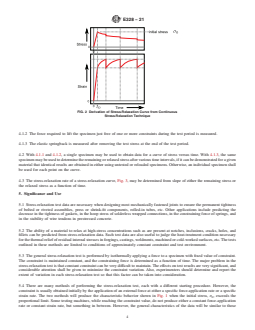
FIG. 2 Derivation of Stress-Relaxation Curve from Continuous
Stress-Relaxation Technique
5. Significance and Use 5.2 The ability of a material to relax at high-stress concen-
trations such as are present at notches, inclusions, cracks,
5.1 Stress-relaxation test data are necessary when designing
holes, and fillets can be predicted from stress-relaxation data.
most mechanically fastened joints to ensure the permanent
Such test data are also useful to judge the heat-treatment
tightness of bolted or riveted assemblies, press or shrink-fit
condition necessary for the thermal relief of residual internal
components, rolled-in tubes, etc. Other applications include
stresses in forgings, castings, weldments, machined or cold-
predicting the decrease in the tightness of gaskets, in the hoop
worked surfaces, etc. The tests outlined in these methods are
stress of solderless wrapped connections, in the constraining
limited to conditions of approximately constant constraint and
force of springs, and in the stability of wire tendons in
prestressed concrete. test environment.
E328 − 21
FIG. 3 Typical Stress-relaxation Curve
5.3 The general stress-relaxation test is performed by iso- 7. Temperature Control and Measurement
thermally applying a force to a specimen with fixed value of
7.1 Maintain the test environment (controlled-temperature
constraint. The constraint is maintained constant, and the
room, furnace, or cold box) at a constant temperature by a
constraining force is determined as a function of time. The
suitable automatic device. This is the most important single
major problem in the stress-relaxation test is that constant
factor in a stress-relaxation test since the stress-relaxation rate,
constraint can be very difficult to maintain. The effects on test
dimensions, and constraint conditions of the specimen depend
results are very significant, and considerable attention shall be
upon the temperature. Any type of heating or cooling that
giventominimizetheconstraintvariation.Also,experimenters
permits close temperature control of the test environment may
should determine and report the extent of variation in each
be used.
stress-relaxation test so that this factor can be taken into
7.2 The indicated temperature should be recorded, prefer-
consideration.
ably continuously or at least periodically. Indicated tempera-
5.4 There are many methods of performing the stress-
turevariationsofthespecimensfromthespecifiedtemperature
relaxation test, each with a different starting procedure.
duetoallcauses,includingcyclingofthecontrollerorposition
However, the constraint is usually obtained initially by the
along the specimen gauge length, should not exceed 65°F
application of an external force at either a specific force-
(63°C) or 60.5%, whichever is greater. These limits should
application rate or a specific strain rate. The two methods will
apply initially and for the duration of the test.
produce the characteristic behavior shown in Fig. 1 when the
7.3 The combined strain resulting from differential thermal
initial stress, σ , exceeds the proportional limit. Some testing
expansion(associatedwithnormaltemperaturevariationofthe
machines, while reaching the constraint value, do not produce
test environment) between the test specimen and the constraint
either a constant force-application rate or constant strain rate,
andothervariationsintheconstraint(suchaselasticfollowup)
butsomethinginbetween.However,thegeneralcharacteristics
should not exceed 60.000025 in./in. (mm/mm).
of the data will be similar to those indicated. The stress-
application rate in either case should be reasonably rapid, but
7.4 Temperature measurement should be made in accor-
without impact or vibration, so that any relaxation during the
dance with Practice E139.
stress-application period will be small.
5.5 Thestress-relaxationteststartsatzerotime, t,inFig.1.
8. Vibration Control
NOTE 2—This zero time is the reference time from which the observed
8.1 Since stress-relaxation tests are quite sensitive to shock
reduction in force to maintain constant constraint is based. Selection of
and vibration, the testing machine and mounting should be
this time does not imply that the force-application procedure and period
are not significant test parameters which are important in the application
located so that the specimen is isolated from vibration.
of the data.
9. Test Specimens
6. Apparatus
9.1 The test specimens should be of a shape most appropri-
6.1 See the appropriate paragraph under each section.
ate for the testing method and end use. Wire may be tested in
6.2 The equipment should be located in a draft-free, the“as-received”condition.Metalplate,sheet,strip,bar,orrod
constant-temperature laboratory, 65°F(63°C). may be machined to the desired shape.
E328 − 21
9.2 Residual stresses can significantly alter the stress-
relaxation characteristics of the material, so care should be
exercised in machining to prevent alteration of the residual
stresses.
9.3 Test specimens shall have a uniform cross-section
throughoutthegaugelengthandmeetthefollowingtolerances:
Tolerance, % of Diameter
Nominal Diameter or Width
or Width
0.100 in. (2.5 mm) ±0.5
0.250 in. (6.4 mm) ±0.4
0.375 in. (9.5 mm) ±0.3
0.500 in. (12.7 mm) ±0.2
FIG. 4 Tension Stress-Relaxation Test Using Periodic Force Mea-
surement
10. Test Environment
10.1 If the specified temperature is different from ambient,
specimens previously fitted with strain gages or extensometers
14. Summary of Test Method
should be exposed to the specified temperature for a period of
14.1 The specimen is subjected to an increasing tensile
time sufficient to obtain dimensional stability before starting
forceuntilthespecifiedinitialstrainisattained.Theinitialand
the tests.
remaining stresses are determined by either of the methods in
10.2 The stress-relaxation test may be started immediately
4.1.
upon achieving thermal equilibrium.
15. Apparatus
11. Guide for Processing Test Data
15.1 The testing machine shall have an accuracy of 1%
11.1 The remaining stress, relaxed stress, or applied force
throughouttheworkingrange(seePracticesE4),andshouldbe
may be plotted against time or log time. Log stress versus log
calibrated under both decreasing and increasing force applica-
time plots may also be employed.
tions.
11.2 For convenience in comparing the relative stress-
15.2 The testing machine shall incorporate means of adjust-
relaxation characteristics of materials, the ratio “Fraction
ing the force in a continuous and automatic manner in order to
Initial Stress Relaxed” may be plotted against time. This ratio
maintain constant constraint, so that the strain on the specimen
is the difference between the initial stress and the remaining
is maintained within 60.000025 mm/mm (in./in) (see Fig. 4).
stress at any time divided by the initial stress.
15.3 Axiality of force application is extremely important
andshouldbecheckedusingtheprocedureoutlinedinPractice
12. Report
E1012. Nonaxiality, so measured, should not exceed 15% in
12.1 The report should include as much of the following
elastic strain readings.
information as is appropriate:
12.1.1 Material Being Tested: 16. Test Specimens
12.1.1.1 Chemical composition,
16.1 Testspecimensofthetype,size,andshapedescribedin
12.1.1.2 Microstructure,
Test Methods E8/E8M and Practice E139 are generally suit-
12.1.1.3 Mechanical properties,
able. The cross section should be uniform throughout the
12.1.2 Specimen geometry,
length of the reduced parallel section. To facilitate control of
12.1.3 Testing machine or apparatus,
thelimitingstrain,thegaugelengthshouldbelongerthanthose
12.1.4 Strain measurement method,
specified in Test Methods E8/E8M. The following round
12.1.5 Indicated temperature measurement method,
specimen dimensions, for example, have been used success-
12.1.6 Atmosphere.
fully:
12.1.7 Stress-Relaxation Test Data:
Specimen Gauge Diameter Gauge Length
12.1.7.1 Initial stress and strain data,
1 0.375 in. 7.000 in.
12.1.7.2 Final stress and strain data,
(9.07 mm) (177.8 mm)
2 0.375 in. 6.000 in.
12.1.7.3 Plot of data.
(9.07 mm) (152.4 mm)
3 0.252 in. 4.000 in.
A. METHOD FOR CONDUCTING TENSION STRESS-
(6.40 mm) (101.6 mm)
RELAXATION TESTS 4 0.500 in. 6.000 in.
(12.70 mm) (152.4 mm)
13. Scope 16.2 Specimens of circular cross-section may have either
threaded or shouldered ends for gripping. The threads or
13.1 This test method covers the determination of the
shoulders should be concentric with the specimen axis to
time-dependentdecreaseinstressinaspecimensubjectedtoan
within+0.0005 in. (+0.01 mm).
uniaxial constant tension strain under conditions of uniform
test environment and negligible vibration. It also includes 16.3 Testspecimensurfacesshouldbesmoothandfreefrom
recommendations for the necessary testing equipment. nicks and scratches. Eccentricity in the specimen should be
E328 − 21
NOTE 3—Specimen geometry and frictional end effects play an impor-
minimized, and the force should be applied axially. In
tant role in producing a deviation from the idealized specimen deforma-
machining, precautions should be taken to avoid deformation
tion. An initially cylindrical specimen ideally would remain a cylinder,
by bending.
but, because of friction, the specimen cross section is larger midway
between the bearing blocks than at either bearing block. The slenderness
17. Grips
ratio of the specimen recommended in this procedure is intended to
17.1 Thegripsandgrippingtechniqueshouldbedesignedto minimize such effects.Amore detailed study of these effects is presented
by Cook and Larke. (2)
minimize eccentricity in loading in the test specimen.
24. Apparatus
18. Procedure
18.1 Mount the specimen in the testing machine and mini- 24.1 An apparatus (Fig. 5) similar to that described in
PartA, may be used with the following additional require-
mize axial misalignment. At room temperature, the strain on
opposite sides of the test specimen shall not differ from the ments.Axialityofforceapplicationisextremelyimportantand
average by more than 15%. Attach the thermocouples and should be checked using the procedure outlined in Test
extensometer to the specimen. Heat the specimen to the Methods E9. Nonaxiality upon attaining the specified initial
specified temperature, avoid overheating (Section 7), and hold force or strain should not exceed a difference of 10% in
at this temperature for a period sufficient to reach thermal elastic-strain readings on opposite sides of a flat specimen.
equilibrium and dimensional stability. Apply the initial force Measure this difference at the surfaces, which are assumed to
rapidly without shock. The zero time, t , occurs when the be parallel, symmetric to, and as remote as possible from the
desired test stress is achieved. force-application axis. Round specimens shall be measured at
three points spaced 120° apart along the circumference.
18.2 Maintain the limiting strain constant during the dura-
tion of the test. 24.2 Testing Machine—This device shall have no instability
in compression within the force range being used. The platens
18.3 Any temperature disturbance causing the indicated
ofthetestingmachineshallremainessentiallyparallelandfree
temperature of the specimen to rise above or below the limits
of sidewise motion.
specifiedin7.2iscauseforrejectionofthetest.Exceptionmay
be made to this where the time above or below specified 24.3 Bearing Surfaces—The bearing surfaces of the heads
temperature is so short that it will not significantly influence of the testing machine shall be plane, parallel, and maintained
the stress-relaxation characteristics of the material under test. in good condition so that there will be substantially no tilting
of the bearing blocks throughout the test (see Test Methods
18.4 After the specified time has elapsed, determine
E9).
changes in force or stress.
24.4 Bearing Blocks—Bothendsofacompressionspecimen
19. Guide for Processing Test Data
shall bear on blocks with surfaces flat and parallel within
19.1 See Section 11.
0.0002 in./in. (or mm/mm). The bearing blocks shall be made
of suitably hard material such that the blocks will suffer no
20. Report
appreciable permanent deformation during the test. Suitable
20.1 See Section 12.
types of bearing blocks are described in Test Methods E9.
21. Precision and Bias
24.5 Alignment Device—A suitable alignment device, such
as that shown in Test Methods E9, should be used.
21.1 Precision—Sufficient multilaboratory tests have not
been performed to establish the reproducibility of this test
25. Test Specimens
method. These are long-term tests unsuited for routine testing
or for specifications in the purchase of material. 25.1 Testspecimensofthetype,size,andshapedescribedin
Test Methods E9 are generally suitable. Solid cylindrical
21.2 Bias—There is no basis for defining the bias for this
specimenswithan L/D(length/diameterratio)of8to10should
test method.
beused.Othertestspecimensofspecialmaterialsorforspecial
B. METHOD FOR CONDUCTING COMPRESSION forms of material may be used.
STRESS-RELAXATION TESTS
25.2 Thin-sheet specimens described in Test Methods E9
maybeusedwhenappropriateanti-bucklingfixturesforlateral
22. Scope
support are used.
22.1 This test method covers the determination of the
25.3 Preparation of Specimens:
time-dependent decrease in stress in a specimen subjected to a
25.3.1 Specimens for compression stress-relaxation tests of
long-duration, uniaxial, constant compression strain in a uni-
metals should be prepared in accordance with Test Methods
formtestenvironmentandnegligiblevibration.Italsoincludes
E9. Care in machining should be exercised so that residual
recommendations for the necessary testing equipment.
stresses are minimized.
23. Summary of Test Method
25.3.2 Test specimen surfaces should be smooth and free
23.1 The specimen is subjected to an increasing compres- from nicks and scratches. Special care should be exercised to
siveforceuntilthespecifiedinitialstrainisattained.Theinitial minimize eccentricity in the specimen. In machining and
andremainingstressaredeterminedbyeitherofthemethodsin handling, precautions should be taken to avoid deformation by
4.1. bending.
E328 − 21
FIG. 5 Compression Stress-Relaxation Test
26. Procedure 26.2 Apply the initial stress without shock. The stress-
application rate shall not exceed 100 ksi/min (690 MPa/min).
26.1 Mountthespecimen,preferablyinanalignmentdevice
Definetheinstantthatthedesiredinitialstressisattainedasthe
(see 24.5), minimize axial misalignment, and attach the exten-
zero time.
someter and thermocouples. Axiality of force application
should be in accordance with 24.1. For elevated-temperature
26.3 Maintain the total strain constant within the limits
tests, heat the specimen to the specified temperature without
specified in 7.3.
overheating (see Section 7). Maintain the specimen at the
specified temperature for a time sufficient to reach thermal 26.4 After the specified time has elapsed, determine the
equilibriumanddimensionalstability(see7.3)beforeapplying changes in force or stress.
initial stress.
E328 − 21
26.5 If the elastic springback (see 4.1.3) is used to deter-
minestressrelaxation,unloadthespecimenandremoveitfrom
the test environment. Determine the remaining strain and
calculate stress relaxation. If it is demonstrable that periodic
reloading has no effect on the stress-relaxation curve, the same
specimen may be reloaded to the same initial constraint to
establish the stress-relaxation curve as a function of time.That
is, the specimen may be reloaded to the same compressed
gauge length as that used immediately upon initial loading. If
periodic reloading affects the shape of the stress-relaxation
curve, an untested specimen shall be used to determine each
point on the stress-relaxation curve.
27. Guide for Processing Test Data
27.1 See Section 11.
28. Report
28.1 See Section 12.
29. Precision and Bias
29.1 Precision—Sufficient multilaboratory tests have not
been performed to establish the reproducibility of this test
method. These are long-term tests unsuited for routine testing
or for specifications in the purchase of material.
29.2 Bias—There is no basis for defining the bias for this
test method.
C. METHOD FOR CONDUCTING BENDING STRESS-
RELAXATION TESTS
FIG. 6 Specimen and Spherometer in Four-Point Flexural Stress
Fixture
30. Scope
30.1 This test method covers the determination of the
time-dependent decrease in stress in a specimen subject to
untested or previously stressed specimens. Otherwise, an
long-duration, constant bending strain, in a uniform test
individual specimen shall be used for each point on the curve.
environment, and negligible vibration. Recommendations for
sometypicaltestingequipmentareincluded.Methodsincluded
32. Apparatus
are only those in which the outer fiber strain is essentially
32.1 The apparatus consists of equipment for maintaining
uniform in the test section.
the test environment, and applying, maintaining, and measur-
31. Summary of Test Method ing the restraining force.
31.1 The specimen is subjected to an increasing bending 32.2 The test environment shall be maintained by apparatus
moment until the specified initial maximum bending strain is that conforms to the conditions specified in Sections 7, 8, and
attained. The initial and remaining stresses are determined 10.
from either of the methods shown in 4.1.
32.3 Test Method C-1:
31.1.1 Test Method C-1—Readings are taken from a con-
32.3.1 Theforce-(ormoment-)adjustingapparatusconsists
tinuously reading force indicator while the apparatus adjusts
of a device that applies and indicates the force or moment and
the force to maintain constraint within specified bounds (see
measures specimen deflection (see Fig. 6).
4.1.1).
32.3.2 The fixtures for testing the specimen shall be of the
31.1.2 Test Method C-2—The force required to lift the
four-point flexural stress type shown in Fig. 6. The force
specimen just free of one or more constraints during the test
bearing points should be symmetrical about the mid-span so
period is measured (see 4.1.2).
that the central portion of the specimen is in uniform bending
31.1.3 Test Method C-3—Elastic springback upon removal
with a uniform outer fiber stress.
of stress at the end of the test period is measured (see 4.1.3).
32.3.3 The maximum permissible variation in specimen
31.2 With Test Methods C-1 and C-2, a single specimen strain during the force- (or moment-) adjusting process shall
may be used to obtain data for a curve of stress versus time. not exceed the elastic strain corresponding to a 1% change in
W
...
This document is not an ASTM standard and is intended only to provide the user of an ASTM standard an indication of what changes have been made to the previous version. Because
it may not be technically possible to adequately depict all changes accurately, ASTM recommends that users consult prior editions as appropriate. In all cases only the current version
of the standard as published by ASTM is to be considered the official document.
Designation: E328 − 20 E328 − 21
Standard Test Methods for
Stress Relaxation for Materials and Structures
This standard is issued under the fixed designation E328; the number immediately following the designation indicates the year of
original adoption or, in the case of revision, the year of last revision. A number in parentheses indicates the year of last reapproval. A
superscript epsilon (´) indicates an editorial change since the last revision or reapproval.
INTRODUCTION
These test methods cover a broad range of testing activities. To aid in locating the subject matter
pertinent to a particular test, the standard is divided into a general section, which applies to all
stress-relaxation tests for materials and structures. This general section is followed by letter-designated
parts that apply to tests for material characteristics when subjected to specific, simple stresses, such
as uniform tension, uniform compression, bending or torsion. To choose from among these types of
stress, three factors should be considered:
(1) When the material data are to be applied to the design of a particular class of component, the stress
during the stress-relaxation test should be similar to that imposed on the component. For example,
tension tests are suitable for bolting applications and bending tests for leaf springs.
(2) Tension and compression stress-relaxation tests have the advantage that the stress can be reported
simply and unequivocally. During bending stress-relaxation tests, the state of stress is complex, but
can be accurately determined when the initial strains are elastic. If plastic strains occur on application
of force, stresses can usually be determined within a bounded range only. Tension stress-relaxation
tests, when compared to compression stress-relaxation tests, have the advantage that it is unnecessary
to guard against buckling. Therefore, when the test method is not restricted by the type of stress in the
component, tension stress-relaxation testing should be used.
(3) Bending stress-relaxation tests, when compared to tension and compression stress-relaxation tests,
have the advantage of using lighter and simpler apparatus for specimens of the same cross-sectional
area. Strains are usually calculated from deflection or curvature measurements. Since the specimens
can usually be designed so that these quantities are much greater than the axial deformation in a direct
stress test, strain is more easily measured and more readily used for machine control in bending
stress-relaxation tests. Due to the small forces normally required and the simplicity of the apparatus
when static fixtures are sufficient, many specimens can be placed in a single oven or furnace when tests
are made at elevated temperatures.
1. Scope*
NOTE 1—The method of testing for the stress relaxation of plastics has been withdrawn from this standard, and the responsibility has been transferred
to Practice D2991.
1.1 These test methods cover the determination of the time dependence of stress (stress relaxation) in materials and structures
under conditions of approximately constant constraint, constant test environment, and negligible vibration. In the procedures, the
material or structure is initially constrained by externally applied forces, and the change in the external force necessary to maintain
this constraint is determined as a function of time.
These test methods are under the jurisdiction of ASTM Committee E28 on Mechanical Testing and is the direct responsibility of Subcommittee E28.04 on Uniaxial
Testing.
Current edition approved Dec. 1, 2020Feb. 1, 2021. Published February 2021. Originally approved in 1967. Last previous approved in 20132020 as E328–13.–20. DOI:
10.1520/E0328-20.10.1520/E0328-21.
*A Summary of Changes section appears at the end of this standard
Copyright © ASTM International, 100 Barr Harbor Drive, PO Box C700, West Conshohocken, PA 19428-2959. United States
E328 − 21
1.2 Specific methods for conducting stress-relaxation tests on materials subjected to tension, compression, bending and torsion
stresses are described in Parts A, B, C, and D, respectively. These test methods also include recommendations for the necessary
testing equipment and for the analysis of the test data.
1.3 Bending stress-relaxation tests to determine relaxation properties by using ring-shaped specimens machined from bulk
material have been thoroughly developed and widely used to determine stress-relaxation properties (1). These tests are outside
the scope of these test methods.
1.4 The long time periods required for these types of tests are often unsuited for routine testing or for specification in the purchase
of material. However, these tests are valuable tools in obtaining practical design information on the stress relaxation of materials
subjected to constant constraint, constant test environment, and negligible vibration, and in investigations of the fundamental
behavior of materials.
1.5 Units—The values stated in inch-pound units are to be regarded as standard. The values given in parentheses are mathematical
conversions to SI units that are provided for information only and are not considered standard.
1.6 This standard does not purport to address all of the safety concerns, if any, associated with its use. It is the responsibility
of the user of this standard to establish appropriate safety, health, and environmental practices and determine the applicability of
regulatory limitations prior to use.
1.7 This international standard was developed in accordance with internationally recognized principles on standardization
established in the Decision on Principles for the Development of International Standards, Guides and Recommendations issued
by the World Trade Organization Technical Barriers to Trade (TBT) Committee.
2. Referenced Documents
2.1 ASTM Standards:
D2991 Test Method for Stress-Relaxation of Plastics (Withdrawn 1990)
E4 Practices for Force Verification of Testing Machines
E6 Terminology Relating to Methods of Mechanical Testing
E8/E8M Test Methods for Tension Testing of Metallic Materials
E9 Test Methods of Compression Testing of Metallic Materials at Room Temperature
E139 Test Methods for Conducting Creep, Creep-Rupture, and Stress-Rupture Tests of Metallic Materials
E1012 Practice for Verification of Testing Frame and Specimen Alignment Under Tensile and Compressive Axial Force
Application
3. Terminology
3.1 Definitions:
3.1.1 Definitions of terms common to mechanical testing that appear in Terminology E6 apply to this test method, including
calibration, eccentricity, gauge length, indicated temperature, modulus of elasticity, Poisson’s ratio, proportional limit, reduced
parallel section, residual stress, shear modulus, specified temperature, and testing machine.
3.1.2 stress relaxation, n—the time-dependent decrease in stress in a solid under given constraint conditions.
3.2 Definitions of Terms Specific to This Standard:
−2
3.2.1 initial stress, σ ,[FL ],n—the stress introduced into a specimen by imposing the given constraint conditions before stress
relaxation begins.
3.2.1.1 Discussion—
This is sometimes called instantaneous stress.
−2
3.2.2 relaxed stress [FL ],n—the initial stress minus the remaining stress at a given time during a stress-relaxation test.
The boldface numbers in parentheses refer to a list of references at the end of this standard.
For referenced ASTM standards, visit the ASTM website, www.astm.org, or contact ASTM Customer Service at service@astm.org. For Annual Book of ASTM Standards
volume information, refer to the standard’s Document Summary page on the ASTM website.
The last approved version of this historical standard is referenced on www.astm.org.
E328 − 21
(a) constant strain rate (b) constant force application rate
FIG. 1 Characteristic Behavior During Force-Application Period in a Stress-Relaxation Test
−2
3.2.3 remaining stress [FL ],n—the stress remaining at a given time during a stress-relaxation test.
3.2.4 spherometer, n—an instrument used to measure circular or spherical curvature.
3.2.5 stress-relaxation curve, n—a plot of either the remaining time or relaxed stress as a function of time.
−2 –1
3.2.6 stress-relaxation rate [FL T ],n—the absolute value of the slope of the stress-relaxation curve at a given time.
3.2.6.1 Discussion—
A stress-relaxation curve is a plot of either the remaining stress or relaxed stress as a function of time.
3.2.7 zero time, t ,n—the time when the given stress or constraint conditions are initially obtained in a stress-relaxation test.
4. Summary of Test Methods
4.1 In each of the various methods of stress application described in the applicable specific sections, the specimen is subjected to
an increasing force until the specified initial strain is attained (see zero time, t , in 3.2.7 and in Fig. 1). For the duration of the test,
the specimen constraint is maintained constant. The initial stress is calculated from the initial force (moment, torque) as measured
at zero time, the specimen geometry, and the appropriate elastic constants, often using simple elastic theory. The remaining stress
may be calculated from the force (moment or torque) determined under constraint conditions either continuously (4.1.1),
periodically (4.1.2), or by elastic springback at the end of the test period (4.1.3).
4.1.1 Readings are taken continuously from a force indicator while the apparatus adjusts the force to maintain constraint within
specified bounds.
4.1.1.1 Most force-, moment-, or torque-measuring devices depend on the elasticity of the device to measure the quantities
involved. Therefore, when using such devices, maintain the total strain constant within an upper and lower bound as shown in Fig.
2.
E328 − 21
FIG. 2 Derivation of Stress-Relaxation Curve from Continuous
Stress-Relaxation Technique
4.1.2 The force required to lift the specimen just free of one or more constraints during the test period is measured.
4.1.3 The elastic springback is measured after removing the test stress at the end of the test period.
4.2 With 4.1.1 and 4.1.2, a single specimen may be used to obtain data for a curve of stress versus time. With 4.1.3, the same
specimen may be used to determine the remaining or relaxed stress after various time intervals, if it can be demonstrated for a given
material that identical results are obtained in either using untested or reloaded specimens. Otherwise, an individual specimen shall
be used for each point on the curve.
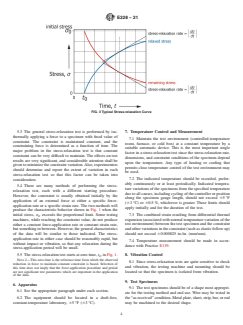
4.3 The stress-relaxation rate of a stress-relaxation curve, Fig. 3, may be determined from slope of either the remaining stress or
the relaxed stress as a function of time.
5. Significance and Use
5.1 Stress-relaxation test data are necessary when designing most mechanically fastened joints to ensure the permanent tightness
of bolted or riveted assemblies, press or shrink-fit components, rolled-in tubes, etc. Other applications include predicting the
decrease in the tightness of gaskets, in the hoop stress of solderless wrapped connections, in the constraining force of springs, and
in the stability of wire tendons in prestressed concrete.
5.2 The ability of a material to relax at high-stress concentrations such as are present at notches, inclusions, cracks, holes, and
fillets can be predicted from stress-relaxation data. Such test data are also useful to judge the heat-treatment condition necessary
for the thermal relief of residual internal stresses in forgings, castings, weldments, machined or cold-worked surfaces, etc. The tests
outlined in these methods are limited to conditions of approximately constant constraint and test environment.
5.3 The general stress-relaxation test is performed by isothermally applying a force to a specimen with fixed value of constraint.
The constraint is maintained constant, and the constraining force is determined as a function of time. The major problem in the
stress-relaxation test is that constant constraint can be very difficult to maintain. The effects on test results are very significant, and
considerable attention shall be given to minimize the constraint variation. Also, experimenters should determine and report the
extent of variation in each stress-relaxation test so that this factor can be taken into consideration.
5.4 There are many methods of performing the stress-relaxation test, each with a different starting procedure. However, the
constraint is usually obtained initially by the application of an external force at either a specific force-application rate or a specific
strain rate. The two methods will produce the characteristic behavior shown in Fig. 1 when the initial stress, σ , exceeds the
proportional limit. Some testing machines, while reaching the constraint value, do not produce either a constant force-application
rate or constant strain rate, but something in between. However, the general characteristics of the data will be similar to those
E328 − 21
FIG. 3 Typical Stress-relaxation Curve
indicated. The stress-application rate in either case should be reasonably rapid, but without impact or vibration, so that any
relaxation during the stress-application period will be small.
5.5 The stress-relaxation test starts at zero time, t , in Fig. 1.
NOTE 2—This zero time is the reference time from which the observed reduction in force to maintain constant constraint is based. Selection of this time
does not imply that the force-application procedure and period are not significant test parameters which are important in the application of the data.
6. Apparatus
6.1 See the appropriate paragraph under each section.
6.2 The equipment should be located in a draft-free, constant-temperature laboratory, 65 °F (63 °C).
7. Temperature Control and Measurement
7.1 Maintain the test environment (controlled-temperature room, furnace, or cold box) at a constant temperature by a suitable
automatic device. This is the most important single factor in a stress-relaxation test since the stress-relaxation rate, dimensions,
and constraint conditions of the specimen depend upon the temperature. Any type of heating or cooling that permits close
temperature control of the test environment may be used.
7.2 The indicated temperature should be recorded, preferably continuously or at least periodically. Indicated temperature
variations of the specimens from the specified temperature due to all causes, including cycling of the controller or position along
the specimen gauge length, should not exceed 65 °F (63 °C) or 60.5 %, whichever is greater. These limits should apply initially
and for the duration of the test.
7.3 The combined strain resulting from differential thermal expansion (associated with normal temperature variation of the test
environment) between the test specimen and the constraint and other variations in the constraint (such as elastic follow up) should
not exceed 60.000025 in./in. (mm/mm).
7.4 Temperature measurement should be made in accordance with Practice E139.
8. Vibration Control
8.1 Since stress-relaxation tests are quite sensitive to shock and vibration, the testing machine and mounting should be located so
that the specimen is isolated from vibration.
E328 − 21
9. Test Specimens
9.1 The test specimens should be of a shape most appropriate for the testing method and end use. Wire may be tested in the
“as-received” condition. Metal plate, sheet, strip, bar, or rod may be machined to the desired shape.
9.2 Residual stresses can significantly alter the stress-relaxation characteristics of the material, so care should be exercised in
machining to prevent alteration of the residual stresses.
9.3 Test specimens shall have a uniform cross-section throughout the gauge length and meet the following tolerances:
Tolerance, % of Diameter
Nominal Diameter or Width
or Width
0.100 in. (2.5 mm) ±0.5
0.250 in. (6.4 mm) ±0.4
0.375 in. (9.5 mm) ±0.3
0.500 in. (12.7 mm) ±0.2
10. Test Environment
10.1 If the specified temperature is different from ambient, specimens previously fitted with strain gages or extensometers should
be exposed to the specified temperature for a period of time sufficient to obtain dimensional stability before starting the tests.
10.2 The stress-relaxation test may be started immediately upon achieving thermal equilibrium.
11. Guide for Processing Test Data
11.1 The remaining stress, relaxed stress, or applied force may be plotted against time or log time. Log stress versus log time plots
may also be employed.
11.2 For convenience in comparing the relative stress-relaxation characteristics of materials, the ratio “Fraction Initial Stress
Relaxed” may be plotted against time. This ratio is the difference between the initial stress and the remaining stress at any time
divided by the initial stress.
12. Report
12.1 The report should include as much of the following information as is appropriate:
12.1.1 Material Being Tested:
12.1.1.1 Chemical composition,
12.1.1.2 Microstructure,
12.1.1.3 Mechanical properties,
12.1.2 Specimen geometry,
12.1.3 Testing machine or apparatus,
12.1.4 Strain measurement method,
12.1.5 Indicated temperature measurement method,
12.1.6 Atmosphere.
12.1.7 Stress-Relaxation Test Data:
12.1.7.1 Initial stress and strain data,
E328 − 21
FIG. 4 Tension Stress-Relaxation Test Using Periodic Force Measurement
12.1.7.2 Final stress and strain data,
12.1.7.3 Plot of data.
A. METHOD FOR CONDUCTING TENSION STRESS-RELAXATION TESTS
13. Scope
13.1 This test method covers the determination of the time-dependent decrease in stress in a specimen subjected to an uniaxial
constant tension strain under conditions of uniform test environment and negligible vibration. It also includes recommendations
for the necessary testing equipment.
14. Summary of Test Method
14.1 The specimen is subjected to an increasing tensile force until the specified initial strain is attained. The initial and remaining
stresses are determined by either of the methods in 4.1.
15. Apparatus
15.1 The testing machine shall have an accuracy of 1 % throughout the working range (see Practices E4), and should be calibrated
under both decreasing and increasing force applications.
15.2 The testing machine shall incorporate means of adjusting the force in a continuous and automatic manner in order to maintain
constant constraint, so that the strain on the specimen is maintained within 60.000025 mm/mm (in./in) (see Fig. 4).
15.3 Axiality of force application is extremely important and should be checked using the procedure outlined in Practice E1012.
Nonaxiality, so measured, should not exceed 15 % in elastic strain readings.
16. Test Specimens
16.1 Test specimens of the type, size, and shape described in Test Methods E8/E8M and Practice E139 are generally suitable. The
cross section should be uniform throughout the length of the reduced parallel section. To facilitate control of the limiting strain,
the gauge length should be longer than those specified in Test Methods E8/E8M. The following round specimen dimensions, for
example, have been used successfully:
Specimen Gauge Diameter Gauge Length
1 0.375 in. 7.000 in.
(9.07 mm) (177.8 mm)
2 0.375 in. 6.000 in.
(9.07 mm) (152.4 mm)
3 0.252 in. 4.000 in.
(6.40 mm) (101.6 mm)
4 0.500 in. 6.000 in.
(12.70 mm) (152.4 mm)
E328 − 21
16.2 Specimens of circular cross-section may have either threaded or shouldered ends for gripping. The threads or shoulders
should be concentric with the specimen axis to within + 0.0005 in. ( + 0.01 mm).
16.3 Test specimen surfaces should be smooth and free from nicks and scratches. Eccentricity in the specimen should be
minimized, and the force should be applied axially. In machining, precautions should be taken to avoid deformation by bending.
17. Grips
17.1 The grips and gripping technique should be designed to minimize eccentricity in loading in the test specimen.
18. Procedure
18.1 Mount the specimen in the testing machine and minimize axial misalignment. At room temperature, the strain on opposite
sides of the test specimen shall not differ from the average by more than 15 %. Attach the thermocouples and extensometer to the
specimen. Heat the specimen to the specified temperature, avoid overheating (Section 7), and hold at this temperature for a period
sufficient to reach thermal equilibrium and dimensional stability. Apply the initial force rapidly without shock. The zero time, t ,
occurs when the desired test stress is achieved.
18.2 Maintain the limiting strain constant during the duration of the test.
18.3 Any temperature disturbance causing the indicated temperature of the specimen to rise above or below the limits specified
in 7.2 is cause for rejection of the test. Exception may be made to this where the time above or below specified temperature is so
short that it will not significantly influence the stress-relaxation characteristics of the material under test.
18.4 After the specified time has elapsed, determine changes in force or stress.
19. Guide for Processing Test Data
19.1 See Section 11.
20. Report
20.1 See Section 12.
21. Precision and Bias
21.1 Precision—Sufficient multilaboratory tests have not been performed to establish the reproducibility of this test method. These
are long-term tests unsuited for routine testing or for specifications in the purchase of material.
21.2 Bias—There is no basis for defining the bias for this test method.
B. METHOD FOR CONDUCTING COMPRESSION STRESS-RELAXATION TESTS
22. Scope
22.1 This test method covers the determination of the time-dependent decrease in stress in a specimen subjected to a long-duration,
uniaxial, constant compression strain in a uniform test environment and negligible vibration. It also includes recommendations for
the necessary testing equipment.
23. Summary of Test Method
23.1 The specimen is subjected to an increasing compressive force until the specified initial strain is attained. The initial and
remaining stress are determined by either of the methods in 4.1.
E328 − 21
FIG. 5 Compression Stress-Relaxation Test
NOTE 3—Specimen geometry and frictional end effects play an important role in producing a deviation from the idealized specimen deformation. An
initially cylindrical specimen ideally would remain a cylinder, but, because of friction, the specimen cross section is larger midway between the bearing
blocks than at either bearing block. The slenderness ratio of the specimen recommended in this procedure is intended to minimize such effects. A more
detailed study of these effects is presented by Cook and Larke. (2)
24. Apparatus
24.1 An apparatus (Fig. 5) similar to that described in Part A, may be used with the following additional requirements. Axiality
of force application is extremely important and should be checked using the procedure outlined in Test Methods E9. Nonaxiality
upon attaining the specified initial force or strain should not exceed a difference of 10 % in elastic-strain readings on opposite sides
E328 − 21
of a flat specimen. Measure this difference at the surfaces, which are assumed to be parallel, symmetric to, and as remote as
possible from the force-application axis. Round specimens shall be measured at three points spaced 120° apart along the
circumference.
24.2 Testing Machine—This device shall have no instability in compression within the force range being used. The platens of the
testing machine shall remain essentially parallel and free of sidewise motion.
24.3 Bearing Surfaces—The bearing surfaces of the heads of the testing machine shall be plane, parallel, and maintained in good
condition so that there will be substantially no tilting of the bearing blocks throughout the test (see Test Methods E9).
24.4 Bearing Blocks—Both ends of a compression specimen shall bear on blocks with surfaces flat and parallel within 0.0002
in./in. (or mm/mm). The bearing blocks shall be made of suitably hard material such that the blocks will suffer no appreciable
permanent deformation during the test. Suitable types of bearing blocks are described in Test Methods E9.
24.5 Alignment Device—A suitable alignment device, such as that shown in Test Methods E9, should be used.
25. Test Specimens
25.1 Test specimens of the type, size, and shape described in Test Methods E9 are generally suitable. Solid cylindrical specimens
with an L/D (length/diameter ratio) of 8 to 10 should be used. Other test specimens of special materials or for special forms of
material may be used.
25.2 Thin-sheet specimens described in Test Methods E9 may be used when appropriate anti-buckling fixtures for lateral support
are used.
25.3 Preparation of Specimens:
25.3.1 Specimens for compression stress-relaxation tests of metals should be prepared in accordance with Test Methods E9. Care
in machining should be exercised so that residual stresses are minimized.
25.3.2 Test specimen surfaces should be smooth and free from nicks and scratches. Special care should be exercised to minimize
eccentricity in the specimen. In machining and handling, precautions should be taken to avoid deformation by bending.
26. Procedure
26.1 Mount the specimen, preferably in an alignment device (see 24.5), minimize axial misalignment, and attach the extensometer
and thermocouples. Axiality of force application should be in accordance with 24.1. For elevated-temperature tests, heat the
specimen to the specified temperature without overheating (see Section 7). Maintain the specimen at the specified temperature for
a time sufficient to reach thermal equilibrium and dimensional stability (see 7.3) before applying initial stress.
26.2 Apply the initial stress without shock. The stress-application rate shall not exceed 100 ksi/min (690 MPa/min). Define the
instant that the desired initial stress is attained as the zero time.
26.3 Maintain the total strain constant within the limits specified in 7.3.
26.4 After the specified time has elapsed, determine the changes in force or stress.
26.5 If the elastic springback (see 4.1.3) is used to determine stress relaxation, unload the specimen and remove it from the test
environment. Determine the remaining strain and calculate stress relaxation. If it is demonstrable that periodic reloading has no
effect on the stress-relaxation curve, the same specimen may be reloaded to the same initial constraint to establish the
stress-relaxation curve as a function of time. That is, the specimen may be reloaded to the same compressed gauge length as that
used immediately upon initial loading. If periodic reloading affects the shape of the stress-relaxation curve, an untested specimen
shall be used to determine each point on the stress-relaxation curve.
E328 − 21
27. Guide for Processing Test Data
27.1 See Section 11.
28. Report
28.1 See Section 12.
29. Precision and Bias
29.1 Precision—Sufficient multilaboratory tests have not been performed to establish the reproducibility of this test method. These
are long-term tests unsuited for routine testing or for specifications in the purchase of material.
29.2 Bias—There is no basis for defining the bias for this test method.
C. METHOD FOR CONDUCTING BENDING STRESS-RELAXATION TESTS
30. Scope
30.1 This test method covers the determination of the time-dependent decrease in stress in a specimen subject to long-duration,
constant bending strain, in a uniform test environment, and negligible vibration. Recommendations for some typical testing
equipment are included. Methods included are only those in which the outer fiber strain is essentially uniform in the test section.
31. Summary of Test Method
31.1 The specimen is subjected to an increasing bending moment until the specified initial maximum bending strain is attained.
The initial and remaining stresses are determined from either of the methods shown in 4.1.
31.1.1 Test Method C-1—Readings are taken from a continuously reading force indicator while the apparatus adjusts the force to
maintain constraint within specified bounds (see 4.1.1).
31.1.2 Test Method C-2—The force required to lift the specimen just free of one or more constraints during the test period is
measured (see 4.1.2).
31.1.3 Test Method C-3—Elastic springback upon removal of stress at the end of the test period is measured (see 4.1.3).
31.2 With Test Methods C-1 and C-2, a single specimen may be used to obtain data for a curve of stress versus time. With Test
Method C-3, the same specimen may be used to determine the remaining or relaxed stress with time, if it can be demonstrated that
identical results are obtained using either untested or previously stressed specimens. Otherwise, an individual specimen shall be
used for each point on the curve.
32. Apparatus
32.1 The apparatus consists of equipment for maintaining the test environment, and applying, maintaining, and measuring the
restraining force.
32.2 The test environment shall be maintained by apparatus that conforms to the conditions specified in Sections 7, 8, and 10.
32.3 Test Method C-1:
32.3.1 The force- (or moment-) adjusting apparatus consists of a device that applies and indicates the force or moment and
measures specimen deflection (see Fig. 6).
E328 − 21
FIG. 6 Specimen and Spherometer in Four-Point Flexural Stress Fixture
32.3.2 The fixtures for testing the specimen shall be of the four-point flexural stress type shown in Fig. 6. The force bearing points
should be symmetrical about the mid-span so that the central portion of the specimen is in uniform bending with a uniform outer
fiber stress.
32.3.3 The maximum permissible variation in specimen strain during the force- (or moment-) adjusting process shall not exceed
the elasti
...