

ASTM D3545-22
(Test Method)Standard Test Method for Alcohol Content and Purity of Acetate Esters by Gas Chromatography
General Information
- Abstract
SIGNIFICANCE AND USE
4.1 This test method is useful for identifying and for determining the quantity of various impurities in acetate esters.
4.2 Total purity of the acetate esters must be determined by use of other appropriate ASTM procedures with this test method.
SCOPE
1.1 This test method covers the determination by gas chromatography of the ester content and the corresponding alcohol content of acetate esters. This test method has been applied to ethyl, n-propyl, isopropyl, n-butyl, isobutyl, and 2-ethoxyethyl acetates.
1.2 Water, and in some cases acetic acid, cannot be determined by this test method and must be measured by other appropriate ASTM procedures and the results used to normalize the chromatographic value.
1.3 For purposes of determining conformance of an observed or a calculated value using this test method to relevant specifications, test result(s) shall be rounded off “to the nearest unit” in the last right-hand digit used in expressing the specification limit, in accordance with the rounding-off method of Practice E29.
1.4 The values stated in SI units are to be regarded as standard. No other units of measurement are included in this standard.
1.5 For specific hazard information and guidance, see the supplier’s Material Safety Data Sheet for material listed in this specification.
1.6 This standard does not purport to address all of the safety concerns, if any, associated with its use. It is the responsibility of the user of this standard to establish appropriate safety, health, and environmental practices and determine the applicability of regulatory limitations prior to use.
1.7 This international standard was developed in accordance with internationally recognized principles on standardization established in the Decision on Principles for the Development of International Standards, Guides and Recommendations issued by the World Trade Organization Technical Barriers to Trade (TBT) Committee.
- Status
- Published
- Publication Date
- 31-Dec-2021
- Technical Committee
- D01 - Paint and Related Coatings, Materials, and Applications
- Drafting Committee
- D01.35 - Solvents, Plasticizers, and Chemical Intermediates
Overview
ASTM D3545-22: Standard Test Method for Alcohol Content and Purity of Acetate Esters by Gas Chromatography defines procedures for measuring alcohol content and identifying impurities in acetate esters using gas chromatography (GC). This international standard, published by ASTM, establishes robust analytical guidance for ethyl, n-propyl, isopropyl, n-butyl, isobutyl, and 2-ethoxyethyl acetates. Its scope is vital for chemical manufacturing, quality control, and regulatory compliance across industries that require precise characterization of solvent purity.
Key Topics
Determination of Alcohol and Ester Content:
The method enables accurate quantification of the parent alcohol and ester components by separating them from impurities during chromatographic analysis.Identification of Impurities:
The standard supports the identification and quantification of various impurities typically present in acetate esters, aiding in comprehensive product characterization.Gas Chromatographic Analysis:
The procedure utilizes a gas chromatograph with appropriate detectors, such as thermal conductivity or flame ionization, providing flexibility for different laboratory setups. Calibration with reference materials ensures data accuracy.Exclusion of Some Components:
The method does not determine water or, in some cases, acetic acid content. These must be measured separately using other referenced ASTM procedures, with results used to normalize chromatographic values.Reporting and Precision:
Results are rounded as specified and reported in SI units only. The standard specifies procedures for calculating composition and purity, and includes guidance on validating repeatability and reproducibility of results.
Applications
ASTM D3545-22 is widely used where the purity and composition of acetate esters directly impact product quality, regulatory compliance, and consumer safety.
Chemical Manufacturing:
Enables producers of solvents, plasticizers, and chemical intermediates to monitor and control product specifications effectively.Quality Control Laboratories:
Offers a reliable method for routine analyses, supporting decisions during production and batch release.Paints, Coatings, and Adhesives Industry:
Ensures solvents used are compliant with industry and environmental standards, reducing the risk of product defects.Regulatory Testing:
Facilitates documentation and reporting required for trade, import/export, and declaration, supporting international acceptance in line with WTO principles.Research and Development:
Useful for analytical studies that require a clear profile of ester and alcohol content to optimize formulations or develop new products.
Related Standards
For comprehensive analysis and quality control of acetate esters, ASTM D3545-22 references and aligns with several other key ASTM standards:
- ASTM D1364 – Test Method for Water in Volatile Solvents (Karl Fischer Reagent Titration Method)
- ASTM D1613 – Test Method for Acidity in Volatile Solvents and Chemical Intermediates Used in Paint, Varnish, Lacquer, and Related Products
- ASTM D2593 – Test Method for Butadiene Purity and Hydrocarbon Impurities by Gas Chromatography
- ASTM E29 – Practice for Using Significant Digits in Test Data to Determine Conformance With Specifications
- ASTM E260 – Practice for Packed Column Gas Chromatography
These methods are employed in conjunction to obtain a holistic and accurate profile of acetate ester products, ensuring validity and precision in analytical results.
Keywords: alcohol content, acetate esters, gas chromatography, impurity analysis, solvent purity, ASTM D3545, quality control, chemical analysis, standard test method, calibration, industrial solvents
Relations
- Effective Date
- 01-Sep-2019
- Effective Date
- 01-Jun-2012
- Effective Date
- 01-Nov-2011
- Effective Date
- 01-Jul-2009
- Effective Date
- 01-Oct-2008
- Effective Date
- 01-Jun-2007
- Effective Date
- 15-Nov-2006
- Effective Date
- 15-Sep-2006
- Effective Date
- 01-May-2006
- Effective Date
- 01-Apr-2006
- Effective Date
- 01-Mar-2006
- Effective Date
- 01-Dec-2004
- Effective Date
- 01-Nov-2004
- Effective Date
- 01-Oct-2003
- Effective Date
- 10-Dec-2002
Frequently Asked Questions
ASTM D3545-22 is a standard published by ASTM International. Its full title is "Standard Test Method for Alcohol Content and Purity of Acetate Esters by Gas Chromatography". This standard covers: SIGNIFICANCE AND USE 4.1 This test method is useful for identifying and for determining the quantity of various impurities in acetate esters. 4.2 Total purity of the acetate esters must be determined by use of other appropriate ASTM procedures with this test method. SCOPE 1.1 This test method covers the determination by gas chromatography of the ester content and the corresponding alcohol content of acetate esters. This test method has been applied to ethyl, n-propyl, isopropyl, n-butyl, isobutyl, and 2-ethoxyethyl acetates. 1.2 Water, and in some cases acetic acid, cannot be determined by this test method and must be measured by other appropriate ASTM procedures and the results used to normalize the chromatographic value. 1.3 For purposes of determining conformance of an observed or a calculated value using this test method to relevant specifications, test result(s) shall be rounded off “to the nearest unit” in the last right-hand digit used in expressing the specification limit, in accordance with the rounding-off method of Practice E29. 1.4 The values stated in SI units are to be regarded as standard. No other units of measurement are included in this standard. 1.5 For specific hazard information and guidance, see the supplier’s Material Safety Data Sheet for material listed in this specification. 1.6 This standard does not purport to address all of the safety concerns, if any, associated with its use. It is the responsibility of the user of this standard to establish appropriate safety, health, and environmental practices and determine the applicability of regulatory limitations prior to use. 1.7 This international standard was developed in accordance with internationally recognized principles on standardization established in the Decision on Principles for the Development of International Standards, Guides and Recommendations issued by the World Trade Organization Technical Barriers to Trade (TBT) Committee.
SIGNIFICANCE AND USE 4.1 This test method is useful for identifying and for determining the quantity of various impurities in acetate esters. 4.2 Total purity of the acetate esters must be determined by use of other appropriate ASTM procedures with this test method. SCOPE 1.1 This test method covers the determination by gas chromatography of the ester content and the corresponding alcohol content of acetate esters. This test method has been applied to ethyl, n-propyl, isopropyl, n-butyl, isobutyl, and 2-ethoxyethyl acetates. 1.2 Water, and in some cases acetic acid, cannot be determined by this test method and must be measured by other appropriate ASTM procedures and the results used to normalize the chromatographic value. 1.3 For purposes of determining conformance of an observed or a calculated value using this test method to relevant specifications, test result(s) shall be rounded off “to the nearest unit” in the last right-hand digit used in expressing the specification limit, in accordance with the rounding-off method of Practice E29. 1.4 The values stated in SI units are to be regarded as standard. No other units of measurement are included in this standard. 1.5 For specific hazard information and guidance, see the supplier’s Material Safety Data Sheet for material listed in this specification. 1.6 This standard does not purport to address all of the safety concerns, if any, associated with its use. It is the responsibility of the user of this standard to establish appropriate safety, health, and environmental practices and determine the applicability of regulatory limitations prior to use. 1.7 This international standard was developed in accordance with internationally recognized principles on standardization established in the Decision on Principles for the Development of International Standards, Guides and Recommendations issued by the World Trade Organization Technical Barriers to Trade (TBT) Committee.
ASTM D3545-22 is classified under the following ICS (International Classification for Standards) categories: 87.060.30 - Solvents. The ICS classification helps identify the subject area and facilitates finding related standards.
ASTM D3545-22 has the following relationships with other standards: It is inter standard links to ASTM E260-96(2019), ASTM D1613-06(2012), ASTM E260-96(2011), ASTM D2593-93(2009), ASTM E29-08, ASTM D1364-02(2007), ASTM E29-06b, ASTM E29-06a, ASTM E29-06, ASTM D1613-06, ASTM E260-96(2006), ASTM E29-04, ASTM D2593-93(2004)e1, ASTM D1613-03, ASTM D1364-02. Understanding these relationships helps ensure you are using the most current and applicable version of the standard.
ASTM D3545-22 is available in PDF format for immediate download after purchase. The document can be added to your cart and obtained through the secure checkout process. Digital delivery ensures instant access to the complete standard document.
Standards Content (Sample)
This international standard was developed in accordance with internationally recognized principles on standardization established in the Decision on Principles for the
Development of International Standards, Guides and Recommendations issued by the World Trade Organization Technical Barriers to Trade (TBT) Committee.
Designation: D3545 − 22
Standard Test Method for
Alcohol Content and Purity of Acetate Esters by Gas
Chromatography
This standard is issued under the fixed designation D3545; the number immediately following the designation indicates the year of
original adoption or, in the case of revision, the year of last revision. A number in parentheses indicates the year of last reapproval. A
superscript epsilon (´) indicates an editorial change since the last revision or reapproval.
This standard has been approved for use by agencies of the U.S. Department of Defense.
1. Scope mendations issued by the World Trade Organization Technical
Barriers to Trade (TBT) Committee.
1.1 This test method covers the determination by gas
chromatography of the ester content and the corresponding
2. Referenced Documents
alcohol content of acetate esters. This test method has been
applied to ethyl, n-propyl, isopropyl, n-butyl, isobutyl, and
2.1 ASTM Standards:
2-ethoxyethyl acetates.
D1364 Test Method for Water in Volatile Solvents (Karl
Fischer Reagent Titration Method)
1.2 Water, and in some cases acetic acid, cannot be deter-
D1613 Test Method for Acidity in Volatile Solvents and
mined by this test method and must be measured by other
Chemical Intermediates Used in Paint, Varnish, Lacquer,
appropriate ASTM procedures and the results used to normal-
and Related Products
ize the chromatographic value.
D2593 Test Method for Butadiene Purity and Hydrocarbon
1.3 For purposes of determining conformance of an ob-
Impurities by Gas Chromatography
served or a calculated value using this test method to relevant
E29 Practice for Using Significant Digits in Test Data to
specifications, test result(s) shall be rounded off “to the nearest
Determine Conformance with Specifications
unit” in the last right-hand digit used in expressing the
E180 Practice for Determining the Precision of ASTM
specificationlimit,inaccordancewiththerounding-offmethod
Methods for Analysis and Testing of Industrial and Spe-
of Practice E29. 3
cialty Chemicals (Withdrawn 2009)
1.4 The values stated in SI units are to be regarded as E260 Practice for Packed Column Gas Chromatography
standard. No other units of measurement are included in this
standard.
3. Summary of Test Method
1.5 For specific hazard information and guidance, see the
3.1 A representative specimen is introduced into a gas-
supplier’s Material Safety Data Sheet for material listed in this
liquid partition column. The acetate is separated from impuri-
specification.
ties such as alcohols, other esters, ethers, and several uniden-
tified compounds while the components are transported
1.6 This standard does not purport to address all of the
through the column by an inert carrier gas. The separated
safety concerns, if any, associated with its use. It is the
components are measured in the effluent by a detector and
responsibility of the user of this standard to establish appro-
recorded as a chromatogram. The chromatogram is interpreted
priate safety, health, and environmental practices and deter-
by applying component attenuation and detector response
mine the applicability of regulatory limitations prior to use.
factors to the peak areas, and the relative concentrations are
1.7 This international standard was developed in accor-
determined by relating the individual peak responses to the
dance with internationally recognized principles on standard-
total peak response. Water and acidity are measured by Test
ization established in the Decision on Principles for the
Methods D1364 and D1613, respectively, and the results are
Development of International Standards, Guides and Recom-
used to normalize the values obtained by gas chromatography.
This test method is under the jurisdiction of ASTM Committee D01 on Paint
and Related Coatings, Materials, andApplications and is the direct responsibility of For referenced ASTM standards, visit the ASTM website, www.astm.org, or
Subcommittee D01.35 on Solvents, Plasticizers, and Chemical Intermediates. contact ASTM Customer Service at service@astm.org. For Annual Book of ASTM
Current edition approved Jan. 1, 2022. Published January 2022. Originally Standards volume information, refer to the standard’s Document Summary page on
approved in 1976. Last previous edition approved in 2012 as D3545 – 06 (2012) the ASTM website.
which was withdrawn January 2021 and reinstated in January 2022. DOI: 10.1520/ The last approved version of this historical standard is referenced on
D3545-22. www.astm.org.
Copyright © ASTM International, 100 Barr Harbor Drive, PO Box C700, West Conshohocken, PA 19428-2959. United States
D3545 − 22
4. Significance and Use 6.1.1 If hydrogen is used special safety precautions must be
taken to ensure that the system is free of leaks and that the
4.1 This test method is useful for identifying and for
effluent is vented properly.
determining the quantity of various impurities in acetate esters.
6.2 Column Materials:
4.2 Total purity of the acetate esters must be determined by
6,7
6.2.1 Liquid Phase, Dow Corning QF-1/FS 1265 silicone
use of other appropriate ASTM procedures with this test
and nonylphenoxypoly(ethyleneoxy)ethanol (CAS #
method.
9016–45–9), HLB = 19.
4,6,5
6.2.2 Solid Support,ChromosorbG-HP, 80to100mesh
5. Apparatus
size.
5.1 Chromatograph—Any gas chromatograph having either
6.2.3 Solvents—Methylene chloride and acetone, reagent
a thermal conductivity or flame ionization detector, provided
grade.
the system has sufficient sensitivity and stability to obtain for
6.2.4 Tubing Material—Stainless steel and aluminum have
0.01 % of the parent alcohol a recorder deflection of at least
been found satisfactory for column tubing. The tubing must be
20 mmatasignal-to-noiseratioofatleast5to1.Thespecimen
nonreactive with the substrate, sample, and carrier gas and
size used in judging the sensitivity must be such that the
must be of uniform internal diameter.
column is not overloaded, which would result in peak
6.3 Standards for Calibration and Identification—Standard
broadening, loss of resolution, shifting retention times and
samples of all components present are needed for identification
formation of leading peaks. Volumes of 5 µL with thermal
by retention time and for calibration for quantitative measure-
conductivityand1to2µLwithflameionizationdetectorshave
ments. Most can be obtained from chemical supply houses.
been found acceptable.
5.1.1 The injection port of the chromatograph must have a
7. Preparation of Apparatus
volume of at least 1.2 mLto provide for proper vaporization of
7.1 Column Packing Preparation—Place 100 g of Chromo-
the material. The use of a smaller injection port or on-column
4,6,5
sorb G-HP, 80 to 100 mesh, in a large evaporating dish.
injection has been found to cause peak broadening and tailing.
6,7
Dissolve 10 g of Dow Corning QF-1/FS 1265 silicone in
5.2 Column—A 3-m length of 6.4-mm outside diameter
50 mL of acetone and add to the solid support. Add sufficient
aluminum or stainless steel tubing packed with 80 to 100-mesh
acetone to wet and cover the solid support. Evaporate the
4,5,6
Chromosorb G-HP that has been coated with 9.05 % Dow
acetone in a fume hood with gentle stirring and under a gentle
6,7
Corning QF-1 silicone and 0.45 % nonylphenoxypoly(ethyl-
stream of nitrogen. Dissolve 0.5 g of nonylphenoxypoly(eth-
eneoxy)ethanol (CAS # 9016–45–9), HLB = 19.0 has been
ylenexy)ethanol(CAS#9016–45–9).HLB=19.0 in50mLof
found suitable. Any column, packed or capillary, or any
methylene chloride and add it to the packing material. Add
packing material capable of resolving one acetate ester from
sufficient methylene chloride to wet and cover the packing.
any other esters and from any impurities that may be present
Evaporate the methylene chloride with gentle stirring under a
and giving equivalent or superior performance may be used.
gentle stream of nitrogen. Commercially available columns or
5.3 Recorder—A recording potentiometer with a full-scale
packings, or both, are available from several chromatography
deflection of 1 mV. Full-scale response time should be 2 s or
supply sources.
less with sufficient sensitivity and stability to meet the require-
7.2 Column Preparation—The method used to pack the
ments of 5.1.
column is not critical provided that the finished column
5.4 Specimen Introduction System—Any system capable of produces the required separation of all of the components to be
introducing a representative specimen into the column. Mi-
determined. Commercially available columns or packings, or
crolitre syringes have been used successfully. both, are available from several chromatography supply
sources.
6. Reagents and Materials
7.3 Chromatograph—Install the column in the chromato-
6.1 Carrier Gas, appropriate to the type of detector used.
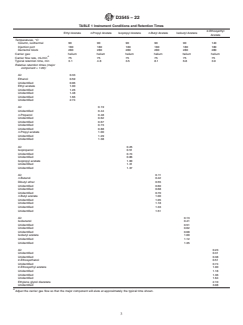
graph.UsetheinformationinTable1asaguidetoestablishthe
Helium or hydrogen may be employed with thermal conduc- conditionsofcolumntemperatureandcarriergasflowthatgive
tivity detectors and nitrogen, helium, or argon with flame
the necessary resolution of the components in the product
ionization detectors. The minimum purity of the carrier gas being analyzed. Allow sufficient time for the instrument to
used should be 99.95 mol %.
reach equilibrium as indicated by a stable recorder baseline.
Control the detector temperature constant to within 1 °C
without thermostat cycling, which causes an uneven baseline.
Adjust the carrier-gas flow rate to a constant value.
A registered trademark of Manville Products Corp., Lompoc, CA 93436.
The sole source of supply for this material known to the committee at this time
NOTE 1—Useful information on column preparation may be found in
is Manville Products Corp., Lompoc, CA 93436.
Test Method D2593 and Practice E260.
If you are aware of alternative suppliers, please provide this information to
ASTM International Headquarters. Your comments will receive careful consider-
8. Calibration and Standardization
ation a
...