


ASTM D6602-13(2022)
(Practice)Standard Practice for Sampling and Testing of Possible Carbon Black Fugitive Emissions or Other Environmental Particulate, or Both
Standard Practice for Sampling and Testing of Possible Carbon Black Fugitive Emissions or Other Environmental Particulate, or Both
SIGNIFICANCE AND USE
5.1 There are a variety of darkening agents that contribute to air and surface contamination in industrial, urban and rural environments. Biofilms (fungal and algal), soil minerals, plant fragments, rubber fragments, metal corrosion and soot are common darkening agents. Soot is formed as an unwanted by-product of combustion and consequently varies widely with the type of fuel and combustion conditions. Carbon black, on the other hand, is purposely produced under a controlled set of conditions. Therefore, it is important to be able to distinguish carbon black from soot, as well as other environmental contaminants.
SCOPE
1.1 This practice covers sampling and testing for distinguishing ASTM type carbon black, in the N100 to N900 series, from other environmental particulates.
1.2 This practice requires some degree of expertise on the part of the microscopist. For this reason, the microscopist must have adequate training and on-the-job experience in identifying the morphological parameters of carbon black and general knowledge of other particles that may be found in the environment. In support of this analysis, Donnet's book2 is highly recommended to be used as a technical reference for recognizing and understanding the microstructure of carbon black.
1.3 The values stated in SI units are to be regarded as standard. No other units of measurement are included in this standard.
1.4 This standard may involve hazardous materials, operations, and equipment. This standard does not purport to address all of the safety concerns, if any, associated with its use. It is the responsibility of the user of this standard to establish appropriate safety, health, and environmental practices and determine the applicability of regulatory limitations prior to use.
1.5 This international standard was developed in accordance with internationally recognized principles on standardization established in the Decision on Principles for the Development of International Standards, Guides and Recommendations issued by the World Trade Organization Technical Barriers to Trade (TBT) Committee.
General Information
Buy Standard
Standards Content (Sample)
NOTICE: This standard has either been superseded and replaced by a new version or withdrawn.
Contact ASTM International (www.astm.org) for the latest information
Designation: D6602 − 13 (Reapproved 2022)
Standard Practice for
Sampling and Testing of Possible Carbon Black Fugitive
Emissions or Other Environmental Particulate, or Both
This standard is issued under the fixed designation D6602; the number immediately following the designation indicates the year of
original adoption or, in the case of revision, the year of last revision. A number in parentheses indicates the year of last reapproval. A
superscript epsilon (´) indicates an editorial change since the last revision or reapproval.
1. Scope 2. Referenced Documents
1.1 This practice covers sampling and testing for distin- 2.1 ASTM Standards:
guishing ASTM type carbon black, in the N100 to N900 series, D1619 Test Methods for Carbon Black—Sulfur Content
from other environmental particulates. D3053 Terminology Relating to Carbon Black
D3849 Test Method for Carbon Black—Morphological
1.2 This practice requires some degree of expertise on the
Characterization of Carbon Black Using Electron Micros-
part of the microscopist. For this reason, the microscopist must
copy
have adequate training and on-the-job experience in identifying
the morphological parameters of carbon black and general
3. Terminology
knowledge of other particles that may be found in the envi-
3.1 Definitions of Terms Specific to This Standard:
ronment. In support of this analysis, Donnet’s book is highly
3.1.1 aciniform—shaped like a cluster of grapes.
recommended to be used as a technical reference for recogniz-
3.1.1.1 Discussion—The spheroidal primary particles of
ing and understanding the microstructure of carbon black.
carbon black are fused into aggregates of colloidal dimension
1.3 The values stated in SI units are to be regarded as
forming an acinoform morphology.
standard. No other units of measurement are included in this
3.1.2 aciniform carbon—colloidal carbon having a mor-
standard.
phology consisting of spheroidal primary particles (nodules)
1.4 This standard may involve hazardous materials,
fused together in aggregates of colloidal dimension in a shape
operations, and equipment. This standard does not purport to
having grape-like clusters or open branch-like structures
address all of the safety concerns, if any, associated with its
3.1.3 carbon black, n—an engineered material, primarily
use. It is the responsibility of the user of this standard to
composed of elemental carbon, obtained from the partial
establish appropriate safety, health, and environmental prac-
combustion or thermal decomposition of hydrocarbons, exist-
tices and determine the applicability of regulatory limitations
ing in the form of aggregates of aciniform morphology which
prior to use.
are composed of spheroidal primary particles characterized by
1.5 This international standard was developed in accor-
uniformity of primary particle sizes within a given aggregate
dance with internationally recognized principles on standard-
and turbostratic layering within the primary particles.
ization established in the Decision on Principles for the
3.1.3.1 Discussion—Particle size and aggregate size (num-
Development of International Standards, Guides and Recom-
ber of particles per aggregate) are distributional properties and
mendations issued by the World Trade Organization Technical
vary depending on the carbon black grade. Transmission
Barriers to Trade (TBT) Committee.
electron micrographs shown in Annex A2 demonstrate that
while particle and aggregate sizes vary greatly within a given
This practice is under the jurisdiction of ASTM Committee D24 on Carbon
grade of carbon black, the primary particle size is essentially
Black and is the direct responsibility of Subcommittee D24.66 on Environment,
uniform within an individual aggregate.
Health, and Safety.
Current edition approved June 1, 2022. Published July 2022. Originally approved
in 2000. Last previous edition approved in 2018 as D6602 – 13 (2018). DOI:
10.1520/D6602-13R22. For referenced ASTM standards, visit the ASTM website, www.astm.org, or
Hess, W.M. and Herd, C.R., Carbon Black Science and Technology, Edited by contact ASTM Customer Service at service@astm.org. For Annual Book of ASTM
Donnet, J.B., Bansal, R.C., and Wang, M.J., Marcel Dekker, Inc., New York, NY, Standards volume information, refer to the standard’s Document Summary page on
1993, pp. 89–173. the ASTM website.
Copyright © ASTM International, 100 Barr Harbor Drive, PO Box C700, West Conshohocken, PA 19428-2959. United States
D6602 − 13 (2022)
3.1.4 chain of custody—a document describing the condi- 4. Summary of Practice
tion of a sample during its collection, analysis, and disposal.
4.1 This practice describes the procedures and protocols to
3.1.5 char—a particulate larger than 1 µm made by incom- follow in order to collect fugitive emission/environmental
plete combustion which may not deagglomerate or disperse by samples and identify the classes of particulate present includ-
ordinary techniques, may contain material which is not black, ing materials consistent or inconsistent with manufactured
and may contain some of the original material’s cell structure, carbon black (referred to simply as carbon black). A semi-
minerals, ash, cinders, and so forth. quantitative estimate of the percentage of each type of surface
particulate component is determined using polarized light
3.1.6 fugitive dust—transitory, fleeting material comprised
microscopy (PLM). However, PLM analysis cannot differen-
of particulates foreign to the surface of deposition.
tiate between carbon black and soots (black carbons) that may
3.1.7 fungus, sooty mold, mildew, biofilm—particulates from
come from many sources in the environment. Therefore,
a superficial growth that grows on living and decaying organic
transmission electron microscopy (TEM) analysis is mandatory
matter.
in determining whether a sample contains carbon black.
Because the preparation steps for the TEM analysis eliminates
3.1.8 mineral dust—naturally occurring inorganic particu-
certain types of particles and concentrates only the fine (small)
lates inherent to the area such as soil minerals.
particles from the sample, the TEM analysis alone cannot be
3.1.9 pollen—particulates from a mass of microspores in a
used to estimate the amount of carbon black or other particle
seed plant.
type in the whole sample. Either the PLM or TEM analysis
3.1.10 rubber dust—finely divided soft particulates abraded
may be done first.
from rubber.
4.2 Section 6 provides guidelines for proper sampling and
3.1.11 sample—a small fractional part of a material or a
handling of fugitive emission/environmental samples. Sections
specified number of objects that are selected for testing,
8 and 9 describe the analysis of the sample using polarized
inspection, or specific observations of particular characteris-
light microscopy (PLM) and transmission electron microscopy
tics.
(TEM). The TEM analysis is critical in determining if the
collected sample is consistent or inconsistent with carbon
3.1.12 soot—a submicron black powder generally produced
black. Use of the TEM analysis is mandatory in determining
as an unwanted by-product of combustion or pyrolysis. It
whether a sample is positive for carbon black. The use of the
consists of various quantities of carbonaceous and inorganic
PLM analysis is not mandatory when the TEM analysis finds
solids in conjunction with adsorbed and occluded organic tars
no aciniform aggregates resembling carbon black. Section 9
and resins.
describes additional ancillary techniques that may be included
3.1.12.1 Discussion—The carbonaceous portion also is col-
in a sample analysis for purposes of providing supporting
loidal and often has the aciniform morphology. Soot may have
information as to the nature of the sample material. These are
several carbon morphologies. Examples of soot are carbon
situation-dependent methods and can provide critical identifi-
residues from diesel and gasoline engines, industrial flares,
cation information in certain cases.
sludge pits, burning tires, and so forth.
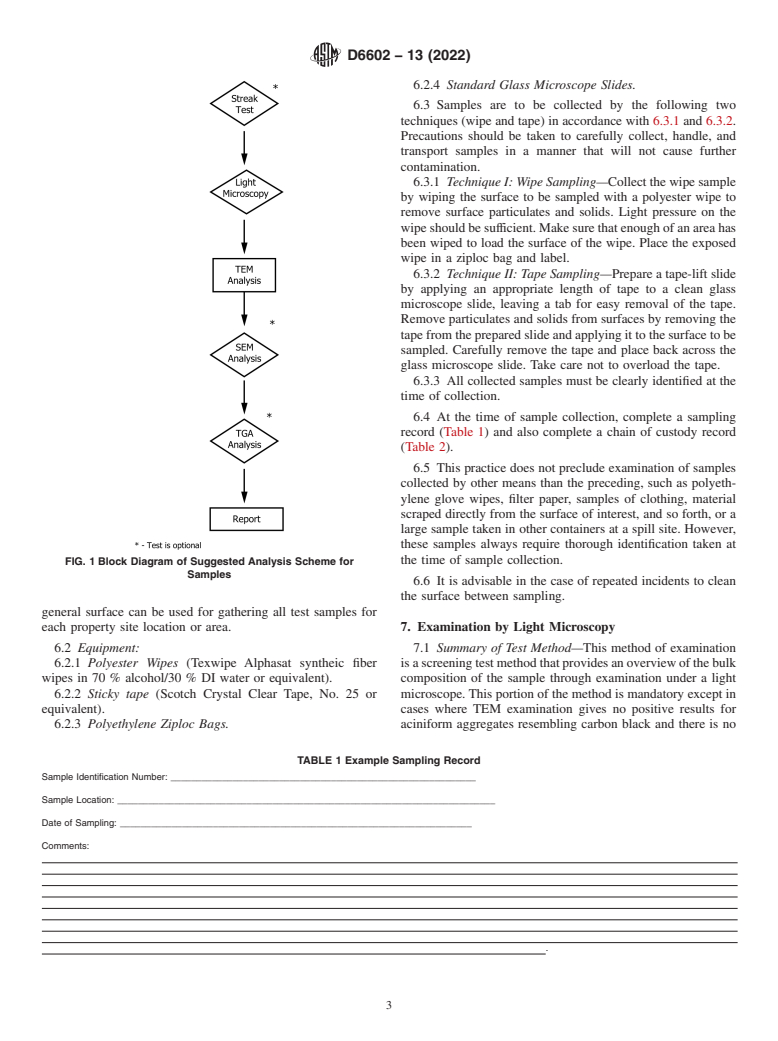
4.3 A block diagram is presented in Fig. 1 to give a possible
3.1.13 sticky tape—a section of tape with a sticky, solvent-
scheme to follow in performing this analysis. However, it
soluble adhesive used in the collection of particles from
should be noted that this diagram is a suggestion, not a
surfaces.
requirement. Either the PLM or TEM analysis may be per-
3.1.14 surface—the outer surface, facing, or exterior bound-
formed first.
ary of an object capable of supporting carbon and other fugitive
and natural occurring dusts and particulates.
5. Significance and Use
3.1.15 turbostratic—a type of graphitic crystallographic
5.1 There are a variety of darkening agents that contribute to
structure in which there is no symmetry along the z-axis.
air and surface contamination in industrial, urban and rural
3.2 Acronyms: environments. Biofilms (fungal and algal), soil minerals, plant
fragments, rubber fragments, metal corrosion and soot are
3.2.1 EDS—energy dispersive spectroscopy associated with
common darkening agents. Soot is formed as an unwanted
SEM and TEM for the identification of elemental composition,
by-product of combustion and consequently varies widely with
3.2.2 LM—light microscope,
the type of fuel and combustion conditions. Carbon black, on
3.2.3 PLM—polarizing light microscope,
the other hand, is purposely produced under a controlled set of
conditions. Therefore, it is important to be able to distinguish
3.2.4 SEM—scanning electron microscope,
carbon black from soot, as well as other environmental
3.2.5 TEM—transmission electron microscope.
contaminants.
3.2.6 WDS—wavelength dispersive spectroscopy associated
with SEM and TEM for the identification of elemental com- 6. Sampling
position.
6.1 The area to be sampled should be representative of the
contaminated area. For sampling, choose an area that appears
NOTE 1—Standard terminology relating to carbon black can be found in
Terminology D3053. to contain black particulates. In some situations, the same
D6602 − 13 (2022)
6.2.4 Standard Glass Microscope Slides.
6.3 Samples are to be collected by the following two
techniques (wipe and tape) in accordance with 6.3.1 and 6.3.2.
Precautions should be taken to carefully collect, handle, and
transport samples in a manner that will not cause further
contamination.
6.3.1 Technique I: Wipe Sampling—Collect the wipe sample
by wiping the surface to be sampled with a polyester wipe to
remove surface particulates and solids. Light pressure on the
wipe should be sufficient. Make sure that enough of an area has
been wiped to load the surface of the wipe. Place the exposed
wipe in a ziploc bag and label.
6.3.2 Technique II: Tape Sampling—Prepare a tape-lift slide
by applying an appropriate length of tape to a clean glass
microscope slide, leaving a tab for easy removal of the tape.
Remove particulates and solids from surfaces by removing the
tape from the prepared slide and applying it to the surface to be
sampled. Carefully remove the tape and place back across the
glass microscope slide. Take care not to overload the tape.
6.3.3 All collected samples must be clearly identified at the
time of collection.
6.4 At the time of sample collection, complete a sampling
record (Table 1) and also complete a chain of custody record
(Table 2).
6.5 This practice does not preclude examination of samples
collected by other means than the preceding, such as polyeth-
ylene glove wipes, filter paper, samples of clothing, material
scraped directly from the surface of interest, and so forth, or a
large sample taken in other containers at a spill site. However,
these samples always require thorough identification taken at
the time of sample collection.
FIG. 1 Block Diagram of Suggested Analysis Scheme for
Samples
6.6 It is advisable in the case of repeated incidents to clean
the surface between sampling.
general surface can be used for gathering all test samples for
each property site location or area. 7. Examination by Light Microscopy
6.2 Equipment: 7.1 Summary of Test Method—This method of examination
6.2.1 Polyester Wipes (Texwipe Alphasat syntheic fiber is a screening test method that provides an overview of the bulk
wipes in 70 % alcohol/30 % DI water or equivalent). composition of the sample through examination under a light
6.2.2 Sticky tape (Scotch Crystal Clear Tape, No. 25 or microscope. This portion of the method is mandatory except in
equivalent). cases where TEM examination gives no positive results for
6.2.3 Polyethylene Ziploc Bags. aciniform aggregates resembling carbon black and there is no
TABLE 1 Example Sampling Record
Sample Identification Number: ___________________________________________________________
Sample Location: _________________________________________________________________________
Date of Sampling: ____________________________________________________________________
Comments:
.
D6602 − 13 (2022)
TABLE 2 Example Chain of Custody Record
Sample ID Date Sampled Sampled By Comments
1.
2.
3.
4.
5.
Sample
Relinquished By Received By Time Date Reason for Change:
Number
1.
2.
3.
4.
5.
Comments:
request for a semi-quantitative analysis of the other compo- preserves the integrity of the particle aggregates without the
nents in the sample. In addition, there are special situations smearing that tends to occur when using the wipe sampler.
where other information such as a torn bag near a carbon black 7.3.3 Inspect the wipe sample with a stereobinocular micro-
manufacturing site strongly suggests that the black particulate scope. With a clean razor blade, cut out a small square section
being sampled is carbon black. In this case, a TEM analysis (~1 cm) of a representative portion of the wipe, including an
may be sufficient to confirm the presence of carbon black area of black staining if present. Using two clean tweezers,
without the mandatory PLM analysis. It is important to note agitate, twist, and scrape the square section of the wipe over a
that the results obtained by the light microscopy technique clean microscope slide to dislodge particle from the wipe and
cannot be considered as conclusive for identifying the presence on to the slide. If fine black particles coat some of the fibers of
of carbon black. the wipe, pull some of them out and mount them separately. It
may also be possible to transfer dark particulate from the wipe
7.2 Apparatus:
to a microscope slide using a tungsten needle. Add a drop of
7.2.1 Light Stereomicroscope, capable of at least 40× mag-
immersion oil to the preparation (oil having a refractive index
nification.
of 1.55 works well) and place a cover slip over it.
7.2
...
This document is not an ASTM standard and is intended only to provide the user of an ASTM standard an indication of what changes have been made to the previous version. Because
it may not be technically possible to adequately depict all changes accurately, ASTM recommends that users consult prior editions as appropriate. In all cases only the current version
of the standard as published by ASTM is to be considered the official document.
Designation: D6602 − 13 (Reapproved 2018) D6602 − 13 (Reapproved 2022)
Standard Practice for
Sampling and Testing of Possible Carbon Black Fugitive
Emissions or Other Environmental Particulate, or Both
This standard is issued under the fixed designation D6602; the number immediately following the designation indicates the year of
original adoption or, in the case of revision, the year of last revision. A number in parentheses indicates the year of last reapproval. A
superscript epsilon (´) indicates an editorial change since the last revision or reapproval.
1. Scope
1.1 This practice covers sampling and testing for distinguishing ASTM type carbon black, in the N100 to N900 series, from other
environmental particulates.
1.2 This practice requires some degree of expertise on the part of the microscopist. For this reason, the microscopist must have
adequate training and on-the-job experience in identifying the morphological parameters of carbon black and general knowledge
of other particles that may be found in the environment. In support of this analysis, Donnet’s book is highly recommended to be
used as a technical reference for recognizing and understanding the microstructure of carbon black.
1.3 The values stated in SI units are to be regarded as standard. No other units of measurement are included in this standard.
1.4 This standard may involve hazardous materials, operations, and equipment. This standard does not purport to address all
of the safety concerns, if any, associated with its use. It is the responsibility of the user of this standard to establish appropriate
safety, health, and environmental practices and determine the applicability of regulatory limitations prior to use.
1.5 This international standard was developed in accordance with internationally recognized principles on standardization
established in the Decision on Principles for the Development of International Standards, Guides and Recommendations issued
by the World Trade Organization Technical Barriers to Trade (TBT) Committee.
2. Referenced Documents
2.1 ASTM Standards:
D1619 Test Methods for Carbon Black—Sulfur Content
D3053 Terminology Relating to Carbon Black
D3849 Test Method for Carbon Black—Morphological Characterization of Carbon Black Using Electron Microscopy
3. Terminology
3.1 Definitions of Terms Specific to This Standard:
3.1.1 aciniform—shaped like a cluster of grapes.
This practice is under the jurisdiction of ASTM Committee D24 on Carbon Black and is the direct responsibility of Subcommittee D24.66 on Environment, Health, and
Safety.
Current edition approved June 1, 2018June 1, 2022. Published August 2018July 2022. Originally approved in 2000. Last previous edition approved in 20132018 as
D6602 – 13.D6602 – 13 (2018). DOI: 10.1520/D6602-13R18.10.1520/D6602-13R22.
Hess, W.M. and Herd, C.R., Carbon Black Science and Technology, Edited by Donnet, J.B., Bansal, R.C., and Wang, M.J., Marcel Dekker, Inc., New York, NY, 1993,
pp. 89–173.
For referenced ASTM standards, visit the ASTM website, www.astm.org, or contact ASTM Customer Service at service@astm.org. For Annual Book of ASTM Standards
volume information, refer to the standard’s Document Summary page on the ASTM website.
Copyright © ASTM International, 100 Barr Harbor Drive, PO Box C700, West Conshohocken, PA 19428-2959. United States
D6602 − 13 (2022)
3.1.1.1 Discussion—
The spheroidal primary particles of carbon black are fused into aggregates of colloidal dimension forming an acinoform
morphology.
3.1.2 aciniform carbon—colloidal carbon having a morphology consisting of spheroidal primary particles (nodules) fused together
in aggregates of colloidal dimension in a shape having grape-like clusters or open branch-like structures
3.1.3 carbon black, n—an engineered material, primarily composed of elemental carbon, obtained from the partial combustion or
thermal decomposition of hydrocarbons, existing in the form of aggregates of aciniform morphology which are composed of
spheroidal primary particles characterized by uniformity of primary particle sizes within a given aggregate and turbostratic layering
within the primary particles.
3.1.3.1 Discussion—
Particle size and aggregate size (number of particles per aggregate) are distributional properties and vary depending on the carbon
black grade. Transmission electron micrographs shown in Annex A2 demonstrate that while particle and aggregate sizes vary
greatly within a given grade of carbon black, the primary particle size is essentially uniform within an individual aggregate.
3.1.4 chain of custody—a document describing the condition of a sample during its collection, analysis, and disposal.
3.1.5 char—a particulate larger than 1 μm made by incomplete combustion which may not deagglomerate or disperse by ordinary
techniques, may contain material which is not black, and may contain some of the original material’s cell structure, minerals, ash,
cinders, and so forth.
3.1.6 fugitive dust—transitory, fleeting material comprised of particulates foreign to the surface of deposition.
3.1.7 fungus, sooty mold, mildew, biofilm—particulates from a superficial growth that grows on living and decaying organic matter.
3.1.8 mineral dust—naturally occurring inorganic particulates inherent to the area such as soil minerals.
3.1.9 pollen—particulates from a mass of microspores in a seed plant.
3.1.10 rubber dust—finely divided soft particulates abraded from rubber.
3.1.11 sample—a small fractional part of a material or a specified number of objects that are selected for testing, inspection, or
specific observations of particular characteristics.
3.1.12 soot—a submicron black powder generally produced as an unwanted by-product of combustion or pyrolysis. It consists of
various quantities of carbonaceous and inorganic solids in conjunction with adsorbed and occluded organic tars and resins.
3.1.12.1 Discussion—
The carbonaceous portion also is colloidal and often has the aciniform morphology. Soot may have several carbon morphologies.
Examples of soot are carbon residues from diesel and gasoline engines, industrial flares, sludge pits, burning tires, and so forth.
3.1.13 sticky tape—a section of tape with a sticky, solvent-soluble adhesive used in the collection of particles from surfaces.
3.1.14 surface—the outer surface, facing, or exterior boundary of an object capable of supporting carbon and other fugitive and
natural occurring dusts and particulates.
3.1.15 turbostratic—a type of graphitic crystallographic structure in which there is no symmetry along the z-axis.
3.2 Acronyms:
3.2.1 EDS—energy dispersive spectroscopy associated with SEM and TEM for the identification of elemental composition,
3.2.2 LM—light microscope,
3.2.3 PLM—polarizing light microscope,
D6602 − 13 (2022)
3.2.4 SEM—scanning electron microscope,
3.2.5 TEM—transmission electron microscope.
3.2.6 WDS—wavelength dispersive spectroscopy associated with SEM and TEM for the identification of elemental composition.
NOTE 1—Standard terminology relating to carbon black can be found in Terminology D3053.
4. Summary of Practice
4.1 This practice describes the procedures and protocols to follow in order to collect fugitive emission/environmental samples and
identify the classes of particulate present including materials consistent or inconsistent with manufactured carbon black (referred
to simply as carbon black). A semi-quantitative estimate of the percentage of each type of surface particulate component is
determined using polarized light microscopy (PLM). However, PLM analysis cannot differentiate between carbon black and soots
(black carbons) that may come from many sources in the environment. Therefore, transmission electron microscopy (TEM)
analysis is mandatory in determining whether a sample contains carbon black. Because the preparation steps for the TEM analysis
eliminates certain types of particles and concentrates only the fine (small) particles from the sample, the TEM analysis alone cannot
be used to estimate the amount of carbon black or other particle type in the whole sample. Either the PLM or TEM analysis may
be done first.
4.2 Section 6 provides guidelines for proper sampling and handling of fugitive emission/environmental samples. Sections 8 and
9 describe the analysis of the sample using polarized light microscopy (PLM) and transmission electron microscopy (TEM). The
TEM analysis is critical in determining if the collected sample is consistent or inconsistent with carbon black. Use of the TEM
analysis is mandatory in determining whether a sample is positive for carbon black. The use of the PLM analysis is not mandatory
when the TEM analysis finds no aciniform aggregates resembling carbon black. Section 9 describes additional ancillary techniques
that may be included in a sample analysis for purposes of providing supporting information as to the nature of the sample material.
These are situation-dependent methods and can provide critical identification information in certain cases.
4.3 A block diagram is presented in Fig. 1 to give a possible scheme to follow in performing this analysis. However, it should be
noted that this diagram is a suggestion, not a requirement. Either the PLM or TEM analysis may be performed first.
5. Significance and Use
5.1 There are a variety of darkening agents that contribute to air and surface contamination in industrial, urban and rural
environments. Biofilms (fungal and algal), soil minerals, plant fragments, rubber fragments, metal corrosion and soot are common
darkening agents. Soot is formed as an unwanted by-product of combustion and consequently varies widely with the type of fuel
and combustion conditions. Carbon black, on the other hand, is purposely produced under a controlled set of conditions. Therefore,
it is important to be able to distinguish carbon black from soot, as well as other environmental contaminants.
6. Sampling
6.1 The area to be sampled should be representative of the contaminated area. For sampling, choose an area that appears to contain
black particulates. In some situations, the same general surface can be used for gathering all test samples for each property site
location or area.
6.2 Equipment:
6.2.1 Polyester Wipes (Texwipe Alphasat syntheic fiber wipes in 70 % alcohol/30 % DI water or equivalent).
6.2.2 Sticky tape (Scotch Crystal Clear Tape, No. 25 or equivalent).
6.2.3 Polyethylene Ziploc Bags.
6.2.4 Standard Glass Microscope Slides.
D6602 − 13 (2022)
FIG. 1 Block Diagram of Suggested Analysis Scheme for Samples
6.3 Samples are to be collected by the following two techniques (wipe and tape) in accordance with 6.3.1 and 6.3.2. Precautions
should be taken to carefully collect, handle, and transport samples in a manner that will not cause further contamination.
6.3.1 Technique I: Wipe Sampling—Collect the wipe sample by wiping the surface to be sampled with a polyester wipe to remove
surface particulates and solids. Light pressure on the wipe should be sufficient. Make sure that enough of an area has been wiped
to load the surface of the wipe. Place the exposed wipe in a ziploc bag and label.
6.3.2 Technique II: Tape Sampling—Prepare a tape-lift slide by applying an appropriate length of tape to a clean glass microscope
slide, leaving a tab for easy removal of the tape. Remove particulates and solids from surfaces by removing the tape from the
prepared slide and applying it to the surface to be sampled. Carefully remove the tape and place back across the glass microscope
slide. Take care not to overload the tape.
6.3.3 All collected samples must be clearly identified at the time of collection.
6.4 At the time of sample collection, complete a sampling record (Table 1) and also complete a chain of custody record (Table
2).
6.5 This practice does not preclude examination of samples collected by other means than the preceding, such as polyethylene
glove wipes, filter paper, samples of clothing, material scraped directly from the surface of interest, and so forth, or a large sample
taken in other containers at a spill site. However, these samples always require thorough identification taken at the time of sample
collection.
6.6 It is advisable in the case of repeated incidents to clean the surface between sampling.
D6602 − 13 (2022)
TABLE 1 Example Sampling Record
Sample Identification Number: ___________________________________________________________
Sample Location: _________________________________________________________________________
Date of Sampling: ____________________________________________________________________
Comments:
.
TABLE 2 Example Chain of Custody Record
Sample ID Date Sampled Sampled By Comments
1.
2.
3.
4.
5.
Sample
Relinquished By Received By Time Date Reason for Change:
Number
1.
2.
3.
4.
5.
Comments:
7. Examination by Light Microscopy
7.1 Summary of Test Method—This method of examination is a screening test method that provides an overview of the bulk
composition of the sample through examination under a light microscope. This portion of the method is mandatory except in cases
where TEM examination gives no positive results for aciniform aggregates resembling carbon black and there is no request for a
semi-quantitative analysis of the other components in the sample. In addition, there are special situations where other information
such as a torn bag near a carbon black manufacturing site strongly suggests that the black particulate being sampled is carbon black.
In this case, a TEM analysis may be sufficient to confirm the presence of carbon black without the mandatory PLM analysis. It
is important to note that the results obtained by the light microscopy technique cannot be considered as conclusive for identifying
the presence of carbon black.
7.2 Apparatus:
7.2.1 Light Stereomicroscope, capable of at least 40× magnification.
7.2.2 Polarized Light Microscope, equipped with objectives at least in the 10 to 40× range of magnification.
7.2.3 Refractive Index Liquids including Meltmount, 1.662 or 1.55 RI Cargille liquid or equivalent.
7.2.4 Scissors or Safety Razor Blades, or both.
7.2.5 Glass Slides.
D6602 − 13 (2022)
7.2.6 Glass Cover Slips.
7.2.7 Microscope Camera (Polaroid, 35 mm, or digital).
7.2.8 Tungsten Needles.
7.2.9 Forceps.
7.2.10 Reference Slides of
...
Questions, Comments and Discussion
Ask us and Technical Secretary will try to provide an answer. You can facilitate discussion about the standard in here.