

ASTM F3246-18(2023)
(Specification)Standard Specification for Quality Assurance for Manufacturers of Aircraft Systems
General Information
- Abstract
SCOPE
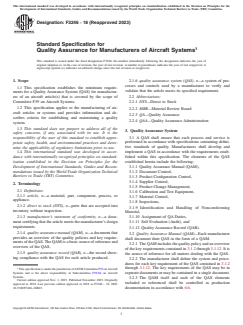
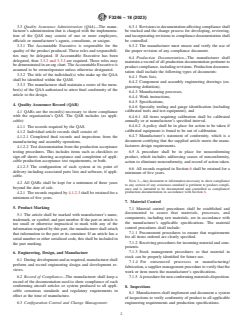
1.1 This specification establishes the minimum requirements for a Quality Assurance System (QAS) for manufacturers of an aircraft article(s) that is covered by the scope of Committee F39 on Aircraft Systems.
1.2 This specification applies to the manufacturing of aircraft articles or systems and provides information and describes criteria for establishing and maintaining a quality system.
1.3 This standard does not purport to address all of the safety concerns, if any, associated with its use. It is the responsibility of the user of this standard to establish appropriate safety, health, and environmental practices and determine the applicability of regulatory limitations prior to use.
1.4 This international standard was developed in accordance with internationally recognized principles on standardization established in the Decision on Principles for the Development of International Standards, Guides and Recommendations issued by the World Trade Organization Technical Barriers to Trade (TBT) Committee.
- Status
- Published
- Publication Date
- 31-Oct-2023
- Technical Committee
- F39 - Aircraft Systems
- Drafting Committee
- F39.04 - Aircraft Systems


Overview
ASTM F3246-18(2023) - Standard Specification for Quality Assurance for Manufacturers of Aircraft Systems provides minimum requirements for establishing and maintaining a Quality Assurance System (QAS) for manufacturers of aircraft articles or systems. Developed by ASTM Committee F39 on Aircraft Systems, this standard is applicable to organizations producing items covered under this committee’s scope. By specifying the necessary processes and criteria, ASTM F3246-18(2023) promotes consistently high-quality manufacturing, compliance with regulatory requirements, and improved safety in aviation production.
Key Topics
ASTM F3246-18(2023) addresses essential aspects of a comprehensive QAS for manufacturers of aircraft systems, including:
- Quality Assurance Manual (QAM): A central document outlining a manufacturer’s quality policy, procedures, and reference for quality assurance requirements.
- Document and Configuration Control: Stringent processes for controlling production and compliance documentation, including maintaining records, revision tracking, and controlling specifications.
- Supplier and Material Control: Procedures for ensuring materials, parts, and components meet all required specifications. This includes supplier verification, receiving inspections, and management of nonconforming materials.
- Inspections and Testing: Robust inspection criteria for incoming materials, in-process, and finished products, using documented procedures and qualified personnel.
- Product Change Management: Managed processes for introducing and documenting product changes to ensure ongoing conformity and compliance.
- Nonconforming Material Management: Established processes for identification, segregation, and corrective action regarding nonconforming products or materials.
- Training and Competence: Requirements to document employee competency and maintain training records.
- Internal Auditing and Management Review: Periodic self-evaluation (internal audits), records retention, and annual management reviews to assess and continuously improve QAS effectiveness.
Applications
The practical value of ASTM F3246-18(2023) lies in its structured approach to quality management for aircraft system manufacturers. Its industry-recognized practices help organizations:
- Demonstrate compliance with applicable regulatory requirements and international aviation standards.
- Ensure consistent product quality, reduce errors, and improve traceability through standardized documentation, inspection, and testing.
- Facilitate customer confidence by providing traceability through Quality Assurance Records (QARs), manufacturer’s statements of conformity, and robust calibration and documentation procedures.
- Manage supplier relationships effectively by enforcing documentation, inspection, and corrective action requirements for parts and services.
- Streamline auditing and management reviews by establishing clear retention and evaluation procedures.
- Mitigate risks related to safety, performance, and regulatory compliance by enforcing clear controls over design, manufacture, and inspection processes.
ASTM F3246-18(2023) is ideally suited for manufacturers involved in the production, assembly, and supply of aircraft systems, aiding both large corporations and specialized suppliers in meeting rigorous industry expectations.
Related Standards
Manufacturers and quality personnel utilizing ASTM F3246-18(2023) may also find value in consulting related standards and industry frameworks, such as:
- AS9100: Quality Management Systems for Aerospace.
- ISO 9001: Quality Management Systems - Requirements.
- FAA and EASA regulations: For aviation product approval and continued airworthiness.
- Other ASTM F39 committee standards: Providing further technical and procedural guidance for aircraft systems.
By aligning with global best practices and integrating with other internationally recognized standards, ASTM F3246-18(2023) helps organizations build robust, effective quality assurance systems key to aircraft safety and performance.
Keywords: Quality Assurance, Aircraft Systems, ASTM F3246-18, Manufacturing, Aviation Standards, Compliance, Inspection, Documentation, Supplier Control
Relations
- Replaces
ASTM F3246-18 - Standard Specification for Quality Assurance for Manufacturers of Aircraft Systems - Effective Date
- 01-Nov-2023
Get Certified
Connect with accredited certification bodies for this standard

BSI Group
BSI (British Standards Institution) is the business standards company that helps organizations make excellence a habit.

Bureau Veritas
Bureau Veritas is a world leader in laboratory testing, inspection and certification services.

DNV
DNV is an independent assurance and risk management provider.
Sponsored listings
Frequently Asked Questions
ASTM F3246-18(2023) is a technical specification published by ASTM International. Its full title is "Standard Specification for Quality Assurance for Manufacturers of Aircraft Systems". This standard covers: SCOPE 1.1 This specification establishes the minimum requirements for a Quality Assurance System (QAS) for manufacturers of an aircraft article(s) that is covered by the scope of Committee F39 on Aircraft Systems. 1.2 This specification applies to the manufacturing of aircraft articles or systems and provides information and describes criteria for establishing and maintaining a quality system. 1.3 This standard does not purport to address all of the safety concerns, if any, associated with its use. It is the responsibility of the user of this standard to establish appropriate safety, health, and environmental practices and determine the applicability of regulatory limitations prior to use. 1.4 This international standard was developed in accordance with internationally recognized principles on standardization established in the Decision on Principles for the Development of International Standards, Guides and Recommendations issued by the World Trade Organization Technical Barriers to Trade (TBT) Committee.
SCOPE 1.1 This specification establishes the minimum requirements for a Quality Assurance System (QAS) for manufacturers of an aircraft article(s) that is covered by the scope of Committee F39 on Aircraft Systems. 1.2 This specification applies to the manufacturing of aircraft articles or systems and provides information and describes criteria for establishing and maintaining a quality system. 1.3 This standard does not purport to address all of the safety concerns, if any, associated with its use. It is the responsibility of the user of this standard to establish appropriate safety, health, and environmental practices and determine the applicability of regulatory limitations prior to use. 1.4 This international standard was developed in accordance with internationally recognized principles on standardization established in the Decision on Principles for the Development of International Standards, Guides and Recommendations issued by the World Trade Organization Technical Barriers to Trade (TBT) Committee.
ASTM F3246-18(2023) is classified under the following ICS (International Classification for Standards) categories: 03.120.10 - Quality management and quality assurance; 49.020 - Aircraft and space vehicles in general. The ICS classification helps identify the subject area and facilitates finding related standards.
ASTM F3246-18(2023) has the following relationships with other standards: It is inter standard links to ASTM F3246-18. Understanding these relationships helps ensure you are using the most current and applicable version of the standard.
ASTM F3246-18(2023) is available in PDF format for immediate download after purchase. The document can be added to your cart and obtained through the secure checkout process. Digital delivery ensures instant access to the complete standard document.
Standards Content (Sample)
This international standard was developed in accordance with internationally recognized principles on standardization established in the Decision on Principles for the
Development of International Standards, Guides and Recommendations issued by the World Trade Organization Technical Barriers to Trade (TBT) Committee.
Designation: F3246 − 18 (Reapproved 2023)
Standard Specification for
Quality Assurance for Manufacturers of Aircraft Systems
This standard is issued under the fixed designation F3246; the number immediately following the designation indicates the year of
original adoption or, in the case of revision, the year of last revision. A number in parentheses indicates the year of last reapproval. A
superscript epsilon (´) indicates an editorial change since the last revision or reapproval.
1. Scope 2.1.6 quality assurance system (QAS), n—a system of pro-
cesses and controls used by a manufacturer to verify and
1.1 This specification establishes the minimum require-
validate that the article meets its specified requirement.
ments for a Quality Assurance System (QAS) for manufactur-
ers of an aircraft article(s) that is covered by the scope of 2.2 Abbreviations:
Committee F39 on Aircraft Systems.
2.2.1 DTS—Direct to Stock
1.2 This specification applies to the manufacturing of air-
2.2.2 MRB—Material Review Board
craft articles or systems and provides information and de-
2.2.3 QA—Quality Assurance
scribes criteria for establishing and maintaining a quality
2.2.4 QAA—Quality Assurance Administration
system.
1.3 This standard does not purport to address all of the
3. Quality Assurance System
safety concerns, if any, associated with its use. It is the
3.1 A QAS shall ensure that each process and service is
responsibility of the user of this standard to establish appro-
performed in accordance with specifications containing defini-
priate safety, health, and environmental practices and deter-
tive standards of quality. Manufacturers shall develop and
mine the applicability of regulatory limitations prior to use.
implement a QAS in accordance with the requirements estab-
1.4 This international standard was developed in accor-
lished within this specification. The elements of the QAS
dance with internationally recognized principles on standard-
established herein include the following:
ization established in the Decision on Principles for the
Development of International Standards, Guides and Recom- 3.1.1 Quality Assurance Manual (QAM),
mendations issued by the World Trade Organization Technical 3.1.2 Document Control,
Barriers to Trade (TBT) Committee.
3.1.3 Product Configuration Control,
3.1.4 Supplier Control,
2. Terminology
3.1.5 Product Change Management,
2.1 Definitions:
3.1.6 Calibration and Test Equipment,
2.1.1 article, n—a material, part, component, process, or
3.1.7 Material Control,
appliance.
3.1.8 Inspections,
2.1.2 direct to stock (DTS), n—parts that are accepted into
3.1.9 Identification and Handling of Nonconforming
inventory without inspection.
Material,
2.1.3 manufacturer’s statement of conformity, n—a docu-
3.1.10 Assignment of QA Duties,
ment certifying that the article meets the manufacturer’s design
3.1.11 Self Evaluation (Audit), and
requirements.
3.1.12 Quality Assurance Record (QAR).
2.1.4 quality assurance manual (QAM), n—a document that
3.2 Quality Assurance Manual (QAM)—Each manufacturer
provides an overview of the quality policies and key require-
shall document their QAS in the form of a QAM.
ments of the QAS. The QAM is a basic source of reference and
3.2.1 The QAM includes the quality policy and an overview
overview of the QAS.
of the key requirements contained in 3.1.2 through 3.1.12. It is
2.1.5 quality assurance record (QAR), n—the record show-
the source of reference for all matters dealing with the QAS.
ing compliance with the QAS for each article produced.
3.2.2 The manufacturer shall define the system and proce-
dures for each key requirement of the QAS contained in 3.1.2
1 through 3.1.12. The key requirements of the QAS may be in
This specification is under the jurisdiction of ASTM Committee F39 on Aircraft
Systems and is the direct responsibility of Subcommittee F39.04 on Aircraft
separate documents or may be contained in a single document.
Systems.
3.2.3 The QAM itself and each of the QAS elements
Current edition approved Nov. 1, 2023. Published November 2023. Originally
included or referenced shall be controlled as production
approved in 2018. Last previous edition approved in 2018 as F3246 – 18. DOI:
10.1520/F3246–18R23. documentation in accordance with 6.6.
Copyright © ASTM International, 100 Barr Harbor Drive, PO Box C700, West Conshohocken, PA 19428-2959. United States
F3246 − 18 (2023)
3.3 Quality Assurance Administration (QAA)—The manu- 6.3.1 Revisions to documentation affecting compliance shall
facturer’s administration that is charged with the implementa- be tracked and the change process for developing, reviewing,
tion of the QAS may consist of one or more employees, and incorporating revisions to compliance documentation shall
officials or manufacturer’s agents, consultants, or assigns. be controlled.
3.3.1 The Accountable Executive is responsible for the 6.3.2 The manufacturer must ensure and verify the use of
the proper revision of any compliance document.
quality of the product produced. These roles and responsibili-
ties may be delegated. If Accountable Executive has been
6.4 Production Documentation—The manufacturer shall
delegated, then 3.3.2 and 3.3.3 are required. These roles may
maintain a record of all production documentation pertinent to
be demonstrated in an org chart. The Accountable Executive is
product compliance, including revisions. Production documen-
assumed to be owner/operator unless otherwise designated.
tation shall include the following types of documents:
3.3.2 The title of the individual(s) who make up the QAA
6.4.1 Parts lists,
shall be identified within the QAM.
6.4.2 Component and assembly engineering drawings (en-
3.3.3 The manufacturer shall maintain a roster of the mem-
gineering definition),
ber(s) of the QAA authorized to attest final conformity of the
6.4.3 Manufacturing processes,
article to the design.
6.4.4 Work instructions,
6.4.5 Specifications,
4. Quality Assurance Record (QAR)
6.4.6 Specialty tooling and gauge identification (including
calibrated tools and test equipment), and
4.1 QARs are the record(s) necessary to show compliance
with the organization’s QAS. The QAR includes (as appli- 6.4.6.1 All items requiring calibration shall be calibrated
cable): annually or at manufacturer’s specified interval.
4.1.1 The records required by the QAS. 6.4.6.2 A policy shall be in place for action to be taken if
calibrated equipment is found to be out of calibration.
4.1.2 Individual article records shall consist of:
6.4.7 Manufacturer’s statement of conformity, which is a
4.1.2.1 Completed final records and inspections from the
document certifying that the supplied article meets the manu-
manufacturing and assembly operations.
facturers design requirements.
4.1.2.2 Test documentation from the production acceptance
testing procedures. This includes items such as checklists or
6.5 A procedure shall be in place for nonconforming
sign-off sheets showing acceptance and completion of appli-
product, which includes addressing causes of nonconformity,
cable production acceptance test requirements, or both.
action to eliminate nonconformity, and record of action taken.
4.1.2.3 The configuration of each system at its point of
6.6 All rec
...