

ASTM C241/C241M-21
(Test Method)Standard Test Method for Abrasion Resistance of Stone Subjected to Foot Traffic
General Information
- Abstract
SIGNIFICANCE AND USE
5.1 This test method is useful in indicating the differences in abrasion resistance between various building stones. This test method also provides one element in comparing stones of the same type.
Note 1: Test Method C1353/C1353M is an alternative method to evaluate abrasion resistance for stone subjected to foot traffic, but is not applicable for hard and coarse-grained stones such as granite. Preliminary assessments by Subcommittee C18.03 indicate it results in similar Ha values as established by this method.
SCOPE
1.1 This test method covers the determination of abrasion resistance of all types of stones for floors, steps, and similar uses where the wear is caused by foot traffic.
1.2 The values stated in either SI units or inch-pound units are to be regarded separately as standard. The values stated in each system may not be exact equivalents; therefore, each system shall be used independently of the other. Combining values from the two systems may result in non-conformance with the standard.
1.2.1 Exception—The formula for calculation of the result of this test method relies on the use of SI units; all measurements of weight in this test method shall be recorded in SI units. See 10.1 and 11.1.
1.3 This standard does not purport to address all of the safety concerns, if any, associated with its use. It is the responsibility of the user of this standard to establish appropriate safety, health, and environmental practices and determine the applicability of regulatory limitations prior to use.
1.4 This international standard was developed in accordance with internationally recognized principles on standardization established in the Decision on Principles for the Development of International Standards, Guides and Recommendations issued by the World Trade Organization Technical Barriers to Trade (TBT) Committee.
- Status
- Published
- Publication Date
- 14-Nov-2021
- Technical Committee
- C18 - Dimension Stone
- Drafting Committee
- C18.01 - Test Methods
Buy Documents
ASTM C241/C241M-21 - Standard Test Method for Abrasion Resistance of Stone Subjected to Foot Traffic
REDLINE ASTM C241/C241M-21 - Standard Test Method for Abrasion Resistance of Stone Subjected to Foot Traffic
Overview
ASTM C241/C241M-21 is the internationally recognized standard test method for determining the abrasion resistance of natural stone that is subjected to foot traffic. Developed by ASTM International, this standard is essential for evaluating the durability and performance of stones used in floors, steps, and other high-wear surfaces in buildings and infrastructure. The test assesses differences in abrasion resistance between various stone types and is a crucial factor for architects, engineers, and contractors who need reliable performance data to ensure long-term serviceability of stone materials in heavily trafficked environments.
Key Topics
Abrasion Resistance Assessment
The method measures the resistance of stone to wear caused by foot traffic, providing an abrasion hardness value that quantifies material durability.Applicability
Suitable for all types of natural stone used in flooring and stepping surfaces. The procedure accommodates different finishes and thicknesses, making it flexible for diverse project requirements.Test Methodology
- Requires at least three stone specimens to be mounted and abraded under specific loads using a standardized apparatus.
- Uses No. 60 Alundum abrasive grit to simulate wear conditions.
- Employs SI units for all mass and calculation measures, with results based on weight loss, bulk density, and specific gravity as per referenced ASTM methods.
- Final result is reported as an abrasion resistance index, valuable for material selection and specification.
Reporting and Evaluation
The standard outlines comprehensive reporting requirements, including specimen identification, testing conditions (temperature, humidity, rotation direction), and any deviations from standard procedures.
Applications
Dimension Stone Selection
Used by architects and specifiers to compare the abrasion resistance of different stones, ensuring material choices meet the durability needs of intended applications.Quality Control and Verification
Producers and suppliers of stone products use this method as part of quality assurance programs to document consistent performance across quarry batches or finished products.Performance Validation
Facility managers and engineers rely on abrasion resistance data when planning maintenance or replacements for high-traffic flooring materials in commercial, institutional, or public environments.Regulatory and Project Compliance
Many building codes, public works projects, and procurement specifications reference ASTM C241/C241M-21 as a required test for flooring stone, ensuring standardized durability benchmarks are met.
Related Standards
- ASTM C97/C97M: Test Methods for Absorption and Bulk Specific Gravity of Dimension Stone - referenced for determining key physical properties used in calculations.
- ASTM C119: Terminology Relating to Dimension Stone - provides standardized definitions used in stone testing.
- ASTM C1353/C1353M: Test Method for Abrasion Resistance of Dimension Stone Using a Rotary Platform Abraser - an alternative method, though not suitable for harder or coarse-grained stones like granite.
- ASTM C1799/C1799M: Guide to Dimension Stone Test Specimen Sampling and Preparation - details best practices for preparing test samples.
Keywords: stone abrasion resistance, dimension stone testing, flooring durability, ASTM C241, building stone performance, foot traffic stone wear, stone quality assurance
ASTM C241/C241M-21 is the definitive method for evaluating the longevity of stone surfaces exposed to repetitive pedestrian traffic. Its adoption ensures high standards for stone performance, reduces maintenance needs, and promotes lasting value in architectural and civil projects.
Relations
- Effective Date
- 01-Apr-2020
- Effective Date
- 01-Apr-2020
- Effective Date
- 01-May-2019
- Refers
ASTM C97/C97M-18 - Standard Test Methods for Absorption and Bulk Specific Gravity of Dimension Stone - Effective Date
- 01-May-2018
- Effective Date
- 01-May-2016
- Effective Date
- 01-May-2015
- Refers
ASTM C97/C97M-15 - Standard Test Methods for Absorption and Bulk Specific Gravity of Dimension Stone - Effective Date
- 01-May-2015
- Effective Date
- 15-Feb-2015
- Effective Date
- 01-Dec-2014
- Effective Date
- 01-Dec-2014
- Refers
ASTM C1799/C1799M-14 - Standard Guide to Dimension Stone Test Specimen Sampling and Preparation - Effective Date
- 01-May-2014
- Effective Date
- 15-Jun-2011
- Effective Date
- 01-Sep-2009
- Refers
ASTM C97/C97M-09 - Standard Test Methods for Absorption and Bulk Specific Gravity of Dimension Stone - Effective Date
- 01-Apr-2009
- Effective Date
- 01-Feb-2008
Buy Documents
ASTM C241/C241M-21 - Standard Test Method for Abrasion Resistance of Stone Subjected to Foot Traffic
REDLINE ASTM C241/C241M-21 - Standard Test Method for Abrasion Resistance of Stone Subjected to Foot Traffic
Get Certified
Connect with accredited certification bodies for this standard

DIBt (Deutsches Institut für Bautechnik)
German Institute for Building Technology.
DIN CERTCO
DIN Group product certification.

Aboma Certification B.V.
Specialized in construction, metal, and transport sectors.
Sponsored listings
Frequently Asked Questions
ASTM C241/C241M-21 is a standard published by ASTM International. Its full title is "Standard Test Method for Abrasion Resistance of Stone Subjected to Foot Traffic". This standard covers: SIGNIFICANCE AND USE 5.1 This test method is useful in indicating the differences in abrasion resistance between various building stones. This test method also provides one element in comparing stones of the same type. Note 1: Test Method C1353/C1353M is an alternative method to evaluate abrasion resistance for stone subjected to foot traffic, but is not applicable for hard and coarse-grained stones such as granite. Preliminary assessments by Subcommittee C18.03 indicate it results in similar Ha values as established by this method. SCOPE 1.1 This test method covers the determination of abrasion resistance of all types of stones for floors, steps, and similar uses where the wear is caused by foot traffic. 1.2 The values stated in either SI units or inch-pound units are to be regarded separately as standard. The values stated in each system may not be exact equivalents; therefore, each system shall be used independently of the other. Combining values from the two systems may result in non-conformance with the standard. 1.2.1 Exception—The formula for calculation of the result of this test method relies on the use of SI units; all measurements of weight in this test method shall be recorded in SI units. See 10.1 and 11.1. 1.3 This standard does not purport to address all of the safety concerns, if any, associated with its use. It is the responsibility of the user of this standard to establish appropriate safety, health, and environmental practices and determine the applicability of regulatory limitations prior to use. 1.4 This international standard was developed in accordance with internationally recognized principles on standardization established in the Decision on Principles for the Development of International Standards, Guides and Recommendations issued by the World Trade Organization Technical Barriers to Trade (TBT) Committee.
SIGNIFICANCE AND USE 5.1 This test method is useful in indicating the differences in abrasion resistance between various building stones. This test method also provides one element in comparing stones of the same type. Note 1: Test Method C1353/C1353M is an alternative method to evaluate abrasion resistance for stone subjected to foot traffic, but is not applicable for hard and coarse-grained stones such as granite. Preliminary assessments by Subcommittee C18.03 indicate it results in similar Ha values as established by this method. SCOPE 1.1 This test method covers the determination of abrasion resistance of all types of stones for floors, steps, and similar uses where the wear is caused by foot traffic. 1.2 The values stated in either SI units or inch-pound units are to be regarded separately as standard. The values stated in each system may not be exact equivalents; therefore, each system shall be used independently of the other. Combining values from the two systems may result in non-conformance with the standard. 1.2.1 Exception—The formula for calculation of the result of this test method relies on the use of SI units; all measurements of weight in this test method shall be recorded in SI units. See 10.1 and 11.1. 1.3 This standard does not purport to address all of the safety concerns, if any, associated with its use. It is the responsibility of the user of this standard to establish appropriate safety, health, and environmental practices and determine the applicability of regulatory limitations prior to use. 1.4 This international standard was developed in accordance with internationally recognized principles on standardization established in the Decision on Principles for the Development of International Standards, Guides and Recommendations issued by the World Trade Organization Technical Barriers to Trade (TBT) Committee.
ASTM C241/C241M-21 is classified under the following ICS (International Classification for Standards) categories: 91.100.15 - Mineral materials and products. The ICS classification helps identify the subject area and facilitates finding related standards.
ASTM C241/C241M-21 has the following relationships with other standards: It is inter standard links to ASTM C1353/C1353M-20, ASTM C1353/C1353M-20e1, ASTM C119-19, ASTM C97/C97M-18, ASTM C119-16, ASTM C1353/C1353M-15a, ASTM C97/C97M-15, ASTM C1353/C1353M-15, ASTM C119-14e1, ASTM C119-14, ASTM C1799/C1799M-14, ASTM C119-11, ASTM C1353/C1353M-09e1, ASTM C97/C97M-09, ASTM C119-08e2. Understanding these relationships helps ensure you are using the most current and applicable version of the standard.
ASTM C241/C241M-21 is available in PDF format for immediate download after purchase. The document can be added to your cart and obtained through the secure checkout process. Digital delivery ensures instant access to the complete standard document.
Standards Content (Sample)
This international standard was developed in accordance with internationally recognized principles on standardization established in the Decision on Principles for the
Development of International Standards, Guides and Recommendations issued by the World Trade Organization Technical Barriers to Trade (TBT) Committee.
Designation: C241/C241M − 21
Standard Test Method for
Abrasion Resistance of Stone Subjected to Foot Traffic
This standard is issued under the fixed designation C241/C241M; the number immediately following the designation indicates the year
of original adoption or, in the case of revision, the year of last revision. A number in parentheses indicates the year of last reapproval.
A superscript epsilon (´) indicates an editorial change since the last revision or reapproval.
This standard has been approved for use by agencies of the U.S. Department of Defense.
1. Scope* Dimension Stone Subjected to FootTraffic Using a Rotary
Platform Abraser
1.1 This test method covers the determination of abrasion
C1799/C1799M Guide to Dimension Stone Test Specimen
resistance of all types of stones for floors, steps, and similar
Sampling and Preparation
uses where the wear is caused by foot traffic.
1.2 The values stated in either SI units or inch-pound units
3. Terminology
are to be regarded separately as standard. The values stated in
3.1 Definitions—All definitions are in accordance with Ter-
each system may not be exact equivalents; therefore, each
minology C119.
system shall be used independently of the other. Combining
values from the two systems may result in non-conformance
4. Summary of Test Method
with the standard.
4.1 Three stone specimens are mounted in rotating speci-
1.2.1 Exception—The formula for calculation of the result
men holders. While the grinding lap and the specimen rotate, a
of this test method relies on the use of SI units; all measure-
loose abrasive grit flows onto the grinding lap to abrade the
ments of weight in this test method shall be recorded in SI
bottom of the specimens. Each specimen supports a load of 4.4
units. See 10.1 and 11.1.
lb [2000 g], which includes the weight of the specimen holder,
1.3 This standard does not purport to address all of the
but not the specimen itself. The abrasion resistance index,
safety concerns, if any, associated with its use. It is the
which is proportional to the volume abraded, is calculated for
responsibility of the user of this standard to establish appro-
each specimen using the average weight (before and after
priate safety, health, and environmental practices and deter-
abrading), the weight loss, and the apparent density.
mine the applicability of regulatory limitations prior to use.
1.4 This international standard was developed in accor-
5. Significance and Use
dance with internationally recognized principles on standard-
5.1 Thistestmethodisusefulinindicatingthedifferencesin
ization established in the Decision on Principles for the
abrasion resistance between various building stones. This test
Development of International Standards, Guides and Recom-
method also provides one element in comparing stones of the
mendations issued by the World Trade Organization Technical
same type.
Barriers to Trade (TBT) Committee.
NOTE 1—Test Method C1353/C1353M is an alternative method to
evaluate abrasion resistance for stone subjected to foot traffic, but is not
2. Referenced Documents
applicable for hard and coarse-grained stones such as granite. Preliminary
assessments by Subcommittee C18.03 indicate it results in similar H
2.1 ASTM Standards:
a
values as established by this method.
C97/C97M Test Methods for Absorption and Bulk Specific
Gravity of Dimension Stone
6. Apparatus
C119 Terminology Relating to Dimension Stone
6.1 The abrasion testing apparatus shall consist of the
C1353/C1353M Test Method for Abrasion Resistance of
elements described in 6.1.1 to 6.1.6 (see Fig. 1).
6.1.1 A power-driven grinding lap, A, which is 10 in. [250
This test method is under the jurisdiction of ASTM Committee C18 on
mm] in diameter and revolves at a speed of 45 r/min.
Dimension Stone and is the direct responsibility of Subcommittee C18.01 on Test
Connected to the grinding lap shall be a vertical center drive
Methods.
shaft that includes a gear to drive three shafts with specimen
Current edition approved Nov. 15, 2021. Published December 2021. Originally
ɛ1
holders;
approved in 1950. Last previous edition approved in 2015 as C241–15 . DOI:
10.1520/C0241_C0241M-21.
6.1.2 Three shafts, that are located 3 in. [76 mm] rad at 120°
For referenced ASTM standards, visit the ASTM website, www.astm.org, or
from the center drive shaft; can move vertically and include:
contact ASTM Customer Service at service@astm.org. For Annual Book of ASTM
6.1.2.1 A detachable specimen holder, B, to secure test
Standards volume information, refer to the standard’s Document Summary page on
the ASTM website. specimens as specified in 8.1;
*A Summary of Changes section appears at the end of this standard
Copyright © ASTM International, 100 Barr Harbor Drive, PO Box C700, West Conshohocken, PA 19428-2959. United States
C241/C241M − 21
FIG. 1 Apparatus for Abrasion Resistance Test of Stone
NOTE 2—Fig. 1 shows one of the specimen holders removed from the
6.6 Diamond saw (cut-off) with diamond-edged blade,
shaft.
cooled and flushed with water.
6.1.2.2 A gear, C, to rotate the specimen holders (see Note
6.7 Ventilated drying oven.
3);
NOTE 3—The original instrument this test method is based on, includes
7. Sampling
specimen holders that rotate in the same direction as the grinding lap
(counter-clockwise) at a speed of 22.5 r/min.
7.1 The sample shall represent the average quality of the
type or grade of stone under consideration. It shall be of
6.1.2.3 A weight hopper, D, to which additional weights
may be added to achieve the specified load as stated in 6.1.3; sufficient size to permit the preparation of at least three test
6.1.3 Each shaft shall apply a load of 4.4 6 0.01 lb [2000 6 specimens, and one face should have the finish to be exposed
5g]onthespecimenwhichisthecombinedloadofthevertical
to traffic. The sample preferably should be 1 in. [25 mm] thick
shaft, specimen holder, gear, and weight hopper, but not the
and 8 in. [200 mm] square.
specimen itself;
NOTE 5—Refer to Guide C1799/C1799M for additional information on
6.1.4 A rigid frame, E, that includes bearing sleeves, F,to
selecting, preparing, and conditioning test specimens.
ensure the shafts are perpendicular to the grinding lap;
6.1.5 An abrasive grit feeder, G, capable of continuously
8. Test Specimens
feeding abrasive to the grinding lap during testing;
8.1 At least three specimens 2 in. [50 mm] square and
6.1.6 A collection bin, H, to collect used abrasive grit.
preferably 1 in. [25 mm] in thickness shall be sawed from the
6.2 Abrasive grit, No. 60 Alundum abrasive (Norton treat-
sample and include any surface finish. One 2 in. [50 mm]
ment 138S), or equivalent.
squarefaceshallhavethefinishtobeevaluated,theotherfaces
NOTE 4—The abrasive grit Norton treatment 138S is now referred to as
may have saw marks but should not be cut in a manner that
Norton 3001 60 Grit 38a Alundum (white fused alumina).
fractures the stone. The edges of the surface to be tested shall
1 1
6.3 Soft bristle brush, to remove loose particles from the
be rounded by grinding to a radius of between ⁄32 in. to ⁄16 in.
abrasive wheels or surface of the specimen.
[1 mm to 2 mm].
NOTE 6—Specimens of other thicknesses may be utilized by adjusting
6.4 Balance, with a capacity of 1 lb [500 g] and capable of
the load specified in 6.1.3, so the load applied to the abrading face is the
reading to two decimal places.
same as it would be if the specimen were 1 in. [25 mm] thick. For
6.5 Desiccator, containing a drying agent and of sufficient
example, a specimen ⁄4 in. [19 mm] thick, the load would be increased by
siz
...
This document is not an ASTM standard and is intended only to provide the user of an ASTM standard an indication of what changes have been made to the previous version. Because
it may not be technically possible to adequately depict all changes accurately, ASTM recommends that users consult prior editions as appropriate. In all cases only the current version
of the standard as published by ASTM is to be considered the official document.
Designation: C241/C241M − 20 C241/C241M − 21
Standard Test Method for
Abrasion Resistance of Stone Subjected to Foot Traffic
This standard is issued under the fixed designation C241/C241M; the number immediately following the designation indicates the year
of original adoption or, in the case of revision, the year of last revision. A number in parentheses indicates the year of last reapproval.
A superscript epsilon (´) indicates an editorial change since the last revision or reapproval.
This standard has been approved for use by agencies of the U.S. Department of Defense.
1. Scope*
1.1 This test method covers the determination of abrasion resistance of all types of stones for floors, steps, and similar uses where
the wear is caused by foot traffic.
1.2 The values stated in either SI units or inch-pound units are to be regarded separately as standard. The values stated in each
system may not be exact equivalents; therefore, each system shall be used independently of the other. Combining values from the
two systems may result in non-conformance with the standard.
1.2.1 Exception—The formula for calculation of the result of this test method relies on the use of SI units; all measurements of
weight in this test method shall be recorded in SI units. See 10.1 and 11.1.
1.3 This standard does not purport to address all of the safety concerns, if any, associated with its use. It is the responsibility
of the user of this standard to establish appropriate safety, health, and environmental practices and determine the applicability of
regulatory limitations prior to use.
1.4 This international standard was developed in accordance with internationally recognized principles on standardization
established in the Decision on Principles for the Development of International Standards, Guides and Recommendations issued
by the World Trade Organization Technical Barriers to Trade (TBT) Committee.
2. Referenced Documents
2.1 ASTM Standards:
C97/C97M Test Methods for Absorption and Bulk Specific Gravity of Dimension Stone
C119 Terminology Relating to Dimension Stone
C1353/C1353M Test Method for Abrasion Resistance of Dimension Stone Subjected to Foot Traffic Using a Rotary Platform
Abraser
C1799/C1799M Guide to Dimension Stone Test Specimen Sampling and Preparation
3. Terminology
3.1 Definitions—All definitions are in accordance with Terminology C119.
4. Summary of Test Method
4.1 Three stone specimens are mounted in a holder that rotates in the same direction as the grinding lap, but at a different speed.
This test method is under the jurisdiction of ASTM Committee C18 on Dimension Stone and is the direct responsibility of Subcommittee C18.01 on Test Methods.
Current edition approved Nov. 1, 2020Nov. 15, 2021. Published December 2020December 2021. Originally approved in 1950. Last previous edition approved in 2015 as
ɛ1
C241–15 . DOI: 10.1520/C0241_C0241M-20.
For referenced ASTM standards, visit the ASTM website, www.astm.org, or contact ASTM Customer Service at service@astm.org. For Annual Book of ASTM Standards
volume information, refer to the standard’s Document Summary page on the ASTM website.
*A Summary of Changes section appears at the end of this standard
Copyright © ASTM International, 100 Barr Harbor Drive, PO Box C700, West Conshohocken, PA 19428-2959. United States
C241/C241M − 21
rotating specimen holders. While the grinding lap and the specimen rotate, a loose abrasive grit flows onto the grinding lap to
abrade the bottom of the specimens. Each specimen supports a load of 4.4 lb [2000 g], which includes the weight of the specimen
holder, but not the specimen itself. The abrasion resistance index, which is proportional to the volume abraded, is calculated for
each specimen using the average weight (before and after abrading), the weight loss, and the apparent density.
5. Significance and Use
5.1 This test method is useful in indicating the differences in abrasion resistance between various building stones. This test method
also provides one element in comparing stones of the same type.
NOTE 1—Test Method C1353/C1353M is an alternative method to evaluate abrasion resistance for stone subjected to foot traffic, but is not applicable for
hard and coarse-grained stones such as granite. Preliminary assessments by Subcommittee C18.03 indicate it results in similar H values as established
a
by this method.
6. Apparatus
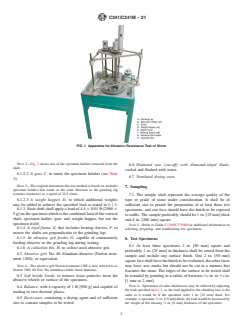
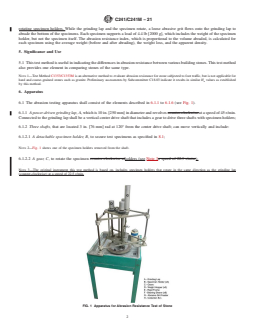
6.1 The abrasion testing apparatus shall consist of the elements described in 6.1.1 to 6.1.6 (see Fig. 1).
6.1.1 A power-driven grinding lap, A, which is 10 in. [250 mm] in diameter and revolves counter-clockwise at a speed of 45 r/min.
Connected to the grinding lap shall be a vertical center drive shaft that includes a gear to drive three shafts with specimen holders;
6.1.2 Three shafts, that are located 3 in. [76 mm] rad at 120° from the center drive shaft; can move vertically and include:
6.1.2.1 A detachable specimen holder, B, to secure test specimens as specified in 8.1;
NOTE 2—Fig. 1 shows one of the specimen holders removed from the shaft.
6.1.2.2 A gear, C, to rotate the specimen counter-clockwise atholders (see Note 3a speed of 22.5 r/min;);
NOTE 3—The original instrument this test method is based on, includes specimen holders that rotate in the same direction as the grinding lap
(counter-clockwise) at a speed of 22.5 r/min.
FIG. 1 Apparatus for Abrasion Resistance Test of Stone
C241/C241M − 21
6.1.2.3 A weight hopper, D, to which additional massweights may be added to achieve the specified load as stated in 6.1.3;
6.1.3 Each shaft shall apply a load of 4.4 6 0.01 lb [2000 6 5 g] on the specimen andwhich is the combined massload of the
vertical shaft, specimen holder, gear, and weight hopper, but not the specimen itself;
6.1.4 A rigid frame, E, that includes bearing sleeves, F, to ensure the shafts are perpendicular to the grinding lap;
6.1.5 An abrasive grit feeder, G, capable of continuously feeding abrasive to the grinding lap during testing;
6.1.6 A collection bin, H, to collect used abrasive grit.
6.2 Abrasive grit, No. 60 Alundum abrasive (Norton treatment 138S).138S), or equivalent.
NOTE 4—The abrasive grit Norton treatment 138S is now referred to as Norton 3001 60 Grit 38a Alundum (white fused alumina).
6.3 Soft bristle brush, to remove loose particles from the abrasive wheels or surface of the specimen.
6.4 Balance, with a capacity of 1 lb [500 g] and capable of reading to two decimal places.
6.5 Desiccator, containing a drying agent and of sufficient size to contain samples to be tested.
6.6 Diamond saw (cut-off) with diamond-edged blade, cooled and flushed with water.
6.7 Ventilated drying oven.
7. Sampling
7.1 The sample shall represent the average quality of the type or grade of stone under consideration. It shall be of sufficient size
to permit the preparation of at least three test specimens, and one face should have the finish to be exposed to traffic. The sample
preferably should be 1 in. [25 mm] thick and 8 in. [200 mm] square.
NOTE 5—Refer to Guide C1799/C1799M for additional information on selecting, preparing, and conditioning test specimens.
8. Test Specimens
8.1 At least three specimens 2 in. [50 mm] square and preferably 1 in. [25 mm] in thickness shall be sawed from the sample and
include any surface finish. One 2 in. [50 mm] square face shall have the finish to be evaluated, the other faces may have saw marks
but should not be cut in a manner that fractures the stone. The edges of the surface to be tested shall be rounded by grinding to
1 1
a radius of between ⁄32 in. to ⁄16 in. [1 mm to 2 mm].
NOTE 6—Specimens of other thicknesses may be utilized by adjusting the load specifi
...