

ASTM D8361-20
(Test Method)Standard Test Method for Total Organic Carbon in Water by Two Stage Wet Chemical Catalyzed Hydroxyl Radical Oxidation with Infra-Red Detection of Resulting Carbon Dioxide
General Information
- Abstract
SIGNIFICANCE AND USE
5.1 This test method is used for determination of the carbon content of water from a variety of natural, domestic, and industrial sources. In its most common form, this test method is used to measure organic carbon as a means of monitoring organic pollutants in industrial wastewater. These measurements are also used in monitoring waste treatment processes.
5.2 The relationship of TOC to other water quality parameters such as chemical oxygen demand (COD) and total oxygen demand (TOD) is described in the literature (5).
SCOPE
1.1 This test method covers the catalyzed hydroxyl radical oxidation system for the in-stream, online (Guide D5173) or laboratory analysis of total organic carbon, total carbon and total inorganic carbon in drinking water, wastewater, industrial process water, and effluent water. It is applicable to both dissolved and suspended materials. Suspended materials and particulates up to 2 mm in diameter can be analyzed.
1.2 This test method allows for determination of TOC ≥ 1 mg/L, TC ≥ 1 mg/L, and TIC ≥ 1 mg/L. The lower and upper working ranges are restricted by instrument-dependent conditions (for example, sample volume, amount of each reactant) and can be adjusted for a wider range.
1.3 This test method can be applied for the determination of total carbon (TC) and total inorganic carbon (TIC). Volatile or purgeable organic carbon (VOC, POC) can be determined separately by this test method (see Annex A1).
1.4 This test method allows the measurement of organic and inorganic carbon concentration samples, and samples containing dissolved chlorides up to seawater chloride concentrations.
1.5 The chemical oxidation process, applied in this test method, takes place at ambient pressure and temperature by using hydroxyl radicals. The advantage of catalytic hydroxyl radical oxidation is that it is free from seawater salinity interference.
1.6 The values stated in SI units are to be regarded as standard. No other units of measurement are included in this standard.
1.7 This standard does not purport to address all of the safety concerns, if any, associated with its use. It is the responsibility of the user of this standard to establish appropriate safety, health, and environmental practices and determine the applicability of regulatory limitations prior to use. For specific hazard statements, see Section 9.
1.8 ASTM International takes no position respecting the validity of any patent rights asserted in connection with any item mentioned in this standard. Users of this standard are expressly advised that determination of the validity of any such patent rights, and the risk of infringement of such rights, are entirely their own responsibility.
1.9 This international standard was developed in accordance with internationally recognized principles on standardization established in the Decision on Principles for the Development of International Standards, Guides and Recommendations issued by the World Trade Organization Technical Barriers to Trade (TBT) Committee.
- Status
- Published
- Publication Date
- 30-Nov-2020
- Technical Committee
- D19 - Water
Overview
ASTM D8361-20 – Standard Test Method for Total Organic Carbon (TOC) in Water by Two-Stage Wet Chemical Catalyzed Hydroxyl Radical Oxidation with Infra-Red Detection of Resulting Carbon Dioxide specifies a practical and reliable method for quantifying the carbon content in water samples. This internationally recognized method, developed by ASTM, is widely used to monitor and control organic pollutants in various water matrices, including drinking water, wastewater, industrial process water, and effluent water. The test is suitable for both laboratory and in-stream, online applications, making it valuable for process monitoring and environmental compliance.
Key Topics
- Total Organic Carbon (TOC) Measurement: The central focus is the determination of organic carbon in water by catalyzed oxidation with hydroxyl radicals, followed by detection of carbon dioxide using non-dispersive infrared (NDIR) spectroscopy.
- Sample Versatility: Applicable to samples with dissolved and suspended materials (particles up to 2 mm), and for a broad range of organic and inorganic carbon concentrations (≥1 mg/L).
- Interference Resistance: This method is specifically robust against interference from seawater salinity, allowing accurate results even in high-chloride environments.
- Differentiation of Carbon Forms: The method enables separate or simultaneous determination of total carbon (TC), total inorganic carbon (TIC), non-purgeable organic carbon (NPOC), and volatile/purgeable organic carbon (VOC/POC), as needed.
- Quality Assurance: The standard outlines calibration, precision, and quality control steps to ensure reliable and repeatable measurements across diverse water matrices.
Applications
ASTM D8361-20 is crucial where accurate measurement of organic carbon is required for regulatory, quality control, or process reasons:
Industrial and Municipal Wastewater Monitoring
- Detect and quantify organic pollutants for regulatory compliance.
- Optimize and verify performance of water and wastewater treatment processes.
- Aid in waste minimization and product loss prevention.
Drinking Water and Surface Water Quality
- Measure TOC as an indicator of natural organic matter and potential disinfection byproduct precursors.
- Track changes in source water organic content.
Industrial Process Water
- Control water quality in manufacturing and power generation facilities.
- Prevent fouling and process interference caused by excess organic carbon.
Effluent and Environmental Discharge
- Document final discharge quality to meet environmental protection requirements.
- Provide data for surface water impact assessments.
Related Standards
ASTM D8361-20 references and aligns with several key standards to ensure consistency and broad applicability:
- ASTM D5173: Guide for On-Line Monitoring of Total Organic Carbon in Water
- ASTM D1129: Terminology Relating to Water
- ASTM D1193: Specification for Reagent Water
- ASTM D3694, D4453, D5847, D2777: Practices for sample handling, preservation, and quality control in water analysis
- EN 1484: European guidelines for the determination of total organic carbon and dissolved organic carbon in water
Practical Value
Employing ASTM D8361-20 offers water treatment professionals, environmental labs, and regulatory agencies a reliable, interference-resistant procedure for TOC analysis. The method’s adaptability to both dissolved and particulate samples, resistance to salinity, and capability for both laboratory and automated in-stream measurements make it especially useful for continuous monitoring, process control, and discharge compliance in diverse operational environments.
Keywords: Total Organic Carbon, TOC analysis, water quality monitoring, wastewater testing, organic pollutants, catalyzed hydroxyl radical oxidation, NDIR detection, industrial water, effluent compliance, ASTM D8361-20, non-purgeable organic carbon, VOC, POC, TC, TIC, standard test method.
Relations
- Effective Date
- 01-Apr-2024
- Effective Date
- 01-May-2020
- Effective Date
- 01-Feb-2017
- Effective Date
- 15-Feb-2016
- Effective Date
- 15-Jun-2012
- Effective Date
- 01-May-2011
- Effective Date
- 01-Feb-2011
- Effective Date
- 01-Mar-2010
- Effective Date
- 15-Jan-2008
- Effective Date
- 15-Jun-2007
- Effective Date
- 01-Sep-2006
- Effective Date
- 01-Sep-2006
- Effective Date
- 15-Aug-2006
- Effective Date
- 01-Jul-2006
- Effective Date
- 01-Mar-2006
Get Certified
Connect with accredited certification bodies for this standard

CIS Institut d.o.o.
Personal Protective Equipment (PPE) certification body. Notified Body NB-2890 for EU Regulation 2016/425 PPE.

Kiwa BDA Testing
Building and construction product certification.
Kmetijski inštitut Slovenije
Agricultural Institute of Slovenia. Soil testing, plant health, agricultural product analysis.
Sponsored listings
Frequently Asked Questions
ASTM D8361-20 is a standard published by ASTM International. Its full title is "Standard Test Method for Total Organic Carbon in Water by Two Stage Wet Chemical Catalyzed Hydroxyl Radical Oxidation with Infra-Red Detection of Resulting Carbon Dioxide". This standard covers: SIGNIFICANCE AND USE 5.1 This test method is used for determination of the carbon content of water from a variety of natural, domestic, and industrial sources. In its most common form, this test method is used to measure organic carbon as a means of monitoring organic pollutants in industrial wastewater. These measurements are also used in monitoring waste treatment processes. 5.2 The relationship of TOC to other water quality parameters such as chemical oxygen demand (COD) and total oxygen demand (TOD) is described in the literature (5). SCOPE 1.1 This test method covers the catalyzed hydroxyl radical oxidation system for the in-stream, online (Guide D5173) or laboratory analysis of total organic carbon, total carbon and total inorganic carbon in drinking water, wastewater, industrial process water, and effluent water. It is applicable to both dissolved and suspended materials. Suspended materials and particulates up to 2 mm in diameter can be analyzed. 1.2 This test method allows for determination of TOC ≥ 1 mg/L, TC ≥ 1 mg/L, and TIC ≥ 1 mg/L. The lower and upper working ranges are restricted by instrument-dependent conditions (for example, sample volume, amount of each reactant) and can be adjusted for a wider range. 1.3 This test method can be applied for the determination of total carbon (TC) and total inorganic carbon (TIC). Volatile or purgeable organic carbon (VOC, POC) can be determined separately by this test method (see Annex A1). 1.4 This test method allows the measurement of organic and inorganic carbon concentration samples, and samples containing dissolved chlorides up to seawater chloride concentrations. 1.5 The chemical oxidation process, applied in this test method, takes place at ambient pressure and temperature by using hydroxyl radicals. The advantage of catalytic hydroxyl radical oxidation is that it is free from seawater salinity interference. 1.6 The values stated in SI units are to be regarded as standard. No other units of measurement are included in this standard. 1.7 This standard does not purport to address all of the safety concerns, if any, associated with its use. It is the responsibility of the user of this standard to establish appropriate safety, health, and environmental practices and determine the applicability of regulatory limitations prior to use. For specific hazard statements, see Section 9. 1.8 ASTM International takes no position respecting the validity of any patent rights asserted in connection with any item mentioned in this standard. Users of this standard are expressly advised that determination of the validity of any such patent rights, and the risk of infringement of such rights, are entirely their own responsibility. 1.9 This international standard was developed in accordance with internationally recognized principles on standardization established in the Decision on Principles for the Development of International Standards, Guides and Recommendations issued by the World Trade Organization Technical Barriers to Trade (TBT) Committee.
SIGNIFICANCE AND USE 5.1 This test method is used for determination of the carbon content of water from a variety of natural, domestic, and industrial sources. In its most common form, this test method is used to measure organic carbon as a means of monitoring organic pollutants in industrial wastewater. These measurements are also used in monitoring waste treatment processes. 5.2 The relationship of TOC to other water quality parameters such as chemical oxygen demand (COD) and total oxygen demand (TOD) is described in the literature (5). SCOPE 1.1 This test method covers the catalyzed hydroxyl radical oxidation system for the in-stream, online (Guide D5173) or laboratory analysis of total organic carbon, total carbon and total inorganic carbon in drinking water, wastewater, industrial process water, and effluent water. It is applicable to both dissolved and suspended materials. Suspended materials and particulates up to 2 mm in diameter can be analyzed. 1.2 This test method allows for determination of TOC ≥ 1 mg/L, TC ≥ 1 mg/L, and TIC ≥ 1 mg/L. The lower and upper working ranges are restricted by instrument-dependent conditions (for example, sample volume, amount of each reactant) and can be adjusted for a wider range. 1.3 This test method can be applied for the determination of total carbon (TC) and total inorganic carbon (TIC). Volatile or purgeable organic carbon (VOC, POC) can be determined separately by this test method (see Annex A1). 1.4 This test method allows the measurement of organic and inorganic carbon concentration samples, and samples containing dissolved chlorides up to seawater chloride concentrations. 1.5 The chemical oxidation process, applied in this test method, takes place at ambient pressure and temperature by using hydroxyl radicals. The advantage of catalytic hydroxyl radical oxidation is that it is free from seawater salinity interference. 1.6 The values stated in SI units are to be regarded as standard. No other units of measurement are included in this standard. 1.7 This standard does not purport to address all of the safety concerns, if any, associated with its use. It is the responsibility of the user of this standard to establish appropriate safety, health, and environmental practices and determine the applicability of regulatory limitations prior to use. For specific hazard statements, see Section 9. 1.8 ASTM International takes no position respecting the validity of any patent rights asserted in connection with any item mentioned in this standard. Users of this standard are expressly advised that determination of the validity of any such patent rights, and the risk of infringement of such rights, are entirely their own responsibility. 1.9 This international standard was developed in accordance with internationally recognized principles on standardization established in the Decision on Principles for the Development of International Standards, Guides and Recommendations issued by the World Trade Organization Technical Barriers to Trade (TBT) Committee.
ASTM D8361-20 is classified under the following ICS (International Classification for Standards) categories: 13.060.50 - Examination of water for chemical substances. The ICS classification helps identify the subject area and facilitates finding related standards.
ASTM D8361-20 has the following relationships with other standards: It is inter standard links to ASTM D3694-96(2024), ASTM D1129-13(2020)e2, ASTM D4453-17, ASTM D4453-16, ASTM D2777-12, ASTM D3694-96(2011), ASTM D4453-11, ASTM D1129-10, ASTM D2777-08, ASTM D5173-97(2007), ASTM D1129-06ae1, ASTM D1129-06a, ASTM D2777-06, ASTM D4453-02(2006), ASTM D1193-06. Understanding these relationships helps ensure you are using the most current and applicable version of the standard.
ASTM D8361-20 is available in PDF format for immediate download after purchase. The document can be added to your cart and obtained through the secure checkout process. Digital delivery ensures instant access to the complete standard document.
Standards Content (Sample)
This international standard was developed in accordance with internationally recognized principles on standardization established in the Decision on Principles for the
Development of International Standards, Guides and Recommendations issued by the World Trade Organization Technical Barriers to Trade (TBT) Committee.
Designation: D8361 − 20
Standard Test Method for
Total Organic Carbon in Water by Two Stage Wet Chemical
Catalyzed Hydroxyl Radical Oxidation with Infra-Red
Detection of Resulting Carbon Dioxide
This standard is issued under the fixed designation D8361; the number immediately following the designation indicates the year of
original adoption or, in the case of revision, the year of last revision. A number in parentheses indicates the year of last reapproval. A
superscript epsilon (´) indicates an editorial change since the last revision or reapproval.
1. Scope mine the applicability of regulatory limitations prior to use.
For specific hazard statements, see Section 9.
1.1 This test method covers the catalyzed hydroxyl radical
1.8 ASTM International takes no position respecting the
oxidation system for the in-stream, online (Guide D5173)or
validity of any patent rights asserted in connection with any
laboratory analysis of total organic carbon, total carbon and
item mentioned in this standard. Users of this standard are
total inorganic carbon in drinking water, wastewater, industrial
expressly advised that determination of the validity of any such
process water, and effluent water. It is applicable to both
patent rights, and the risk of infringement of such rights, are
dissolved and suspended materials. Suspended materials and
entirely their own responsibility.
particulates up to 2 mm in diameter can be analyzed.
1.9 This international standard was developed in accor-
1.2 This test method allows for determination of TOC ≥ 1
dance with internationally recognized principles on standard-
mg/L, TC ≥ 1 mg/L, and TIC ≥ 1 mg/L. The lower and upper
ization established in the Decision on Principles for the
working ranges are restricted by instrument-dependent condi-
Development of International Standards, Guides and Recom-
tions (for example, sample volume, amount of each reactant)
mendations issued by the World Trade Organization Technical
and can be adjusted for a wider range.
Barriers to Trade (TBT) Committee.
1.3 This test method can be applied for the determination of
total carbon (TC) and total inorganic carbon (TIC). Volatile or
2. Referenced Documents
purgeable organic carbon (VOC, POC) can be determined
2.1 ASTM Standards:
separately by this test method (see Annex A1).
D1129 Terminology Relating to Water
1.4 Thistestmethodallowsthemeasurementoforganicand
D1193 Specification for Reagent Water
inorganic carbon concentration samples, and samples contain-
D2777 Practice for Determination of Precision and Bias of
ing dissolved chlorides up to seawater chloride concentrations.
Applicable Test Methods of Committee D19 on Water
1.5 The chemical oxidation process, applied in this test
D3694 Practices for Preparation of Sample Containers and
method, takes place at ambient pressure and temperature by
for Preservation of Organic Constituents
using hydroxyl radicals. The advantage of catalytic hydroxyl
D4453 Practice for Handling of High Purity Water Samples
radical oxidation is that it is free from seawater salinity
D5173 Guide for On-Line Monitoring of Total Organic
interference.
Carbon in Water by Oxidation and Detection of Resulting
1.6 The values stated in SI units are to be regarded as Carbon Dioxide
standard. No other units of measurement are included in this
D5847 Practice for Writing Quality Control Specifications
standard. for Standard Test Methods for Water Analysis
1.7 This standard does not purport to address all of the
2.2 Other Standard:
safety concerns, if any, associated with its use. It is the
EN 1484 Water analysis guidelines for the determination of
responsibility of the user of this standard to establish appro-
total organic carbon and dissolved organic carbon
priate safety, health, and environmental practices and deter-
For referenced ASTM standards, visit the ASTM website, www.astm.org, or
This test method is under the jurisdiction of ASTM Committee D19 on Water contact ASTM Customer Service at service@astm.org. For Annual Book of ASTM
and is the direct responsibility of Subcommittee D19.03 on Sampling Water and Standards volume information, refer to the standard’s Document Summary page on
Water-Formed Deposits,Analysis of Water for Power Generation and Process Use, the ASTM website.
On-Line Water Analysis, and Surveillance of Water. WaterAnalysis Guidelines for the Determination of Total Organic Carbon and
Current edition approved Dec. 1, 2020. Published December 2020. DOI: Dissolved Organic Carbon, European Standard EN 1484, European Committee for
10.1520/D8361-20. Standardization, May 1997.
Copyright © ASTM International, 100 Barr Harbor Drive, PO Box C700, West Conshohocken, PA 19428-2959. United States
D8361 − 20
3. Terminology possibility to create oxalates. If any oxalates are formed, then
they are further oxidized to CO through acidification in the
3.1 Definitions—For definitions of terms used in this test
presence of ozone and catalyst.
method, refer to Terminology D1129.
4.3.1 In the first stage of the two-stage oxidation, the base
3.2 Definitions of Terms Specific to This Standard:
reagent is added to the reaction vessel, and the sample is
3.2.1 dissolved organic carbon (DOC), n—carbon deter-
oxidized by hydroxyl radicals, which are generated by expos-
mined on filtered samples.
ing high pH reagents to ozone. The oxidation process takes
3.2.2 inorganic carbon (IC), n—carbon in the form of
place at ambient conditions. The oxidation of organic com-
carbon dioxide, carbonate ion, or bicarbonate ion. pounds takes place and the primary compounds formed are
“carbonates”, and depending on the organic constituents of the
3.2.3 in-stream analysis, n—analyte determination achieved
sample, the secondary compound “oxalates” can also be
by capturing the sample from the desired stream of fluid that
formed (3, 4).
canbepartofaprocessorofawaterbodyanddeliveringitinto
4.3.2 In the second stage of the two-stage oxidation an acid
the measurement cell.
reagent, which contains a catalyst, is added into the reaction
3.2.4 limit of detection (LOD), n—the lowest concentration
vessel and the carbonates are converted to carbon dioxide.
that can be determined to be statistically different from a blank
Simultaneously, oxalates are broken down to carbon dioxide in
with 99 % confidence. LOD’s are matrix, method, and analyte
the presence of the catalyst and ozone.
specific.
4.4 The quantification of TOC is achieved by measuring
3.2.5 limit of quantification (LOQ), n—the level above
CO over the oxidation time using non-dispersive infrared
which quantitative results may be obtained at a specified
spectroscopy (NDIR) detection method.
degree of confidence; mathematically equal to 10 x the std
deviation of the results for a series of replicates used to
5. Significance and Use
determine a justifiable LOD
5.1 This test method is used for determination of the carbon
3.2.6 non-purgeable organic carbon (NPOC), n—carbon
content of water from a variety of natural, domestic, and
measured in a sample after acidification and sparging to
industrial sources. In its most common form, this test method
remove inorganic carbon.
is used to measure organic carbon as a means of monitoring
organic pollutants in industrial wastewater. These measure-
3.2.7 organic carbon (OC), n—carbon that is bound to
hydrogen, oxygen, sulfur, nitrogen through either single, ments are also used in monitoring waste treatment processes.
double or triple bonds.
5.2 The relationship of TOC to other water quality param-
3.2.8 purgeable organic carbon (POC), n—carbon that
eterssuchaschemicaloxygendemand(COD)andtotaloxygen
purges from acidified samples, also known as volatile organic demand (TOD) is described in the literature (5).
compounds (VOC).
6. Interference and Limitations
3.2.9 total carbon (TC), n—the sum of IC and TOC.
6.1 This test method is validated for chloride interference
3.2.10 totalorganiccarbon(TOC),n—carbonintheformof
from seawater at a salinity of 2.1 %. For salinity greater than
organic compounds.
2.1 % perform additional interference recovery test. No inter-
ference is expected below 30 % (6).
4. Summary of Test Method
6.2 Analyses of samples, which contain significant concen-
4.1 Carbon can occur in water as an inorganic and organic
trations of VOC compounds, in a TIC and NPOC system,
compound. This test method can be used to make independent
under-report the actual organic carbon concentrations. Preser-
measurements of IC, NPOC, and TC, and can also determine
vation of sample by acidification needs to be avoided because
OC by the difference of TC and IC. DOC is determined on
it can lead to under-reporting of VOC values.
samples that have been filtered through a 0.45-µm filter (1, 2).
6.3 Homogenizing or sparging of a sample, or both, may
4.2 TOC and DOC procedures require that IC has been
cause loss of purgeable organic compounds, thus yielding a
removed from the sample before it is analyzed for organic
value lower than the true TOC level. (For this reason, such
carbon content. The sample free of IC is injected into the TOC
measurements are sometimes known as NPOC). The extent
instrument where all carbon is converted to CO and measured
and significance of such losses must be evaluated on an
bythedetector.Failureofthistestmethodtoremove/determine
individual basis. Comparison of the difference, if any, between
all IC prior to analysis for organic carbon will result in
NPOC and TOC by subtraction represents POC lost during
significant error.
sparging.
4.3 This test method is used to monitor TOC from an
6.4 Note that error will be introduced when the method of
aqueoussample.Ozoneandbaseareaddedtoastreamofwater
difference is used to derive a relatively small level from two
where hydroxyl radicals are formed. The hydroxyl radicals
large levels. For example, a ground water high in IC and low
oxidize organic carbon to carbon dioxide and there is a
in TOC will give a poorer TOC value as (TC – IC) than by
direct measurement as NPOC.
6.5 Carbon in reagent water and reagent blanks can be
The boldface numbers in parentheses refer to the list of references at the end of
this standard. reduced to a minimum, and consistent value, but cannot be
D8361 − 20
eliminated. Analyzing low-level TOC (less than 1.0 mg/L) Analytical Reagents of the American Chemical Society. The
bears special consideration requiring that the same water used organic and inorganic carbon contamination inside the concen-
to set the baseline be used to prepare the calibration standards. trated chemicals, which are used to prepare the reagents,
should be as low as possible. Even though it is not
6.6 Atmospheric carbon dioxide absorbs into reagent water
recommended, other grades, such as technical grade reagents,
increasing its inorganic carbon content with time. The small
may also be used, provided that the background contamination
levels of CO absorbed into reagent water can cause consid-
inside the reagents does not have any negative impact on the
erable inaccuracies in low-level TIC analysis.
accuracy of the measurement.
6.7 Trace organics in the atmosphere can be absorbed into
8.2 Purity of Water—Unless otherwise stated, references to
reagent water increasing its organic carbon content with time.
water shall be understood to mean water meeting the quanti-
6.8 This test method measures TIC as the sum of dissolved
tative requirements of Specification D1193, Type I or Type II.
carbon dioxide, carbonates and hydrogen carbonates. Cyanide,
This specification does not specify the maximum allowable
cyanate, and thiocyanate are reported as organic carbon and
inorganic and organic carbon contamination levels. Contami-
included in the NPOC, TC or TOC measurements depending
nation in water may affect the accuracy of the measurements
on system configuration discussed in 4.2.
adversely. Glass containers are recommended for storage of
water and standard solutions. Practices D3694 and D4453
7. Apparatus
address the handling of the water samples.
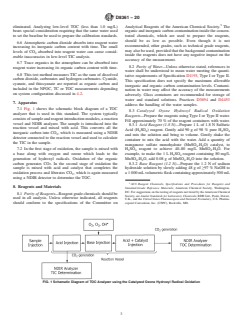
7.1 Fig. 1 shows the schematic block diagram of a TOC
8.3 Catalyzed Ozone Hydroxyl Radical Oxidation
analyzer that is used in this standard. The system typically
Reagents—Prepare the reagents using Type I or Type II water.
consistsofsampleandreagentintroductionmodules,areaction
Fill approximately 70 % of the reagent containers with water.
vessel and NDIR analyzer. The sample is introduced into the
8.3.1 Acid Reagent (1.8 N)—Prepare 1 L of 1.8 N Sulfuric
reaction vessel and mixed with acid. This converts all the
Acid (H SO ) reagent. Gently add 90 g of 98 % pure H SO
2 4 2 4
inorganic carbon into CO , which is measured using a NDIR
and mix the solution and bring to volume. Gently shake the
detector connected to the reaction vessel and used to calculate
container to mix the acid with the water. Add a quantity of
the TIC in the sample.
manganese sulfate monohydrate (MnSO .H O) catalyst, to
4 2
7.2 In the first stage of oxidation, the sample is mixed with H SO reagent to achieve 40–80 mg/L MnSO .H O. For
2 4 4 2
a base along with oxygen and ozone which leads to the
example, to make the 1 L H SO reagent containing 80 mg/L
2 4
generation of hydroxyl radicals. Oxidation of the organic MnSO .H O, add 0.08 g of MnSO .H O into the solution.
4 2 4 2
carbon generates CO . In the second stage of oxidation the
8.3.2 Base Reagent (1.2 N)—Prepare the 1.2 N of sodium
sample is mixed with acid and catalyst that completes the hydroxide solution by slowly adding 48 g of ≥97 % NaOH to
oxidation process and liberates CO , which is again measured
a 1 000 mLvolumetric flask containing approximately 500 mL
using a NDIR detector to determine the TOC.
ACS Reagent Chemicals, Specifications and Procedures for Reagents and
8. Reagents and Materials
Standard-Grade Reference Materials, American Chemical Society, Washington,
DC. For suggestions on the testing of reagents not listed by theAmerican Chemical
8.1 Purity of Reagents—Reagent grade chemicals should be
Society, see Analar Standards for Laboratory Chemicals, BDH Ltd., Poole, Dorset,
used in all analysis. Unless otherwise indicated, all reagents
U.K., and the United States Pharmacopeia and National Formulary, U.S. Pharma-
should conform to the specifications of the Committee on copeial Convention, Inc. (USPC), Rockville, MD.
FIG. 1 Schematic Diagram of TOC Analyzer using the Catalyzed Ozone Hydroxyl Radical Oxidation
D8361 − 20
of water. Mix the solution until the NaOH has dissolved, then precautions to prevent any fire hazard. Comply with all local
stopper the flask and allow the solution to come to room and national regulations when working with oxygen.
temperature. Bring solution to volume with water.
9.3 Refer to manufacturer’s manuals for the details of the
8.4 Oxygen—The carrier gas used in the catalyzed ozone safety precautions.
hydroxyl radical oxidation method is oxygen. Oxygen shall be
10. Calibration
free of carbon dioxide, carbon monoxide, nitrogen, hydrocar-
bons and water. Typical oxygen purity supplied by an oxygen
10.1 Calibrate the analyzer in accordance with the manu-
concentrator is 93 % (63 %) with balance gas argon. facturer’s instructions.
8.5 TOC Standard Solution (1000 mg/L)—Use non-volatile,
10.2 Prepare the preferred concentration TOC standard
soluble, stable, reagent grade and concentrated (typically solutionasdescribedin8.5andifnecessary,dilutethestandard
greater than 99 % pure), organic carbon compounds to prepare
solution as required.
the TOC standard solution. Potassium hydrogen phthalate
10.3 Connect the standard solution to the inlet port of the
(KHP) is typically used as standard. Gravimetrically weigh the
analyzer and begin the calibration or verification process using
corresponding mass of the organic compound required to
a TOC standard solution at the specific analysis range.
prepare the 1000 mg/L TOC standard stock solution. For
10.4 Connect the standard solution to the inlet port of the
instance, weigh 2.13 g of 99.9 % pure KHP ina1L container
analyzer and begin the calibration or verification process using
and bring it up to volume. Apply standard dilution procedures
a TOC standard solution at the specific analysis range.
to prepare standard solutions with concentrations less than
1000 mg/L. Standard solutions less than 5mg/L concentration
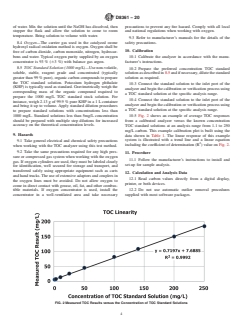
10.5 Fig. 2 shows an example of average TOC responses
should be prepared with multiple step dilutions for increased
from a calibrated analyzer versus the known concentration
accuracy on the theoretical concentration levels.
TOC standard solutions at an analysis range from 1.1 to 250
mg/L carbon. This example calibration plot is built using the
9. Hazards
data shown in Table 1. The linear response of this example
system is illustrated with a trend line and a linear equation
9.1 Take general electrical and chemical safety precautions
including the coefficient of determination (R ) value on Fig. 2.
when working with the TOC analyzer using this test method.
9.2 Take the same precautions required for any high pres-
11. Procedure
sure or compressed gas system when working with the oxygen
11.1 Follow the manufacturer’s instructions to install and
gas. If oxygen cylinders are used, they must be labeled clearly
set-up for sample analysis.
for identification, well secured for storage and transport, and
transferred safely using appropriate equipment such as carts
12. Calculation and Analysis Data
and hand trucks. The use of extensive adapt
...