

ASTM F3371-22
(Specification)Standard Specification for Polyolefin Pipe and Fittings for Drainage, Waste, and Vent Applications
General Information
- Abstract
SCOPE
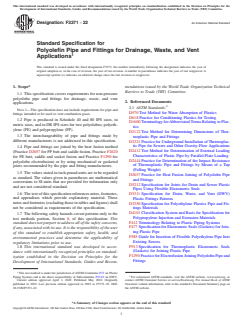
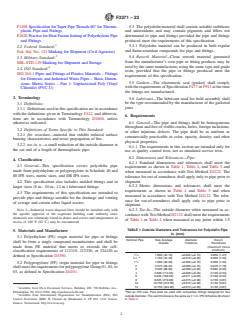
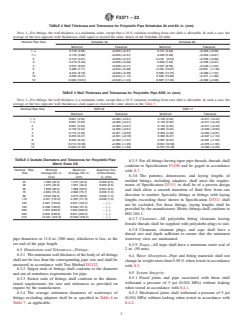
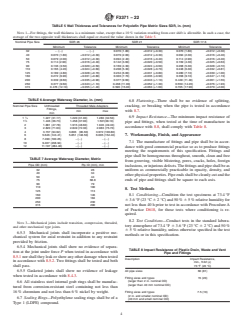
1.1 This specification covers requirements for non-pressure polyolefin pipe and fittings for drainage, waste, and vent applications.
Note 1: This specification does not include requirements for pipe and fittings intended to be used to vent combustion gases.
1.2 Pipe is produced in Schedule 40 and 80 IPS sizes, in metric sizes, and in DR IPS sizes for two polyolefins; polyethylene (PE) and polypropylene (PP).
1.3 The interchangeability of pipe and fittings made by different manufacturers is not addressed in this specification.
1.4 Pipe and fittings are joined by the heat fusion method (Practice D2657 for PP butt and saddle fusion, Practice F2620 for PE butt, saddle and socket fusion and Practice F1290 for polyolefin electrofusion) or by using mechanical or gasketed joints recommended by the pipe and fitting manufacturers.
1.5 The values stated in inch-pound units are to be regarded as standard. The values given in parentheses are mathematical conversions to SI units that are provided for information only and are not considered standard.
1.6 The text of this specification references notes, footnotes, and appendixes which provide explanatory material. These notes and footnotes (excluding those in tables and figures) shall not be considered as requirements of the specification.
1.7 The following safety hazards caveat pertains only to the test methods portion, Section 8, of this specification: This standard does not purport to address all of the safety concerns, if any, associated with its use. It is the responsibility of the user of this standard to establish appropriate safety, health, and environmental practices and determine the applicability of regulatory limitations prior to use.
1.8 This international standard was developed in accordance with internationally recognized principles on standardization established in the Decision on Principles for the Development of International Standards, Guides and Recommendations issued by the World Trade Organization Technical Barriers to Trade (TBT) Committee.
- Status
- Published
- Publication Date
- 31-Mar-2022
- Technical Committee
- F17 - Plastic Piping Systems
- Drafting Committee
- F17.63 - DWV
Buy Documents
ASTM F3371-22 - Standard Specification for Polyolefin Pipe and Fittings for Drainage, Waste, and Vent Applications
REDLINE ASTM F3371-22 - Standard Specification for Polyolefin Pipe and Fittings for Drainage, Waste, and Vent Applications
Overview
ASTM F3371-22 is the standard specification for polyolefin pipe and fittings – specifically made from polyethylene (PE) and polypropylene (PP) – used in drainage, waste, and vent (DWV) applications. Published by ASTM International, this standard outlines the material, dimensional, performance, and quality requirements for non-pressure plastic piping systems typically found in commercial, residential, and industrial buildings. ASTM F3371-22 supports the design, installation, and verification of reliable DWV systems, providing guidelines to ensure safety, quality, and compatibility in construction and plumbing projects.
Key Topics
- Materials Covered: The standard applies to virgin polyethylene (PE) and polypropylene (PP) compounds, including fire-retardant variants. Materials must meet or exceed ASTM D3350 for PE and ASTM D4101 for PP.
- Product Types and Sizes: Covers Schedule 40 and 80 Iron Pipe Size (IPS), metric sizes, and Dimension Ratio (DR) IPS sizes.
- Joining Methods: Polyolefin pipe and fittings may be joined by heat fusion (as per ASTM D2657, F2620, and F1290 standards), or with mechanical or gasketed joints, following manufacturer recommendations.
- Dimensions and Tolerances: Specifies outside diameter, wall thickness, and other tolerances to ensure proper fit and system integrity.
- Performance Criteria: Includes requirements for water absorption, hydrostatic pressure resistance, impact resistance, flattening, and system integrity under specified laboratory conditions.
- Quality and Workmanship: Requires all pipes and fittings to be free from defects, including visible cracks, blisters, or other injurious imperfections.
- Marking Requirements: Products must be clearly marked with the manufacturer’s information, material type, size, schedule, and the designation F3371.
Applications
The ASTM F3371-22 standard is broadly applicable across various sectors where efficient, robust drainage and waste management systems are critical:
- Residential and Commercial Buildings: Used for non-pressurized drainage, waste, and vent piping, including both underground and above-ground installations.
- Industrial Facilities: For liquid waste disposal where chemical and temperature exposures are within material limits; special care should be taken for applications involving atypical chemicals or elevated temperatures.
- Renovation and Retrofitting: Appropriate for use in projects involving updates or expansions to existing plumbing systems, especially where corrosion resistance and ease of installation are required.
- Infrastructure Projects: Suitable for municipal projects, including stormwater management and sanitary drains, following applicable building codes and local regulations.
Related Standards
To ensure system compatibility, safety, and performance, ASTM F3371-22 references and is used alongside other critical standards, including:
- ASTM D3350 – Specification for Polyethylene Plastics Pipe and Fittings Materials
- ASTM D4101 – Classification for Polypropylene Injection and Extrusion Materials
- ASTM D2657, F2620, F1290 – Practices for Heat Fusion and Electrofusion Joining
- ASTM D2321 – Practice for Installation of Thermoplastic Pipe for Sewers and Gravity-Flow Applications
- ASTM D2122, D2412, D2444 – Methods for testing pipe and fitting dimensions, external loads, impact resistance
- ASTM D3212, F477, F913 – Specifications for joints and elastomeric seals
- ISO 265-1 – Pipes and Fittings of Plastics Materials for Waste Pipes (Metric Series)
- Fed. Std. No. 123 and MIL-STD-129 – Marking for shipment and storage
Practical Value
By following ASTM F3371-22, engineers, designers, contractors, and product manufacturers can:
- Ensure product reliability and compatibility for non-pressure DWV systems.
- Improve long-term system performance by specifying materials with proven chemical resistance and structural integrity.
- Align with code and regulatory compliance for plumbing and construction projects.
- Facilitate quality assurance through consistent testing and marking requirements.
- Optimize installation processes with standardized practices for cutting, joining, and supporting polyolefin piping.
Keywords: ASTM F3371, polyolefin pipe, polyethylene pipe, polypropylene pipe, drainage, waste pipe, vent pipe, DWV, pipe fittings, non-pressure piping, plumbing standards, plastic piping systems, building drainage, heat fusion joining, mechanical joints.
Relations
- Effective Date
- 01-Feb-2024
- Effective Date
- 01-Apr-2020
- Effective Date
- 15-Mar-2020
- Effective Date
- 01-Jan-2019
- Effective Date
- 01-Jan-2019
- Effective Date
- 01-Mar-2018
- Refers
ASTM D1600-18 - Standard Terminology for Abbreviated Terms Relating to Plastics (Withdrawn 2024) - Effective Date
- 01-Jan-2018
- Effective Date
- 15-Nov-2017
- Effective Date
- 01-Aug-2017
- Effective Date
- 01-Feb-2017
- Effective Date
- 15-Nov-2016
- Effective Date
- 01-Aug-2016
- Effective Date
- 01-Feb-2016
- Effective Date
- 01-Jun-2015
- Refers
ASTM D2122-15 - Standard Test Method for Determining Dimensions of Thermoplastic Pipe and Fittings - Effective Date
- 15-Mar-2015
Buy Documents
ASTM F3371-22 - Standard Specification for Polyolefin Pipe and Fittings for Drainage, Waste, and Vent Applications
REDLINE ASTM F3371-22 - Standard Specification for Polyolefin Pipe and Fittings for Drainage, Waste, and Vent Applications
Get Certified
Connect with accredited certification bodies for this standard

Institut za varilstvo d.o.o. (Welding Institute)
Slovenia's leading welding institute since 1952. ISO 3834, EN 1090, pressure equipment certification, NDT personnel, welder qualification. Only IIW Au
Sponsored listings
Frequently Asked Questions
ASTM F3371-22 is a technical specification published by ASTM International. Its full title is "Standard Specification for Polyolefin Pipe and Fittings for Drainage, Waste, and Vent Applications". This standard covers: SCOPE 1.1 This specification covers requirements for non-pressure polyolefin pipe and fittings for drainage, waste, and vent applications. Note 1: This specification does not include requirements for pipe and fittings intended to be used to vent combustion gases. 1.2 Pipe is produced in Schedule 40 and 80 IPS sizes, in metric sizes, and in DR IPS sizes for two polyolefins; polyethylene (PE) and polypropylene (PP). 1.3 The interchangeability of pipe and fittings made by different manufacturers is not addressed in this specification. 1.4 Pipe and fittings are joined by the heat fusion method (Practice D2657 for PP butt and saddle fusion, Practice F2620 for PE butt, saddle and socket fusion and Practice F1290 for polyolefin electrofusion) or by using mechanical or gasketed joints recommended by the pipe and fitting manufacturers. 1.5 The values stated in inch-pound units are to be regarded as standard. The values given in parentheses are mathematical conversions to SI units that are provided for information only and are not considered standard. 1.6 The text of this specification references notes, footnotes, and appendixes which provide explanatory material. These notes and footnotes (excluding those in tables and figures) shall not be considered as requirements of the specification. 1.7 The following safety hazards caveat pertains only to the test methods portion, Section 8, of this specification: This standard does not purport to address all of the safety concerns, if any, associated with its use. It is the responsibility of the user of this standard to establish appropriate safety, health, and environmental practices and determine the applicability of regulatory limitations prior to use. 1.8 This international standard was developed in accordance with internationally recognized principles on standardization established in the Decision on Principles for the Development of International Standards, Guides and Recommendations issued by the World Trade Organization Technical Barriers to Trade (TBT) Committee.
SCOPE 1.1 This specification covers requirements for non-pressure polyolefin pipe and fittings for drainage, waste, and vent applications. Note 1: This specification does not include requirements for pipe and fittings intended to be used to vent combustion gases. 1.2 Pipe is produced in Schedule 40 and 80 IPS sizes, in metric sizes, and in DR IPS sizes for two polyolefins; polyethylene (PE) and polypropylene (PP). 1.3 The interchangeability of pipe and fittings made by different manufacturers is not addressed in this specification. 1.4 Pipe and fittings are joined by the heat fusion method (Practice D2657 for PP butt and saddle fusion, Practice F2620 for PE butt, saddle and socket fusion and Practice F1290 for polyolefin electrofusion) or by using mechanical or gasketed joints recommended by the pipe and fitting manufacturers. 1.5 The values stated in inch-pound units are to be regarded as standard. The values given in parentheses are mathematical conversions to SI units that are provided for information only and are not considered standard. 1.6 The text of this specification references notes, footnotes, and appendixes which provide explanatory material. These notes and footnotes (excluding those in tables and figures) shall not be considered as requirements of the specification. 1.7 The following safety hazards caveat pertains only to the test methods portion, Section 8, of this specification: This standard does not purport to address all of the safety concerns, if any, associated with its use. It is the responsibility of the user of this standard to establish appropriate safety, health, and environmental practices and determine the applicability of regulatory limitations prior to use. 1.8 This international standard was developed in accordance with internationally recognized principles on standardization established in the Decision on Principles for the Development of International Standards, Guides and Recommendations issued by the World Trade Organization Technical Barriers to Trade (TBT) Committee.
ASTM F3371-22 is classified under the following ICS (International Classification for Standards) categories: 23.040.20 - Plastics pipes. The ICS classification helps identify the subject area and facilitates finding related standards.
ASTM F3371-22 has the following relationships with other standards: It is inter standard links to ASTM D4101-24, ASTM F412-20, ASTM D2321-20, ASTM F412-19, ASTM F1290-19, ASTM D2321-18, ASTM D1600-18, ASTM D2444-17, ASTM F412-17a, ASTM F412-17, ASTM F412-16a, ASTM F412-16, ASTM D3311-11(2016), ASTM F412-15, ASTM D2122-15. Understanding these relationships helps ensure you are using the most current and applicable version of the standard.
ASTM F3371-22 is available in PDF format for immediate download after purchase. The document can be added to your cart and obtained through the secure checkout process. Digital delivery ensures instant access to the complete standard document.
Standards Content (Sample)
This international standard was developed in accordance with internationally recognized principles on standardization established in the Decision on Principles for the
Development of International Standards, Guides and Recommendations issued by the World Trade Organization Technical Barriers to Trade (TBT) Committee.
Designation:F3371 −22 An American National Standard
Standard Specification for
Polyolefin Pipe and Fittings for Drainage, Waste, and Vent
Applications
This standard is issued under the fixed designation F3371; the number immediately following the designation indicates the year of
original adoption or, in the case of revision, the year of last revision. A number in parentheses indicates the year of last reapproval. A
superscript epsilon (´) indicates an editorial change since the last revision or reapproval.
1. Scope* mendations issued by the World Trade Organization Technical
Barriers to Trade (TBT) Committee.
1.1 This specification covers requirements for non-pressure
polyolefin pipe and fittings for drainage, waste, and vent
2. Referenced Documents
applications.
2.1 ASTM Standards:
NOTE 1—This specification does not include requirements for pipe and
D570 Test Method for Water Absorption of Plastics
fittings intended to be used to vent combustion gases.
D618 Practice for Conditioning Plastics for Testing
1.2 Pipe is produced in Schedule 40 and 80 IPS sizes, in
D1600 Terminology forAbbreviatedTerms Relating to Plas-
metric sizes, and in DR IPS sizes for two polyolefins; polyeth-
tics
ylene (PE) and polypropylene (PP).
D2122 Test Method for Determining Dimensions of Ther-
1.3 The interchangeability of pipe and fittings made by
moplastic Pipe and Fittings
different manufacturers is not addressed in this specification.
D2321 PracticeforUndergroundInstallationofThermoplas-
tic Pipe for Sewers and Other Gravity-Flow Applications
1.4 Pipe and fittings are joined by the heat fusion method
D2412 Test Method for Determination of External Loading
(Practice D2657 for PP butt and saddle fusion, Practice F2620
Characteristics of Plastic Pipe by Parallel-Plate Loading
for PE butt, saddle and socket fusion and Practice F1290 for
D2444 Practice for Determination of the Impact Resistance
polyolefin electrofusion) or by using mechanical or gasketed
of Thermoplastic Pipe and Fittings by Means of a Tup
joints recommended by the pipe and fitting manufacturers.
(Falling Weight)
1.5 The values stated in inch-pound units are to be regarded
D2657 Practice for Heat Fusion Joining of Polyolefin Pipe
as standard. The values given in parentheses are mathematical
and Fittings
conversions to SI units that are provided for information only
D3212 Specification for Joints for Drain and Sewer Plastic
and are not considered standard.
Pipes Using Flexible Elastomeric Seals
1.6 The text of this specification references notes, footnotes,
D3311 Specification for Drain, Waste, and Vent (DWV)
and appendixes which provide explanatory material. These
Plastic Fittings Patterns
notesandfootnotes(excludingthoseintablesandfigures)shall
D3350 Specification for Polyethylene Plastics Pipe and Fit-
not be considered as requirements of the specification.
tings Materials
D4101 Classification System and Basis for Specification for
1.7 The following safety hazards caveat pertains only to the
Polypropylene Injection and Extrusion Materials
test methods portion, Section 8, of this specification: This
F412 Terminology Relating to Plastic Piping Systems
standard does not purport to address all of the safety concerns,
F477 Specification for Elastomeric Seals (Gaskets) for Join-
if any, associated with its use. It is the responsibility of the user
ing Plastic Pipe
of this standard to establish appropriate safety, health, and
F585 Guide for Insertion of Flexible Polyethylene Pipe Into
environmental practices and determine the applicability of
Existing Sewers
regulatory limitations prior to use.
F913 Specification for Thermoplastic Elastomeric Seals
1.8 This international standard was developed in accor-
(Gaskets) for Joining Plastic Pipe
dance with internationally recognized principles on standard-
F1290 PracticeforElectrofusionJoiningPolyolefinPipeand
ization established in the Decision on Principles for the
Fittings
Development of International Standards, Guides and Recom-
This test method is under the jurisdiction of ASTM Committee F17 on Plastic
Piping Systems and is the direct responsibility of Subcommittee F17.63 on DWV. For referenced ASTM standards, visit the ASTM website, www.astm.org, or
Current edition approved April 1, 2022. Published May 2022. Originally contact ASTM Customer Service at service@astm.org. For Annual Book of ASTM
published in 2019. Last previous edition approved in 2019 as F3371–19. DOI: Standards volume information, refer to the standard’s Document Summary page on
10.1520/F3371–22 the ASTM website.
*A Summary of Changes section appears at the end of this standard
Copyright © ASTM International, 100 Barr Harbor Drive, PO Box C700, West Conshohocken, PA 19428-2959. United States
F3371−22
F1498 Specification forTaper PipeThreads 60° forThermo- 5.3 The polyolefin material shall contain suitable stabilizers
plastic Pipe and Fittings and antioxidants and may contain pigments and fillers not
F2620 Practice for Heat Fusion Joining of Polyethylene Pipe detrimental to pipe and fittings provided the pipe and fittings
and Fittings produced meet the requirements of this specification.
5.3.1 Polyolefin material can be produced in both regular
2.2 Federal Standard:
and flame-retardant compounds for pipe and fittings.
Fed. Std. No. 123 Marking for Shipment (Civil Agencies)
5.4 Rework Material—Clean rework material generated
2.3 Military Standard:
from the manufacturer’s own pipe or fitting products may be
MIL-STD-129 Marking for Shipment and Storage
used by the same manufacturer, using the same type and grade
2.4 ISO Standard:
resin, provided that the pipe or fittings produced meet the
ISO 265-1 Pipes and Fittings of Plastics Materials – Fittings
requirements of this specification.
for Domestic and Industrial Waste Pipes – Basic Dimen-
5.5 Gaskets—The elastomeric seal (gasket) shall comply
sions: Metric Series – Part 1: Unplasticized Poly (Vinyl
withtherequirementsofSpecificationF477orF913atthetime
Chloride) (PVC-U)
the fittings are manufactured.
3. Terminology
5.6 Lubricant—The lubricant used for field assembly shall
be the type recommended by the manufacturer of the gasketed
3.1 Definitions:
joint.
3.1.1 Definitions used in this specification are in accordance
with the definitions given in Terminology F412, and abbrevia-
6. Requirements
tions are in accordance with Terminology D1600, unless
6.1 General—The pipe and fittings shall be homogeneous
otherwise indicated.
throughout and free of visible cracks, holes, foreign inclusions,
3.2 Definitions of Terms Specific to This Standard:
or other injurious defects. The pipe shall be as uniform as
3.2.1 fire retardant—material that exhibit reduced surface
commercially practicable in color, opacity, density, and other
burning characteristics and resist propagation of fire.
physical properties.
3.2.2 toe-in, n—a small reduction of the outside diameter at
6.1.1 The requirements in this section are intended only for
the cut end of a length of thermoplastic pipe.
use as quality control tests, not as simulated service tests.
6.2 Dimensions and Tolerances—Pipe:
4. Classification
6.2.1 Standard dimensions and tolerances shall meet the
4.1 General—This specification covers polyolefin pipe
requirements as shown in Table 1, Table 2, and Table 3 and
made from polyethylene or polypropylene in Schedule 40 and
when measured in accordance with Test Method D2122. The
80 IPS sizes, metric sizes, and DR IPS sizes.
tolerance for out-of-roundness shall apply only to pipe prior to
shipment.
4.2 This specification also includes molded fittings and in
6.2.2 Metric dimensions and tolerances shall meet the
larger sizes (8 in., 10 in., 12 in.) fabricated fittings.
requirements as shown in Table 4 and Table 5 and when
4.3 The requirements of this specification are intended to
measured in accordance with Test Method D2122. The toler-
provide pipe and fittings suitable for the drainage and venting
ance for out-of-roundness shall apply only to pipe prior to
of sewage and certain other liquid wastes.
shipment.
NOTE 2—Industrial waste disposal lines should be installed only with
6.2.3 Toe-In—The outside diameter when measured in ac-
the specific approval of the cognizant building code authority since
cordance with Test Method D2122 shall meet the requirements
chemicals not commonly found in drains and sewers and temperatures in
of Table 1 or Table 4 when measured at any point within 1.5
excess of 180 °F (82 °C) may be encountered.
TABLE 1 Outside Diameters and Tolerances for Polyolefin Pipe
5. Materials and Manufacture
in. (mm)
5.1 Polyethylene (PE) virgin material for pipe or fittings
Nominal Pipe Size Average Diameter Out-of-
shall be from a single compound manufacturer and shall be
Outside Tolerance Roundness
made from PE material that meets or exceeds the cell- (maximum minus
minimum)
classification requirements of 112110, 213330, or 324430 as
1 ⁄4 1.660 (42.16) ±0.005 (±0.13) 0.050 (1.27)
defined in Specification D3350.
A
1 ⁄2 1.750 (44.45) ±0.010 (±0.25) 0.060 (1.52)
1 ⁄2 1.900 (48.26) ±0.006 (±0.15) 0.060 (1.52)
5.2 Polypropylene (PP) virgin material for pipe or fittings
2 2.375 (60.32) ±0.006 (±0.15) 0.070 (1.78)
shallmeettherequirementsforpolypropyleneGroup01,02,or
3 3.500 (88.90) ±0.008 (±0.20) 0.080 (2.03)
03, as defined in Specification D4101.
4 4.500 (114.30) ±0.009 (±0.23) 0.100 (2.54)
6 6.625 (168.28) ±0.011 (±0.28) 0.100 (2.54)
8 8.625 (219.08) ±0.015 (±0.38) 0.150 (3.81)
10 10.750 (273.05) ±0.015 (±0.38) 0.150 (3.81)
12 12.750 (323.85) ±0.015 (±0.38) 0.150 (3.81)
Available from DLA Document Services, Building 4/D, 700 Robbins Ave.,
A
Philadelphia, PA 19111-5094, http://quicksearch.dla.mil.
Not an IPS size. Pipe shall be used with compatible fittings designed for this
Available from International Organization for Standardization (ISO), ISO
outsidediameter.Thewallthicknessisthesameas1 ⁄2in.IPSSchedule40shown
Central Secretariat, BIBC II, Chemin de Blandonnet 8, CP 401, 1214 Vernier,
in Table 2.
Geneva, Switzerland, http://www.iso.org.
F3371−22
TABLE 2 Wall Thickness and Tolerances for Polyolefin Pipe Schedules 40 and 80, in. (mm)
NOTE 1—For fittings, the wall thickness is a minimum value, except that a 10 % variation resulting from core shift is allowable. In such a case, the
average of the two opposite wall thicknesses shall equal or exceed the value shown in the Schedule 40 table.
Nominal Pipe Size Schedule 40 Schedule 80
Minimum Tolerance Minimum Tolerance
1 ⁄4 0.140 (3.56) +0.020 (+0.51) 0.191 (4.85) +0.023 (+0.58)
1 ⁄2 0.145 (3.68) +0.020 (+0.51) 0.200 (5.08) +0.024 (+0.61)
2 0.154 (3.91) +0.020 (+0.51) 0.218 (5.54) +0.026 (+0.66)
3 0.216 (5.49) +0.026 (+0.66) 0.300 (7.62) +0.036 (+0.91)
4 0.237 (6.02) +0.028 (+0.71) 0.337 (8.56) +0.040 (+1.02)
6 0.280 (7.11) +0.034 (+0.86) 0.432 (10.97) +0.052 (+1.32)
8 0.322 (8.18) +0.039 (+0.99) 0.500 (12.70) +0.060 (+1.52)
10 0.365 (9.27) +0.044 (+1.12) 0.593 (15.06) +0.071 (+1.80)
12 0.406 (10.31) +0.049 (+1.24) 0.687 (17.45) +0.082 (+2.08)
TABLE 3 Wall Thickness and Tolerances for Polyolefin Pipe SDR, in. (mm)
NOTE 1—For fittings, the wall thickness is a minimum value, except that a 10 % variation resulting from core shift is allowable. In such a case, the
average of the two opposite wall thicknesses shall equal or exceed the value shown in the Table 3.
Nominal Pipe Size SDR 26 SDR 17
Minimum Tolerance Minimum Tolerance
1 ⁄4 0.091 (2.32) +0.020 (+0.51) 0.140 (2.32) +0.017 (+0.43)
1 ⁄2 0.091 (2.32) +0.020 (+0.51) 0.140 (2.32) +0.017 (+0.43)
2 0.091 (2.32) +0.020 (+0.51) 0.140 (2.32) +0.017 (+0.43)
3 0.135 (3.42) +0.020 (+0.51) 0.206 (3.43) +0.025 (+0.63)
4 0.173 (4.40) +0.021 (+0.53) 0.265 (4.40) +0.032 (+0.81)
6 0.255 (6.47) +0.031 (+0.78) 0.390 (6.47) +0.047 (+1.19)
8 0.332 (8.43) +0.040 (+1.01) 0.507 (8.43) +0.061 (+1.55)
10 0.413 (10.50) +0.050 (+1.26) 0.632 (10.50) +0.076 (+1.93)
12 0.490 (12.46) +0.059 (+1.50) 0.750 (12.46) +0.090 (+2.29)
TABLE 4 Outside Diameters and Tolerances for Polyolefin Pipe
6.3.5 For all fittings having taper pipe threads, threads shall
Metric Sizes OD
conform to Specification F1498 and be gaged in accordance
Nominal Pipe Minimum Maximum Maximum Out-
with 8.7.
Size Average OD, in. Average OD, in. of-Roundness,
6.3.6 The patterns, dimensions, and laying lengths of
(mm) (mm) in. (mm)
molded fittings, including adaptors, shall meet the require-
32 1.260 (32.0) 1.272 (32.3) 0.020 (0.5)
40 1.575 (40.0) 1.591 (40.4) 0.020 (0.5)
ments of Specification D3311 or shall be of a proven design
50 1.969 (50.0) 1.988 (50.5) 0.024 (0.6)
and shall allow a smooth transition of fluid flow from one
75 2.953 (75.0) 2.980 (75.7) 0.039 (1.0)
direction to another. Specialty fittings or fittings with laying
90 3.543 (90.0) 3.575 (90.8) 0.039 (1.0)
110 4.331 (110.0) 4.370 (111.0) 0.039 (1.0)
lengths exceeding those shown in Specification D3311 shall
125 4.921 (125.0) 4.937 (125.4) . (.)
not be excluded. For these fittings, laying lengths shall be
160 6.299 (160.0) 6.358 (161.5) . (.)
provided by the manufacturer. Metric fittings shall conform to
200 7.874 (200.0) 7.953 (202.0) . (.)
250 9.842 (250.0) 9.941 (252.5) . (.)
ISO 265-1.
315 12.401 (315.0) 12.528 (318.2) . (.)
6.3.7 Cleanouts—All polyolefin fitting cleanouts having
female threads shall be supplied with polyolefin plugs to suit.
6.3.8 Cleanouts, cleanout plugs, and caps shall have a
thread size and depth sufficient to ensure that the minimum
pipe diameters or 11.8 in. (300 mm), whichever is less, to the waterway sizes are maintained.
cut end of the pipe length.
6.3.9 Traps—All traps shall have a minimum water seal of
2 in. (50 mm).
6.3 Dimensions and Tolerances—Fittings:
6.3.1 The minimum wall thickness of the body of all fittings
6.4 Water Absorption—Pipe and fitting materials shall not
shall not be less than the corresponding pipe size and shall be
change in weight more than 0.50 % when tested in accordance
measured in accordance with Test Method D2122.
with 8.3.
6.3.2 Spigot ends of fittings shall conform to the diameter
6.5 System Integrity:
and out-of-roundness requirements for pipe.
6.5.1 Fused joints and pipe associated with them shall
6.3.3 Socket ends of fittings shall conform to the dimen-
withstand a pressure of 5 psi (0.034 MPa) without leaking
sional requirements for size and tolerances as provided on
when tested in accordance with 8.4.1.
request by the manufacturer.
6.3.4 The average minimum diameters of waterways of 6.5.2 Mechanical joints shall withstand a pressure of 5 psi
fittings excluding adapters shall be as specified in Table 6 or (0.034 MPa) without leaking when tested in accordance with
Table 7, as applicable. 8.4.2.
F3371−22
TABLE 5 Wall Thickness and Tolerances for Polyolefin Pipe Metric Sizes SDR, in. (mm)
NOTE 1—For fittings, the wall thickness is a minimum value, except that a 10 % variation resulting from core shift is allowable. In such a case, the
average of the two opposite wall thicknesses shall equal or exceed the value shown in the Table 5.
Nominal Pipe Size SDR 26 SDR 21 SDR 17.6
Minimum Tolerance Minimum Tolerance Minimum Tolerance
32 . (.) . (.) 0.070 (1.80) +0.012 (+0.30) 0.070 (1.80) +0.012 (+0.30)
40 0.070 (1.80) +0.012 (+0.30) 0.079 (2.00) +0.012 (+0.30) 0.094 (2.30) +0.016 (+0.40)
50 0.079 (2.00) +0.012 (+0.30) 0.094 (2.40) +0.016 (+0.40) 0.114 (2.90) +0.016 (+0.40)
75 0.114 (2.90) +0.016 (+0.40) 0.142 (3.60) +0.020 (+0.50) 0.169 (4.30) +0.025 (+0.63)
90 0.136 (3.50) +0.020 (+0.50) 0.169 (4.30) +0.024 (+0.60) 0.208 (5.30) +0.028 (+0.72)
110 0.165 (4.20) +0.024 (+0.60) 0.208 (5.30) +0.028 (+0.70) 0.248 (6.30) +0.032 (+0.81)
125 0.189 (4.80) +0.028 (+0.70) 0.234 (6.00) +0.031 (+0.80) 0.280 (7.10) +0.039 (+1.00)
160 0.272 (6.90) +0.031 (+0.80) 0.303 (7.70) +0.035 (+0.90) 0.358 (9.10) +0.047 (+1.19)
200 0.339 (8.60) +0.035 (+0.90) 0.377 (9.60) +0.043 (+1.10) 0.449 (11.40) +0.061 (+1.55)
250 0.377 (9.60) +0.043 (+1.10) 0.468 (11.90) +0.052 (+1.30) 0.559 (14.20) +0.076 (+1.93)
315 0.476 (12.10) +0.055 (+1.40) 0.590 (15.00) +0.063 (+1.60) 0.705 (17.90) +0.079 (+2.00)
TABLE 6 Average Waterway Diameter, in. (mm)
6.8 Flattening—There shall be no evidence of splitting,
Nominal Pipe Size Unthreaded Threaded Male Adapters cracking, or breaking when the pipe is tested in accordance
Fittings,
min max with 8.7.
min
1 6.9 Impact Resistance—The minimum impact resistance of
1 ⁄4 1.227 (31.17) 1.220 (31.00) 1.280 (32.50)
1 ⁄2 1.446 (36.73) 1.458 (37.00) 1.501(38.10)
pipe and fittings, when tested at the time of manufacture in
2 1.881 (47.78) 1.915 (48.60) 1.946 (49.40)
accordance with 8.8, shall comply with Table 8.
3 2.820 (71.63) 2.849 (72.30) 2.983 (75.70)
4 3.737 (94.92) 3.806 (96.60) 3.972 (100.80)
6 5.646 (143.41) 5.851 (148.50) 6.005 (152.40) 7. Workmanship, Finish, and Appearance
8 7.490 (190.25) .(.) .(.)
7.1 The manufacture of fittings and pipe shall be in accor-
10 9.407 (238.94) .(.) .(.)
12 11.197 (284.40) .(.) .(.)
dance with good commercial practice so as to produce fittings
meeting the requirements of this specification. Fittings and
pipe shall be homogeneous throughout, smooth, clean and free
TABLE 7 Average Waterway Diameter, Metric
from grooving, visible blistering, pores, cracks, holes, foreign
Pipe OD (mm) Pip ID (mm), min
inclusions,orinjuriousdefects.Thefittingsandpipeshallbeas
32 26
uniform as commercially practicable in opacity, density, and
40 34
otherphysicalproperties.Pipeendsshallbecleanlycutandthe
50 44
ends of pipe and fittings shall be square to each axis.
75 68.8
90 79
110 100
8. Test Methods
125 113
160 146
8.1 Conditioning—Condition the test specimens at 73.4 °F
200 184
63.6 °F(23 °C 62 °C)and50 % 65 %relativehumidityfor
250 230
315 290 not less than 40 h prior to test in accordance with ProcedureA
of Practice D618, for those tests where conditioning is re-
quired.
8.2 Test Conditions—Conduct tests in the standard labora-
NOTE 3—Mechanical joints include transition, compression, threaded,
tory atmosphere of 73.4 °F 6 3.6 °F (23 °C 6 2 °C) and 50 %
and other mechanical type joints.
6 5 % relative humidity, unless otherwise specified in the test
6.5.3 Mechanical joints shall incorporate a positive me-
methods or in this specification.
chanical system for axial restraint in addition to any restraint
provided by friction.
6.5.4 Mechanical joints shall show no evidence of separa-
TABLE 8 Impact Resistance of Plastic Drain, Waste and Vent
tion at the joint under force P when tested in accordance with
Pipe and Fittings
8.5.1norshalltheyleakorshowanyotherdamagewhentested
Description Impact Resistance,
in accordance with 8.5.2. Two fittings shall be tested and both
min., ft·lbf (J)
73 °F (23 °C)
shall pass.
6.5.5 Gasketed joints shall show no evidence of leakage All pipe sizes 60 (81)
when tested in accordance with 8.4.3.
Fitting sizes and types 15 (20)
(larger than 2 in. nominal OD)
6.6 All stainless steel internal grab rings shall be manufac-
(larger than 40 mm nominal OD)
tured from corrosion-resistant steel containing not less than
16 % chromium and not less than 6 % nickel by weight.
Fitting sizes and types 7.5 (10)
(2 in. and smaller nominal OD)
6.7 Sealing Rings—Polyethylene sealing rings shall be of a
(40 mm and small nominal OD)
Type 1 (LDPE) compound.
F3371−22
8.3 Water Absorption—Weigh three cleanly cut specimens 8.5.3 Remove the axial force and pressurize the complete
having smooth edges to the nearest 0.001 g and immerse in joint assembly to 5 psi (0.034 MPa) hydrostatic pressure for a
distilled water at 73.4 °F 6 1.8 °F (23 °C 6 1 °C) for 24 h + period of 1 h and inspect for leaks.
⁄2 –0 h, in accordance with Test Method D570. Remove the
8.6 Threads—All taper pipe threads shall be gaged in
specimens, wipe dry with a clean, dry cloth, and reweigh
accordance with Specification F1498.
immediately. Calculate the average percent gain in weight to
8.7 Flattening—Using Test Method D2412, flatten three
the nearest 0.01 % on the basis of the initial weight.
specimens of pipe 6 in. (152 mm) long, between parallel plates
8.4 Hydrostatic Pressure Tests:
in a suitable press until the distance between the plates is 40 %
8.4.1 Fused-Joint Pressure Test—Select at random six of the original outside diameter of the pipe.The rate of vertical
specimens of pipe, each five times the nominal diameter or a
displacement shall be uniform and such that the flattening is
maximum of 18 in. (450 mm) in length, for each size of piping completed within 2
...
This document is not an ASTM standard and is intended only to provide the user of an ASTM standard an indication of what changes have been made to the previous version. Because
it may not be technically possible to adequately depict all changes accurately, ASTM recommends that users consult prior editions as appropriate. In all cases only the current version
of the standard as published by ASTM is to be considered the official document.
Designation: F3371 − 19 F3371 − 22 An American National Standard
Standard Specification for
Polyolefin Pipe and Fittings for Drainage, Waste, and Vent
Applications
This standard is issued under the fixed designation F3371; the number immediately following the designation indicates the year of
original adoption or, in the case of revision, the year of last revision. A number in parentheses indicates the year of last reapproval. A
superscript epsilon (´) indicates an editorial change since the last revision or reapproval.
1. Scope Scope*
1.1 This specification covers requirements for non-pressure polyolefin pipe and fittings for drainage, waste, and vent applications.
NOTE 1—This specification does not include requirements for pipe and fittings intended to be used to vent combustion gases.
1.2 Pipe is produced in Schedule 40 and 80 IPS sizes, in metric sizes, and in DR IPS sizes for two polyolefins; polyethylene (PE)
and polypropylene (PP).
1.3 The interchangeability of pipe and fittings made by different manufacturers is not addressed in this specification.
1.4 Pipe and fittings are joined by the heat fusion method (Practice D2657 for PP butt and saddle fusion, Practice F2620 for PE
butt, saddle and socket fusion and Practice F1290 for polyolefin electrofusion) or by using mechanical or gasketed joints
recommended by the pipe and fitting manufacturers.
1.5 The values stated in inch-pound units are to be regarded as standard. The values given in parentheses are mathematical
conversions to SI units that are provided for information only and are not considered standard.
1.6 The text of this specification references notes, footnotes, and appendixes which provide explanatory material. These notes and
footnotes (excluding those in tables and figures) shall not be considered as requirements of the specification.
1.7 The following safety hazards caveat pertains only to the test methods portion, Section 8, of this specification: This standard
does not purport to address all of the safety concerns, if any, associated with its use. It is the responsibility of the user of this
standard to establish appropriate safety, health, and environmental practices and determine the applicability of regulatory
limitations prior to use.
1.8 This international standard was developed in accordance with internationally recognized principles on standardization
established in the Decision on Principles for the Development of International Standards, Guides and Recommendations issued
by the World Trade Organization Technical Barriers to Trade (TBT) Committee.
2. Referenced Documents
2.1 ASTM Standards:
This test method is under the jurisdiction of ASTM Committee F17 on Plastic Piping Systems and is the direct responsibility of Subcommittee F17.63 on DWV.
Current edition approved April 1, 2019April 1, 2022. Published April 2019May 2022. Originally published in 2019. Last previous edition approved in 2019 as F3371–19.
DOI: 10.1520/F3371–1910.1520/F3371–22
For referenced ASTM standards, visit the ASTM website, www.astm.org, or contact ASTM Customer Service at service@astm.org. For Annual Book of ASTM Standards
volume information, refer to the standard’s Document Summary page on the ASTM website.
*A Summary of Changes section appears at the end of this standard
Copyright © ASTM International, 100 Barr Harbor Drive, PO Box C700, West Conshohocken, PA 19428-2959. United States
F3371 − 22
D570 Test Method for Water Absorption of Plastics
D618 Practice for Conditioning Plastics for Testing
D1600 Terminology for Abbreviated Terms Relating to Plastics
D2122 Test Method for Determining Dimensions of Thermoplastic Pipe and Fittings
D2321 Practice for Underground Installation of Thermoplastic Pipe for Sewers and Other Gravity-Flow Applications
D2412 Test Method for Determination of External Loading Characteristics of Plastic Pipe by Parallel-Plate Loading
D2444 Practice for Determination of the Impact Resistance of Thermoplastic Pipe and Fittings by Means of a Tup (Falling
Weight)
D2657 Practice for Heat Fusion Joining of Polyolefin Pipe and Fittings
D3212 Specification for Joints for Drain and Sewer Plastic Pipes Using Flexible Elastomeric Seals
D3311 Specification for Drain, Waste, and Vent (DWV) Plastic Fittings Patterns
D3350 Specification for Polyethylene Plastics Pipe and Fittings Materials
D4101 Classification System and Basis for Specification for Polypropylene Injection and Extrusion Materials
F412 Terminology Relating to Plastic Piping Systems
F477 Specification for Elastomeric Seals (Gaskets) for Joining Plastic Pipe
F585 Guide for Insertion of Flexible Polyethylene Pipe Into Existing Sewers
F913 Specification for Thermoplastic Elastomeric Seals (Gaskets) for Joining Plastic Pipe
F1290 Practice for Electrofusion Joining Polyolefin Pipe and Fittings
F1498 Specification for Taper Pipe Threads 60° for Thermoplastic Pipe and Fittings
F2620 Practice for Heat Fusion Joining of Polyethylene Pipe and Fittings
2.2 Federal Standard:
Fed. Std. No. 123 Marking for Shipment (Civil Agencies)
2.3 Military Standard:
MIL-STD-129 Marking for Shipment and Storage
2.4 ISO Standard:
ISO 265-1 Pipes and Fittings of Plastics Materials – Fittings for Domestic and Industrial Waste Pipes – Basic Dimensions:
Metric Series – Part 1: Unplasticized Poly (Vinyl Chloride) (PVC-U)
3. Terminology
3.1 Definitions:
3.1.1 Definitions used in this specification are in accordance with the definitions given in Terminology F412, and abbreviations
are in accordance with Terminology D1600, unless otherwise indicated.
3.2 Definitions of Terms Specific to This Standard:
3.2.1 fire retardant—material that exhibit reduced surface burning characteristics and resist propagation of fire.
3.2.2 toe-in, n—a small reduction of the outside diameter at the cut end of a length of thermoplastic pipe.
4. Classification
4.1 General—This specification covers polyolefin pipe made from polyethylene or polypropylene in Schedule 40 and 80 IPS sizes,
metric sizes, and DR IPS sizes.
4.2 This specification also includes molded fittings and in larger sizes (8, 10,(8 in., 10 in., 12 in.) fabricated fittings.
4.3 The requirements of this specification are intended to provide pipe and fittings suitable for the drainage and venting of sewage
and certain other liquid wastes.
NOTE 2—Industrial waste disposal lines should be installed only with the specific approval of the cognizant building code authority since chemicals not
commonly found in drains and sewers and temperatures in excess of 180 °F (82 °C) may be encountered.
Available from DLA Document Services, Building 4/D, 700 Robbins Ave., Philadelphia, PA 19111-5094, http://quicksearch.dla.mil.
Available from International Organization for Standardization (ISO), ISO Central Secretariat, BIBC II, Chemin de Blandonnet 8, CP 401, 1214 Vernier, Geneva,
Switzerland, http://www.iso.org.
F3371 − 22
5. Materials and Manufacture
5.1 Polyethylene (PE) virgin material for pipe or fittings shall be from a single compound manufacturer and shall be made from
PE material that meets or exceeds the cell-classification requirements of 112110, 213330, or 324430 as defined in Specification
D3350.
5.2 Polypropylene (PP) virgin material for pipe or fittings shall meet the requirements for polypropylene Group 01, 02, or 03, as
defined in Specification D4101.
5.3 The polyolefin material shall contain suitable stabilizers and antioxidants and may contain pigments and fillers not detrimental
to pipe and fittings provided the pipe and fittings produced meet the requirements of this specification.
5.3.1 Polyolefin material can be produced in both regular and flame-retardant compounds for pipe and fittings.
5.4 Rework Material—Clean rework material generated from the manufacturer’s own pipe or fitting products may be used by the
same manufacturer, using the same type and grade resin, provided that the pipe or fittings produced meet the requirements of this
specification.
5.5 Gaskets—The elastomeric seal (gasket) shall comply with the requirements of Specification F477 or F913 at the time the
fittings are manufactured.
5.6 Lubricant—The lubricant used for field assembly shall be the type recommended by the manufacturer of the gasketed joint.
6. Requirements
6.1 General—The pipe and fittings shall be homogeneous throughout and free of visible cracks, holes, foreign inclusions, or other
injurious defects. The pipe shall be as uniform as commercially practicable in color, opacity, density, and other physical properties.
6.1.1 The requirements in this section are intended only for use as quality control tests, not as simulated service tests.
6.2 Dimensions and Tolerances—Pipe:
6.2.1 Standard dimensions and tolerances shall meet the requirements as shown in Table 1, Table 2, and Table 3 and when
measured in accordance with Test Method D2122. The tolerance for out-of-roundness shall apply only to pipe prior to shipment.
6.2.2 Metric dimensions and tolerances shall meet the requirements as shown in Table 4 and Table 5 and when measured in
accordance with Test Method D2122. The tolerance for out-of-roundness shall apply only to pipe prior to shipment.
TABLE 1 Outside Diameters and Tolerances for Polyolefin Pipe
in. (mm)
Nominal Pipe Size Average Diameter Out-of-
Outside Tolerance Roundness
(maximum minus
minimum)
1 ⁄4 1.660 (42.16) ±0.005 (±0.13) 0.050 (1.27)
A
1 ⁄2 1.750 (44.45) ±0.010 (±0.25) 0.060 (1.52)
1 ⁄2 1.900 (48.26) ±0.006 (±0.15) 0.060 (1.52)
2 2.375 (60.32) ±0.006 (±0.15) 0.070 (1.78)
3 3.500 (88.90) ±0.008 (±0.20) 0.080 (2.03)
4 4.500 (114.30) ±0.009 (±0.23) 0.100 (2.54)
6 6.625 (168.28) ±0.011 (±0.28) 0.100 (2.54)
8 8.625 (219.08) ±0.015 (±0.38) 0.150 (3.81)
10 10.750 (273.05) ±0.015 (±0.38) 0.150 (3.81)
12 12.750 (323.85) ±0.015 (±0.38) 0.150 (3.81)
A
Not an IPS size. Pipe shall be used with compatible fittings designed for this
outside diameter. The wall thickness is the same as 1 ⁄2 in. IPS Schedule 40 shown
in Table 2.
F3371 − 22
TABLE 2 Wall Thickness and Tolerances for Polyolefin Pipe Schedules 40 and 80, in. (mm)
NOTE 1—For fittings, the wall thickness is a minimum value, except that a 10 % variation resulting from core shift is allowable. In such a case, the
average of the two opposite wall thicknesses shall equal or exceed the value shown in the Schedule 40 table.
Nominal Pipe Size Schedule 40 Schedule 80
Minimum Tolerance Minimum Tolerance
1 ⁄4 0.140 (3.56) +0.020 (+0.51) 0.191 (4.85) +0.023 (+0.58)
1 ⁄2 0.145 (3.68) +0.020 (+0.51) 0.200 (5.08) +0.024 (+0.61)
2 0.154 (3.91) +0.020 (+0.51) 0.218 (5.54) +0.026 (+0.66)
3 0.216 (5.49) +0.026 (+0.66) 0.300 (7.62) +0.036 (+0.91)
4 0.237 (6.02) +0.028 (+0.71) 0.337 (8.56) +0.040 (+1.02)
6 0.280 (7.11) +0.034 (+0.86) 0.432 (10.97) +0.052 (+1.32)
8 0.322 (8.18) +0.039 (+0.99) 0.500 (12.70) +0.060 (+1.52)
10 0.365 (9.27) +0.044 (+1.12) 0.593 (15.06) +0.071 (+1.80)
12 0.406 (10.31) +0.049 (+1.24) 0.687 (17.45) +0.082 (+2.08)
TABLE 3 Wall Thickness and Tolerances for Polyolefin Pipe SDR, in. (mm)
NOTE 1—For fittings, the wall thickness is a minimum value, except that a 10 % variation resulting from core shift is allowable. In such a case, the
average of the two opposite wall thicknesses shall equal or exceed the value shown in the Table 3.
Nominal Pipe Size SDR 26 SDR 17
Minimum Tolerance Minimum Tolerance
1 ⁄4 0.091 (2.32) +0.020 (+0.51) 0.140 (2.32) +0.017 (+0.43)
1 ⁄2 0.091 (2.32) +0.020 (+0.51) 0.140 (2.32) +0.017 (+0.43)
2 0.091 (2.32) +0.020 (+0.51) 0.140 (2.32) +0.017 (+0.43)
3 0.135 (3.42) +0.020 (+0.51) 0.206 (3.43) +0.025 (+0.63)
4 0.173 (4.40) +0.021 (+0.53) 0.265 (4.40) +0.032 (+0.81)
6 0.255 (6.47) +0.031 (+0.78) 0.390 (6.47) +0.047 (+1.19)
8 0.332 (8.43) +0.040 (+1.01) 0.507 (8.43) +0.061 (+1.55)
10 0.413 (10.50) +0.050 (+1.26) 0.632 (10.50) +0.076 (+1.93)
12 0.490 (12.46) +0.059 (+1.50) 0.750 (12.46) +0.090 (+2.29)
TABLE 4 Outside Diameters and Tolerances for Polyolefin Pipe
Metric Sizes OD
Nominal Pipe Minimum Maximum Maximum Out-
Size Average OD, in. Average OD, in. of-Roundness,
(mm) (mm) in. (mm)
32 1.260 (32.0) 1.272 (32.3) 0.020 (0.5)
40 1.575 (40.0) 1.591 (40.4) 0.020 (0.5)
50 1.969 (50.0) 1.988 (50.5) 0.024 (0.6)
75 2.953 (75.0) 2.980 (75.7) 0.039 (1.0)
90 3.543 (90.0) 3.575 (90.8) 0.039 (1.0)
110 4.331 (110.0) 4.370 (111.0) 0.039 (1.0)
125 4.921 (125.0) 4.937 (125.4) . (.)
160 6.299 (160.0) 6.358 (161.5) . (.)
200 7.874 (200.0) 7.953 (202.0) . (.)
250 9.842 (250.0) 9.941 (252.5) . (.)
315 12.401 (315.0) 12.528 (318.2) . (.)
6.2.3 Toe-In—The outside diameter when measured in accordance with Test Method D2122 shall meet the requirements of Table
1 or Table 4 when measured at any point within 1.5 pipe diameters or 11.8 in. (300 mm), whichever is less, to the cut end of the
pipe length.
6.3 Dimensions and Tolerances—Fittings:
6.3.1 The minimum wall thickness of the body of all fittings shall not be less than the corresponding pipe size and shall be
measured in accordance with Test Method D2122.
6.3.2 Spigot ends of fittings shall conform to the diameter and out-of-roundness requirements for pipe.
6.3.3 Socket ends of fittings shall conform to the dimensional requirements for size and tolerances as provided on request by the
manufacturer.
F3371 − 22
TABLE 5 Wall Thickness and Tolerances for Polyolefin Pipe Metric Sizes SDR, in. (mm)
NOTE 1—For fittings, the wall thickness is a minimum value, except that a 10 % variation resulting from core shift is allowable. In such a case, the
average of the two opposite wall thicknesses shall equal or exceed the value shown in the Table 5.
Nominal Pipe Size SDR 26 SDR 21 SDR 17.6
Minimum Tolerance Minimum Tolerance Minimum Tolerance
32 . (.) . (.) 0.070 (1.80) +0.012 (+0.30) 0.070 (1.80) +0.012 (+0.30)
40 0.070 (1.80) +0.012 (+0.30) 0.079 (2.00) +0.012 (+0.30) 0.094 (2.30) +0.016 (+0.40)
50 0.079 (2.00) +0.012 (+0.30) 0.094 (2.40) +0.016 (+0.40) 0.114 (2.90) +0.016 (+0.40)
75 0.114 (2.90) +0.016 (+0.40) 0.142 (3.60) +0.020 (+0.50) 0.169 (4.30) +0.025 (+0.63)
90 0.136 (3.50) +0.020 (+0.50) 0.169 (4.30) +0.024 (+0.60) 0.208 (5.30) +0.028 (+0.72)
110 0.165 (4.20) +0.024 (+0.60) 0.208 (5.30) +0.028 (+0.70) 0.248 (6.30) +0.032 (+0.81)
125 0.189 (4.80) +0.028 (+0.70) 0.234 (6.00) +0.031 (+0.80) 0.280 (7.10) +0.039 (+1.00)
160 0.272 (6.90) +0.031 (+0.80) 0.303 (7.70) +0.035 (+0.90) 0.358 (9.10) +0.047 (+1.19)
200 0.339 (8.60) +0.035 (+0.90) 0.377 (9.60) +0.043 (+1.10) 0.449 (11.40) +0.061 (+1.55)
250 0.377 (9.60) +0.043 (+1.10) 0.468 (11.90) +0.052 (+1.30) 0.559 (14.20) +0.076 (+1.93)
315 0.476 (12.10) +0.055 (+1.40) 0.590 (15.00) +0.063 (+1.60) 0.705 (17.90) +0.079 (+2.00)
6.3.4 The average minimum diameters of waterways of fittings excluding adapters shall be as specified in Table 6 or Table 7, as
applicable.
6.3.5 For all fittings having taper pipe threads, threads shall conform to Specification F1498 and be gaged in accordance with 8.7.
6.3.6 The patterns, dimensions, and laying lengths of molded fittings, including adaptors, shall meet the requirements of
Specification D3311 or shall be of a proven design and shall allow a smooth transition of fluid flow from one direction to another.
Specialty fittings or fittings with laying lengths exceeding those shown in Specification D3311 shall not be excluded. For these
fittings, laying lengths shall be provided by the manufacturer. Metric fittings shall conform to ISO 265-1.
6.3.7 Cleanouts—All polyolefin fitting cleanouts having female threads shall be supplied with polyolefin plugs to suit.
6.3.8 Cleanouts, cleanout plugs, and caps shall have a thread size and depth sufficient to ensure that the minimum waterway sizes
are maintained.
6.3.9 Traps—All traps shall have a minimum water seal of 2 in. (50 mm).
6.4 Water Absorption—Pipe and fitting materials shall not change in weight more than 0.50 % when tested in accordance with 8.3.
6.5 System Integrity:System Integrity:
6.5.1 Fused joints and pipe associated with them shall withstand a pressure of 5 psi (0.034 MPa) without leaking when tested in
accordance with 8.4.1.
6.5.2 Mechanical joints shall withstand a pressure of 5 psi (0.034 MPa) without leaking when tested in accordance with 8.4.2.
NOTE 3—Mechanical joints include transition, compression, threaded, and other mechanical type joints.
TABLE 6 Average Waterway Diameter, in. (mm)
Nominal Pipe Size Unthreaded Threaded Male Adapters
Fittings,
min max
min
1 ⁄4 1.227 (31.17) 1.220 (31.00) 1.280 (32.50)
1 ⁄2 1.446 (36.73) 1.458 (37.00) 1.501(38.10)
2 1.881 (47.78) 1.915 (48.60) 1.946 (49.40)
3 2.820 (71.63) 2.849 (72.30) 2.983 (75.70)
4 3.737 (94.92) 3.806 (96.60) 3.972 (100.80)
6 5.646 (143.41) 5.851 (148.50) 6.005 (152.40)
8 7.490 (190.25) .(.) .(.)
10 9.407 (238.94) .(.) .(.)
12 11.197 (284.40) .(.) .(.)
F3371 − 22
TABLE 7 Average Waterway Diameter, Metric
Pipe OD (mm) Pip ID (mm), min
32 26
40 34
50 44
75 68.8
90 79
110 100
125 113
160 146
200 184
250 230
315 290
6.5.3 Mechanical joints shall incorporate a positive mechanical system for axial restraint in addition to any restraint provided by
friction.
6.5.4 Mechanical joints shall show no evidence of separation at the joint under force P when tested in accordance with 8.5.1 nor
shall they leak or show any other damage when tested in accordance with 8.5.2. Two fittings shall be tested and both shall pass.
6.5.5 Gasketed joints shall show no evidence of leakage when tested in accordance with 8.4.3.
6.6 All stainless steel internal grab rings shall be manufactured from corrosion-resistant steel containing not less than 16 %
chromium and not less than 6 % nickel by weight.
6.7 Sealing Rings—Polyethylene sealing rings shall be of a Type 1 (LDPE) compound.
6.8 Flattening—There shall be no evidence of splitting, cracking, or breaking when the pipe is tested in accordance with 8.7.
6.9 Impact Resistance—The minimum impact resistance of pipe and fittings, when tested at the time of manufacture in accordance
with 8.8, shall comply with Table 8.
7. Workmanship, Finish, and Appearance
7.1 The manufacture of fittings and pipe shall be in accordance with good commercial practice so as to produce fittings meeting
the requirements of this specification. Fittings and pipe shall be homogeneous throughout, smooth, clean and free from grooving,
visible blistering, pores, cracks, holes, foreign inclusions, or injurious defects. The fittings and pipe shall be as uniform as
commercially practicable in opacity, density, and other physical properties. Pipe ends shall be cleanly cut and the ends of pipe and
fittings shall be square to each axis.
8. Test Methods
8.1 Conditioning—Condition the test specimens at 73.473.4 °F 6 3.6 °F (23(23 °C 6 2 °F)2 °C) and 5050 % 6 5 % relative
humidity for not less than 40 h prior to test in accordance with Procedure A of Practice D618, for those tests where conditioning
is required.
TABLE 8 Impact Resistance of Plastic Drain, Waste and Vent
Pipe and Fittings
Description Impact Resistance,
min., ft·lbf (J)
73 °F (23 °C)
All pipe sizes 60 (81)
Fitting sizes and types 15 (20)
(larger than 2 in. nominal OD)
(larger than 40 mm nominal OD)
Fitting sizes and types 7.5 (10)
(2 in. and smaller nominal OD)
(40 mm and small nominal OD)
F3371 − 22
8.2 Test Conditions—Conduct tests in the standard laboratory atmosphere of 73.473.4 °F 6 3.6 °F (23(23 °C 6 2 °C) and 5050 %
6 5 % relative humidity, unless otherwise specified in the test methods or in this specification.
8.3 Water Absorption—Weigh three cleanly cut specimens having smooth edges to the nearest 0.001 g and immerse in distilled
water at 73.473.4 °F 6 1.8 °F (23(23 °C 6 1 °C) for 24 h + ⁄2 –0 h, in accordance with Test Method D570. Remove the specimens,
wipe dry with a clean, dry cloth, and reweigh immediately. Calculate the average percent gain in weight to the nearest 0.01 % on
the basis of the initial weight.
8.4 Hydrostatic Pressure Tests:
8.4.1 Fused-Joint Pressure Test—Select at random six specimens of pipe, each five times the nominal diameter or a maximum of
18 in. (450 mm) in length, for each size of piping and each type of system being considered. Also select three suitable couplings
at random. Prepare three joined specimens by joining two pipe specimens with one coupling, using the fusion equipment and
instructions supplied by the manufacturer of the system. Fill each specimen with water at 73.473.4 °F 6 3.6 °F (236 (23 °C 6
2 °C) and cap, taking care to exclude all air from the system. Fix one end of the specimen to a pressurizing apparatus, and support
the free end if necessary. Pressurize each specimen to 5 ps
...