


ASTM B840-99(2004)
(Specification)Standard Specification for Electrodeposited Coatings for Zinc Cobalt Alloy Deposits
Standard Specification for Electrodeposited Coatings for Zinc Cobalt Alloy Deposits
ABSTRACT
This specification covers the requirements for electrodeposited zinc cobalt alloy coatings on metals. The coating class is Class 1 and five coating types are Type a, Type b, Type c, Type d, and Type e. The metal to be plated shall be subjected to such cleaning, pickling, and electroplating procedures. Coating requirements include: substrate, nature of coating, appearance, thickness, adhesion, corrosion resistance, and pre- and post-coating treatments of iron and steel for reducing the risk of hydrogen embrittlement. Adhesion, porosity, corrosion resistance, or appearance tests shall be made.
SCOPE
1.1 This specification covers the requirements for electrodeposited zinc cobalt alloy coatings on metals.
1.2 The following precautionary caveat pertains to the test method portion only, Section 8, of this specification: This standard does not purport to address all of the safety concerns, if any, associated with its use. It is the responsibility of the user of this standard to establish appropriate safety and health practices and determine the applicability of regulatory limitations prior to use.
General Information
Relations
Standards Content (Sample)
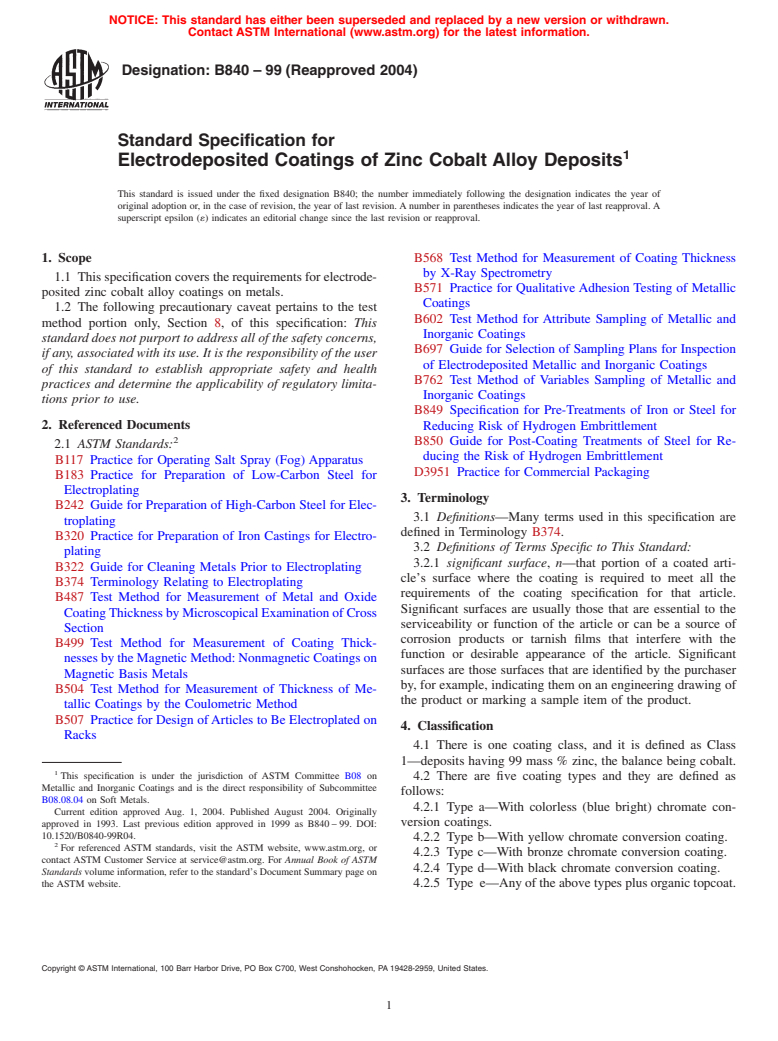
NOTICE: This standard has either been superseded and replaced by a new version or withdrawn.
Contact ASTM International (www.astm.org) for the latest information.
Designation: B840 – 99 (Reapproved 2004)
Standard Specification for
Electrodeposited Coatings of Zinc Cobalt Alloy Deposits
This standard is issued under the fixed designation B840; the number immediately following the designation indicates the year of
original adoption or, in the case of revision, the year of last revision. A number in parentheses indicates the year of last reapproval. A
superscript epsilon (´) indicates an editorial change since the last revision or reapproval.
1. Scope B568 Test Method for Measurement of Coating Thickness
by X-Ray Spectrometry
1.1 This specification covers the requirements for electrode-
B571 Practice for Qualitative Adhesion Testing of Metallic
posited zinc cobalt alloy coatings on metals.
Coatings
1.2 The following precautionary caveat pertains to the test
B602 Test Method for Attribute Sampling of Metallic and
method portion only, Section 8, of this specification: This
Inorganic Coatings
standard does not purport to address all of the safety concerns,
B697 Guide for Selection of Sampling Plans for Inspection
if any, associated with its use. It is the responsibility of the user
of Electrodeposited Metallic and Inorganic Coatings
of this standard to establish appropriate safety and health
B762 Test Method of Variables Sampling of Metallic and
practices and determine the applicability of regulatory limita-
Inorganic Coatings
tions prior to use.
B849 Specification for Pre-Treatments of Iron or Steel for
2. Referenced Documents Reducing Risk of Hydrogen Embrittlement
B850 Guide for Post-Coating Treatments of Steel for Re-
2.1 ASTM Standards:
ducing the Risk of Hydrogen Embrittlement
B117 Practice for Operating Salt Spray (Fog) Apparatus
D3951 Practice for Commercial Packaging
B183 Practice for Preparation of Low-Carbon Steel for
Electroplating
3. Terminology
B242 Guide for Preparation of High-Carbon Steel for Elec-
3.1 Definitions—Many terms used in this specification are
troplating
defined in Terminology B374.
B320 Practice for Preparation of Iron Castings for Electro-
3.2 Definitions of Terms Specific to This Standard:
plating
3.2.1 significant surface, n—that portion of a coated arti-
B322 Guide for Cleaning Metals Prior to Electroplating
cle’s surface where the coating is required to meet all the
B374 Terminology Relating to Electroplating
requirements of the coating specification for that article.
B487 Test Method for Measurement of Metal and Oxide
Significant surfaces are usually those that are essential to the
CoatingThicknessbyMicroscopicalExaminationofCross
serviceability or function of the article or can be a source of
Section
corrosion products or tarnish films that interfere with the
B499 Test Method for Measurement of Coating Thick-
function or desirable appearance of the article. Significant
nessesbytheMagneticMethod:NonmagneticCoatingson
surfaces are those surfaces that are identified by the purchaser
Magnetic Basis Metals
by, for example, indicating them on an engineering drawing of
B504 Test Method for Measurement of Thickness of Me-
the product or marking a sample item of the product.
tallic Coatings by the Coulometric Method
B507 Practice for Design ofArticles to Be Electroplated on
4. Classification
Racks
4.1 There is one coating class, and it is defined as Class
1—deposits having 99 mass % zinc, the balance being cobalt.
This specification is under the jurisdiction of ASTM Committee B08 on 4.2 There are five coating types and they are defined as
Metallic and Inorganic Coatings and is the direct responsibility of Subcommittee
follows:
B08.08.04 on Soft Metals.
4.2.1 Type a—With colorless (blue bright) chromate con-
Current edition approved Aug. 1, 2004. Published August 2004. Originally
version coatings.
approved in 1993. Last previous edition approved in 1999 as B840 – 99. DOI:
10.1520/B0840-99R04.
4.2.2 Type b—With yellow chromate conversion coating.
For referenced ASTM standards, visit the ASTM website, www.astm.org, or
4.2.3 Type c—With bronze chromate conversion coating.
contact ASTM Customer Service at service@astm.org. For Annual Book of ASTM
4.2.4 Type d—With black chromate conversion coating.
Standards volume information, refer to the standard’s Document Summary page on
the ASTM website. 4.2.5 Type e—Any of the above types plus organic topcoat.
Copyright © ASTM International, 100 Barr Harbor Drive, PO Box C700, West Conshohocken, PA 19428-2959, United States.
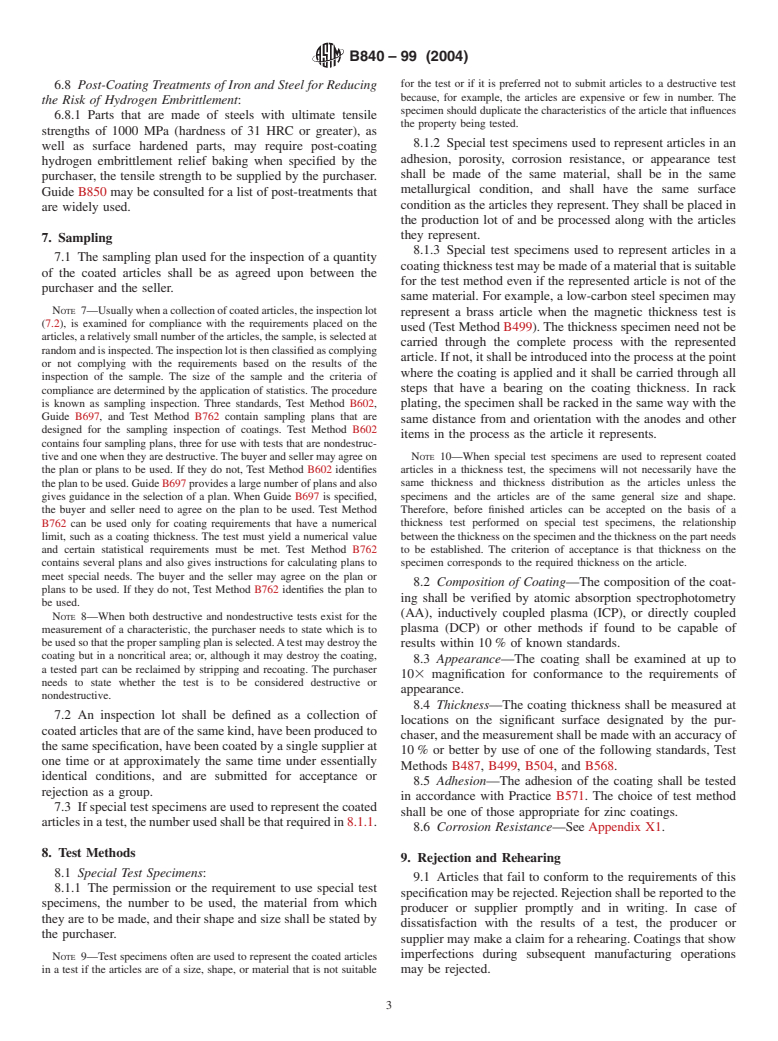
B840 – 99 (2004)
NOTE 1—Whereas colored chromate conversion coatings are usually
6.3 Appearance:
meant to include various shades of yellow to bronze when used with
6.3.1 The coating on all readily visible surfaces shall have
non-alloyed zinc, yellow and bronze chromate conversion coatings are
an acceptable and characteristic appearance as agreed upon by
considered distinctly different when applied to alloyed zinc coatings and
the purchaser and seller. The coating shall be uniform insofar
are formulated specifically to produce the desired coating.
as the basis metal will permit. When the article is to be plated
4.3 There are three grades according to thickness and are
on a rack, contact marks may be unavoidable. Location of such
defined as follows:
mark(s) shall be indicated on the article or its drawing.
Minimum Thickness, µm New ASTM Grade Old ASTM Grade
6.3.2 Defects and variations in appearance that arise from
66 1
surfaceconditionsofthesubstrate(scratches,pores,rollmarks,
12 12 2
18 18 3 inclusions, and the like) and that persist in the coating despite
the observance of good metal finishing practices, shall not be
5. Ordering Information
cause for rejection. The coating shall be adherent, free from
5.1 In order to make the application of this specification
blisters, pits, or discontinuities, and shall be free of cracks in
complete, the purchaser needs to supply the following infor-
the as plated state. Flaking shall be cause for rejection in either
mation to the seller in the purchase order and drawings.
the as plated state or after subsequent operations.
5.1.1 Title,ASTM designation number, and date of issue of
NOTE 3—These coatings are commonly used in automotive applica-
this specification.
tions where subsequent forming, bending, and crimping operations are
5.1.2 Deposit by classification including class, type, and
commonly performed. These operations will necessarily detract from the
grade (see 4.1, 4.2, 4.3).
performance of the coatings. While some cracking of coatings will be
5.1.3 Composition and metallurgical condition of the sub- unavoidable, flaking of the coatings after these subsequent operations
shall be cause for rejection.
strate to be coated.
NOTE 4—Coatings generally perform better in service when the sub-
5.1.4 Location of significant surfaces (3.2.1).
strate over which they are applied is smooth and free of torn metal,
5.1.5 Heat treatment for stress relief, whether it has been
inclusions, pores, and other defects. The specifications covering the
performed by purchaser or is required (6.7).
unfinishedproductshouldprovidelimitsforthesedefects.Ametalfinisher
5.1.6 Heat treatment after electroplating, if required (6.8).
can often remove defects through special treatments, such as grinding,
5.1.7 Whether or not location of rack marks is to be defined
polishing, abrasive blasting, chemical etches, and electropolishing. How-
(6.3.1).
ever, these are not normal in the treatment steps preceding the application
5.1.8 Any requirement for special test specimens (8.1.1). of the coating. When they are desired, they are the subject of special
agreement between the purchaser and the seller.
5.1.9 Acceptance inspection procedure to be used (Section
7).
6.4 Thickness—The thickness of the coating everywhere on
5.1.10 Any requirement for certification (Section 10).
the significant surfaces as defined in 3.2.1 and shall conform to
5.1.11 Anyotheritemsneedingagreement.Forthepurposes
the requirements of the specified grade as defined in 4.3.
of this specification, prior agreement on the nature of the finish
NOTE 5—The thickness of electrodeposited coatings varies from point
is required as items plated in bulk may differ in appearance
to point on the surfaces of a product (see Practice B507). The thickness is
from those that are rack plated.
less in interior corners and in holes. Such surfaces are often exempt from
thickness requirements. If the full thickness is required in those locations,
6. Coating Requirements
the electroplater will have to use special techniques that will probably
6.1 Substrate—The metal to be plated shall be free of flaws
raise the cost of the process.
and defects that will be detrimental to the zinc alloy coating. It
NOTE 6—The coating requirement of this specification is a minimum.
shallbesubjectedtosuchcleaning,pickling,andelectroplating Variationinthethicknessfrompointtopointonanarticleandfromarticle
to article in a production lot is inherent in electroplating. Therefore, if all
procedures as are necessary to yield deposits with the desired
ofthearticlesinaproductionlotaretomeetthethicknessrequirement,the
quality.
average coating thickness for the production lot as a whole will be greater
NOTE 2—Proper preparatory procedures and thorough cleaning are
than the specified minimum.
essential to ensure satisfactory adhesion and corrosion resistance perfor-
6.5 Adhesion—Thecoatingshallwithstandnormalhandling
mance of the coating. Materials used for cleaning should not damage the
and storage conditions without chipping, flaking, or other
basis metal, for example, by causing defects such as pits, intergranular
attack, or stress corrosion cracking. It is recommended that the following coating damage and shall conform to the minimum require-
ASTM practices for cleaning, where appropriate, be used: Practices B183,
ments set forth in Section 8.
B320, and B322 and Guide B242.
6.6 Corrosion Resistance—The corrosion resistance of the
6.1.1 Theelectroplatingshallbeappliedafterallbasismetal coating may be evaluated using the method in Appendix X1.
heat treatments have been completed. 6.7 Pretreatment of Iron and Steel for Reducing the Risk of
6.2 Nature of Coating: Hydrogen Embrittlement:
6.2.1 The coating shall consist of a zinc cobal
...
Questions, Comments and Discussion
Ask us and Technical Secretary will try to provide an answer. You can facilitate discussion about the standard in here.