

ASTM C1799/C1799M-22e1
(Guide)Standard Guide to Dimension Stone Test Specimen Sampling and Preparation
General Information
- Abstract
SIGNIFICANCE AND USE
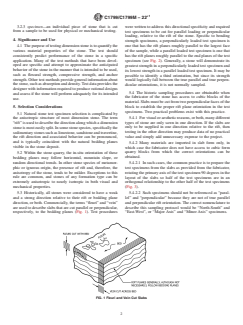
4.1 The purpose of testing dimension stone is to quantify the various material properties of the stone. The test should consistently predict performance of the stone in a specific application. Many of the test methods that have been developed are specific and attempt to approximate the anticipated behavior of the stone in the manner that is intended to be used, such as flexural strength, compressive strength, and anchor strength. Other test methods provide general information about the stone, such as absorption and density. Test data provides the designer with information required to produce rational designs and assess if the stone will perform adequately for its intended use.
SCOPE
1.1 This guide covers sampling, selection, preparation, and conditioning of specimens that will be used to test material properties of dimension stone.
1.2 This guide sets forth basic recommendations for sampling and preparation of dimension stone test specimens and provides information regarding variables that should be considered.
1.3 This guide is intended to be used by architects, engineers, contractors and material suppliers who design, select, specify, install, purchase, fabricate, finish, or test natural stone products for construction applications.
1.4 The values stated in either SI units or inch-pound units are to be regarded separately as standard. The values stated in each system are not necessarily exact equivalents; therefore, to ensure conformance with the standard, each system shall be used independently of the other, and values from the two systems shall not be combined.
1.5 This standard does not purport to address all of the safety concerns, if any, associated with its use. It is the responsibility of the user of this standard to establish appropriate safety, health, and environmental practices and determine the applicability of regulatory limitations prior to use.
1.6 This international standard was developed in accordance with internationally recognized principles on standardization established in the Decision on Principles for the Development of International Standards, Guides and Recommendations issued by the World Trade Organization Technical Barriers to Trade (TBT) Committee.
- Status
- Published
- Publication Date
- 14-May-2022
- Technical Committee
- C18 - Dimension Stone
- Drafting Committee
- C18.08 - Selection of Dimension Stone
Overview
ASTM C1799/C1799M-22e1: Standard Guide to Dimension Stone Test Specimen Sampling and Preparation sets forth basic recommendations for the sampling, selection, preparation, and conditioning of dimension stone specimens to be used in testing material properties. Developed by ASTM, this international standard serves as a key reference for professionals involved in the design, selection, specification, installation, or testing of natural stone in construction applications. It ensures test results are relevant, reproducible, and directly related to real-world performance needs.
Dimension stones are inherently variable materials due to their natural origin. As such, proper specimen sampling and preparation are critical for obtaining reliable test data. Such data are foundational in building rational designs and verifying if a stone's properties meet the intended use.
Key Topics
- Purpose of Testing: Testing dimension stone quantifies material properties such as flexural strength, compressive strength, absorption, and density. These data points aid designers and engineers in predicting performance across specific applications.
- Sampling Recommendations: The standard discusses methods for selecting samples that represent the average grade and quality supplied to the market. It also addresses the complications posed by stone anisotropy and rift orientation.
- Preparation of Specimens: Guidelines specify how test specimens should be sawn, finished, and marked to ensure consistency, including details on right-angle cuts and surface finishes.
- Conditioning Protocols: Procedures for preparing specimens under dry and wet conditions are included to mimic various service environments. Conditioning typically involves fixed drying and immersion periods.
- Reporting Requirements: Clear instructions are provided for documenting specimen source, preconditioning, test procedures, and results, supporting transparency and traceability.
Applications
ASTM C1799/C1799M-22e1 provides significant practical value across the dimension stone industry:
- Architects and Engineers: Use the guide to specify stone testing requirements and interpret test data when designing assemblies requiring natural stone.
- Contractors and Fabricators: Reference the standard for sampling and sample preparation to ensure that material supplied aligns with project specifications.
- Material Suppliers: Rely on these guidelines to prepare compliant test specimens, supporting sales, quality assurance, and compliance documentation.
- Testing Agencies: Apply standardized specimen preparation and conditioning methods, ensuring test validity and reproducibility.
The standard is also essential for projects where stone properties must be verified according to both SI and inch-pound units, providing international applicability.
Related Standards
Many key ASTM standards complement C1799/C1799M-22e1, including:
- ASTM C97 - Absorption and Bulk Specific Gravity of Dimension Stone
- ASTM C99 - Modulus of Rupture of Dimension Stone
- ASTM C170 - Compressive Strength of Dimension Stone
- ASTM C119 - Terminology Relating to Dimension Stone
- ASTM C880 - Flexural Strength of Dimension Stone
- ASTM C120, C121, C217, C241, C1352, C1353 - Additional testing methods covering a range of mechanical and physical properties
These related standards, when used in conjunction with ASTM C1799/C1799M-22e1, ensure a comprehensive approach to dimension stone evaluation.
Conclusion
Adhering to ASTM C1799/C1799M-22e1 enables industry stakeholders to produce and interpret reliable dimension stone test data. By establishing clear procedures for sampling and specimen preparation, the standard supports better project outcomes and reduces risk in stone specification and performance assessment.
Keywords: dimension stone, sampling, specimen preparation, ASTM C1799, stone testing, flexural strength, compressive strength, rift orientation, architectural stone, construction standards.
Relations
- Effective Date
- 01-May-2019
- Effective Date
- 01-May-2016
- Effective Date
- 01-Dec-2014
- Effective Date
- 01-Dec-2014
- Effective Date
- 15-Jun-2011
- Effective Date
- 01-Sep-2009
- Effective Date
- 01-Nov-2008
- Effective Date
- 01-Nov-2008
- Effective Date
- 01-Oct-2008
- Refers
ASTM C1352-96(2008) - Standard Test Method for Flexural Modulus of Elasticity of Dimension Stone - Effective Date
- 01-Oct-2008
- Effective Date
- 01-Feb-2008
- Effective Date
- 01-Feb-2008
- Effective Date
- 01-Feb-2008
- Effective Date
- 01-Feb-2008
- Effective Date
- 01-Aug-2007
Get Certified
Connect with accredited certification bodies for this standard

DIBt (Deutsches Institut für Bautechnik)
German Institute for Building Technology.
DIN CERTCO
DIN Group product certification.

Aboma Certification B.V.
Specialized in construction, metal, and transport sectors.
Sponsored listings
Frequently Asked Questions
ASTM C1799/C1799M-22e1 is a guide published by ASTM International. Its full title is "Standard Guide to Dimension Stone Test Specimen Sampling and Preparation". This standard covers: SIGNIFICANCE AND USE 4.1 The purpose of testing dimension stone is to quantify the various material properties of the stone. The test should consistently predict performance of the stone in a specific application. Many of the test methods that have been developed are specific and attempt to approximate the anticipated behavior of the stone in the manner that is intended to be used, such as flexural strength, compressive strength, and anchor strength. Other test methods provide general information about the stone, such as absorption and density. Test data provides the designer with information required to produce rational designs and assess if the stone will perform adequately for its intended use. SCOPE 1.1 This guide covers sampling, selection, preparation, and conditioning of specimens that will be used to test material properties of dimension stone. 1.2 This guide sets forth basic recommendations for sampling and preparation of dimension stone test specimens and provides information regarding variables that should be considered. 1.3 This guide is intended to be used by architects, engineers, contractors and material suppliers who design, select, specify, install, purchase, fabricate, finish, or test natural stone products for construction applications. 1.4 The values stated in either SI units or inch-pound units are to be regarded separately as standard. The values stated in each system are not necessarily exact equivalents; therefore, to ensure conformance with the standard, each system shall be used independently of the other, and values from the two systems shall not be combined. 1.5 This standard does not purport to address all of the safety concerns, if any, associated with its use. It is the responsibility of the user of this standard to establish appropriate safety, health, and environmental practices and determine the applicability of regulatory limitations prior to use. 1.6 This international standard was developed in accordance with internationally recognized principles on standardization established in the Decision on Principles for the Development of International Standards, Guides and Recommendations issued by the World Trade Organization Technical Barriers to Trade (TBT) Committee.
SIGNIFICANCE AND USE 4.1 The purpose of testing dimension stone is to quantify the various material properties of the stone. The test should consistently predict performance of the stone in a specific application. Many of the test methods that have been developed are specific and attempt to approximate the anticipated behavior of the stone in the manner that is intended to be used, such as flexural strength, compressive strength, and anchor strength. Other test methods provide general information about the stone, such as absorption and density. Test data provides the designer with information required to produce rational designs and assess if the stone will perform adequately for its intended use. SCOPE 1.1 This guide covers sampling, selection, preparation, and conditioning of specimens that will be used to test material properties of dimension stone. 1.2 This guide sets forth basic recommendations for sampling and preparation of dimension stone test specimens and provides information regarding variables that should be considered. 1.3 This guide is intended to be used by architects, engineers, contractors and material suppliers who design, select, specify, install, purchase, fabricate, finish, or test natural stone products for construction applications. 1.4 The values stated in either SI units or inch-pound units are to be regarded separately as standard. The values stated in each system are not necessarily exact equivalents; therefore, to ensure conformance with the standard, each system shall be used independently of the other, and values from the two systems shall not be combined. 1.5 This standard does not purport to address all of the safety concerns, if any, associated with its use. It is the responsibility of the user of this standard to establish appropriate safety, health, and environmental practices and determine the applicability of regulatory limitations prior to use. 1.6 This international standard was developed in accordance with internationally recognized principles on standardization established in the Decision on Principles for the Development of International Standards, Guides and Recommendations issued by the World Trade Organization Technical Barriers to Trade (TBT) Committee.
ASTM C1799/C1799M-22e1 is classified under the following ICS (International Classification for Standards) categories: 91.100.15 - Mineral materials and products. The ICS classification helps identify the subject area and facilitates finding related standards.
ASTM C1799/C1799M-22e1 has the following relationships with other standards: It is inter standard links to ASTM C119-19, ASTM C119-16, ASTM C119-14, ASTM C119-14e1, ASTM C119-11, ASTM C1353-09, ASTM C99-08, ASTM C1353-08, ASTM C97-02(2008), ASTM C1352-96(2008), ASTM C119-08, ASTM C119-08e3, ASTM C119-08e1, ASTM C119-08e2, ASTM C119-07a. Understanding these relationships helps ensure you are using the most current and applicable version of the standard.
ASTM C1799/C1799M-22e1 is available in PDF format for immediate download after purchase. The document can be added to your cart and obtained through the secure checkout process. Digital delivery ensures instant access to the complete standard document.
Standards Content (Sample)
This international standard was developed in accordance with internationally recognized principles on standardization established in the Decision on Principles for the
Development of International Standards, Guides and Recommendations issued by the World Trade Organization Technical Barriers to Trade (TBT) Committee.
´1
Designation: C1799/C1799M − 22
Standard Guide to
Dimension Stone Test Specimen Sampling and Preparation
This standard is issued under the fixed designation C1799/C1799M; the number immediately following the designation indicates the
year of original adoption or, in the case of revision, the year of last revision. A number in parentheses indicates the year of last
reapproval. A superscript epsilon (´) indicates an editorial change since the last revision or reapproval.
ε NOTE—The language in 8.1.2, 8.3, and 8.4 was updated editorially to be consistent with other sections in October
2022.
INTRODUCTION
Dimension stones are products of nature, and as such, are subject to the variability and
unpredictability that is associated with all products harvested in nature. Testing of dimension stones
to generate reliable data on which engineering decisions can be based has been a standard procedure
in the industry for decades. The reliability of the data produced is largely influenced by the care and
protocol used in obtaining and preparing the stone test specimens.
1. Scope Development of International Standards, Guides and Recom-
mendations issued by the World Trade Organization Technical
1.1 This guide covers sampling, selection, preparation, and
Barriers to Trade (TBT) Committee.
conditioning of specimens that will be used to test material
properties of dimension stone.
2. Referenced Documents
1.2 This guide sets forth basic recommendations for sam-
2.1 ASTM Standards:
pling and preparation of dimension stone test specimens and
C97 Test Methods forAbsorption and Bulk Specific Gravity
provides information regarding variables that should be con-
of Dimension Stone
sidered.
C99 Test Method for Modulus of Rupture of Dimension
1.3 This guide is intended to be used by architects,
Stone
engineers, contractors and material suppliers who design,
C119 Terminology Relating to Dimension Stone
select, specify, install, purchase, fabricate, finish, or test natural
C120 Test Methods for Flexure Testing of Structural and
stone products for construction applications.
Roofing Slate
C121 Test Method for Water Absorption of Slate
1.4 The values stated in either SI units or inch-pound units
C170 Test Method for Compressive Strength of Dimension
are to be regarded separately as standard. The values stated in
Stone
each system are not necessarily exact equivalents; therefore, to
C217 Test Methods for Weather Resistance of Slate
ensure conformance with the standard, each system shall be
C241 Test Method for Abrasion Resistance of Stone Sub-
used independently of the other, and values from the two
jected to Foot Traffic
systems shall not be combined.
C880 Test Method for Flexural Strength of Dimension Stone
1.5 This standard does not purport to address all of the
C1352 Test Method for Flexural Modulus of Elasticity of
safety concerns, if any, associated with its use. It is the
Dimension Stone
responsibility of the user of this standard to establish appro-
C1353 Test Method for Abrasion Resistance of Dimension
priate safety, health, and environmental practices and deter-
Stone Subjected to Foot Traffic Using a Rotary Platform
mine the applicability of regulatory limitations prior to use.
Abraser
1.6 This international standard was developed in accor-
dance with internationally recognized principles on standard-
3. Terminology
ization established in the Decision on Principles for the
3.1 Refer to Terminology C119.
3.2 Definitions:
This guide is under the jurisdiction of ASTM Committee C18 on Dimension
3.2.1 sample—a small part or quantity of stone, usually a
Stone and is the direct responsibility of Subcommittee C18.08 on Selection of
Dimension Stone.
slab, panel, or ashlar, that is cut from a larger block of stone.
Current edition approved May 15, 2022. Published June 2022. Originally
3.2.2 specifying authority—party requiring testing of di-
approved in 2014. Last previous edition approved in 2019 as C1799/C1799M-19.
DOI: 10.1520/C1799_C1799M-22E01. mension stone material.
Copyright © ASTM International, 100 Barr Harbor Drive, PO Box C700, West Conshohocken, PA 19428-2959. United States
´1
C1799/C1799M − 22
3.2.3 specimen—an individual piece of stone that is cut were written to address this directional specificity and required
from a sample to be used for physical or mechanical testing. test specimens to be cut for parallel loading or perpendicular
loading, relative to the rift of the stone. Specific to bending
4. Significance and Use
strength specimens, a perpendicularly loaded test specimen is
4.1 Thepurposeoftestingdimensionstoneistoquantifythe one that has the rift planes roughly parallel to the largest face
various material properties of the stone. The test should of the sample, while a parallel loaded test specimen is one that
consistently predict performance of the stone in a specific
has the rift planes roughly parallel to the end planes of the test
application. Many of the test methods that have been devel-
specimen (see Fig. 2). Generally, a stone will demonstrate its
oped are specific and attempt to approximate the anticipated
greatest strength in a perpendicularly loaded test specimen and
behavior of the stone in the manner that is intended to be used,
its lowest strength in a parallel loaded test specimen. It may be
such as flexural strength, compressive strength, and anchor
possible to identify a third orientation, but since its strength
strength. Other test methods provide general information about
would logically fall between the true parallel and true perpen-
thestone,suchasabsorptionanddensity.Testdataprovidesthe
dicular orientations, it is not normally sampled.
designer with information required to produce rational designs
5.4 The historic sampling procedures are obtainable when
and assess if the stone will perform adequately for its intended
the fabricator of the stone has access to cubic blocks of the
use.
material. Slabs must be cut from two perpendicular faces of the
5. Selection Considerations block to establish the proper rift plane orientation in the test
specimens. Two practical problems exist with this practice.
5.1 Natural stone test specimen selection is complicated by
5.4.1 For visual or aesthetic reasons, or both, many different
the anisotropic structure of most dimension stone. The term
types of stone are only sawn in one direction. If the slabs are
“rift” is used to describe the direction along which a dimension
only to be supplied in one direction relative to the rift, then
stoneismosteasilysplit.Insomestonespecies,specificallythe
testing in the other direction may produce data of no practical
sedimentarystonessuchaslimestone,sandstoneandtravertine,
value and simply add unnecessary expense to the project.
the rift direction and associated behavior can be pronounced,
and is typically coincident with the natural bedding planes
5.4.2 Many materials are imported in slab form only, in
visible in the stone deposit.
which case the fabricator does not have access to cubic form
quarry blocks from which the correct orientations can be
5.2 Within the stone quarry, the in-situ orientation of these
obtained.
bedding planes may follow horizontal, mountain slope, or
random directional trends. In other stone species of metamor- 5.4.2.1 In such cases, the common practice is to prepare the
phic or igneous origin, the presence of rift and, therefore, the
test specimens from the slabs as provided from the fabricator,
anisotropy of the stone, tends to be milder. Exceptions to this rotating the primary axis of the test specimen 90 degrees in the
rule are common, and stones of any formation type can be
layout of the slabs so half of the test specimens are in an
extremely anisotropic to nearly isotropic in both visual and
orthogonal relationship to the other half of the test specimens
mechanical properties.
(Fig. 3).
5.4.2.2 Such specimens should not be referenced as “paral-
5.3 Historically, all stones were considered to have a weak
and a strong direction relative to their rift or bedding plane lel” and “perpendicular” because they are not of true parallel
and perpendicular rift orientation. The correct nomenclature to
direction, or both. Commercially, the terms “fleuri” and “vein”
are used to describe slabs that are cut parallel or perpendicular, describe this sampling protocol would be “North-South” and
respectively, to the bedding planes (Fig. 1). Test procedures “East-West”, or “Major Axis” and “Minor Axis” specimens.
FIG. 1 Fleuri and Vein Cut Slabs
´1
C1799/C1799M − 22
FIG. 2 True Parallel and Perpendicular Rift Orientation
FIG. 3 Orthogonal Layout of Test Specimens
5.4.2.3 For slabs that are exclusively vein cut, flexural 7.2 The sides of the specimen should be at right angles with
strength testing may produce results that demonstrate the effect respect to the top and bottom surfaces.
of directionality on specimens oriented orthogonally to each
7.3 The planes of the specimen perpendicular to the load
other.
should have a fine abrasive finish and the sides of the specimen
6. Sampling should have sawn finishes. Unless noted otherwise by the test
standard, rough surfaces perpendicular to the load should be
6.1 Samples should be selected to represent a true average
lapped with a No. 80 abrasive.
of the grade of stone under consideration and of the quality
supplied to the market under the type designation to be tested.
7.4 The load-bearing surfaces and the direction of bedding
The sample may be selected by the purchaser or his authorized
(or rift) should be marked on each specimen after preparation.
representativefromthequarriedstoneortakenfromthenatural
ledge. Samples should be of adequate size to permit prepara-
8. Conditioning
tion of the desired number of test specimens. Samples taken
8.1 Conditioning of test specimens is standardized through-
from a single slab should be discouraged. When perceptible
out the dimension stone test standards. As is the case with
variations occur, the purchaser may select as many samples as
directionality, performing tests o
...