

ASTM D5280-96(2021)
(Practice)Standard Practice for Evaluation of Performance Characteristics of Air Quality Measurement Methods with Linear Calibration Functions
General Information
- Abstract
ABSTRACT
This practice covers procedures for evaluating the performance characteristics of air quality measurement methods with linear calibration functions. The steps involved in the measurement method used shall be described, and the performance characteristics to be evaluated shall be specified and tested under explicitly specified conditions. The performance characteristics for evaluation include bias, calibration function and linearity, instability, lower detection limit, period of unattended operation, selectivity, sensitivity, and upper limit of measurement.
SCOPE
1.1 This practice2 covers procedures for evaluating the following performance characteristics of air quality measurement methods: bias (in part only), calibration function and linearity, instability, lower detection limit, period of unattended operation, selectivity, sensitivity, and upper limit of measurement.
1.2 The procedures presented in this practice are applicable only to air quality measurement methods with linear continuous calibration functions, and the output variable of which is a defined time average. The linearity may be due to postprocessing of the primary output variable. Additionally, replicate values belonging to the same input state are assumed to be normally distributed. Components required to transform the primary measurement method output into the time averages desired are regarded as an integral part of this measurement method.
1.3 For surveillance of measurement method stability under routine measurement conditions, it may suffice to check the essential performance characteristics using simplified tests, the degree of simplification acceptable being dependent on the knowledge on the invariance properties of the performance characteristics previously gained by the procedures presented here.
1.4 There is no fundamental difference between the instrumental (automatic) and the manual (for example, wet-chemical) procedures, as long as the measured value is an average representative for a predefined time interval. Therefore, the procedures presented are applicable to both. Furthermore, they are applicable to measurement methods for ambient, workplace, and indoor atmospheres, as well as emissions.
1.5 This standard does not purport to address all of the safety concerns, if any, associated with its use. It is the responsibility of the user of this standard to establish appropriate safety, health, and environmental practices and determine the applicability of regulatory limitations prior to use.
1.6 This international standard was developed in accordance with internationally recognized principles on standardization established in the Decision on Principles for the Development of International Standards, Guides and Recommendations issued by the World Trade Organization Technical Barriers to Trade (TBT) Committee.
- Status
- Published
- Publication Date
- 31-Aug-2021
- Technical Committee
- D22 - Air Quality
- Drafting Committee
- D22.03 - Ambient Atmospheres and Source Emissions
Overview
ASTM D5280-96(2021) - Standard Practice for Evaluation of Performance Characteristics of Air Quality Measurement Methods with Linear Calibration Functions outlines comprehensive procedures for assessing the efficacy and accuracy of air quality measurement methods that utilize linear calibration functions. Developed by ASTM Committee D22 on Air Quality, this international standard provides a systematic framework for evaluating critical performance characteristics-such as bias, calibration linearity, sensitivity, selectivity, detection limits, and operational stability-under defined and controlled test conditions.
Following internationally recognized principles laid out by the World Trade Organization's TBT Committee, this standard applies to both instrumental (automatic) and manual (e.g., wet-chemical) air quality measurement methods, covering applications in ambient, workplace, indoor atmospheres, and emissions monitoring.
Key Topics
Performance Characteristics
The standard prescribes evaluation for the following:- Bias (partial)
- Calibration function and linearity
- Instability (including drift and dispersion)
- Lower detection limit (LDL)
- Period of unattended operation
- Selectivity
- Sensitivity
- Upper limit of measurement
Applicable Methods
The assessment methods are strictly for air quality measurement techniques with linear, continuous calibration functions, where outputs are defined as time-averaged values.Testing Parameters and Conditions
- Replicate measurements must be normally distributed.
- Components involved in deriving time-averaged results are considered part of the measurement method.
- Both simplified and in-depth evaluation procedures can be adopted, based on prior knowledge and measurement system stability.
- Testing applies across manual and instrumental methods, provided the results are time-representative.
Statistical and Functional Analysis
Includes procedures for:- Calculating repeatability and reproducibility
- Quantifying measurement uncertainty
- Testing for outliers using Grubbs’ test
- Assessing linearity with F-distribution approaches
Operational Assessments
- Determining warm-up or run-up times
- Evaluating the period of unattended operation, ensuring measurement stability without external intervention
Applications
ASTM D5280-96(2021) is widely used in laboratories, environmental monitoring agencies, industrial hygiene, workplace safety, and regulatory bodies for standardizing the evaluation of measurement systems that monitor air quality. Its practical value includes:
- Verification and Validation: Assuring that air quality measurement methods meet required precision and accuracy, critical for credible environmental assessments and compliance reporting.
- Instrument Qualification: Providing a tested framework for manufacturers and calibration labs to demonstrate that new instruments or procedures meet analytical performance standards.
- Routine Performance Checking: Facilitating ongoing surveillance and quality control of monitoring systems, both for ambient and emission sources.
- Comparability: Enabling harmonized results across different measurement methods and locations by normalizing data to standardized intervals and procedures.
- Method Development: Supporting the development, optimization, and documentation of new or improved air monitoring methods.
Related Standards
For enhanced implementation and integration of ASTM D5280-96(2021), users may consider referencing the following related standards:
- ASTM D1356 – Terminology Relating to Sampling and Analysis of Atmospheres
- ASTM E177 – Practice for Use of the Terms Precision and Bias in ASTM Test Methods
- ASTM E456 – Terminology Relating to Quality and Statistics
- ISO 6879:1983 – Air Quality – Performance Characteristics and Related Concepts for Air Quality Measuring Methods
By aligning with these related standards, users ensure consistency in terminologies, methodologies, and statistical approaches essential to air quality measurement and evaluation practices.
Keywords: air quality measurement, linear calibration functions, performance characteristics, ASTM D5280, bias, selectivity, sensitivity, detection limits, method evaluation, environmental monitoring, measurement linearity, precision, reproducibility, unattended operation.
Relations
- Effective Date
- 01-Apr-2022
- Effective Date
- 01-Sep-2020
- Effective Date
- 15-Mar-2020
- Effective Date
- 01-Oct-2017
- Effective Date
- 01-Oct-2017
- Effective Date
- 15-Oct-2015
- Effective Date
- 01-Jul-2015
- Effective Date
- 01-Dec-2014
- Effective Date
- 01-May-2014
- Effective Date
- 01-May-2014
- Effective Date
- 15-Jan-2014
- Effective Date
- 15-Nov-2013
- Effective Date
- 15-Nov-2013
- Effective Date
- 15-Nov-2013
- Effective Date
- 15-Nov-2013
Get Certified
Connect with accredited certification bodies for this standard

CIS Institut d.o.o.
Personal Protective Equipment (PPE) certification body. Notified Body NB-2890 for EU Regulation 2016/425 PPE.

Kiwa BDA Testing
Building and construction product certification.
Kmetijski inštitut Slovenije
Agricultural Institute of Slovenia. Soil testing, plant health, agricultural product analysis.
Sponsored listings
Frequently Asked Questions
ASTM D5280-96(2021) is a standard published by ASTM International. Its full title is "Standard Practice for Evaluation of Performance Characteristics of Air Quality Measurement Methods with Linear Calibration Functions". This standard covers: ABSTRACT This practice covers procedures for evaluating the performance characteristics of air quality measurement methods with linear calibration functions. The steps involved in the measurement method used shall be described, and the performance characteristics to be evaluated shall be specified and tested under explicitly specified conditions. The performance characteristics for evaluation include bias, calibration function and linearity, instability, lower detection limit, period of unattended operation, selectivity, sensitivity, and upper limit of measurement. SCOPE 1.1 This practice2 covers procedures for evaluating the following performance characteristics of air quality measurement methods: bias (in part only), calibration function and linearity, instability, lower detection limit, period of unattended operation, selectivity, sensitivity, and upper limit of measurement. 1.2 The procedures presented in this practice are applicable only to air quality measurement methods with linear continuous calibration functions, and the output variable of which is a defined time average. The linearity may be due to postprocessing of the primary output variable. Additionally, replicate values belonging to the same input state are assumed to be normally distributed. Components required to transform the primary measurement method output into the time averages desired are regarded as an integral part of this measurement method. 1.3 For surveillance of measurement method stability under routine measurement conditions, it may suffice to check the essential performance characteristics using simplified tests, the degree of simplification acceptable being dependent on the knowledge on the invariance properties of the performance characteristics previously gained by the procedures presented here. 1.4 There is no fundamental difference between the instrumental (automatic) and the manual (for example, wet-chemical) procedures, as long as the measured value is an average representative for a predefined time interval. Therefore, the procedures presented are applicable to both. Furthermore, they are applicable to measurement methods for ambient, workplace, and indoor atmospheres, as well as emissions. 1.5 This standard does not purport to address all of the safety concerns, if any, associated with its use. It is the responsibility of the user of this standard to establish appropriate safety, health, and environmental practices and determine the applicability of regulatory limitations prior to use. 1.6 This international standard was developed in accordance with internationally recognized principles on standardization established in the Decision on Principles for the Development of International Standards, Guides and Recommendations issued by the World Trade Organization Technical Barriers to Trade (TBT) Committee.
ABSTRACT This practice covers procedures for evaluating the performance characteristics of air quality measurement methods with linear calibration functions. The steps involved in the measurement method used shall be described, and the performance characteristics to be evaluated shall be specified and tested under explicitly specified conditions. The performance characteristics for evaluation include bias, calibration function and linearity, instability, lower detection limit, period of unattended operation, selectivity, sensitivity, and upper limit of measurement. SCOPE 1.1 This practice2 covers procedures for evaluating the following performance characteristics of air quality measurement methods: bias (in part only), calibration function and linearity, instability, lower detection limit, period of unattended operation, selectivity, sensitivity, and upper limit of measurement. 1.2 The procedures presented in this practice are applicable only to air quality measurement methods with linear continuous calibration functions, and the output variable of which is a defined time average. The linearity may be due to postprocessing of the primary output variable. Additionally, replicate values belonging to the same input state are assumed to be normally distributed. Components required to transform the primary measurement method output into the time averages desired are regarded as an integral part of this measurement method. 1.3 For surveillance of measurement method stability under routine measurement conditions, it may suffice to check the essential performance characteristics using simplified tests, the degree of simplification acceptable being dependent on the knowledge on the invariance properties of the performance characteristics previously gained by the procedures presented here. 1.4 There is no fundamental difference between the instrumental (automatic) and the manual (for example, wet-chemical) procedures, as long as the measured value is an average representative for a predefined time interval. Therefore, the procedures presented are applicable to both. Furthermore, they are applicable to measurement methods for ambient, workplace, and indoor atmospheres, as well as emissions. 1.5 This standard does not purport to address all of the safety concerns, if any, associated with its use. It is the responsibility of the user of this standard to establish appropriate safety, health, and environmental practices and determine the applicability of regulatory limitations prior to use. 1.6 This international standard was developed in accordance with internationally recognized principles on standardization established in the Decision on Principles for the Development of International Standards, Guides and Recommendations issued by the World Trade Organization Technical Barriers to Trade (TBT) Committee.
ASTM D5280-96(2021) is classified under the following ICS (International Classification for Standards) categories: 13.040.20 - Ambient atmospheres. The ICS classification helps identify the subject area and facilitates finding related standards.
ASTM D5280-96(2021) has the following relationships with other standards: It is inter standard links to ASTM E456-13a(2022)e1, ASTM D1356-20a, ASTM D1356-20, ASTM E456-13A(2017)e3, ASTM E456-13A(2017)e1, ASTM D1356-15a, ASTM D1356-15, ASTM D1356-14b, ASTM D1356-14a, ASTM E177-14, ASTM D1356-14, ASTM E456-13a, ASTM E456-13ae2, ASTM E456-13ae1, ASTM E456-13ae3. Understanding these relationships helps ensure you are using the most current and applicable version of the standard.
ASTM D5280-96(2021) is available in PDF format for immediate download after purchase. The document can be added to your cart and obtained through the secure checkout process. Digital delivery ensures instant access to the complete standard document.
Standards Content (Sample)
This international standard was developed in accordance with internationally recognized principles on standardization established in the Decision on Principles for the
Development of International Standards, Guides and Recommendations issued by the World Trade Organization Technical Barriers to Trade (TBT) Committee.
Designation: D5280 − 96 (Reapproved 2021)
Standard Practice for
Evaluation of Performance Characteristics of Air Quality
Measurement Methods with Linear Calibration Functions
This standard is issued under the fixed designation D5280; the number immediately following the designation indicates the year of
original adoption or, in the case of revision, the year of last revision.Anumber in parentheses indicates the year of last reapproval.A
superscript epsilon (´) indicates an editorial change since the last revision or reapproval.
1. Scope 1.5 This standard does not purport to address all of the
2 safety concerns, if any, associated with its use. It is the
1.1 This practice covers procedures for evaluating the
responsibility of the user of this standard to establish appro-
following performance characteristics of air quality measure-
priate safety, health, and environmental practices and deter-
ment methods: bias (in part only), calibration function and
mine the applicability of regulatory limitations prior to use.
linearity,instability,lowerdetectionlimit,periodofunattended
1.6 This international standard was developed in accor-
operation, selectivity, sensitivity, and upper limit of measure-
dance with internationally recognized principles on standard-
ment.
ization established in the Decision on Principles for the
1.2 The procedures presented in this practice are applicable
Development of International Standards, Guides and Recom-
only to air quality measurement methods with linear continu-
mendations issued by the World Trade Organization Technical
ous calibration functions, and the output variable of which is a
Barriers to Trade (TBT) Committee.
definedtimeaverage.Thelinearitymaybeduetopostprocess-
ing of the primary output variable. Additionally, replicate
2. Referenced Documents
values belonging to the same input state are assumed to be
2.1 ASTM Standards:
normally distributed. Components required to transform the
D1356Terminology Relating to Sampling and Analysis of
primary measurement method output into the time averages
Atmospheres
desired are regarded as an integral part of this measurement
E177Practice for Use of the Terms Precision and Bias in
method.
ASTM Test Methods
1.3 For surveillance of measurement method stability under
E456Terminology Relating to Quality and Statistics
routine measurement conditions, it may suffice to check the
2.2 ISO Standard:
essentialperformancecharacteristicsusingsimplifiedtests,the
ISO 6879:1983Air Quality—Performance Characteristics
degree of simplification acceptable being dependent on the
and Related Concepts for Air Quality Measuring Meth-
knowledge on the invariance properties of the performance
ods
characteristics previously gained by the procedures presented
here.
3. Terminology
1.4 There is no fundamental difference between the instru-
3.1 Definitions:
mental (automatic) and the manual (for example, wet-
3.1.1 For definitions of terms used in this practice, refer to
chemical) procedures, as long as the measured value is an
Terminology D1356.
average representative for a predefined time interval.
3.2 Definitions of Terms Specific to This Standard:
Therefore, the procedures presented are applicable to both.
NOTE 1—The statistical performance characteristics used throughout
Furthermore, they are applicable to measurement methods for
this practice are estimated, by convention, at the confidence level
ambient, workplace, and indoor atmospheres, as well as
1− α=0.95.
emissions.
3.2.1 averaging time, n—predefined time interval length for
which the air quality characteristic is made representative and
∆θ the averaging time.
ThispracticeisunderthejurisdictionofASTMCommitteeD22onAirQuality
and is the direct responsibility of Subcommittee D22.03 on Ambient Atmospheres
and Source Emissions.
Current edition approved Sept. 1, 2021. Published October 2021. Originally For referenced ASTM standards, visit the ASTM website, www.astm.org, or
approved in 1994. Last previous edition approved in 2013 as D5280–96 (2013). contact ASTM Customer Service at service@astm.org. For Annual Book of ASTM
DOI: 10.1520/D5280-96R21. Standards volume information, refer to the standard’s Document Summary page on
This practice was adapted from International Standard ISO/DP9169, prepared the ASTM website.
byISO/TC146/SC4/WG4,bythekindpermissionoftheChairmanofISO/TC146 Available from International Organization for Standardization (ISO), 1, ch. de
and the Secretariat of ISO/TC 146/SC 4. la Voie-Creuse, CP 56, CH-1211 Geneva 20, Switzerland, http://www.iso.org.
Copyright © ASTM International, 100 Barr Harbor Drive, PO Box C700, West Conshohocken, PA 19428-2959. United States
D5280 − 96 (2021)
3.2.1.1 Discussion—Every measured value obtained is rep- one successively without replacement until the population is
resentative for a defined interval of time, τ, the value of which exhausted, the numbers are said to be drawn in random order.
always lies above a certain minimum due to the intrinsic 3.2.7.1 Discussion—If these numbers have been associated
properties of the measuring procedure applied. In order to in advance with n distinct objects or n distinct operations that
attain mutual comparability of data pertaining to comparable are then rearranged in the order in which the numbers are
objects, a normalization to a common, predefined interval of drawn, the order of the objects or operations is said to be
time is necessary. randomized.
3.2.1.2 Discussion—By convention, this normalization is 3.2.8 reference conditions, n—a specified set of values
(including tolerances) of influence variables delivering repre-
achieved by transformation by means of a simple, linear, and
unweighted averaging process. sentative values of performance characteristics.
3.2.9 variance function, n—avarianceoftheoutputvariable
(a) Series of Discrete Samples:
as a function of the air quality characteristic observed.
cˆ θ ∆θ 5
~ !
?
3.2.10 warm-up time, n—the minimum waiting time for an
K
(1)
instrument to meet predefined values of its performance
cˆ~θ 1 ~k 21! τ τ!
( 0 ?
K
k51
characteristics after activating an instrument stabilized in a
where: nonoperating condition.
3.2.10.1 Discussion—In practice, the warm-up time can be
θ = θ− ∆θ, and
determined by using the performance characteristic that is
Kτ = ∆θ, τ << ∆θ
expected to require the longest interval of time.
(b) Continuous Time Series:
3.2.10.2 Discussion—In the case of the manual procedures,
cˆ θ ∆θ 5
~ !
? run-up time is used correspondingly.
1 θ (2)
dθcˆ θ τ 3.3 Symbols and Abbreviations:
* ~ !
?
∆θ θ
3.3.1 a ,a ,a —coefficientsofthevariancefunctionmodel.
0 1 2
In both cases (a and b), the original sample, described by
3.3.2 b,b —parameters of the estimate function for the
0 1
ĉ(t), is linked to a representative interval of time of length τ
calibration function.
whereas ĉ(∆θ), the result after application of the averaging
3.3.3 C—air quality characteristic.
process,ismaderepresentativefortheintervaloftime ∆θ(just
3.3.4 c—value of C.
preceding θ), the averaging time.
3.2.1.3 Discussion—Theaveragingtime,∆θ,isthereforethe 3.3.5 ĉ—measured value at c.
predefined and, by convention, common time interval length
3.3.6 c—value of C in the i-th sample; this sample may be
i
for which the measured variable ĉ is made representative in a
generated from reference material.
sensethatthesquaredeviationoftheoriginalvalues,attributed
3.3.7 c —normalizationfactorforairqualitycharacteristics;
to time interval lengths τ << ∆θ from ĉ over ∆θ is a minimum.
in this case | c |=1.
3.2.1.4 Discussion—The averaging process can alterna-
3.3.8 ∆c —inaccuracy of C at c.
tively be realized by means of a special sampling technique 1 I
(averaging by sampling).
3.3.9 c¯ —weighted mean, with set of weights ω .
ω k
3.2.2 continuously measuring system, n—asystemreturning
3.3.10 D(b )—drift (see ISO 6879:1983) of the intercept of
acontinuousoutputsignaluponcontinuousinteractionwiththe
the linear calibration function.
air quality characteristic.
3.3.11 D(b )—drift of the slope of the linear calibration
3.2.3 influence variable, n—a variable affecting the interre-
function.
lationship between the (true) values of the air quality charac-
3.3.12 D(ĉ)—drift of the measured value, ĉ,at c.
teristic observed and the corresponding measured values; for
example, variable affecting the slope or the intercept of or the
3.3.13 DEP(b ) —firstordermeasureofdependenceofthe
0 IVi
scatter around the calibration function.
intercept on the influence variable labeled by i.
3.2.4 noncontinuously measuring system, n—a system re-
3.3.14 DEP(b ) —firstordermeasureofdependenceofthe
1 IVi
turning a series of discrete output signals.
slope on the influence variable labeled by i.
3.2.4.1 Discussion—The discretization of the output vari-
3.3.15 DEP(ĉ) —first order measure of dependence of the
IVi
able can be due to sampling in discrete portions or to inner
measured value on the influence variable labeled by i at c.
function characteristics of the system components.
3.3.16 DEP(x) —first order measure of dependence of the
IVi
3.2.5 period of unattended operation, n—the maximum
output signal on the influence variable labeled by i.
admissible interval of time for which the performance charac-
teristicswillremainwithinapredefinedrangewithoutexternal 3.3.17 F—statistic (cf F-test).
servicing, for example, refill, calibration, adjustment.
3.3.18 F —x-quantile of the F-distribution.
x
3.2.6 random variable, n—a variable that may take any of
3.3.19 I —selectivitywithrespecttotheinfluencevariable
IVi
the values of a specified set of values and with which is
labeled by i.
associated a probability distribution.
3.3.20 IV— influence variable labeled by i.
i
3.2.7 randomization, n—if, from a population consisting of
the natural numbers 1 to n, these are drawn at random one by 3.3.21 iv— value of IV.
i i
D5280 − 96 (2021)
3.3.22 ∆ iv—difference of values of IV. 3.3.52 β , β —intercept and slope of the linear calibration
i i 0 1
3.3.23 L—total number of time intervals of the instability function, respectively.
test.
3.3.53 θ—time.
3.3.24 LDL—lower detection limit.
3.3.54 ∆θ—averaging time.
3.3.25 M—total number of samples generated by reference
3.3.55 υ—number of degrees of freedom in the calibration
material within one calibration experiment.
experiment.
3.3.26 N— number of values of the output variable at c.
i i 3.3.56 υ , υ —number of degrees of freedom for the nu-
1 2
merator and denominator of the F-distribution, respectively.
3.3.27 P ,p —estimate of the slope of the regression
|ll u
function of the output variable on time at c = c , c = c ,
|ll u 3.3.57 ω = ω(c)—continuous weighing factor gained by
respectively.
modeling s.
i
3.3.28 R—reproducibility.
3.3.58 ω —weighing factor at c .
1 1
3.3.29 r—repeatability.
4. Requirements and Provisions
3.3.30 RES — resolution at C = c.
c
4.1 Description of the Steps of the Measurement Methods
3.3.31 ŝ—estimate of the smoothed standard deviation of X
Under Test—Describe all steps of the measurement method
at c.
used, such as sampling, analysis, postprocessing, and calibra-
3.3.32 ŝ —smoothedestimateofthevarianceof X(repeated
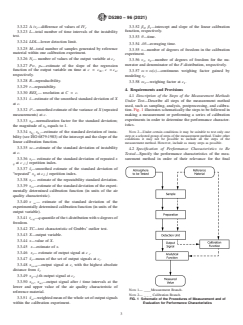
tion. Fig. 1 illustrates schematically the steps to be followed in
measurements) at c. making a measurement or performing a series of calibration
experiments in order to determine the performance character-
3.3.33 s —normalization factor for the standard deviation;
istics.
the magnitude of s equals to 1.
NOTE 2—Under certain conditions it may be suitable to test only one
3.3.34 s ,s —estimate of the standard deviation of insta-
b b
0 1
step or a selected group of steps of the measurement method. Under other
bility(seeISO6879:1983)oftheinterceptandtheslopeofthe
conditions it may not be possible to include all the steps of the
linear calibration function.
measurement method. However, include as many steps as possible.
3.3.35 sc—estimate of the standard deviation of instability
4.2 Specification of Performance Characteristics to Be
at c.
Tested—Specify the performance characteristics of the mea-
3.3.36 s— estimate of the standard deviation of repeated x
surement method in order of their relevance for the final
i
at c ; j repetition index.
ij i
3.3.37 ŝ—smoothed estimate of the standard deviation of
i
“repeated” x at c; j repetition index.
ij i
3.3.38 s — estimate of the repeatability standard deviation.
r
3.3.39 s —estimate of the standard deviation of the experi-
ĉx
mentally determined calibration function (in units of the air
quality characteristic).
3.3.40 s — estimate of the standard deviation of the
xc
experimentally determined calibration function (in units of the
output variable).
3.3.41 t —q-quantileofthet-distributionwithυdegreesof
υ;q
freedom.
3.3.42 TC—test characteristic of Grubbs’ outlier test.
3.3.43 X—output variable.
3.3.44 x—value of X.
3.3.45 x—estimate of x.
3.3.46 x— estimate of output signal at c .
i i
3.3.47 x¯ —mean of the set of output signals at c.
i i
3.3.48 x —output signal at c with the highest absolute
i,extr i
distance from x¯ .
i
3.3.49 x —j-th output signal at c.
ij i
3.3.50 x ,x —output signal after i time intervals at the
l;i' u;i
lower and upper value of the air quality characteristic of
NOTE 1— ____Measurement Branch.
reference material.
NOTE2—___ Calibration Branch.
3.3.51 x¯ —weightedmeanofthewholesetofoutputsignals
ω FIG. 1 Schematic of the Procedures of Measurement and of
within the calibration experiment. Evaluation for Performance Characteristics
D5280 − 96 (2021)
assessment of accuracy. The descriptors of the calibration time, filling time, or accumulation time, depending on the
function, for example, intercept, β , and slope, β , as well as measurement method.
0 1
their qualifying performance characteristics are vital. Those
5.2 FunctionalandStatisticalPerformanceCharacteristics:
performance characteristics for which prior knowledge is
5.2.1 The performance characteristics to be determined are:
available, and those pertaining to influence variables covered
5.2.1.1 Performancecharacteristicsrelatedtothecalibration
by randomization are of lesser importance and need not be
function and its stability under reference conditions, and
determined.
5.2.1.2 Performance characteristics related to the depen-
4.3 Test Conditions—Perform the tests under explicitly dence of the calibration function on influence variables.
stated conditions representative of the operational measure-
5.2.2 Determine a linear calibration function by its slope
ments. When testing for performance characteristics, describ- (sensitivity) and its intercept. Describe instability and the
ing functional dependencies, keep all influence variables con-
effects of influence variables by their impacts on the slope
stant except the one under consideration. (sensitivity) and intercept.
5.2.3 Obtain all output signals evaluated throughout these
5. Test Procedures
tests after the measuring system has reached stabilized condi-
tions.
5.1 Averaging Time (see 3.2.1)—The range of allowable
averaging times is constrained by the requirement that the
5.3 Calibration:
differences of subsequent output signals be mutually statisti-
5.3.1 Acalibration experiment for the evaluation of perfor-
cally independent.The corresponding minimum of the averag-
mancecharacteristicsconsistsofatleasttenrepeatedmeasure-
ing time is determined by a specific performance (time)
ments at a minimum of five different values (two each) of the
characteristic, that is, continuously measuring systems; the
air quality characteristic.
response time and noncontinuously measuring systems; the
5.3.2 In case of drift, restrain the duration of the calibration
sample time (filling time, accumulation time, etc.).
experiment to one as short as possible. This may be accom-
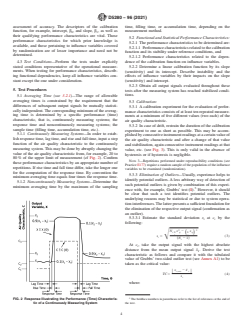
5.1.1 Continuously Measuring Systems—In order to estab-
plishedbyconsecutiveinstrumentreadingsatacertainvalueof
lish response time, lag time, and rise and fall time, input a step
the air quality characteristic and after a change of that value
function of the air quality characteristic to the continuously
and stabilization, again consecutive instrument readings at that
measuring system.This may be done by abruptly changing the
value, etc. (see Fig. 3). This is only valid in the absence of
value of the air quality characteristic from, for example, 20 to
hysteresis or if hysteresis is negligible.
80% of the upper limit of measurement (cf Fig. 2). Confirm
NOTE 3—Repetitions performed under reproducibility conditions (see
these performance characteristics by an appropriate number of
PracticeE177)requirearandomsampleofthepopulationoftheinfluence
repetitions. If rise time and fall time differ, take the longer one
variables to be examined (randomization).
for the computation of the response time. By convention the
5.3.3 Elimination of Outliers—Usually, experience helps to
minimum averaging time equals four times the response time.
identify potential outliers.Aless arbitrary way of detection of
5.1.2 Noncontinuously Measuring Systems—Determine the
such potential outliers is given by combination of this experi-
minimum averaging time by the maximum of the sampling
ence with, for example, Grubbs’ test (1). However, it should
be clear that such a test identifies potential outliers. The
underlying reasons may be statistical or due to system opera-
tioninterferences.Thelatterpresentsasufficientfoundationfor
theeliminationoftherespectiveoutputsignal(confirmationas
an outlier).
5.3.3.1 Estimate the standard deviation s at c by the
i i
following:
2 2
N x 2 x
i ( ij ( ij
~ !
j j
Œ
s 5 (3)
i
N 21
~ !
i
At c, take the output signal with the highest absolute
i
distance from the mean output signal x¯ . Derive the test
characteristic as follows and compare it with the tabulated
value of Grubbs’ two-sided outlier test (see Annex A1)tobe
taken as the critical value:
x 2 x¯
i,extr i
? ?
TC 5 (4)
s
i
where:
FIG. 2 Response Illustrating the Performance (Time) Characteris- Theboldfacenumbersinparenthesesrefertothelistofreferencesattheendof
tic of a Continuously Measuring System the text.
D5280 − 96 (2021)
NOTE 1—X —j-th time average over the interval of time ∆θ at the i-th value of the air quality characteristic generated by reference material.
ij
∆θ—Intervals of time during which unsmoothed output signals shall not be submitted to the averaging procedure, and thus, not be evaluated.
I
FIG. 3 Example of a Calibration Experiment
x
( ij polynomial in = c / c as follows:
~ !
j
x¯ 5 (5)
N
i y 2 a z 2 a z
( i i ( i 2 ( i
i i i
a 5 (8)
5.3.3.2 If TC exceeds the critical value, check if it is due to
M
operational reasons, and if so, reject it. This procedure may be
Q Q 2 2 2 Q 2 Q 2
z,y ~z ,z ! ~z , y! ~z,z !
~ !
repeated; however, no more than 5% of the number of output
a 5 (9)
1 2
Q Q 2 2 2 Q 2
~ !
~z,z! ~z ,z ! ~z,
...