


ASTM D7205/D7205M-06(2016)
(Test Method)Standard Test Method for Tensile Properties of Fiber Reinforced Polymer Matrix Composite Bars
Standard Test Method for Tensile Properties of Fiber Reinforced Polymer Matrix Composite Bars
SIGNIFICANCE AND USE
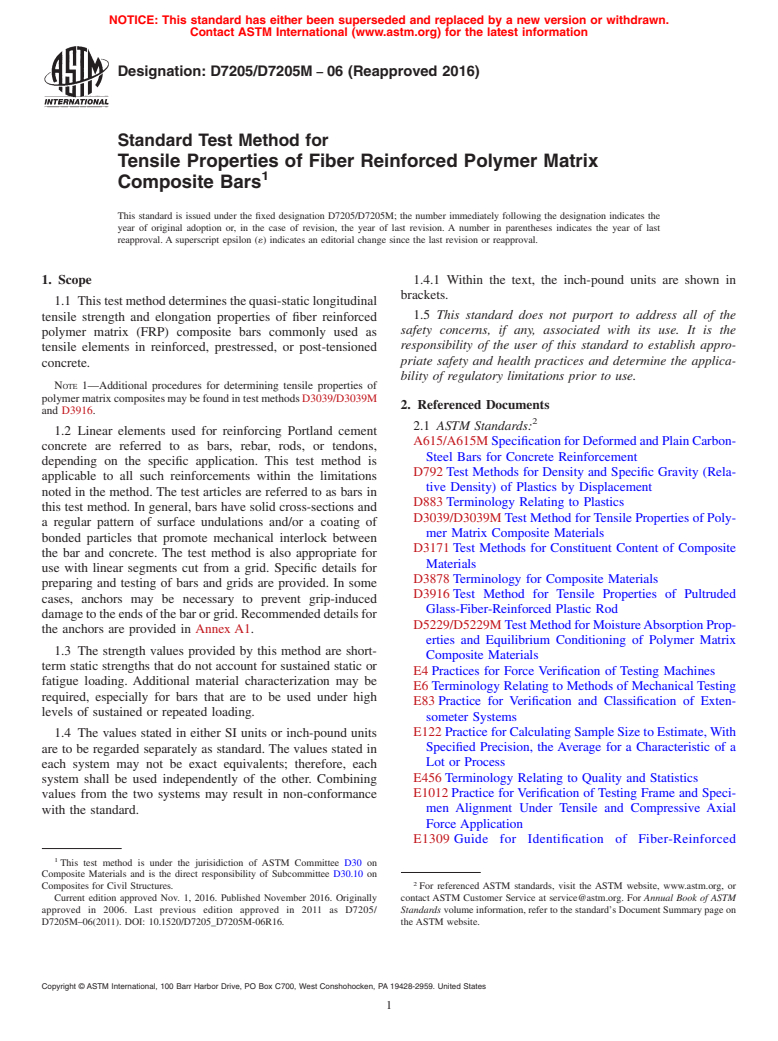
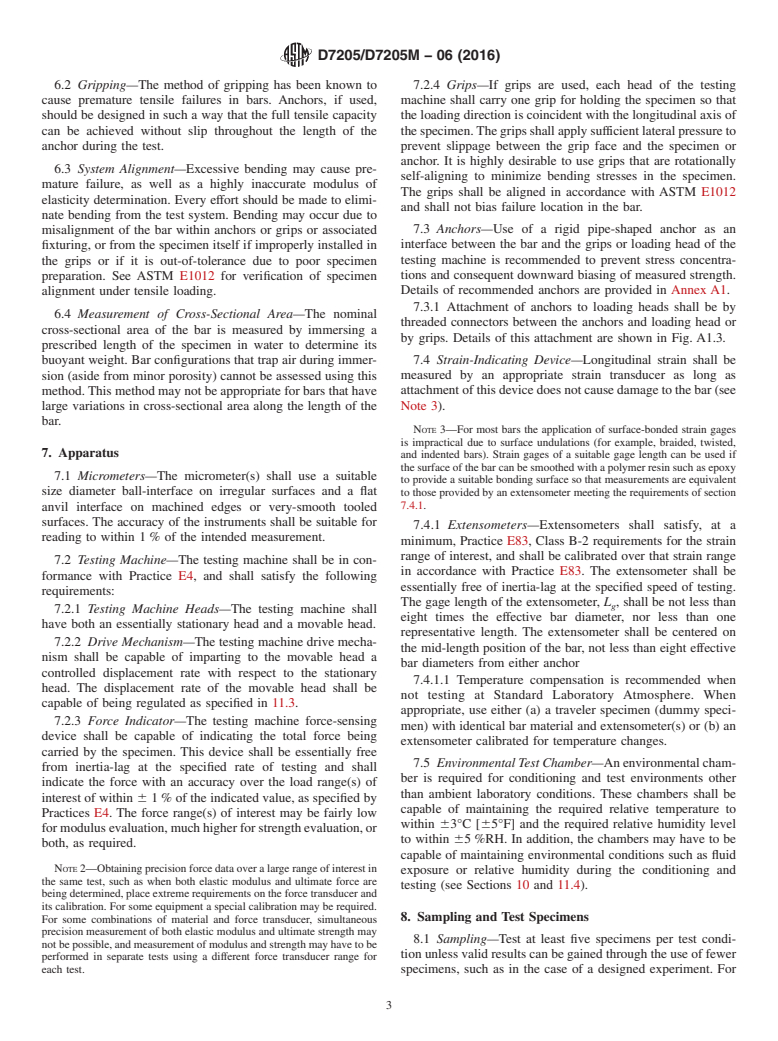
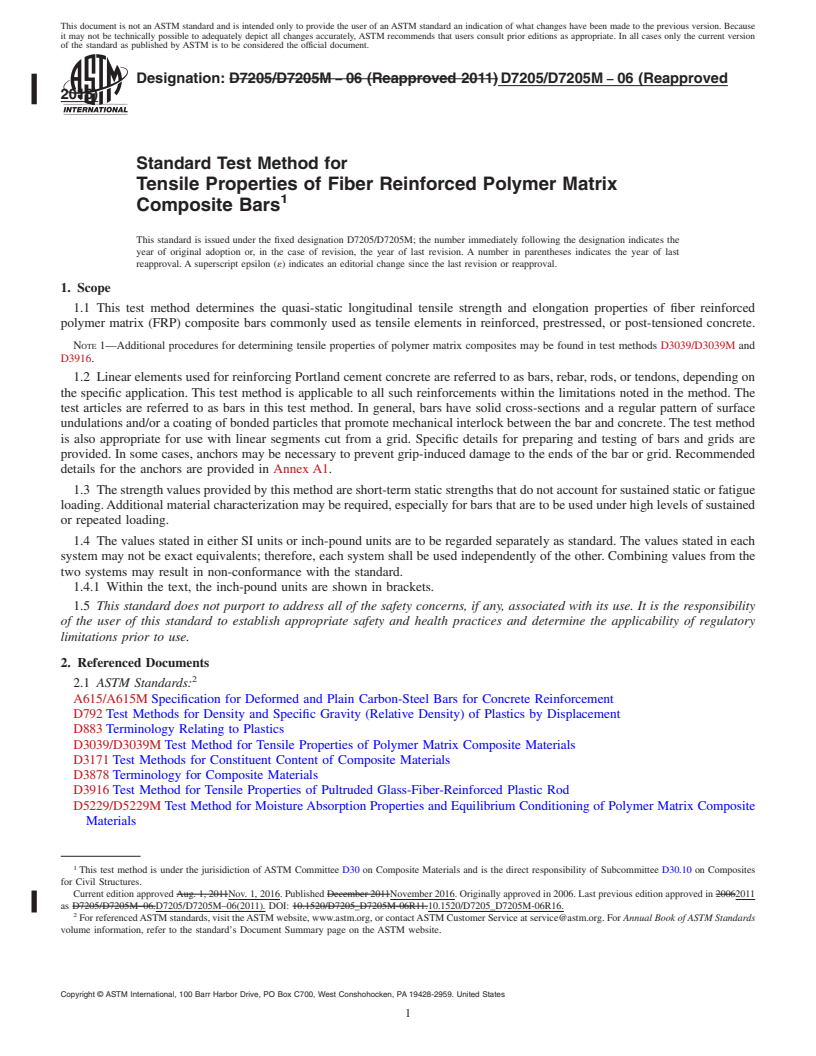
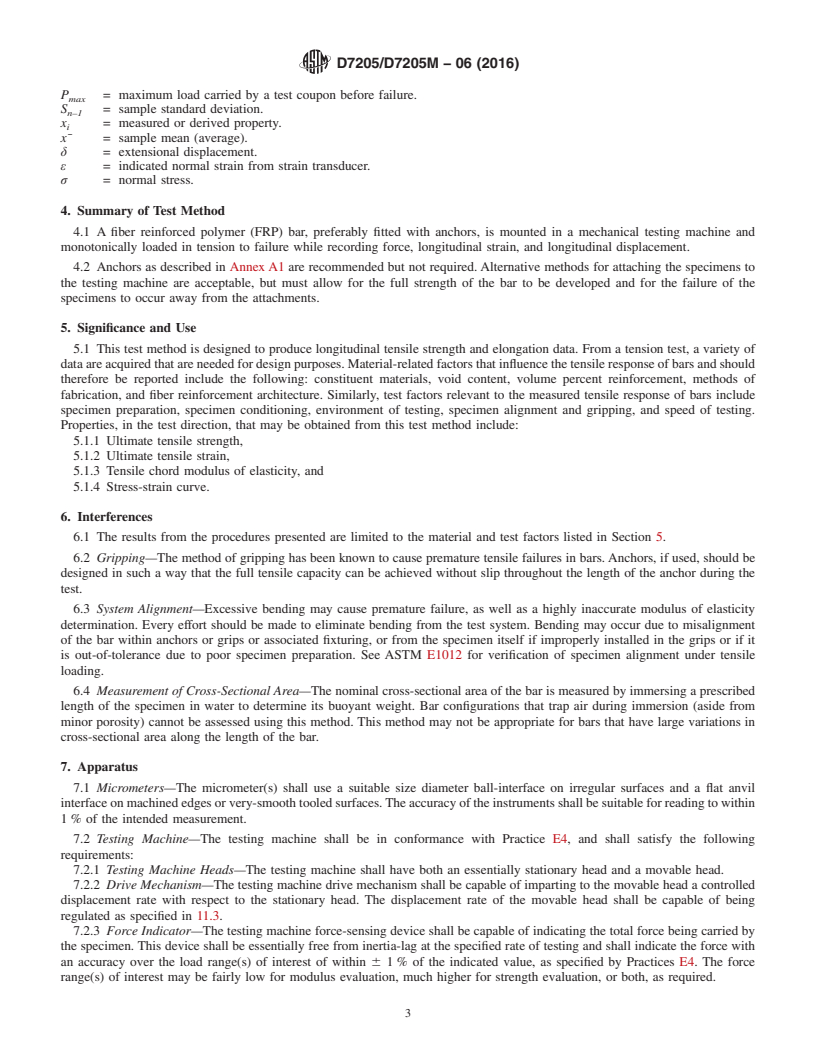
5.1 This test method is designed to produce longitudinal tensile strength and elongation data. From a tension test, a variety of data are acquired that are needed for design purposes. Material-related factors that influence the tensile response of bars and should therefore be reported include the following: constituent materials, void content, volume percent reinforcement, methods of fabrication, and fiber reinforcement architecture. Similarly, test factors relevant to the measured tensile response of bars include specimen preparation, specimen conditioning, environment of testing, specimen alignment and gripping, and speed of testing. Properties, in the test direction, that may be obtained from this test method include:
5.1.1 Ultimate tensile strength,
5.1.2 Ultimate tensile strain,
5.1.3 Tensile chord modulus of elasticity, and
5.1.4 Stress-strain curve.
SCOPE
1.1 This test method determines the quasi-static longitudinal tensile strength and elongation properties of fiber reinforced polymer matrix (FRP) composite bars commonly used as tensile elements in reinforced, prestressed, or post-tensioned concrete.
Note 1: Additional procedures for determining tensile properties of polymer matrix composites may be found in test methods D3039/D3039M and D3916.
1.2 Linear elements used for reinforcing Portland cement concrete are referred to as bars, rebar, rods, or tendons, depending on the specific application. This test method is applicable to all such reinforcements within the limitations noted in the method. The test articles are referred to as bars in this test method. In general, bars have solid cross-sections and a regular pattern of surface undulations and/or a coating of bonded particles that promote mechanical interlock between the bar and concrete. The test method is also appropriate for use with linear segments cut from a grid. Specific details for preparing and testing of bars and grids are provided. In some cases, anchors may be necessary to prevent grip-induced damage to the ends of the bar or grid. Recommended details for the anchors are provided in Annex A1.
1.3 The strength values provided by this method are short-term static strengths that do not account for sustained static or fatigue loading. Additional material characterization may be required, especially for bars that are to be used under high levels of sustained or repeated loading.
1.4 The values stated in either SI units or inch-pound units are to be regarded separately as standard. The values stated in each system may not be exact equivalents; therefore, each system shall be used independently of the other. Combining values from the two systems may result in non-conformance with the standard.
1.4.1 Within the text, the inch-pound units are shown in brackets.
1.5 This standard does not purport to address all of the safety concerns, if any, associated with its use. It is the responsibility of the user of this standard to establish appropriate safety and health practices and determine the applicability of regulatory limitations prior to use.
General Information
Buy Standard
Standards Content (Sample)
NOTICE: This standard has either been superseded and replaced by a new version or withdrawn.
Contact ASTM International (www.astm.org) for the latest information
Designation: D7205/D7205M − 06 (Reapproved 2016)
Standard Test Method for
Tensile Properties of Fiber Reinforced Polymer Matrix
Composite Bars
This standard is issued under the fixed designation D7205/D7205M; the number immediately following the designation indicates the
year of original adoption or, in the case of revision, the year of last revision. A number in parentheses indicates the year of last
reapproval. A superscript epsilon (´) indicates an editorial change since the last revision or reapproval.
1. Scope 1.4.1 Within the text, the inch-pound units are shown in
brackets.
1.1 Thistestmethoddeterminesthequasi-staticlongitudinal
1.5 This standard does not purport to address all of the
tensile strength and elongation properties of fiber reinforced
safety concerns, if any, associated with its use. It is the
polymer matrix (FRP) composite bars commonly used as
responsibility of the user of this standard to establish appro-
tensile elements in reinforced, prestressed, or post-tensioned
priate safety and health practices and determine the applica-
concrete.
bility of regulatory limitations prior to use.
NOTE 1—Additional procedures for determining tensile properties of
polymermatrixcompositesmaybefoundintestmethodsD3039/D3039M
2. Referenced Documents
and D3916.
2.1 ASTM Standards:
1.2 Linear elements used for reinforcing Portland cement
A615/A615M SpecificationforDeformedandPlainCarbon-
concrete are referred to as bars, rebar, rods, or tendons,
Steel Bars for Concrete Reinforcement
depending on the specific application. This test method is
D792 Test Methods for Density and Specific Gravity (Rela-
applicable to all such reinforcements within the limitations
tive Density) of Plastics by Displacement
noted in the method. The test articles are referred to as bars in
D883 Terminology Relating to Plastics
this test method. In general, bars have solid cross-sections and
D3039/D3039M Test Method for Tensile Properties of Poly-
a regular pattern of surface undulations and/or a coating of
mer Matrix Composite Materials
bonded particles that promote mechanical interlock between
D3171 Test Methods for Constituent Content of Composite
the bar and concrete. The test method is also appropriate for
Materials
use with linear segments cut from a grid. Specific details for
D3878 Terminology for Composite Materials
preparing and testing of bars and grids are provided. In some
D3916 Test Method for Tensile Properties of Pultruded
cases, anchors may be necessary to prevent grip-induced
Glass-Fiber-Reinforced Plastic Rod
damagetotheendsofthebarorgrid.Recommendeddetailsfor
D5229/D5229M TestMethodforMoistureAbsorptionProp-
the anchors are provided in Annex A1.
erties and Equilibrium Conditioning of Polymer Matrix
1.3 The strength values provided by this method are short-
Composite Materials
term static strengths that do not account for sustained static or
E4 Practices for Force Verification of Testing Machines
fatigue loading. Additional material characterization may be
E6 Terminology Relating to Methods of Mechanical Testing
required, especially for bars that are to be used under high
E83 Practice for Verification and Classification of Exten-
levels of sustained or repeated loading.
someter Systems
E122 Practice for Calculating Sample Size to Estimate,With
1.4 The values stated in either SI units or inch-pound units
Specified Precision, the Average for a Characteristic of a
are to be regarded separately as standard. The values stated in
Lot or Process
each system may not be exact equivalents; therefore, each
E456 Terminology Relating to Quality and Statistics
system shall be used independently of the other. Combining
E1012 Practice for Verification of Testing Frame and Speci-
values from the two systems may result in non-conformance
men Alignment Under Tensile and Compressive Axial
with the standard.
Force Application
E1309 Guide for Identification of Fiber-Reinforced
This test method is under the jurisidiction of ASTM Committee D30 on
Composite Materials and is the direct responsibility of Subcommittee D30.10 on
Composites for Civil Structures. For referenced ASTM standards, visit the ASTM website, www.astm.org, or
Current edition approved Nov. 1, 2016. Published November 2016. Originally contact ASTM Customer Service at service@astm.org. For Annual Book of ASTM
approved in 2006. Last previous edition approved in 2011 as D7205/ Standards volume information, refer to the standard’s Document Summary page on
D7205M–06(2011). DOI: 10.1520/D7205_D7205M-06R16. the ASTM website.
Copyright © ASTM International, 100 Barr Harbor Drive, PO Box C700, West Conshohocken, PA 19428-2959. United States
D7205/D7205M − 06 (2016)
Polymer-Matrix Composite Materials in Databases (With- 3.2.9 surface undulation, n—variation in the area,
drawn 2015) orientation, or shape of cross-section of a bar along its length,
E1434 Guide for Recording Mechanical Test Data of Fiber- intended to enhance mechanical interlock between a bar and
ReinforcedCompositeMaterialsinDatabases(Withdrawn concrete, made by any of a number of processes such as, for
2015) example, indentation, addition of extra materials, and twisting.
E1471 Guide for Identification of Fibers, Fillers, and Core
3.3 Symbols:
Materials in Computerized Material Property Databases
(Withdrawn 2015) A = nominal cross-sectional area of a bar.
CV = sample coefficient of variation, in percent.
d = effective bar diameter
3. Terminology
E = chord modulus of elasticity in the test direction.
chord
3.1 Terminology in D3878 defines terms relating to high-
F = ultimate tensile strength.
tu
modulus fibers and their composites. Terminology in D883
L = free length of specimen (length between anchors).
defines terms relating to plastics. Terminology in E6 defines
L = anchor length.
a
terms relating to mechanical testing. Terminology in E456 and
L = extensometer gage length.
g
in Practice E122 define terms relating to statistics and the
n = number of specimens.
selection of sample sizes. In the event of a conflict between
P = force carried by specimen.
D3878 shall have precedence over the P = maximum load carried by a test coupon before
terms, Terminology in
max
other terminology standards. failure.
S = sample standard deviation.
n–1
3.2 Definitions of Terms Specific to This Standard:
x = measured or derived property.
i
3.2.1 anchor, n—a protective device placed on each end of
x¯ = sample mean (average).
a bar, between the bar and the grips of the tensile testing
δ = extensional displacement.
machine, to prevent grip-induced damage. Usually used on
ε = indicated normal strain from strain transducer.
bars with irregular surfaces, as opposed to flat strips where
σ = normal stress.
bonded tabs are more typical.
3.2.2 bar, n—a linear element, often with surface undula-
4. Summary of Test Method
tions or a coating of particles that promote mechanical inter-
4.1 A fiber reinforced polymer (FRP) bar, preferably fitted
lock with concrete
with anchors, is mounted in a mechanical testing machine and
3.2.3 grid, n—a two-dimensional (planar) or three-
monotonically loaded in tension to failure while recording
dimensional (spatial) rigid array of interconnected FRP bars
force, longitudinal strain, and longitudinal displacement.
that form a contiguous lattice that can be used to reinforce
4.2 Anchors as described in Annex A1 are recommended
concrete. The lattice can be manufactured with integrally
but not required. Alternative methods for attaching the speci-
connected bars or constructed of mechanically connected
mens to the testing machine are acceptable, but must allow for
individual bars. The grid bar elements have transverse dimen-
the full strength of the bar to be developed and for the failure
sions typically greater than 3 mm [0.125 in.].
of the specimens to occur away from the attachments.
3.2.4 effective diameter, n—a geometric value representing
the diameter of a circle which has an enclosed area equal to the
5. Significance and Use
nominal cross-sectional area of a bar.
5.1 This test method is designed to produce longitudinal
3.2.5 nominal cross-sectional area, n—a measure of cross-
tensile strength and elongation data. From a tension test, a
sectional area of a bar, determined over at least one represen-
variety of data are acquired that are needed for design
tative length, used to calculate stress.
purposes. Material-related factors that influence the tensile
3.2.6 nominal value, n—a value, existing in name only,
response of bars and should therefore be reported include the
assigned to a measurable property for the purpose of conve-
following: constituent materials, void content, volume percent
nient designation. Tolerances may be applied to a nominal
reinforcement, methods of fabrication, and fiber reinforcement
value to define an acceptable range for the property.
architecture. Similarly, test factors relevant to the measured
tensile response of bars include specimen preparation, speci-
3.2.7 representative length, n—the minimum length of a bar
men conditioning, environment of testing, specimen alignment
that contains a repeating geometric pattern that, placed end-to-
and gripping, and speed of testing. Properties, in the test
end, reproduces the geometric pattern of a continuous bar
direction, that may be obtained from this test method include:
(usually used in reference to bars having surface undulations
5.1.1 Ultimate tensile strength,
for enhancing interlock with concrete).
5.1.2 Ultimate tensile strain,
3.2.8 standard cross-sectional area, n—the cross-sectional
5.1.3 Tensile chord modulus of elasticity, and
area of a standard numbered steel concrete reinforcing bar as
5.1.4 Stress-strain curve.
given in ASTM A615/A615M, Table 1.
6. Interferences
6.1 The results from the procedures presented are limited to
The last approved version of this historical standard is referenced on
www.astm.org. the material and test factors listed in Section 5.
D7205/D7205M − 06 (2016)
6.2 Gripping—The method of gripping has been known to 7.2.4 Grips—If grips are used, each head of the testing
cause premature tensile failures in bars. Anchors, if used, machine shall carry one grip for holding the specimen so that
should be designed in such a way that the full tensile capacity the loading direction is coincident with the longitudinal axis of
can be achieved without slip throughout the length of the thespecimen.Thegripsshallapplysufficientlateralpressureto
anchor during the test. prevent slippage between the grip face and the specimen or
anchor. It is highly desirable to use grips that are rotationally
6.3 System Alignment—Excessive bending may cause pre-
self-aligning to minimize bending stresses in the specimen.
mature failure, as well as a highly inaccurate modulus of
The grips shall be aligned in accordance with ASTM E1012
elasticity determination. Every effort should be made to elimi-
and shall not bias failure location in the bar.
nate bending from the test system. Bending may occur due to
misalignment of the bar within anchors or grips or associated 7.3 Anchors—Use of a rigid pipe-shaped anchor as an
interface between the bar and the grips or loading head of the
fixturing, or from the specimen itself if improperly installed in
the grips or if it is out-of-tolerance due to poor specimen testing machine is recommended to prevent stress concentra-
tions and consequent downward biasing of measured strength.
preparation. See ASTM E1012 for verification of specimen
alignment under tensile loading. Details of recommended anchors are provided in Annex A1.
7.3.1 Attachment of anchors to loading heads shall be by
6.4 Measurement of Cross-Sectional Area—The nominal
threaded connectors between the anchors and loading head or
cross-sectional area of the bar is measured by immersing a
by grips. Details of this attachment are shown in Fig. A1.3.
prescribed length of the specimen in water to determine its
buoyant weight. Bar configurations that trap air during immer- 7.4 Strain-Indicating Device—Longitudinal strain shall be
measured by an appropriate strain transducer as long as
sion (aside from minor porosity) cannot be assessed using this
method.This method may not be appropriate for bars that have attachmentofthisdevicedoesnotcausedamagetothebar(see
Note 3).
large variations in cross-sectional area along the length of the
bar.
NOTE 3—For most bars the application of surface-bonded strain gages
is impractical due to surface undulations (for example, braided, twisted,
7. Apparatus
and indented bars). Strain gages of a suitable gage length can be used if
the surface of the bar can be smoothed with a polymer resin such as epoxy
7.1 Micrometers—The micrometer(s) shall use a suitable
to provide a suitable bonding surface so that measurements are equivalent
size diameter ball-interface on irregular surfaces and a flat
to those provided by an extensometer meeting the requirements of section
7.4.1.
anvil interface on machined edges or very-smooth tooled
surfaces. The accuracy of the instruments shall be suitable for
7.4.1 Extensometers—Extensometers shall satisfy, at a
reading to within 1 % of the intended measurement.
minimum, Practice E83, Class B-2 requirements for the strain
range of interest, and shall be calibrated over that strain range
7.2 Testing Machine—The testing machine shall be in con-
in accordance with Practice E83. The extensometer shall be
formance with Practice E4, and shall satisfy the following
essentially free of inertia-lag at the specified speed of testing.
requirements:
The gage length of the extensometer, L , shall be not less than
g
7.2.1 Testing Machine Heads—The testing machine shall
eight times the effective bar diameter, nor less than one
have both an essentially stationary head and a movable head.
representative length. The extensometer shall be centered on
7.2.2 Drive Mechanism—The testing machine drive mecha-
the mid-length position of the bar, not less than eight effective
nism shall be capable of imparting to the movable head a
bar diameters from either anchor
controlled displacement rate with respect to the stationary
7.4.1.1 Temperature compensation is recommended when
head. The displacement rate of the movable head shall be
not testing at Standard Laboratory Atmosphere. When
capable of being regulated as specified in 11.3.
appropriate, use either (a) a traveler specimen (dummy speci-
7.2.3 Force Indicator—The testing machine force-sensing
men) with identical bar material and extensometer(s) or (b) an
device shall be capable of indicating the total force being
extensometer calibrated for temperature changes.
carried by the specimen. This device shall be essentially free
7.5 Environmental Test Chamber—Anenvironmentalcham-
from inertia-lag at the specified rat
...
This document is not an ASTM standard and is intended only to provide the user of an ASTM standard an indication of what changes have been made to the previous version. Because
it may not be technically possible to adequately depict all changes accurately, ASTM recommends that users consult prior editions as appropriate. In all cases only the current version
of the standard as published by ASTM is to be considered the official document.
Designation: D7205/D7205M − 06 (Reapproved 2011) D7205/D7205M − 06 (Reapproved
2016)
Standard Test Method for
Tensile Properties of Fiber Reinforced Polymer Matrix
Composite Bars
This standard is issued under the fixed designation D7205/D7205M; the number immediately following the designation indicates the
year of original adoption or, in the case of revision, the year of last revision. A number in parentheses indicates the year of last
reapproval. A superscript epsilon (´) indicates an editorial change since the last revision or reapproval.
1. Scope
1.1 This test method determines the quasi-static longitudinal tensile strength and elongation properties of fiber reinforced
polymer matrix (FRP) composite bars commonly used as tensile elements in reinforced, prestressed, or post-tensioned concrete.
NOTE 1—Additional procedures for determining tensile properties of polymer matrix composites may be found in test methods D3039/D3039M and
D3916.
1.2 Linear elements used for reinforcing Portland cement concrete are referred to as bars, rebar, rods, or tendons, depending on
the specific application. This test method is applicable to all such reinforcements within the limitations noted in the method. The
test articles are referred to as bars in this test method. In general, bars have solid cross-sections and a regular pattern of surface
undulations and/or a coating of bonded particles that promote mechanical interlock between the bar and concrete. The test method
is also appropriate for use with linear segments cut from a grid. Specific details for preparing and testing of bars and grids are
provided. In some cases, anchors may be necessary to prevent grip-induced damage to the ends of the bar or grid. Recommended
details for the anchors are provided in Annex A1.
1.3 The strength values provided by this method are short-term static strengths that do not account for sustained static or fatigue
loading. Additional material characterization may be required, especially for bars that are to be used under high levels of sustained
or repeated loading.
1.4 The values stated in either SI units or inch-pound units are to be regarded separately as standard. The values stated in each
system may not be exact equivalents; therefore, each system shall be used independently of the other. Combining values from the
two systems may result in non-conformance with the standard.
1.4.1 Within the text, the inch-pound units are shown in brackets.
1.5 This standard does not purport to address all of the safety concerns, if any, associated with its use. It is the responsibility
of the user of this standard to establish appropriate safety and health practices and determine the applicability of regulatory
limitations prior to use.
2. Referenced Documents
2.1 ASTM Standards:
A615/A615M Specification for Deformed and Plain Carbon-Steel Bars for Concrete Reinforcement
D792 Test Methods for Density and Specific Gravity (Relative Density) of Plastics by Displacement
D883 Terminology Relating to Plastics
D3039/D3039M Test Method for Tensile Properties of Polymer Matrix Composite Materials
D3171 Test Methods for Constituent Content of Composite Materials
D3878 Terminology for Composite Materials
D3916 Test Method for Tensile Properties of Pultruded Glass-Fiber-Reinforced Plastic Rod
D5229/D5229M Test Method for Moisture Absorption Properties and Equilibrium Conditioning of Polymer Matrix Composite
Materials
This test method is under the jurisidiction of ASTM Committee D30 on Composite Materials and is the direct responsibility of Subcommittee D30.10 on Composites
for Civil Structures.
Current edition approved Aug. 1, 2011Nov. 1, 2016. Published December 2011November 2016. Originally approved in 2006. Last previous edition approved in 20062011
as D7205/D7205M–06.D7205/D7205M–06(2011). DOI: 10.1520/D7205_D7205M-06R11.10.1520/D7205_D7205M-06R16.
For referenced ASTM standards, visit the ASTM website, www.astm.org, or contact ASTM Customer Service at service@astm.org. For Annual Book of ASTM Standards
volume information, refer to the standard’s Document Summary page on the ASTM website.
Copyright © ASTM International, 100 Barr Harbor Drive, PO Box C700, West Conshohocken, PA 19428-2959. United States
D7205/D7205M − 06 (2016)
E4 Practices for Force Verification of Testing Machines
E6 Terminology Relating to Methods of Mechanical Testing
E83 Practice for Verification and Classification of Extensometer Systems
E122 Practice for Calculating Sample Size to Estimate, With Specified Precision, the Average for a Characteristic of a Lot or
Process
E456 Terminology Relating to Quality and Statistics
E1012 Practice for Verification of Testing Frame and Specimen Alignment Under Tensile and Compressive Axial Force
Application
E1309 Guide for Identification of Fiber-Reinforced Polymer-Matrix Composite Materials in Databases (Withdrawn 2015)
E1434 Guide for Recording Mechanical Test Data of Fiber-Reinforced Composite Materials in Databases (Withdrawn 2015)
E1471 Guide for Identification of Fibers, Fillers, and Core Materials in Computerized Material Property Databases (Withdrawn
2015)
3. Terminology
3.1 Terminology in D3878 defines terms relating to high-modulus fibers and their composites. Terminology in D883 defines
terms relating to plastics. Terminology in E6 defines terms relating to mechanical testing. Terminology in E456 and in Practice
E122 define terms relating to statistics and the selection of sample sizes. In the event of a conflict between terms, Terminology
in D3878 shall have precedence over the other terminology standards.
3.2 Definitions of Terms Specific to This Standard:
3.2.1 anchor, n—a protective device placed on each end of a bar, between the bar and the grips of the tensile testing machine,
to prevent grip-induced damage. Usually used on bars with irregular surfaces, as opposed to flat strips where bonded tabs are more
typical.
3.2.2 bar, n—a linear element, often with surface undulations or a coating of particles that promote mechanical interlock with
concrete
3.2.3 grid, n—a two-dimensional (planar) or three-dimensional (spatial) rigid array of interconnected FRP bars that form a
contiguous lattice that can be used to reinforce concrete. The lattice can be manufactured with integrally connected bars or
constructed of mechanically connected individual bars. The grid bar elements have transverse dimensions typically greater than
3 mm [0.125 in.].
3.2.4 effective diameter, n—a geometric value representing the diameter of a circle which has an enclosed area equal to the
nominal cross-sectional area of a bar.
3.2.5 nominal cross-sectional area, n—a measure of cross-sectional area of a bar, determined over at least one representative
length, used to calculate stress.
3.2.6 nominal value, n—a value, existing in name only, assigned to a measurable property for the purpose of convenient
designation. Tolerances may be applied to a nominal value to define an acceptable range for the property.
3.2.7 representative length, n—the minimum length of a bar that contains a repeating geometric pattern that, placed end-to-end,
reproduces the geometric pattern of a continuous bar (usually used in reference to bars having surface undulations for enhancing
interlock with concrete).
3.2.8 standard cross-sectional area, n—the cross-sectional area of a standard numbered steel concrete reinforcing bar as given
in ASTM A615/A615M, Table 1.
3.2.9 surface undulation, n—variation in the area, orientation, or shape of cross-section of a bar along its length, intended to
enhance mechanical interlock between a bar and concrete, made by any of a number of processes such as, for example, indentation,
addition of extra materials, and twisting.
3.3 Symbols:
A = nominal cross-sectional area of a bar.
CV = sample coefficient of variation, in percent.
d = effective bar diameter
E = chord modulus of elasticity in the test direction.
chord
F = ultimate tensile strength.
tu
L = free length of specimen (length between anchors).
L = anchor length.
a
L = extensometer gage length.
g
n = number of specimens.
P = force carried by specimen.
The last approved version of this historical standard is referenced on www.astm.org.
D7205/D7205M − 06 (2016)
P = maximum load carried by a test coupon before failure.
max
S = sample standard deviation.
n–1
x = measured or derived property.
i
x¯ = sample mean (average).
δ = extensional displacement.
ε = indicated normal strain from strain transducer.
σ = normal stress.
4. Summary of Test Method
4.1 A fiber reinforced polymer (FRP) bar, preferably fitted with anchors, is mounted in a mechanical testing machine and
monotonically loaded in tension to failure while recording force, longitudinal strain, and longitudinal displacement.
4.2 Anchors as described in Annex A1 are recommended but not required. Alternative methods for attaching the specimens to
the testing machine are acceptable, but must allow for the full strength of the bar to be developed and for the failure of the
specimens to occur away from the attachments.
5. Significance and Use
5.1 This test method is designed to produce longitudinal tensile strength and elongation data. From a tension test, a variety of
data are acquired that are needed for design purposes. Material-related factors that influence the tensile response of bars and should
therefore be reported include the following: constituent materials, void content, volume percent reinforcement, methods of
fabrication, and fiber reinforcement architecture. Similarly, test factors relevant to the measured tensile response of bars include
specimen preparation, specimen conditioning, environment of testing, specimen alignment and gripping, and speed of testing.
Properties, in the test direction, that may be obtained from this test method include:
5.1.1 Ultimate tensile strength,
5.1.2 Ultimate tensile strain,
5.1.3 Tensile chord modulus of elasticity, and
5.1.4 Stress-strain curve.
6. Interferences
6.1 The results from the procedures presented are limited to the material and test factors listed in Section 5.
6.2 Gripping—The method of gripping has been known to cause premature tensile failures in bars. Anchors, if used, should be
designed in such a way that the full tensile capacity can be achieved without slip throughout the length of the anchor during the
test.
6.3 System Alignment—Excessive bending may cause premature failure, as well as a highly inaccurate modulus of elasticity
determination. Every effort should be made to eliminate bending from the test system. Bending may occur due to misalignment
of the bar within anchors or grips or associated fixturing, or from the specimen itself if improperly installed in the grips or if it
is out-of-tolerance due to poor specimen preparation. See ASTM E1012 for verification of specimen alignment under tensile
loading.
6.4 Measurement of Cross-Sectional Area—The nominal cross-sectional area of the bar is measured by immersing a prescribed
length of the specimen in water to determine its buoyant weight. Bar configurations that trap air during immersion (aside from
minor porosity) cannot be assessed using this method. This method may not be appropriate for bars that have large variations in
cross-sectional area along the length of the bar.
7. Apparatus
7.1 Micrometers—The micrometer(s) shall use a suitable size diameter ball-interface on irregular surfaces and a flat anvil
interface on machined edges or very-smooth tooled surfaces. The accuracy of the instruments shall be suitable for reading to within
1 % of the intended measurement.
7.2 Testing Machine—The testing machine shall be in conformance with Practice E4, and shall satisfy the following
requirements:
7.2.1 Testing Machine Heads—The testing machine shall have both an essentially stationary head and a movable head.
7.2.2 Drive Mechanism—The testing machine drive mechanism shall be capable of imparting to the movable head a controlled
displacement rate with respect to the stationary head. The displacement rate of the movable head shall be capable of being
regulated as specified in 11.3.
7.2.3 Force Indicator—The testing machine force-sensing device shall be capable of indicating the total force being carried by
the specimen. This device shall be essentially free from inertia-lag at the specified rate of testing and shall indicate the force with
an accuracy over the load range(s) of interest of within 6 1 % of the indicated value, as specified by Practices E4. The force
range(s) of interest may be fairly low for modulus evaluation, much higher for strength evaluation, or both, as required.
D7205/D7205M − 06 (2016)
NOTE 2—Obtaining precision force data over a large range of interest in the same test, such as when both elastic modulus and ultimate force are being
determined, place extreme requirements on the force transducer and its calibration. For some equipment a special calibration may be required. For some
combinations of material and force transducer, simultaneous precision measurement of both elastic modulus and ultimate strength may not be possible,
and measurement of modulus and strength may have to be performed in separate tests using a different force transducer range for each test.
7.2.4 Grips—If grips are used, each head of the testing machine shall carry one grip for holding the specimen so that the loading
direction is coincident with the longitudinal axis of the specimen. The grips shall apply sufficient lateral pressure to prevent
slippage between the grip face and the specimen or anchor. It is highly desirable to use grips that are rotationally self-aligning to
minimize bending stresses in the specimen. The grips shall be aligned in accordance with ASTM E1012 and shall not bias failure
location in the bar.
7.3 Anchors—Use of a rigid pipe-shaped anchor as an interface between the bar and the grips or loading head of the testing
machine is recommended to prevent stress concentrations and consequent downward biasing of measured strength. Details of
recommended anchors are provided in Annex A1.
7.3.1 Attachment of anchors to loading heads shall be by threaded connectors between the anchors and loading head or by grips.
Details of this attachment are shown in Fig. A1.3.
7.4 Strain-Indicating Device—Longitudinal strain shall be measured by an appropriate strain transducer as long as attachment
of this device does not cause damage to the bar (see Note
...
Questions, Comments and Discussion
Ask us and Technical Secretary will try to provide an answer. You can facilitate discussion about the standard in here.