

ASTM F1056-18(2022)
(Specification)Standard Specification for Socket Fusion Tools for Use in Socket Fusion Joining Polyethylene Pipe or Tubing and Fittings
General Information
- Abstract
ABSTRACT
This specification covers socket fusion tools for use in making socket fusion joints between polyethylene pipe or tubing and fittings as specified by certain specifications. It covers newly manufactured heater faces and used heater faces which have been recoated. Heater faces may be manufactured from aluminum, steel, or other suitable heat conducting material. The manufacture of these socket fusion tools shall be in accordance with good commercial practice so as to produce socket fusion tools meeting the requirements specified. Heater faces shall have surfaces free of cracks, voids, foreign inclusions, or injurious defects.
SCOPE
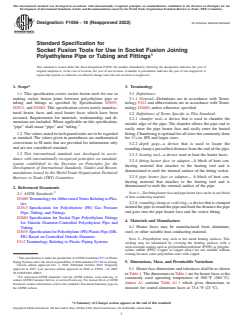
1.1 This specification covers socket fusion tools for use in making socket fusion joints between polyethylene pipe or tubing and fittings as specified by Specifications D3035, D2513, and D2683. This specification covers newly manufactured heater faces and used heater faces which have been recoated. Requirements for materials, workmanship, and dimensions are included. Where applicable on this specification, “pipe” shall mean “pipe” and “tubing.”
1.2 The values stated in inch-pound units are to be regarded as standard. The values given in parentheses are mathematical conversions to SI units that are provided for information only and are not considered standard.
1.3 This international standard was developed in accordance with internationally recognized principles on standardization established in the Decision on Principles for the Development of International Standards, Guides and Recommendations issued by the World Trade Organization Technical Barriers to Trade (TBT) Committee.
- Status
- Published
- Publication Date
- 30-Sep-2022
- Technical Committee
- F17 - Plastic Piping Systems
- Drafting Committee
- F17.20 - Joining
Overview
ASTM F1056-18(2022): Standard Specification for Socket Fusion Tools for Use in Socket Fusion Joining Polyethylene Pipe or Tubing and Fittings establishes the requirements for socket fusion tools designed for creating socket fusion joints between polyethylene (PE) pipes or tubing and their corresponding fittings. Developed and maintained by ASTM International, this specification ensures that socket fusion tools, including heater faces-either newly manufactured or recoated-meet rigorous quality, material, workmanship, and dimensional standards. Adherence to this standard ensures reliable and safe joining of PE piping systems, which is essential for sectors such as gas distribution, water supply, and industrial piping.
Key Topics
Scope and Applicability
This standard applies to socket fusion tools used for joining PE pipes and fittings as referenced in ASTM D3035, D2513, and D2683. Both inch-pound and SI units are referenced, with inch-pound as the standard.Material Requirements
Heater faces must be manufactured from aluminum, steel, or other suitable heat-conducting materials. Only materials that prevent adverse reactions with polyethylene are permitted, with stick-resistant coatings recommended to protect surfaces and maintain performance.Design and Dimensions
- Detailed dimensional requirements for heater faces and depth gauges are provided, ensuring proper fit and reliable socket fusion joints.
- Variations in diameter, depth, and tolerances for multiple sizes of pipe and tubing are specified for consistent performance.
Workmanship and Quality
Socket fusion tool manufacturing must adhere to good commercial practice, ensuring surfaces are free from cracks, voids, foreign inclusions, or injurious defects.- Inspection guidelines detail methods for verifying dimensional accuracy and surface integrity.
Product Marking and Packaging
Each tool must be permanently marked, where possible, with the nominal pipe size, manufacturer’s name or trademark, and the ASTM designation. Packaging must ensure product integrity during handling and shipping, with clear, informative labels.
Applications
Polyethylene Gas Distribution Systems
By conforming to ASTM F1056, socket fusion tools deliver precision and confidence for joining pipes and fittings in gas supply networks, where joint reliability is critical for safety.Water Supply and Utilities
The standard supports joining of PE components in potable water distribution, irrigation, and similar applications requiring leak-proof, durable joints.Industrial Piping Installations
Facilities that use PE piping for process or wastewater needs benefit from standardized tooling, reducing risk and streamlining installation processes.Maintenance and Repair
The ability to use either new or recoated heater faces, as long as they meet the material and workmanship requirements, offers flexibility for utilities and contractors performing pipe system repairs or upgrades.
Related Standards
For comprehensive compliance and best results, refer to these associated ASTM standards:
- ASTM D3035 – Polyethylene (PE) Plastic Pipe (DR-PR) Based on Controlled Outside Diameter
- ASTM D2513 – Polyethylene (PE) Gas Pressure Pipe, Tubing, and Fittings
- ASTM D2683 – Socket-Type Polyethylene Fittings for Outside Diameter-Controlled Polyethylene Pipe and Tubing
- ASTM D1600 – Terminology for Abbreviated Terms Relating to Plastics
- ASTM F412 – Terminology Relating to Plastic Piping Systems
Practical Value
By specifying requirements for materials, dimensions, and quality assurance, ASTM F1056-18(2022) promotes the use of reliable, high-quality socket fusion tools for polyethylene pipe joining. Standardization of these tools underpins the safety and performance of PE piping systems in critical infrastructure, helping manufacturers, suppliers, installers, and utility owners meet regulatory and operational demands with confidence.
Keywords: socket fusion tools, polyethylene pipe, ASTM F1056, socket fusion joining, PE pipe fittings, heater faces, industrial piping standards, depth gauge, recoated heater face, pipe joining tools.
Relations
- Effective Date
- 01-Apr-2020
- Effective Date
- 01-Jan-2019
- Refers
ASTM D2513-18 - Standard Specification for Polyethylene (PE) Gas Pressure Pipe, Tubing, and Fittings - Effective Date
- 15-Apr-2018
- Refers
ASTM D1600-18 - Standard Terminology for Abbreviated Terms Relating to Plastics (Withdrawn 2024) - Effective Date
- 01-Jan-2018
- Effective Date
- 01-Aug-2017
- Effective Date
- 01-Feb-2017
- Effective Date
- 15-Dec-2016
- Refers
ASTM D2513-16 - Standard Specification for Polyethylene (PE) Gas Pressure Pipe, Tubing, and Fittings - Effective Date
- 01-Dec-2016
- Effective Date
- 15-Nov-2016
- Effective Date
- 01-Aug-2016
- Effective Date
- 01-Jun-2015
- Effective Date
- 01-Aug-2014
- Effective Date
- 25-Apr-2014
- Effective Date
- 25-Apr-2014
- Effective Date
- 01-Mar-2014
Get Certified
Connect with accredited certification bodies for this standard

Institut za varilstvo d.o.o. (Welding Institute)
Slovenia's leading welding institute since 1952. ISO 3834, EN 1090, pressure equipment certification, NDT personnel, welder qualification. Only IIW Au
Sponsored listings
Frequently Asked Questions
ASTM F1056-18(2022) is a technical specification published by ASTM International. Its full title is "Standard Specification for Socket Fusion Tools for Use in Socket Fusion Joining Polyethylene Pipe or Tubing and Fittings". This standard covers: ABSTRACT This specification covers socket fusion tools for use in making socket fusion joints between polyethylene pipe or tubing and fittings as specified by certain specifications. It covers newly manufactured heater faces and used heater faces which have been recoated. Heater faces may be manufactured from aluminum, steel, or other suitable heat conducting material. The manufacture of these socket fusion tools shall be in accordance with good commercial practice so as to produce socket fusion tools meeting the requirements specified. Heater faces shall have surfaces free of cracks, voids, foreign inclusions, or injurious defects. SCOPE 1.1 This specification covers socket fusion tools for use in making socket fusion joints between polyethylene pipe or tubing and fittings as specified by Specifications D3035, D2513, and D2683. This specification covers newly manufactured heater faces and used heater faces which have been recoated. Requirements for materials, workmanship, and dimensions are included. Where applicable on this specification, “pipe” shall mean “pipe” and “tubing.” 1.2 The values stated in inch-pound units are to be regarded as standard. The values given in parentheses are mathematical conversions to SI units that are provided for information only and are not considered standard. 1.3 This international standard was developed in accordance with internationally recognized principles on standardization established in the Decision on Principles for the Development of International Standards, Guides and Recommendations issued by the World Trade Organization Technical Barriers to Trade (TBT) Committee.
ABSTRACT This specification covers socket fusion tools for use in making socket fusion joints between polyethylene pipe or tubing and fittings as specified by certain specifications. It covers newly manufactured heater faces and used heater faces which have been recoated. Heater faces may be manufactured from aluminum, steel, or other suitable heat conducting material. The manufacture of these socket fusion tools shall be in accordance with good commercial practice so as to produce socket fusion tools meeting the requirements specified. Heater faces shall have surfaces free of cracks, voids, foreign inclusions, or injurious defects. SCOPE 1.1 This specification covers socket fusion tools for use in making socket fusion joints between polyethylene pipe or tubing and fittings as specified by Specifications D3035, D2513, and D2683. This specification covers newly manufactured heater faces and used heater faces which have been recoated. Requirements for materials, workmanship, and dimensions are included. Where applicable on this specification, “pipe” shall mean “pipe” and “tubing.” 1.2 The values stated in inch-pound units are to be regarded as standard. The values given in parentheses are mathematical conversions to SI units that are provided for information only and are not considered standard. 1.3 This international standard was developed in accordance with internationally recognized principles on standardization established in the Decision on Principles for the Development of International Standards, Guides and Recommendations issued by the World Trade Organization Technical Barriers to Trade (TBT) Committee.
ASTM F1056-18(2022) is classified under the following ICS (International Classification for Standards) categories: 23.040.20 - Plastics pipes. The ICS classification helps identify the subject area and facilitates finding related standards.
ASTM F1056-18(2022) has the following relationships with other standards: It is inter standard links to ASTM F412-20, ASTM F412-19, ASTM D2513-18, ASTM D1600-18, ASTM F412-17a, ASTM F412-17, ASTM D2513-16a, ASTM D2513-16, ASTM F412-16a, ASTM F412-16, ASTM F412-15, ASTM D3035-14a, ASTM D2513-14, ASTM D2513-14e1, ASTM D3035-14. Understanding these relationships helps ensure you are using the most current and applicable version of the standard.
ASTM F1056-18(2022) is available in PDF format for immediate download after purchase. The document can be added to your cart and obtained through the secure checkout process. Digital delivery ensures instant access to the complete standard document.
Standards Content (Sample)
This international standard was developed in accordance with internationally recognized principles on standardization established in the Decision on Principles for the
Development of International Standards, Guides and Recommendations issued by the World Trade Organization Technical Barriers to Trade (TBT) Committee.
Designation:F1056 −18 (Reapproved 2022) An American National Standard
Standard Specification for
Socket Fusion Tools for Use in Socket Fusion Joining
Polyethylene Pipe or Tubing and Fittings
This standard is issued under the fixed designation F1056; the number immediately following the designation indicates the year of
original adoption or, in the case of revision, the year of last revision. A number in parentheses indicates the year of last reapproval. A
superscript epsilon (´) indicates an editorial change since the last revision or reapproval.
1. Scope* 3. Terminology
1.1 This specification covers socket fusion tools for use in 3.1 Definitions:
making socket fusion joints between polyethylene pipe or 3.1.1 General—Definitions are in accordance with Termi-
tubing and fittings as specified by Specifications D3035, nology F412 and abbreviations are in accordance with Termi-
D2513, and D2683. This specification covers newly manufac- nology D1600, unless otherwise specified.
tured heater faces and used heater faces which have been
3.2 Definitions of Terms Specific to This Standard:
recoated. Requirements for materials, workmanship, and di-
3.2.1 chamfer tool—a device that is used to chamfer the
mensions are included. Where applicable on this specification,
outside edge of the pipe. The chamfer allows the pipe end to
“pipe” shall mean “pipe” and “tubing.”
easily enter the pipe heater face and easily enter the heated
1.2 The values stated in inch-pound units are to be regarded fitting. Chamfering is optional for all sizes but commonly done
as standard. The values given in parentheses are mathematical for 1 ⁄4-in. IPS and larger sizes.
conversions to SI units that are provided for information only
3.2.2 depth gage—a device that is used to locate the
and are not considered standard.
rounding clamp a prescribed distance from the end of the pipe.
1.3 This international standard was developed in accor-
3.2.3 heating tool—a device used to heat the heater faces.
dance with internationally recognized principles on standard-
3.2.4 fitting heater face or adapter—A block of heat con-
ization established in the Decision on Principles for the
ducting material that attaches to the heating tool and is
Development of International Standards, Guides and Recom-
dimensioned to melt the internal surface of the fitting socket.
mendations issued by the World Trade Organization Technical
3.2.5 pipe heater face or adapter— A block of heat con-
Barriers to Trade (TBT) Committee.
ducting material that attaches to the heating tool and is
dimensioned to melt the external surface of the pipe.
2. Referenced Documents
NOTE1—Thefittingheaterfaceandpipeheaterfacecanbeinoneblock
2.1 ASTM Standards:
of heat conducting material.
D1600 Terminology forAbbreviatedTerms Relating to Plas-
3.2.6 rounding clamp or cold ring—a device that is clamped
tics
aroundthepipetoroundthepipeandlimitthedistancethepipe
D2513 Specification for Polyethylene (PE) Gas Pressure
end goes into the pipe heater face and the socket fitting.
Pipe, Tubing, and Fittings
D2683 Specification for Socket-Type Polyethylene Fittings
4. Materials and Manufacture
for Outside Diameter-Controlled Polyethylene Pipe and
4.1 Heater faces may be manufactured from aluminum,
Tubing
steel, or other suitable heat conducting material.
D3035 SpecificationforPolyethylene(PE)PlasticPipe(DR-
PR) Based on Controlled Outside Diameter
NOTE 2—Polyethylene may stick to hot metal heating surfaces. This
F412 Terminology Relating to Plastic Piping Systems
sticking may be minimized by covering the heating surfaces with a
stick-resistant coating such as polytetrafluoroethylene (PTFE) or polyphe-
nylene sulfide (PPS). Copper or copper alloys are not suitable without
coating because some polyolefins react with copper.
This specification is under the jurisdiction ofASTM Committee F17 on Plastic
Piping Systems and is the direct responsibility of Subcommittee F17.20 on Joining.
5. Dimensions, Mass, and Permissible Variations
Current edition approved Oct. 1, 2022. Published October 2022. Originally
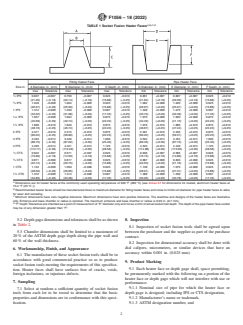
5.1 Heaterfacedimensionsandtolerancesshallbeasshown
approved in 1987. Last previous edition approved in 2018 as F1056 – 18. DOI:
10.1520/F1056-18R22.
in Table 1.The dimensions in Table 1 are for heater faces at the
For referenced ASTM standards, visit the ASTM website, www.astm.org, or
commonly used operating temperature of 500 °F (260 °C).
contact ASTM Customer Service at service@astm.org. For Annual Book of ASTM
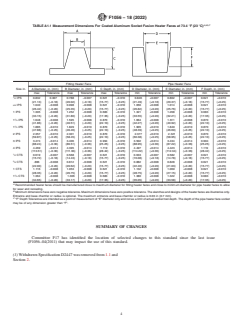
Annex A1 contains Table A1.1 which gives dimensions to
Standards volume information, refer to the standard’s Document Summary page on
the ASTM website. measure for coated aluminum faces at 73.4 °F (23 °C).
*A Summary of Changes section appears at the end of this standard
Copyright © ASTM International, 100 Barr Harbor Drive, PO Box C700, West Conshohocken, PA 19428-2959. United States
F1056−18 (2022)
A,B,C,D
TABLE 1 Socket Fusion Heater Faces
Fitting Heater Face Pipe Heater Face
Size in. A Diameter, in. (mm) B Diameter, in. (mm) C Depth, in. (mm) D Diameter, in. (mm) E Diameter, in. (mm) F Depth, in. (mm)
max Tolerance max Tolerance max Tolerance min Tolerance min Tolerance min Tolerance
⁄2 IPS 0.837 –0.007 0.793 –0.007 0.625 −0.010 0.851 +0.007 0.807 +0.007 0.625 +0.010
(21.26) (−0.18) (20.14) (−0.18) (15.88) (−0.25) (21.62) (+0.18) (20.50) (+0.18) (15.88) (+0.25)
⁄4 IPS 1.046 –0.008 1.004 –0.008 0.625 −0.010 1.062 +0.008 1.020 +0.008 0.625 +0.010
(26.57) (−0.20) (25.50) (−0.20) (15.88) (−0.25) (26.97) (+0.20) (25.91) (+0.20) (15.88) (+0.25)
1 IPS 1.312 –0.008 1.259 –0.008 0.687 −0.010 1.328 +0.008 1.275 +0.008 0.687 +0.010
(33.32) (−0.20) (31.98) (−0.20) (17.45) (−0.25) (33.73) (+0.20) (32.39) (+0.20) (17.45) (+0.25)
1 ⁄4 IPS 1.657 –0.008 1.604 –0.008 0.875 −0.010 1.673 +0.008 1.620 +0.008 0.875 +0.010
(42.09) (−0.20) (40.74) (−0.20) (22.23) (−0.25) (42.49) (+0.20) (41.15) (+0.20) (22.23) (+0.25)
1 ⁄2 IPS 1.896 –0.010 1.840 –0.010 0.875 −0.010 1.916 +0.010 1.860 +0.010 0.875 +0.010
(48.16) (−0.25) (46.74) (−0.25) (22.23) (−0.25) (48.67) (+0.25) (47.24) (+0.25) (22.23) (+0.25)
2 IPS 2.371 –0.010 2.315 –0.010 0.875 −0.010 2.391 +0.010 2.335 +0.010 0.875 +0.010
(60.22) (−0.25) (58.80) (−0.25) (22.23) (−0.25) (60.22) (+0.25) (59.31) (+0.25) (22.23) (+0.25)
3 IPS 3.494 –0.014 3.426 –0.014 1.000 −0.010 3.522 +0.014 3.454 +0.014 1.000 +0.010
(88.75) (−0.36) (87.02) (−0.36) (25.40) (−0.25) (89.46) (+0.36) (87.73) (+0.36) (25.40) (+0.25)
4 IPS 4.495 –0.014 4.421 −0.014 1.125 −0.010 4.523 +0.014 4.449 +0.014 1.125 +0.010
(114.17) (−0.36) (112.29) (−0.36) (28.58) (−0.25) (114.88) (+0.36) (113.00) (+0.36) (28.58) (+0.25)
⁄2 CTS 0.622 –0.007 0.571 −0.007 0.625 −0.010 0.636 +0.007 0.585 +0.007 0.625 +0.010
(15.80) (−0.18) (14.50) (−0.18) (15.88) (−0.25) (16.15) (+0.18) (14.86) (+0.18) (15.88) (+0.25)
⁄4 CTS 0.871 –0.008 0.817 −0.008 0.625 −0.010 0.887 +0.008 0.833 +0.008 0.625 +0.010
(22.12) (−0.20) (20.75) (−0.20) (15.88) (−0.25) (22.53) (+0.20) (21.16) (+0.20) (15.88) (+0.25)
1 CTS 1.122 –0.008 1.059 −0.008 0.625 −0.010 1.138 +0.008 1.075 +0.008 0.625 +0.010
(28.50) (−0.20) (26.85) (−0.20) (15.88) (−0.25) (28.91) (+0.20) (27.31) (+0.20) (15.88) (+0.25)
1 ⁄4 CTS 1.372 –0.008 1.314 −0.008 0.687 −0.010 1.388 +0.008 1.330 +0.008 0.687 +0.010
(34.85) (−0.20) (33.38) (−0.20) (17.45) (−0.25) (35.26) (+0.20) (33.78) (+0.20) (17.45) (+0.25)
A
Dimensions are for heater faces at the commonly used operating temperature of 500 °F (260 °C) (see AnnexA1 for dimensions for coated, aluminum heater faces at
73.4 °F (23 °C )).
B
Recommended heater faces should be manufactured close to maximum diameter for fitting heater faces and close to minimum diameter for pipe heater faces to allow
for wear and recoating.
C
Minimum dimensions have zero negative tolerance. Maximum dimensions have zero positive tolerance. The sketches and designs of the heater faces are illustrative
only. Entrance and base chamfer or radius is optional. The maximum entrance and base chamfer or radius is 0.03 in. (0.7 mm).
D
“F”DepthTolerancesareintendedasapointofmeasurementof“E”diameteronlyandnotasalimitofactualsockettooldepth.Thedepthofthepipeheaterfacesocket
may be of any dimension greater than “F”.
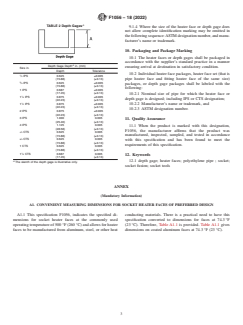
5.2 Depthgagedimensionsandtolerancesshallbeasshown 8. Inspection
in Table 2.
8.1 Inspection of socket fusion tools shall be agreed upon
5.3 Chamfer dimensions shall be limited to a maximum of between
...