

ASTM D5889/D5889M-18(2022)
(Practice)Standard Practice for Quality Control of Geosynthetic Clay Liners
General Information
- Abstract
SIGNIFICANCE AND USE
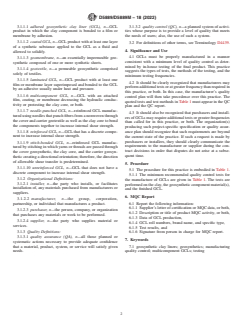
4.1 GCLs must be properly manufactured in a manner consistent with a minimum level of quality control as determined by in-house testing of the final product. This practice suggests the types of tests, the methods of the testing, and the minimum testing frequencies.
MD = machine direction.
CD = cross-machine direction.
Minimum = lowest result for the produced lot from which the supplied rolls were selected.
Maximum = highest result for the produced lot from which the supplied rolls were selected.
n/a = not applicable. (A) The tests on the bentonite are to be performed on the as-received material before fabrication into the GCL product.(B) Cert letter from component manufacturer or QA from GCL manufacturer, or both. Cert letters must arrive and be checked before the components are used for the GCL production.(C) If the moisture content from the bentonite added during production did not change, the mass per unit area and moisture content of the bentonite (evaluated according to 1.3 in Table 1) can be used to determine the values of the finished GCL product.(D) Components from finished GCL product should not be separated and tested, because the production process may alter the properties of the components.(E) MARV–minimum average roll value, only evaluated for a one-year production period with an average value minus 2 standard deviations. If the production period is less than one year, for example, for job-specific products, a MARV value may not be able to be evaluated, then the minimum value shall be reported.(F) Dried bentonite should be defined as 0 % moisture content.(G) Internal shear testing (Test Method D6243/D6243M) may be applicable to quality control of the bonding strength of non-needle-punched reinforced and stitch-bonded GCLs.(H) This test is not applicable for multi-component GCLs (for example, products with geomembrane backing(s), geofilm backing(s), or polymer backing(s)).
4.2 It should be clearly recognized that manufacturers may perf...
SCOPE
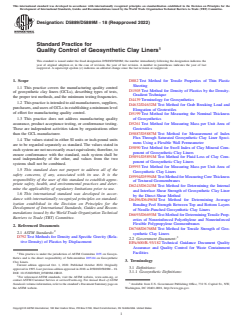
1.1 This practice covers the manufacturing quality control of geosynthetic clay liners (GCLs), describing types of tests, the proper test methods, and the minimum testing frequencies.
1.2 This practice is intended to aid manufacturers, suppliers, purchasers, and users of GCLs in establishing a minimum level of effort for manufacturing quality control.
1.3 This practice does not address manufacturing quality assurance, product acceptance testing, or conformance testing. These are independent activities taken by organizations other than the GCL manufacturer.
1.4 The values stated in either SI units or inch-pound units are to be regarded separately as standard. The values stated in each system are not necessarily exact equivalents; therefore, to ensure conformance with the standard, each system shall be used independently of the other, and values from the two systems shall not be combined.
1.5 This standard does not purport to address all of the safety concerns, if any, associated with its use. It is the responsibility of the user of this standard to establish appropriate safety, health, and environmental practices and determine the applicability of regulatory limitations prior to use.
1.6 This international standard was developed in accordance with internationally recognized principles on standardization established in the Decision on Principles for the Development of International Standards, Guides and Recommendations issued by the World Trade Organization Technical Barriers to Trade (TBT) Committee.
- Status
- Published
- Publication Date
- 30-Sep-2022
- Technical Committee
- D35 - Geosynthetics
- Drafting Committee
- D35.04 - Geosynthetic Clay Liners


Overview
ASTM D5889/D5889M-18(2022), Standard Practice for Quality Control of Geosynthetic Clay Liners (GCLs), provides essential guidelines for the manufacturing quality control (MQC) of geosynthetic clay liners. GCLs are widely used in civil engineering, landfill, and environmental containment applications due to their superior barrier properties. This standard outlines the necessary types of tests, recognized test methods, and minimum testing frequencies manufacturers must implement to ensure consistent product quality. By establishing a robust quality control framework, ASTM D5889/D5889M-18(2022) facilitates improved performance, reliability, and compliance of GCL products in the field.
Key Topics
Scope and Applicability
- Defines the standard practice for manufacturing quality control of GCLs.
- Intended for manufacturers, suppliers, purchasers, and end-users of GCLs.
- Distinguishes MQC from quality assurance (QA), product acceptance, and conformance testing (which are outside the standard's focus).
Testing Requirements
- Specifies the minimum types and frequencies of tests for:
- Bentonite clay (swell index, fluid loss, moisture content)
- Geotextile and geomembrane components (mass per unit area, tensile strength, thickness)
- Finished GCL product (mass per unit area, bonding peel strength, tensile strength, index flux)
- Details recognized ASTM test methods for each property.
- Specifies the minimum types and frequencies of tests for:
Reporting and Certification
- Requires documentation including test results, certificate letters from component suppliers, and MQC data.
- Stipulates that certification letters must be verified before production to ensure only qualified components are used.
Test Methodology
- Outlines separation between machine direction (MD) and cross-machine direction (CD) in testing protocols.
- Addresses methodology considerations (e.g., MARV - minimum average roll value - for one year of production, procedures for dried bentonite, and limits for multi-component GCLs).
Applications
Geosynthetic clay liners are critical in containment and lining systems. This standard is applicable in:
- Landfill and Waste Containment
- GCLs serve as barriers for leachate and gas migration, requiring reliable quality control to meet environmental regulations.
- Waterproofing in Civil Engineering
- Used in canals, tunnels, dam cores, and reservoirs for their hydraulic barrier performance.
- Mining and Industrial Projects
- Implemented in heap leach pads, tailings dams, and secondary containment for chemical and hazardous materials storage.
Manufacturers following ASTM D5889/D5889M-18(2022) are better positioned to provide products that meet project specifications and regulatory demands, reducing the risk of installation failures and environmental hazards.
Related Standards
For complete quality assurance and testing coverage of geosynthetic clay liners, users should reference the following ASTM standards:
- ASTM D4439 - Terminology for Geosynthetics
- ASTM D5261 - Measuring Mass per Unit Area of Geotextiles
- ASTM D4632/D4632M - Grab Breaking Load and Elongation of Geotextiles
- ASTM D5993 - Mass per Unit Area of GCLs
- ASTM D6768/D6768M - Tensile Strength of GCLs
- ASTM D6496/D6496M - Bonding Peel Strength of Needle-Punched GCLs
- ASTM D5887/D5887M - Measurement of Index Flux Through GCLs
- ASTM D5890/D5891/D5891M - Swell Index and Fluid Loss of Bentonite Clays
By implementing ASTM D5889/D5889M-18(2022) in conjunction with applicable related standards, organizations can ensure high manufacturing quality control for geosynthetic clay liners and maintain industry best practices.
Keywords: geosynthetic clay liners, GCL, quality control, ASTM standards, manufacturing, testing, environmental containment, geosynthetics, landfill liner, civil engineering.
Relations
- Effective Date
- 01-Feb-2024
- Effective Date
- 01-Nov-2023
- Effective Date
- 01-May-2020
- Effective Date
- 15-Mar-2020
- Effective Date
- 01-Aug-2019
- Refers
ASTM D5199-12(2019) - Standard Test Method for Measuring the Nominal Thickness of Geosynthetics - Effective Date
- 15-Jun-2019
- Effective Date
- 01-May-2019
- Effective Date
- 01-May-2019
- Effective Date
- 01-May-2019
- Effective Date
- 01-Aug-2018
- Effective Date
- 01-Jul-2018
- Effective Date
- 01-Jun-2018
- Effective Date
- 01-Jun-2018
- Effective Date
- 15-Apr-2018
- Effective Date
- 01-Aug-2017
Get Certified
Connect with accredited certification bodies for this standard

Control Union Certifications
Global certification for agriculture and sustainability.

DIBt (Deutsches Institut für Bautechnik)
German Institute for Building Technology.
DIN CERTCO
DIN Group product certification.
Sponsored listings
Frequently Asked Questions
ASTM D5889/D5889M-18(2022) is a standard published by ASTM International. Its full title is "Standard Practice for Quality Control of Geosynthetic Clay Liners". This standard covers: SIGNIFICANCE AND USE 4.1 GCLs must be properly manufactured in a manner consistent with a minimum level of quality control as determined by in-house testing of the final product. This practice suggests the types of tests, the methods of the testing, and the minimum testing frequencies. MD = machine direction. CD = cross-machine direction. Minimum = lowest result for the produced lot from which the supplied rolls were selected. Maximum = highest result for the produced lot from which the supplied rolls were selected. n/a = not applicable. (A) The tests on the bentonite are to be performed on the as-received material before fabrication into the GCL product.(B) Cert letter from component manufacturer or QA from GCL manufacturer, or both. Cert letters must arrive and be checked before the components are used for the GCL production.(C) If the moisture content from the bentonite added during production did not change, the mass per unit area and moisture content of the bentonite (evaluated according to 1.3 in Table 1) can be used to determine the values of the finished GCL product.(D) Components from finished GCL product should not be separated and tested, because the production process may alter the properties of the components.(E) MARV–minimum average roll value, only evaluated for a one-year production period with an average value minus 2 standard deviations. If the production period is less than one year, for example, for job-specific products, a MARV value may not be able to be evaluated, then the minimum value shall be reported.(F) Dried bentonite should be defined as 0 % moisture content.(G) Internal shear testing (Test Method D6243/D6243M) may be applicable to quality control of the bonding strength of non-needle-punched reinforced and stitch-bonded GCLs.(H) This test is not applicable for multi-component GCLs (for example, products with geomembrane backing(s), geofilm backing(s), or polymer backing(s)). 4.2 It should be clearly recognized that manufacturers may perf... SCOPE 1.1 This practice covers the manufacturing quality control of geosynthetic clay liners (GCLs), describing types of tests, the proper test methods, and the minimum testing frequencies. 1.2 This practice is intended to aid manufacturers, suppliers, purchasers, and users of GCLs in establishing a minimum level of effort for manufacturing quality control. 1.3 This practice does not address manufacturing quality assurance, product acceptance testing, or conformance testing. These are independent activities taken by organizations other than the GCL manufacturer. 1.4 The values stated in either SI units or inch-pound units are to be regarded separately as standard. The values stated in each system are not necessarily exact equivalents; therefore, to ensure conformance with the standard, each system shall be used independently of the other, and values from the two systems shall not be combined. 1.5 This standard does not purport to address all of the safety concerns, if any, associated with its use. It is the responsibility of the user of this standard to establish appropriate safety, health, and environmental practices and determine the applicability of regulatory limitations prior to use. 1.6 This international standard was developed in accordance with internationally recognized principles on standardization established in the Decision on Principles for the Development of International Standards, Guides and Recommendations issued by the World Trade Organization Technical Barriers to Trade (TBT) Committee.
SIGNIFICANCE AND USE 4.1 GCLs must be properly manufactured in a manner consistent with a minimum level of quality control as determined by in-house testing of the final product. This practice suggests the types of tests, the methods of the testing, and the minimum testing frequencies. MD = machine direction. CD = cross-machine direction. Minimum = lowest result for the produced lot from which the supplied rolls were selected. Maximum = highest result for the produced lot from which the supplied rolls were selected. n/a = not applicable. (A) The tests on the bentonite are to be performed on the as-received material before fabrication into the GCL product.(B) Cert letter from component manufacturer or QA from GCL manufacturer, or both. Cert letters must arrive and be checked before the components are used for the GCL production.(C) If the moisture content from the bentonite added during production did not change, the mass per unit area and moisture content of the bentonite (evaluated according to 1.3 in Table 1) can be used to determine the values of the finished GCL product.(D) Components from finished GCL product should not be separated and tested, because the production process may alter the properties of the components.(E) MARV–minimum average roll value, only evaluated for a one-year production period with an average value minus 2 standard deviations. If the production period is less than one year, for example, for job-specific products, a MARV value may not be able to be evaluated, then the minimum value shall be reported.(F) Dried bentonite should be defined as 0 % moisture content.(G) Internal shear testing (Test Method D6243/D6243M) may be applicable to quality control of the bonding strength of non-needle-punched reinforced and stitch-bonded GCLs.(H) This test is not applicable for multi-component GCLs (for example, products with geomembrane backing(s), geofilm backing(s), or polymer backing(s)). 4.2 It should be clearly recognized that manufacturers may perf... SCOPE 1.1 This practice covers the manufacturing quality control of geosynthetic clay liners (GCLs), describing types of tests, the proper test methods, and the minimum testing frequencies. 1.2 This practice is intended to aid manufacturers, suppliers, purchasers, and users of GCLs in establishing a minimum level of effort for manufacturing quality control. 1.3 This practice does not address manufacturing quality assurance, product acceptance testing, or conformance testing. These are independent activities taken by organizations other than the GCL manufacturer. 1.4 The values stated in either SI units or inch-pound units are to be regarded separately as standard. The values stated in each system are not necessarily exact equivalents; therefore, to ensure conformance with the standard, each system shall be used independently of the other, and values from the two systems shall not be combined. 1.5 This standard does not purport to address all of the safety concerns, if any, associated with its use. It is the responsibility of the user of this standard to establish appropriate safety, health, and environmental practices and determine the applicability of regulatory limitations prior to use. 1.6 This international standard was developed in accordance with internationally recognized principles on standardization established in the Decision on Principles for the Development of International Standards, Guides and Recommendations issued by the World Trade Organization Technical Barriers to Trade (TBT) Committee.
ASTM D5889/D5889M-18(2022) is classified under the following ICS (International Classification for Standards) categories: 65.020.40 - Landscaping and silviculture; 91.100.15 - Mineral materials and products. The ICS classification helps identify the subject area and facilitates finding related standards.
ASTM D5889/D5889M-18(2022) has the following relationships with other standards: It is inter standard links to ASTM D4439-24, ASTM D5887/D5887M-23, ASTM D6768/D6768M-20, ASTM D6243/D6243M-20, ASTM D5891/D5891M-19, ASTM D5199-12(2019), ASTM D5890-19, ASTM D6768/D6768M-19, ASTM D6496/D6496M-19, ASTM D5890-18, ASTM D5261-10(2018), ASTM D6496/D6496M-18, ASTM D6768/D6768M-18, ASTM D4439-18, ASTM D4439-17. Understanding these relationships helps ensure you are using the most current and applicable version of the standard.
ASTM D5889/D5889M-18(2022) is available in PDF format for immediate download after purchase. The document can be added to your cart and obtained through the secure checkout process. Digital delivery ensures instant access to the complete standard document.
Standards Content (Sample)
This international standard was developed in accordance with internationally recognized principles on standardization established in the Decision on Principles for the
Development of International Standards, Guides and Recommendations issued by the World Trade Organization Technical Barriers to Trade (TBT) Committee.
Designation: D5889/D5889M − 18 (Reapproved 2022)
Standard Practice for
Quality Control of Geosynthetic Clay Liners
This standard is issued under the fixed designation D5889/D5889M; the number immediately following the designation indicates the
year of original adoption or, in the case of revision, the year of last revision. A number in parentheses indicates the year of last
reapproval. A superscript epsilon (´) indicates an editorial change since the last revision or reapproval.
1. Scope D882 Test Method for Tensile Properties of Thin Plastic
Sheeting
1.1 This practice covers the manufacturing quality control
D1505 Test Method for Density of Plastics by the Density-
of geosynthetic clay liners (GCLs), describing types of tests,
Gradient Technique
the proper test methods, and the minimum testing frequencies.
D4439 Terminology for Geosynthetics
1.2 Thispracticeisintendedtoaidmanufacturers,suppliers,
D4632/D4632M Test Method for Grab Breaking Load and
purchasers, and users of GCLs in establishing a minimum level
Elongation of Geotextiles
of effort for manufacturing quality control.
D5199 Test Method for Measuring the Nominal Thickness
1.3 This practice does not address manufacturing quality of Geosynthetics
D5261 Test Method for Measuring Mass per Unit Area of
assurance, product acceptance testing, or conformance testing.
These are independent activities taken by organizations other Geotextiles
D5887/D5887M Test Method for Measurement of Index
than the GCL manufacturer.
Flux Through Saturated Geosynthetic Clay Liner Speci-
1.4 The values stated in either SI units or inch-pound units
mens Using a Flexible Wall Permeameter
are to be regarded separately as standard. The values stated in
D5890 Test Method for Swell Index of Clay Mineral Com-
each system are not necessarily exact equivalents; therefore, to
ponent of Geosynthetic Clay Liners
ensure conformance with the standard, each system shall be
D5891/D5891M Test Method for Fluid Loss of Clay Com-
used independently of the other, and values from the two
ponent of Geosynthetic Clay Liners
systems shall not be combined.
D5993 Test Method for Measuring Mass per Unit Area of
1.5 This standard does not purport to address all of the
Geosynthetic Clay Liners
safety concerns, if any, associated with its use. It is the
D5994/D5994M Test Method for Measuring CoreThickness
responsibility of the user of this standard to establish appro-
of Textured Geomembranes
priate safety, health, and environmental practices and deter-
D6243/D6243M Test Method for Determining the Internal
mine the applicability of regulatory limitations prior to use.
and Interface Shear Strength of Geosynthetic Clay Liner
1.6 This international standard was developed in accor-
by the Direct Shear Method
dance with internationally recognized principles on standard-
D6496/D6496M Test Method for Determining Average
ization established in the Decision on Principles for the
Bonding Peel Strength Between Top and Bottom Layers
Development of International Standards, Guides and Recom-
of Needle-Punched Geosynthetic Clay Liners
mendations issued by the World Trade Organization Technical
D6693/D6693M Test Method for Determining Tensile Prop-
Barriers to Trade (TBT) Committee.
erties of Nonreinforced Polyethylene and Nonreinforced
Flexible Polypropylene Geomembranes
2. Referenced Documents
D6768/D6768M Test Method for Tensile Strength of Geo-
2.1 ASTM Standards:
synthetic Clay Liners
D792 Test Methods for Density and Specific Gravity (Rela-
2.2 Government Document:
tive Density) of Plastics by Displacement
EPA/600/R-93/182 Technical Guidance Document Quality
Assurance and Quality Control for Waste Containment
Facilities
This practice is under the jurisdiction of ASTM Committee D35 on Geosyn-
thetics and is the direct responsibility of Subcommittee D35.04 on Geosynthetic
3. Terminology
Clay Liners.
Current edition approved Oct. 1, 2022. Published October 2022. Originally
3.1 Definitions:
approved in 1995. Last previous edition approved in 2018 as D5889/D5889M – 18.
3.1.1 Geosynthetic Definitions:
DOI: 10.1520/D5889_D5889M-18R22.
For referenced ASTM standards, visit the ASTM website, www.astm.org, or
contact ASTM Customer Service at service@astm.org. For Annual Book of ASTM
Standards volume information, refer to the standard’s Document Summary page on Available from U.S. Government Publishing Office, 732 N. Capitol St., NW,
the ASTM website. Washington, DC 20401-0001, http://www.gpo.gov.
Copyright © ASTM International, 100 Barr Harbor Drive, PO Box C700, West Conshohocken, PA 19428-2959. United States
D5889/D5889M − 18 (2022)
3.1.1.1 adhered geosynthetic clay liner (GCL), n—GCL 3.1.3.2 quality control (QC), n—a planned system of activi-
product in which the clay component is bonded to a film or ties whose purpose is to provide a level of quality that meets
membrane by adhesion. the needs of users; also, the use of such a system.
3.1.1.2 coated GCL, n—GCLproduct with at least one layer
3.2 For definitions of other terms, see Terminology D4439.
of a synthetic substance applied to the GCL as a fluid and
4. Significance and Use
allowed to solidify.
4.1 GCLs must be properly manufactured in a manner
3.1.1.3 geomembrane, n—an essentially impermeable geo-
consistent with a minimum level of quality control as deter-
synthetic composed of one or more synthetic sheets.
mined by in-house testing of the final product. This practice
3.1.1.4 geotextile, n—a permeable geosynthetic comprised
suggests the types of tests, the methods of the testing, and the
solely of textiles.
minimum testing frequencies.
3.1.1.5 laminated GCL, n—GCL product with at least one
4.2 It should be clearly recognized that manufacturers may
film or membrane layer superimposed and bonded to the GCL
performadditionaltestsoratgreaterfrequencythanrequiredin
by an adhesive usually under heat and pressure.
this practice, or both. In this case, the manufacturer’s quality
3.1.1.6 multicomponent GCL, n—GCL with an attached
control plan will then take precedence over this practice. The
film, coating, or membrane decreasing the hydraulic conduc-
quoted tests and test methods in Table 1 must appear in the QC
tivity or protesting the clay core, or both.
plan and the QC report.
3.1.1.7 needle-punched GCL, n—reinforced GCL manufac-
4.3 It should also be recognized that purchasers and install-
tured using needles that punch fibers from a nonwoven through
ers of GCLs may require additional tests or greater frequencies
the cover and carrier geotextile as well as the clay core to bond
than called for in this practice, or both. The organization(s)
the components together to increase internal shear strength.
producing such project-specific specification or quality assur-
3.1.1.8 reinforced GCL, n—GCL that has a discrete compo- ance plan should recognize that such requirements are beyond
nent to increase internal shear strength.
the c
...