

ASTM F1977-22
(Test Method)Standard Test Method for Determining Initial, Fractional, Filtration Efficiency of a Vacuum Cleaner System
General Information
- Abstract
SIGNIFICANCE AND USE
5.1 It is well known that modern electrical appliances, incorporating electric motors that use carbon brushes for commutation, may emit aerosolized, particles into the surrounding environment. This test method determines the initial, fractional, filtration efficiency of a vacuum cleaner system, taking those emissions into consideration.
5.2 For all vacuum cleaner systems tested, the total emissions of the unit, whatever the source(s), will be counted at each of the six particle size levels identified in the test procedure. This test method determines the initial, fractional filtration efficiency of a vacuum cleaner system, with or without the motor emissions mathematically removed in the calculation of efficiency.
SCOPE
1.1 This test method may be used to determine the initial, fractional, filtration efficiency of household and commercial canister (tank-type), stick, hand-held, upright, and utility vacuum cleaner systems.
1.1.1 Water-filtration vacuum cleaners which do not utilize a replaceable dry media filter located between the water-based filter and cleaning air exhaust are not included in this test method. It has been determined that the exhaust of these vacuum cleaners is not compatible with the specified discrete particle counter (DPC) procedure.
1.2 The initial, fractional, filtration efficiencies of the entire vacuum cleaner system, at six discrete particle sizes (0.3, 0.5, 0.7, 1.0, 2.0, and >3 μm), is derived by counting upstream challenge particles and the constituent of downstream particles while the vacuum cleaner system is being operated in a stationary test condition.
1.3 The vacuum cleaner system is tested either at the floor nozzle, the end of the hose (handle), or at the vacuum cleaner inlet (for handheld products) at the normal airflow rate.
1.4 The vacuum cleaner system is tested with a new filter(s) installed, and with no preliminary dust loading. The fractional efficiencies determined by this test method shall be considered initial system filtration efficiencies.
1.5 Neutralized potassium chloride (KCl) is used as the challenge media in this test method.
1.6 One or two particle counters may be used to satisfy the requirements of this test method. If using one counter, flow control is required to switch between sampling the upstream and downstream air sampling probes.
1.7 To efficiently utilize this test method, automated test equipment and computer data acquisition is recommended.
1.8 Different sampling parameters, flow rates, and so forth, for the specific applications of the equipment and test procedure may provide equivalent results. It is beyond the scope of this test method to define those various possibilities.
1.9 This test method is limited to the test apparatus, or its equivalent, as described in this document.
1.10 This test method is not intended or designed to provide any measure of the health effects or medical aspects of vacuum cleaning.
1.11 This test method is not intended or designed to determine the integrity of HEPA filtration assemblies used in vacuum cleaner systems employed in nuclear and defense facilities.
1.12 The inch-pound system of units is used in this test method, except for the common usage of the micrometer, μm, for the description of particle size which is a SI unit.
1.13 This standard does not purport to address all of the safety concerns, if any, associated with its use. It is the responsibility of the user of this standard to establish appropriate safety, health, and environmental practices and determine the applicability of regulatory limitations prior to use.
1.14 This international standard was developed in accordance with internationally recognized principles on standardization established in the Decision on Principles for the Development of International Standards, Guides and Recommendations issued by the World Trade Organization Technical Barriers to Trade (TBT) Committee.
- Status
- Published
- Publication Date
- 31-Dec-2021
- Technical Committee
- F11 - Vacuum Cleaners
- Drafting Committee
- F11.23 - Filtration
Buy Documents
ASTM F1977-22 - Standard Test Method for Determining Initial, Fractional, Filtration Efficiency of a Vacuum Cleaner System
REDLINE ASTM F1977-22 - Standard Test Method for Determining Initial, Fractional, Filtration Efficiency of a Vacuum Cleaner System
Overview
ASTM F1977-22 is the standard test method established by ASTM International for determining the initial, fractional, filtration efficiency of vacuum cleaner systems. This method provides a way to assess how effectively vacuum cleaner systems filter airborne particles of various sizes, including emissions generated by electric motors commonly found in modern household and commercial vacuums. By testing filtration efficiency across six particle size ranges, this standard ensures manufacturers, laboratories, and consumers understand the performance of vacuum cleaner filtration as initially supplied, prior to actual use or dust loading. The test method does not address health effects or regulatory compliance for specialized sectors such as nuclear or defense applications.
Key Topics
- Fractional Filtration Efficiency: Measures the vacuum’s ability to capture particles at sizes: 0.3, 0.5, 0.7, 1.0, 2.0, and >3 micrometers (μm).
- System-Wide Testing: Evaluates the entire vacuum cleaner, including all potential particle emissions, such as from internal electric motors.
- Applicable Vacuum Types: Covers canister, upright, stick, handheld, and utility vacuum cleaners. Excludes water-filtration units without a replaceable dry filter media.
- Challenge Media: Uses neutralized potassium chloride (KCl) aerosol as the standardized test challenge.
- Sampling and Analysis: Employs discrete particle counters (DPC) to measure particle counts upstream and downstream of the vacuum within a controlled environment.
- Initial Efficiency: Test is conducted with new filter media, with no preliminary dust loading, providing an indication of the vacuum’s initial system filtration efficiency.
- Test Apparatus: Specifies requirements for test chambers, airflows, and sample collection, but allows for equivalent systems where applicable.
Applications
- Product Development and Quality Assurance: Vacuum manufacturers use this standard to benchmark and improve filtration performance of new models.
- Third-Party Testing Laboratories: Provides a repeatable, validated method for independent labs to verify manufacturer claims about vacuum filtration.
- Procurement and Regulatory Compliance: Government agencies, commercial buyers, and organizations can specify ASTM F1977-22 compliance to ensure air quality standards in facilities.
- Comparative Evaluation: Enables consistent comparison of vacuum cleaner filtration performance across different models and brands.
- Consumer Information: Retailers and consumer groups can use results from ASTM F1977-22 tests to inform purchasing decisions based on verified filtration efficiency.
Related Standards
- ASTM F50 - Practice for Continuous Sizing and Counting of Airborne Particles
- ASTM F558 - Test Method for Measuring Air Performance Characteristics of Vacuum Cleaners
- ASTM D1193 - Specification for Reagent Water
- ASTM D3154 - Test Method for Average Velocity in a Duct (Pitot Tube Method)
- EN 1822 - High Efficiency Air Filters (HEPA and ULPA)
- ISO 29463-1 - High-efficiency filters and filter media for removing particles in air
- IES-RP-CC001/IEST-RP-CC001 - Recommendations for HEPA and ULPA filter testing
Practical Value
Meeting ASTM F1977-22 aids manufacturers and testing organizations in providing credible evidence of vacuum cleaner air filtration performance, particularly regarding emissions control. This ensures products meet customer and industry expectations for indoor air quality. As consumer awareness about airborne particles and allergens increases, adherence to standards like ASTM F1977-22 serves as a mark of product reliability and effectiveness. Laboratories benefit from a uniform, internationally recognized protocol, improving the reproducibility and comparability of test results related to vacuum cleaner filtration systems.
Relations
- Effective Date
- 01-Sep-2020
- Effective Date
- 15-Mar-2020
- Effective Date
- 01-Mar-2018
- Effective Date
- 15-Oct-2015
- Effective Date
- 01-Jul-2015
- Effective Date
- 01-Dec-2014
- Effective Date
- 01-May-2014
- Effective Date
- 15-Jan-2014
- Effective Date
- 01-Apr-2012
- Effective Date
- 01-Apr-2010
- Effective Date
- 01-Apr-2010
- Effective Date
- 01-Nov-2007
- Effective Date
- 01-Sep-2007
- Effective Date
- 01-Apr-2006
- Effective Date
- 01-Mar-2006
Buy Documents
ASTM F1977-22 - Standard Test Method for Determining Initial, Fractional, Filtration Efficiency of a Vacuum Cleaner System
REDLINE ASTM F1977-22 - Standard Test Method for Determining Initial, Fractional, Filtration Efficiency of a Vacuum Cleaner System
Frequently Asked Questions
ASTM F1977-22 is a standard published by ASTM International. Its full title is "Standard Test Method for Determining Initial, Fractional, Filtration Efficiency of a Vacuum Cleaner System". This standard covers: SIGNIFICANCE AND USE 5.1 It is well known that modern electrical appliances, incorporating electric motors that use carbon brushes for commutation, may emit aerosolized, particles into the surrounding environment. This test method determines the initial, fractional, filtration efficiency of a vacuum cleaner system, taking those emissions into consideration. 5.2 For all vacuum cleaner systems tested, the total emissions of the unit, whatever the source(s), will be counted at each of the six particle size levels identified in the test procedure. This test method determines the initial, fractional filtration efficiency of a vacuum cleaner system, with or without the motor emissions mathematically removed in the calculation of efficiency. SCOPE 1.1 This test method may be used to determine the initial, fractional, filtration efficiency of household and commercial canister (tank-type), stick, hand-held, upright, and utility vacuum cleaner systems. 1.1.1 Water-filtration vacuum cleaners which do not utilize a replaceable dry media filter located between the water-based filter and cleaning air exhaust are not included in this test method. It has been determined that the exhaust of these vacuum cleaners is not compatible with the specified discrete particle counter (DPC) procedure. 1.2 The initial, fractional, filtration efficiencies of the entire vacuum cleaner system, at six discrete particle sizes (0.3, 0.5, 0.7, 1.0, 2.0, and >3 μm), is derived by counting upstream challenge particles and the constituent of downstream particles while the vacuum cleaner system is being operated in a stationary test condition. 1.3 The vacuum cleaner system is tested either at the floor nozzle, the end of the hose (handle), or at the vacuum cleaner inlet (for handheld products) at the normal airflow rate. 1.4 The vacuum cleaner system is tested with a new filter(s) installed, and with no preliminary dust loading. The fractional efficiencies determined by this test method shall be considered initial system filtration efficiencies. 1.5 Neutralized potassium chloride (KCl) is used as the challenge media in this test method. 1.6 One or two particle counters may be used to satisfy the requirements of this test method. If using one counter, flow control is required to switch between sampling the upstream and downstream air sampling probes. 1.7 To efficiently utilize this test method, automated test equipment and computer data acquisition is recommended. 1.8 Different sampling parameters, flow rates, and so forth, for the specific applications of the equipment and test procedure may provide equivalent results. It is beyond the scope of this test method to define those various possibilities. 1.9 This test method is limited to the test apparatus, or its equivalent, as described in this document. 1.10 This test method is not intended or designed to provide any measure of the health effects or medical aspects of vacuum cleaning. 1.11 This test method is not intended or designed to determine the integrity of HEPA filtration assemblies used in vacuum cleaner systems employed in nuclear and defense facilities. 1.12 The inch-pound system of units is used in this test method, except for the common usage of the micrometer, μm, for the description of particle size which is a SI unit. 1.13 This standard does not purport to address all of the safety concerns, if any, associated with its use. It is the responsibility of the user of this standard to establish appropriate safety, health, and environmental practices and determine the applicability of regulatory limitations prior to use. 1.14 This international standard was developed in accordance with internationally recognized principles on standardization established in the Decision on Principles for the Development of International Standards, Guides and Recommendations issued by the World Trade Organization Technical Barriers to Trade (TBT) Committee.
SIGNIFICANCE AND USE 5.1 It is well known that modern electrical appliances, incorporating electric motors that use carbon brushes for commutation, may emit aerosolized, particles into the surrounding environment. This test method determines the initial, fractional, filtration efficiency of a vacuum cleaner system, taking those emissions into consideration. 5.2 For all vacuum cleaner systems tested, the total emissions of the unit, whatever the source(s), will be counted at each of the six particle size levels identified in the test procedure. This test method determines the initial, fractional filtration efficiency of a vacuum cleaner system, with or without the motor emissions mathematically removed in the calculation of efficiency. SCOPE 1.1 This test method may be used to determine the initial, fractional, filtration efficiency of household and commercial canister (tank-type), stick, hand-held, upright, and utility vacuum cleaner systems. 1.1.1 Water-filtration vacuum cleaners which do not utilize a replaceable dry media filter located between the water-based filter and cleaning air exhaust are not included in this test method. It has been determined that the exhaust of these vacuum cleaners is not compatible with the specified discrete particle counter (DPC) procedure. 1.2 The initial, fractional, filtration efficiencies of the entire vacuum cleaner system, at six discrete particle sizes (0.3, 0.5, 0.7, 1.0, 2.0, and >3 μm), is derived by counting upstream challenge particles and the constituent of downstream particles while the vacuum cleaner system is being operated in a stationary test condition. 1.3 The vacuum cleaner system is tested either at the floor nozzle, the end of the hose (handle), or at the vacuum cleaner inlet (for handheld products) at the normal airflow rate. 1.4 The vacuum cleaner system is tested with a new filter(s) installed, and with no preliminary dust loading. The fractional efficiencies determined by this test method shall be considered initial system filtration efficiencies. 1.5 Neutralized potassium chloride (KCl) is used as the challenge media in this test method. 1.6 One or two particle counters may be used to satisfy the requirements of this test method. If using one counter, flow control is required to switch between sampling the upstream and downstream air sampling probes. 1.7 To efficiently utilize this test method, automated test equipment and computer data acquisition is recommended. 1.8 Different sampling parameters, flow rates, and so forth, for the specific applications of the equipment and test procedure may provide equivalent results. It is beyond the scope of this test method to define those various possibilities. 1.9 This test method is limited to the test apparatus, or its equivalent, as described in this document. 1.10 This test method is not intended or designed to provide any measure of the health effects or medical aspects of vacuum cleaning. 1.11 This test method is not intended or designed to determine the integrity of HEPA filtration assemblies used in vacuum cleaner systems employed in nuclear and defense facilities. 1.12 The inch-pound system of units is used in this test method, except for the common usage of the micrometer, μm, for the description of particle size which is a SI unit. 1.13 This standard does not purport to address all of the safety concerns, if any, associated with its use. It is the responsibility of the user of this standard to establish appropriate safety, health, and environmental practices and determine the applicability of regulatory limitations prior to use. 1.14 This international standard was developed in accordance with internationally recognized principles on standardization established in the Decision on Principles for the Development of International Standards, Guides and Recommendations issued by the World Trade Organization Technical Barriers to Trade (TBT) Committee.
ASTM F1977-22 is classified under the following ICS (International Classification for Standards) categories: 97.080 - Cleaning appliances. The ICS classification helps identify the subject area and facilitates finding related standards.
ASTM F1977-22 has the following relationships with other standards: It is inter standard links to ASTM D1356-20a, ASTM D1356-20, ASTM F395-10(2018), ASTM D1356-15a, ASTM D1356-15, ASTM D1356-14b, ASTM D1356-14a, ASTM D1356-14, ASTM F50-12, ASTM D1356-05(2010), ASTM F395-10, ASTM F50-07, ASTM F395-03(2007), ASTM D3154-00(2006), ASTM D1193-06. Understanding these relationships helps ensure you are using the most current and applicable version of the standard.
ASTM F1977-22 is available in PDF format for immediate download after purchase. The document can be added to your cart and obtained through the secure checkout process. Digital delivery ensures instant access to the complete standard document.
Standards Content (Sample)
This international standard was developed in accordance with internationally recognized principles on standardization established in the Decision on Principles for the
Development of International Standards, Guides and Recommendations issued by the World Trade Organization Technical Barriers to Trade (TBT) Committee.
Designation: F1977 − 22
Standard Test Method for
Determining Initial, Fractional, Filtration Efficiency of a
Vacuum Cleaner System
This standard is issued under the fixed designation F1977; the number immediately following the designation indicates the year of
original adoption or, in the case of revision, the year of last revision.Anumber in parentheses indicates the year of last reapproval.A
superscript epsilon (´) indicates an editorial change since the last revision or reapproval.
1. Scope dure may provide equivalent results. It is beyond the scope of
this test method to define those various possibilities.
1.1 This test method may be used to determine the initial,
fractional, filtration efficiency of household and commercial 1.9 This test method is limited to the test apparatus, or its
canister (tank-type), stick, hand-held, upright, and utility equivalent, as described in this document.
vacuum cleaner systems.
1.10 Thistestmethodisnotintendedordesignedtoprovide
1.1.1 Water-filtration vacuum cleaners which do not utilize
anymeasureofthehealtheffectsormedicalaspectsofvacuum
a replaceable dry media filter located between the water-based
cleaning.
filter and cleaning air exhaust are not included in this test
1.11 This test method is not intended or designed to
method. It has been determined that the exhaust of these
determine the integrity of HEPA filtration assemblies used in
vacuum cleaners is not compatible with the specified discrete
vacuum cleaner systems employed in nuclear and defense
particle counter (DPC) procedure.
facilities.
1.2 The initial, fractional, filtration efficiencies of the entire
1.12 The inch-pound system of units is used in this test
vacuum cleaner system, at six discrete particle sizes (0.3, 0.5,
method, except for the common usage of the micrometer, µm,
0.7, 1.0, 2.0, and >3 µm), is derived by counting upstream
for the description of particle size which is a SI unit.
challengeparticlesandtheconstituentofdownstreamparticles
while the vacuum cleaner system is being operated in a 1.13 This standard does not purport to address all of the
safety concerns, if any, associated with its use. It is the
stationary test condition.
responsibility of the user of this standard to establish appro-
1.3 The vacuum cleaner system is tested either at the floor
priate safety, health, and environmental practices and deter-
nozzle, the end of the hose (handle), or at the vacuum cleaner
mine the applicability of regulatory limitations prior to use.
inlet (for handheld products) at the normal airflow rate.
1.14 This international standard was developed in accor-
1.4 Thevacuumcleanersystemistestedwithanewfilter(s)
dance with internationally recognized principles on standard-
installed, and with no preliminary dust loading. The fractional
ization established in the Decision on Principles for the
efficiencies determined by this test method shall be considered
Development of International Standards, Guides and Recom-
initial system filtration efficiencies.
mendations issued by the World Trade Organization Technical
Barriers to Trade (TBT) Committee.
1.5 Neutralized potassium chloride (KCl) is used as the
challenge media in this test method.
2. Referenced Documents
1.6 One or two particle counters may be used to satisfy the
2.1 ASTM Standards:
requirements of this test method. If using one counter, flow
D1193Specification for Reagent Water
control is required to switch between sampling the upstream
D1356Terminology Relating to Sampling and Analysis of
and downstream air sampling probes.
Atmospheres
1.7 To efficiently utilize this test method, automated test
D3154Test Method for Average Velocity in a Duct (Pitot
equipment and computer data acquisition is recommended.
Tube Method)
1.8 Different sampling parameters, flow rates, and so forth,
F50Practice for Continuous Sizing and Counting of Air-
for the specific applications of the equipment and test proce- borne Particles in Dust-Controlled Areas and Clean
Rooms Using Instruments Capable of Detecting Single
ThistestmethodisunderthejurisdictionofASTMCommitteeF11onVacuum
Cleaners and is the direct responsibility of Subcommittee F11.23 on Filtration. For referenced ASTM standards, visit the ASTM website, www.astm.org, or
CurrenteditionapprovedJan.1,2022.PublishedJune2022.Originallyapproved contact ASTM Customer Service at service@astm.org. For Annual Book of ASTM
in 1999. Last previous edition approved in 2017 as F1977 – 04 (2017). DOI: Standards volume information, refer to the standard’s Document Summary page on
10.1520/F1977-22. the ASTM website.
Copyright © ASTM International, 100 Barr Harbor Drive, PO Box C700, West Conshohocken, PA 19428-2959. United States
F1977 − 22
3.1.4 normal airflow, n—that airflow produced by the
vacuum cleaner when operating at maximum normal use
settings.
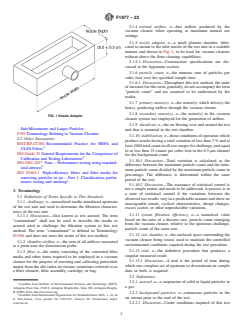
3.1.5 nozzle adaptor, n—a small plenum chamber, fabri-
cated to mount to the inlet nozzle of the test unit in a sealable
manner and shown in Fig. 1, to be used for vacuum cleaners
without above the floor cleaning capabilities.
3.1.5.1 Discussion—Construction specifications are dis-
cussed in the Apparatus section.
3.1.6 particle count, n—the numeric sum of particles per
cubic foot over the specified sample time.
3.1.6.1 Discussion—Throughout this test method, the units
ofmeasureforthisterm,generally,donotaccompanytheterm
“particle count” and are assumed to be understood by the
reader.
3.1.7 primary motor(s), n—the motor(s) which drive(s) the
fan(s), producing airflow through the vacuum cleaner.
3.1.8 secondary motor(s), n—the motor(s) in the vacuum
FIG. 1 Nozzle Adapter
cleaner system not employed for the generation of airflow.
3.1.9 sheath air, n—the air flowing over and around the test
Sub-Micrometre and Larger Particles
unit that is mounted in the test chamber.
F395Terminology Relating to Vacuum Cleaners
3.1.10 stabilization, n—those conditions of operation which
2.2 Other Documents:
produce results having a total variation of less than 3% and at
IEST-RP-CC001Recommended Practice for HEPA and
least1000totalcountinallsizerangesforchallenge,andequal
ULPA Filters
to or less than 15 counts per cubic foot in the 0.3-µm channel
ISO Guide 25General Requirements for the Competence of
for the background count.
Calibration and Testing Laboratories
3.1.10.1 Discussion—Total variation is calculated as the
ISO 5801:2017 Fans – Performance testing using standard-
difference between the maximum particle count and the mini-
ized airways
mum particle count divided by the maximum particle count in
ISO 29463-1 High-efficiency filters and filter media for
percentage. The difference is determined within the same
removing particles in air – Part 1: Classification, perfor-
period of the test.
mance testing and marking
3.1.10.2 Discussion—The assurance of statistical control is
not a simple matter and needs to be addressed.Aprocess is in
3. Terminology
a state of statistical control if the variations between the
3.1 Definitions of Terms Specific to This Standard:
observedtestresultsvaryinapredictablemannerandshowno
3.1.1 challenge, n—aerosolized media introduced upstream
unassignable trends, cyclical characteristics, abrupt changes,
of the test unit and used to determine the filtration character-
excess scatter, or other unpredictable variations.
istics of the test unit.
3.1.11 system filtration effıciency, n—a numerical value
3.1.1.1 Discussion—Also known as test aerosol. The term
based on the ratio of a discrete size, particle count emerging
“contaminant” shall not be used to describe the media or
from the vacuum cleaner, relative to the upstream challenge,
aerosol used to challenge the filtration system in this test
particle count of the same size.
method. The term “contaminant” is defined in Terminology
D1356 and does not meet the needs of this test method. 3.1.12 test chamber, n—the enclosed space surrounding the
vacuum cleaner being tested, used to maintain the controlled
3.1.2 chamber airflow, n—the sum of all airflows measured
environmental conditions required during the test procedure.
at a point near the downstream probe.
3.1.13 trial, n—the definitive procedure that produces a
3.1.3 filter, n—the entity consisting of the converted filter
singular measured result.
media and other items required to be employed in a vacuum
3.1.13.1 Discussion—A trial is the period of time during
cleaner for the purpose of arresting and collecting particulate
which one complete set of upstream or downstream air sample
matter from the dirt-laden air stream; sometimes referred to as
data, or both, is acquired.
a filter element, filter assembly, cartridge, or bag.
3.2 Definitions:
3.2.1 aerosol, n—a suspension of solid or liquid particles in
Available from Institute of Environmental Sciences and Technology (IEST),
a gas.
Arlington Place One, 2340 S.Arlington Heights Rd., Suite 100,Arlington Heights,
IL 60005-4516, http://www.iest.org.
3.2.2 background particles, n—extraneous particles in the
Available from International Organization for Standardization (ISO), 1, ch. de
air stream prior to the start of the test.
la Voie-Creuse, Case postale 56, CH-1211, Geneva 20, Switzerland, http://
www.iso.ch. 3.2.2.1 Discussion—Under conditions required of this test
F1977 − 22
method, extraneous particles will be found to pass through the portional to the ratio of the inertial force of the gas to the
5,6
test chamber (for example, particles penetrating the test cham- frictional forces acting on each element of the fluid.
ber’s HEPA filters or being abraded or released from the
3.2.13 neutralizer, n—in aerosol technology, a device used
surfaces of tubing and test equipment). Operating under
to minimize losses and coagulation caused by electrostatic
stabilized conditions, these particles shall be counted in the
charges, and to counteract high charge levels in aerosols
downstream flow and subsequently subtracted from the test
generated by nebulization, combustion, or dispersion by neu-
data to determine the initial, fractional, filtration efficiency of
tralizingtheparticlechargeleveltotheBoltzmanndistribution
the test unit (see Note 3).
level.
3.2.13.1 Discussion—Neutralizers generally use radioactive
3.2.3 channel, n—in particle analyzers, a group of particle
Krypton gas, Kr-85, sealed in a stainless steel tube shielded by
sizes having a definitive range; the lower end of the range
an outer metal housing.
identifies the channel, for example, a range of particle sizes
from 0.3 to 0.5 µm is identified as the 0.3-µm channel.
3.2.14 particle, n—a small, discrete object.
3.2.15 particulate, adj—indicates that the material in ques-
3.2.4 coincidence error, n—in particle analyzers, errors
tion has particle-like properties.
occurring at concentration levels near or above the design
limits of the instrument being used because two or more
3.2.16 population, n—thetotalofalltheunitsofaparticular
particles are simultaneously being sensed.
model vacuum cleaner being tested.
3.2.5 diffusion dryer, n—in aerosol technology, a device
3.2.17 sample, n—a small, representative group of vacuum
containing desiccant, surrounding the aerosol flow path, that cleaners, taken from a large collection (population) of vacuum
removes excess moisture by diffusion capture.
cleaners of one particular model, which serve to provide
information that may be used as a basis for making a
3.2.6 diluter, n—in aerosol technology, a device used to
determination concerning the larger collection.
reduce the concentration of particles in an aerosol.
3.2.18 submicrometer, adj—describes the range of particles
3.2.7 downstream, adv—signifies the position of any object
–6
having a mean diameter of less than 1 µm (1 × 10 m).
or condition that is physically in or part of the airflow stream
3.2.19 unit or test unit, n—a single vacuum cleaner system
occurring after the referenced item.
of the model being tested.
3.2.8 DPC, n—an acronym for Discrete Particle Counter.
3.2.20 upstream, adv—signifiesthepositionofanyobjector
3.2.8.1 Discussion—The IEST Recommended Practice
condition that is physically in or part of the airflow stream
CC001.3 and Practice F50 describe a discrete particle counter
occurring before the referenced item.
as an instrument that utilizes light-scattering or other suitable
3.2.21 vacuum cleaner, n—as defined inTerminology F395.
principle to count and size discrete particles in air, and that
displays or records the results. The discrete particle counter is 3.3 Symbols:
also known as a single-particle counter or simply as a particle
cfm = cubic feet/minute.
counter and it determines geometric rather than aerodynamic
D = diameter, in.
particle size.
ft = feet.
3.2.9 fractional effıciency, n—a numerical value based on
°F = degrees Fahrenheit.
the ratio of the number of emergent, downstream particles of a Hz = frequency, Hertz.
discrete size, relative to the number of incident, upstream H O = water, column.
in. = inch.
particles of the same size.
psi = pound-force per square inch.
3.2.9.1 Discussion—In practice, a single particle size is
Q = airflow rate, cubic feet/minute.
reported, having an understood or assumed size range equal to
RH = relative humidity.
the channel size. This value is also known as the differential
RMS = root mean square.
size efficiency or particle size efficiency, or both.
s = second.
¯
X = population mean.
3.2.10 fractional effıciency curve, n—the fractional effi-
X = test unit average.
ciency plotted as a function of the particle size.
i
–6
µm = micrometre (10 m).
3.2.11 HEPA, adj—an acronym for high-efficiency particu-
% = percent.
late air.
3.2.11.1 Discussion—Additional information pertaining to
4. Summary of Test Method
HEPA may be found in IEST-RP-CC001 or ISO 29463-1.
4.1 This test method provides a procedure to determine the
3.2.12 laminar, adj—in pneumatics, nonturbulent, laminar
initial, fractional, filtration efficiency of a vacuum cleaner
flow through a pipe is considered laminar when the Reynolds
number is less than approximately 2000 and turbulent for a
Reynolds number greater than approximately 4000. Hinds, William C., Aerosol Technology—Properties, Behavior, and Measure-
ment of Airborne Particles, John Wiley & Sons, 1982, ISBN 0-471-08726-2.
3.2.12.1 Discussion—Laminar flow in a pipe is character-
Willeke, Klaus, and Baron, Paul A., Aerosol Measurement—Principles,
ized by a smooth symmetrical pattern of streamlines. The
Techniques,andApplications,JohnWiley&Sons,formerlyVanNostrandReinhold,
Reynolds number is a non-dimensional unit of measure pro- 1993, ISBN 0-442-004486-9.
F1977 − 22
system (system filtration efficiency). The effects of the down- capableofsupportingthetestunit,shallbeplacedatornearthe
streamconcentrationofparticlesthatmaybecausedbyvarious bottom of the test chamber (opening space 2 in. (50mm) or
factors including the electric motor(s) used in the vacuum greater; open area 80% or greater).
cleanerarecountedaspartofthetestmethod.Thereportonthe
6.3 Sheath Air Supply—The test chamber’s sheath airflow
results of the testing will indicate if these downstream counts
shall be produced by a positive pressure blower system. The
were included or were mathematically removed in the deter-
sheathairisintroducedintothetopofthetestchamberthrough
mination of the initial fractional efficiency.
amanifoldanddiffusersectioninamannertoensureavelocity
4.2 In determining a vacuum cleaner system’s initial,
profile across a horizontal plane, at the middle of the chamber,
fractional, filtration efficiency, the test unit is placed in a test
that is within 10% of the maximum velocity measured at any
chamber, and sealed from ambient conditions. In this test
point on that plane, when measured at chamber flow rates of
chamber, a large, controlled volume of HEPA filtered air
100cfmorgreater;inaccordancewiththeproceduredescribed
(meeting HEPA standards as defined by IEST-RP-CC001) is
in Test Method D3154.
passed over and around the test unit. A controlled aerosol
6.3.1 The HEPA-rated filtration section and the test cham-
challenge is introduced into the vacuum cleaner system.
ber’s air supply, blower system shall be sized to provide a
Upstream and downstream, air sampling measurements of the
minimum airflow of 100 cfm at the load previously described.
number and sizes of particles, within six particular ranges
6.4 Challenge Injection System—Airenteringthetestcham-
(channels), are acquired on a near, real time basis. The initial,
ber at any point or for any purpose, unless specifically stated
fractional, filtration efficiency values at six incremental sizes
otherwise, shall initially pass through a HEPA filter. (HEPA
are then calculated.
filtration specifications are found in IEST-RP-CC001 or ISO
5. Significance and Use
29463-1.)
5.1 It is well known that modern electrical appliances,
6.4.1 An atomizing system (challenge feeder) is required to
incorporating electric motors that use carbon brushes for
inject the challenge at a constant rate equal to 65% of the
commutation, may emit aerosolized, particles into the sur-
concentrationlevelrequiredduringthedataacquisitionperiod.
rounding environment.This test method determines the initial,
This system is supported with equipment and components to
fractional, filtration efficiency of a vacuum cleaner system,
supply the required concentration level of aerosol at a maxi-
taking those emissions into consideration.
mum 20% relative humidity.
6.4.2 The atomizer shall be designed to generate polydis-
5.2 For all vacuum cleaner systems tested, the total emis-
perseaerosols(inparticularpotassiumchloride(KCl))withthe
sions of the unit, whatever the source(s), will be counted at
ability to generate sufficient particles in the 0.3 to 3.75-µm
each of the six particle size levels identified in the test
ranges as specified in 11.3.2.
procedure. This test method determines the initial, fractional
filtration efficiency of a vacuum cleaner system, with or
6.4.3 Asourceofhighpressure,HEPA-filtered,cleandryair
without the motor emissions mathematically removed in the
is provided to the challenge feed system. This air supply shall
calculation of efficiency.
be regulated to 61 psi.
6.4.4 Control of the challenge concentration level shall be
6. Apparatus
provided to ensure that the upstream air sampling concentra-
6.1 Theinformationprovidedinthistestmethodisintended
tion level does not produce coincidence errors in the upstream
to enable a laboratory to design, fabricate, and qualify the
DPC. Any control means that does not introduce extraneous
various components utilized in this procedure. Detailed and
contaminants or change the characteristics of the challenge, or
specific information regarding the components, a set of con-
the air stream which is transporting it, may be used. A
struction drawings, photos, vendor information, assembly,
procedure to determine the maximum concentration limit is
calibration, qualification testing instructions, and so forth, are
provided in Annex A4.
not provided.
6.4.5 The challenge passes through a dryer prior to entering
6.2 Main Test Chamber—The test chamber is mounted in a
the neutralizer. A dryer providing a maximum 20% relative
vertical attitude and shall be capable of enclosing the vacuum
humidity at its exit is required. A humidity probe may be
cleaner which is to be mounted in a horizontally, centralized
insertedintothedryer;therefore,theairvelocitywillnotaffect
positionthatwillallowthetestchambersheathairtoflowover
the humidity measurement.
and around it. Shown diagrammatically in Fig. 2, the body of
6.4.6 After drying, the challenge aerosol shall pass through
the chamber is between approximately 2.5ft and 3 ft in
a neutralizing device to neutralize or discharge the aerosol to
diameter (a rectangular chamber may be used) by approxi-
Boltzmann equilibrium. The neutralization may be accom-
mately 4ft to 5 ft in height, which is considered adequate for
plished with any device capable of reducing the charge of the
testing household and commercial vacuum cleaners as identi-
particulate to less than 61000 ions/cc.
fied in the scope. The test chamber is fabricated from alumi-
NOTE 1—Adequate neutralizing of particulate has been demonstrated
num or stainless steel and shall be electrically connected to an
with a variety of methods including the use of a krypton-85 gas-charged
earth ground.Alarge access panel or door shall be provided to
neutralizer and with electrostatic devices.
accommodate the installation of the test unit. This door shall
have a peripheral seal to ensure against the loss of aerosolized, 6.4.7 All air sampling and air handling tubes, positioned
challengeparticlesduringtesting.Aremovablewireformgrill, downstreamoftheneutralizerandupstreamoftheairsampling
F1977 − 22
FIG. 2 Filtration Test Chamber and Supporting Equipment
DPC,shallbemetallicorelastomerictubeswithmetallicliners (1)The injector tube should be at least 2-in. (50mm)
orantistaticproperties.Ineithercase,thesetubesshallbeearth diameterand24in.(610mm)long;fabricatedfromaluminum,
grounded. stainless steel, or steel with a rust-preventative coating; and
6.4.8 Ametallic injector tube with a smooth interior wall is shall be earth-grounded.
connected in a vertical orientation to the test chamber so that (2)The airflow metering device shall have an accuracy of
theoutletispositionedaboveandincloseproximitytotheinlet 62% with a full-scale reading of not more than two times the
point of the test vacuum cleaner. The challenge aerosol is normal airflow, and readability to 1 cfm (1lps).
injected into the top of the injector tube, through a dispersion
NOTE 2—This recommended configuration will satisfy the normal
means, to ensure a particle concentration profile, across the
airflow requirements for most known vacuum cleaners. However, a
diameter of the tube at the position of the probe, that shall be laboratory may require several injector tubes, configured differently, to
satisfy the entire range of testing conditions it could experience.
within 63%ofthemeasured,maximumparticleconcentration
whentheinjectortubeisoperatingatsteadystateconditionsof 6.4.8.2 The HEPA-filtered air enters the top of the injector
50cfm and 100cfm (23.5lps and 47lps) flow rates. This tube. The airflow produced by the vacuum cleaner shall be
section of pipe will support the thin-walled sampling probe assisted by an auxiliary air blower.
which shall be mounted in a position to ensure its proper (1)The injector tube’s auxiliary blower system shall be
5,6
function. sized to minimally provide any additional airflow required to
6.4.8.1 Operating at the specified, normal airflow rate, the make up for the losses caused by the injector tube and any
injector tube shall be sized to produce turbulent flow. The plastic tubing and the nozzle adaptor (discussed as follows),
thin-walled probe and airflow metering device shall be when the test unit is to be operating at normal airflow. The
mounted within this tube section in positions to ensure their auxiliary air blower shall be adjusted until the differential
proper functioning. pressuremeasuredbetweentheinjectiontube(thatis,upstream
F1977 − 22
channel) near the connection to the vacuum cleaner and the maximummeasuredconcentrationlevelwhenthetestchamber
main test chamber is –0.1(+0.0/–0.1) in H O (–25 Pa). is operating under steady-state flow conditions of 100cfm.
6.5.3 The air duct system, downstream from the lower pipe
NOTE 3—During the sequence of determining the background particle
section, may be of any appropriate material and may include
counts, normal airflow through the injector tube is not required. Any
backgroundparticlecountsintheinjectortubeareinsignificantandwillbe air straighteners, filters, and so forth, to accommodate airflow
counted with the challenge.
measurement devices placed in this duct section to measure
and monitor the test chamber’s airflow. A minimum, 6-in.
6.4.8.3 The neutralized challenge and feed air shall be fed
(150mm) diameter pipe should be used.
into the vacuum cleaner through the integral hose of the
product, if present.
6.6 Discrete Particle Counter(s):
6.4.8.4 Should the vacuum cleaner, under test, not have an
6.6.1 Atleastonediscreteparticlecounter(DPC),supported
integral hose, a nozzle adapter (Fig. 1) shall be constructed
by computer equipment, software, and other peripherals, is
withaflexibletubeattachedtoallowconnectiontotheinjector
required.
tube.Theflexibletube,transportingthechallengeaerosolfrom
6.6.1.1 The three possible test conditions, described in this
the outlet of the injector tube to the vacuum cleaner, by means
test method, may utilize either a one- or two-DPC system.
of a nozzle adaptor, shall not be longer than 2 times the
6.6.1.2 The DPC system may acquire air samples through a
distancebetweentheendoftheinjectortubeandtheinlettothe
switching valve system.
nozzle adaptor. This flexible tube shall be conductive and be
earth-grounded.The inside diameter of this tubing shall not be
NOTE 5—When using either DPC system, the total operational times of
less than 1.5 in. (38mm). The tubing shall not be allowed to the test unit during the trial will be identical to ensure that the unit is
subjected to the same operating conditions in both situations. This will
kink between the end of the injector tube and the inlet to the
result in different trial times; see 11.22.1 and its sub-paragraphs.
nozzle adaptor.The interfacing connections of this tube, to the
(1)In a system using two DPCs, the need to develop a
outlet of the injector tube and the inlet of the nozzle adaptor,
correlation ratio between the two DPCs and apply it when
are to be sealed and constructed to ensure no loss of challenge
determining the initial, fractional, filtration efficiency is dis-
particles or dilution of the challenge concentration.
cussed in Annex A5. When a correlation ratio is required, it
NOTE 4—Because the tubing and connections may be operating under shall be used in the determination of the fractional efficiency.
negative or positive pressure depending upon the testing conditions,
(2)For the single DPC system switching process, a me-
aerosol losses could occur from mechanical means due to improper
chanicalvalvesystemmaybeusedtoswitchbetweensampling
construction of the joints, and dilution could occur from leaks.
probes allowing sufficient time to flush the sampling line
(1)The nozzle adaptor (a rectangular-shaped box acting as
between counting periods.
a plenum chamber; see Fig. 1) is securely attached and sealed
(3)DPC equipment is extremely sensitive to high concen-
to the vacuum cleaner’s nozzle. The nozzle adaptor may be
trations of, and cumulative exposure to, any aerosolized
fabricated from any suitable, non-porous, rigid construction
particles.
materials. The seal between the nozzle and the nozzle adaptor
(4)DPCequipmentissensitivetohigh-moistureconditions
shall be leak-free. The nozzle adaptor shall not interfere with
and water vapor.
theoperationofanymechanismsthatmaybepresentinthetest
(5)Particle size measurement is a function of both the
unit’s nozzle, for example, a rotating agitator, bristle brush.
actualparticledimensionorshapefactor,orboth,aswellasthe
Theinside,cross-sectionalshapeandsizeofthenozzleadaptor
particular physical or chemical properties of the particle being
is to conform to the inside, perimeter dimensions of the test
measured. Caution is required when comparing data from
unit’snozzle.Thenozzleadaptor’sinsideheight,inadirection
instrumentsoperatingondifferentphysicalorchemicalparam-
perpendicular from the face of the nozzle, is to be 4.0in. 60.5
eters or with different particle size measurement ranges.
in. (100mm 612 mm). The flexible tube from the injector
Sample acquisition, handling, and preparation can also affect
tube, is to enter the nozzle adaptor through the center of any
the reported particle size results.
one of the three larger surfaces and shall not extend inside the
chamber by more than ⁄2 in. (see 11.2 to 11.2.7.5).
6.6.1.3 The minimal requirements of the DPC system to be
used for this procedure are as follows:
6.5 Lower Chamber:
Sizing sensitivity $0.3 µm
6.5.1 The truncated extension at the bottom of the test
Sample flow rate #1.0 cfm nominal; user adjustable within ±20 %
chamber reduces the test chamber’s horizontal cross section, 3
Concentration limit $ 1 000 000 particles ⁄ft with less than 10 %
perpendicular to the direction of airflow, resulting in an
coincidence error at the concentration limit
Operating principle Laser optics
increase in the air stream velocity through the metallic, lower
Sizing information $6 channels, user selective
pipe section placed at the bottom of this truncated section.
6.7 Dilution System:
6.5.2 The diameter of the lower pipe section should be
6.7.1 A dilution system in both the upstream and down-
approximately6in.to8in.Thissectionofpipewillsupportthe
stream sampling line may be required to maintain the DPC
downstream, air sampling, thin-walled probe which shall be
5,6
concentration level below the limit established in this test
mounted in a position to ensure its proper function. The
method.
minimum length for this pipe section shall be no less than 2 ft
(610 mm).Aerosol passing through this pipe at the location of 6.7.1.1 If the dilution system reduces particle concentration
the probe, shall have a concentration profile across the pipe by injecting air into the sampling line, this air shall be filtered
diameter that does not vary by more than 3% from the through a HEPA filter.
F1977 − 22
6.7.1.2 An airflow meter that is at least equivalent in 8. Sampling
accuracy and readability to that used in the DPC shall be used
8.1 To determine the best single estimate of the initial,
to monitor the dilution airflow.
fractional,filtrationefficiencyforthepopulationofthevacuum
cleaner model being tested, the arithmetic mean of the frac-
NOTE 6—Development of a large, upstream particle count is highly
desirable so that meaningful downstream counts are established. When tionalefficiencyratingsoftheindividualunitsfromasampleof
testing units which have a high motor emissions count, overconcentrating
the population shall be established by testing the necessary
the downstream DPC may dictate the use of a dilution system.The use of
quantity of units from the sample population, to a 90%
any dilution means will sacrifice precision in the calculation of efficiency.
confidence level within 65% of the mean value of the
In those cases where high motor emissions are present, the number of
fractional efficiency, for each particle size required.
trials required to reach 95% confidence may become high.
8.1.1 A minimum of three samples (of the same model
6.8 Other Equipment:
vacuum cleaner), selected at random in accordance with good
6.8.1 Digital Display Humidity Meter,usedforqualification
statistical practice, shall constitute the population sample.
and verification of the various air supplies. Accuracy: mini-
8.2 For each particle size required, the mean initial,
mum 63% at 70°F between 20 and 90% of range. Display
fractional, filtration efficiency of the individual test unit is
resolution: 61% RH. Response time: 15 s for a 60% step
established by performing the necessary number of trials to
change in moving air.
reach a 95% confidence level within 65% of the mean value
6.8.2 Voltmeter, to measure rated input volts to the vacuum
of the measurements acquired per particle size from all of the
cleaner; capable of providing measurements accurate within
trials.Foreachparticlesize,themeanefficiencyofthetestunit
61% of the vacuum cleaner’s rated input voltage.
is then recorded as the best estimate of the initial, fractional,
6.8.3 Voltage Regulator System, to control the input voltage
filtration efficiency of that unit and is utilized to calculate the
tothevacuumcleaner.Theregulatorsystemshallbecapableof
mean initial, fractional, filtration efficiency for the population
maintaining the vacuum cleaner’s rated voltage 61% and
sample.
rated frequency having a wave form that is essentially sinusoi-
dal with 63% maximum harmonic distortion for the duration
NOTE7—Aminimumofthreetrialsisgenerallysufficienttoachievethe
95% confidence requirement, but more may be necessary due to varia-
of the test.
tions in sample quality.
6.8.4 Thin-Walled Probes of various sizes may be required
8.2.1 For particles sizes having less than 50 counts, the
to accommodate the flow requirements of the DPC(s). The
statistics are based upon the Poisson distribution (see Annex
probesshallbesizedtomeetisokineticsamplingrequirements.
A1). For counts greater than 50, use Binomial statistics (see
Isokinetic sampling requires that the velocities of air flows in
Annex A2).
thesamplingchannels,v ,andattheentryofthesampling
channel
system, v , shall satisfy the relation:
probe
9. Calibration, Qualification, and Standardization
v
probe
0,8, ,1,2 (1)
9.1 Unless otherwise stated in this test method or the
v
channel
annexes, the maximum frequency of calibration or
.
qualification,orboth,oftheequipmentusedinthistestmethod
6.8.4.1 Probesaretobelocatedandproperlymountedinthe
is to be based upon the equipment manufacturer’s specifica-
centeroftheairstreamoftheirrespectiveductswiththeirinlets
tion. Calibrate or qualify all other equipment based on quality
oriented perpendicular to the direction of airflow.
laboratory practices set forth in ISO/IEC 17025.
6.8.4.2 The output of each probe shall be channeled to the
9.1.1 Calibrate or qualify individual equipment pieces, or
DPC through earth-grounded, smooth bore, metallic tubing.
both,whenabnormalperformanceofthespecificpieceisnoted
Electrically conductive, plastic tubing with the conductive
or suspected.
layer being earth-grounded may also be used. The tubing shall
9.2 Monitor the high-pressure air supply for the challenge
convey the aerosol sample to the DPC through the shortest
feederoranydilutionsystemforconformancetohumidityand
practicaldistance(≤1m).Inallcases,theinlettotheDPCshall
air quality requirements every six months, or immediately if
be physically positioned below the probes.All bend radii from
contamination is suspected.
the probe to the DPC shall be greater than 10 times the inside
9.3 Calibrateallotherequipment,notspecificallyidentified,
diameter of the tubing.
at least every six months.
6.8.5 Time Measuring Device, accurate to 1 s.
6.8.6 Air Ion Counter, with a range of 2 million ions/cc and
10. Conditioning
resolution of 10 ions/cc. The accuracy is to be at least 625%
of reading. 10.1 Maintain the laboratory in which all conditioning and
testing will be performed, at 70 6 5°F (21 6 3°C) and 35 to
55% relative humidity.
7. Materials
10.2 All components involved in this test method are to
7.1 A solution of KCl and distilled or demineralized water
remain in and be exposed to the controlled environment for a
as required by the aerosol generator.
minimum of 16 h prior to the start of the test.
7.1.1 KCl (potassium chloride, pure).
7.1.2 Reagent Water, Type IV, grade in accordance with 10.3 To stabilize the vacuum cleaner’s motor emissions,
Specification Designation D1193. operate the vacuum cleaner system’s motor(s) at nameplate
F1977 − 22
rated voltage (61%) and rated frequency (61 Hz), with as edge cleaning slots, should be sealed during this testing but
unimpeded airflow for a minimum of 3 h (or longer if bleed holes should be left open.
required). For vacuum cleaners with dual nameplate voltage
11.2.6 If required, change the injector tube configuration to
ratings, condition the vacuum cleaner samples at the highest
accommodate positional or flow requirements, or both, (length
rated voltage.
or diameter, or both).
10.3.1 Determine stabilization by operating the test unit in
NOTE 8—Proper dispersion of the challenge through this tube shall be
the test chamber and monitoring the downstream counts.
ensured.
Stabilization requirements are defined in the Terminology
11.2.7 It is beyond the scope of this test method to provide
section.
instructions for mounting all of the various types or styles of
vacuumcleaners.Itisincumbentuponthelaboratorytomount
11. Fractional Filtration Efficiency Test Procedure
the test units to comply with the intent of the test method and
11.1 If the motor emissions are to be excluded from the
to ensure the mounting of the vacuum cleaner allows the unit
efficiency calculations used to determine the vacuum cleaner
to function properly.
system’s initial, fractional, filtration efficiency, do not operate
11.2.7.1 The exhaust streams of the test unit and any
any secondary motor in the vacuum cleaner system during the
accessory, shall freely enter the sheath air stream.
ingestionofthechallenge.However,ifthemotoremissionsare
11.2.7.2 The vacuum cleaner system is not required to be
to be included in the efficiency calculations used to determine
mounted in a position that simulates normal operation. (This
thevacuumcleaner’sinitial,fractional,filtrationefficiency,any
does not preclude mounting the unit or accessory in an upside
secondary motor in the vacuum cleaner system shall be
down position.)
operated as recommended in the vacuum cleaner’s user guide
11.2.7.3 The normal flow of air through the vacuum cleaner
during the ingestion of the challenge.
system shall not be restricted.
11.2.7.4 The placement of the unit or the accessories, or
MOUNTING OF VACUUM CLEANER
both, shall not restrict or interfere with the functionality of one
11.2 Mount the entire vacuum cleaning system within the
another.
test chamber as follows:
11.2.7.5 Any method of mounting that allows injecting
11.2.1 Install new filter(s) in the test sample.
100% of the challenge into the test unit and establishing
11.2.2 Mount the test sample on the support grill as near to
normal exhaust streams is to be used.
the horizontal center of the test chamber as possible.
EQUIPMENT INITIALIZATION AND SETUP
11.2.3 For vacuum cleaners with an integral hose, connect
the end of the hose directly to the upstream channel.
11.3 Activate the DPC(s) and associated equipment, the
11.2.3.1 For vacuum cleaner systems which incorporate a computer, and any other electrical or electronic equipment.
separate attachment containing a secondary motor, this sepa- Allow this equipment to warm up for at least 30 min.
rate attachment and any associated tube may be removed from
11.3.1 Initialize the DPC(s) channel sizes.
the sample under test if all motor emissions are to be excluded
11.3.2 For determining the initial, fractional, filtration effi-
from the efficiency calculations. The end of the hose may be
ciency of the test unit, at the required particle sizes, set six
connected directly to the upstream channel.
particle size channels of the DPC(s) as follows:
11.2.3.2 If motor emissions are to be included in the
Channel 1 0.3 – 0.5 µm
efficiencycalculations,mountthisattachmentandtheconnect- Channel 2 0.5 – 0.7 µm
Channel 3 0.7 – 1.0 µm
ing hose and wands in the test chamber, as described in 11.2.4.
Channel 4 1.0 – 2.0 µm
All secondary motors must be connected to power and be
Channel 5 2.0 – 3.0 µm
Channel 6 >3.0 µm
energized during testing.
11.2.4 For test units without an integral hose, securely
11.3.2.1 Onlythedatafromthesesixchannelsshallbeused
attach and seal a nozzle adaptor (Fig. 1) to the vacuum
to determine the respective, fractional, filtration efficiencies at
cleaner’snozzleopeningasdescribedintheApparatussection.
the 0.3, 0.5, 0.7, 1.0, 2.0, and >3.0 µm levels.
11.2.4.1 It is the intent of this procedure that the flexible 11.3.2.2 The cumulative particle count (number of particles
tube, joining the outlet of the injector tube to the nozzle
that size and greater) data from Channel 1 will be utilized to
adaptor, be as short as possible and meet the requirements in determine stabilization.
6.4.8.4.
ESTABLISHMENT OF DYNAMIC OPERATING
11.2.5 The connection of the flexible tube to the nozzle
AIRFLOW CONDITIONS
adaptor and the nozzle adapter to the vacuum cleaner’s nozzle
is to be sealed so that all of the vacuum cleaner system’s 11.4 With the test chamber sealed and the test unit installed
airflow passes through this connection. This connection is not
in the chamber but not operating, simultaneously flush the test
toimpedethefloworreducetheparticlecountofthechallenge chamberandthetestunitwithHEPA-filteredair.Flushingmay
aerosol.
be accomplished more efficiently at high airflows.
11.2.5.1 It is not the intent of this procedure to seal any 11.4.1 Continue flushing until both the upstream and
positive or negative pressure leaks that the vacuum cleaner downstream,cumulativeparticlecountinthe0.3-µmchannelis
may have due to its design or manufacturing. Openings, such stabilizedequaltoorbelow15counts/ft /minattheinitialflow
F1977 − 22
conditions of normal airflow through the injector tube and required. Similar calculations based on the 1-cfm flow rate of
100cfm or greater through the downstream pipe. the DPC can be used to determine the required dilution ratio.
NOTE 9—Total airflow through the downstream pipe is the sum of the
11.10 With all of the equipment operating at the established
upstream sources, that is, the injector blower flow and the sheath airflow
test conditions, verify that the downstream particle count is
minus the DPC(s) flow.
20% (+0.0%, –5.0%) of the DPC concentration limit. Repeat
11.5 Applypowertothevacuumcleaner’sprimarymotorat
the preceding procedure if required.
nameplate rated voltage (61%) and rated frequency (61 Hz)
11.10.1 Record the established, test condition flow rates
andreadjusttheinjectortube’sflowratetonormalflowrate.If
(injector tube and test chamber) and any downstream dilution
thetestunithasadualvoltagenameplaterating,usethehigher
ratio.
voltage.
VERIFICATION OF CHALLENGE INJECTION
11.5.1 If the motor emissions are to be included in the
SYSTEM
efficiency calculations, energize the vacuum cleaner’s second-
ary motor(s) at the nameplate rated voltage (61%) and rated
11.11 Remove the test sample from the test chamber and
frequency (61 Hz). If the test unit has a dual voltage
reseal.Simultaneouslyflushthetestchamberandtheupstream
nameplate rating, use the higher voltage.
challengetubewithHEPA-filteredair.Flushingmaybeaccom-
11.6 Energize the injector tube’s auxiliary air blower to plished more efficiently at high airflows.
establishnormalflowthoughtheinjectortubeandthetestunit. 11.11.1 Continue flushing until both the upstream and
Adjusttheairbloweruntilthedifferentialpressurebetweenthe downstream,cumulativeparticlecountinthe0.3-µmchannelis
upstream challenge channel and the test chamber is –0.1 stabilizedequaltoorbelow15counts/ft /minattheinitialflow
inH2O(+0.0/–0.1inH2).Recordtheflowratefortheupstream conditions of normal airflow through the injector tube and
challenge tube. 100cfm or greater through the downstream pipe.
NOTE 10—Total airflow through the downstream pipe is the sum of the
11.7 With all equipment operating at these initial flow
upstream sources, that is, the injector blower flow and the sheath airflow
conditions, monitor the downstream air until the cumulative
minus the DPC(s) flow.
particle count in the 0.3-µm channel has stabilized.
11.12 Adjust the airflow in the upstream challenge tube to
11.8 If the stabilized, downstream particle counts are less
match the flow determined in 11.6 and de-energize the sheath
than 20% of the DPC concentration limit, reduce the test
air blower supplying air through the test chamber.
chamberairflowratetoarriveatalowerflowrate, Q ,which
new
11.13 Monitor the DPC sampling airflow rate and adjust to
will simultaneously increase the concentration level to the
61% of rated flow.
desired 20% level.
11.14 Activate the challenge feeder and establish a constant
0.10
Q 5 Q (2)
S D feed rate to produce a stable aerosol. Stability is determined
initial new
0.20
when counts vary by less than 10% between sampling succes-
11.8.1 Decrease the test chamber airflow rate by decreasing
sive sampling periods of the upstream sampling point for 15s
the sheath airflow rate only. As an example, the desired 20%
for at least 1min.
concentration level divided into a downstream count of 10%
11.14.1 Adjust until the upstream cumulative particle count
of the concentration limit, times the initial test chamber flow
for all channels is ≤20% (+0% / –5%) of the concentration
rate provides the new flow rate.
limit of the DPC when sampled through a dilution system.
11.8.2 The test chamber flow rate shall not be reduced to
11.15
...
This document is not an ASTM standard and is intended only to provide the user of an ASTM standard an indication of what changes have been made to the previous version. Because
it may not be technically possible to adequately depict all changes accurately, ASTM recommends that users consult prior editions as appropriate. In all cases only the current version
of the standard as published by ASTM is to be considered the official document.
Designation: F1977 − 04 (Reapproved 2017) F1977 − 22
Standard Test Method for
Determining Initial, Fractional, Filtration Efficiency of a
Vacuum Cleaner System
This standard is issued under the fixed designation F1977; the number immediately following the designation indicates the year of
original adoption or, in the case of revision, the year of last revision. A number in parentheses indicates the year of last reapproval. A
superscript epsilon (´) indicates an editorial change since the last revision or reapproval.
1. Scope
1.1 This test method may be used to determine the initial, fractional, filtration efficiency of household and commercial canister
(tank-type), stick, hand-held, upright, and utility vacuum cleaner systems.
1.1.1 Water-filtration vacuum cleaners which do not utilize a replaceable dry media filter located between the water-based filter
and cleaning air exhaust are not included in this test method. It has been determined that the exhaust of these vacuum cleaners is
not compatible with the specified discrete particle counter (DPC) procedure.
1.2 The initial, fractional, filtration efficiencies of the entire vacuum cleaner system, at six discrete particle sizes (0.3, 0.5, 0.7, 1.0,
2.0, and >3 μm), is derived by counting upstream challenge particles and the constituent of downstream particles while the vacuum
cleaner system is being operated in a stationary test condition.
1.3 The vacuum cleaner system is tested either at the nozzle with the normal airflow rate produced by restricting the inlet to the
nozzle adapter with the 1floor nozzle, the end of the hose (handle), or at the vacuum cleaner inlet (for handheld products) at ⁄4-in.
orifice. the normal airflow rate.
1.4 The vacuum cleaner system is tested with a new filter(s) installed, and with no preliminary dust loading. The fractional
efficiencies determined by this test method shall be considered initial system filtration efficiencies. The filters are not changed
between test runs on the same cleaner.
1.5 Neutralized potassium chloride (KCl) is used as the challenge media in this test method.
1.6 One or two particle counters may be used to satisfy the requirements of this test method. If using one counter, flow control
is required to switch between sampling the upstream and downstream air sampling probes.
1.7 To efficiently utilize this test method, automated test equipment and computer automation data acquisition is recommended.
1.8 Different sampling parameters, flow rates, and so forth, for the specific applications of the equipment and test procedure may
provide equivalent results. It is beyond the scope of this test method to define those various possibilities.
1.9 This test method is limited to the test apparatus, or its equivalent, as described in this document.
This test method is under the jurisdiction of ASTM Committee F11 on Vacuum Cleaners and is the direct responsibility of Subcommittee F11.23 on Filtration.
Current edition approved March 1, 2017Jan. 1, 2022. Published March 2017June 2022. Originally approved in 1999. Last previous edition approved in 20102017 as F1977
– 04 (2010).(2017). DOI: 10.1520/F1977-04R17.10.1520/F1977-22.
Copyright © ASTM International, 100 Barr Harbor Drive, PO Box C700, West Conshohocken, PA 19428-2959. United States
F1977 − 22
1.10 This test method is not intended or designed to provide any measure of the health effects or medical aspects of vacuum
cleaning.
1.11 This test method is not intended or designed to determine the integrity of HEPA filtration assemblies used in vacuum cleaner
systems employed in nuclear and defense facilities.
1.12 The inch-pound system of units is used in this test method, except for the common usage of the micrometer, μm, for the
description of particle size which is a SI unit.
1.13 This standard does not purport to address all of the safety concerns, if any, associated with its use. It is the responsibility
of the user of this standard to establish appropriate safety safety, health, and healthenvironmental practices and determine the
applicability of regulatory limitations prior to use.
1.14 This international standard was developed in accordance with internationally recognized principles on standardization
established in the Decision on Principles for the Development of International Standards, Guides and Recommendations issued
by the World Trade Organization Technical Barriers to Trade (TBT) Committee.
2. Referenced Documents
2.1 ASTM Standards:
D1193 Specification for Reagent Water
D1356 Terminology Relating to Sampling and Analysis of Atmospheres
D3154 Test Method for Average Velocity in a Duct (Pitot Tube Method)
F50 Practice for Continuous Sizing and Counting of Airborne Particles in Dust-Controlled Areas and Clean Rooms Using
Instruments Capable of Detecting Single Sub-Micrometre and Larger Particles
F395 Terminology Relating to Vacuum Cleaners
F558 Test Method for Measuring Air Performance Characteristics of Vacuum Cleaners
2.2 Other Documents:
IES Recommended Practice CC021.1 Testing HEPA and ULPA Filter Media
IES Recommended Practice CC001.3IEST-RP-CC001 Recommended Practice for HEPA and ULPA Filters
FIG. 1 Nozzle Adapter
For referenced ASTM standards, visit the ASTM website, www.astm.org, or contact ASTM Customer Service at service@astm.org. For Annual Book of ASTM Standards
volume information, refer to the standard’s Document Summary page on the ASTM website.
Available from Institute of Environmental Sciences and Technology (IEST), Arlington Place One, 2340 S. Arlington Heights Rd., Suite 100, Arlington Heights, IL
60005-4516, http://www.iest.org.
F1977 − 22
ISO Guide 25 General Requirements for the Competence of Calibration and Testing Laboratories
EN 1822ISO 5801:2017 High Efficiency Air Filters (HEPA and ULPA)Fans – Performance testing using standardized airways
ISO 29463-1 High-efficiency filters and filter media for removing particles in air – Part 1: Classification, performance testing
and marking
3. Terminology
3.1 Definitions of Terms Specific to This Standard:
3.1.1 challenge, n—aerosolized media introduced upstream of the test unit and used to determine the filtration characteristics of
the test unit.
3.1.1.1 Discussion—
Also known as test aerosol. The term “contaminant” shall not be used to describe the media or aerosol used to challenge the
filtration system in this test method. The term “contaminant” is defined in Terminology D1356 and does not meet the needs of this
test method.
3.1.2 chamber airflow, n—the sum of all airflows measured at a point near the downstream probe.
3.1.3 filter, n—the entity consisting of the converted filter media and other items required to be employed in a vacuum cleaner for
the purpose of arresting and collecting particulate matter from the dirt-laden air stream; sometimes referred to as a filter element,
filter assembly, cartridge, or bag.
3.1.4 normal airflow, n—that airflow occurring at the system’s nozzle due to the 1produced by the vacuum cleaner when operating
⁄4-in. orifice restriction at the inlet to the nozzle adapter.at maximum normal use settings.
3.1.5 nozzle adaptor, n—a small plenum chamber, fabricated to mount to the inlet nozzle of the test unit in a sealable manner and
shown in Fig. 1., to be used for vacuum cleaners without above the floor cleaning capabilities.
3.1.5.1 Discussion—
Construction specifications are discussed in the Apparatus section.
3.1.6 particle count, n—the numeric sum of particles per cubic foot over the specified sample time.
3.1.6.1 Discussion—
Throughout this test method, the units of measure for this term, generally, do not accompany the term “particle count” and are
assumed to be understood by the reader.
3.1.7 primary motor(s), n—the motor(s) which drive(s) the blower(s),fan(s), producing airflow through the vacuum cleaner.
3.1.8 secondary motor(s), n—the motor(s) in the vacuum cleaner system not employed for the generation of airflow.
3.1.9 sheath air, n—the air flowing over and around the test unit that is mounted in the test chamber.
3.1.10 stabilization, n—those conditions of operation which produce results having a total variation of less than 3 % and at least
1000 total count in all size ranges for challenge challenge, and equal to or less than 15 counts per cubic foot in the 0.3-μm channel
for the background count.
3.1.10.1 Discussion—
Total variation is calculated as the maximum data point minus the minimum data pointdifference between the maximum particle
count and the minimum particle count divided by the maximum data point times 100.particle count in percentage. The difference
is determined within the same period of the test.
3.1.10.2 Discussion—
The assurance of statistical control is not a simple matter and needs to be addressed. A process is in a state of statistical control
if the variations between the observed test results vary in a predictable manner and show no unassignable trends, cyclical
characteristics, abrupt changes, excess scatter, or other unpredictable variations.
3.1.11 system filtration effıciency, n—a numerical value based on the ratio of a discrete size, particle count emerging from the
vacuum cleaner, relative to the upstream challenge, particle count of the same size.
Available from International Organization for Standardization (ISO), 1, ch. de la Voie-Creuse, Case postale 56, CH-1211, Geneva 20, Switzerland, http://www.iso.ch.
F1977 − 22
3.1.12 test chamber, n—the enclosed space surrounding the vacuum cleaner being tested, used to maintain the controlled
environmental conditions required during the test procedure.
3.1.13 test run, trial, n—the definitive procedure that produces a singular measured result.
3.1.13.1 Discussion—
A test run trial is the period of time during which one complete set of upstream or downstream air sample data, or both, is acquired.
3.2 Definitions:
3.2.1 aerosol, n—a suspension of solid or liquid particles in a gas.
3.2.2 background particles, n—extraneous particles in the air stream prior to the start of the test.
3.2.2.1 Discussion—
Under conditions required of this test method, extraneous particles will be found to pass through the test chamber (for example,
particles penetrating the test chamber’s HEPA filters or being abraded or released from the surfaces of tubing and test equipment).
Operating under stabilized conditions, these particles shall be counted in the downstream flow and subsequently subtracted from
the test data to determine the initial, fractional, filtration efficiency of the test unit (see Note 3).
3.2.3 channel, n—in particle analyzers, a group of particle sizes having a definitive range; the lower end of the range identifies
the channel, for example, a range of particle sizes from 0.3 to 0.5 μm is identified as the 0.3-μm channel.
3.2.4 coincidence error, n—in particle analyzers, errors occurring at concentration levels near or above the design limits of the
instrument being used because two or more particles are simultaneously being sensed.
3.2.5 diffusion dryer, n—in aerosol technology, a device containing desiccant, surrounding the aerosol flow path, that removes
excess moisture by diffusion capture.
3.2.6 diluter, n—in aerosol technology, a device used to reduce the concentration of particles in an aerosol.
3.2.7 downstream, adv—signifies the position of any object or condition that is physically in or part of the airflow stream occurring
after the referenced item.
3.2.8 DPC, n—an acronym for discrete particle counter.Discrete Particle Counter.
3.2.8.1 Discussion—
The IESIEST Recommended Practice CC001.3 and Practice F50 describe a discrete particle counter as aan instrument that utilizes
light-scattering or other suitable principle to count and size discrete particles in air, and that displays or records the results. The
discrete particle counter is also known as a single-particle counter or simply as a particle counter and it determines geometric rather
than aerodynamic particle size.
3.2.9 fractional effıciency, n—a numerical value based on the ratio of the number of emergent, downstream particles of a discrete
size, relative to the number of incident, upstream particles of the same size.
3.2.9.1 Discussion—
In practice, a single particle size is reported, having an understood or assumed size range equal to the channel size. This value is
also known as the differential size efficiency or particle size efficiency, or both.
3.2.10 fractional effıciency curve, n—the fractional efficiency plotted as a function of the particle size.
3.2.11 HEPA, adj—an acronym for high-efficiency particulate air.
3.2.11.1 Discussion—
Additional information pertaining to HEPA may be found in IES 21.1 (99.97 % at 0.3 μ in salt as modified) or EN 1822 (H12 or
better at 0.3 μ rather than most penetrating particle size).IEST-RP-CC001 or ISO 29463-1.
3.2.12 laminar, adj—in pneumatics, nonturbulent, laminar flow through a pipe is considered laminar when the Reynolds number
is less than approximately 2000 and turbulent for a Reynolds number greater than approximately 4000.
3.2.12.1 Discussion—
F1977 − 22
Laminar flow in a pipe is characterized by a smooth symmetrical pattern of streamlines. The Reynolds number is a
nondimensionalnon-dimensional unit of measure proportional to the ratio of the inertial force of the gas to the frictional forces
5,6
acting on each element of the fluid.
3.2.13 neutralizer, n—in aerosol technology, a device used to minimize losses and coagulation caused by electrostatic charges, and
to counteract high charge levels in aerosols generated by nebulization, combustion, or dispersion by neutralizing the particle charge
level to the Boltzmann distribution level.
3.2.13.1 Discussion—
Neutralizers generally use radioactive Krypton gas, Kr-85, sealed in a stainless steel tube shielded by an outer metal housing.
3.2.14 particle, n—a small, discrete object.
3.2.15 particulate, adj—indicates that the material in question has particle-like properties.
3.2.16 population, n—the total of all the units of a particular model vacuum cleaner being tested.
3.2.17 sample, n—a small, representative group of vacuum cleaners, taken from a large collection (population) of vacuum cleaners
of one particular model, which serve to provide information that may be used as a basis for making a determination concerning
the larger collection.
–6
3.2.18 submicrometer, adj—describes the range of particles having a mean diameter of less than 1 μm (1 × 10 m).
3.2.19 unit or test unit, n—a single vacuum cleaner system of the model being tested.
3.2.20 upstream, adv—signifies the position of any object or condition that is physically in or part of the airflow stream occurring
before the referenced item.
3.2.21 vacuum cleaner, n—as defined in Terminology F395.
3.3 Symbols:
cfm = cubic feet/minute.
D = diameter, in.
ft = feet.
°F = degrees Fahrenheit.
Hz = frequency, Hertz.
H O = water, column.
in. = inch.
psi = pound-force per square inch.
Q = airflow rate, cubic feet/minute.
RH = relative humidity.
RMS = root mean square.
s = second.
X¯ = population mean.
X = test unit average.
i
–6
μm = micrometre (10 m).
% = percent.
4. Summary of Test Method
4.1 This test method provides a procedure to determine the initial, fractional, filtration efficiency of a vacuum cleaner system
(system filtration efficiency). The effects of the downstream concentration of particles that may be caused by various factors
Hinds, William C., Aerosol Technology—Properties, Behavior, and Measurement of Airborne Particles, John Wiley & Sons, 1982, ISBN 0-471-08726-2.
Willeke, Klaus, and Baron, Paul A., Aerosol Measurement—Principles, Techniques, and Applications, John Wiley & Sons, formerly Van Nostrand Reinhold, 1993, ISBN
0-442-004486-9.
F1977 − 22
including the electric motor(s) used in the vacuum cleaner are counted as part of the test method. The report on the results of the
testing will indicate if these downstream counts were included or were mathematically removed in the determination of the initial
fractional efficiency.
4.2 In determining a vacuum cleaner system’s initial, fractional, filtration efficiency, the test unit is placed in a test chamber, and
sealed from ambient conditions. In this test chamber, a large, controlled volume of HEPA filtered air (meeting HEPA standards as
defined by IES-RC-CC021.1)IEST-RP-CC001) is passed over and around the test unit. A controlled aerosol challenge is introduced
into the vacuum cleaner system. Upstream and downstream, air sampling measurements of the number and sizes of particles,
within six particular ranges (channels), are acquired on a near, real time basis. The initial, fractional, filtration efficiency values
at six incremental sizes are then calculated.
5. Significance and Use
5.1 It is well known that modern electrical appliances, incorporating electric motors that use carbon brushes for commutation, may
emit aerosolized, particles into the surrounding environment. This test method determines the initial, fractional, filtration efficiency
of a vacuum cleaner system, taking those emissions into consideration.
5.2 For all vacuum cleaner systems tested, the total emissions of the unit, whatever the source(s), will be counted at each of the
six particle size levels identified in the test procedure. This test method determines the initial, fractional filtration efficiency of a
vacuum cleaner system, with or without the motor emissions mathematically removed in the calculation of efficiency.
6. Apparatus
6.1 The information provided in this test method is intended to enable a laboratory to design, fabricate, and qualify the various
components utilized in this procedure. Detailed and specific information regarding the components, a set of construction drawings,
photos, vendor information, assembly, calibration, qualification testing instructions, and so forth, are not provided.
6.2 Laboratory Filtration Test Room:
6.2.1 The laboratory shall be maintained at 70 6 5°F and 35 to 55 % RH.
6.2.2 To maintain the required ambient conditions within the laboratory and the test chamber, the test chamber airflow may be
recirculated through the laboratory, in a closed-loop fashion. The air should pass through a HEPA filtration system before
exhausting into the laboratory.
6.2 Main Test Chamber—The test chamber is mounted in a vertical attitude and shall be capable of enclosing the vacuum cleaner
which is to be mounted in a horizontally, centralized position that will allow the test chamber sheath air to flow over and around
it. Shown diagrammatically in Fig. 2, the body of the chamber is between approximately 2.52.5 ft and 3 ft in diameter (a
rectangular chamber may be used) by approximately 44 ft to 5 ft in height, which is considered adequate for testing household and
commercial vacuum cleaners as identified in the scope. The test chamber is fabricated from aluminum or stainless steel and shall
be electrically connected to an earth ground. A large access panel or door shall be provided to accommodate the installation of the
test unit. This door shall have a peripheral seal to ensure against the loss of aerosolized, challenge particles during testing. A
removable wire form grill, capable of supporting the test unit, shall be placed at or near the bottom of the test chamber (opening
space 2 in. (50 mm) or greater; 0.2-in. diameter rod or less; open area 80 % or greater).
6.3 Sheath Air Supply—The test chamber’s sheath airflow shall be produced by a positive pressure blower system. The sheath air
is introduced into the top of the test chamber through a manifold and diffuser section in a manner to ensure a velocity profile across
a horizontal plane, at the middle of the chamber, that is within 10 % of the maximum velocity measured at any point on that plane,
when measured at chamber flow rates of 100 and 1000 cfm;cfm or greater; in accordance with the procedure described in Test
Method D3154.
6.3.1 The HEPA-rated filtration section and the test chamber’s air supply, blower system shall be sized to provide a minimum
airflow of 1000100 cfm at the load previously described.
6.4 Challenge Injection System—Air entering the test chamber at any point or for any purpose, unless specifically stated otherwise,
shall initially pass through a HEPA filter. (HEPA filtration specifications are found in IES-RP-CC021.1.)IEST-RP-CC001 or ISO
29463-1.)
F1977 − 22
FIG. 2 Filtration Test Chamber and Supporting Equipment
6.4.1 An atomizing system (challenge feeder) is required to inject the challenge at a constant rate equal to 65 % of the
concentration level required during the data acquisition period. This system is supported with equipment and components to supply
the required concentration level of aerosol at a maximum 20 % relative humidity.
6.4.2 The atomizer shall be designed to generate polydisperse aerosols (in particular potassium chloride (KCl)) with the ability
to generate sufficient particles in the 0.3 to 3.75-μm ranges as specified in 12.3.211.3.2.
6.4.3 A source of high pressure, HEPA-filtered, clean dry air is provided to the challenge feed system. This air supply shall be
regulated to 61 psi and operator controlled between 0 and 80 psi.
6.4.4 Control of the challenge concentration level shall be provided to ensure that the upstream air sampling concentration level
does not produce coincidence errors in the upstream DPC. Any control means that does not introduce extraneous contaminants or
change the characteristics of the challenge, or the air stream which is transporting it, may be used. A procedure to determine the
maximum concentration limit is provided in Annex A4. The amount of challenge for a particular particle size should not exceed
1 million counts upstream.
6.4.5 The challenge passes through a dryer prior to entering the neutralizer. A dryer providing a maximum 20 % relative humidity
at its exit is required. TheA humidity probe is located in may be inserted into the dryer; therefore, the air velocity will not affect
the humidity measurement.
6.4.6 After drying, the challenge aerosol shall pass through a krypton-85, gas-charged neutralizer neutralizing device to neutralize
F1977 − 22
or discharge the aerosol to Boltzmann equilibrium. The neutralization may be accomplished with any device capable of reducing
the charge of the particulate to less than 61000 ions/cc.
NOTE 1—Adequate neutralizing of particulate has been demonstrated with a variety of methods including the use of a krypton-85 gas-charged neutralizer
and with electrostatic devices.
6.4.7 All air sampling and air handling tubes, positioned downstream of the neutralizer and upstream of the air sampling DPC,
shall be metallic or elastomeric tubes with metallic liners. liners or antistatic properties. In either case, these tubes shall be earth
grounded.
6.4.8 A metallic injector tube with a smooth interior wall is mounted vertically inside connected in a vertical orientation to the
test chamber so that the outlet is positioned above and in close proximity to the inlet point of the test vacuum cleaner. The challenge
aerosol is injected into the top of the injector tube, through a dispersion means, to ensure a particle concentration profile, across
the diameter of the tube at the position of the probe, that shall be within 63 % of the measured, maximum particle concentration
when the injector tube is operating at steady state conditions of 50 and 100-cfm 50 cfm and 100 cfm (23.5 lps and 47 lps) flow
rates. This section of pipe will support the thin-walled sampling probe which shall be mounted in a position to ensure its proper
5,6
function.
6.4.8.1 Operating at the specified, normal airflow rate, the injector tube shall be sized to produce turbulent flow. The thin-walled
probe and airflow metering device shall be mounted within this tube section in positions to ensure their proper functioning.
(1) The injector tube should be approximately at least 2-in. (50 mm) diameter and 24 in. (610 mm) long; fabricated from
aluminum, stainless steel, or steel with a rust-preventative coating; and shall be earth-grounded.
(2) The airflow metering device shall have an accuracy of 62 % with a full-scale reading of not more than two times the
normal airflow, and readability to 1 cfm.cfm (1 lps).
NOTE 2—This recommended configuration will satisfy the normal airflow requirements for most known vacuum cleaners and is considered a practical
size for mounting within the test chamber. cleaners. However, a laboratory may require several injector tubes, configured differently, to satisfy the entire
range of testing conditions it could experience.
6.4.8.2 The HEPA-filtered air enters the top of the injector tube. The airflow can be produced by a DPC vacuum pump, the vacuum
cleaner, the vacuum cleaner shall be assisted by an auxiliary air blower, or any combination of those elements. In some cases, such
as testing a secondary motor, an auxiliary blower is required.blower.
(1) The injector tube’s auxiliary blower system shall be sized to minimally provide any additional airflow required to make up
for the losses caused by the injector tube and any plastic tubing and the nozzle adaptor (discussed as follows), when the test unit
is to be operating at normal airflow. The auxiliary air blower shall be adjusted until the differential pressure measured between the
injection tube (that is, upstream channel) near the connection to the vacuum cleaner and the main test chamber is –0.1(+0.0/–0.1)
in H O (–25 Pa).
NOTE 3—During the sequence of determining the background particle counts, normal airflow through the injector tube is not required. Any background
particle counts in the injector tube are insignificant and will be counted with the challenge.
6.4.8.3 The neutralized challenge and feed air shall be fed into the vacuum cleaner through the integral hose of the product, if
present.
6.4.8.4 Should the vacuum cleaner, under test, not have an integral hose, a nozzle adapter (Fig. 1) shall be constructed with a
flexible tube attached to allow connection to the injector tube. The flexible tube, transporting the challenge aerosol from the outlet
of the injector tube to the vacuum cleaner, by means of a nozzle adaptor, shall not be longer than 2 times the distance between
the end of the injector tube and the inlet to the nozzle adaptor. An elastomeric tube having an earth-grounded, metallic liner shall
be used. This flexible tube shall be conductive and be earth-grounded. The inside diameter of this tubing shall not be less than 1
in.; the wall of the tubing shall not be less than 1.5 ⁄8in. (38 mm). The tubing shall not be allowed to kink between the end of the
injector tube and the inlet to the nozzle adaptor. The interfacing connections of this tube, to the outlet of the injector tube and the
inlet of the nozzle adaptor, are to be sealed and constructed to ensure no loss of challenge particles or dilution of the challenge
concentration.
NOTE 4—Because the tubing and connections may be operating under negative or positive pressure depending upon the testing conditions, aerosol losses
could occur from mechanical means due to improper construction of the joints, and dilution could occur from leaks.
F1977 − 22
(1) The injector tube’s blower system shall be sized to minimally provide any additional airflow required to make up for the
losses caused by the injector tube, plastic tubing, and the nozzle adaptor (discussed as follows), when the test unit is to be operating
at normal airflow. A blower system with the following performance characteristics should be expected to satisfy most test
conditions: sealed suction in excess 100 in. H O and airflow in excess of 100 cfm at a 2-in. orifice as determined in accordance
with Test Method F558.
(1) The nozzle adaptor (a rectangular-shaped box acting as a plenum chamber; see Fig. 1) is securely attached and sealed to
the vacuum cleaner’s nozzle. The nozzle adaptor may be fabricated from any suitable, non-porous, rigid construction materials.
The seal between the nozzle and the nozzle adaptor shall be leak-free. The nozzle adaptor shall not interfere with the operation
of any mechanisms that may be present in the test unit’s nozzle, for example, a rotating agitator, bristle brush. The inside,
cross-sectional shape and size of the nozzle adaptor is to conform to the inside, perimeter dimensions of the test unit’s nozzle. The
nozzle adaptor’s inside height, in a direction perpendicular from the face of the nozzle, is to be 4.0 in. 60.5 in. (100 mm 612 mm).
The flexible tube from the injector tube, is to enter the nozzle adaptor through the center of any one of the three larger surfaces
and shall not extend inside the chamber by more than ⁄2 in. (see 11.2 to 11.2.7.5).
NOTE 3—During the sequence of determining the background particle counts, normal airflow through the injector tube is not required. Any background
particle counts in the injector tube are insignificant and will be counted with the challenge.
6.5.9 The nozzle adaptor (a rectangular-shaped box acting as a plenum chamber; see Fig. 1) is securely attached and sealed to the
vacuum cleaner’s nozzle. The nozzle adaptor may be fabricated from wood or other suitable construction materials. The seal
between the nozzle and the nozzle adaptor shall be leak-free. The nozzle adaptor shall not interfere with the operation of any
mechanisms that may be present in the test unit’s nozzle, for example, a rotating agitator, bristle brush. The inside, cross-sectional
shape and size of the nozzle adaptor is to conform to the inside, perimeter dimensions of the test unit’s nozzle. The nozzle adaptor’s
inside height, in a direction perpendicular from the face of the nozzle, is to be 4 6 ⁄2 in. The flexible tube from the injector tube,
is to enter the nozzle adaptor through the center of any one of the three larger surfaces and shall not extend inside the chamber
by more than ⁄2 in. (see 12.2 to 12.2.8.5).
6.5 Lower Chamber:
6.5.1 The truncated extension at the bottom of the test chamber reduces the test chamber’s horizontal cross section, perpendicular
to the direction of airflow, resulting in an increase in the air stream velocity through the metallic, lower pipe section placed at the
bottom of this truncated section.
6.5.2 The diameter of the lower pipe section should be approximately 66 in. to 8 in. This will produce a desirable, turbulent flow
without greatly restricting the test chamber airflow. This section of pipe will support the downstream, air sampling, thin-walled
5,6
probe which shall be mounted in a position to ensure its proper function. The minimum length for this pipe section shall be no
less than 2 ft. ft (610 mm). Aerosol passing through this pipe at the location of the probe, shall have a concentration profile across
the pipe diameter that does not vary by more than 3 % from the maximum measured concentration level when the test chamber
is operating under steady-state flow conditions of 100 and 1000 cfm.100 cfm.
6.5.3 The air duct system, downstream from the lower pipe section, may be of any appropriate material and may include air
straighteners, filters, and so forth, to accommodate airflow measurement devices placed in this duct section to measure and monitor
the test chamber’s airflow. A minimum, 6-in. (150 mm) diameter pipe should be used.
6.6 Discrete Particle Counter(s):
6.6.1 At least one discrete particle counter (DPC), supported by computer equipment, software, and other peripherals, is required.
6.6.1.1 The three possible test conditions, described in this test method, may utilize either a one- or two-DPC system.
6.6.1.2 The DPC system may acquire air samples through a switching valve system.
NOTE 5—When using either DPC system, the total operational times of the test unit during the test run trial will be identical to ensure that the unit is
subjected to the same operating conditions in both situations. This will result in different test run trial times; see 12.13.111.22.1 and its sub-paragraphs.
(1) In a system using two DPCs, capable of simultaneously switching from sampling one probe to the other, the the need to
develop a correlation ratio between the two DPCs and apply it when determining the initial, fractional, filtration efficiency is
discussed in Annex A5. When a correlation ratio is required, it shall be used in the determination of the fractional efficiency. In
F1977 − 22
most cases, it can be expected that the need will be negated because any difference between the two DPCs and the sampling lines
would be canceled out in the switching process.
(2) For the single DPC system switching process, an electrical a mechanical valve system should be used in both DPC
systems.may be used to switch between sampling probes allowing sufficient time to flush the sampling line between counting
periods.
(3) DPC equipment is extremely sensitive to high concentrations of, and cumulative exposure to, any aerosolized particles.
(4) DPC equipment is sensitive to high-moisture conditions and water vapor.
(5) Particle size measurement is a function of both the actual particle dimension or shape factor, or both, as well as the
particular physical or chemical properties of the particle being measured. Caution is required when comparing data from
instruments operating on different physical or chemical parameters or with different particle size measurement ranges. Sample
acquisition, handling, and preparation can also affect the reported particle size results.
6.6.1.3 The minimal requirements of the DPC system to be used for this procedure are as follows:
Sizing sensitivity $0.3 μm
Sample flow rate #1.0 cfm nominal; user adjustable within ±20 %
Concentration limit $ a minimum 1 000 000 particles ⁄ft with less
than 10 % coincidence error at the concentration
limit
Concentration limit $ 1 000 000 particles ⁄ft with less than 10 %
coincidence error at the concentration limit
Operating principle Laser optics
Sizing information $8 channels, user selective
Sizing information $6 channels, user selective
6.7 Dilution System:
6.7.1 A dilution system in both the upstream and downstream sampling line may be required to maintain the DPC concentration
level below the limit established in this test method.
6.7.1.1 If the dilution system reduces particle concentration by injecting air into the sampling line, this air shall be filtered through
a HEPA filter.
6.7.1.2 An airflow meter that is at least equivalent in accuracy and readability to that used in the DPC shall be used to monitor
the dilution airflow.
NOTE 6—Development of a large, upstream particle count is highly desirable so that meaningful downstream counts are established. When testing units
which have a high motor emissions count, overconcentrating the downstream DPC may dictate the use of a dilution system. The use of any dilution means
will sacrifice precision in the calculation of efficiency. In those cases where high motor emissions are present, the number of test runs trials required to
reach 95 % confidence may become high.
6.8 Other Equipment:
6.8.1 Digital Display Humidity Meter, used for qualification and verification of the various air supplies. Accuracy: minimum 63 %
at 78°F70°F between 20 and 90 % of range. Display resolution: 61 % RH. Response time: 15 s for a 60 % step change in moving
air.
6.8.2 Voltmeter, to measure rated input volts to the vacuum cleaner; capable of providing measurements accurate within 61 % of
the vacuum cleaner’s rated input voltage.
6.8.3 Voltage Regulator System, to control the input voltage to the vacuum cleaner. The regulator system shall be capable of
maintaining the vacuum cleaner’s rated voltage 61 % and rated frequency having a wave form that is essentially sinusoidal with
63 % maximum harmonic distortion for the duration of the test.
6.8.4 Thin-Walled Probes of various sizes may be required to accommodate the flow requirements of the DPC(s). The probes shall
be sized to meet the performance requirements isokinetic sampling requirements. Isokinetic sampling requires that the velocities
of 12.4air flows in the sampling channels, v and its depending, sub-paragraphs., and at the entry of the sampling system,
channel
v , shall satisfy the relation:
probe
F1977 − 22
v
probe
0,8, ,1,2 (1)
v
channel
.
6.8.4.1 Probes are to be located and properly mounted in the middlecenter of the airstream of their respective ducts.ducts with their
inlets oriented perpendicular to the direction of airflow.
6.8.4.2 The output of each probe shall be channeled to the DPC through earth-grounded, smooth bore, metallic tubing. Electrically
conductive, plastic tubing with the conductive layer being earth-grounded may also be used. The tubing shall convey the aerosol
sample to the DPC through the shortest practical distance. distance (≤1 m). In all cases, the inlet to the DPC shall be physically
positioned below the probes outlet and not more than 2 ft from the vertical center line of the test chamber. probes. All bend radii
from the probe to the DPC shall be greater than 10 times the inside diameter of the tubing which shall be sized so that high-velocity
flow conditions exist (Reynolds number 4000 or larger).tubing.
6.8.5 Time Measuring Device, accurate to 1 s.
6.8.6 Air Ion Counter, with a range of 2 million ions/cc and resolution of 10 ions/cc. The accuracy is to be at least 625 % of
reading.
7. Materials
7.1 A solution of KCl and distilled or demineralized water as required by the aerosol generator.
7.1.1 KCl (potassium chloride, pure).
7.1.2 Reagent Water, Type IV, grade in accordance with Specification Designation D1193.
7.2 Latex (Polystyrene) Spherical Particles, traceable to the National Institute of Standards and Technology, (NIST) used for the
calibration or verification, or both, of the DPC.
7.2.1 The proper concentration level of latex spheres shall be used in the aerosol generator as discussed in Aerosol
Measurement-Principles, Techniques, and Applications, p. 63-64.
8. Hazards
8.1 Warning—DPC equipment is extremely sensitive to high concentrations of, and cumulative exposure to, any aerosolized
particles.
8.2 Warning—DPC equipment is sensitive to high-moisture conditions and water vapor.
8.3 Warning—Particle size measurement is a function of both the actual particle dimension or shape factor, or both, as well as
the particular physical or chemical properties of the particle being measured. Caution is required when comparing data from
instruments operating on different physical or chemical parameters or with different particle size measurement ranges. Sample
acquisition, handling, and preparation can also affect the reported particle size results.
8. Sampling
8.1 To determine the best single estimate of the initial, fractional, filtration efficiency for the population of the vacuum cleaner
model being tested, the arithmetic mean of the fractional efficiency ratings of the individual units from a sample of the population
shall be established by testing the necessary quantity of units from the sample population, to a 90 % confidence level within 65 %
of the mean value of the fractional efficiency, for each particle size required.
8.1.1 A minimum of three unitssamples (of the same model vacuum cleaner), selected at random in accordance with good
statistical practice, shall constitute the population sample.
8.2 For each particle size required, the mean initial, fractional, filtration efficiency of the individual test unit is established by
F1977 − 22
performing the necessary number of test runs trials to reach a 95 % confidence level within 65 % of the mean value of the
measurements acquired per particle size from all of the test runs. trials. For each particle size, the mean efficiency of the test unit
is then recorded as the best estimate of the initial, fractional, filtration efficiency of that unit and is utilized to calculate the mean
initial, fractional, filtration efficiency for the population sample.
NOTE 7—A minimum of three trials is generally sufficient to achieve the 95 % confidence requirement, but more may be necessary due to variations in
sample quality.
8.2.1 For particles sizes having less than 50 counts, the statistics are based upon the Poisson distribution (see Annex A1). For
counts greater than 50, use Binomial statistics (see Annex A2).
9. Calibration, Qualification, and Standardization
9.1 Unless otherwise stated in this test method or the annexes, the maximum frequency of calibration or qualification, or both, of
the equipment used in this test method is to be based upon the equipment manufacturer’s specification. Calibrate or qualify all other
equipment based on quality laboratory practices set forth in ISO/DISISO/IEC 17025.
9.1.1 Calibrate or qualify individual equipment pieces, or both, when abnormal performance of the specific piece is noted or
suspected.
9.2 Monitor the high-pressure air supply for the challenge feeder or any dilution system for conformance to humidity and air
quality requirements every six months, or immediately if contamination is suspected.
9.3 Calibrate all other equipment, not specifically identified, at least every six months.
10. Conditioning
10.1 Maintain the laboratory in which all conditioning and testing will be performed, at 70 6 5°F (21 6 3°C) and 35 to 55 %
relative humidity.
10.2 All components involved in this test method are to remain in and be exposed to the controlled environment for a minimum
of 16 h prior to the start of the test.
10.3 To stabilize the vacuum cleaner’s motor emissions, operate the vacuum cleaner system’s motor(s) at nameplate rated voltage
(61 %) and rated frequency (61 Hz), with unimpeded airflow for a minimum of 3 h or(or longer if required.required). For vacuum
cleaners with dual nameplate voltage ratings, conduct the run in condition the vacuum cleaner samples at the highest rated voltage.
10.3.1 Determine stabilization by operating the test unit in the test chamber and monitoring the downstream counts. Stabilization
requirements are defined in the Terminology section.
11. Fractional Filtration Efficiency Test Procedure
11.1 If the motor emissions are to be excluded from the efficiency calculations used to determine the vacuum cleaner system’s
initial, fractional, filtration efficiency, do not operate any secondary motor in the vacuum cleaner system during the ingestion of
the challenge. However, if the motor emissions are to be included in the efficiency calculations used to determine the vacuum
cleaner’s initial, fractional, filtration efficiency, any secondary motor in the vacuum cleaner system must be operated shall be
operated as recommended in the vacuum cleaner’s user guide during the ingestion of the challenge.
12.1.1 For those units incorporating the secondary motor in a separate attachment (for example, a powered nozzle in a canister
vacuum cleaner system), mount this attachment and the connecting hose and wands in the test chamber, as described as follows.
Power to the secondary motor may be disconnected during the ingestion of the challenge to aid in reducing the downstream particle
count if motor emissions are to be excluded from the efficiency calculations. However, if motor emissions are to be included in
the efficiency calculations, all secondary motors must be connected to power and be energized during testing.
F1977 − 22
MOUNTING OF VACUUM CLEANER
11.2 Mount the entire vacuum cleaning system within the test chamber as follows:
12.2.1 For all test units, securely attach and seal a nozzle adaptor (Fig. 1) to the vacuum cleaner’s nozzle as described in the
Apparatus section.
11.2.1 Install new filter(s) in the test unit.sample.
11.2.2 Mount the test unitsample on the support grill as near to the horizontal center of the test chamber as possible.
11.2.3 For vacuum cleaners with an integral hose, connect the end of the hose directly to the upstream channel.
11.2.3.1 For vacuum cleaner systems which incorporate a separate attachment containing a secondary motor, this separate
attachment and any associated tube may
...