

ASTM G208-12(2020)
(Practice)Standard Practice for Evaluating and Qualifying Oilfield and Refinery Corrosion Inhibitors Using Jet Impingement Apparatus
General Information
- Abstract
SIGNIFICANCE AND USE
5.1 Selection of corrosion inhibitor for oilfield and refinery applications involves qualification of corrosion inhibitors in the laboratory (see Guide G170). Field conditions should be simulated in the laboratory in a fast and cost-effective manner.
5.2 Oilfield and refinery corrosion inhibitors should provide protection over a range of flow conditions from stagnant to that found during typical production conditions. The inhibitors are not equally effective over all flow conditions, so it is important to determine the flow conditions in which they are effective.
5.3 Severity of hydrodynamic conditions depends on the type of laboratory methodology. Typically, rotating cylinder electrode is effective up to 20 Pa of wall shear stress, rotating cage (RC) is effective between 20 and 200 Pa of wall shear stress, and jet impingement (JI) is effective at wall shear stress above 200 Pa (1)3 of wall shear stress.
5.4 The JI test system is relatively inexpensive and uses simple flat specimens.
5.5 In this practice, a general procedure is presented to obtain reproducible results using JI simulating the effects of different types of coupon materials; inhibitor concentrations; oil, gas, and brine compositions; temperature; pressure; and flow. Erosive effects predominate when the flow rate is very high (typically above 500 Pa) or when sand or solid particles are present; however, this practice does not cover the erosive effects.
SCOPE
1.1 This practice covers a generally accepted procedure to use the jet impingement (JI) apparatus for evaluating corrosion inhibitors for oilfield and refinery applications in defined flow conditions.
1.2 The values stated in SI units are to be regarded as standard. No other units of measurement are included in this standard.
1.3 This standard does not purport to address all of the safety concerns, if any, associated with its use. It is the responsibility of the user of this standard to establish appropriate safety, health, and environmental practices and determine the applicability of regulatory limitations prior to use.
1.4 This international standard was developed in accordance with internationally recognized principles on standardization established in the Decision on Principles for the Development of International Standards, Guides and Recommendations issued by the World Trade Organization Technical Barriers to Trade (TBT) Committee.
- Status
- Published
- Publication Date
- 31-Oct-2020
- Technical Committee
- G01 - Corrosion of Metals
- Drafting Committee
- G01.05 - Laboratory Corrosion Tests
Overview
ASTM G208-12(2020) is the internationally recognized standard practice for evaluating and qualifying oilfield and refinery corrosion inhibitors using a jet impingement (JI) apparatus. Published by ASTM International, this standard provides a reproducible laboratory method to assess the effectiveness of corrosion inhibitors under controlled hydrodynamic conditions that simulate those found in oil and gas production and processing environments.
Corrosion control is vital to the integrity and reliability of oilfield and refinery infrastructure. Selecting effective corrosion inhibitors demands reliable laboratory qualification, ensuring the chosen product performs across relevant field conditions. ASTM G208 details test procedures using JI equipment to support consistent, cost-effective, and rapid laboratory assessment, complementing the broad requirements of operational safety and asset longevity.
Key Topics
- Jet Impingement Apparatus: Outlines the use of JI systems, which can simulate flow conditions found in aggressive oilfield and refinery processes. The standard describes several design configurations with varying specimen types (disc and ring).
- Hydrodynamic Conditions: Provides guidance on replicating flow environments with wall shear stresses above 200 Pa, often exceeding the capabilities of rotating cylinder or cage methodologies.
- Corrosion Inhibitor Evaluation: Includes procedures for testing different coupon materials, inhibitor concentrations, and compositions relevant to oil, gas, and brine systems at various temperatures and pressures.
- Test Reproducibility and Reporting: Specifies detailed requirements for recording key experimental parameters (e.g., solution chemistry, jet velocity, specimen details) and statistical data analysis to ensure result reproducibility and comparability.
- Exclusions: The practice does not cover erosive effects, such as those induced by sand or solid particles in flows above 500 Pa.
- Safety and Compliance: Users are responsible for establishing appropriate health, safety, and environmental protocols and determining regulatory applicability.
Applications
This standard is central to laboratory R&D and quality control in industries where corrosion poses a significant operational threat. Practical applications include:
- Oilfield Inhibitor Qualification: Screen and qualify candidate products for downhole, pipeline, and surface facility protection, reducing field trial costs and downtime.
- Refinery Corrosion Control: Assess inhibitors for diverse refinery streams, ensuring assets are shielded from corrosive process fluids under turbulent or high-velocity flow.
- Flow Condition Simulation: Replicate severe hydrodynamic environments, predicting inhibitor performance for scenarios not feasible in other lab setups (e.g., high-flow pipelines, production tubing).
- Product Comparison and Optimization: Generate quantitative performance data to support inhibitor selection, benchmarking, and optimization for specific operational requirements.
- Regulatory and Safety Compliance: Demonstrate conformance to industry expectations and facilitate documentation in line with international trade and safety regulations.
Related Standards
For comprehensive corrosion inhibitor evaluation, ASTM G208 is frequently used alongside other pertinent ASTM standards, including:
- ASTM G170 - Guide for Evaluating and Qualifying Oilfield and Refinery Corrosion Inhibitors in the Laboratory
- ASTM G184 - Practice for Evaluating and Qualifying Oil Field and Refinery Corrosion Inhibitors Using Rotating Cage
- ASTM G185 - Practice for Evaluating and Qualifying Oil Field and Refinery Corrosion Inhibitors Using the Rotating Cylinder Electrode
- ASTM G31 - Guide for Laboratory Immersion Corrosion Testing of Metals
- ASTM G46 - Guide for Examination and Evaluation of Pitting Corrosion
- ASTM G102 - Practice for Calculation of Corrosion Rates and Related Information from Electrochemical Measurements
- ASTM G16 - Guide for Applying Statistics to Analysis of Corrosion Data
Adhering to ASTM G208 demonstrates a commitment to global best practices in laboratory corrosion inhibitor qualification, supporting safe, efficient, and reliable oil and gas operations.
Keywords: ASTM G208, jet impingement apparatus, oilfield corrosion inhibitors, refinery corrosion inhibitors, hydrodynamic corrosion testing, laboratory qualification, corrosion rate, inhibitor efficiency, flow simulation, oil and gas corrosion standards
Relations
- Effective Date
- 15-Feb-2019
- Effective Date
- 01-May-2018
- Effective Date
- 01-Jan-2016
- Effective Date
- 01-Nov-2014
- Effective Date
- 01-Dec-2013
- Effective Date
- 01-Aug-2013
- Effective Date
- 01-May-2013
- Effective Date
- 01-May-2013
- Effective Date
- 01-Feb-2013
- Effective Date
- 01-Feb-2013
- Effective Date
- 01-Feb-2013
- Effective Date
- 15-Nov-2012
- Effective Date
- 01-Nov-2012
- Effective Date
- 01-Dec-2011
- Effective Date
- 15-Nov-2011
Get Certified
Connect with accredited certification bodies for this standard

Element Materials Technology
Materials testing and product certification.

ABS Group Brazil
ABS Group certification services in Brazil.

ABS Quality Evaluations Inc.
American Bureau of Shipping quality certification.
Sponsored listings
Frequently Asked Questions
ASTM G208-12(2020) is a standard published by ASTM International. Its full title is "Standard Practice for Evaluating and Qualifying Oilfield and Refinery Corrosion Inhibitors Using Jet Impingement Apparatus". This standard covers: SIGNIFICANCE AND USE 5.1 Selection of corrosion inhibitor for oilfield and refinery applications involves qualification of corrosion inhibitors in the laboratory (see Guide G170). Field conditions should be simulated in the laboratory in a fast and cost-effective manner. 5.2 Oilfield and refinery corrosion inhibitors should provide protection over a range of flow conditions from stagnant to that found during typical production conditions. The inhibitors are not equally effective over all flow conditions, so it is important to determine the flow conditions in which they are effective. 5.3 Severity of hydrodynamic conditions depends on the type of laboratory methodology. Typically, rotating cylinder electrode is effective up to 20 Pa of wall shear stress, rotating cage (RC) is effective between 20 and 200 Pa of wall shear stress, and jet impingement (JI) is effective at wall shear stress above 200 Pa (1)3 of wall shear stress. 5.4 The JI test system is relatively inexpensive and uses simple flat specimens. 5.5 In this practice, a general procedure is presented to obtain reproducible results using JI simulating the effects of different types of coupon materials; inhibitor concentrations; oil, gas, and brine compositions; temperature; pressure; and flow. Erosive effects predominate when the flow rate is very high (typically above 500 Pa) or when sand or solid particles are present; however, this practice does not cover the erosive effects. SCOPE 1.1 This practice covers a generally accepted procedure to use the jet impingement (JI) apparatus for evaluating corrosion inhibitors for oilfield and refinery applications in defined flow conditions. 1.2 The values stated in SI units are to be regarded as standard. No other units of measurement are included in this standard. 1.3 This standard does not purport to address all of the safety concerns, if any, associated with its use. It is the responsibility of the user of this standard to establish appropriate safety, health, and environmental practices and determine the applicability of regulatory limitations prior to use. 1.4 This international standard was developed in accordance with internationally recognized principles on standardization established in the Decision on Principles for the Development of International Standards, Guides and Recommendations issued by the World Trade Organization Technical Barriers to Trade (TBT) Committee.
SIGNIFICANCE AND USE 5.1 Selection of corrosion inhibitor for oilfield and refinery applications involves qualification of corrosion inhibitors in the laboratory (see Guide G170). Field conditions should be simulated in the laboratory in a fast and cost-effective manner. 5.2 Oilfield and refinery corrosion inhibitors should provide protection over a range of flow conditions from stagnant to that found during typical production conditions. The inhibitors are not equally effective over all flow conditions, so it is important to determine the flow conditions in which they are effective. 5.3 Severity of hydrodynamic conditions depends on the type of laboratory methodology. Typically, rotating cylinder electrode is effective up to 20 Pa of wall shear stress, rotating cage (RC) is effective between 20 and 200 Pa of wall shear stress, and jet impingement (JI) is effective at wall shear stress above 200 Pa (1)3 of wall shear stress. 5.4 The JI test system is relatively inexpensive and uses simple flat specimens. 5.5 In this practice, a general procedure is presented to obtain reproducible results using JI simulating the effects of different types of coupon materials; inhibitor concentrations; oil, gas, and brine compositions; temperature; pressure; and flow. Erosive effects predominate when the flow rate is very high (typically above 500 Pa) or when sand or solid particles are present; however, this practice does not cover the erosive effects. SCOPE 1.1 This practice covers a generally accepted procedure to use the jet impingement (JI) apparatus for evaluating corrosion inhibitors for oilfield and refinery applications in defined flow conditions. 1.2 The values stated in SI units are to be regarded as standard. No other units of measurement are included in this standard. 1.3 This standard does not purport to address all of the safety concerns, if any, associated with its use. It is the responsibility of the user of this standard to establish appropriate safety, health, and environmental practices and determine the applicability of regulatory limitations prior to use. 1.4 This international standard was developed in accordance with internationally recognized principles on standardization established in the Decision on Principles for the Development of International Standards, Guides and Recommendations issued by the World Trade Organization Technical Barriers to Trade (TBT) Committee.
ASTM G208-12(2020) is classified under the following ICS (International Classification for Standards) categories: 75.100 - Lubricants, industrial oils and related products. The ICS classification helps identify the subject area and facilitates finding related standards.
ASTM G208-12(2020) has the following relationships with other standards: It is inter standard links to ASTM G16-13(2019), ASTM G96-90(2018), ASTM D4410-16, ASTM G5-14, ASTM G16-13, ASTM G96-90(2013), ASTM G46-94(2013), ASTM G111-97(2013), ASTM G5-13, ASTM G5-13e1, ASTM G5-13e2, ASTM G5-12, ASTM G185-06(2012), ASTM G1-03(2011), ASTM G5-94(2011)e1. Understanding these relationships helps ensure you are using the most current and applicable version of the standard.
ASTM G208-12(2020) is available in PDF format for immediate download after purchase. The document can be added to your cart and obtained through the secure checkout process. Digital delivery ensures instant access to the complete standard document.
Standards Content (Sample)
This international standard was developed in accordance with internationally recognized principles on standardization established in the Decision on Principles for the
Development of International Standards, Guides and Recommendations issued by the World Trade Organization Technical Barriers to Trade (TBT) Committee.
Designation:G208 −12 (Reapproved 2020)
Standard Practice for
Evaluating and Qualifying Oilfield and Refinery Corrosion
Inhibitors Using Jet Impingement Apparatus
This standard is issued under the fixed designation G208; the number immediately following the designation indicates the year of
original adoption or, in the case of revision, the year of last revision. A number in parentheses indicates the year of last reapproval. A
superscript epsilon (´) indicates an editorial change since the last revision or reapproval.
1. Scope G31 Guide for Laboratory Immersion Corrosion Testing of
Metals
1.1 This practice covers a generally accepted procedure to
G46 Guide for Examination and Evaluation of Pitting Cor-
use the jet impingement (JI) apparatus for evaluating corrosion
rosion
inhibitors for oilfield and refinery applications in defined flow
G59 Test Method for Conducting Potentiodynamic Polariza-
conditions.
tion Resistance Measurements
1.2 The values stated in SI units are to be regarded as
G96 Guide for Online Monitoring of Corrosion in Plant
standard. No other units of measurement are included in this
Equipment (Electrical and Electrochemical Methods)
standard.
G102 Practice for Calculation of Corrosion Rates and Re-
1.3 This standard does not purport to address all of the lated Information from Electrochemical Measurements
safety concerns, if any, associated with its use. It is the
G106 Practice for Verification of Algorithm and Equipment
responsibility of the user of this standard to establish appro- for Electrochemical Impedance Measurements
priate safety, health, and environmental practices and deter-
G111 Guide for Corrosion Tests in High Temperature or
mine the applicability of regulatory limitations prior to use. High Pressure Environment, or Both
1.4 This international standard was developed in accor-
G170 Guide for Evaluating and Qualifying Oilfield and
dance with internationally recognized principles on standard- Refinery Corrosion Inhibitors in the Laboratory
ization established in the Decision on Principles for the
G184 Practice for Evaluating and Qualifying Oil Field and
Development of International Standards, Guides and Recom- Refinery Corrosion Inhibitors Using Rotating Cage
mendations issued by the World Trade Organization Technical
G185 Practice for Evaluating and Qualifying Oil Field and
Barriers to Trade (TBT) Committee. RefineryCorrosionInhibitorsUsingtheRotatingCylinder
Electrode
2. Referenced Documents
G193 Terminology and Acronyms Relating to Corrosion
2.1 ASTM Standards:
3. Terminology
D1141 Practice for the Preparation of Substitute Ocean
Water
3.1 Theterminologyusedhereinshallbeinaccordancewith
D1193 Specification for Reagent Water
Terminology D4410, Guide G170, and Terminology G193.
D4410 Terminology for Fluvial Sediment
G1 Practice for Preparing, Cleaning, and Evaluating Corro-
4. Summary of Practice
sion Test Specimens
4.1 Thispracticeprovidesamethodforevaluatingcorrosion
G5 Reference Test Method for Making Potentiodynamic
inhibitor efficiency in jet impingement (JI) apparatus. The
Anodic Polarization Measurements
method uses a well-defined impinging jet set up and mass loss
G16 Guide for Applying Statistics to Analysis of Corrosion
or electrochemical techniques to measure corrosion rates.
Data
Measurements are made using three different experimental
designs and at several flow rates to evaluate the inhibitor
performance under increasingly severe hydrodynamic condi-
This practice is under the jurisdiction of ASTM Committee G01 on Corrosion
of Metals and is the direct responsibility of Subcommittee G01.05 on Laboratory tions.
Corrosion Tests.
Current edition approved Nov. 1, 2020. Published November 2020. Originally
5. Significance and Use
approved in 2012. Last previous edition approved in 2016 as G208 – 12 (2016).
DOI: 10.1520/G0208-12R20.
5.1 Selection of corrosion inhibitor for oilfield and refinery
For referenced ASTM standards, visit the ASTM website, www.astm.org, or
applicationsinvolvesqualificationofcorrosioninhibitorsinthe
contact ASTM Customer Service at service@astm.org. For Annual Book of ASTM
laboratory (see Guide G170). Field conditions should be
Standards volume information, refer to the standard’s Document Summary page on
the ASTM website. simulated in the laboratory in a fast and cost-effective manner.
Copyright © ASTM International, 100 Barr Harbor Drive, PO Box C700, West Conshohocken, PA 19428-2959. United States
G208−12 (2020)
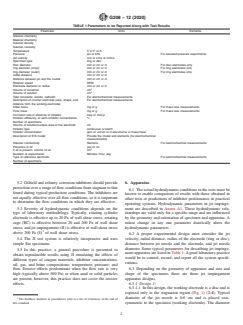
TABLE 1 Parameters to be Reported Along with Test Results
Parameter Units Remarks
Solution chemistry
Material chemistry
Solution density
Solution viscosity
Temperature C or F or K
Pressure psi or kPa For elevated pressure experiments
Jet velocity m/s or cm/s or inch/s
Specimen type ring or disc
Disc diameter mm or cm or m For disc electrodes only
ring diameter (inner) mm or cm or m For ring electrodes only
ring diameter (outer) mm or cm or m For ring electrodes only
radial distance mm or cm or m
Distance between jet and the nozzle mm or cm or m
Rotation speed RPM
Electrode diameter or radius mm or cm or m
Volume of container cm
Volume of solution cm
Tafel constants, anodic, cathodic For electrochemical measurements
Description of counter electrode (size, shape, and For electrochemical measurements
distance from the working electrode)
Initial mass mg or g For mass loss measurements
Final mass mg or g For mass loss measurements
Corrosion rate in absence of inhibitor mpy or mm/yr
Inhibitor efficiency, at each inhibitor concentration %
Number of specimens
Volume of solution/surface area of the electrode cm
Inhibitor type continuous or batch
Inhibitor concentration ppm or vol/vol or mass/volume or mass/mass
Description of EIS model Provide the model and elements (for electrochemical
measurements)
Solution conductivity Siemens For electrochemical measurements
Presence of oil yes or no
If oil is present, volume of oil cm
Duration of experiments Minutes, hour, day
Type of reference electrode For electrochemical measurements
Number of specimens
5.2 Oilfield and refinery corrosion inhibitors should provide 6. Apparatus
protectionoverarangeofflowconditionsfromstagnanttothat
6.1 The actual hydrodynamic conditions in the tests must be
found during typical production conditions. The inhibitors are
known to enable comparison of results with those obtained in
not equally effective over all flow conditions, so it is important
other tests or predictions of inhibitor performance in practical
to determine the flow conditions in which they are effective.
operating systems. Hydrodynamic parameters in jet impinge-
5.3 Severity of hydrodynamic conditions depends on the ment are described in Annex A1. These hydrodynamic rela-
type of laboratory methodology. Typically, rotating cylinder tionships are valid only for a specific range and are influenced
electrode is effective up to 20 Pa of wall shear stress, rotating by the geometry and orientation of specimen and apparatus.A
cage (RC) is effective between 20 and 200 Pa of wall shear minor change in any one parameter drastically alters the
stress, and jet impingement (JI) is effective at wall shear stress hydrodynamic parameters.
above 200 Pa (1) of wall shear stress.
6.2 A proper experimental design must consider the jet
5.4 The JI test system is relatively inexpensive and uses velocity, radial distance, radius of the electrode (ring or disc),
simple flat specimens. distance between jet nozzle and the electrode, and jet nozzle
diameter. Some typical parameters for describing jet impinge-
5.5 In this practice, a general procedure is presented to
mentapparatusarelistedinTable1.Agoodlaboratorypractice
obtain reproducible results using JI simulating the effects of
would be to control, record, and report all the system specifi-
different types of coupon materials; inhibitor concentrations;
cations.
oil, gas, and brine compositions; temperature; pressure; and
flow. Erosive effects predominate when the flow rate is very 6.3 Depending on the geometry of apparatus and size and
high (typically above 500 Pa) or when sand or solid particles shape of the specimens there are three jet impingement
are present; however, this practice does not cover the erosive apparatus designs.
effects. 6.3.1 Design 1:
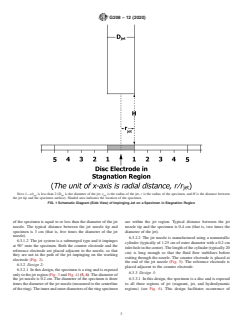
6.3.1.1 In this design, the working electrode is a disc and is
exposed only to the stagnation region (Fig. 1)(2-4). Typical
diameter of the jet nozzle is 0.6 cm and is placed axis-
The boldface numbers in parentheses refer to a list of references at the end of
this standard. symmetric to the specimen (working electrode). The diameter
G208−12 (2020)
NOTE 1—r/r is less than 2 (D is the diameter of the jet, r is the radius of the jet, r is the radius of the specimen, and H is the distance between
jet jet jet
the jet tip and the specimen surface). Shaded area indicates the location of the specimen.
FIG. 1Schematic Diagram (Side View) of Impinging Jet on a Specimen in Stagnation Region
of the specimen is equal to or less than the diameter of the jet are within the jet region. Typical distance between the jet
nozzle. The typical distance between the jet nozzle tip and
nozzle tip and the specimen is 0.4 cm (that is, two times the
specimen is 3 cm (that is, five times the diameter of the jet
diameter of the jet).
nozzle).
6.3.2.2 The jet nozzle is manufactured using a nonmetallic
6.3.1.2 The jet system is a submerged type and it impinges
cylinder (typically of 1.25 cm of outer diameter with a 0.2 cm
at 90° onto the specimen. Both the counter electrode and the
inletholeinthecenter).Thelengthofthecylinder(typically20
reference electrode are placed adjacent to the nozzle, so that
cm) is long enough so that the fluid flow stabilizes before
they are not in the path of the jet impinging on the working
exiting through the nozzle. The counter electrode is placed at
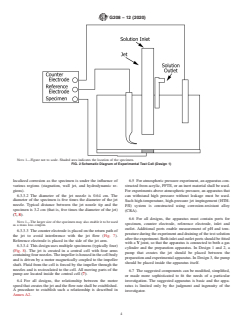
electrode (Fig. 2).
the end of the jet nozzle (Fig. 5). The reference electrode is
6.3.2 Design 2:
placed adjacent to the counter electrode.
6.3.2.1 In this design, the specimen is a ring and is exposed
6.3.3 Design 3:
only to the jet region (Fig. 3 and Fig. 4) (5, 6).The diameter of
6.3.3.1 In this design, the specimen is a disc and is exposed
the jet nozzle is 0.2 cm. The diameter of the specimen is three
times the diameter of the jet nozzle (measured to the centerline to all three regions of jet (stagnant, jet, and hydrodynamic
regions) (see Fig. 6). This design facilitates occurrence of
ofthering).Theinnerandouterdiametersoftheringspecimen
G208−12 (2020)
NOTE 1—Figure not to scale. Shaded area indicates the location of the specimen.
FIG. 2Schematic Diagram of Experimental Test Cell (Design 1)
localized corrosion as the specimen is under the influence of 6.5 For atmospheric pressure experiment, an apparatus con-
various regions (stagnation, wall jet, and hydrodynamic re-
structed from acrylic, PFTE, or an inert material shall be used.
gions).
For experiments above atmospheric pressure, an apparatus that
6.3.3.2 The diameter of the jet nozzle is 0.64 cm. The
can withstand high pressure without leakage must be used.
diameter of the specimen is five times the diameter of the jet
Such high-temperature, high-pressure jet impingement (HTH-
nozzle. Typical distance between the jet nozzle tip and the
PJI) system is constructed using corrosion-resistant alloy
specimen is 3.2 cm (that is, five times the diameter of the jet)
(CRA).
(7, 8).
6.6 For all designs, the apparatus must contain ports for
NOTE 1—The larger size of the specimen may also enable it to be used
specimen, counter electrode, reference electrode, inlet and
as a mass loss coupon.
outlet. Additional ports enable measurement of pH and tem-
6.3.3.3 The counter electrode is placed on the return path of
perature during the experiment and draining of the test solution
the jet to avoid interference with the jet flow (Fig. 7).
aftertheexperiment.Bothinletandoutletportsshouldbefitted
Reference electrode is placed in the side of the jet arm.
with a Y joint, so that the apparatus is connected to both a gas
6.3.3.4 This design uses multiple specimens (typically four)
cylinder and the preparation apparatus. In Design 1 and 2, a
(Fig. 8). The jet is created in a central cell with four arms
pump that creates the jet should be placed between the
containingfournozzles.Theimpellerishousedinthecellbody
preparation and experimental apparatus. In Design 3, the pump
and is driven by a motor magnetically coupled to the impeller
should be placed inside the apparatus itself.
shaft. Fluid from the cell is forced by the impeller through the
nozzles and is recirculated to the cell. All moving parts of the
6.7 The suggested components can be modified, simplified,
pump are located inside the central cell (7).
or made more sophisticated to fit the needs of a particular
6.4 For all designs, the relationship between the motor investigation. The suggested apparatus is basic and the appa-
speed that creates the jet and the flow rate shall be established. ratus is limited only by the judgment and ingenuity of the
A procedure to establish such a relationship is described in
investigator.
Annex A2.
G208−12 (2020)
NOTE 1—(r is the radius of jet, D is the diameter of jet nozzle, and H is the distance between jet nozzle and the specimen). Shaded area indicates
jet jet
the location of the specimen.
FIG. 3Schematic Diagram (Side View) of Impinging Jet on a Specimen in Wall Jet Region
7. Preparation of Test Specimens 7.3 Theappropriateringordiscspecimenshallbemachined
andsnuglyfittedintothePTFEsampleholderorsampleholder
7.1 Methods for preparing specimens for tests and for
made from any other appropriate material, with no gap
removing specimens after the test are described in Practice G1.
between the sample and the holder. If necessary, a very small
7.2 The specimen shall be made of the material (for
amount of epoxy should be used to fit the specimen into the
example, carbon steel) for which the inhibitor is being evalu-
holder. The presence of a gap will create crevice corrosion as
ated. Corrosion rates and inhibitor performance change by
well as change the flow pattern. The end cap is screwed in or
severalordersofmagnitudeassurfaceroughnesschangesfrom
attached tightly so that only the disc or ring of known area is
rough to fine. The surface roughness shall be kept the same
exposedtothesolution.Electricalconnectionshallbeprovided
during inhibitor screening and, if possible, the surface rough-
at the back of the specimen through spring connections.
ness of specimens used in the laboratory experiments shall be
7.4 The specimens shall be rinsed with distilled water;
related to that of field pipe. The specimens shall be ground to
a specified surface finish. The grinding shall produce a repro- degreased by immersing in acetone or methanol or any other
suitable solvent; ultrasonically cleaned (typically for about
ducible surface finish, with no rust deposits, pits, or deep
scratches.All sharp edges on the specimen shall be ground.All 1 min); and then dried by blowing air. The surface of the
loose dirt particles shall be removed. specimens shall not be touched with bare hands. The specimen
G208−12 (2020)
NOTE 1—(D is the diameter of jet nozzle). Shaded ring area indicates the location of the specimen.
jet
FIG. 4Schematic Diagram (Top View) of Impinging Jet on a Specimen in Wall Jet Region
FIG. 5Schematic of Experimental Test Cell (Design 2) (6)
G208−12 (2020)
NOTE 1—(r radius of jet, D diameter of jet nozzle, and H distance between jet nozzle and specimen). Shaded area indicates the location of the
jet jet
specimen.
FIG. 6Schematic Diagram of Impinging Jet on a Specimen Covering Stagnation, Wall Jet, and Hydrodynamic Boundary Regions
shallbeweighedtothenearest0.1mg.Thedimensionsshallbe 8.2 If aqueous phase is not available, synthetic aqueous
measured to the nearest 1 mm and the surface area calculated. phase shall be used; the composition of which, however, shall
be based on field water analysis. The composition of the
7.5 The specimen shall be placed into the experimental
aqueous phase shall be determined and reported.Alternatively,
apparatus within1hof preparing the surface and the lid of the
standard brine (such as in accordance with Practice D1141)
apparatus closed immediately.
shall be used. The aqueous phase shall be prepared following
7.5.1 Specimen to be treated with batch inhibitor shall be
good laboratory practice. Their composition shall be specified
exposed to inhibitor containing oil phase for a certain amount
in the work plan and recorded in the laboratory logbook. The
of time (usually 30 min). 8.8 describes the preparation of
aqueous phase shall be prepared using analytical grade re-
inhibitor containing oil phase. The specimen shall be removed
agents and deionized water (Specification D1193). If other
and introduced into the experimental apparatus immediately.
grades of chemicals are used, their purity or grade shall be
recorded in the laboratory logbook.
8. Preparation of Test Solution
8.3 The test solution shall be deaerated by passing nitrogen
8.1 Test solution shall be prepared in a separate container
or any other inert gas or CO and kept under deaerated
(preparation apparatus). Ideally, all phases (oil and aqueous) of
conditions.
test solution shall be obtained from the field for which the
inhibitor is being evaluated. It is important that live fluids do 8.4 The test solution shall be heated to the predetermined
not already contain corrosion inhibitor. temperature (that is, temperature at which experiments will be
8.1.1 If the field crude oil is not available, heptane, conducted). Depending on the size of apparatus, heating unit
kerosene,oranysuitablehydrocarboncanbeusedasoilphase. (mantle, bath, or wrapper around the apparatus), difference
G208−12 (2020)
NOTE 1—(This design contains four identical test arms, but only one arm is shown in this figure. This figure is not to scale). Shaded area indicates
the location of the specimen.
FIG. 7Schematic Diagram of Experimental Test Cell (Design 3)
FIG. 8Schematic Diagram of Jet Impingement Apparatus (Design 3) with Four Disc Specimens
G208−12 (2020)
between room and experimental temperatures, a range of gas cylinders shall be connected to the experimental apparatus
temperature may prevail within the apparatus. The apparatus through the Y joint inlet port.
shall be heated with stirring to uniformly raise the temperature
9.1.1 If the experimental apparatus is deaerated using acid
of the solution to the predetermined temperature. The outlet of
gases, the additional step of disconnecting the inert gas and
the apparatus shall be opened so as to avoid pressure built up.
connecting the acid gas cylinder is not required.
Once the test temperature is reached, the outlet shall be closed
9.1.2 Acid gases may be introduced from individual gas
and temperature shall be maintained within 2 °C of the
cylindersthroughaflowregulatororfromasinglegascylinder
specified temperature.
containing mixed acid gases of known composition.
8.5 The test solution shall be saturated with acid gases of
9.2 The specimen, counter electrode, reference electrode,
composition similar to that field composition. The appropriate
and other probes (for example, thermometer and pH probe)
composition of acid gases can be obtained by mixing H S and
shall be inserted. Alternatively, they could be inserted before
CO streams from the standard laboratory gas supply. Nitrogen
deaerating the experimental apparatus.
or other inert gases can be used as a diluent to obtain the
9.3 The heater shall be turned on to heat the experimental
required ratio of the acid gases. Alternatively, gas mixtures of
apparatus to the experimental temperature.
the required compositions can be purchased from suppliers of
industrial gases. The concentrations of impurities, particularly
9.4 The passage between the experimental and preparation
oxygen, shall be kept as low as technically possible (less than
apparatus shall now be opened, that is, both Y joint inlet port
5 ppb, preferably less than 1 ppb oxygen in solution). The
to the preparation apparatus and Y joint outlet port to the
solution oxygen concentrati
...