

ASTM D3084-20
(Practice)Standard Practice for Alpha-Particle Spectrometry of Water
General Information
- Abstract
SIGNIFICANCE AND USE
5.1 Alpha-particle spectrometry can be used either as a quantitative counting technique or as a qualitative method for informing the analyst of the purity of a given sample.
5.2 The method may be used for evaporated alpha-particle sources, but the quality of the spectra obtained will be limited by the absorbing material on the planchet and the surface finish of the planchet.
SCOPE
1.1 This practice covers the processes that are required to obtain well-resolved alpha-particle spectra from water samples and discusses associated problems. This practice is generally combined with specific chemical separations, mounting techniques, and counting instrumentation, as referenced.
1.2 The values stated in SI units are to be regarded as standard. No other units of measurement are included in this standard.
1.3 This standard does not purport to address all of the safety concerns, if any, associated with its use. It is the responsibility of the user of this standard to establish appropriate safety, health, and environmental practices and determine the applicability of regulatory limitations prior to use.
1.4 This international standard was developed in accordance with internationally recognized principles on standardization established in the Decision on Principles for the Development of International Standards, Guides and Recommendations issued by the World Trade Organization Technical Barriers to Trade (TBT) Committee.
- Status
- Published
- Publication Date
- 30-Jun-2020
- Technical Committee
- D19 - Water
- Drafting Committee
- D19.04 - Methods of Radiochemical Analysis
Overview
ASTM D3084-20: Standard Practice for Alpha-Particle Spectrometry of Water provides comprehensive guidance for obtaining well-resolved alpha-particle spectra from water samples. Developed by ASTM International, this practice outlines the required processes, recommended equipment, and analytical steps for both quantitative and qualitative alpha spectrometric analysis. As alpha-particle spectrometry is a critical technique for detecting and measuring the presence of alpha-emitting radionuclides in water, this standard is frequently used in environmental monitoring, health physics, and water quality assurance.
Alpha-particle spectrometry is valued for its sensitivity and ability to distinguish between different alpha-emitting isotopes in water samples. The standard addresses challenges related to sample preparation, spectral resolution, calibration, and quality control, ensuring repeatable and accurate results.
Key Topics
Alpha-Particle Spectrometry Principles
Explains the use of alpha spectrometry for quantifying and identifying radioactive contaminants in water, emphasizing both quantitative counting and qualitative analysis of sample purity.Sample Preparation Techniques
Details preferred methods for source preparation, including electrodeposition, microcoprecipitation, and evaporation, which directly affect spectral quality.Types of Detectors and Instrumentation
Discusses the use of silicon semiconductor detectors and Frisch-grid pulse-ionization chambers, their comparative advantages in resolution, stability, and cost, as well as requirements for vacuum systems, gas handling, and data acquisition.Calibration and Measurement Uncertainty
Provides guidelines for calibration with traceable standards, background corrections, and calculation approaches for counting efficiency, recovery, and minimum detectable concentrations.Quality Control Measures
Emphasizes the use of internal and external quality control samples-such as blanks, replicates, spiked samples, and reference materials-and recommends rigorous documentation, consistency, and regular verification of instrument performance.Interferences and Resolution
Identifies common interferences and factors affecting spectral separation, urging careful chemical separation and optimization of detection conditions to reduce tailing and spillover.
Applications
ASTM D3084-20 is widely applicable in:
Drinking Water Surveillance
Ensures compliance with regulatory standards for radioactive contaminants by detecting isotopes such as uranium, plutonium, and radium.Environmental Monitoring
Supports routine water quality assessment for radionuclide contamination from nuclear facilities, mining operations, or natural sources.Health Physics and Radiological Assessment
Enables qualitative and quantitative determination of alpha-emitting radionuclides for risk assessment and environmental remediation decision-making.Nuclear Industry Laboratories
Provides standardized methodologies for laboratory analysis, supporting operational safety and regulatory reporting.
The practice ensures that laboratories employ validated methods with traceable calibrations, robust quality controls, and clear documentation, making the results trustworthy and suitable for regulatory and decision-making processes.
Related Standards
ASTM D3084-20 references and complements several related ASTM standards, including:
- ASTM D1129 – Terminology Relating to Water
- ASTM D3648 – Practices for the Measurement of Radioactivity
- ASTM D3865 – Test Method for Plutonium in Water
- ASTM D3972 – Test Method for Isotopic Uranium in Water by Radiochemistry
- ASTM D7282 – Practice for Set-up, Calibration, and Quality Control of Instruments Used for Radioactivity Measurements
- ASTM C859 – Terminology Relating to Nuclear Materials
- ASTM C1163 – Practice for Mounting Actinides for Alpha Spectrometry Using Neodymium Fluoride
- ASTM D7902 – Terminology for Radiochemical Analyses
These standards collectively provide a framework for consistent terminology, methodological guidance, calibration processes, and analytical quality assurance, reinforcing confidence in alpha-particle spectrometric analysis for water testing.
Keywords: alpha-particle spectrometry, water testing, radiochemistry, radioactivity measurement, alpha-emitting radionuclides, ASTM D3084-20, environmental monitoring, nuclear laboratory, alpha detectors, calibration, quality control.
Relations
- Effective Date
- 01-Jan-2024
- Effective Date
- 01-May-2020
- Effective Date
- 01-May-2020
- Effective Date
- 01-Feb-2018
- Effective Date
- 01-Feb-2016
- Effective Date
- 01-Jan-2015
- Effective Date
- 01-Jan-2015
- Effective Date
- 15-Jun-2014
- Effective Date
- 15-Jan-2014
- Effective Date
- 15-Jan-2014
- Effective Date
- 15-Jan-2014
- Effective Date
- 01-Jun-2013
- Effective Date
- 01-May-2013
- Effective Date
- 01-Jan-2011
- Effective Date
- 01-Nov-2010
Get Certified
Connect with accredited certification bodies for this standard

CIS Institut d.o.o.
Personal Protective Equipment (PPE) certification body. Notified Body NB-2890 for EU Regulation 2016/425 PPE.

Kiwa BDA Testing
Building and construction product certification.
Kmetijski inštitut Slovenije
Agricultural Institute of Slovenia. Soil testing, plant health, agricultural product analysis.
Sponsored listings
Frequently Asked Questions
ASTM D3084-20 is a standard published by ASTM International. Its full title is "Standard Practice for Alpha-Particle Spectrometry of Water". This standard covers: SIGNIFICANCE AND USE 5.1 Alpha-particle spectrometry can be used either as a quantitative counting technique or as a qualitative method for informing the analyst of the purity of a given sample. 5.2 The method may be used for evaporated alpha-particle sources, but the quality of the spectra obtained will be limited by the absorbing material on the planchet and the surface finish of the planchet. SCOPE 1.1 This practice covers the processes that are required to obtain well-resolved alpha-particle spectra from water samples and discusses associated problems. This practice is generally combined with specific chemical separations, mounting techniques, and counting instrumentation, as referenced. 1.2 The values stated in SI units are to be regarded as standard. No other units of measurement are included in this standard. 1.3 This standard does not purport to address all of the safety concerns, if any, associated with its use. It is the responsibility of the user of this standard to establish appropriate safety, health, and environmental practices and determine the applicability of regulatory limitations prior to use. 1.4 This international standard was developed in accordance with internationally recognized principles on standardization established in the Decision on Principles for the Development of International Standards, Guides and Recommendations issued by the World Trade Organization Technical Barriers to Trade (TBT) Committee.
SIGNIFICANCE AND USE 5.1 Alpha-particle spectrometry can be used either as a quantitative counting technique or as a qualitative method for informing the analyst of the purity of a given sample. 5.2 The method may be used for evaporated alpha-particle sources, but the quality of the spectra obtained will be limited by the absorbing material on the planchet and the surface finish of the planchet. SCOPE 1.1 This practice covers the processes that are required to obtain well-resolved alpha-particle spectra from water samples and discusses associated problems. This practice is generally combined with specific chemical separations, mounting techniques, and counting instrumentation, as referenced. 1.2 The values stated in SI units are to be regarded as standard. No other units of measurement are included in this standard. 1.3 This standard does not purport to address all of the safety concerns, if any, associated with its use. It is the responsibility of the user of this standard to establish appropriate safety, health, and environmental practices and determine the applicability of regulatory limitations prior to use. 1.4 This international standard was developed in accordance with internationally recognized principles on standardization established in the Decision on Principles for the Development of International Standards, Guides and Recommendations issued by the World Trade Organization Technical Barriers to Trade (TBT) Committee.
ASTM D3084-20 is classified under the following ICS (International Classification for Standards) categories: 13.060.50 - Examination of water for chemical substances. The ICS classification helps identify the subject area and facilitates finding related standards.
ASTM D3084-20 has the following relationships with other standards: It is inter standard links to ASTM C859-24, ASTM D1129-13(2020)e2, ASTM D7902-20, ASTM D7902-18, ASTM D7902-16, ASTM D3865-09(2015), ASTM D3972-09(2015), ASTM C859-14a, ASTM D7902-14e1, ASTM D7902-14, ASTM C859-14, ASTM C859-13a, ASTM C859-13, ASTM D3648-04(2011), ASTM C859-10b. Understanding these relationships helps ensure you are using the most current and applicable version of the standard.
ASTM D3084-20 is available in PDF format for immediate download after purchase. The document can be added to your cart and obtained through the secure checkout process. Digital delivery ensures instant access to the complete standard document.
Standards Content (Sample)
This international standard was developed in accordance with internationally recognized principles on standardization established in the Decision on Principles for the
Development of International Standards, Guides and Recommendations issued by the World Trade Organization Technical Barriers to Trade (TBT) Committee.
Designation: D3084 − 20
Standard Practice for
Alpha-Particle Spectrometry of Water
This standard is issued under the fixed designation D3084; the number immediately following the designation indicates the year of
original adoption or, in the case of revision, the year of last revision. A number in parentheses indicates the year of last reapproval. A
superscript epsilon (´) indicates an editorial change since the last revision or reapproval.
1. Scope D7902 Terminology for Radiochemical Analyses
1.1 This practice covers the processes that are required to
3. Terminology
obtain well-resolved alpha-particle spectra from water samples
3.1 Definitions:
and discusses associated problems. This practice is generally
3.1.1 For definitions of terms used in this standard, refer to
combined with specific chemical separations, mounting
Terminologies D1129, D7902, and C859. For terms not found
techniques, and counting instrumentation, as referenced.
in these terminologies, reference may be made to other
1.2 The values stated in SI units are to be regarded as
published glossaries (1, 2).
standard. No other units of measurement are included in this
standard.
4. Summary of Practice
1.3 This standard does not purport to address all of the
4.1 Alpha-particle spectrometry of radionuclides in water
safety concerns, if any, associated with its use. It is the
(also called alpha-particle pulse-height analysis) has been
responsibility of the user of this standard to establish appro-
carried out by several methods involving magnetic
priate safety, health, and environmental practices and deter-
spectrometers, gas counters, scintillation spectrometers,
mine the applicability of regulatory limitations prior to use.
nuclear emulsion plates, cloud chambers, absorption
1.4 This international standard was developed in accor-
techniques, and solid-state counters. Gas counters, operating
dance with internationally recognized principles on standard-
either as an ionization chamber or in the proportional region,
ization established in the Decision on Principles for the
have been widely used to identify and measure the relative
Development of International Standards, Guides and Recom-
amounts of different alpha-emitters. However, more recently,
mendations issued by the World Trade Organization Technical
the solid-state counter has become the predominant system
Barriers to Trade (TBT) Committee.
because of its excellent resolution and compactness. Knoll (3)
extensively discusses the characteristics of both detector types.
2. Referenced Documents
4.2 Of the two gas-counting techniques, the pulsed ioniza-
2.1 ASTM Standards:
tion chamber is more widely used as it gives much better
C859 Terminology Relating to Nuclear Materials
resolution than does the other. This is because there is no
C1163 Practice for MountingActinides forAlpha Spectrom-
spread arising from multiplication or from imperfection of the
etry Using Neodymium Fluoride
wire such as occurs with the proportional counter.
D1129 Terminology Relating to Water
4.3 The semiconductor detectors used for alpha-particle
D3648 Practices for the Measurement of Radioactivity
spectrometry are similar in principle to ionization chambers.
D3865 Test Method for Plutonium in Water
The ionization of the gas by α-particles gives rise to electron-
D3972 Test Method for Isotopic Uranium in Water by
ion pairs, while in a semiconductor detector, electron-hole
Radiochemistry
pairs are produced. Subsequently, the liberated charges are
D7282 Practice for Set-up, Calibration, and Quality Control
collected by an electric field. In general, silicon detectors are
of Instruments Used for Radioactivity Measurements
usedforalpha-particlespectrometry.Thesedetectorsaren-type
base material upon which gold is evaporated or ions such as
boron are implanted, making an electrical contact. A reversed
This practice is under the jurisdiction of ASTM Committee D19 on Water and
bias is applied to the detector to reduce the leakage current and
is the direct responsibility of Subcommittee D19.04 on Methods of Radiochemical
Analysis.
to create a depletion layer of free-charge carriers. This layer is
Current edition approved July 1, 2020. Published July 2020. Originally approved
thin and the leakage current is very low. Therefore, the slight
in 1972. Last previous edition approved in 2012 as D3084 – 05 (2012). DOI:
interactions of photons with the detector produce no signal.
10.1520/D3084-20.
For referenced ASTM standards, visit the ASTM website, www.astm.org, or
contact ASTM Customer Service at service@astm.org. For Annual Book of ASTM
Standards volume information, refer to the standard’s Document Summary page on The boldface numbers in parentheses refer to a list of references at the end of
the ASTM website. this standard.
Copyright © ASTM International, 100 Barr Harbor Drive, PO Box C700, West Conshohocken, PA 19428-2959. United States
D3084 − 20
Theeffectofanyinteractionsofbetaparticleswiththedetector alpha-particle pulses. The resolution that can be achieved by
can be eliminated by appropriate electronic discrimination this method is 250 to 300 keV FWHM. This is superior to
(gating) of signals entering the multichannel analyzer. A conventionalliquid-scintillationcountingbutinferiortosilicon
semiconductor detector detects all alpha particles emitted by detectors and gridded pulse-ionization chambers. An applica-
radionuclides (approximately 2 to 10 MeV) with essentially tion of this method is given in Ref (4).
equal efficiency, which simplifies its calibration.
5. Significance and Use
4.4 Semiconductor detectors have better resolution than gas
5.1 Alpha-particle spectrometry can be used either as a
detectors because the average energy required to produce an
quantitative counting technique or as a qualitative method for
electron-hole pair in silicon is 3.5 6 0.1 eV (0.56 6 0.02 aJ)
informing the analyst of the purity of a given sample.
compared with from 25 to 30 eV (4.0 to 4.8 aJ) to produce an
ion pair in a gas ionization chamber. Detector resolution, 5.2 The method may be used for evaporated alpha-particle
defined as peak full-width at half-maximum height (FWHM), sources, but the quality of the spectra obtained will be limited
is customarily expressed in kiloelectron-volts. The FWHM bytheabsorbingmaterialontheplanchetandthesurfacefinish
increases with increasing detector area, but is typically be- of the planchet.
tween 15 and 60 keV. The background is normally lower for a
6. Interferences
semiconductor detector than for an ionization chamber. Silicon
detectors have four other advantages compared to ionization
6.1 There can be interferences due to tailing or spillover
chambers: they are lower in cost, have superior stability, have
from one spectral region of interest into another, or to impu-
higher permissible counting rates, and have better time reso-
rities in the tracer, if any.
lution for coincidence measurements. However, the semicon-
6.2 The resolution, or ability to separate alpha-particle
ductor detector requires sophisticated electronics because of
peaks, will depend on the quality of the detector, the pressure
thelowchargethatisgeneratedbytheincident α-particleinthe
inside the counting chamber, the source-to-detector distance,
detector. Low-noise and high-stability, charge-sensitive pream-
the instrumentation, and the quality of the source. If peaks
plifiers are used prior to the detection, analog-to-digital
overlap, a better spectrometer or additional chemical separa-
conversion, and storage of the voltage pulse by a multichannel
tions will be required.
analyzer.Thecountingisnearlyalwaysperformedinavacuum
chamber so that the α-particles will not lose energy by
7. Apparatus
collisions with air molecules between the source and the
7.1 Alpha Particle Detector, either a silicon semiconductor
detector.
or a Frisch-grid pulse-ionization chamber.
4.5 A gridded pulse-ionization chamber was developed by
7.2 Counting Chamber, to house the detector, hold the
Otto Frisch for high-resolution alpha spectrometry. The unit
source, and allow the detector system to be evacuated.
consists of a standard ionization chamber fitted with a colli-
7.3 Counting Gas, for ionization chamber, typically a 90 %
mator between the source and the collector plate and a wire
argon–10 % methane mixture, and associated gas-handling
gridtoshieldthecollectorfromtheeffectsofpositiveions.The
equipment.
resolution of a Frisch-grid pulse ionization chamber ranges
from 35 to 100 keV for routine work. The detector parameters
7.4 Pulse Amplification System, possibly including a
that affect resolution are primarily the following: statistical
preamplifier, amplifier, postamplifier, pulse stretcher, and a
variations in the number of ion pairs formed at a given alpha
high-voltage power supply, as directed by the quality and type
energy, the variation in rise time of pulses, and the effects of
of detector employed.
positive ions. An advantage of gridded ionization chambers is
7.5 Multichannel Pulse-Height Analyzer, including data
their ability to count large-area sources with good efficiency.
readout equipment. This is now often computer based.
4.6 There are two reasons for collimating a sample in a
7.6 Vacuum Pump, with low vapor-pressure oil and prefer-
gridded ionization chamber. When thick-sample sources are
ably with a trap to protect the detector from oil vapors.
encountered, the alpha-particles emitted at a large solid angle
would show an energy degradation upon ionization of the gas.
8. Source Preparation
The effect leads to tailing of the alpha-particle spectrum. This
8.1 Thetechniqueemployedforpreparingthesourceshould
problem is reduced significantly by use of the collimator.
produce a low-mass, uniformly distributed deposit that is on a
Secondly, when the nucleus following an α-particle emission
very smooth surface. The three techniques that are generally
does not decay to a ground state, the γ-rays that may be
employed are electrodeposition, microcoprecipitation, and
produced are usually highly converted, and the conversion
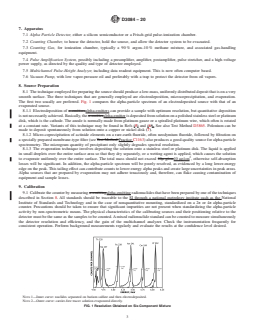
evaporation. The first two usually are preferred. Fig. 1 com-
electrons ionize the gas. The special mesh-type collimators
pares the alpha-particle spectrum of an electrodeposited source
stop the conversion electrons and collimate the source simul-
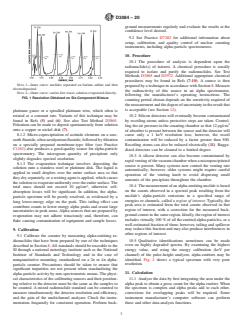
with that of an evaporated source.
taneously.
8.1.1 Electrodeposition of alpha-emitters can provide a
4.7 A more recently developed measurement method is sample with optimum resolution, but quantitative deposition is
photon-electron-rejecting alpha liquid-scintillation spectrom- not necessarily achieved. Basically, the alpha-emitter is depos-
etry. The sample is counted in a special liquid-scintillation ited from solution on a polished stainless steel or platinum
spectrometer that discriminates electronically against non- disk, which is the cathode. The anode is normally made from
D3084 − 20
ground measurements regularly and evaluate the results at the
confidence level desired.
9.2 See Practice D7282 for additional information about
setup, calibration, and quality control of nuclear counting
instruments, including alpha-particle spectrometers.
10. Procedure
10.1 The procedure of analysis is dependent upon the
radionuclide(s) of interest. A chemical procedure is usually
required to isolate and purify the radionuclides. See Test
Methods D3865 and D3972. Additional appropriate chemical
procedures may be found in Refs (7-10). A source is then
NOTE 1—Inner curve: nuclides separated on barium sulfate and then
preparedbyatechniqueinaccordancewithSection8.Measure
electrodeposited.
the radioactivity of this source in an alpha spectrometer,
NOTE 2—Outer curve: carrier-free tracer solution evaporated directly.
following the manufacturer’s operating instructions. The
FIG. 1 Resolution Obtained on Six-Component Mixture
counting period chosen depends on the sensitivity required of
themeasurementandthedegreeofuncertaintyintheresultthat
is acceptable (see Section 12).
platinum gauze or a spiralled platinum wire, which often is
rotated at a constant rate. Variants of this technique may be 10.2 Silicon detectors will eventually become contaminated
found in Refs (5) and (6). See also Test Method D3865.
by recoiling atoms unless protective steps are taken. Control-
Polonium can be made to deposit spontaneously from solution ling the air pressure in the counting chamber so that 12 µg/cm
onto a copper or nickel disk (7).
of absorber is present between the source and the detector will
8.1.2 Micro-coprecipitation of actinide elements on a rare- cause only a 1 keV resolution loss; however, the recoil
earthfluoride,oftenneodymiumfluoride,followedbyfiltration
contamination will be reduced by a factor greater than 500.
on a specially prepared membrane-type filter (see Practice Recoiling atoms can also be reduced electrically (11). Rugge-
C1163) also produces a good-quality source for alpha-particle
dized detectors can be cleaned to a limited degree.
spectrometry. The microgram quantity of precipitant only
10.3 A silicon detector can also become contaminated by
slightly degrades spectral resolution.
rapidventingofthevacuumchamberwhenamicroprecipitated
8.1.3 The evaporation technique involves depositing the
source is present. Many systems now control the venting rate
solution onto a stainless steel or platinum disk. The liquid is
automatically; however, older systems might require careful
applied in small droplets over the entire surface area so that
operation of the venting knob to avoid dispersing small
they dry separately, or a wetting agent is applied, which causes
amounts of the precipitate throughout the chamber.
thesolutiontoevaporateuniformlyovertheentiresurface.The
10.4 Themeasurementofanalpha-emittingnuclideisbased
total mass should not exceed 10 µg/cm , otherwise self-
on the counts observed in a spectral peak resulting from the
absorption losses will be significant. In addition, the alpha-
nuclide’s alpha-particle emissions in a specified range of
particle spectrum will be poorly resolved, as evidenced by a
energies or channels, called a region of interest. Typically, the
long lower-energy edge on the peak. This tailing effect can
peak area is estimated from the total counts observed in that
contribute counts to lower energy alpha peaks and create large
region of interest, with a correction for the measured back-
uncertainties in peak areas.Alpha sources that are prepared by
groundcountsinthesameregion.Ideally,theregionofinterest
evaporation may not adhere tenaciously and, therefore, can
includes virtually 100 % of all the emitted alpha-particles, or a
flake causing contamination of equipment and sample losses.
well-estimated fraction of them; however, tailing and spillover
may reduce this fraction and may also produce interferences in
9. Calibration
other regions of interest.
9.1 Calibrate the counter by measuring alpha-emitting ra-
10.5 Qualitative identifications sometimes can be made
dionuclides that have been prepared by one of the techniques
described in Section 8.All standards should be traceable to the even on highly degraded spectra. By examining the highest
energy value, and using the energy calibration (keV per
SI through a national metrology institute such as the National
Institute of Standards and Technology and in the case of channel) of the pulse-height analyzer, alpha-emitters may be
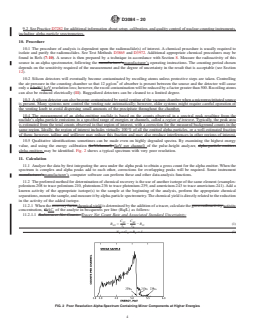
identified. Fig. 2 shows a typical spectrum with very poor
nonquantitative mounting, standardized on a 2π or 4π alpha-
particle counter. Precautions should be taken to ensure that resolution.
significant impurities are not present when standardizing the
11. Calculation
alpha-particle activity by non-spectrometric means. The physi-
cal characteristics of the calibrating sources and their position- 11.1 Analyze the data by first integrating the area under the
ing relative to the detector must be the same as the samples to alpha peak to obtain a gross count for the alpha emitter. When
be counte
...
This document is not an ASTM standard and is intended only to provide the user of an ASTM standard an indication of what changes have been made to the previous version. Because
it may not be technically possible to adequately depict all changes accurately, ASTM recommends that users consult prior editions as appropriate. In all cases only the current version
of the standard as published by ASTM is to be considered the official document.
Designation: D3084 − 05 (Reapproved 2012) D3084 − 20
Standard Practice for
Alpha-Particle Spectrometry of Water
This standard is issued under the fixed designation D3084; the number immediately following the designation indicates the year of
original adoption or, in the case of revision, the year of last revision. A number in parentheses indicates the year of last reapproval. A
superscript epsilon (´) indicates an editorial change since the last revision or reapproval.
1. Scope
1.1 This practice covers the processes that are required to obtain well-resolved alpha-particle spectra from water samples and
discusses associated problems. This practice is generally combined with specific chemical separations, mounting techniques, and
counting instrumentation, as referenced.
1.2 The values stated in SI units are to be regarded as standard. No other units of measurement are included in this standard.
1.3 This standard does not purport to address all of the safety concerns, if any, associated with its use. It is the responsibility
of the user of this standard to establish appropriate safety safety, health, and healthenvironmental practices and determine the
applicability of regulatory limitations prior to use.
1.4 This international standard was developed in accordance with internationally recognized principles on standardization
established in the Decision on Principles for the Development of International Standards, Guides and Recommendations issued
by the World Trade Organization Technical Barriers to Trade (TBT) Committee.
2. Referenced Documents
2.1 ASTM Standards:
C859 Terminology Relating to Nuclear Materials
C1163 Practice for Mounting Actinides for Alpha Spectrometry Using Neodymium Fluoride
D1129 Terminology Relating to Water
D3648 Practices for the Measurement of Radioactivity
D3865 Test Method for Plutonium in Water
D3972 Test Method for Isotopic Uranium in Water by Radiochemistry
D7282 Practice for Set-up, Calibration, and Quality Control of Instruments Used for Radioactivity Measurements
D7902 Terminology for Radiochemical Analyses
3. Terminology
3.1 For definitions of terms used in this practice, refer to Terminologies D1129 and C859. For terms not found in these
terminologies, reference may be made to other published glossaries (1, 2). Definitions:
3.1.1 For definitions of terms used in this standard, refer to Terminologies D1129, D7902, and C859. For terms not found in
these terminologies, reference may be made to other published glossaries (1, 2).
4. Summary of Practice
4.1 Alpha-particle spectrometry of radionuclides in water (also called alpha-particle pulse-height analysis) has been carried out
by several methods involving magnetic spectrometers, gas counters, scintillation spectrometers, nuclear emulsion plates, cloud
chambers, absorption techniques, and solid-state counters. Gas counters, operating either as an ionization chamber or in the
proportional region, have been widely used to identify and measure the relative amounts of differentα -emitters.different
alpha-emitters. However, more recently, the solid-state counter has become the predominant system because of its excellent
resolution and compactness. Knoll (3) extensively discusses the characteristics of both detector types.
This practice is under the jurisdiction of ASTM Committee D19 on Water and is the direct responsibility of Subcommittee D19.04 on Methods of Radiochemical Analysis.
Current edition approved June 1, 2012July 1, 2020. Published August 2012July 2020. Originally approved in 1972. Last previous edition approved in 20052012 as
D3084 – 05.D3084 – 05 (2012). DOI: 10.1520/D3084-05R12.10.1520/D3084-20.
For referenced ASTM standards, visit the ASTM website, www.astm.org, or contact ASTM Customer Service at service@astm.org. For Annual Book of ASTM Standards
volume information, refer to the standard’sstandard’s Document Summary page on the ASTM website.
The boldface numbers in parentheses refer to thea list of references at the end of this document.standard.
Copyright © ASTM International, 100 Barr Harbor Drive, PO Box C700, West Conshohocken, PA 19428-2959. United States
D3084 − 20
4.2 Of the two gas-counting techniques, the pulsed ionization chamber is more widely used as it gives much better resolution
than does the other. This is because there is no spread arising from multiplication or from imperfection of the wire such as occurs
with the proportional counter.
4.3 The semiconductor detectors used for alpha-particle spectrometry are similar in principle to ionization chambers. The
ionization of the gas by α-particles gives rise to electron-ion pairs, while in a semiconductor detector, electron-hole pairs are
produced. Subsequently, the liberated changescharges are collected by an electric field. In general, silicon detectors are used for
alpha-particle spectrometry. These detectors are n-type base material upon which gold is evaporated or ions such as boron are
implanted, making an electrical contact. A reversed bias is applied to the detector to reduce the leakage current and to create a
depletion layer of free-charge carriers. This layer is thin and the leakage current is very low. Therefore, the slight interactions of
photons with the detector produce no signal. The effect of any interactions of beta particles with the detector can be eliminated
by appropriate electronic discrimination (gating) of signals entering the multichannel analyzer. A semiconductor detector detects
all alpha particles emitted by radionuclides (approximately 2 to 10 MeV) with essentially equal efficiency, which simplifies its
calibration.
4.4 Semiconductor detectors have better resolution than gas detectors because the average energy required to produce an
electron-hole pair in silicon is 3.5 6 0.1 eV (0.56 6 0.02 aJ) compared with from 25 to 30 eV (4.0 to 4.8 aJ) to produce an ion
pair in a gas ionization chamber. Detector resolution, defined as peak full-width at half-maximum height (FWHM), is customarily
expressed in kiloelectron-volts. The FWHM increases with increasing detector area, but is typically between 15 and 60 keV. The
background is normally lower for a semiconductor detector than for an ionization chamber. Silicon detectors have four other
advantages compared to ionization chambers: they are lower in cost, have superior stability, have higher permissible counting rates,
and have better time resolution for coincidence measurements. However, the semiconductor detector requires sophisticated
electronics because of the low charge that is generated by the incident α-particle in the detector. Low-noise and high-stability,
charge-sensitive preamplifiers are used prior to the detection, analog-to-digital conversion, and storage of the voltage pulse by a
multichannel analyzer. The counting is nearly always performed in a vacuum chamber so that the α-particles will not lose energy
by collisions with air molecules between the source and the detector.
4.5 A gridded pulse-ionization chamber was developed by Otto Frisch for high-resolution alpha spectrometry. The unit consists
of a standard ionization chamber fitted with a collimator between the source and the collector plate and a wire grid to shield the
collector from the effects of positive ions. The resolution of a griddedFrisch-grid pulse ionization chamber isranges from 35 to 100
keV for routine work. The detector parameters that affect resolution are primarily the following: statistical variations in the number
of ion pairs formed at a given alpha energy, the variation in rise time of pulses, and the effects of positive ions. An advantage of
gridded ionization chambers is their ability to count large-area sources with good efficiency.
4.6 There are two reasons for collimating a sample in a gridded ionization chamber. When thick-sample sources are
encountered, the alpha-particles emitted at a large solid angle would show an energy degradation upon ionization of the gas. The
effect leads to tailing of the alpha-particle spectrum. This problem is reduced significantly by use of the collimator. Secondly, when
the nucleus following anα -particlean α-particle emission does not decay to a ground state, the γ-rays that may be produced are
usually highly converted, and the conversion electrons ionize the gas. The special mesh-type collimators stop the conversion
electrons and collimate the source simultaneously.
4.7 A more recently developed measurement method is photon-electron-rejecting alpha liquid-scintillation spectrometry. The
sample is counted in a special liquid-scintillation spectrometer that discriminates electronically against non-alpha-particle pulses.
The resolution that can be achieved by this method is 250 to 300-keV 300 keV FWHM. This is superior to conventional
liquid-scintillation counting,counting but inferior to silicon detectors and gridded pulse-ionization chambers. An application of this
method is given in Ref (4.).
5. Significance and Use
5.1 Alpha-particle spectrometry can either be used either as a quantitative counting technique or as a qualitative method for
informing the analyst of the purity of a given sample.
5.2 The method may be used for evaporated alpha-particle sources, but the quality of the spectra obtained will be limited by
the absorbing material on the planchet and the surface finish of the planchet.
6. Interferences
6.1 There can be interferences due to tailing or spillover from one spectral region of interest into another, or to impurities in
the tracer, if any.
6.2 The resolution, or ability to separate alpha-particle peaks, will depend on the quality of the detector, the pressure inside the
counting chamber, the source-to-detector distance, the instrumentation, and the quality of the source. If peaks overlap, a better
spectrometer or additional chemical separations will be required.
D3084 − 20
7. Apparatus
7.1 Alpha Particle Detector, either a silicon semiconductor or a Frisch-grid pulse-ionization chamber.
7.2 Counting Chamber, to house the detector, hold the source, and allow the detector system to be evacuated.
7.3 Counting Gas, for ionization chamber, typically a 90 % argon–10 % methane mixture, and associated gas-handling
equipment.
7.4 Pulse Amplification System, possibly including a preamplifier, amplifier, postamplifier, pulse stretcher, and a high-voltage
power supply, as directed by the quality and type of detector employed.
7.5 Multichannel Pulse-Height Analyzer, including data readout equipment. This is now often computer based.
7.6 Vacuum Pump, with low vapor-pressure oil and preferably with a trap to protect the detector from oil vapors.
8. Source Preparation
8.1 The technique employed for preparing the source should produce a low-mass, uniformly distributed deposit that is on a very
smooth surface. The three techniques that are generally employed are electrodeposition, microcoprecipitation, and evaporation.
The first two usually are preferred. Fig. 1 compares the alpha-particle spectrum of an electrodeposited source with that of an
evaporated source.
8.1.1 Electrodeposition of α-emittersalpha-emitters can provide a sample with optimum resolution, but quantitative deposition
is not necessarily achieved. Basically, the α-emitteralpha-emitter is deposited from solution on a polished stainless steel or platinum
disk, which is the cathode. The anode is normally made from platinum gauze or a spiralled platinum wire, which often is rotated
at a constant rate. Variants of this technique may be found in Refs (5) and (6.). See also Test Method D3865. Polonium can be
made to deposit spontaneously from solution onto a copper or nickel disk (7).
8.1.2 Micro-coprecipitation of actinide elements on a rare-earth fluoride, often neodymium fluoride, followed by filtration on
a specially prepared membrane-type filter (see Test Method Practice C1163) also produces a good-quality source for alpha-particle
spectrometry. The microgram quantity of precipitant only slightly degrades spectral resolution.
8.1.3 The evaporation technique involves depositing the solution onto a stainless steel or platinum disk. The liquid is applied
in small droplets over the entire surface area so that they dry separately, or a wetting agent is applied, which causes the solution
to evaporate uniformly over the entire surface. The total mass should not exceed 10μ g/cm10 μg/cm , otherwise self-absorption
losses will be significant. In addition, the alpha-particle spectrum will be poorly resolved, as evidenced by a long lower-energy
edge on the peak. This tailing effect can contribute counts to lower energy alpha peaks and create large uncertainties in peak areas.
Alpha sources that are prepared by evaporation may not adhere tenaciously and, therefore, can flake causing contamination of
equipment and sample losses.
9. Calibration
9.1 Calibrate the counter by measuring α-emittingalpha-emitting radionuclides that have been prepared by one of the techniques
described in Section 8. All standards should be traceable to the SI through a national metrology institute such as the National
Institute of Standards and Technology and in the case of nonquantitative mounting, standardized on a 2π or 4π alpha-particle
counter. Precautions should be taken to ensure that significant impurities are not present when standardizing the alpha-particle
activity by non-spectrometric means. The physical characteristics of the calibrating sources and their positioning relative to the
detector must be the same as the samples to be counted. A mixed radionuclide standard can be counted to measure simultaneously
the detector resolution and efficiency, and the gain of the multichannel analyzer. Check the instrumentation frequently for
consistent operation. Perform background measurements regularly and evaluate the results at the confidence level desired.
NOTE 1—Inner curve: nuclides separated on barium sulfate and then electrodeposited.
NOTE 2—Outer curve: carrier-free tracer solution evaporated directly.
FIG. 1 Resolution Obtained on Six-Component Mixture
D3084 − 20
9.2 See Practice D7282 for additional information about setup, calibration, and quality control of nuclear counting instruments,
including alpha-particle spectrometers.
10. Procedure
10.1 The procedure of analysis is dependent upon the radionuclide(s) of interest. A chemical procedure is usually required to
isolate and purify the radionuclides. See Test Methods D3865 and D3972. Additional appropriate chemical procedures may be
found in Refs (7-10). A source is then prepared by a technique in accordance with Section 8. Measure the radioactivity of this
source in an alpha spectrometer, following the manufacturer’smanufacturer’s operating instructions. The counting period chosen
depends on the sensitivity required of the measurement and the degree of uncertainty in the result that is acceptable (see Section
12).
10.2 Silicon detectors will eventually become contaminated by recoiling atoms unless protective steps are taken. Controlling
the air pressure in the counting chamber so that 12 μg/cm of absorber is present between the source and the detector will cause
only a 1-keV 1 keV resolution loss; however, the recoil contamination will be reduced by a factor greater than 500. Recoiling atoms
can also be reduced electrically (11). Ruggedized detectors can be cleaned to a limited degree.
10.3 A silicon detector can also become contaminated by rapid venting of the vacuum chamber when a microprecipitated source
is present. Many systems now control the venting rate automatically; however, older systems might require careful operation of
the venting knob to avoid dispersing small amounts of the precipitate throughout the chamber.
10.4 The measurement of an alpha-emitting nuclide is based on the counts observed in a spectral peak resulting from the
nuclide’s alpha-particle emissions in a specified range of energies or channels, called a region of interest. Typically, the peak area
is estimated from the total counts observed in that region of interest, with a correction for the measured background counts in the
same region. Ideally, the region of interest includes virtually 100 % of all the emitted alpha-particles, or a well-estimated fraction
of them; however, tailing and spillover may reduce this fraction and may also produce interferences in other regions of interest.
10.5 Qualitative identifications sometimes can be made even on highly degraded spectra. By examining the highest energy
value, and using the energy calibration (keV/channel) (keV per channel) of the pulse-height analyzer, alpha-particle emitters
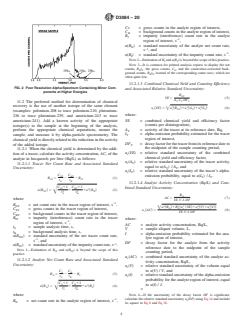
alpha-emitters may be identified. Fig. 2 shows a typical spectrum with very poor resolution.
11. Calculation
11.1 Analyze the data by first integrating the area under the alpha peak to obtain a gross count for the alpha emitter. When the
spectrum is complex and alpha peaks add to each other, corrections for overlapping peaks will be required. Some instrument
manufacturer’smanufacturer’s computer software can perform these and other data-analysis functions.
11.2 The preferred method for determination of chemical recovery is the use of another isotope of the same element (examples:
polonium-208 to trace polonium-210, plutonium-236 to trace plutonium-239, and americium-243 to trace americium-241). Add a
known activity of the appropriate isotope(s) to the sample at the beginning of the analysis, perform the appropriate chemical
separations, mount the sample, and measure it by alpha-particle spectrometry. The chemical yield is directly related to the reduction
in the activity of the added isotope.
11.2.1 When the recovery factorchemical yield is determined by the addition of a tracer, calculate the gross radioactivity activity
concentration, C,AC, of the analyte in becquerels per litre (Bq/L) as follows:
11.2.1.1 Radiotracer Net Counts: Tracer Net Count Rate and Associated Standard Uncertainty:
C C
ST BT
R 5 2 2 R (1)
NT IT
t t
S B
N 5 G 2 B 2 I (1)
T T C
FIG. 2 Poor Resolution Alpha-Spectrum Containing Minor Components a
...