

ASTM C1522-05(2021)
(Test Method)Standard Test Method for Extensibility After Heat Aging of Cold Liquid-Applied Elastomeric Waterproofing Membranes
General Information
- Abstract
SIGNIFICANCE AND USE
6.1 This test method is used to determine a membrane's ability to bridge a crack that forms after the membrane has been applied and allowed to cure.
SCOPE
1.1 This test method describes a laboratory procedure for determining extensibility for one- or two-component cold liquid-applied elastomeric waterproofing membranes.
1.2 The values stated in SI units are to be regarded as the standard. The values in parentheses are for information only.
1.3 The committee with jurisdiction over this standard is not aware of any comparable standards published by other organizations.
1.4 This standard does not purport to address all of the safety concerns, if any, associated with its use. It is the responsibility of the user of this standard to establish appropriate safety, health, and environmental practices and determine the applicability of regulatory limitations prior to use.
1.5 This international standard was developed in accordance with internationally recognized principles on standardization established in the Decision on Principles for the Development of International Standards, Guides and Recommendations issued by the World Trade Organization Technical Barriers to Trade (TBT) Committee.
- Status
- Published
- Publication Date
- 30-Nov-2021
- Technical Committee
- D08 - Roofing and Waterproofing
- Drafting Committee
- D08.22 - Waterproofing and Dampproofing Systems


Overview
ASTM C1522-05(2021): Standard Test Method for Extensibility After Heat Aging of Cold Liquid-Applied Elastomeric Waterproofing Membranes is an internationally recognized method developed by ASTM International. This standard outlines a laboratory procedure to determine the extensibility-or capacity to stretch-of one- or two-component cold liquid-applied elastomeric waterproofing membranes after undergoing heat aging. The method is essential for evaluating a membrane's ability to bridge cracks that may develop in a substrate after membrane application and curing, thereby ensuring the durability and reliability of waterproofing systems in construction and infrastructure projects.
Key Topics
- Purpose and Scope: Defines a consistent approach for assessing the extensibility of cold-applied waterproofing membranes subjected to heat aging.
- Test Procedure: Involves preparing substrate test blocks, applying the membrane, heat aging the assembly for a specified duration, and measuring the membrane’s ability to span a predetermined crack width without failure.
- Significance: Directly assesses a membrane’s crack-bridging capacity after exposure to elevated temperatures, which is critical for long-term waterproofing performance.
- Safety and Compliance: Highlights user responsibility for safety and compliance with health and environmental regulations.
- International Applicability: Developed in accordance with World Trade Organization (WTO) principles for global standardization.
Applications
Implementing ASTM C1522-05(2021) brings substantial value to professionals and organizations in construction, building envelope design, and infrastructure maintenance:
- Quality Assurance for Waterproofing Membranes: Manufacturers and specifiers use this test to ensure that cold liquid-applied elastomeric membranes retain their flexibility and crack-bridging abilities after aging, an essential property for effective waterproofing in challenging environmental conditions.
- Product Development and Specification: Product developers utilize this standard when creating or evaluating new membrane formulations, ensuring compliance with industry requirements for extensibility after heat exposure.
- Project and Site Testing: Contractors and consultants reference this method in laboratory settings to verify that membranes selected for projects meet specifications for post-aging performance, reducing risk of premature failures.
- Regulatory and Warranty Purposes: Providing documented proof that installed membranes satisfy ASTM C1522 requirements can support compliance, project warranty, and insurance needs.
Related Standards
Several ASTM standards and guides are related to the testing and use of building sealants and waterproofing membranes:
- ASTM C717 - Terminology of Building Seals and Sealants: Provides standard definitions for relevant terms used in waterproofing and sealant testing, important for interpreting C1522’s scope and results.
- ASTM C1375 - Guide for Substrates Used in Testing Building Seals and Sealants: Outlines substrate preparation methods for testing membranes and sealants in laboratory conditions.
- ASTM C1250 (Withdrawn) - Test Method for Nonvolatile Content of Cold Liquid-Applied Elastomeric Waterproofing Membranes: Previously used for determining key application properties.
- No Comparable International Standard: According to the ASTM C1522-05(2021) committee, there are no directly comparable standards published by other organizations.
Conclusion
Adopting ASTM C1522-05(2021) ensures a robust, uniform method for evaluating the extensibility and crack-bridging performance of cold liquid-applied elastomeric waterproofing membranes after heat aging. This supports enhanced quality assurance, product development, and performance verification across the construction and waterproofing industries, addressing both technical and regulatory requirements in waterproofing membrane specification and use.
Relations
- Refers
ASTM C1375-00(2020) - Standard Guide for Substrates Used in Testing Building Seals and Sealants - Effective Date
- 01-Jan-2020
- Effective Date
- 01-Mar-2019
- Effective Date
- 01-Mar-2018
- Effective Date
- 01-Nov-2017
- Effective Date
- 01-Jan-2017
- Effective Date
- 15-Nov-2016
- Effective Date
- 01-Sep-2016
- Effective Date
- 01-May-2014
- Effective Date
- 01-Feb-2014
- Refers
ASTM C1375-00(2014) - Standard Guide for Substrates Used in Testing Building Seals and Sealants - Effective Date
- 01-Jan-2014
- Effective Date
- 01-Nov-2013
- Effective Date
- 01-Dec-2012
- Effective Date
- 01-May-2012
- Effective Date
- 15-Jan-2012
- Effective Date
- 01-Mar-2011
Get Certified
Connect with accredited certification bodies for this standard

DIN CERTCO
DIN Group product certification.

Smithers Quality Assessments
US management systems and product certification.
Sponsored listings
Frequently Asked Questions
ASTM C1522-05(2021) is a standard published by ASTM International. Its full title is "Standard Test Method for Extensibility After Heat Aging of Cold Liquid-Applied Elastomeric Waterproofing Membranes". This standard covers: SIGNIFICANCE AND USE 6.1 This test method is used to determine a membrane's ability to bridge a crack that forms after the membrane has been applied and allowed to cure. SCOPE 1.1 This test method describes a laboratory procedure for determining extensibility for one- or two-component cold liquid-applied elastomeric waterproofing membranes. 1.2 The values stated in SI units are to be regarded as the standard. The values in parentheses are for information only. 1.3 The committee with jurisdiction over this standard is not aware of any comparable standards published by other organizations. 1.4 This standard does not purport to address all of the safety concerns, if any, associated with its use. It is the responsibility of the user of this standard to establish appropriate safety, health, and environmental practices and determine the applicability of regulatory limitations prior to use. 1.5 This international standard was developed in accordance with internationally recognized principles on standardization established in the Decision on Principles for the Development of International Standards, Guides and Recommendations issued by the World Trade Organization Technical Barriers to Trade (TBT) Committee.
SIGNIFICANCE AND USE 6.1 This test method is used to determine a membrane's ability to bridge a crack that forms after the membrane has been applied and allowed to cure. SCOPE 1.1 This test method describes a laboratory procedure for determining extensibility for one- or two-component cold liquid-applied elastomeric waterproofing membranes. 1.2 The values stated in SI units are to be regarded as the standard. The values in parentheses are for information only. 1.3 The committee with jurisdiction over this standard is not aware of any comparable standards published by other organizations. 1.4 This standard does not purport to address all of the safety concerns, if any, associated with its use. It is the responsibility of the user of this standard to establish appropriate safety, health, and environmental practices and determine the applicability of regulatory limitations prior to use. 1.5 This international standard was developed in accordance with internationally recognized principles on standardization established in the Decision on Principles for the Development of International Standards, Guides and Recommendations issued by the World Trade Organization Technical Barriers to Trade (TBT) Committee.
ASTM C1522-05(2021) is classified under the following ICS (International Classification for Standards) categories: 83.060 - Rubber. The ICS classification helps identify the subject area and facilitates finding related standards.
ASTM C1522-05(2021) has the following relationships with other standards: It is inter standard links to ASTM C1375-00(2020), ASTM C717-19, ASTM C717-18, ASTM C717-17a, ASTM C717-17, ASTM C717-16a, ASTM C717-16, ASTM C717-14a, ASTM C717-14, ASTM C1375-00(2014), ASTM C717-13, ASTM C717-12b, ASTM C717-12a, ASTM C717-12, ASTM C717-11a. Understanding these relationships helps ensure you are using the most current and applicable version of the standard.
ASTM C1522-05(2021) is available in PDF format for immediate download after purchase. The document can be added to your cart and obtained through the secure checkout process. Digital delivery ensures instant access to the complete standard document.
Standards Content (Sample)
This international standard was developed in accordance with internationally recognized principles on standardization established in the Decision on Principles for the
Development of International Standards, Guides and Recommendations issued by the World Trade Organization Technical Barriers to Trade (TBT) Committee.
Designation:C1522 −05 (Reapproved 2021)
Standard Test Method for
Extensibility After Heat Aging of Cold Liquid-Applied
Elastomeric Waterproofing Membranes
This standard is issued under the fixed designation C1522; the number immediately following the designation indicates the year of
original adoption or, in the case of revision, the year of last revision.Anumber in parentheses indicates the year of last reapproval.A
superscript epsilon (´) indicates an editorial change since the last revision or reapproval.
1. Scope 3. Terminology
3.1 Definitions—Refer to Terminology C717 for definitions
1.1 This test method describes a laboratory procedure for
determining extensibility for one- or two-component cold of terms used in this standard.
liquid-applied elastomeric waterproofing membranes.
4. Comparison to Other Standards
1.2 The values stated in SI units are to be regarded as the
4.1 Thecommitteewithjurisdictionoverthisstandardisnot
standard. The values in parentheses are for information only.
aware of any comparable standards published by other orga-
1.3 Thecommitteewithjurisdictionoverthisstandardisnot
nizations.
aware of any comparable standards published by other orga-
nizations.
5. Summary of Test Method
1.4 This standard does not purport to address all of the
5.1 This test method consists of preparing three samples for
safety concerns, if any, associated with its use. It is the
each membrane to be tested and extending after aging 14 days
responsibility of the user of this standard to establish appro-
at 70 6 2°C (158 6 3.6°F).
priate safety, health, and environmental practices and deter-
mine the applicability of regulatory limitations prior to use.
6. Significance and Use
1.5 This international standard was developed in accor-
6.1 This test method is used to determine a membrane’s
dance with internationally recognized principles on standard-
ability to bridge a crack that forms after the membrane has
ization established in the Decision on Principles for the
been applied and allowed to cure.
Development of International Standards, Guides and Recom-
mendations issued by the World Trade Organization Technical
7. Apparatus
Barriers to Trade (TBT) Committee.
7.1 Forced Draft Oven, controlled to 70 6 2°C (158 6
3.6°F).
2. Referenced Documents
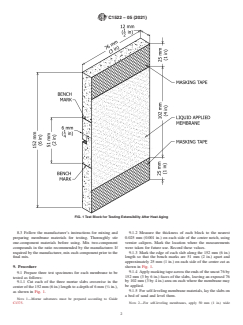
7.2 Three Mortar Test Blocks, dimensions 12 × 76 ×
2.1 ASTM Standards:
1 1
152mm( ⁄2×3×6in.)nominalwith6mm( ⁄4in.)deepnotch
C717Terminology of Building Seals and Sealants
cut across the width (see Fig. 1).
C1250TestMethodforNonvolatileContentofColdLiquid-
Applied Elastomeric Waterproofing Membranes (With- 7.3 Masking Tape.
drawn 2015)
7.4 Sand.
C1375Guide for Substrates Used in Testing Building Seals
7.5 Wood Board, Steel Wedge, Hammer, and Wood Blades.
and Sealants
7.6 Testing Machine,withtensiongripscapableofpullingat
a rate of separation of 12.7 mm (0.5 in.)/min.
ThistestmethodisunderthejurisdictionofASTMCommitteeD08onRoofing
7.7 Vernier Calipers.
and Waterproofing and is the direct responsibility of Subcommittee D08.22 on
Waterproofing and Dampproofing Systems.
8. Conditioning/Mixing
Current edition approved Dec. 1, 2021. Published December 2021. Originally
approved in 2002. Last previous edition approved in 2013 as C1522–05 (2013).
8.1 Unless otherwise specified by those authorizing the test,
DOI: 10.1520/C1522-05R21.
standard conditions are 23 6 1°C (73.4 6 1.8°F) and 50 6
For referenced ASTM standards, visit the ASTM website, www.astm.org, or
5% relative humidity.
contact ASTM Customer Service at service@astm.org. For Annual Book of ASTM
Standards volume information, refer to the standard’s Document Summary page on
8.2 Store all membrane materials to be tested in an un-
the ASTM website.
openedcontaineratstandardconditionsforatleast24hbefore
The last approved version of this historical standard is referenced on
www.astm.org. any test specimens are prepared.
Copyright © ASTM International, 100 Barr Harbor Drive, PO Box C700, West Conshohocken, PA 19428-2959. United States
C1522−05 (2021)
FIG. 1Test Block for Testing Extensibility After Heat Aging
8.3 Follow the manufacturer’s instructions for mixing and 9.1.2 Measure the thickness of each block to the nearest
preparing membrane materials for testing. Thoroughly stir 0.025 mm (0.001 in.) on each side of the center notch, using
one-component materials before using. Mix two-component vernier calipers. Mark the location where the measurements
compounds in the ratio recommended b
...