

ASTM D5898/D5898M-96(2021)
(Guide)Standard Guide for Standard Details for Adhered Sheet Waterproofing
General Information
- Abstract
SIGNIFICANCE AND USE
4.1 This guide illustrates general details for below-grade and plaza waterproofing. It serves as a guide that will enable the designer to prepare complete waterproofing details for each specific condition that occurs on a project.
SCOPE
1.1 This guide covers details for typical conditions encountered in adhered sheet waterproofing on below-grade structures and plazas.
1.2 This guide does not cover liquid-applied waterproofing.
1.3 The values stated in either SI units or inch-pound units are to be regarded separately as standard. The values stated in each system may not be exact equivalents; therefore, each system shall be used independently of the other. Combining values from the two systems may result in nonconformance with the standard.
1.4 This international standard was developed in accordance with internationally recognized principles on standardization established in the Decision on Principles for the Development of International Standards, Guides and Recommendations issued by the World Trade Organization Technical Barriers to Trade (TBT) Committee.
- Status
- Published
- Publication Date
- 30-Nov-2021
- Technical Committee
- D08 - Roofing and Waterproofing
- Drafting Committee
- D08.22 - Waterproofing and Dampproofing Systems
Overview
ASTM D5898/D5898M-96(2021): Standard Guide for Standard Details for Adhered Sheet Waterproofing is an international ASTM standard developed to assist designers in preparing detailed drawings and specifications for adhered sheet waterproofing systems. This guide is especially relevant for below-grade structures and plaza applications, providing guidance on typical and special conditions encountered during waterproofing installation. The standard focuses exclusively on adhered sheet waterproofing, specifically omitting liquid-applied waterproofing systems, and adheres to recognized international standardization principles as outlined by the World Trade Organization Technical Barriers to Trade (TBT) Committee.
Key Topics
ASTM D5898/D5898M-96(2021) covers essential aspects and requirements for adhered sheet waterproofing, including:
- General Detailing: Illustrates standard construction details for applied sheet membranes on below-grade surfaces and plazas.
- Design Practices: Guides designers to consider every specific job site condition, particularly at transitions, penetrations, and junctions of different planes.
- Material Reinforcement: Discusses the necessity and placement of reinforcement materials at transitions, expansion joints, penetrations, corners, and construction joints.
- Use of Protection Layers: Recommends the use of protective boards or drainage panels over membranes to avoid damage from backfill, construction traffic, and ultraviolet exposure.
- Accommodation of Structural Movement: Provides detailing guidance for expansion joints, penetrations, and differential slab movements to maintain waterproofing integrity.
- Standard Units: States that values in SI or inch-pound units are not interchangeable and must be utilized exclusively within each system to ensure compliance.
Key Concepts:
- Adhered sheet waterproofing
- Reinforcement at corners and penetrations
- Flashing and terminations
- Protection of membranes
- Expansion and control joints
Applications
ASTM D5898/D5898M-96(2021) is widely used in the construction industry for:
- Below-Grade Waterproofing: Protecting foundations, tunnels, and walls below ground level from water ingress using adhered sheet membranes.
- Plaza and Deck Waterproofing: Ensuring performance on plaza decks and elevated slabs subject to structural movement and weather exposure.
- Detailing Penetrations and Joints: Providing solutions for waterproofing around pipes, conduits, drains, expansion joints, planters, benches, equipment supports, and footings.
- Building and Infrastructure Projects: Facilitating the design and construction of commercial, residential, and civil infrastructure projects where long-term waterproofing is critical for durability and asset value.
By following the illustrated guides and recommendations, architects, engineers, and contractors can enhance the reliability and longevity of adhered sheet waterproofing systems in diverse building environments.
Related Standards
Several other ASTM and international standards complement or are referenced by ASTM D5898/D5898M-96(2021):
- ASTM D1079: Terminology Relating to Roofing and Waterproofing, referenced for definitions used in waterproofing systems.
- ASTM Standards for Waterproofing Materials: Guidelines on properties, installation, and performance of various waterproofing systems.
- World Trade Organization (WTO) TBT Committee Principles: Ensures the standard conforms to international standardization requirements for broader global acceptance.
Keywords: adhered sheet waterproofing, foundation waterproofing, plaza waterproofing, ASTM waterproofing standards, expansion joints, waterproofing protection layer, construction detailing, waterproofing reinforcement.
Relations
- Effective Date
- 01-May-2020
- Effective Date
- 15-Dec-2018
- Effective Date
- 15-Dec-2018
- Effective Date
- 01-Feb-2016
- Effective Date
- 01-Mar-2013
- Effective Date
- 01-Mar-2013
- Effective Date
- 01-Sep-2010
- Effective Date
- 01-Jul-2009
- Effective Date
- 01-Feb-2008
- Effective Date
- 01-Jan-2008
- Effective Date
- 01-Jun-2007
- Effective Date
- 15-Jan-2007
- Effective Date
- 01-Aug-2006
- Effective Date
- 15-Sep-2005
- Refers
ASTM D1079-05 - Standard Terminology Relating to Roofing, Waterproofing, and Bituminous Materials - Effective Date
- 01-Mar-2005
Get Certified
Connect with accredited certification bodies for this standard

DIN CERTCO
DIN Group product certification.

Smithers Quality Assessments
US management systems and product certification.
Sponsored listings
Frequently Asked Questions
ASTM D5898/D5898M-96(2021) is a guide published by ASTM International. Its full title is "Standard Guide for Standard Details for Adhered Sheet Waterproofing". This standard covers: SIGNIFICANCE AND USE 4.1 This guide illustrates general details for below-grade and plaza waterproofing. It serves as a guide that will enable the designer to prepare complete waterproofing details for each specific condition that occurs on a project. SCOPE 1.1 This guide covers details for typical conditions encountered in adhered sheet waterproofing on below-grade structures and plazas. 1.2 This guide does not cover liquid-applied waterproofing. 1.3 The values stated in either SI units or inch-pound units are to be regarded separately as standard. The values stated in each system may not be exact equivalents; therefore, each system shall be used independently of the other. Combining values from the two systems may result in nonconformance with the standard. 1.4 This international standard was developed in accordance with internationally recognized principles on standardization established in the Decision on Principles for the Development of International Standards, Guides and Recommendations issued by the World Trade Organization Technical Barriers to Trade (TBT) Committee.
SIGNIFICANCE AND USE 4.1 This guide illustrates general details for below-grade and plaza waterproofing. It serves as a guide that will enable the designer to prepare complete waterproofing details for each specific condition that occurs on a project. SCOPE 1.1 This guide covers details for typical conditions encountered in adhered sheet waterproofing on below-grade structures and plazas. 1.2 This guide does not cover liquid-applied waterproofing. 1.3 The values stated in either SI units or inch-pound units are to be regarded separately as standard. The values stated in each system may not be exact equivalents; therefore, each system shall be used independently of the other. Combining values from the two systems may result in nonconformance with the standard. 1.4 This international standard was developed in accordance with internationally recognized principles on standardization established in the Decision on Principles for the Development of International Standards, Guides and Recommendations issued by the World Trade Organization Technical Barriers to Trade (TBT) Committee.
ASTM D5898/D5898M-96(2021) is classified under the following ICS (International Classification for Standards) categories: 83.140.50 - Seals. The ICS classification helps identify the subject area and facilitates finding related standards.
ASTM D5898/D5898M-96(2021) has the following relationships with other standards: It is inter standard links to ASTM D1079-20, ASTM D1079-18, ASTM D1079-18e1, ASTM D1079-16, ASTM D1079-13e1, ASTM D1079-13, ASTM D1079-10, ASTM D1079-09, ASTM D1079-08a, ASTM D1079-08, ASTM D1079-07a, ASTM D1079-07, ASTM D1079-06, ASTM D1079-05a, ASTM D1079-05. Understanding these relationships helps ensure you are using the most current and applicable version of the standard.
ASTM D5898/D5898M-96(2021) is available in PDF format for immediate download after purchase. The document can be added to your cart and obtained through the secure checkout process. Digital delivery ensures instant access to the complete standard document.
Standards Content (Sample)
This international standard was developed in accordance with internationally recognized principles on standardization established in the Decision on Principles for the
Development of International Standards, Guides and Recommendations issued by the World Trade Organization Technical Barriers to Trade (TBT) Committee.
Designation:D5898/D5898M −96 (Reapproved 2021)
Standard Guide for
Standard Details for Adhered Sheet Waterproofing
This standard is issued under the fixed designation D5898/D5898M; the number immediately following the designation indicates the
year of original adoption or, in the case of revision, the year of last revision. A number in parentheses indicates the year of last
reapproval. A superscript epsilon (´) indicates an editorial change since the last revision or reapproval.
1. Scope a polymeric or vulcanized elastomeric membrane. The system
is applied directly to concrete or masonry surfaces below
1.1 This guide covers details for typical conditions encoun-
grade.
tered in adhered sheet waterproofing on below-grade structures
3.2.2 elevated slab, n—a framed or suspended concrete slab
and plazas.
over a habitable or useable space.
1.2 This guide does not cover liquid-applied waterproofing.
3.2.3 fillet, n—liquid-applied modified bitumen or mastic
1.3 The values stated in either SI units or inch-pound units
used at internal corners before membrane application to form a
are to be regarded separately as standard. The values stated in
transition of less than 90°.
each system may not be exact equivalents; therefore, each
3.2.4 reinforcement, n—generally, one or more strips of
system shall be used independently of the other. Combining
membrane, felts, or fabrics, installed at corners and over
values from the two systems may result in nonconformance
construction joints.
with the standard.
3.3 Abbreviations:
1.4 This international standard was developed in accor-
3.3.1 LAM—liquid-applied membrane.
dance with internationally recognized principles on standard-
3.3.2 SS—stainless steel.
ization established in the Decision on Principles for the
Development of International Standards, Guides and Recom-
3.3.3 EJ—expansion joint.
mendations issued by the World Trade Organization Technical
3.3.4 NR—not recommended.
Barriers to Trade (TBT) Committee.
3.3.5 MTL—noncorrosive metal.
2. Referenced Documents
4. Significance and Use
2.1 ASTM Standards:
4.1 This guide illustrates general details for below-grade
D1079 Terminology Relating to Roofing and Waterproofing
and plaza waterproofing. It serves as a guide that will enable
the designer to prepare complete waterproofing details for each
3. Terminology
specific condition that occurs on a project.
3.1 Definitions—For definitions of terms used in this guide,
5. Drawings
refer to Terminology D1079.
5.1 This guide is not all inclusive. The designer should
3.2 Definitions of Terms Specific to This Standard:
detail all typical and special conditions on the project, paying
3.2.1 adhered sheet waterproofing, n—a system consisting
particular attention to transitions in plane and intersection of
of one or more plies of organic or glass fiber felts or fabrics
different details. The applicator should provide shop drawings
applied in hot or cold bitumens or modified bitumens, or one or
of each condition to confirm field conditions and to verify his
more plies of a manufactured sheet of modified bitumen that
understanding of the design intent.
may be reinforced or laminated with scrim or polyethylene, or
5.2 Waterproofing membranes and reinforcement are indi-
cated on the figures as a single thick line, regardless of the
number of plies.
This guide is under the jurisdiction of ASTM Committee D08 on Roofing and
Waterproofing and is the direct responsibility of Subcommittee D08.22 on Water-
5.3 Protection layers have been omitted for clarity. See
proofing and Dampproofing Systems.
Section 6.
Current edition approved Dec. 1, 2021. Published December 2021. Originally
approved in 1996. Last previous edition approved in 2013 as D5898 – 96 (2013).
6. Protection
DOI: 10.1520/D5898_D5898M-96R21.
For referenced ASTM standards, visit the ASTM website, www.astm.org, or
6.1 Protection materials are required over all waterproofing
contact ASTM Customer Service at service@astm.org. For Annual Book of ASTM
to prevent damage from backfill, reinforcing chairs, and
Standards volume information, refer to the standard’s Document Summary page on
the ASTM website. construction traffic, unless the membrane system incorporates
Copyright © ASTM International, 100 Barr Harbor Drive, PO Box C700, West Conshohocken, PA 19428-2959. United States
D5898/D5898M−96 (2021)
an integral protection layer. Protection also is required where Cast iron drains, cast into the slab with flanges flush with or
membranes terminate above grade and may be exposed to slightly below the slab, are preferred. Additional plies of
ultraviolet light. reinforcement should be installed at drains.
6.2 Materials for protection include: asphalt composition 8.2 Wearing courses on plaza decks move differentially
boards, plastic drainage panels, low-density expanded polysty- from the structural slab. To prevent damage to the drainage
rene boards, and extruded polystyrene insulation. Low-density system or flashing rupture from this movement, drains should
expanded polystyrene boards and some types of plastic drain- be installed in the structural slab with inlets in the wearing
age panels are not suitable for protection on horizontal sur- course divorced from the drain body.
faces. Protection materials are loose-laid on horizontal mem-
9. Expansion Joints
branes and attached to vertical membranes with compatible
adhesives. They should be installed as soon as possible after
9.1 Structural expansion joints should be designed to permit
the membrane, or each portion of it, is completed or water
independent movement of structural elements on each side of
tested.
the joint. Control joints should be located to permit non-
reversible movement and may be dynamic. The size and
7. Reinforcement
location of expansion and control joints should be determined
by the structural engineer. Expansion joint covers should be
7.1 Reinforcement is required for built-up and modified
bitumenmembranesattransitions,suchasinternalandexternal designed to maintain continuity at all changes in plane. They
should be designed to prevent displacement when subjected to
corners and at static concrete construction joints and cracks.
Reinforcement also is required where reinforcing bars, pipes, waterpressure.Wheretheyoccurinelevatedslabs,theyshould
be raised above the surface. Control joints are not detailed as
and conduits penetrate the membrane. Separate reinforcement
generally is not required for polymeric and vulcanized elasto- expansion joints but should be reinforced in all membrane
systems.
meric membranes.
7.2 Reinforcement usually is installed before the membrane
10. Structural Items
but may be applied over it. Refer to the membrane manufac-
10.1 Water stops, keyways, and other structural elements
turer for details.
that are frequently installed in construction and control joints
7.3 The minimum reinforcement is one ply. Systems using a
are not indicated on the details.
multiple-ply membrane usually require two or more reinforce-
ment plies, whereas single-ply modified bitumen systems
11. Mud Mats
generally require one.
11.1 Mud mats are cast on the subgrade to support water-
7.4 When additional plies are used as reinforcement, they
proofing. Protection boards and tamped sand beds may be
should extend at least 150 mm [6 in.] beyond the corner or
acceptable alternates with some manufacturers.
penetration and each succeeding ply should extend 75 mm
[3 in.] beyond the previous ply. 12. Planters, Bench, and Equipment Supports
7.5 Where reinforcing bars penetrate waterproofing, such as 12.1 Waterproofing membranes on horizontal surfaces
at rock anchors and wall-to-slab transitions, they should be should be carried under planters and supports without inter-
sealed with reinforcing plies finger cut around the bars or ruption. Such items should be installed on the concrete
liquid-applied membrane or both. protection slab. Waterproofing of planters should be indepen-
dent of the slab waterproofing.
7.6 Some manufacturers require cementitious cants or a
liquid-appliedwaterproofingormasticfilletatreentrantangles,
13. Explanatory Notes
chamfered external corners, and other special conditions to be
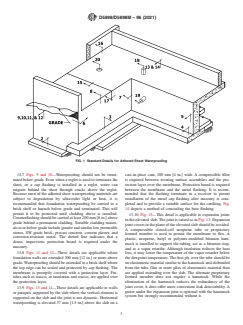
13.1 Fig. 1—Standard details for adhered sheet waterproof-
implemented during construction. These should be indicated
ing.
on project details.
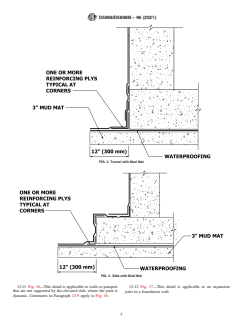
13.2 Fig. 2—This detail is applicable to tunnels and condi-
7.7 Details should recognize the normal sequencing of
tions where the width of excavations is limited.Alternately, the
construction. Foundation walls may be cast before or after
mud mat may be omitted and waterproofing applied to the top
slabs on grade. Structural slabs are cast after walls. Water-
of a structural slab and turned down to the toe. Then,
proofing of individual elements frequently follows this
w
...