

ASTM D2595-22
(Test Method)Standard Test Method for Evaporation Loss of Lubricating Greases Over Wide-Temperature Range
General Information
- Abstract
SIGNIFICANCE AND USE
5.1 The loss of volatile materials from greases and oils can adversely affect the original performance characteristics of a lubricant and, therefore, could be a significant factor in evaluating a lubricant for a specific use. Such volatiles can also be considered contaminants in the environment in which the lubricant is to be used. Correlation between results from this test method and service performance has not been established.
5.2 The test method can be used at any specified temperature between 93 °C and 316 °C (200 °F and 600 °F) that may be agreed upon by the user of the method. (Warning—This test method should not be used at temperatures which exceed the flash point of the base oil of the grease.)
Note 1: The specified flow of air, 2.58 g/min ± 0.02 g/min, (2 L/min at standard temperature and pressure), assumes dry air. It is not known that the original work involved dry air but it has since been shown that this can be a factor in reproducibility and should be addressed. Air with a dew point of less than 10 °C at standard temperature and pressure will be satisfactory.
SCOPE
1.1 This test method covers the determination of evaporation loss of lubricating greases at temperatures between 93 °C and 316 °C (200 °F and 600 °F). This test method is intended to augment Test Method D972, which is limited to 149 °C (300 °F).
1.2 The values stated in SI units are to be regarded as the standard. The values in parentheses are for information only.
1.3 This standard does not purport to address all of the safety concerns, if any, associated with its use. It is the responsibility of the user of this standard to establish appropriate safety, health, and environmental practices and determine the applicability of regulatory limitations prior to use. For specific safety information, see 5.2.
1.4 This international standard was developed in accordance with internationally recognized principles on standardization established in the Decision on Principles for the Development of International Standards, Guides and Recommendations issued by the World Trade Organization Technical Barriers to Trade (TBT) Committee.
- Status
- Published
- Publication Date
- 30-Nov-2022
- Technical Committee
- D02 - Petroleum Products, Liquid Fuels, and Lubricants
- Drafting Committee
- D02.G0.03 - Physical Tests
Buy Documents

ASTM D2595-22 - Standard Test Method for Evaporation Loss of Lubricating Greases Over Wide-Temperature Range
REDLINE ASTM D2595-22 - Standard Test Method for Evaporation Loss of Lubricating Greases Over Wide-Temperature Range
Overview
ASTM D2595-22 is the standard test method for determining the evaporation loss of lubricating greases over a wide temperature range. Developed and published by ASTM International, this standard specifies a procedure designed to evaluate how much volatile material is lost from lubricating greases when they are exposed to elevated temperatures. The test can be conducted at any temperature between 93°C and 316°C (200°F to 600°F), enabling assessment under conditions closer to those found in various real-world applications.
Evaporation loss is a crucial performance indicator because the escape of volatile components can degrade grease performance and lead to changes in consistency, lubrication properties, and increased environmental contamination. This standard supports the selection, quality control, and formulation of greases intended for use in environments subject to high thermal stress.
Key Topics
- Evaporation loss measurement: Provides a detailed, repeatable method to determine the mass percentage of volatile loss in greases.
- Temperature range: Allows testing between 93°C and 316°C, exceeding the limits of ASTM D972, making it suitable for higher-temperature applications.
- Sample preparation and apparatus: Outlines the required sample sizes, apparatus assembly, temperature control, and air flow specifications for consistent results.
- Significance: Addresses the impact of volatile loss on lubricant performance and its implications for selection and environmental considerations.
- Reporting and precision: Guidance on repeatability and reproducibility of test results, essential for laboratory comparison.
Applications
ASTM D2595-22 is widely utilized in the following contexts:
- Lubricating grease development: Supports R&D teams in formulating high-performance greases with minimal evaporation losses, suitable for equipment subject to significant thermal exposure.
- Quality control: Enables grease manufacturers and end-users to verify product stability and performance over anticipated operating temperatures.
- Comparative analysis: Provides a uniform benchmark for comparing different grease formulations or batches.
- Industrial equipment maintenance: Assists in selecting greases for machinery operating at elevated temperatures, such as in automotive, aerospace, or heavy industry sectors, helping to minimize lubricant depletion and related issues.
- Compliance and procurement: Helps compliance officers and purchasers verify that lubricating greases meet relevant high-temperature stability requirements.
Related Standards
For comprehensive evaluation and terminology relating to lubricating greases and associated products, consider the following ASTM standards:
- ASTM D972 - Standard Test Method for Evaporation Loss of Lubricating Greases and Oils (up to 149°C)
- ASTM D217 - Test Methods for Cone Penetration of Lubricating Grease
- ASTM D4175 - Terminology Relating to Petroleum Products, Liquid Fuels, and Lubricants
- ASTM E2877 - Guide for Digital Contact Thermometers (instrumentation guidelines)
These related standards provide additional test methods, terminology, and tools to deepen quality assessment and ensure comprehensive lubricant evaluation.
Keywords: ASTM D2595-22, evaporation loss, lubricating grease, high temperature, volatile loss, grease performance, ASTM standards, industrial lubricants, thermal stability, test method.
Relations
- Refers
ASTM D4175-23a - Standard Terminology Relating to Petroleum Products, Liquid Fuels, and Lubricants - Effective Date
- 15-Dec-2023
- Effective Date
- 01-Nov-2023
- Refers
ASTM D4175-23e1 - Standard Terminology Relating to Petroleum Products, Liquid Fuels, and Lubricants - Effective Date
- 01-Jul-2023
- Effective Date
- 01-May-2019
- Effective Date
- 01-Nov-2017
- Effective Date
- 01-Dec-2016
- Effective Date
- 01-May-2016
- Effective Date
- 01-Nov-2015
- Effective Date
- 01-Mar-2015
- Effective Date
- 01-Jan-2015
- Effective Date
- 01-May-2014
- Effective Date
- 01-Nov-2013
- Effective Date
- 01-Oct-2013
- Effective Date
- 01-May-2013
- Effective Date
- 01-Apr-2013
Buy Documents
ASTM D2595-22 - Standard Test Method for Evaporation Loss of Lubricating Greases Over Wide-Temperature Range
REDLINE ASTM D2595-22 - Standard Test Method for Evaporation Loss of Lubricating Greases Over Wide-Temperature Range
Get Certified
Connect with accredited certification bodies for this standard

Element Materials Technology
Materials testing and product certification.

ABS Group Brazil
ABS Group certification services in Brazil.

ABS Quality Evaluations Inc.
American Bureau of Shipping quality certification.
Sponsored listings
Frequently Asked Questions
ASTM D2595-22 is a standard published by ASTM International. Its full title is "Standard Test Method for Evaporation Loss of Lubricating Greases Over Wide-Temperature Range". This standard covers: SIGNIFICANCE AND USE 5.1 The loss of volatile materials from greases and oils can adversely affect the original performance characteristics of a lubricant and, therefore, could be a significant factor in evaluating a lubricant for a specific use. Such volatiles can also be considered contaminants in the environment in which the lubricant is to be used. Correlation between results from this test method and service performance has not been established. 5.2 The test method can be used at any specified temperature between 93 °C and 316 °C (200 °F and 600 °F) that may be agreed upon by the user of the method. (Warning—This test method should not be used at temperatures which exceed the flash point of the base oil of the grease.) Note 1: The specified flow of air, 2.58 g/min ± 0.02 g/min, (2 L/min at standard temperature and pressure), assumes dry air. It is not known that the original work involved dry air but it has since been shown that this can be a factor in reproducibility and should be addressed. Air with a dew point of less than 10 °C at standard temperature and pressure will be satisfactory. SCOPE 1.1 This test method covers the determination of evaporation loss of lubricating greases at temperatures between 93 °C and 316 °C (200 °F and 600 °F). This test method is intended to augment Test Method D972, which is limited to 149 °C (300 °F). 1.2 The values stated in SI units are to be regarded as the standard. The values in parentheses are for information only. 1.3 This standard does not purport to address all of the safety concerns, if any, associated with its use. It is the responsibility of the user of this standard to establish appropriate safety, health, and environmental practices and determine the applicability of regulatory limitations prior to use. For specific safety information, see 5.2. 1.4 This international standard was developed in accordance with internationally recognized principles on standardization established in the Decision on Principles for the Development of International Standards, Guides and Recommendations issued by the World Trade Organization Technical Barriers to Trade (TBT) Committee.
SIGNIFICANCE AND USE 5.1 The loss of volatile materials from greases and oils can adversely affect the original performance characteristics of a lubricant and, therefore, could be a significant factor in evaluating a lubricant for a specific use. Such volatiles can also be considered contaminants in the environment in which the lubricant is to be used. Correlation between results from this test method and service performance has not been established. 5.2 The test method can be used at any specified temperature between 93 °C and 316 °C (200 °F and 600 °F) that may be agreed upon by the user of the method. (Warning—This test method should not be used at temperatures which exceed the flash point of the base oil of the grease.) Note 1: The specified flow of air, 2.58 g/min ± 0.02 g/min, (2 L/min at standard temperature and pressure), assumes dry air. It is not known that the original work involved dry air but it has since been shown that this can be a factor in reproducibility and should be addressed. Air with a dew point of less than 10 °C at standard temperature and pressure will be satisfactory. SCOPE 1.1 This test method covers the determination of evaporation loss of lubricating greases at temperatures between 93 °C and 316 °C (200 °F and 600 °F). This test method is intended to augment Test Method D972, which is limited to 149 °C (300 °F). 1.2 The values stated in SI units are to be regarded as the standard. The values in parentheses are for information only. 1.3 This standard does not purport to address all of the safety concerns, if any, associated with its use. It is the responsibility of the user of this standard to establish appropriate safety, health, and environmental practices and determine the applicability of regulatory limitations prior to use. For specific safety information, see 5.2. 1.4 This international standard was developed in accordance with internationally recognized principles on standardization established in the Decision on Principles for the Development of International Standards, Guides and Recommendations issued by the World Trade Organization Technical Barriers to Trade (TBT) Committee.
ASTM D2595-22 is classified under the following ICS (International Classification for Standards) categories: 75.100 - Lubricants, industrial oils and related products. The ICS classification helps identify the subject area and facilitates finding related standards.
ASTM D2595-22 has the following relationships with other standards: It is inter standard links to ASTM D4175-23a, ASTM A240/A240M-23a, ASTM D4175-23e1, ASTM E2877-12(2019), ASTM A240/A240M-17, ASTM A240/A240M-16a, ASTM A240/A240M-16, ASTM A240/A240M-15b, ASTM A240/A240M-15a, ASTM A240/A240M-15, ASTM A240/A240M-14, ASTM A240/A240M-13c, ASTM A240/A240M-13b, ASTM A240/A240M-13a, ASTM A240/A240M-13. Understanding these relationships helps ensure you are using the most current and applicable version of the standard.
ASTM D2595-22 is available in PDF format for immediate download after purchase. The document can be added to your cart and obtained through the secure checkout process. Digital delivery ensures instant access to the complete standard document.
Standards Content (Sample)
This international standard was developed in accordance with internationally recognized principles on standardization established in the Decision on Principles for the
Development of International Standards, Guides and Recommendations issued by the World Trade Organization Technical Barriers to Trade (TBT) Committee.
Designation: D2595 − 22
Standard Test Method for
Evaporation Loss of Lubricating Greases Over Wide-
Temperature Range
This standard is issued under the fixed designation D2595; the number immediately following the designation indicates the year of
original adoption or, in the case of revision, the year of last revision.Anumber in parentheses indicates the year of last reapproval.A
superscript epsilon (´) indicates an editorial change since the last revision or reapproval.
This standard has been approved for use by agencies of the U.S. Department of Defense.
1. Scope* 3. Terminology
1.1 This test method covers the determination of evapora- 3.1 Definitions:
tion loss of lubricating greases at temperatures between 93°C
3.1.1 For definitions of terms used in this test method, refer
and 316°C (200°F and 600°F). This test method is intended
to Terminology D4175.
to augment Test Method D972, which is limited to 149°C
3.1.2 lubricating grease, n—a semi-fluid to solid product of
(300°F).
a thickener in a liquid lubricant.
1.2 The values stated in SI units are to be regarded as the 3.1.2.1 Discussion—Thedispersionofthethickenerformsa
standard. The values in parentheses are for information only. two-phase system and immobilizes the liquid lubricant by
surfacetensionandotherphysicalforces.Otheringredientsare
1.3 This standard does not purport to address all of the
commonly included to impart special properties.
safety concerns, if any, associated with its use. It is the
responsibility of the user of this standard to establish appro-
3.1.3 thickener, n—in lubricating grease, a substance com-
priate safety, health, and environmental practices and deter-
posed of finely divided particles dispersed in a liquid lubricant
mine the applicability of regulatory limitations prior to use.
to form the product’s structure.
For specific safety information, see 5.2.
3.1.3.1 Discussion—The thickener can be fibers (such as
1.4 This international standard was developed in accor-
various metallic soaps) or plates or spheres (such as certain
dance with internationally recognized principles on standard-
non-soapthickeners)whichareinsolubleor,atmost,onlyvery
ization established in the Decision on Principles for the
slightly soluble in the liquid lubricant. The general require-
Development of International Standards, Guides and Recom-
mentsarethatthesolidparticlesbeextremelysmall,uniformly
mendations issued by the World Trade Organization Technical
dispersed, and capable of forming a relatively stable, gel-like
Barriers to Trade (TBT) Committee.
structure with the liquid lubricant.
2. Referenced Documents
4. Summary of Test Method
2.1 ASTM Standards:
4.1 A weighed sample of grease in an evaporation cell is
A240/A240MSpecification for Chromium and Chromium-
placed in a heating device maintained at the desired test
Nickel Stainless Steel Plate, Sheet, and Strip for Pressure
temperature. Heated air is passed over the grease surface for
Vessels and for General Applications
22h 6 0.1h. The loss in weight of the sample due to
D972Test Method for Evaporation Loss of Lubricating
evaporation is determined.
Greases and Oils
D4175Terminology Relating to Petroleum Products, Liquid
5. Significance and Use
Fuels, and Lubricants
E2877Guide for Digital Contact Thermometers
5.1 The loss of volatile materials from greases and oils can
adversely affect the original performance characteristics of a
lubricant and, therefore, could be a significant factor in
This test method is under the jurisdiction of ASTM Committee D02 on
evaluatingalubricantforaspecificuse.Suchvolatilescanalso
Petroleum Products, Liquid Fuels, and Lubricants and is the direct responsibility of
Subcommittee D02.G0.03 on Physical Tests. be considered contaminants in the environment in which the
Current edition approved Dec. 1, 2022. Published December 2022. Originally
lubricant is to be used. Correlation between results from this
approved in 1967. Last previous edition approved in 2017 as D2595–17. DOI:
test method and service performance has not been established.
10.1520/D2595-22.
For referenced ASTM standards, visit the ASTM website, www.astm.org, or
5.2 The test method can be used at any specified tempera-
contact ASTM Customer Service at service@astm.org. For Annual Book of ASTM
ture between 93°C and 316°C (200°F and 600°F) that may
Standards volume information, refer to the standard’s Document Summary page on
the ASTM website. be agreed upon by the user of the method. (Warning—This
*A Summary of Changes section appears at the end of this standard
Copyright © ASTM International, 100 Barr Harbor Drive, PO Box C700, West Conshohocken, PA 19428-2959. United States
D2595 − 22
SECTION OF GREASE SAMPLE CUP ALL DIMENSIONS 60.0156 in.
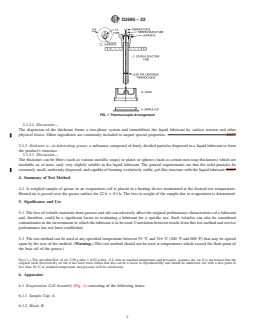
FIG. 1 Thermocouple Arrangement
(60.4 mm) UNLESS OTHERWISE SPECIFIED
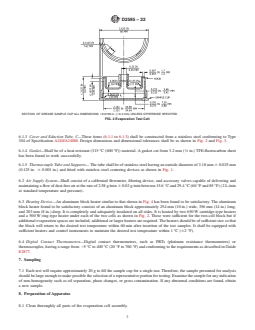
FIG. 2 Evaporation Test Cell
test method should not be used at temperatures which exceed
the flash point of the base oil of the grease.)
NOTE 1—The specified flow of air, 2.58g⁄min 6 0.02g⁄min, (2L⁄min
atstandardtemperatureandpressure),assumesdryair.Itisnotknownthat
theoriginalworkinvolveddryairbutithassincebeenshownthatthiscan
be a factor in reproducibility and should be addressed. Air with a dew
point of less than 10°C at standard temperature and pressure will be
satisfactory.
6. Apparatus
6.1 Evaporation Cell Assembly (Fig. 1) consisting of the
following items:
6.1.1 Sample Cup, A.
6.1.2 Hood, B.
6.1.3 Cover and Eduction Tube, C—These items (6.1.1 to
6.1.3) shall be constructed from a stainless steel conforming to
Type 304 of Specification A240/A240M. Design dimensions
anddimensionaltolerancesshallbeasshowninFig.2andFig.
3.
6.1.4 Gasket—Shall be of a heat-resistant (315°C (600°F))
material. A gasket cut from 3.2mm ( ⁄8in.) TFE-fluorocarbon
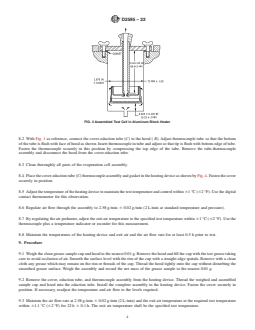
sheet has been found to work successfully. FIG. 3 Assembled Test Cell in Aluminum Block Heater
6.1.5 Thermocouple Tube and Supports— The tube shall be
of stainless steel having an outside diameter of 3.18mm 6
0.025mm(0.125in. 60.001in.)andfittedwithstainlesssteel
centering devices as shown in Fig. 1.
ofthetwocellsasshowninFig.2.Theseweresufficientforthe
two-cell block but if additional evaporation spaces are
6.2 Air Supply System—Shall consist of a calibrated
included, additional or larger heaters are required. The heaters
flowmeter, filtering device, and accessory valves capable of
should be of sufficient size so that the block will return to the
delivering and maintaining a flow of dust-free air at the rate of
desiredtesttemperaturewithin60minafterinsertionofthetest
2.58g⁄min 6 0.02g⁄min between 15.6°C and 29.4°C (60°F
samples.Itshallbeequippedwithsufficientheatersandcontrol
and 85°F) (2L⁄min at standard temperature and pressure).
instruments to maintain the desired test te
...
This document is not an ASTM standard and is intended only to provide the user of an ASTM standard an indication of what changes have been made to the previous version. Because
it may not be technically possible to adequately depict all changes accurately, ASTM recommends that users consult prior editions as appropriate. In all cases only the current version
of the standard as published by ASTM is to be considered the official document.
Designation: D2595 − 17 D2595 − 22
Standard Test Method for
Evaporation Loss of Lubricating Greases Over Wide-
Temperature Range
This standard is issued under the fixed designation D2595; the number immediately following the designation indicates the year of
original adoption or, in the case of revision, the year of last revision. A number in parentheses indicates the year of last reapproval. A
superscript epsilon (´) indicates an editorial change since the last revision or reapproval.
This standard has been approved for use by agencies of the U.S. Department of Defense.
1. Scope*
1.1 This test method covers the determination of evaporation loss of lubricating greases at temperatures between 93 °C and 316 °C
(200 °F and 600 °F). This test method is intended to augment Test Method D972, which is limited to 149 °C (300 °F).
1.2 The values stated in SI units are to be regarded as the standard. The values in parentheses are for information only.
1.3 This standard does not purport to address all of the safety concerns, if any, associated with its use. It is the responsibility
of the user of this standard to establish appropriate safety safety, health, and healthenvironmental practices and determine the
applicability of regulatory limitations prior to use. For specific safety information, see 5.2.
1.4 This international standard was developed in accordance with internationally recognized principles on standardization
established in the Decision on Principles for the Development of International Standards, Guides and Recommendations issued
by the World Trade Organization Technical Barriers to Trade (TBT) Committee.
2. Referenced Documents
2.1 ASTM Standards:
A240/A240M Specification for Chromium and Chromium-Nickel Stainless Steel Plate, Sheet, and Strip for Pressure Vessels and
for General Applications
D217 Test Methods for Cone Penetration of Lubricating Grease
D972 Test Method for Evaporation Loss of Lubricating Greases and Oils
D4175 Terminology Relating to Petroleum Products, Liquid Fuels, and Lubricants
E2877 Guide for Digital Contact Thermometers
3. Terminology
3.1 Definitions:
3.1.1 For definitions of terms used in this test method, refer to Terminology D4175.
3.1.2 lubricating grease, n—a semi-fluid to solid product of a thickener in a liquid lubricant.
This test method is under the jurisdiction of ASTM Committee D02 on Petroleum Products, Liquid Fuels, and Lubricants and is the direct responsibility of Subcommittee
D02.G0.03 on Physical Tests.
Current edition approved June 1, 2017Dec. 1, 2022. Published July 2017December 2022. Originally approved in 1967. Last previous edition approved in 20082017 as
ε1
D2595 – 96D2595 – 17.(2008) , which was withdrawn January 2017 and reinstated June 2017. DOI: 10.1520/D2595-17. DOI: 10.1520/D2595-22.
For referenced ASTM standards, visit the ASTM website, www.astm.org, or contact ASTM Customer Service at service@astm.org. For Annual Book of ASTM Standards
volume information, refer to the standard’s Document Summary page on the ASTM website.
*A Summary of Changes section appears at the end of this standard
Copyright © ASTM International, 100 Barr Harbor Drive, PO Box C700, West Conshohocken, PA 19428-2959. United States
D2595 − 22
FIG. 1 Thermocouple Arrangement
3.1.2.1 Discussion—
The dispersion of the thickener forms a two-phase system and immobilizes the liquid lubricant by surface tension and other
physical forces. Other ingredients are commonly included to impart special properties. D217
3.1.3 thickener, n—in lubricating grease, a substance composed of finely divided particles dispersed in a liquid lubricant to form
the product’s structure.
3.1.3.1 Discussion—
The thickener can be fibers (such as various metallic soaps) or plates or spheres (such as certain non-soap thickeners) which are
insoluble or, at most, only very slightly soluble in the liquid lubricant. The general requirements are that the solid particles be
extremely small, uniformly dispersed, and capable of forming a relatively stable, gel-like structure with the liquid lubricant. D217
4. Summary of Test Method
4.1 A weighed sample of grease in an evaporation cell is placed in a heating device maintained at the desired test temperature.
Heated air is passed over the grease surface for 22 h 6 0.1 h. The loss in weight of the sample due to evaporation is determined.
5. Significance and Use
5.1 The loss of volatile materials from greases and oils can adversely affect the original performance characteristics of a lubricant
and, therefore, could be a significant factor in evaluating a lubricant for a specific use. Such volatiles can also be considered
contaminants in the environment in which the lubricant is to be used. Correlation between results from this test method and service
performance has not been established.
5.2 The test method can be used at any specified temperature between 93 °C and 316 °C (200 °F and 600 °F) that may be agreed
upon by the user of the method. (Warning—This test method should not be used at temperatures which exceed the flash point of
the base oil of the grease.)
NOTE 1—The specified flow of air, 2.58 g ⁄min 6 0.02 g ⁄min, (2 L ⁄min at standard temperature and pressure), assumes dry air. It is not known that the
original work involved dry air but it has since been shown that this can be a factor in reproducibility and should be addressed. Air with a dew point of
less than 10 °C at standard temperature and pressure will be satisfactory.
6. Apparatus
6.1 Evaporation Cell Assembly (Fig. 1) consisting of the following items:
6.1.1 Sample Cup, A.
6.1.2 Hood, B.
D2595 − 22
SECTION OF GREASE SAMPLE CUP ALL DIMENSIONS 60.0156 in. (60.4 mm) UNLESS OTHERWISE SPECIFIED
FIG. 2 Evaporation Test Cell
6.1.3 Cover and Eduction Tube, C—These items (6.1.1 to 6.1.3) shall be constructed from a stainless steel conforming to Type
304 of Specification A240/A240M. Design dimensions and dimensional tolerances shall be as shown in Fig. 2 and Fig. 3.
6.1.4 Gasket—Shall be of a heat-resistant (315 °C (600 °F)) material. A gasket cut from 3.2 mm ( ⁄8 in.) TFE-fluorocarbon sheet
has been found to work successfully.
6.1.5 Thermocouple Tube and Supports— The tube shall be of stainless steel having an outside diameter of 3.18 mm 6 0.025 mm
(0.125 in. 6 0.001 in.) and fitted with stainless steel centering devices as shown in Fig. 1.
6.2 Air Supply System—Shall consist of a calibrated flowmeter, filtering device, and accessory valves capable of delivering and
maintaining a flow of dust-free air at the rate of 2.58 g ⁄min 6 0.02 g ⁄min between 15.6 °C and 29.4 °C (60 °F and 85 °F) (2 L ⁄min
at standard temperature and pressure).
6.3 Heating Device—An aluminum block heater similar to that shown in Fig. 4 has been found to be satisfactory. The aluminum
block heater found to be satisfactory consists of an aluminum block approximately 254 mm (10 in.) wide, 356 mm (14 in.) long,
and 203 mm (8 in.) deep. It is completely and adequately insulated on all sides. It is heated by two 650 W cartridge-type heaters
and a 500 W ring-type
...