


ASTM D4423-10(2015)
(Test Method)Standard Test Method for Determination of Carbonyls in C4 Hydrocarbons
Standard Test Method for Determination of Carbonyls in C<inf>4</inf> Hydrocarbons
SIGNIFICANCE AND USE
4.1 The determination of the carbonyl content of polymerization-grade 1,3-butadiene is necessary, since in some polymerization reactions, the presence of carbonyls in excess over some specified amount can have a deleterious effect upon the polymer properties or the reaction itself, or both.
SCOPE
1.1 This test method covers the determination of carbonyls (ketones and aldehydes) in C4 hydrocarbons. This test method was tested on polymerization-grade 1,3-butadiene.
1.2 The applicable range for this test method is 0 mg/kg to 50 mg/kg carbonyls calculated as acetaldehyde.
1.3 Other C4 hydrocarbons and their mixtures besides polymerization-grade 1,3-butadiene could be tested using this same test method. However, the precision section of this test method covers only carbonyls in applicable range as listed in 1.2, as found in polymerization-grade 1,3-butadiene.
1.4 WARNING—Mercury has been designated by many regulatory agencies as a hazardous material that can cause central nervous system, kidney and liver damage. Mercury, or its vapor, may be hazardous to health and corrosive to materials. Caution should be taken when handling mercury and mercury containing products. See the applicable product Material Safety Data Sheet (MSDS) for details and EPA’s website—http://www.epa.gov/mercury/faq.htm—for additional information. Users should be aware that selling mercury and/or mercury containing products into your state or country may be prohibited by law.
1.5 The values stated in SI units are to be regarded as standard. No other units of measurement are included in this standard.
1.6 This standard does not purport to address all of the safety concerns, if any, associated with its use. It is the responsibility of the user of this standard to establish appropriate safety and health practices and determine the applicability of regulatory limitations prior to use.
General Information
Buy Standard
Standards Content (Sample)
NOTICE: This standard has either been superseded and replaced by a new version or withdrawn.
Contact ASTM International (www.astm.org) for the latest information
Designation: D4423 − 10 (Reapproved 2015)
Standard Test Method for
Determination of Carbonyls in C Hydrocarbons
This standard is issued under the fixed designation D4423; the number immediately following the designation indicates the year of
original adoption or, in the case of revision, the year of last revision. A number in parentheses indicates the year of last reapproval. A
superscript epsilon (´) indicates an editorial change since the last revision or reapproval.
1. Scope 2. Referenced Documents
2.1 ASTM Standards:
1.1 This test method covers the determination of carbonyls
D484 Specification for Hydrocarbon Dry Cleaning Solvents
(ketones and aldehydes) in C hydrocarbons. This test method
(Withdrawn 1982)
was tested on polymerization-grade 1,3-butadiene.
D1193 Specification for Reagent Water
1.2 The applicable range for this test method is 0 mg ⁄kg to
E1 Specification for ASTM Liquid-in-Glass Thermometers
50 mg ⁄kg carbonyls calculated as acetaldehyde.
3. Summary of Test Method
1.3 Other C hydrocarbons and their mixtures besides
3.1 A measured amount of sample is added to an alcoholic
polymerization-grade 1,3-butadiene could be tested using this
hydroxylamine hydrochloride solution that has been adjusted
same test method. However, the precision section of this test
to a given coloration using either alcoholic acid or base. The
method covers only carbonyls in applicable range as listed in
carbonyls will react with the hydroxylamine hydrochloride
1.2, as found in polymerization-grade 1,3-butadiene.
releasing an equivalent amount of hydrochloric acid which is
1.4 WARNING—Mercury has been designated by many then back-titrated to the original coloration. A blank containing
only methanol and sample is titrated and the sample’s results
regulatory agencies as a hazardous material that can cause
are calculated using the blank adjustment. Results are reported
central nervous system, kidney and liver damage. Mercury, or
as milligrams per kilogram carbonyls as acetaldehyde.
its vapor, may be hazardous to health and corrosive to
materials. Caution should be taken when handling mercury and
4. Significance and Use
mercury containing products. See the applicable product Ma-
4.1 The determination of the carbonyl content of
terial Safety Data Sheet (MSDS) for details and EPA’s
polymerization-grade 1,3-butadiene is necessary, since in some
website—http://www.epa.gov/mercury/faq.htm—for addi-
polymerization reactions, the presence of carbonyls in excess
tional information. Users should be aware that selling mercury
over some specified amount can have a deleterious effect upon
and/or mercury containing products into your state or country
the polymer properties or the reaction itself, or both.
may be prohibited by law.
5. Apparatus
1.5 The values stated in SI units are to be regarded as
standard. No other units of measurement are included in this
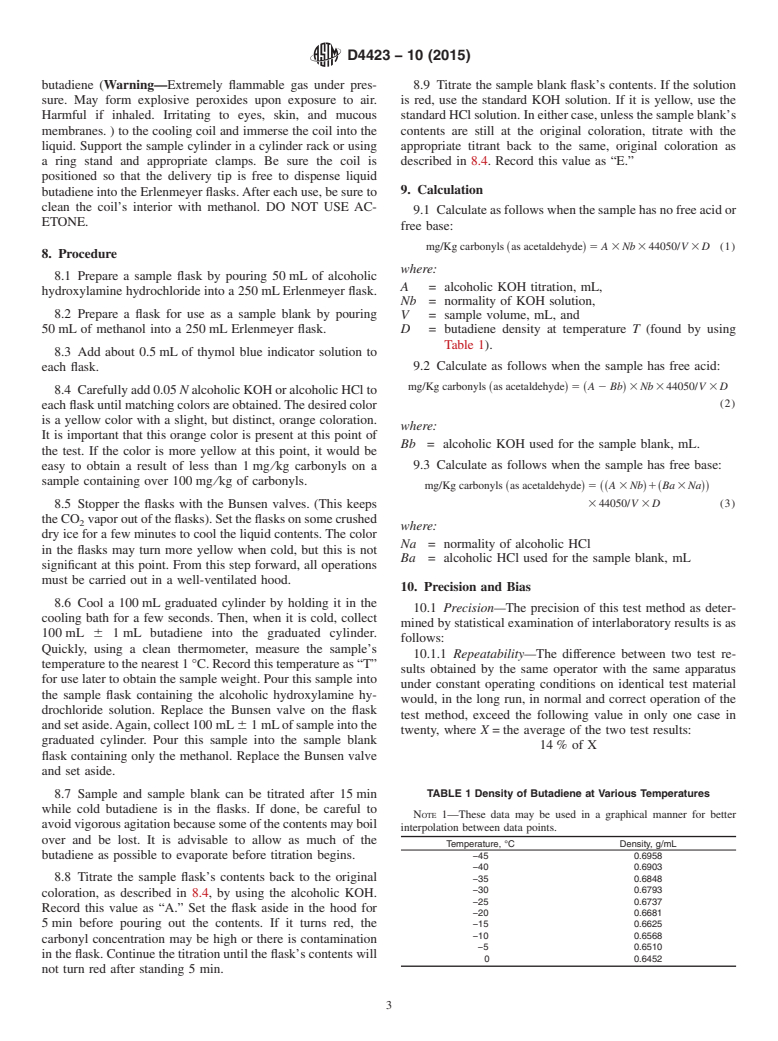
5.1 Bunsen Valves—A device constructed so that when used
standard.
with an Erlenmeyer flask, the sample vapors can exit the flask
while protecting the flask’s liquid contents. See Fig. 1 for
1.6 This standard does not purport to address all of the
details.
safety concerns, if any, associated with its use. It is the
responsibility of the user of this standard to establish appro-
5.2 Cooling Coil—Prepare a cooling coil by winding about
priate safety and health practices and determine the applica-
10 cm to 15 cm of seamless copper tubing (about 6 mm
bility of regulatory limitations prior to use. diameter) on a short length of pipe (about 1.5 cm to 2.0 cm
diameter), allowing sufficient length of tubing at the end of the
coil to connect it to the sample source. Attach a valve at a point
that would not extend more than 8 cm above the surface of the
cooling bath liquid. To the valve, attach a 6 cm to 8 cm length
1 2
This test method is under the jurisdiction of ASTM Committee D02 on For referenced ASTM standards, visit the ASTM website, www.astm.org, or
Petroleum Products, Liquid Fuels, and Lubricants and is the direct responsibility of contact ASTM Customer Service at service@astm.org. For Annual Book of ASTM
Subcommittee D02.D0.04 on C4 Hydrocarbons. Standards volume information, refer to the standard’s Document Summary page on
Current edition approved April 1, 2015. Published May 2015. Originally the ASTM website.
approved in 1984. Last previous edition approved in 2010 as D4423 – 10. DOI: The last approved version of this historical standard is referenced on
10.1520/D4423-10R15. www.astm.org.
Copyright © ASTM International, 100 Barr Harbor Drive, PO Box C700, West Conshohocken, PA 19428-2959. United States
D4423 − 10 (2015)
such specifications are available. Other grades may be used,
provided it is first ascertained that the reagent is of sufficiently
high purity to permit its use without lessening the accuracy of
the determination.
6.2 Purity of Water—Unless otherwise indicated, references
to water shall be understood to mean Type II reagent water
conforming to Specification D1193.
6.3 Alcoholic Hydrochloric Acid (0.05 N)—Dilute 4.2 mL of
concentrated hydrochloric acid (Warning—Poison. Corrosive.
May be fatal if swallowed. Liquid and vapor cause severe
burns. Harmful if inhaled.) to volume with anhydrous methanol
in a 1 L volumetric flask. Use the alcoholic 0.05 N potassium
hydroxide solution to standardize the HCl solution.
6.4 Alcoholic Hydroxylamine Hydrochloride—Dissolve
35.0 g of hydroxylamine hydrochloride (Warning—May be
irritating to skin, eyes, or mucous membranes. Harmful if
FIG. 1 Apparatus
inhaled.) in 3.5 L of anhydrous methanol. (Warning—
Flammable. Vapor harmful. May be fatal or cause blindness if
swallowed or inhaled. Cannot be made nonpoisonous.)
piece of tubing bent downward so that the hydrocarbon liquid
6.5 Alcoholic Potassium Hydroxide (0.05 N)—Dissolve
can be directed into the receiving container.
3.3 g of potassium hydroxide in anhydrous methanol.
5.3 Dewar Flask—The Dewar flask must be of sufficient (Warning—Corrosive. Can cause severe burns or blindness.
volume to completely immerse the main portion of the cooling Evolution of heat produces a violent reaction or eruption upon
coil except for the extremities necessary for receiving and too rapid mixture with water.) Make to volume with methanol
delivering the sample through the coil. in a 1 L volumetric flask. Standardize against a primary
standard, potassium acid phthalate.
5.4 Erlenmeyer Flasks, 250 mL capacity.
6.6 Dry Ice (Carbon Dioxide Solid)—(Warning—
5.5 Volumetric Flasks, 1 L capacity. These flasks should be
Extremely cold (−78.5 °C). Liberates heavy gas which may
Class A glassware.
cause suffocation. Contact with skin causes burns or freezing,
5.6 Graduated Cylinders—100 mL capacity, glass
or both. Vapors may react violently with hot magnesium or
cylinders, graduated in 1 mL or 2 mL divisions.
aluminum alloys.)
5.7 Microburets, 2.00 mL or 5.00 mL capacity. The mi-
6.7 Stoddard Solvent—Conforming to the specification
croburets should be Class A glassware with 0.01 mL or
listed in Specification D484. (Warning—Combustible. Vapor
0.02 mL divisions or less. It is advisable to have the buret’s tip
harmful.)
end equipped with a syringe needle to dispense very small
6.8 Thymol Blue Indicator—Dissolve 0.04 g of thymol blue
drops of titrant.
in 100 mL of anhydrous methanol. (Warning—Flammable.
5.8 Sample Cylinders—These should be of sufficient vol-
Vapor harmful. May be fatal or cause blindness if swallowed or
ume to give the required amount of sample for testing.
inhaled. Cannot be made nonpoisonous.)
Stainless steel cylinders equipped with needle valves should be
used. It is suggested that a 500 mL-capacity cylinder be the 7. Preparation of Apparatus
minimum size to be used for butadiene.
7.1 Dry Ice-Stoddard Solvent Bath— Add a sufficient quan-
5.9 Thermometer—For observing temperatures below tity of Stoddard solvent into the Dewar flask to ensure that the
−45 °C. The Low Cloud and Pour Point Thermometer, con- cooling coil will be submerged in the liquid plus dry ice (solid
forming to the requirements for ASTM Thermometer 6C, as CO ). (Warning—See 6.6 and 6.7.) Carefully add sufficient
prescribed in Specification E1, is satisfactory. Thermometer 6C dry ice to the Stoddard solvent to obtain a temperature of at
has a range
...
This document is not an ASTM standard and is intended only to provide the user of an ASTM standard an indication of what changes have been made to the previous version. Because
it may not be technically possible to adequately depict all changes accurately, ASTM recommends that users consult prior editions as appropriate. In all cases only the current version
of the standard as published by ASTM is to be considered the official document.
Designation: D4423 − 10 D4423 − 10 (Reapproved 2015)
Standard Test Method for
Determination of Carbonyls in C Hydrocarbons
This standard is issued under the fixed designation D4423; the number immediately following the designation indicates the year of
original adoption or, in the case of revision, the year of last revision. A number in parentheses indicates the year of last reapproval. A
superscript epsilon (´) indicates an editorial change since the last revision or reapproval.
1. Scope
1.1 This test method covers the determination of carbonyls (ketones and aldehydes) in C hydrocarbons. This test method was
tested on polymerization-grade 1,3-butadiene.
1.2 The applicable range for this test method is 00 mg ⁄kg to 50 mg ⁄kg carbonyls calculated as acetaldehyde.
1.3 Other C hydrocarbons and their mixtures besides polymerization-grade 1,3-butadiene could be tested using this same test
method. However, the precision section of this test method covers only carbonyls in applicable range as listed in 1.2, as found in
polymerization-grade 1,3-butadiene.
1.4 WARNING—Mercury has been designated by many regulatory agencies as a hazardous material that can cause central
nervous system, kidney and liver damage. Mercury, or its vapor, may be hazardous to health and corrosive to materials. Caution
should be taken when handling mercury and mercury containing products. See the applicable product Material Safety Data Sheet
(MSDS) for details and EPA’s website—http://www.epa.gov/mercury/faq.htm—for additional information. Users should be aware
that selling mercury and/or mercury containing products into your state or country may be prohibited by law.
1.5 The values stated in SI units are to be regarded as standard. No other units of measurement are included in this standard.
1.6 This standard does not purport to address all of the safety concerns, if any, associated with its use. It is the responsibility
of the user of this standard to establish appropriate safety and health practices and determine the applicability of regulatory
limitations prior to use.
2. Referenced Documents
2.1 ASTM Standards:
D484 Specification for Hydrocarbon Dry Cleaning Solvents (Withdrawn 1982)
D1193 Specification for Reagent Water
E1 Specification for ASTM Liquid-in-Glass Thermometers
3. Summary of Test Method
3.1 A measured amount of sample is added to an alcoholic hydroxylamine hydrochloride solution that has been adjusted to a
given coloration using either alcoholic acid or base. The carbonyls will react with the hydroxylamine hydrochloride releasing an
equivalent amount of hydrochloric acid which is then back-titrated to the original coloration. A blank containing only methanol
and sample is titrated and the sample’s results are calculated using the blank adjustment. Results are reported as milligrams per
kilogram carbonyls as acetaldehyde.
4. Significance and Use
4.1 The determination of the carbonyl content of polymerization-grade 1,3-butadiene is necessary, since in some polymerization
reactions, the presence of carbonyls in excess over some specified amount can have a deleterious effect upon the polymer properties
or the reaction itself, or both.
This test method is under the jurisdiction of ASTM Committee D02 on Petroleum Products Products, Liquid Fuels, and Lubricants and is the direct responsibility of
Subcommittee D02.D0.04 on C4 Hydrocarbons.
Current edition approved May 1, 2010April 1, 2015. Published June 2010 May 2015. Originally approved in 1984. Last previous edition approved in 20062010 as
D4423–00(2006).D4423 – 10. DOI: 10.1520/D4423-10.10.1520/D4423-10R15.
For referenced ASTM standards, visit the ASTM website, www.astm.org, or contact ASTM Customer Service at service@astm.org. For Annual Book of ASTM Standards
volume information, refer to the standard’s Document Summary page on the ASTM website.
The last approved version of this historical standard is referenced on www.astm.org.
Copyright © ASTM International, 100 Barr Harbor Drive, PO Box C700, West Conshohocken, PA 19428-2959. United States
D4423 − 10 (2015)
5. Apparatus
5.1 Bunsen Valves—A device constructed so that when used with an Erlenmeyer flask, the sample vapors can exit the flask while
protecting the flask’s liquid contents. See Fig. 1 for details.
5.2 Cooling Coil—Prepare a cooling coil by winding about 1010 cm to 15 cm 15 cm of seamless copper tubing (about
6-mm6 mm diameter) on a short length of pipe (about 1.51.5 cm to 2.0-cm2.0 cm diameter), allowing sufficient length of tubing
at the end of the coil to connect it to the sample source. Attach a valve at a point that would not extend more than 8 cm 8 cm above
the surface of the cooling bath liquid. To the valve, attach a 66 cm to 8 cm 8 cm length piece of tubing bent downward so that
the hydrocarbon liquid can be directed into the receiving container.
5.3 Dewar Flask—The Dewar flask must be of sufficient volume to completely immerse the main portion of the cooling coil
except for the extremities necessary for receiving and delivering the sample through the coil.
5.4 Erlenmeyer Flasks, 250-mL250 mL capacity.
5.5 Volumetric Flasks, 1-L1 L capacity. These flasks should be Class A glassware.
5.6 Graduated Cylinders—100-mL100 mL capacity, glass cylinders, graduated in 11 mL or 2-mL2 mL divisions.
5.7 Microburets, 2.002.00 mL or 5.00-mL5.00 mL capacity. The microburets should be Class A glassware with 0.010.01 mL or
0.02-mL0.02 mL divisions or less. It is advisable to have the buret’s tip end equipped with a syringe needle to dispense very small
drops of titrant.
5.8 Sample Cylinders—These should be of sufficient volume to give the required amount of sample for testing. Stainless steel
cylinders equipped with needle valves should be used. It is suggested that a 500-mL-capacity500 mL-capacity cylinder be the
minimum size to be used for butadiene.
5.9 Thermometer—For observing temperatures below −45°C.−45 °C. The Low Cloud and Pour Point Thermometer, conforming
to the requirements for ASTM Thermometer 6C, as prescribed in Specification E1, is satisfactory. Thermometer 6C has a range
from −80−80 °C to +20°C.+20 °C. Temperature measuring devices that cover the temperature range of interest, such as the ASTM
1C thermometer, or liquid-in-glass thermometers, thermocouples, or platinum resistance thermometers that provide equivalent or
better accuracy and precision may be used.
6. Reagents and Materials
6.1 Purity of Reagents—Reagent grade chemicals should be used in all tests. Unless otherwise indicated, it is intended that all
reagents conform to the specifications of the Committee on Analytical Reagents of the American Chemical Society where such
specifications are available. Other grades may be used, provided it is first ascertained that the reagent is of sufficiently high purity
to permit its use without lessening the accuracy of the determination.
6.2 Purity of Water—Unless otherwise indicated, references to water shall be understood to mean Type II reagent water
conforming to Specification D1193.
Reagent Chemicals, American Chemical Society Specifications, American Chemical Society, Washington, DC. For suggestions on the testing of reagents not listed by
the American Chemical Society, see Analar Standards for Laboratory Chemicals, BDH Ltd., Poole, Dorset, U.K., and the United States Pharmacopeia and National
Formulary, U.S. Pharmacopeial Convention, Inc. (USPC), Rockville, MD.
FIG. 1 Apparatus
D4423 − 10 (2015)
6.3 Alcoholic Hydrochloric Acid (0.05N)—Dilute 4.2 mL 4.2 mL of concentrated hydrochloric acid (Warning—Poison.
Corrosive. May be fatal if swallowed. Liquid and vapor cause severe burns. Harmful if inhaled.) to volume with anhydrous
methanol in a 1-L1 L volumetric flask. Use the alcoholic 0.05 0.05 N potassium hydroxide solution to standardize the HCl solution.
6.4 Alcoholic Hydroxylamine Hydrochloride—Dissolve 35.0 g 35.0 g of hydroxylamine hydrochloride (Warning—May be
irritating to skin, eyes, or mucous membranes. Harmful if inhaled.) in 3.5 L 3.5 L of anhydrous methanol. (Warning—Flammable.
Vapor harmful. May be fatal or cause blindness if swallowed or inhaled. Cannot be made nonpoisonous.)
6.5 Alcoholic Potassium Hydroxide (0.05N)—Dissolve 3.3 g of potassium hydroxide in anhydrous methanol.
...
Questions, Comments and Discussion
Ask us and Technical Secretary will try to provide an answer. You can facilitate discussion about the standard in here.