

ASTM G33-99(2020)
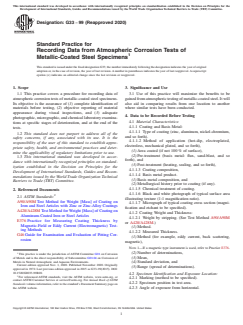
(Practice)Standard Practice for Recording Data from Atmospheric Corrosion Tests of Metallic-Coated Steel Specimens
General Information
- Abstract
SIGNIFICANCE AND USE
3.1 Use of this practice will maximize the benefits to be gained from atmospheric testing of metallic-coated steel. It will also aid in comparing results from one location to another where similar tests have been conducted.
SCOPE
1.1 This practice covers a procedure for recording data of atmospheric corrosion tests of metallic-coated steel specimens. Its objective is the assurance of (1) complete identification of materials before testing, (2) objective reporting of material appearance during visual inspections, and (3) adequate photographic, micrographic, and chemical laboratory examinations at specific stages of deterioration, and at the end of the tests.
1.2 This standard does not purport to address all of the safety concerns, if any, associated with its use. It is the responsibility of the user of this standard to establish appropriate safety, health, and environmental practices and determine the applicability of regulatory limitations prior to use.
1.3 This international standard was developed in accordance with internationally recognized principles on standardization established in the Decision on Principles for the Development of International Standards, Guides and Recommendations issued by the World Trade Organization Technical Barriers to Trade (TBT) Committee.
- Status
- Published
- Publication Date
- 31-Oct-2020
- Technical Committee
- G01 - Corrosion of Metals


Overview
ASTM G33-99(2020), Standard Practice for Recording Data from Atmospheric Corrosion Tests of Metallic-Coated Steel Specimens, provides a comprehensive methodology for documenting data from atmospheric corrosion testing of metallic-coated steel. Published by ASTM International, this standard is designed to ensure complete identification of materials, consistent reporting of physical appearances, and proper documentation using photographic, micrographic, and chemical analysis at specific stages of exposure. Leveraging this standard enables improved comparability of corrosion test results, especially across different locations or laboratories.
Key Topics
- Material Identification: Guidance on recording all pertinent details before testing, including coating type (e.g., zinc, aluminum, nickel-chromium), application method (hot-dip, electroplated, etc.), area coated, and basis metal properties.
- Photographic & Micrographic Documentation: Instructions for producing and archiving black and white photographs of typical surfaces as well as micrographs of cross-sections to record coating texture and thickness.
- Specimen Preparation & Description: Procedures for noting dimensions, surface appearance, edge conditions, and cleaning methods for each specimen prior to exposure.
- Field Data During Exposure: Steps for consistent data gathering on specimen identification, marking, exposure details (position, angle, location), environmental conditions at the time of inspection, and visual rating of corrosion phenomena.
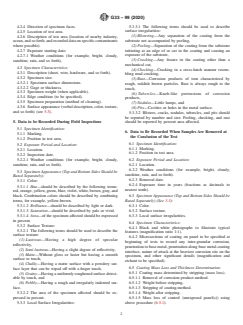
- Reporting Surface Features: Use of standardized definitions for common defects and corrosion products such as blistering, peeling, rust, pitting, nodules, and tubercles, as well as providing percentage coverage.
- Post-Test Evaluation: Methods for determining coating mass loss, thickness measurements, and documentation of surface and subsurface changes due to atmospheric exposure.
- Adaptability and Exceptions: Recommendations for noting deviations from the standard protocol if certain data cannot be obtained due to practical limitations.
Applications
ASTM G33-99(2020) is vital for organizations, laboratories, and researchers involved in:
- Corrosion Testing & Material Selection: Facilitates accurate documentation for experimental and comparative evaluation of metallic-coated steel in various atmospheric environments.
- Product Quality Control: Standardizes the recording process, helping manufacturers assess coating performance and durability over time.
- Environmental Simulation Studies: Supports researchers in analyzing the impact of atmospheric factors, by ensuring data consistency and reliability.
- Comparative Studies Across Locations: Provides a framework for aggregating and comparing corrosion data from different geographic regions, test sites, or laboratories.
- Regulatory Compliance and Reporting: Used to support claims regarding corrosion resistance in line with industry standards for construction, infrastructure, and transport sectors.
Related Standards
The following ASTM standards are frequently referenced alongside ASTM G33-99(2020):
- ASTM A90/A90M: Test Method for Weight [Mass] of Coating on Iron and Steel Articles with Zinc or Zinc-Alloy Coatings
- ASTM A428/A428M: Test Method for Weight [Mass] of Coating on Aluminum-Coated Iron or Steel Articles
- ASTM E376: Practice for Measuring Coating Thickness by Magnetic-Field or Eddy Current Methods
- ASTM G46: Guide for Examination and Evaluation of Pitting Corrosion
Practical Value
Implementing ASTM G33-99(2020) ensures reliable, objective, and standardized documentation of atmospheric corrosion data for metallic-coated steel specimens. The practice significantly enhances the value of corrosion testing by enabling better comparison of results, supporting product development, and maintaining material quality standards across industries.
Keywords: ASTM G33, atmospheric corrosion, metallic-coated steel, corrosion testing, mass loss, pitting, documentation, surface appearance, coating thickness, material identification.
Relations
- Effective Date
- 01-May-2019
- Effective Date
- 01-Nov-2017
- Effective Date
- 01-May-2013
- Effective Date
- 01-Jul-2011
- Effective Date
- 01-Dec-2006
- Effective Date
- 01-May-2005
- Effective Date
- 10-Mar-2003
- Effective Date
- 10-Jan-1999
- Effective Date
- 10-Dec-1996
Get Certified
Connect with accredited certification bodies for this standard

Element Materials Technology
Materials testing and product certification.

Inštitut za kovinske materiale in tehnologije
Institute of Metals and Technology. Materials testing, metallurgical analysis, NDT.
Sponsored listings
Frequently Asked Questions
ASTM G33-99(2020) is a standard published by ASTM International. Its full title is "Standard Practice for Recording Data from Atmospheric Corrosion Tests of Metallic-Coated Steel Specimens". This standard covers: SIGNIFICANCE AND USE 3.1 Use of this practice will maximize the benefits to be gained from atmospheric testing of metallic-coated steel. It will also aid in comparing results from one location to another where similar tests have been conducted. SCOPE 1.1 This practice covers a procedure for recording data of atmospheric corrosion tests of metallic-coated steel specimens. Its objective is the assurance of (1) complete identification of materials before testing, (2) objective reporting of material appearance during visual inspections, and (3) adequate photographic, micrographic, and chemical laboratory examinations at specific stages of deterioration, and at the end of the tests. 1.2 This standard does not purport to address all of the safety concerns, if any, associated with its use. It is the responsibility of the user of this standard to establish appropriate safety, health, and environmental practices and determine the applicability of regulatory limitations prior to use. 1.3 This international standard was developed in accordance with internationally recognized principles on standardization established in the Decision on Principles for the Development of International Standards, Guides and Recommendations issued by the World Trade Organization Technical Barriers to Trade (TBT) Committee.
SIGNIFICANCE AND USE 3.1 Use of this practice will maximize the benefits to be gained from atmospheric testing of metallic-coated steel. It will also aid in comparing results from one location to another where similar tests have been conducted. SCOPE 1.1 This practice covers a procedure for recording data of atmospheric corrosion tests of metallic-coated steel specimens. Its objective is the assurance of (1) complete identification of materials before testing, (2) objective reporting of material appearance during visual inspections, and (3) adequate photographic, micrographic, and chemical laboratory examinations at specific stages of deterioration, and at the end of the tests. 1.2 This standard does not purport to address all of the safety concerns, if any, associated with its use. It is the responsibility of the user of this standard to establish appropriate safety, health, and environmental practices and determine the applicability of regulatory limitations prior to use. 1.3 This international standard was developed in accordance with internationally recognized principles on standardization established in the Decision on Principles for the Development of International Standards, Guides and Recommendations issued by the World Trade Organization Technical Barriers to Trade (TBT) Committee.
ASTM G33-99(2020) is classified under the following ICS (International Classification for Standards) categories: 77.060 - Corrosion of metals. The ICS classification helps identify the subject area and facilitates finding related standards.
ASTM G33-99(2020) has the following relationships with other standards: It is inter standard links to ASTM E376-19, ASTM E376-17, ASTM G46-94(2013), ASTM E376-11, ASTM E376-06, ASTM G46-94(2005), ASTM E376-03, ASTM G46-94(1999), ASTM E376-96. Understanding these relationships helps ensure you are using the most current and applicable version of the standard.
ASTM G33-99(2020) is available in PDF format for immediate download after purchase. The document can be added to your cart and obtained through the secure checkout process. Digital delivery ensures instant access to the complete standard document.
Standards Content (Sample)
This international standard was developed in accordance with internationally recognized principles on standardization established in the Decision on Principles for the
Development of International Standards, Guides and Recommendations issued by the World Trade Organization Technical Barriers to Trade (TBT) Committee.
Designation: G33 − 99 (Reapproved 2020)
Standard Practice for
Recording Data from Atmospheric Corrosion Tests of
Metallic-Coated Steel Specimens
This standard is issued under the fixed designation G33; the number immediately following the designation indicates the year of original
adoption or, in the case of revision, the year of last revision.Anumber in parentheses indicates the year of last reapproval.Asuperscript
epsilon (´) indicates an editorial change since the last revision or reapproval.
1. Scope 3. Significance and Use
1.1 This practice covers a procedure for recording data of 3.1 Use of this practice will maximize the benefits to be
atmospheric corrosion tests of metallic-coated steel specimens. gainedfromatmospherictestingofmetallic-coatedsteel.Itwill
Its objective is the assurance of (1) complete identification of also aid in comparing results from one location to another
materials before testing, (2) objective reporting of material where similar tests have been conducted.
appearance during visual inspections, and (3) adequate
4. Data to be Recorded Before Testing
photographic, micrographic, and chemical laboratory examina-
4.1 Material Characteristics:
tions at specific stages of deterioration, and at the end of the
4.1.1 Coating and Basis Metal:
tests.
4.1.1.1 Type of coating (zinc, aluminum, nickel-chromium,
1.2 This standard does not purport to address all of the
and so forth).
safety concerns, if any, associated with its use. It is the
4.1.1.2 Method of application (hot-dip, electroplated,
responsibility of the user of this standard to establish appro-
electroless, mechanical plated, and so forth),
priate safety, health, and environmental practices and deter-
(1) Area coated (if not 100 % of surface),
mine the applicability of regulatory limitations prior to use.
(2) Pre-treatment (basis metal: flux, sand-blast, and so
1.3 This international standard was developed in accor-
forth), and
dance with internationally recognized principles on standard-
(3) Post-treatment (heating, sealing, and so forth),
ization established in the Decision on Principles for the
4.1.1.3 Coating composition,
Development of International Standards, Guides and Recom-
4.1.1.4 Basis metal product.
mendations issued by the World Trade Organization Technical
(1) Basis metal composition, and
Barriers to Trade (TBT) Committee.
(2) Metallurgical history prior to coating (if any).
4.1.1.5 Chemical treatment of coating.
2. Referenced Documents
4.1.1.6 Black and white photograph of typical surface area
2.1 ASTM Standards:
illustrating texture (1:1 magnification ratio).
A90/A90M Test Method for Weight [Mass] of Coating on
4.1.1.7 Micrograph of typical coating cross section (magni-
Iron and Steel Articles with Zinc or Zinc-Alloy Coatings
fication and etchant to be specified).
A428/A428M Test Method for Weight [Mass] of Coating on
4.1.2 Coating Weight and Thickness:
Aluminum-Coated Iron or Steel Articles
4.1.2.1 Weight by stripping. (See Test Method A90/A90M
E376 Practice for Measuring Coating Thickness by
or A428/A428M.)
Magnetic-Field or Eddy Current (Electromagnetic) Test-
(1) Method.
ing Methods
4.1.2.2 Measured Thickness.
G46 Guide for Examination and Evaluation of Pitting Cor-
(1) Method (for example, eddy current, back scattering,
rosion
magnetic),
NOTE 1—If a magnetic type instrument is used, refer to Practice E376.
(2) Number of determinations,
This practice is under the jurisdiction of ASTM Committee G01 on Corrosion
(3) Mean,
of Metals and is the direct responsibility of Subcommittee G01.04 on Corrosion of
Metals in Natural Atmospheric and Aqueous Environments.
(4) Standard deviation, and
Current edition approved Nov. 1, 2020. Published November 2020. Originally
(5) Range (spread of determinations).
approved in 1972. Last previous edition approved in 2015 as G33–99(2015). DOI:
10.1520/G0033-99R20.
4.2 Specimen Identification and Exposure Location:
For referenced ASTM standards, visit the ASTM website, www.astm.org, or
4.2.1 Marking (method to be specified).
contact ASTM Customer Service at service@astm.org. For Annual Book of ASTM
4.2.2 Specimen position in test area.
Standards volume information, refer to the standard’s Document Summary page on
the ASTM website. 4.2.3 Angle of exposure from horizontal.
Copyright © ASTM International, 100 Barr Harbor Drive, PO Box C700, West Conshohocken, PA 19428-2959. United States
G33 − 99 (2020)
4.2.4 Direction of specimen faces. 5.3.3.1 The following terms should be used to describe
4.2.5 Location of test area. surface irregularities:
(1) Blistering—Any separation of the coating from the
4.2.6 Description of test area (location of nearby industry,
substrate not accompanied by peeling,
ocean,andsoforth,andrecordeddataonspecificcontaminants
(2) Peeling—Separation of the coating from the substrate
where possible).
initiating at an edge of or cut in the coating and causing an
4.2.7 Exposure starting date:
exposure of the substrate,
4.2.7.1 Weather conditions (for example, bright, cloudy,
(3) Cracking—Any fissure in the coating other than a
sunshine, rain, and so forth),
mechanical cut,
4.3 Specimen Characteristics:
(4) Checking—Cracking in a cross-hatch manner resem-
4.3.1 Description (sheet, wire, hardware, and so forth).
bling mud cracking,
4.3.2 Specimen size:
(5) Rust—Corrosion products of iron characterized by
4.3.2.1 Specimen surface dimensions.
rough, reddish brown particles. Rust is always rough to the
4.3.2.2 Gage or thickness.
touch,
4.3.3 Specimen weight (when applicable).
(6) Tubercles—Knob-like protrusions of corrosion
4.3.4 Edge condition (to be specified).
products,
4.3.5 Specimen
...