

ASTM E512-94(2020)
(Practice)Standard Practice for Combined, Simulated Space Environment Testing of Thermal Control Materials with Electromagnetic and Particulate Radiation
General Information
- Abstract
ABSTRACT
This practice describes the standard procedures for providing exposure of thermal control materials to a simulated space environment comprising of the major features of vacuum, electromagnetic radiation, charged particle radiation, and temperature control. Broad recommendations relating to spectral reflectance measurements, as well as test parameters and other information that should be reported as an aid in interpreting test results are delineated. Specifications are provided for the vacuum system, solar simulator, charged particle sources, safety precautions, and data interpretation.
SCOPE
1.1 This practice describes procedures for providing exposure of thermal control materials to a simulated space environment comprising the major features of vacuum, electromagnetic radiation, charged particle radiation, and temperature control.
1.2 Broad recommendations relating to spectral reflectance measurements are made.
1.3 Test parameters and other information that should be reported as an aid in interpreting test results are delineated.
1.4 This standard does not purport to address all of the safety concerns, if any, associated with its use. It is the responsibility of the user of this standard to establish appropriate safety, health, and environmental practices and determine the applicability of regulatory limitations prior to use.
1.5 This international standard was developed in accordance with internationally recognized principles on standardization established in the Decision on Principles for the Development of International Standards, Guides and Recommendations issued by the World Trade Organization Technical Barriers to Trade (TBT) Committee.
- Status
- Published
- Publication Date
- 31-Oct-2020
- Technical Committee
- E21 - Space Simulation and Applications of Space Technology
- Drafting Committee
- E21.04 - Space Simulation Test Methods
Overview
ASTM E512-94(2020): Standard Practice for Combined, Simulated Space Environment Testing of Thermal Control Materials with Electromagnetic and Particulate Radiation describes established methodologies for exposing thermal control materials to conditions that closely simulate the space environment. Key elements addressed by the standard include procedures for simulating vacuum, electromagnetic radiation, charged particle radiation, and controlled thermal environments. The practice also outlines recommendations for spectral reflectance measurement and defines test parameters and reporting requirements to support accurate interpretation of test results.
The standard is highly relevant for the aerospace industry, materials scientists, and testing laboratories working on spacecraft coatings, components, and materials expected to perform under real space conditions.
Key Topics
- Simulated Space Environments: The standard practice specifies methods to simulate the main factors impacting thermal control materials in space - namely, vacuum, electromagnetic radiation (such as UV), charged particle radiation, and temperature fluctuations.
- Spectral Reflectance and Radiative Properties: It provides broad recommendations for measuring and reporting spectral reflectance and solar absorptance, which are critical parameters for evaluating the thermal performance and degradation of coatings.
- Specimen Analysis: The document details both in situ (within the vacuum environment) and post-exposure analysis methods. Measurements should be as accurate and timely as possible, with a preference for in situ evaluations to avoid post-exposure changes such as bleaching.
- Vacuum System Requirements: The standard prescribes features for vacuum system construction, pump selection, materials, chamber configuration, and contamination control to ensure the integrity of test results.
- Solar and Particle Simulation: Guidelines are included for sources and methods simulating solar irradiance and charged particle exposure, including the use of xenon arc lamps, hydrogen/deuterium lamps, particle accelerators, and radioactive sources.
- Safety Considerations: ASTM E512-94(2020) emphasizes the importance of adhering to safety, health, and environmental best practices during setup and test execution.
Applications
- Spacecraft Materials Qualification: Organizations use ASTM E512-94(2020) to evaluate the long-term durability and performance of spacecraft thermal control coatings and materials when exposed to simulated space conditions.
- Product Development and Certification: Manufacturers of aerospace materials and coatings employ this standard to rapidly simulate environmental degradation, enabling the selection and optimization of formulations prior to actual flight missions.
- Laboratory Space Environment Simulation: Testing facilities use the standard to design and validate setups that mimic the physical and radiative conditions of space, providing reliable, reproducible results for engineering and research purposes.
- Interpretation and Reporting: With its recommendations for measurement and reporting, the standard helps ensure results are consistent, comparable, and meaningful for decision-makers in aerospace projects.
Related Standards
Organizations may reference additional standards to complement ASTM E512-94(2020), including:
- ASTM E275: Practice for Describing and Measuring the Performance of Ultraviolet and Visible Spectrophotometers
- ASTM E296: Practice for Ionization Gage Application to Space Simulators
- ASTM E349: Terminology Relating to Space Simulation
- ASTM E434: Test Method for Calorimetric Determination of Hemispherical Emittance and Solar Absorptance Using Solar Simulation
- ASTM E490: Solar Constant and Zero Air Mass Solar Spectral Irradiance Tables
- ASTM E903: Test Method for Solar Absorptance, Reflectance, and Transmittance of Materials Using Integrating Spheres
These standards collectively support a comprehensive approach to testing, qualifying, and certifying aerospace thermal control materials for spaceflight readiness. Implementing ASTM E512-94(2020) ensures exposure procedures are both rigorous and internationally recognized, contributing to safer and more reliable spacecraft systems.
Relations
- Effective Date
- 01-Oct-2019
- Effective Date
- 01-Apr-2014
- Effective Date
- 01-Nov-2010
- Effective Date
- 01-Apr-2010
- Effective Date
- 01-Apr-2010
- Refers
ASTM E275-08 - Describing and Measuring Performance of Ultraviolet and Visible Spectrophotometers - Effective Date
- 15-Oct-2008
- Refers
ASTM E490-00a(2006) - Standard Solar Constant and Zero Air Mass Solar Spectral Irradiance Tables - Effective Date
- 01-Apr-2006
- Effective Date
- 01-Apr-2006
- Effective Date
- 01-Sep-2004
- Effective Date
- 01-Sep-2004
- Effective Date
- 01-Sep-2004
- Effective Date
- 10-Feb-2001
- Effective Date
- 10-Feb-2001
- Effective Date
- 10-Oct-2000
- Effective Date
- 10-Oct-2000
Get Certified
Connect with accredited certification bodies for this standard

BUREAU VERITAS Certification Germany
Bureau Veritas certification in Germany.

Element Materials Technology
Materials testing and product certification.

AQMS Ltd.
AQMS provides ISO certification to SMEs across the UK.
Sponsored listings
Frequently Asked Questions
ASTM E512-94(2020) is a standard published by ASTM International. Its full title is "Standard Practice for Combined, Simulated Space Environment Testing of Thermal Control Materials with Electromagnetic and Particulate Radiation". This standard covers: ABSTRACT This practice describes the standard procedures for providing exposure of thermal control materials to a simulated space environment comprising of the major features of vacuum, electromagnetic radiation, charged particle radiation, and temperature control. Broad recommendations relating to spectral reflectance measurements, as well as test parameters and other information that should be reported as an aid in interpreting test results are delineated. Specifications are provided for the vacuum system, solar simulator, charged particle sources, safety precautions, and data interpretation. SCOPE 1.1 This practice describes procedures for providing exposure of thermal control materials to a simulated space environment comprising the major features of vacuum, electromagnetic radiation, charged particle radiation, and temperature control. 1.2 Broad recommendations relating to spectral reflectance measurements are made. 1.3 Test parameters and other information that should be reported as an aid in interpreting test results are delineated. 1.4 This standard does not purport to address all of the safety concerns, if any, associated with its use. It is the responsibility of the user of this standard to establish appropriate safety, health, and environmental practices and determine the applicability of regulatory limitations prior to use. 1.5 This international standard was developed in accordance with internationally recognized principles on standardization established in the Decision on Principles for the Development of International Standards, Guides and Recommendations issued by the World Trade Organization Technical Barriers to Trade (TBT) Committee.
ABSTRACT This practice describes the standard procedures for providing exposure of thermal control materials to a simulated space environment comprising of the major features of vacuum, electromagnetic radiation, charged particle radiation, and temperature control. Broad recommendations relating to spectral reflectance measurements, as well as test parameters and other information that should be reported as an aid in interpreting test results are delineated. Specifications are provided for the vacuum system, solar simulator, charged particle sources, safety precautions, and data interpretation. SCOPE 1.1 This practice describes procedures for providing exposure of thermal control materials to a simulated space environment comprising the major features of vacuum, electromagnetic radiation, charged particle radiation, and temperature control. 1.2 Broad recommendations relating to spectral reflectance measurements are made. 1.3 Test parameters and other information that should be reported as an aid in interpreting test results are delineated. 1.4 This standard does not purport to address all of the safety concerns, if any, associated with its use. It is the responsibility of the user of this standard to establish appropriate safety, health, and environmental practices and determine the applicability of regulatory limitations prior to use. 1.5 This international standard was developed in accordance with internationally recognized principles on standardization established in the Decision on Principles for the Development of International Standards, Guides and Recommendations issued by the World Trade Organization Technical Barriers to Trade (TBT) Committee.
ASTM E512-94(2020) is classified under the following ICS (International Classification for Standards) categories: 49.025.40 - Rubber and plastics. The ICS classification helps identify the subject area and facilitates finding related standards.
ASTM E512-94(2020) has the following relationships with other standards: It is inter standard links to ASTM E349-06(2019)e1, ASTM E349-06(2014), ASTM E434-10, ASTM E296-70(2010), ASTM E491-73(2010), ASTM E275-08, ASTM E490-00a(2006), ASTM E349-06, ASTM E491-73(2004), ASTM E296-70(2004), ASTM E491-73(2004)e1, ASTM E275-93, ASTM E275-01, ASTM E349-00, ASTM E490-00a. Understanding these relationships helps ensure you are using the most current and applicable version of the standard.
ASTM E512-94(2020) is available in PDF format for immediate download after purchase. The document can be added to your cart and obtained through the secure checkout process. Digital delivery ensures instant access to the complete standard document.
Standards Content (Sample)
This international standard was developed in accordance with internationally recognized principles on standardization established in the Decision on Principles for the
Development of International Standards, Guides and Recommendations issued by the World Trade Organization Technical Barriers to Trade (TBT) Committee.
Designation: E512 − 94 (Reapproved 2020)
Standard Practice for
Combined, Simulated Space Environment Testing of
Thermal Control Materials with Electromagnetic and
Particulate Radiation
This standard is issued under the fixed designation E512; the number immediately following the designation indicates the year of
original adoption or, in the case of revision, the year of last revision.Anumber in parentheses indicates the year of last reapproval.A
superscript epsilon (´) indicates an editorial change since the last revision or reapproval.
INTRODUCTION
Spacecraft thermal control coatings may be affected by exposure to the space environment to the
extent that their radiative properties change and the coatings no longer control temperatures within
desiredlimits.Forsomecoatings,thisdegradationofpropertiesoccursrapidly;othersmaytakealong
time to degrade. For the latter materials, accelerated testing is required to permit approximate
determination of their properties for extended flights. The complexity of the degradation phenomena
and the inability to characterize materials in terms of purity and atomic or molecular defects make
laboratory exposures necessary.
It is recognized that there are various techniques of investigation that can be used in space
environment testing. These range in complexity from exposure to ultraviolet radiation in the
wavelength range from 50 to 400 nm, with properties measured before and after testing, to combined
environmental testing using both particle and electromagnetic radiation and in situ measurements of
radiative properties. Although flight testing of thermal control coatings is preferred, ground-based
simulations, which use reliable test methods, are necessary for materials development. These various
approaches to testing must be considered with respect to the design requirements, mission space
environment, and cost.
1. Scope 1.5 This international standard was developed in accor-
dance with internationally recognized principles on standard-
1.1 This practice describes procedures for providing expo-
ization established in the Decision on Principles for the
sure of thermal control materials to a simulated space environ-
Development of International Standards, Guides and Recom-
ment comprising the major features of vacuum, electromag-
mendations issued by the World Trade Organization Technical
netic radiation, charged particle radiation, and temperature
Barriers to Trade (TBT) Committee.
control.
1.2 Broad recommendations relating to spectral reflectance
2. Referenced Documents
measurements are made.
2.1 ASTM Standards:
1.3 Test parameters and other information that should be
E275PracticeforDescribingandMeasuringPerformanceof
reported as an aid in interpreting test results are delineated.
Ultraviolet and Visible Spectrophotometers
1.4 This standard does not purport to address all of the E296Practice for Ionization Gage Application to Space
Simulators
safety concerns, if any, associated with its use. It is the
responsibility of the user of this standard to establish appro- E349Terminology Relating to Space Simulation
E434Test Method for Calorimetric Determination of Hemi-
priate safety, health, and environmental practices and deter-
mine the applicability of regulatory limitations prior to use. sphericalEmittanceandtheRatioofSolarAbsorptanceto
Hemispherical Emittance Using Solar Simulation
E490Standard Solar Constant and Zero Air Mass Solar
This practice is under the jurisdiction of ASTM Committee E21 on Space
Simulation andApplications of SpaceTechnology and is the direct responsibility of
Subcommittee E21.04 on Space Simulation Test Methods. For referenced ASTM standards, visit the ASTM website, www.astm.org, or
Current edition approved Nov. 1, 2020. Published December 2020. Originally contact ASTM Customer Service at service@astm.org. For Annual Book of ASTM
approvedin1973.Lastpreviouseditionapprovedin2015asE512–94(2015).DOI: Standards volume information, refer to the standard’s Document Summary page on
10.1520/E0512-94R20. the ASTM website.
Copyright © ASTM International, 100 Barr Harbor Drive, PO Box C700, West Conshohocken, PA 19428-2959. United States
E512 − 94 (2020)
Spectral Irradiance Tables 3.1.12 particlefluxdensity—thenumberofchargedparticles
E491Practice for Solar Simulation for Thermal Balance incident on a surface per unit area per unit time.
Testing of Spacecraft
3.1.13 reciprocity—a term implying that effect of radiation
E903Test Method for Solar Absorptance, Reflectance, and
is only a function of absorbed dose and is independent of dose
Transmittance of Materials Using Integrating Spheres
rate.
3.1.14 solar absorptance (α )—the fraction of total solar
3. Terminology s
irradiationthatisabsorbedbyasurface.Usetherecommended
3.1 Definitions:
spectral-solar irradiance data contained in Tables E490.
3.1.1 absorbed dose—the amount of energy transferred
3.1.15 solar constant—the solar irradiance, at normal
from ionizing radiation to a unit mass of irradiated material.
incidence, on a surface in free space at the earth’s mean
3.1.2 absorbed dose versus depth—the profile of absorbed
distance from the sum of 1 AU. The value is 1353 6 21
energy versus depth into material.
W/m (see Tables E490).
3.1.3 bleaching—the decrease in absorption of materials
3.1.16 synergistic—relatingtothecooperativeactionoftwo
following irradiation because of a reversal of the damage
or more independent causal agents such that their combined
processes. This results in a reflectance greater than that of the
effect is different than the sum of the effect caused by the
initially damaged material. Also referred to as annealing.
individual agents.
3.1.4 equivalent ultraviolet sun (EUVS)—the ratio of the
3.1.17 thermal emittance (ε)—the ratio of the thermal-
solar simulation source energy to a near ultraviolet sun for the
radiant exitance (flux per unit area) of the radiator (specimen)
same wavelength region of 200 to 400 nm.
to that of a full radiator (blackbody) at the same temperature.
3.1.5 far ultraviolet (FUV)—the wavelength range from 10
to 200 nm. Also referred to as vacuum ultraviolet or extreme
4. Summary of Practice
ultraviolet.
4.1 The most typical approach in performing this test is to
3.1.6 far ultraviolet sun—the spectral and energy content of
measure the radiative properties of the specimen under
the sun in the wavelength range from 10 to 200 nm. The
consideration,thentoplacethespecimeninavacuumchamber
spectrumischaracterizedbyacontinuumspectrumtoapproxi-
and expose it to the desirable simulated space environments.
mately 160 nm and a line spectrum to 10 nm.The solar energy
The specimen temperature is controlled during the period of
intheFUVfluctuatesandforpurposesofirradiationofthermal
exposure. The radiative property measurements are performed
control coatings, the UV sun is defined as 0.1 W/m for the
insituwithoutexposingthespecimentoatmosphericpressure,
wavelength range from 10 to 200 nm (see Tables E490)at1
11 3
after exposure and before measurement. Unless it has been
AU (astronomical unit) (1.4959882×10 m) (1).
established that the material under investigation is not affected
3.1.7 in situ—within the vacuum environment. It may be
by postexposure measurements, the in situ approach is the
usedtodescribemeasurementsperformedduringirradiationas
preferred method. Usually only the radiative property of solar
well as those performed before and after irradiation.
absorptance, α , is of interest, and the net result of the test is a
s
3.1.8 integral flux—the total number of particles impinged
measurement of change in solar absorptance, ∆α . For detailed
s
on a unit area surface for the duration of a test, determined by
discussionsofmethodsofdeterminingradiativeproperties,see
integrating the incident particle’s flux over time.Also referred
Test Method E903 and Refs. (2), (3), and (4).
to as fluence.
4.2 The most effective method is to combine the radiation
3.1.9 irradiance at a point on a surface—thequotientofthe
components of the space environments and investigate the
radiant flux incident on an element of the surface containing
synergisticeffectsonradiativepropertiesofthethermalcontrol
the point, by the area of that element. Symbol: E , E; E
e e
materials.
=dφ /dA; Unit: watt per square metre, W/m . (See Terminol-
e
ogy E349.)
5. Specimen Analysis
3.1.10 near ultraviolet—the wavelength range from 200 to
5.1 Amethodcharacterizingthebehaviorofthermalcontrol
400 nm.
materials during space environment exposure is through spec-
3.1.11 near ultraviolet sun—fortestpurposesonly,thesolar
tralreflectancemeasurements.Thetwoparametersofengineer-
irradiance, at normal incidence, on a surface in free space at a
ing importance are total solar absorptance (α ) and total
s
distanceof1AUfromthesuninthewavelengthbandfrom200
hemispherical emittance (ε ). Solar absorptance is generally
h
to 400 nm. Using the standard solar-spectral irradiance, the
determined from spectral reflectance measured under condi-
value is 8.73% of the solar constant or 118 W/m (see
tions of near normal irradiation and hemispherical viewing
Terminology E349). This definition does not imply that any
over the wavelength range from 0.25 to 2.5 µm. For these
spectral distribution of energy in this wavelength band is
measurements, an integrating sphere with associated spectro-
satisfactory for testing materials.
photometer is commonly used. For reflectance measurements
beyond 2.5 µm, a blackbody cavity or parabolic reflectometer
is frequently used.
Theboldfacenumbersinparenthesesrefertothelistofreferencesattheendof
this practice. 5.2 Postexposure Measurements:
E512 − 94 (2020)
5.2.1 Although in situ measurements are necessary, many ary ion mass spectrometry (SIMS) are some techniques that
measurements must be performed after removal of the speci- can be used to determine the composition of materials on the
men from the test chamber. The accuracy of such measure- surface of the specimens.This information can then be used to
ments should be verified by in situ measurements because of identify any contamination that may be present on the speci-
possible bleaching. mens.
5.2.2 Postexposure measurements of properties should be
5.6 Auxiliary Methods of Specimen Analysis—Several other
accomplished as soon as possible after the exposure. Where
techniques for specimen characterization and analysis are
delays allow the possibility of bleaching, it is necessary to
availabletotheinvestigator.Asarule,theseareusuallyusedin
minimize atmospheric effects by maintaining the specimens in
studies of damage mechanisms rather than engineering tests.
the dark and in vacuum until measured. In the event that
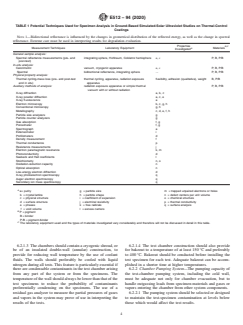
They are included in Table 1 to give a more complete account
evacuation is impractical, it is desirable that the specimens be
ofmethodsforanalysisofthermalcontrolsurfacesdamagedby
maintained under a positive pressure of dry argon. Note that
electromagnetic or particle irradiation, or both.
bleaching by diffusion of oxygen or nitrogen into the system
has been observed to occur in the dark, although more slowly, SIMULATION SYSTEM
than in the light.
6. Vacuum System
5.3 In Situ Analysis:
5.3.1 Calorimetric measurements of thermal-radiative prop-
6.1 General Description—The vacuum system shall consist
erties have received some attention in connection with in situ
of the specimen test chamber, all other components of the
studies of thermal-radiative property changes. A calorimetric
simulation system that are joined to the chamber without
determination gives a direct measure of α /ε and therefore
vacuum isolation during specimen exposure, and the transition
s
indicates the in situ changes in thermal-radiative properties. If
sectionsbywhichthesecomponentsarejoinedtothechamber.
edoes not change, then the change in α /ε shows the change in
The vacuum system must perform the following functions:
s
α . If the electromagnetic radiation source provides a good
s 6.1.1 It must provide for a reduction of pressure of atmo-
matchtotheair-masszerosolar-spectralirradiance,then awill
sphericgasesinthetestchambertoalevelinwhichnoneofthe
be equal to α . The limiting factors in calorimetric α /ε
s s constituents can react with the specimen material to affect the
determinations are the deviation of the spectral irradiance
validity of the tests. This provision implies a pressure no
−6
produced by the simulated solar source from that of the solar
greater than 1×10 torr (133 µPa) at the specimen position.
irradianceandtheaccuracyoftheirradiancemeasurement(see
6.1.2 It must provide that the specimen area be maintained
Test Method E434).
as free as possible from contaminant gases and vapors. These
5.3.2 In situ measurements allow the determination of the
gases and vapors may originate anywhere in the system
reflectance or absorptance in a vacuum environment. The
including from the test specimens themselves.
environment maintained for in situ measurements should have
6.1.3 It must promptly trap or remove any volatiles out-
noeffectonthepropertybeingmeasured.Theannealingofthe
gassed from the test specimens.
specimen after irradiation may occur sufficiently fast to make
6.1.4 Itmustprovideforaccuratepressuremeasurementsin
the posttest measurements misleading. In situ reflectance
the chamber. (See Practice E296.)
measurements allow the investigator to plot a curve of the
6.2 Test Chamber:
change in thermal radiative properties as a function of the
6.2.1 Construction—The specimen test chamber should be
exposure or absorbed dose. Posttest measurements limit the
constructed of materials suitable for use in ultra-high vacuum.
data to one point at the total dose.
Metals, glasses, and ceramics are used. Tables E490 contain
5.4 Physical Property Analysis:
information on materials for vacuum applications. Austenitic-
5.4.1 The complete evaluation of thermal control coatings
stainless steels, such as Type 304, are frequently used for
does not depend only on thermal-radiative property measure-
vacuum-chamber construction.
ments; coatings must have the adhesion and stability required
6.2.1.1 Welding and brazing should be performed in accor-
for retention on a specified substrate. One method used to
dance with good high-vacuum practice and the temperature
evaluate the ability of the coating to remain firmly attached to
requirements of the chamber. Materials to be joined must be
the substrate in space is through thermal cycling of the
properly cleaned so that sound, leaktight, nonporous joints can
specimens either during or after radiation exposure in a
be made. Inert gas arc welding (TIG), using helium or argon,
vacuum.
and electron beam welding have been used. Brazing materials
5.4.2 The loss of mass of thermal control coatings can be
and cleaning techniques are discussed in Refs (5) and (6).
measured, to provide an indication of the amount of decom-
Weldsshouldbeonthevacuumsidetoeliminatethepossibility
position products leaving the coating during exposure. This
of trapping gas in cracks and crevices, thus creating a virtual
may be important in the study of the curing, outgassing, and
leak.Partsmustbeabsolutelycleanbeforewelding.Anoilfilm
contamination potential of thermal control coatings.
can cause gas to evolve and result in a porous, leaky weld.
5.4.3 Vacuum gas analysis (mass spectroscopy or residual
6.2.1.2 Dimensions of the test chamber should be suffi-
gas analysis, RGA) can be used to assess the type and
cientlylargeinrelationtothoseofthespecimenholder,sothat
concentration of decomposition products.
contaminants outgassed from any of the specimens cannot be
5.5 Surface Analysis of Specimens—X-ray photoelectron reflected back from windows or walls to the surface of other
specotroscopy(XPS),augerelectronspectroscopy,andsecond- specimens.
E512 − 94 (2020)
TABLE 1 Potential Techniques Used for Specimen Analysis in Ground-Based Simulated-Solar Ultraviolet Studies on Thermal-Control
Coatings
NOTE 1—Bidirectional reflectance is influenced by the changes in geometrical distribution of the reflected energy, as well as the change in spectral
reflectance. Extreme care must be used in interpreting results for degradation evaluation.
Properties
B,C
Measurement Techniques Laboratory Equipment Materials
A
Investigated
General sample analysis:
Spectral reflectance measurements (pre- and integrating sphere, Hohlraum, Coblentz hemisphere α, ε P, B, P/B
post-test)
In-situ analysis:
Calorimetric vacuum, cryogenic apparatus α, ε P, B, P/B
Spectral bidirectional reflectance, integrating sphere . P, B, P/B
Physical property analysis:
Thermal cycling-mass loss (pre- and post-test thermal cycling, apparatus, radiation exposure flexibility, adhesion (qualitative), weight B, P/B
and in situ) apparatus
Auxiliary methods of analysis: radiation exposure apparatus or simple thermal P, B, P/B
vacuum with or without radiation
X-ray diffraction a, b, c
X-ray powder diffraction a, c, e
X-ray fluorescence a
Electron microscopy b, c, g, h
Conventional microscopy g, h
Metallography c, d, e, f, h
Particle size analyzers g
Particle counter analyzers g
Gas absorption f, g
Porosimeter f, g
Spectrograph a
Extensometer i
Profilometers d
Density measurement f
Thermal conductance p
Resistance measurements j
Electron paramagnetic resonance k, m
Photoconductivity d
Seebeck and Hall coefficients l
Stoichiometry n, o
Oxidation-reduction capacity n
Optical absorption n
Low-energy electron diffraction d
X-ray photoelectron spectroscopy q
Auger electron spectroscopy q
Secondary ion mass spectroscopy q
A
a= purity g = particle size m = trapped unpaired electrons or holes
b = crystal lattice h = particle shape n = defect centers per unit volume
c = physical structure i = coefficient of expansion o = chemical structure
d = surface structure j = electrical resistivity p = thermal conductivity
e = phases k = free radicals q = surface analysis
f = void volume l = excess carriers
B
P = pigment
B = binder
P ⁄B = pigment ⁄binder
C
The laboratory equipment used and the types of materials investigated vary considerably and therefore will not be discussed in detail in this table.
6.2.1.3 Thechambersshouldcontainacryogenicshroud,or 6.2.1.4 The test chamber construction should also provide
be of an insulated double-wall (annular) construction, to for bakeout to a temperature of at least 150°C and preferably
provide for reducing wall temperature by the use of coolant to 400°C. Bakeout should be conducted before installing the
fluids. The walls should preferably be cooled with liquid test specimen for each test. Adequate bakeout can be accom-
nitrogenduringalltests.This feature is particularlyessentialif plished in a shorter time at higher temperatures.
there are condensable contaminants in the test chamber arising 6.2.2 Chamber Pumping System—The pumping capacity of
from any part of the system or from the specimens. The the test-chamber pumping system, including the cold wall,
temperatureofthewallshouldalwaysbelowerthanthatofthe must be adequate not only for chamber evacuation, but to
test specimens to reduce the probability of contaminants handle outgassing loads from specimen materials and gases or
preferentially condensing on the specimens. The use of a vapors entering the chamber from other system components.
residual gas analyzer to measure the partial pressures of gases 6.2.2.1 The pumping system should be selected or designed
and vapors in the system may prove of use in interpreting the to maintain the test-specimen contamination at levels below
results of the tests. those which would affect the test results.
E512 − 94 (2020)
6.2.2.2 Ion pumping, sometimes accompanied by sublima- systems of many. These pumps do not use pumping fluids and
tion pumping, is frequently used for optical-degradation stud- they pump all common gases well. Startup and shutdown
ies of thermal control materials. This combination provides procedures are critical, as with other types of pumps.
easeofoperationforlong-timeperiodswithminimalattention. Cryopumps have an advantage in that they pump water
Other advantages of these types of pumps are that they can be incrediblywell.Sublimationpumpscanbeusedinconjunction
baked without damage, and they do not require cryogenic with diffusion and turbomolecular pumps to handle large gas
baffles. Possible disadvantages of these pumps are their low loads and provide selective pumping.
capacity for noble gases and their slow response to pressure 6.2.3 Demountable Seals—Many standard materials used to
surges. However, newer versions of ion pumps have increased seal openings in walls or at flanges in vacuum systems are a
their capacities for noble gases. major source of contamination. Metal-to-metal demountable
sealsarerecommendedwhenevertheyarefeasibleinasystem.
6.2.2.3 Sputter-ion pumps cause stray magnetic fields that
Where metal-to-metal seals are not practical, as when a part of
may interfere with tests using low-energy protons or electrons.
the system must be electrically isolated, organic materials may
The orbitron and diffusion-type pumps do not present this
be used, but the type should be carefully selected.
problem.Hydrocarbonstendtobuildupinionpumpswhenthe
Fluoroelastomers, fluorocarbons, and polyimides have been
high voltage is turned off, particularly if the system has
used. The design must provide for protection if organic seals
recently been exposed to air. Under normal pump operating
from electromagnetic or particulate radiations are used. It is
conditions, the hydrocarbon buildup is either minimal or does
recommended that organic seals be vacuum baked at 250°C
notoccur.Theemissionofpreviouslytrappedgasesmayoccur
before installation to remove volatile materials. If a system is
when the pump is started or operated at above-normal pres-
to be baked at temperatures in excess of 150°C, means should
sures. The electronic pumps may have a lesser capability of
be provided to prevent excessive heating of the seals. No
operating under pulsed-gas loads than do diffusion pumps.
vacuum grease should be used on the seals or any other parts
6.2.2.4 Since the basic pumping mechanism of the orbitron
of the system.
is one of titanium sublimation, it has a disadvantage, in
common with ordinary titanium-sublimation pumps, in that
6.3 Auxiliary Simulation Components:
new sources of titanium must be frequently provided.
6.3.1 Certain components of the simulation system, which
operate at pressures that are high in relation to that of the test
6.2.2.5 Care must be taken in the design of chambers using
ion pumps and titanium sublimation pumps. Sublimed and chamber, may have to be attached to the chamber without
complete vacuum isolation. Particle accelerators are generally
sputtered material must be kept from the specimen area.
Specimens must also be protected from electromagnetic radia- in this category. Basic pressures of accelerators are usually in
−6
the 0.5 to 5×10 -torr (167- to 665-µPa) range with operating
tion generated by the discharge in the ion pumps especially
−5
upon ignition. The intensity of the startup discharges depends pressures of 0.1 to 1.5×10 torr (133 to 2000 µPa), particu-
larlyforpositive-ionaccelerators.Vacuumisolation,evenwith
uponthepressuretowhichthesystemwasroughpumped,and
−3
roughing to approximately 10 torr (13 mPa) or lower is thin foils, is not feasible, except for higher-energy particles,
and even then this leads to energy straggling.
recommended. Rough pumping can be accomplished by either
6.3.2 Commercial accelerators and other components may
sorption pumps, mechanical pumps, or a combination of both.
provide sources of contamination through the use of elastomer
6.2.2.6 When mechanical pumps are used, proper equip-
seals or by virtue of a poorly designed vacuum system.
ment and procedures are required to minimize the backstream-
Replacement of inadequate seals and modifications of the
ing of oil into the chamber. Dry nitrogen may be used to
vacuum system are recommended when feasible.
maintain the roughing pressure in the viscous-flow regime if
sorption pumps are used for the final rough pumping. Properly
6.4 Transition Sections:
sizedmolecularsievesorcoldtrapsshouldbeusedifroughing
6.4.1 The flow rate of gases and vapors from auxiliary
pressures are below approximately 1 torr (133 Pa).
components into the test chamber must be reduced to a
6.2.2.7 Oil- and mercury-diffusion pumps may be used if minimum.Thisisusuallyaccomplishedbymeansoftransition
their construction and operation provide reduction of back- sections that limit the “leak” rate solely by conductance
streaming of pump fluids to levels below which affect test limiting and differential pumping. This latter method usually
results. Reduction of backstreaming may be accomplished by consists of mounting a vacuum-pumped section in the transi-
using optically dense, anticreep traps or baffles that are tion line between the offending component and the test
cryogenically cooled, or both. A closed-cycle refrigeration chamberandlimitingthegasconductancefromthecomponent
system may be advantageous from the standpoint of extended- into the pumped section and from the pumped section into the
test periods and cost of operation. Thermoelectrically cooled chamber. The differential-pumping method is recommended
baffles may also be used. Silicone, polyphenyl ether, or other because transition sections can be substantially shorter to
low-vapor pressure fluids are recommended for use as pump produce the same reduction in “leak” rate. This not only
fluids because of their stability and lower backstreaming rates. conserves space, but if small diameter metal tubing is used for
conductance limiting from particle accelerators and the tubing
The advantages of diffusion-pumped systems are the ability to
pump all common gases well and the ability to handle pulsed
gas loads.
6.2.2.8 Cryopumps or turbomolecular pumps may also be
Viton-A, available from E.I. Dupont de Nemours and Co., Inc. has been found
used in simulation systems and are the preferred pumping satisfactory for this purpose.
E512 − 94 (2020)
is at ground potential, the resultant beam spreading for low- 7.1.4 Useful Life of Sources—The criteria for changing
energy charged particles may be a problem. lamps should involve a consideration of ultraviolet irradiance
6.4.2 All comments in 6.2 pertinent to vacuum techniques ratherthantotalirradiance.Notethatforxenonshortarclamps,
apply to the transition sections. Use of in-line cryogenic traps the UV output of the lamp decreases more rapidly than that of
in transition sections are advantageous in pumping condens- the rest of the lamp’s spectrum.
able vapors, but are of little value in removing gases such as 7.1.5 Radiation Detector—The total irradiance at the speci-
hydrogen from proton accelerators or ultraviolet-gaseous dis-
men can be measured with a National Institute of Standards
charge sources. The effects of relatively high partial pressures and Technology (NIST) traceable, calibrated total radiation
of such gases on test results have not been evaluated.
detector. The filters should be periodically recalibrated. For
calibration of ultraviolet detectors in the near ultraviolet, refer
7. Solar Simulation
to Practice E275.
7.1 Radiation Above 200 nm—There are several radiation
7.1.6 Spectral Irradiance Measurement—The relative spec-
sources that can be used as ultraviolet energy sources for
tral distribution of the source can be determined accurately
thermal control coatings evaluation work. The source should
with the use of a UV spectroradiometer and a NIST traceable,
duplicate the spectral irradiance of the extraterrestrial sun as
calibrated source. Spectral measurements are useful for the
closelyaspossible(seeTablesE490)eventhoughuncertainties
determination of the degree to which ultravi
...