

ASTM D2925-14(2019)
(Test Method)Standard Test Method for Beam Deflection of “Fiberglass” (Glass-Fiber-Reinforced Thermosetting Resin) Pipe Under Full Bore Flow
General Information
- Abstract
SIGNIFICANCE AND USE
4.1 In the absence of deflection measurements from actual installed-above-ground piping, this test method may be used to evaluate the influence of span length on mid-span deflections at differing temperatures under full bore flow.
Note 3: A flat bearing area, small contact area, and narrow bearing width may induce high localized support interaction stresses, and constraints imposed by the supports may also adversely influence deflections and performance of the pipe.
SCOPE
1.1 This test method covers measurement of the deflection as a function of time of a specimen of fiberglass pipe supported on a flat non-arced support as a simple beam under full bore flow of water at elevated temperatures. Both glass-fiber-reinforced thermosetting-resin pipe (RTRP) and glass-fiber-reinforced polymer mortar pipe (RPMP) are fiberglass pipes.
Note 1: For the purposes of this standard, polymer does not include natural polymers.
1.2 This test method can be used to determine deflection at varying conditions by substituting other test media.
1.3 Deflections observed using this test method are representative only of piping supported as a simple beam under full bore flow which has one diameter of pipe overhanging at each support.
1.4 The values stated in SI units are to be regarded as the standard. The values given in parentheses are provided for information purposes only.
Note 2: There is no known ISO equivalent to this standard.
1.5 This standard does not purport to address all of the safety concerns, if any, associated with its use. It is the responsibility of the user of this standard to establish appropriate safety, health, and environmental practices and determine the applicability of regulatory limitations prior to use.
1.6 This international standard was developed in accordance with internationally recognized principles on standardization established in the Decision on Principles for the Development of International Standards, Guides and Recommendations issued by the World Trade Organization Technical Barriers to Trade (TBT) Committee.
- Status
- Published
- Publication Date
- 31-Jul-2019
- Technical Committee
- D20 - Plastics

Overview
ASTM D2925-14(2019) - Standard Test Method for Beam Deflection of “Fiberglass” (Glass-Fiber-Reinforced Thermosetting Resin) Pipe Under Full Bore Flow provides a systematic approach for measuring the deflection of fiberglass pipes-specifically, glass-fiber-reinforced thermosetting-resin pipe (RTRP) and glass-fiber-reinforced polymer mortar pipe (RPMP)-supported as simple beams under conditions of full bore liquid flow at elevated temperatures. This ASTM standard delivers uniform guidance in the absence of deflection measurements from actual installed above-ground piping and is pivotal for assessing how span length and temperature impact mid-span deflections, contributing to safe and reliable pipeline design and maintenance.
Key Topics
Scope and Applicability
- Focuses on the measurement of deflection over time in fiberglass pipe specimens
- Applies to pipes supported on flat, non-arced supports as simple beams under conditions of constant, full bore water flow
- Covers both RTRP and RPMP fiberglass pipes; natural polymers are excluded
Test Method Parameters
- Evaluates influence of span length, support spacing, and temperature on pipe deflection
- Allows substitution of different test media for broader applicability
- Involves precise measurement tools for deflection, time intervals, temperature, and pressure
Support and Installation Considerations
- Notes impact of flat bearing areas, small contact points, and narrow supports on localized stresses and deflection
- Advises that observed deflections are representative of specific support conditions-one diameter of pipe overhanging at each support
Reporting and Safety
- Specifies detailed requirements for documentation, including sample identification, test setup, dimensional data, conditions, and calculated values
- Emphasizes the responsibility of users to establish safety, health, and environmental protocols relevant to the testing
Applications
Product Development and Quality Control
- Used by manufacturers of fiberglass pipes (RTRP and RPMP) to validate performance under simulated in-service conditions
- Helps ensure products meet rigorous mechanical and structural standards before market release
Design and Engineering
- Provides engineers with data for structural analysis, including span recommendations and expected behavior under fluid flow and temperature variations
- Useful for refining support placement and design in above-ground piping installations
Maintenance and Compliance
- Serves utilities and industrial facilities in assessing the condition of installed fiberglass piping, supporting predictive maintenance strategies
- Assists in verifying compliance with national and international regulations related to polymer composite piping systems
Related Standards
- ASTM D883 - Terminology Relating to Plastics
- ASTM D1600 - Terminology for Abbreviated Terms Relating to Plastics
- ASTM D3567 - Practice for Determining Dimensions of “Fiberglass” (Glass-Fiber-Reinforced Thermosetting Resin) Pipe and Fittings
- ASTM F412 - Terminology Relating to Plastic Piping Systems
- ASTM C33 / C33M - Specification for Concrete Aggregates (for aggregate inclusion in RPMP)
- Currently, no ISO equivalent standard exists for this test method
Practical Value
This ASTM test method is crucial for stakeholders in the design, manufacturing, and maintenance of fiberglass piping systems, particularly where full bore flow, varying temperatures, and specific support configurations influence performance and safety. By establishing reproducible test conditions and reporting requirements, ASTM D2925 ensures dependable data for quality assurance, supporting optimal pipe system longevity and reliability in industrial, municipal, and utility applications.
Keywords: ASTM D2925, fiberglass pipe, glass-fiber-reinforced pipe, beam deflection test, thermosetting resin, full bore flow, pipe support, structural analysis, polymer mortar pipe, above-ground piping systems.
Relations
- Effective Date
- 01-Aug-2019
- Effective Date
- 01-Feb-2024
- Effective Date
- 01-Nov-2023
- Effective Date
- 01-Apr-2020
- Effective Date
- 01-Jan-2020
- Effective Date
- 01-Aug-2019
- Effective Date
- 15-Apr-2019
- Effective Date
- 01-Feb-2019
- Effective Date
- 01-Jan-2019
- Effective Date
- 01-Dec-2018
- Effective Date
- 01-Nov-2018
- Refers
ASTM D1600-18 - Standard Terminology for Abbreviated Terms Relating to Plastics (Withdrawn 2024) - Effective Date
- 01-Jan-2018
- Effective Date
- 15-Aug-2017
- Effective Date
- 01-Aug-2017
- Effective Date
- 01-Feb-2017
Get Certified
Connect with accredited certification bodies for this standard

Institut za varilstvo d.o.o. (Welding Institute)
Slovenia's leading welding institute since 1952. ISO 3834, EN 1090, pressure equipment certification, NDT personnel, welder qualification. Only IIW Au
Sponsored listings
Frequently Asked Questions
ASTM D2925-14(2019) is a standard published by ASTM International. Its full title is "Standard Test Method for Beam Deflection of “Fiberglass” (Glass-Fiber-Reinforced Thermosetting Resin) Pipe Under Full Bore Flow". This standard covers: SIGNIFICANCE AND USE 4.1 In the absence of deflection measurements from actual installed-above-ground piping, this test method may be used to evaluate the influence of span length on mid-span deflections at differing temperatures under full bore flow. Note 3: A flat bearing area, small contact area, and narrow bearing width may induce high localized support interaction stresses, and constraints imposed by the supports may also adversely influence deflections and performance of the pipe. SCOPE 1.1 This test method covers measurement of the deflection as a function of time of a specimen of fiberglass pipe supported on a flat non-arced support as a simple beam under full bore flow of water at elevated temperatures. Both glass-fiber-reinforced thermosetting-resin pipe (RTRP) and glass-fiber-reinforced polymer mortar pipe (RPMP) are fiberglass pipes. Note 1: For the purposes of this standard, polymer does not include natural polymers. 1.2 This test method can be used to determine deflection at varying conditions by substituting other test media. 1.3 Deflections observed using this test method are representative only of piping supported as a simple beam under full bore flow which has one diameter of pipe overhanging at each support. 1.4 The values stated in SI units are to be regarded as the standard. The values given in parentheses are provided for information purposes only. Note 2: There is no known ISO equivalent to this standard. 1.5 This standard does not purport to address all of the safety concerns, if any, associated with its use. It is the responsibility of the user of this standard to establish appropriate safety, health, and environmental practices and determine the applicability of regulatory limitations prior to use. 1.6 This international standard was developed in accordance with internationally recognized principles on standardization established in the Decision on Principles for the Development of International Standards, Guides and Recommendations issued by the World Trade Organization Technical Barriers to Trade (TBT) Committee.
SIGNIFICANCE AND USE 4.1 In the absence of deflection measurements from actual installed-above-ground piping, this test method may be used to evaluate the influence of span length on mid-span deflections at differing temperatures under full bore flow. Note 3: A flat bearing area, small contact area, and narrow bearing width may induce high localized support interaction stresses, and constraints imposed by the supports may also adversely influence deflections and performance of the pipe. SCOPE 1.1 This test method covers measurement of the deflection as a function of time of a specimen of fiberglass pipe supported on a flat non-arced support as a simple beam under full bore flow of water at elevated temperatures. Both glass-fiber-reinforced thermosetting-resin pipe (RTRP) and glass-fiber-reinforced polymer mortar pipe (RPMP) are fiberglass pipes. Note 1: For the purposes of this standard, polymer does not include natural polymers. 1.2 This test method can be used to determine deflection at varying conditions by substituting other test media. 1.3 Deflections observed using this test method are representative only of piping supported as a simple beam under full bore flow which has one diameter of pipe overhanging at each support. 1.4 The values stated in SI units are to be regarded as the standard. The values given in parentheses are provided for information purposes only. Note 2: There is no known ISO equivalent to this standard. 1.5 This standard does not purport to address all of the safety concerns, if any, associated with its use. It is the responsibility of the user of this standard to establish appropriate safety, health, and environmental practices and determine the applicability of regulatory limitations prior to use. 1.6 This international standard was developed in accordance with internationally recognized principles on standardization established in the Decision on Principles for the Development of International Standards, Guides and Recommendations issued by the World Trade Organization Technical Barriers to Trade (TBT) Committee.
ASTM D2925-14(2019) is classified under the following ICS (International Classification for Standards) categories: 23.040.20 - Plastics pipes. The ICS classification helps identify the subject area and facilitates finding related standards.
ASTM D2925-14(2019) has the following relationships with other standards: It is inter standard links to ASTM D2925-14, ASTM D883-24, ASTM D883-23, ASTM F412-20, ASTM D883-20, ASTM D883-19c, ASTM D883-19a, ASTM D883-19, ASTM F412-19, ASTM D883-18a, ASTM D883-18, ASTM D1600-18, ASTM D883-17, ASTM F412-17a, ASTM F412-17. Understanding these relationships helps ensure you are using the most current and applicable version of the standard.
ASTM D2925-14(2019) is available in PDF format for immediate download after purchase. The document can be added to your cart and obtained through the secure checkout process. Digital delivery ensures instant access to the complete standard document.
Standards Content (Sample)
This international standard was developed in accordance with internationally recognized principles on standardization established in the Decision on Principles for the
Development of International Standards, Guides and Recommendations issued by the World Trade Organization Technical Barriers to Trade (TBT) Committee.
Designation: D2925 −14 (Reapproved 2019)
Standard Test Method for
Beam Deflection of “Fiberglass” (Glass-Fiber-Reinforced
Thermosetting Resin) Pipe Under Full Bore Flow
This standard is issued under the fixed designation D2925; the number immediately following the designation indicates the year of
original adoption or, in the case of revision, the year of last revision.Anumber in parentheses indicates the year of last reapproval.A
superscript epsilon (´) indicates an editorial change since the last revision or reapproval.
1. Scope* 2. Referenced Documents
2.1 ASTM Standards:
1.1 This test method covers measurement of the deflection
C33/C33MSpecification for Concrete Aggregates
asafunctionoftimeofaspecimenoffiberglasspipesupported
D883Terminology Relating to Plastics
on a flat non-arced support as a simple beam under full bore
D1600TerminologyforAbbreviatedTermsRelatingtoPlas-
flow of water at elevated temperatures. Both glass-fiber-
tics
reinforced thermosetting-resin pipe (RTRP) and glass-fiber-
D3567PracticeforDeterminingDimensionsof“Fiberglass”
reinforced polymer mortar pipe (RPMP) are fiberglass pipes.
(Glass-Fiber-Reinforced Thermosetting Resin) Pipe and
NOTE 1—For the purposes of this standard, polymer does not include
Fittings
natural polymers.
F412Terminology Relating to Plastic Piping Systems
1.2 This test method can be used to determine deflection at
varying conditions by substituting other test media.
3. Terminology
3.1 General—DefinitionsareinaccordancewithTerminolo-
1.3 Deflections observed using this test method are repre-
sentative only of piping supported as a simple beam under full gies D883 and F412 and abbreviations are in accordance with
Terminology D1600, unless otherwise indicated.
bore flow which has one diameter of pipe overhanging at each
support.
3.2 Definitions of Terms Specific to This Standard:
3.2.1 aggregate—a siliceous sand conforming to the re-
1.4 The values stated in SI units are to be regarded as the
quirements of Specification C33/C33M, except that the re-
standard. The values given in parentheses are provided for
quirements for gradation shall not apply.
information purposes only.
3.2.2 fiberglass pipe—a tubular product containing glass
NOTE 2—There is no known ISO equivalent to this standard.
fiber reinforcement embedded in or surrounded by cured
1.5 This standard does not purport to address all of the
thermosetting resin; the composite structure may contain
safety concerns, if any, associated with its use. It is the
aggregate, granular or platelet fillers, thixotropic agents,
responsibility of the user of this standard to establish appro-
pigments, or dyes; thermoplastic or thermosetting liners may
priate safety, health, and environmental practices and deter-
be included.
mine the applicability of regulatory limitations prior to use.
3.2.3 reinforced thermosetting resin pipe (RTRP)—a fiber-
1.6 This international standard was developed in accor-
glass pipe without aggregate.
dance with internationally recognized principles on standard-
3.2.4 reinforced polymer mortar pipe (RPMP)—a fiberglass
ization established in the Decision on Principles for the
pipe with aggregate.
Development of International Standards, Guides and Recom-
mendations issued by the World Trade Organization Technical
4. Significance and Use
Barriers to Trade (TBT) Committee.
4.1 In the absence of deflection measurements from actual
installed-above-groundpiping,thistestmethodmaybeusedto
This test method is under the jurisdiction ofASTM Committee D20 on Plastics
and is the direct responsibility of Subcommittee D20.23 on Reinforced Plastic
Piping Systems and Chemical Equipment. For referenced ASTM standards, visit the ASTM website, www.astm.org, or
Current edition approved Aug. 1, 2019. Published August 2019. Originally contact ASTM Customer Service at service@astm.org. For Annual Book of ASTM
approved in 1970. Last previous edition approved in 2014 as D2925–14. DOI: Standards volume information, refer to the standard’s Document Summary page on
10.1520/D2925-14R19. the ASTM website.
*A Summary of Changes section appears at the end of this standard
Copyright © ASTM International, 100 Barr Harbor Drive, PO Box C700, West Conshohocken, PA 19428-2959. United States
D2925 − 14 (2019)
evaluatetheinfluenceofspanlengthonmid-spandeflectionsat water at all times. Any recirculation shall be vented to
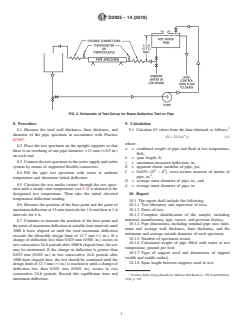
differing temperatures under full bore flow. atmosphere.Aschematic drawing of the test setup is shown on
Fig. 2.
NOTE 3—A flat bearing area, small contact area, and narrow bearing
width may induce high localized support interaction stresses, and con-
5.3 Flexible Connections for the ends of the pipe test
straints imposed by the supports may also adversely influence deflections
specimens,installedsoastoproducenegligiblemomentonthe
and performance of the pipe.
ends of the pipe.
5. Apparatus 5.4 A Device for Measuring the Deflection of the pipe
specimen to the nearest 0.025 mm (0.001 in.) with negligible
5.1 Rigid Support with edges rounded to a 6-mm ( ⁄4-in.)
constraint on the specimen. A recommended device is a
radius, consisting of two uprights of a convenient height. The
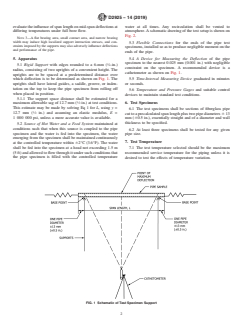
cathetometer as shown on Fig. 1.
uprights are to be spaced at a predetermined distance over
which deflection is to be determined as shown on Fig. 1. The 5.5 Time-Interval Measuring Device graduated in minutes
or seconds.
uprights shall have lateral guides, a saddle, groove, or inden-
tation on the top to keep the pipe specimen from rolling off
5.6 Temperature and Pressure Gages and suitable control
when placed in position.
devices to maintain standard test conditions.
5.1.1 The support space distance shall be estimated for a
6. Test Specimens
maximum allowable sag of 12.7 mm ( ⁄2in.) at test conditions.
This estimate may be made by solving Eq 1 for L, using y=
6.1 The test specimens shall be sections of fiberglass pipe
12.7 mm ( ⁄2 in.) and assuming an elastic modulus, E=
cuttoaprecalculatedspanlengthplustwo
...