


ASTM C829-81(2015)
(Practice)Standard Practices for Measurement of Liquidus Temperature of Glass by the Gradient Furnace Method
Standard Practices for Measurement of Liquidus Temperature of Glass by the Gradient Furnace Method
SIGNIFICANCE AND USE
3.1 These practices are useful for determining the maximum temperature at which crystallization will form in a glass, and a minimum temperature at which a glass can be held, for extended periods of time, without crystal formation and growth.
SCOPE
1.1 These practices cover procedures for determining the liquidus temperature (Note 1) of a glass (Note 1) by establishing the boundary temperature for the first crystalline compound, when the glass specimen is held at a specified temperature gradient over its entire length for a period of time necessary to obtain thermal equilibrium between the crystalline and glassy phases.
Note 1: These terms are defined in Terminology C162.
1.2 Two methods are included, differing in the type of sample, apparatus, procedure for positioning the sample, and measurement of temperature gradient in the furnace. Both methods have comparable precision. Method B is preferred for very fluid glasses because it minimizes thermal and mechanical mixing effects.
1.2.1 Method A employs a trough-type platinum container (tray) in which finely screened glass particles are fused into a thin lath configuration defined by the trough.
1.2.2 Method B employs a perforated platinum tray on which larger screened particles are positioned one per hole on the plate and are therefore melted separately from each other.2
1.3 This standard does not purport to address all of the safety concerns, if any, associated with its use. It is the responsibility of the user of this standard to establish appropriate safety and health practices and determine the applicability of regulatory limitations prior to use.
General Information
Buy Standard
Standards Content (Sample)
NOTICE: This standard has either been superseded and replaced by a new version or withdrawn.
Contact ASTM International (www.astm.org) for the latest information
Designation: C829 − 81 (Reapproved 2015)
Standard Practices for
Measurement of Liquidus Temperature of Glass by the
Gradient Furnace Method
This standard is issued under the fixed designation C829; the number immediately following the designation indicates the year of
original adoption or, in the case of revision, the year of last revision.Anumber in parentheses indicates the year of last reapproval.A
superscript epsilon (´) indicates an editorial change since the last revision or reapproval.
1. Scope 2.2 Other Document:
NIST Certificate for Liquidus Temperature, SRM 773
1.1 These practices cover procedures for determining the
liquidus temperature (Note 1) of a glass (Note 1) by establish-
3. Significance and Use
ing the boundary temperature for the first crystalline
3.1 Thesepracticesareusefulfordeterminingthemaximum
compound, when the glass specimen is held at a specified
temperature at which crystallization will form in a glass, and a
temperature gradient over its entire length for a period of time
minimum temperature at which a glass can be held, for
necessarytoobtainthermalequilibriumbetweenthecrystalline
extended periods of time, without crystal formation and
and glassy phases.
growth.
NOTE 1—These terms are defined in Terminology C162.
1.2 Two methods are included, differing in the type of 4. Apparatus
sample, apparatus, procedure for positioning the sample, and
4.1 The apparatus for determining the liquidus temperature
measurement of temperature gradient in the furnace. Both
shall consist essentially of an electrically heated gradient
methodshavecomparableprecision.MethodBispreferredfor
furnace, a device for controlling the furnace temperature,
veryfluidglassesbecauseitminimizesthermalandmechanical
temperature measuring equipment, and other items listed.
mixing effects.
4.1.1 Furnace:
1.2.1 Method A employs a trough-type platinum container
4.1.1.1 MethodA—Horizontal temperature gradient, electri-
(tray) in which finely screened glass particles are fused into a
cally heated furnace, tube type, as illustrated in Figs. 1-3 and
thin lath configuration defined by the trough.
described in A1.1.
1.2.2 Method B employs a perforated platinum tray on
4.1.1.2 Method B—An alternative furnace detail employing
which larger screened particles are positioned one per hole on
pregrooved Al O cores and dual windings, as illustrated in
2 3
the plate and are therefore melted separately from each other.
Figs. 4 and 5, and described in A1.2.
1.3 This standard does not purport to address all of the
4.1.1.3 Equivalenttemperaturegradientconditionsmayalso
safety concerns, if any, associated with its use. It is the
be obtained with furnaces having multiple windings equipped
responsibility of the user of this standard to establish appro-
with separate power and control, or a tapped winding shunted
priate safety and health practices and determine the applica-
with suitable resistances. For high precision, temperature
bility of regulatory limitations prior to use.
gradients in excess of 10°C/cm should be avoided.
4.1.2 Furnace Temperature Control:
2. Referenced Documents
4.1.2.1 Method A—A suitable temperature controller shall
2.1 ASTM Standards:
be provided to maintain a fixed axial temperature distribution
C162Terminology of Glass and Glass Products over the length of the furnace.
4.1.2.2 Method B—Arheostatshallbeusedtosupplypower
1 totheouterwinding.Aseparaterheostatandcontrollershallbe
These practices are under the jurisdiction of ASTM Committee C14 on Glass
and Glass Productsand are the direct responsibility of Subcommittee C14.04 on
usedfortheinnercorewinding.Thebasicfurnacetemperature
Physical and Mechanical Properties.
level is achieved by controlling power to both inner and outer
Current edition approved May 1, 2015. Published May 2015. Originally
core windings. The slope of the gradient is achieved by
approved in 1976. Last previous edition approved in 2010 as C829–81(2010).
adjusting power input to the outer core winding only. The
DOI: 10.1520/C0829-81R15.
FromNBSResearchPaperRP2096,Vol44,May1950,byO.H.GrauerandE.
establishedtemperaturegradientisthenmaintainedbycontrol-
H. Hamilton, with modification and improvement by K. J. Gajewski, Ford Motor
ling power to the inner core winding only.
Co., Glass Research and Development Office (work unpublished).
For referenced ASTM standards, visit the ASTM website, www.astm.org, or
contact ASTM Customer Service at service@astm.org. For Annual Book of ASTM
Standards volume information, refer to the standard’s Document Summary page on Available from National Institute of Standards and Technology (NIST), 100
the ASTM website. Bureau Dr., Stop 1070, Gaithersburg, MD 20899-1070, http://www.nist.gov.
Copyright © ASTM International, 100 Barr Harbor Drive, PO Box C700, West Conshohocken, PA 19428-2959. United States
C829 − 81 (2015)
NOTE 1—See A1.1 for further description.
1. Outer shell (stainless steel) 7. Outer protection tube
4 5
2. End plate (Transite) 8. Sil-O-Cel insulation
3. End plate (quartz) 9. Control thermocouple (platinum/rhodium)
4. Stand 10. Heating element wire
5. Inner protection tube 11. Specimen tray
6. Heating element tube
FIG. 1 Liquidus Furnace (Method A)
Material: 26-gauge stainless steel
FIG. 2 Liquidus Furnace Shell (Method A)
Millimetres
No. of Turns
A: 6 turns—4.8 mm spacing
B: 13 turns—9.5 mm spacing
C: 5 turns—6.4 mm spacing
D: 24 turns—4.8 mm spacing
FIG. 3 Recommended Liquidus Furnace Winding (Method A)
4.1.3 Temperature-Measuring Equipment— Furnace tem- platinum or platinum alloy plate which supports the tray or
peratures shall be measured with calibrated Type R or S perforated plate. A solid-state digital thermometer capable of
thermocouples in conjunction with a calibrated potentiometer, the measurement accuracy specified may be used for tempera-
orothercomparableinstrumentation,capableofmeasurements ture measurement.
within 0.5°C. In addition to control thermocouples, MethodA 4.1.4 Microscope—Amicroscopecapableofresolutionofat
requires an unshielded supported thermocouple for insertion least 5 µm at 100× is required. A petrographic microscope is
into the furnace chamber to determine temperature gradients, preferredforeaseofcrystalidentificationunderpolarizedlight.
and Method B requires five thermocouples mounted in the 4.1.5 Additional Equipment for Method A:
specimen support fixture as shown in Fig. 6. An alternative 4.1.5.1 Laboratory stand to support thermocouple horizon-
method is to attach (spot weld) the thermocouples to a fixed tally (see Fig. 7).
C829 − 81 (2015)
NOTE 1—See A1.2 for further description.
1. Stainless steel shell 7. Inner heating element tube
2. End plates (Transite ) 8. Perforated platinum tray
3. End seals (Fiberfrax ) 9. Mullite tube of riding device
4. Insulating cover (Fiberfrax ) 10. Alumina spacers
5. Refractory or Sil-O-Cel insulation 11. Controlling thermocouple
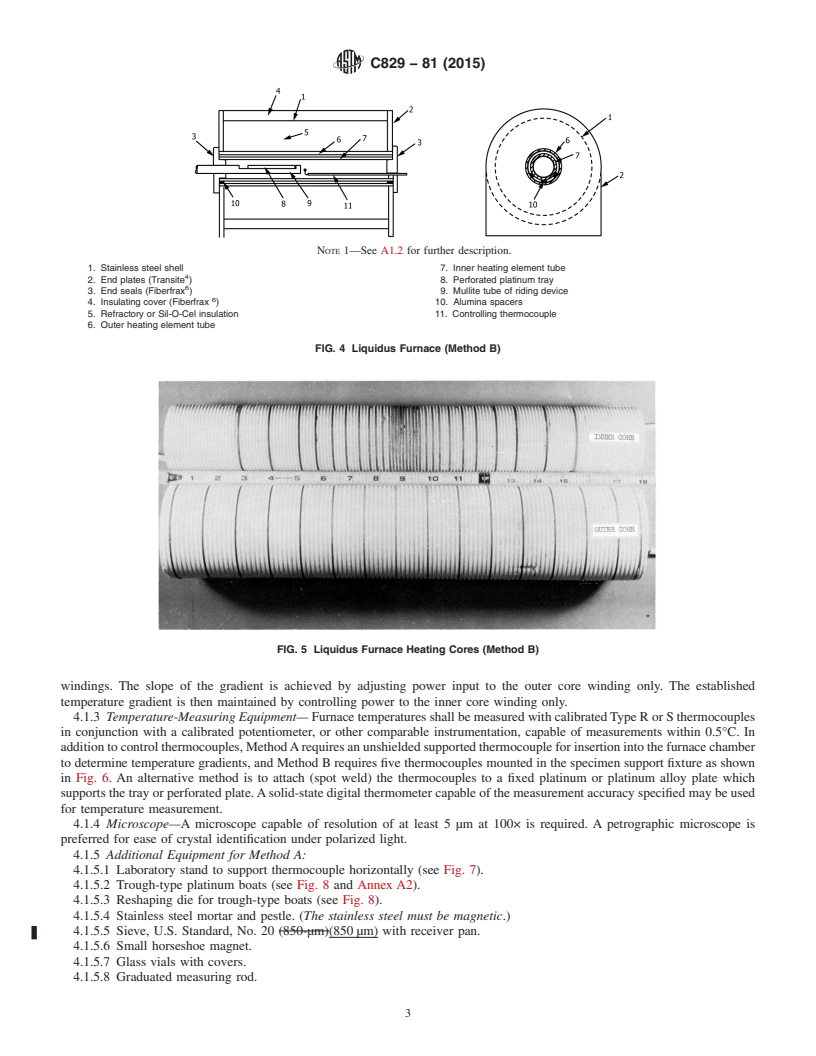
6. Outer heating element tube
FIG. 4 Liquidus Furnace (Method B)
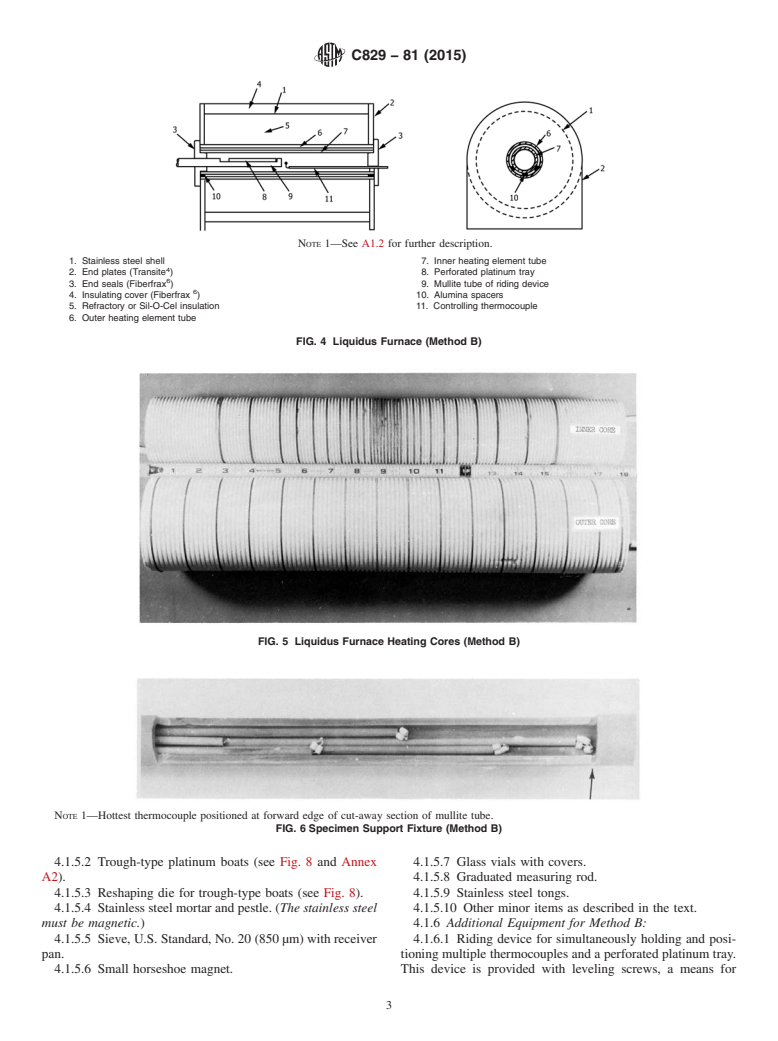
FIG. 5 Liquidus Furnace Heating Cores (Method B)
NOTE 1—Hottest thermocouple positioned at forward edge of cut-away section of mullite tube.
FIG. 6 Specimen Support Fixture (Method B)
4.1.5.2 Trough-type platinum boats (see Fig. 8 and Annex 4.1.5.7 Glass vials with covers.
A2). 4.1.5.8 Graduated measuring rod.
4.1.5.3 Reshaping die for trough-type boats (see Fig. 8). 4.1.5.9 Stainless steel tongs.
4.1.5.4 Stainlesssteelmortarandpestle.(The stainless steel 4.1.5.10 Other minor items as described in the text.
must be magnetic.) 4.1.6 Additional Equipment for Method B:
4.1.5.5 Sieve,U.S.Standard,No.20(850µm)withreceiver 4.1.6.1 Riding device for simultaneously holding and posi-
pan. tioning multiple thermocouples and a perforated platinum tray.
4.1.5.6 Small horseshoe magnet. This device is provided with leveling screws, a means for
C829 − 81 (2015)
either side of the maximum temperature point, and locate so
thattheircentersareatthepredeterminedgradienttemperature
level corresponding to the liquidus temperature, if known.
Record the location of the trays in the furnace. Either the
single- or the double-core furnace may be used. Modify the
double-core furnace design to accommodate two samples by
providingtworidingdevicesandmeansforinsertionfromboth
ends of the furnace.
6.2 Method B—Use one or two perforated specimen trays
that are free of cracks, pits, or adhering glass. Using the
FIG. 7 Thermocouple and Support (Method A)
pointed stainless steel tongs or tweezers, select chips of the
samplefromtheNo.12(1.70mm)sieveandplaceoneineach
of the drilled holes in each tray. Position a tray in the cut-away
lateraladjustment,andapositivestopforpreciselylocatingthe
sectionofthemullitetubeontheridingdevicewiththedouble
boat and thermocouples within the furnace. The device shown
rowofholesforward(towardthehotend),andtheforwardend
in Fig. 9 meets these requirements.
of the tray indexed precisely over the most forward of the five
4.1.6.2 Perforated platinum trays (see Fig. 10 and Annex
thermocouples against the forward edge of the cut-away
A2).
section, as shown in Fig. 4. An alternative method is to move
4.1.6.3 Stainless steel mortar and pestle.
thefurnaceintopositionaroundafixedtray.Onesampleinone
4.1.6.4 Sieves, U.S. Standard, No. 8 (2.36 mm) and No. 12
tray supported by one riding device may be tested in the
(1.70 mm) with receiver pan.
double-core furnace. Two samples may be tested simultane-
4.1.6.5 Glass vials with covers.
ously by modifying the furnace design to provide for insertion
4.1.6.6 Stainless steel pointed tongs.
frombothends.Carefullyfeedtheridingdevicecontainingthe
4.1.6.7 Other minor items as shown in illustrations and
tray into the furnace until the prepositioned stop plate is
described in the text.
contacted. Close the end opening of the furnace around the
riding device with suitable insulation.
5. Preparation of Test Specimens
5.1 Select a mass of glass of approximately 70 g. Break the 6.3 Treatment Time—Leave the specimens in the furnace
sample into pieces of a size that will fit into the mortar. Clean until equilibrium between the crystal and glassy phases is
the sample with acetone, rinse with distilled water, and dry. established. The time required is a function of the glass
composition. Twenty-four hours is sufficient for many glasses,
Clean the mortar and pestle, sieve, and magnet in the same
manner (Note 2). Crush the sample, using the mortar and butsomeglassesmaytakedaystoreachequilibrium.Complete
crystallization of the specimen indicates insufficient tempera-
pestle, by using a hammer or other suitable means.
ture in heat treatment. Total lack of crystallization indicates
NOTE2—Fromthispointon,contactwithbarehandsorothersourceof
insufficient time or excess temperature.
contamination must be avoided.
6.4 Temperature Gradient—Determine the temperature gra-
5.2 Method A—Pour the crushed sample onto a No. 20
dients over the lengths of the specimens at the end of the
(850-µm) sieve. Retain the material not passing the sieve and
heating period just prior to removal from the furnace.
repeat the crushing procedure until all the glass has been
6.4.1 Single-Core Furnace—Establish a temperature profile
reducedtoasizetopassthroughthesieveintothereceiverpan.
over the length of each tray by using a traveling unshielded
With the test specimen still in the pan, move the magnet
Type R or S thermocouple supported horizontally as near the
throughout the specimen to remove magnetic fragments that
top of the trays as practical and centered over their widths.
may have been introduced during crushing. If not to be tested
Start the probe at the hotter end of each tray, toward the center
immediately, place the specimen in a covered glass vial or
of the furnace, and make successive temperature readings
other suitable container.
along the tray length at ⁄2-in. (12.7 mm) intervals. Allow the
5.3 Method B—Pour the crushed sample onto a No. 8 (2.36
thermocouple temperature to stabilize in each position as
mm) sieve fitted over a No. 12 (1.70 mm) sieve and receiver
indicated by constancy of temperature over a period of time.
pan.Retainonlythatpartofthesamplenotpassingthroughthe
Record the temperature of each thermocouple position to the
No. 12 sieve. That glass retained on the No. 8 sieve may be
nearest 1°C as related to tray position, and plot as in Fig. 11.
recrushedifnecessarytoincreasetheNo.12sievesamplesize.
6.4.2 Double-CoreFurnace—Obtainthetemperatureprofile
Discard the fines passing through to the receiver pan. If not to
as related to tray position from readings of the five Type R or
be tested immediately, place the specimen in a covered glass
S thermocouples mounted in fixed positions in the riding
vial or other suitable container.
device.
6. Procedure
6.5 Method A:
6.1 Method A—Fill to one-half to three-quarters full two 6.5.1 Removethespecimensfromthefurnace,freefromthe
specimen trays that are free of cracks, pits, or adhering glass trays, cool, and examine under a microscope for evidence of
with the crushed glass specimen. Distribute evenly over the crystallization. If the single-core furnace has been used for the
length of each tray. Place the filled trays in the furnace, one on heat treatment, grasp the trays with smooth-faced forceps and
C829 − 81 (2015)
FIG. 8 Platinum Tray and Reforming Die (Method A)
NOTE 1—See A1.2 and Fig. 4 for legend.
FIG. 9 Riding Device (Method B)
dragoutsidethefurnaceontoaheat-resistantflatsurface.Ifthe length.After the specimen has solidified, but is still quite hot,
double-core furnace has been used, retract the riding device bend the sidewalls outward to separate the specimen from the
from the furnace, remove the tray, and place it on the tray. Repeat the inward and outward bending as needed to
heat-resistant flat surface. Immediately upon removal and separate the specimen from the tray. Finally, bend the sides of
before the glass specimen hardens, bend the sidewalls of the the tray to nearly their original shape, and invert the tray to
tray slightly inward at 1-in. (25.4 mm) intervals along its removethespecimen.Tappingthetopofthetrayonahard,flat
C829 − 81 (2015)
FIG. 10 Platinum Tray for Holding Glass (Method B)
FIG. 11 Liquidus Furnace Temperature Gradient
surface is usually required to remove the specimen. Immedi- interior, avoiding interference due to devitrification or compo-
ately return the hot specimen to its original position in the tray sitionalchangesorbothatthetopsurface.UseofcrossedNicol
to avoid thermal shock breakage and to preserve orientation. prismswithafull-wavetintplateaidsintheobservationofany
Cool the specime
...
This document is not an ASTM standard and is intended only to provide the user of an ASTM standard an indication of what changes have been made to the previous version. Because
it may not be technically possible to adequately depict all changes accurately, ASTM recommends that users consult prior editions as appropriate. In all cases only the current version
of the standard as published by ASTM is to be considered the official document.
Designation: C829 − 81 (Reapproved 2010) C829 − 81 (Reapproved 2015)
Standard Practices for
Measurement of Liquidus Temperature of Glass by the
Gradient Furnace Method
This standard is issued under the fixed designation C829; the number immediately following the designation indicates the year of
original adoption or, in the case of revision, the year of last revision. A number in parentheses indicates the year of last reapproval. A
superscript epsilon (´) indicates an editorial change since the last revision or reapproval.
1. Scope
1.1 These practices cover procedures for determining the liquidus temperature (Note 1) of a glass (Note 1) by establishing the
boundary temperature for the first crystalline compound, when the glass specimen is held at a specified temperature gradient over
its entire length for a period of time necessary to obtain thermal equilibrium between the crystalline and glassy phases.
NOTE 1—These terms are defined in Terminology C162.
1.2 Two methods are included, differing in the type of sample, apparatus, procedure for positioning the sample, and
measurement of temperature gradient in the furnace. Both methods have comparable precision. Method B is preferred for very fluid
glasses because it minimizes thermal and mechanical mixing effects.
1.2.1 Method A employs a trough-type platinum container (tray) in which finely screened glass particles are fused into a thin
lath configuration defined by the trough.
1.2.2 Method B employs a perforated platinum tray on which larger screened particles are positioned one per hole on the plate
and are therefore melted separately from each other.
1.3 This standard does not purport to address all of the safety concerns, if any, associated with its use. It is the responsibility
of the user of this standard to establish appropriate safety and health practices and determine the applicability of regulatory
limitations prior to use.
2. Referenced Documents
2.1 ASTM Standards:
C162 Terminology of Glass and Glass Products
2.2 Other Document:
NIST Certificate for Liquidus Temperature, SRM 773
3. Significance and Use
3.1 These practices are useful for determining the maximum temperature at which crystallization will form in a glass, and a
minimum temperature at which a glass can be held, for extended periods of time, without crystal formation and growth.
4. Apparatus
4.1 The apparatus for determining the liquidus temperature shall consist essentially of an electrically heated gradient furnace,
a device for controlling the furnace temperature, temperature measuring equipment, and other items listed.
4.1.1 Furnace:
4.1.1.1 Method A—Horizontal temperature gradient, electrically heated furnace, tube type, as illustrated in Fig. 1Figs. 1-3, Fig.
2, and Fig. 3 and described in A1.1.
These practices are under the jurisdiction of ASTM Committee C14 on Glass and Glass Productsand are the direct responsibility of Subcommittee C14.04 on Physical
and Mechanical Properties.
Current edition approved April 1, 2010May 1, 2015. Published May 2010May 2015. Originally approved in 1976. Last previous edition approved in 20052010 as
C829C829 – 81 (2010).-81 (2005). DOI: 10.1520/C0829-81R10.10.1520/C0829-81R15.
From NBS Research Paper RP2096, Vol 44, May 1950, by O. H. Grauer and E. H. Hamilton, with modification and improvement by K. J. Gajewski, Ford Motor Co.,
Glass Research and Development Office (work unpublished).
For referenced ASTM standards, visit the ASTM website, www.astm.org, or contact ASTM Customer Service at service@astm.org. For Annual Book of ASTM Standards
volume information, refer to the standard’s Document Summary page on the ASTM website.
Available from National Institute of Standards and Technology (NIST), 100 Bureau Dr., Stop 1070, Gaithersburg, MD 20899-1070, http://www.nist.gov.
Copyright © ASTM International, 100 Barr Harbor Drive, PO Box C700, West Conshohocken, PA 19428-2959. United States
C829 − 81 (2015)
NOTE 1—See A1.1 for further description.
1. Outer shell (stainless steel) 7. Outer protection tube
4 5
2. End plate (Transite) 8. Sil-O-Cel insulation
3. End plate (quartz) 9. Control thermocouple (platinum/rhodium)
4. Stand 10. Heating element wire
5. Inner protection tube 11. Specimen tray
6. Heating element tube
FIG. 1 Liquidus Furnace (Method A)
Material: 26-gageMaterial: 26-gauge stainless steel
FIG. 2 Liquidus Furnace Shell (Method A)
Millimetres
No. of Turns
A: 6 turns—4.8-mm turns—4.8 mm spacing
B: 13 turns—9.5-mm turns—9.5 mm spacing
C: 5 turns—6.4-mm turns—6.4 mm spacing
D: 24 turns—4.8-mm turns—4.8 mm spacing
FIG. 3 Recommended Liquidus Furnace Winding (Method A)
4.1.1.2 Method B—An alternative furnace detail employing pregrooved Al O cores and dual windings, as illustrated in Fig.
2 3
4Figs. 4 and 5 and Fig. 5, and described in A1.2.
4.1.1.3 Equivalent temperature gradient conditions may also be obtained with furnaces having multiple windings equipped with
separate power and control, or a tapped winding shunted with suitable resistances. For high precision, temperature gradients in
excess of 10°C/cm should be avoided.
4.1.2 Furnace Temperature Control:
4.1.2.1 Method A—A suitable temperature controller shall be provided to maintain a fixed axial temperature distribution over
the length of the furnace.
4.1.2.2 Method B—A rheostat shall be used to supply power to the outer winding. A separate rheostat and controller shall be
used for the inner core winding. The basic furnace temperature level is achieved by controlling power to both inner and outer core
C829 − 81 (2015)
NOTE 1—See A1.2 for further description.
1. Stainless steel shell 7. Inner heating element tube
2. End plates (Transite ) 8. Perforated platinum tray
3. End seals (Fiberfrax ) 9. Mullite tube of riding device
4. Insulating cover (Fiberfrax ) 10. Alumina spacers
5. Refractory or Sil-O-Cel insulation 11. Controlling thermocouple
6. Outer heating element tube
FIG. 4 Liquidus Furnace (Method B)
FIG. 5 Liquidus Furnace Heating Cores (Method B)
windings. The slope of the gradient is achieved by adjusting power input to the outer core winding only. The established
temperature gradient is then maintained by controlling power to the inner core winding only.
4.1.3 Temperature-Measuring Equipment— Furnace temperatures shall be measured with calibrated Type R or S thermocouples
in conjunction with a calibrated potentiometer, or other comparable instrumentation, capable of measurements within 0.5°C. In
addition to control thermocouples, Method A requires an unshielded supported thermocouple for insertion into the furnace chamber
to determine temperature gradients, and Method B requires five thermocouples mounted in the specimen support fixture as shown
in Fig. 6. An alternative method is to attach (spot weld) the thermocouples to a fixed platinum or platinum alloy plate which
supports the tray or perforated plate. A solid-state digital thermometer capable of the measurement accuracy specified may be used
for temperature measurement.
4.1.4 Microscope—A microscope capable of resolution of at least 5 μm at 100× is required. A petrographic microscope is
preferred for ease of crystal identification under polarized light.
4.1.5 Additional Equipment for Method A:
4.1.5.1 Laboratory stand to support thermocouple horizontally (see Fig. 7).
4.1.5.2 Trough-type platinum boats (see Fig. 8 and Annex A2).
4.1.5.3 Reshaping die for trough-type boats (see Fig. 8).
4.1.5.4 Stainless steel mortar and pestle. (The stainless steel must be magnetic.)
4.1.5.5 Sieve, U.S. Standard, No. 20 (850-μm)(850 μm) with receiver pan.
4.1.5.6 Small horseshoe magnet.
4.1.5.7 Glass vials with covers.
4.1.5.8 Graduated measuring rod.
C829 − 81 (2015)
NOTE 1—Hottest thermocouple positioned at forward edge of cut-away section of mullite tube.
FIG. 6 Specimen Support Fixture (Method B)
FIG. 7 Thermocouple and Support (Method A)
4.1.5.9 Stainless steel tongs.
4.1.5.10 Other minor items as described in the text.
4.1.6 Additional Equipment for Method B:
4.1.6.1 Riding device for simultaneously holding and positioning multiple thermocouples and a perforated platinum tray. This
device is provided with leveling screws, a means for lateral adjustment, and a positive stop for precisely locating the boat and
thermocouples within the furnace. The device shown in Fig. 9 meets these requirements.
4.1.6.2 Perforated platinum trays (see Fig. 10 and Annex A2).
4.1.6.3 Stainless steel mortar and pestle.
4.1.6.4 Sieves, U.S. Standard, No. 8 (2.36-mm) (2.36 mm) and No. 12 (1.70-mm) (1.70 mm) with receiver pan.
4.1.6.5 Glass vials with covers.
4.1.6.6 Stainless steel pointed tongs.
4.1.6.7 Other minor items as shown in illustrations and described in the text.
5. Preparation of Test Specimens
5.1 Select a mass of glass of approximately 70 g. Break the sample into pieces of a size that will fit into the mortar. Clean the
sample with acetone, rinse with distilled water, and dry. Clean the mortar and pestle, sieve, and magnet in the same manner (Note
2). Crush the sample, using the mortar and pestle, by using a hammer or other suitable means.
NOTE 2—From this point on, contact with bare hands or other source of contamination must be avoided.
5.2 Method A—Pour the crushed sample onto a No. 20 (850-μm) sieve. Retain the material not passing the sieve and repeat the
crushing procedure until all the glass has been reduced to a size to pass through the sieve into the receiver pan. With the test
specimen still in the pan, move the magnet throughout the specimen to remove magnetic fragments that may have been introduced
during crushing. If not to be tested immediately, place the specimen in a covered glass vial or other suitable container.
5.3 Method B—Pour the crushed sample onto a No. 8 (2.36-mm) (2.36 mm) sieve fitted over a No. 12 (1.70-mm) (1.70 mm)
sieve and receiver pan. Retain only that part of the sample not passing through the No. 12 sieve. That glass retained on the No.
8 sieve may be recrushed if necessary to increase the No. 12 sieve sample size. Discard the fines passing through to the receiver
pan. If not to be tested immediately, place the specimen in a covered glass vial or other suitable container.
6. Procedure
6.1 Method A—Fill to one-half to three-quarters full two specimen trays that are free of cracks, pits, or adhering glass with the
crushed glass specimen. Distribute evenly over the length of each tray. Place the filled trays in the furnace, one on either side of
the maximum temperature point, and locate so that their centers are at the predetermined gradient temperature level corresponding
C829 − 81 (2015)
FIG. 8 Platinum Tray and Reforming Die (Method A)
NOTE 1—See A1.2 and Fig. 4 for legend.
FIG. 9 Riding Device (Method B)
to the liquidus temperature, if known. Record the location of the trays in the furnace. Either the single- or the double-core furnace
may be used. Modify the double-core furnace design to accommodate two samples by providing two riding devices and means for
insertion from both ends of the furnace.
6.2 Method B—Use one or two perforated specimen trays that are free of cracks, pits, or adhering glass. Using the pointed
stainless steel tongs or tweezers, select chips of the sample from the No. 12 (1.70-mm) (1.70 mm) sieve and place one in each of
the drilled holes in each tray. Position a tray in the cut-away section of the mullite tube on the riding device with the double row
C829 − 81 (2015)
FIG. 10 Platinum Tray for Holding Glass (Method B)
of holes forward (toward the hot end), and the forward end of the tray indexed precisely over the most forward of the five
thermocouples against the forward edge of the cut-away section, as shown in Fig. 4. An alternative method is to move the furnace
into position around a fixed tray. One sample in one tray supported by one riding device may be tested in the double-core furnace.
Two samples may be tested simultaneously by modifying the furnace design to provide for insertion from both ends. Carefully feed
the riding device containing the tray into the furnace until the prepositioned stop plate is contacted. Close the end opening of the
furnace around the riding device with suitable insulation.
6.3 Treatment Time—Leave the specimens in the furnace until equilibrium between the crystal and glassy phases is established.
The time required is a function of the glass composition. Twenty-four hours is sufficient for many glasses, but some glasses may
take days to reach equilibrium. Complete crystallization of the specimen indicates insufficient temperature in heat treatment. Total
lack of crystallization indicates insufficient time or excess temperature.
6.4 Temperature Gradient—Determine the temperature gradients over the lengths of the specimens at the end of the
heating period just prior to removal from the furnace.
6.4.1 Single-Core Furnace—Establish a temperature profile over the length of each tray by using a traveling unshielded Type
R or S thermocouple supported horizontally as near the top of the trays as practical and centered over their widths. Start the probe
at the hotter end of each tray, toward the center of the furnace, and make successive temperature readings along the tray length
at ⁄2-in. (12.7-mm) (12.7 mm) intervals. Allow the thermocouple temperature to stabilize in each position as indicated by
constancy of temperature over a period of time. Record the temperature of each thermocouple position to the nearest 1°C as related
to tray position, and plot as in Fig. 11.
6.4.2 Double-Core Furnace—Obtain the temperature profile as related to tray position from readings of the five Type R or S
thermocouples mounted in fixed positions in the riding device.
6.5 Method A:
6.5.1 Remove the specimens from the furnace, free from the trays, cool, and examine under a microscope for evidence of
crystallization. If the single-core furnace has been used for the heat treatment, grasp the trays with smooth-faced forceps and drag
outside the furnace onto a heat-resistant flat surface. If the double-core furnace has been used, retract the riding device from the
furnace, remove the tray, and place it on the heat-resistant flat surface. Immediately upon removal and before the glass specimen
hardens, bend the sidewalls of the tray slightly inward at 1-in. (25.4-mm) (25.
...
Questions, Comments and Discussion
Ask us and Technical Secretary will try to provide an answer. You can facilitate discussion about the standard in here.