

ASTM D632-12(2020)e1
(Specification)Standard Specification for Sodium Chloride
General Information
- Abstract
SIGNIFICANCE AND USE
A1.2 Significance and Use
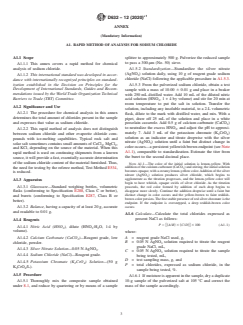
A1.2.1 The procedure for chemical analysis in this annex determines the total amount of chlorides present in the sample and expresses that value as sodium chloride.
A1.2.2 This rapid method of analysis does not distinguish between sodium chloride and other evaporite chloride compounds with ice-melting capabilities. Typical rock salt and solar salt sometimes contains small amounts of CaCl2, MgCl2, and KCl, depending on the source of the material. When this rapid method is used on continuing shipments from a known source, it will provide a fast, essentially accurate determination of the sodium chloride content of the material furnished. Thus, the need for testing by the referee method, Test Method E534, is reduced.
SCOPE
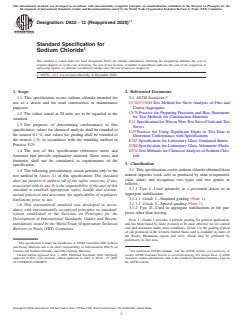
1.1 This specification covers sodium chloride intended for use as a deicer and for road construction or maintenance purposes.
1.2 The values stated as SI units are to be regarded as the standard.
1.3 For purposes of determining conformance to this specification, values for chemical analysis shall be rounded to the nearest 0.1 %, and values for grading shall be rounded to the nearest 1 %, in accordance with the rounding method in Practice E29.
1.4 The text of this specification references notes and footnotes that provide explanatory material. These notes and footnotes shall not be considered as requirements of the specification.
1.5 The following precautionary caveat pertains only to the test method in Annex A1 of this specification: This standard does not purport to address all of the safety concerns, if any, associated with its use. It is the responsibility of the user of this standard to establish appropriate safety, health, and environmental practices and determine the applicability of regulatory limitations prior to use.
1.6 This international standard was developed in accordance with internationally recognized principles on standardization established in the Decision on Principles for the Development of International Standards, Guides and Recommendations issued by the World Trade Organization Technical Barriers to Trade (TBT) Committee.
- Status
- Published
- Publication Date
- 31-Oct-2020
- Technical Committee
- D04 - Road and Paving Materials
- Drafting Committee
- D04.31 - Calcium and Sodium Chlorides and Other Deicing Materials

Overview
ASTM D632-12(2020)e1 – Standard Specification for Sodium Chloride is an internationally recognized standard developed by ASTM International. This specification details the requirements for sodium chloride (NaCl) specifically intended for use as a deicer and for applications in road construction and maintenance. Sodium chloride, commonly known as road salt, plays a crucial role in maintaining safety on roads during winter conditions and is also used for aggregate stabilization in construction projects.
This standard outlines specifications for chemical composition and physical grading to ensure that sodium chloride products are effective and reliable in real-world applications. The document is widely referenced by government agencies, contractors, and suppliers involved in winter maintenance and road infrastructure projects.
Key Topics
- Scope of Standard: Covers sodium chloride for deicing and construction applications, detailing its intended use, variations, and grading requirements.
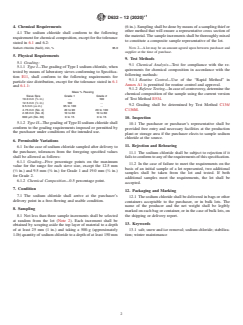
- Chemical Composition: Specifies that sodium chloride content should be at least 95.0%, with chemical analysis expressed as NaCl, ensuring high purity and consistency.
- Types and Grades:
- Type I is used mainly for pavement deicing and aggregate stabilization.
- Grade 1 is for general purposes and is most effective for ice control.
- Grade 2 is typical for certain U.S. regions and may be specified by local purchasers.
- Type II is intended for aggregate stabilization or non-deicing uses, with grading per purchaser requirements.
- Type I is used mainly for pavement deicing and aggregate stabilization.
- Physical Grading: Outlines particle size distribution using standardized sieve sizes, supporting optimal application performance.
- Testing Methods: Includes both a rapid analysis procedure for ongoing quality control and a referee method (referenced as ASTM E534) for dispute resolution or detailed verification.
- Sampling and Inspection: Describes procedures for representative sampling, composite sample preparation, and inspection rights for purchasers.
- Permissible Variations: Provides allowable tolerances for chemical and physical parameters to accommodate practical realities in supply and logistics.
- Safety and Compliance: Stresses the importance of adopting appropriate safety, health, and environmental practices when using and handling sodium chloride.
Applications
- Winter Road Maintenance: Sodium chloride is the primary material for snow and ice removal on roads, highways, and parking areas. Its effective melting capability helps reduce accidents and ensures safer driving conditions during winter months.
- Road Construction: Used for aggregate stabilization in roadbeds, sodium chloride helps improve the durability and strength of pavement structures.
- Municipal and State Purchases: DOTs, municipalities, and facility managers rely on ASTM D632 to specify and procure road salt with assured quality and performance for their maintenance operations.
- Quality Assurance: Suppliers and contractors use this standard to test batches, confirm compliance, and address customer requirements, reducing disputes and ensuring consistency.
Related Standards
- ASTM E534: Test Methods for Chemical Analysis of Sodium Chloride (referee method).
- ASTM C136/C136M: Test Method for Sieve Analysis of Fine and Coarse Aggregates (for physical grading).
- ASTM E11: Specification for Woven Wire Test Sieve Cloth and Test Sieves.
- ASTM E29: Practice for Using Significant Digits in Test Data to Determine Conformance with Specifications.
- ASTM E287/E288: Specifications for Laboratory Glassware, used in testing procedures.
Keywords: ASTM D632, sodium chloride, road salt, snow and ice removal, winter maintenance, deicer, chemical composition, road construction, aggregate stabilization, grading, quality assurance, physical requirements, chemical analysis.
By adhering to the guidelines of ASTM D632-12(2020)e1, stakeholders can ensure the effective and safe application of sodium chloride, optimizing road safety and infrastructure performance, especially during severe weather conditions.
Relations
- Effective Date
- 01-Feb-2024
- Effective Date
- 01-Jan-2024
- Effective Date
- 01-Jul-2019
- Effective Date
- 01-Feb-2018
- Effective Date
- 01-Nov-2017
- Effective Date
- 01-Oct-2013
- Effective Date
- 01-Jul-2013
- Effective Date
- 01-Jun-2013
- Effective Date
- 01-Nov-2012
- Effective Date
- 01-Oct-2010
- Effective Date
- 01-Apr-2010
- Effective Date
- 01-May-2009
- Effective Date
- 01-Oct-2008
- Effective Date
- 01-Nov-2007
- Effective Date
- 15-Nov-2006
Get Certified
Connect with accredited certification bodies for this standard

ECOCERT
Organic and sustainability certification.

Eurofins Food Testing Global
Global leader in food, environment, and pharmaceutical product testing.

Intertek Bangladesh
Intertek certification and testing services in Bangladesh.
Sponsored listings
Frequently Asked Questions
ASTM D632-12(2020)e1 is a technical specification published by ASTM International. Its full title is "Standard Specification for Sodium Chloride". This standard covers: SIGNIFICANCE AND USE A1.2 Significance and Use A1.2.1 The procedure for chemical analysis in this annex determines the total amount of chlorides present in the sample and expresses that value as sodium chloride. A1.2.2 This rapid method of analysis does not distinguish between sodium chloride and other evaporite chloride compounds with ice-melting capabilities. Typical rock salt and solar salt sometimes contains small amounts of CaCl2, MgCl2, and KCl, depending on the source of the material. When this rapid method is used on continuing shipments from a known source, it will provide a fast, essentially accurate determination of the sodium chloride content of the material furnished. Thus, the need for testing by the referee method, Test Method E534, is reduced. SCOPE 1.1 This specification covers sodium chloride intended for use as a deicer and for road construction or maintenance purposes. 1.2 The values stated as SI units are to be regarded as the standard. 1.3 For purposes of determining conformance to this specification, values for chemical analysis shall be rounded to the nearest 0.1 %, and values for grading shall be rounded to the nearest 1 %, in accordance with the rounding method in Practice E29. 1.4 The text of this specification references notes and footnotes that provide explanatory material. These notes and footnotes shall not be considered as requirements of the specification. 1.5 The following precautionary caveat pertains only to the test method in Annex A1 of this specification: This standard does not purport to address all of the safety concerns, if any, associated with its use. It is the responsibility of the user of this standard to establish appropriate safety, health, and environmental practices and determine the applicability of regulatory limitations prior to use. 1.6 This international standard was developed in accordance with internationally recognized principles on standardization established in the Decision on Principles for the Development of International Standards, Guides and Recommendations issued by the World Trade Organization Technical Barriers to Trade (TBT) Committee.
SIGNIFICANCE AND USE A1.2 Significance and Use A1.2.1 The procedure for chemical analysis in this annex determines the total amount of chlorides present in the sample and expresses that value as sodium chloride. A1.2.2 This rapid method of analysis does not distinguish between sodium chloride and other evaporite chloride compounds with ice-melting capabilities. Typical rock salt and solar salt sometimes contains small amounts of CaCl2, MgCl2, and KCl, depending on the source of the material. When this rapid method is used on continuing shipments from a known source, it will provide a fast, essentially accurate determination of the sodium chloride content of the material furnished. Thus, the need for testing by the referee method, Test Method E534, is reduced. SCOPE 1.1 This specification covers sodium chloride intended for use as a deicer and for road construction or maintenance purposes. 1.2 The values stated as SI units are to be regarded as the standard. 1.3 For purposes of determining conformance to this specification, values for chemical analysis shall be rounded to the nearest 0.1 %, and values for grading shall be rounded to the nearest 1 %, in accordance with the rounding method in Practice E29. 1.4 The text of this specification references notes and footnotes that provide explanatory material. These notes and footnotes shall not be considered as requirements of the specification. 1.5 The following precautionary caveat pertains only to the test method in Annex A1 of this specification: This standard does not purport to address all of the safety concerns, if any, associated with its use. It is the responsibility of the user of this standard to establish appropriate safety, health, and environmental practices and determine the applicability of regulatory limitations prior to use. 1.6 This international standard was developed in accordance with internationally recognized principles on standardization established in the Decision on Principles for the Development of International Standards, Guides and Recommendations issued by the World Trade Organization Technical Barriers to Trade (TBT) Committee.
ASTM D632-12(2020)e1 is classified under the following ICS (International Classification for Standards) categories: 71.060.50 - Salts; 71.100.80 - Chemicals for purification of water. The ICS classification helps identify the subject area and facilitates finding related standards.
ASTM D632-12(2020)e1 has the following relationships with other standards: It is inter standard links to ASTM C670-24a, ASTM C670-24, ASTM E287-02(2019), ASTM E534-18, ASTM E288-10(2017), ASTM E11-13, ASTM C670-13, ASTM E534-13, ASTM E287-02(2012), ASTM C670-10, ASTM E288-10, ASTM E11-09e1, ASTM E29-08, ASTM E287-02(2007), ASTM E29-06b. Understanding these relationships helps ensure you are using the most current and applicable version of the standard.
ASTM D632-12(2020)e1 is available in PDF format for immediate download after purchase. The document can be added to your cart and obtained through the secure checkout process. Digital delivery ensures instant access to the complete standard document.
Standards Content (Sample)
This international standard was developed in accordance with internationally recognized principles on standardization established in the Decision on Principles for the
Development of International Standards, Guides and Recommendations issued by the World Trade Organization Technical Barriers to Trade (TBT) Committee.
´1
Designation: D632 −12 (Reapproved 2020)
Standard Specification for
Sodium Chloride
This standard is issued under the fixed designation D632; the number immediately following the designation indicates the year of
original adoption or, in the case of revision, the year of last revision. A number in parentheses indicates the year of last reapproval. A
superscript epsilon (´) indicates an editorial change since the last revision or reapproval.
ε NOTE—10.1 was revised editorially in December 2020.
1. Scope 2. Referenced Documents
1.1 This specification covers sodium chloride intended for 2.1 ASTM Standards:
use as a deicer and for road construction or maintenance C136/C136M Test Method for Sieve Analysis of Fine and
purposes. Coarse Aggregates
C670 Practice for Preparing Precision and Bias Statements
1.2 The values stated as SI units are to be regarded as the
for Test Methods for Construction Materials
standard.
E11 Specification for Woven Wire Test Sieve Cloth and Test
1.3 For purposes of determining conformance to this
Sieves
specification, values for chemical analysis shall be rounded to
E29 Practice for Using Significant Digits in Test Data to
the nearest 0.1 %, and values for grading shall be rounded to
Determine Conformance with Specifications
the nearest 1 %, in accordance with the rounding method in
E287 Specification for Laboratory Glass Graduated Burets
Practice E29.
E288 Specification for Laboratory Glass Volumetric Flasks
1.4 The text of this specification references notes and E534 Test Methods for Chemical Analysis of Sodium Chlo-
ride
footnotes that provide explanatory material. These notes and
footnotes shall not be considered as requirements of the
3. Classification
specification.
3.1 This specification covers sodium chloride obtained from
1.5 The following precautionary caveat pertains only to the
natural deposits (rock salt) or produced by man (evaporated,
test method in Annex A1 of this specification: This standard
solar, other) and recognizes two types and two grades as
does not purport to address all of the safety concerns, if any,
follows:
associatedwithitsuse.Itistheresponsibilityoftheuserofthis
3.1.1 Type I—Used primarily as a pavement deicer or in
standard to establish appropriate safety, health, and environ-
aggregate stabilization.
mental practices and determine the applicability of regulatory
3.1.1.1 Grade 1—Standard grading (Note 1).
limitations prior to use.
3.1.1.2 Grade 2—Special grading (Note 1).
1.6 This international standard was developed in accor-
3.1.2 Type II—Used in aggregate stabilization or for pur-
dance with internationally recognized principles on standard-
poses other than deicing.
ization established in the Decision on Principles for the
Development of International Standards, Guides and Recom-
NOTE 1—Grade 1 provides a particle grading for general application,
mendations issued by the World Trade Organization Technical and has been found by latest research to be most effective for ice control
and skid resistance under most conditions. Grade 2 is the grading typical
Barriers to Trade (TBT) Committee.
of salt produced in the western United States and is available in states of
the Rocky Mountains region and west, which may be preferred by
purchasers in that area.
This specification is under the jurisdiction of ASTM Committee D04 on Road
and Paving Materials and is the direct responsibility of Subcommittee D04.31 on
Calcium and Sodium Chlorides and Other Deicing Materials. For referenced ASTM standards, visit the ASTM website, www.astm.org, or
Current edition approved Nov. 1, 2020. Published November 2020. Originally contact ASTM Customer Service at service@astm.org. For Annual Book of ASTM
approved in 1941. Last previous edition approved in 2012 as D632 – 12. DOI: Standards volume information, refer to the standard’s Document Summary page on
10.1520/D0632-12R20E01. the ASTM website.
Copyright © ASTM International, 100 Barr Harbor Drive, PO Box C700, West Conshohocken, PA 19428-2959. United States
´1
D632 − 12 (2020)
4. Chemical Requirements (6 in.). Sampling shall be done by means of a sampling thief or
other method that will ensure a representative cross section of
4.1 The sodium chloride shall conform to the following
the material.The sample increments shall be thoroughly mixed
requirement for chemical composition, except for the tolerance
to constitute a composite sample representative of the lot.
stated in 6.1 and 6.2:
NOTE 2—A lot may be an amount agreed upon between purchaser and
Sodium chloride (NaCl), min, % 95.0
supplier at the time of purchase.
5. Physical Requirements
9. Test Methods
5.1 Grading:
9.1 Chemical Analysis—Test for compliance with the re-
5.1.1 Type I—The grading of Type I sodium chloride, when
quirements for chemical composition in accordance with the
tested by means of laboratory sieves conforming to Specifica-
following methods:
tion E11, shall conform to the following requirements for
9.1.1 Routine Control—Use of the “Rapid Method” in
particle size distribution, except for the tolerance stated in 6.1
Annex A1 is permitted for routine control and approval.
and 6.1.1:
9.1.2 RefereeTesting—In case of controversy, determine the
Mass % Passing
chemical composition of the sample using the current version
Sieve Size Grade 1 Grade 2
of Test Method E534.
19.0mm( ⁄4 in.) . 100
12.5mm( ⁄2 in.) 100 .
9.2 Grading shall be determined by Test Method C136/
9.5mm( ⁄8 in.) 95 to 100 .
4.75 mm (No. 4) 20 to 90 20 to 100
C136M.
2.36 mm (No. 8) 10 to 60 10 to 60
600 µm (No. 30) 0 to 15 0 to 15
10. Inspection
5.1.2 Type II—The grading of Type II sodium chloride shall
10.1 The purchaser or purchaser’s representative shall be
conform to the grading requirements imposed or permitted by
provided free entry and necessary facilities at the production
the purchaser under conditions of the intended use.
plant or storage area if the purchaser elects to sample sodium
chloride at the source.
6. Permissible Variations
11. Rejection and Rehearing
6.1 In the case of sodium chloride sampled after delivery to
the purchaser, tolerances from the foregoing specified values
11.1 The sodium chloride shall be subject to rejection if it
shall be allowed as follows:
failstoconformtoanyoftherequirementsofthisspecification.
6.1.1 Grading—Five percentage points on the maximum
11.2 In the case of failure to meet the requirements on the
value for the range for each sieve size, except the 12.5 mm
basis of an initial sample of a lot represented, two additional
1 3 3
( ⁄2 in.) and 9.5 mm ( ⁄8 in.) for Grade 1 and 19.0 mm ( ⁄4 in.)
samples shall be taken from the lot and tested. If both
for Grade 2.
additional samples meet the requirements, the lot shall be
6.1.2 Chemical Composition—0.5 percentage point.
accepted.
7. Condition
12. Packaging and Marking
7.1 The sodium chloride shall arrive at the purchaser’s
12.1 The sodium chloride shall be delivered in bags or other
delivery point in a free-flowing and usable condition.
containers acceptable to the purchaser, or in bulk lots. The
name of the producer and the net weight shall be legibly
8. Sampling
marked on each bag or container, or in the case of bulk lots, on
8.1 Not less than three sample increments shall be selected the shipping or delivery report.
at random from the lot (Note 2). Each increment shall be
13. Keywords
obtained by scraping aside the top layer of material to a depth
of at least 25 mm (1 in.) and taking a 500-g (approximately 13.1 salt; snow and ice removal; sodium chloride; stabiliza-
1-lb) quantity of sodium chloride to a depth of at least 150 mm tion; winter maintenance
´1
D632 − 12 (2020)
ANNEX
(Mandatory Information)
A1. RAPID METHOD OF ANALYSIS FOR SODIUM CHLORIDE
A1.1 Scope splitter to approximately 500 g. Pulverize the reduced sample
to pass
...