

ASTM F924-90(2022)
(Test Method)Standard Test Method for Resistance to Puncture of Cushioned Resilient Floor Coverings
General Information
- Abstract
SIGNIFICANCE AND USE
4.1 Much of the cushioned resilient flooring in use today is in household kitchens. Kitchen flooring is frequently subjected to the hazard of dropped tableware and cutting knives, that can puncture the wear layer of cushioned resilient flooring. Food and soil that become embedded in these punctures often can not be removed by ordinary maintenance, resulting in unsightly marks. Moisture, grease, or oils that penetrate to the cushion layer can be wicked into the foam and cause permanent discoloration. Ultimately, the service life of the material is shortened.
SCOPE
1.1 This test method covers the laboratory procedure for determining the resistance of cushioned resilient floor coverings to punctures from dropped pointed objects such as dinner forks.
1.2 This test method employs a 35-g cylindrical dart with a flat, small-diameter tip that is dropped onto a specimen of flooring. The dart represents the weight of a typical fork and the tip produces a similar puncture to those which result from dropped forks.
1.3 Flooring with thick wear layers may not puncture under even the most severe drop. Although data can be obtained by increasing the drop height or the weight of the dart, values of this magnitude have no practical application.
1.4 The values stated in inch-pound units are to be regarded as standard. The values given in parentheses are mathematical conversions to SI units that are provided for information only and are not considered standard.
1.5 This standard does not purport to address all of the safety concerns, if any, associated with its use. It is the responsibility of the user of this standard to establish appropriate safety, health, and environmental practices and determine the applicability of regulatory limitations prior to use. For specific precaution statement see 8.2.
1.6 This international standard was developed in accordance with internationally recognized principles on standardization established in the Decision on Principles for the Development of International Standards, Guides and Recommendations issued by the World Trade Organization Technical Barriers to Trade (TBT) Committee.
- Status
- Published
- Publication Date
- 30-Sep-2022
- Technical Committee
- F06 - Resilient Floor Coverings
- Drafting Committee
- F06.20 - Test Methods

Overview
ASTM F924-90(2022): Standard Test Method for Resistance to Puncture of Cushioned Resilient Floor Coverings establishes a laboratory procedure to evaluate the puncture resistance of cushioned resilient flooring, particularly against pointed objects like dinner forks. This test standard is widely recognized for assessing the durability and longevity of flooring materials commonly used in environments vulnerable to accidental drops and physical impacts, such as household kitchens.
By enabling manufacturers and quality auditors to assess the susceptibility of flooring to punctures, ASTM F924 helps ensure safer and more durable flooring solutions. This is particularly important as punctured floor coverings can lead to embedded food and soil, persistent stains, moisture intrusion, and ultimately a reduction in service life.
Key Topics
- Puncture Resistance Testing: The standard describes a test method using a 35-gram cylindrical dart with a flat, small-diameter tip, mimicking a dropped dinner fork.
- Laboratory Procedures: It outlines precise specimen preparation, conditioning, test apparatus setup, and drop protocols to yield consistent results.
- Failure Criteria: Puncture is defined as a complete break through the wear layer at the point of impact, verified through visual and ink-based methods.
- Repeatability and Precision: Guidance is provided on the acceptable variation between tests and labs, emphasizing consistency across evaluations.
- Interpretation of Results: Results are quantified by averaging drop heights required to cause punctures, providing meaningful data for material comparison.
Applications
- Residential Flooring: Especially relevant for cushioned resilient flooring installed in high-traffic kitchen areas, where dropped utensils present a daily risk.
- Product Development and Quality Assurance: Flooring manufacturers use this method to develop puncture-resistant products and validate product claims.
- Comparative Assessment: The method enables comparison among various flooring materials based on their resistance to typical domestic puncture hazards.
- Risk Assessment in Design: Architects and designers can reference ASTM F924 data to select appropriate flooring materials for environments prone to accidental drops.
Practical benefits of using this standard include:
- Enhanced Durability: Flooring products tested to meet ASTMF924 demonstrate improved resistance to accidental damage, resulting in longer product life.
- Improved Hygiene: Limiting punctures helps prevent food and liquid ingress, reducing unsightly stains and potential bacterial growth.
- Customer Confidence: Verified performance using ASTM test methods helps build trust with consumers and specifiers seeking resilient flooring solutions.
Related Standards
Several ASTM standards complement or are referenced by ASTM F924-90(2022):
- ASTM E171 - Practice for Conditioning and Testing Flexible Barrier Packaging, ensuring proper specimen conditioning.
- ASTM F141 - Terminology Relating to Resilient Floor Coverings, providing necessary definitions and context.
- ASTM F410 - Test Method for Wear Layer Thickness of Resilient Floor Coverings by Optical Measurement, aiding in evaluating factors like wear layer thickness critical to puncture resistance.
In summary, adherence to ASTM F924 supports industry best practices for developing and selecting cushioned resilient floor coverings with verified puncture resistance, helping safeguard flooring aesthetics and performance in demanding residential and commercial environments. This standard is a key tool in the resilient flooring sector for ensuring quality, safety, and customer satisfaction.
Relations
- Effective Date
- 01-Aug-2023
- Effective Date
- 15-Jan-2020
- Effective Date
- 01-Dec-2013
- Effective Date
- 01-Mar-2012
- Effective Date
- 01-Dec-2011
- Effective Date
- 01-Dec-2008
- Effective Date
- 01-Nov-2008
- Effective Date
- 01-Feb-2008
- Effective Date
- 01-Apr-2007
- Effective Date
- 01-Nov-2004
- Effective Date
- 10-Jun-2003
- Effective Date
- 10-Feb-2002
- Effective Date
- 10-Feb-2002
- Effective Date
- 10-Aug-2001
- Effective Date
- 10-Aug-2001
Frequently Asked Questions
ASTM F924-90(2022) is a standard published by ASTM International. Its full title is "Standard Test Method for Resistance to Puncture of Cushioned Resilient Floor Coverings". This standard covers: SIGNIFICANCE AND USE 4.1 Much of the cushioned resilient flooring in use today is in household kitchens. Kitchen flooring is frequently subjected to the hazard of dropped tableware and cutting knives, that can puncture the wear layer of cushioned resilient flooring. Food and soil that become embedded in these punctures often can not be removed by ordinary maintenance, resulting in unsightly marks. Moisture, grease, or oils that penetrate to the cushion layer can be wicked into the foam and cause permanent discoloration. Ultimately, the service life of the material is shortened. SCOPE 1.1 This test method covers the laboratory procedure for determining the resistance of cushioned resilient floor coverings to punctures from dropped pointed objects such as dinner forks. 1.2 This test method employs a 35-g cylindrical dart with a flat, small-diameter tip that is dropped onto a specimen of flooring. The dart represents the weight of a typical fork and the tip produces a similar puncture to those which result from dropped forks. 1.3 Flooring with thick wear layers may not puncture under even the most severe drop. Although data can be obtained by increasing the drop height or the weight of the dart, values of this magnitude have no practical application. 1.4 The values stated in inch-pound units are to be regarded as standard. The values given in parentheses are mathematical conversions to SI units that are provided for information only and are not considered standard. 1.5 This standard does not purport to address all of the safety concerns, if any, associated with its use. It is the responsibility of the user of this standard to establish appropriate safety, health, and environmental practices and determine the applicability of regulatory limitations prior to use. For specific precaution statement see 8.2. 1.6 This international standard was developed in accordance with internationally recognized principles on standardization established in the Decision on Principles for the Development of International Standards, Guides and Recommendations issued by the World Trade Organization Technical Barriers to Trade (TBT) Committee.
SIGNIFICANCE AND USE 4.1 Much of the cushioned resilient flooring in use today is in household kitchens. Kitchen flooring is frequently subjected to the hazard of dropped tableware and cutting knives, that can puncture the wear layer of cushioned resilient flooring. Food and soil that become embedded in these punctures often can not be removed by ordinary maintenance, resulting in unsightly marks. Moisture, grease, or oils that penetrate to the cushion layer can be wicked into the foam and cause permanent discoloration. Ultimately, the service life of the material is shortened. SCOPE 1.1 This test method covers the laboratory procedure for determining the resistance of cushioned resilient floor coverings to punctures from dropped pointed objects such as dinner forks. 1.2 This test method employs a 35-g cylindrical dart with a flat, small-diameter tip that is dropped onto a specimen of flooring. The dart represents the weight of a typical fork and the tip produces a similar puncture to those which result from dropped forks. 1.3 Flooring with thick wear layers may not puncture under even the most severe drop. Although data can be obtained by increasing the drop height or the weight of the dart, values of this magnitude have no practical application. 1.4 The values stated in inch-pound units are to be regarded as standard. The values given in parentheses are mathematical conversions to SI units that are provided for information only and are not considered standard. 1.5 This standard does not purport to address all of the safety concerns, if any, associated with its use. It is the responsibility of the user of this standard to establish appropriate safety, health, and environmental practices and determine the applicability of regulatory limitations prior to use. For specific precaution statement see 8.2. 1.6 This international standard was developed in accordance with internationally recognized principles on standardization established in the Decision on Principles for the Development of International Standards, Guides and Recommendations issued by the World Trade Organization Technical Barriers to Trade (TBT) Committee.
ASTM F924-90(2022) is classified under the following ICS (International Classification for Standards) categories: 97.150 - Floor coverings. The ICS classification helps identify the subject area and facilitates finding related standards.
ASTM F924-90(2022) has the following relationships with other standards: It is inter standard links to ASTM F141-23, ASTM F141-12(2020), ASTM F410-08(2013), ASTM F141-12, ASTM F141-11, ASTM F141-08a, ASTM F141-08, ASTM F410-08, ASTM E171-94(2007), ASTM F141-04, ASTM F141-03, ASTM F410-02, ASTM F410-95, ASTM F141-00A, ASTM F141-00B. Understanding these relationships helps ensure you are using the most current and applicable version of the standard.
ASTM F924-90(2022) is available in PDF format for immediate download after purchase. The document can be added to your cart and obtained through the secure checkout process. Digital delivery ensures instant access to the complete standard document.
Standards Content (Sample)
This international standard was developed in accordance with internationally recognized principles on standardization established in the Decision on Principles for the
Development of International Standards, Guides and Recommendations issued by the World Trade Organization Technical Barriers to Trade (TBT) Committee.
Designation: F924 − 90 (Reapproved 2022)
Standard Test Method for
Resistance to Puncture of Cushioned Resilient Floor
Coverings
ThisstandardisissuedunderthefixeddesignationF924;thenumberimmediatelyfollowingthedesignationindicatestheyearoforiginal
adoption or, in the case of revision, the year of last revision.Anumber in parentheses indicates the year of last reapproval.Asuperscript
epsilon (´) indicates an editorial change since the last revision or reapproval.
1. Scope 2. Referenced Documents
2.1 ASTM Standards:
1.1 This test method covers the laboratory procedure for
E171 Practice for Conditioning and Testing Flexible Barrier
determining the resistance of cushioned resilient floor cover-
Packaging
ings to punctures from dropped pointed objects such as dinner
F141 Terminology Relating to Resilient Floor Coverings
forks.
F410 Test Method for Wear Layer Thickness of Resilient
1.2 This test method employs a 35-g cylindrical dart with a
Floor Coverings by Optical Measurement
flat, small-diameter tip that is dropped onto a specimen of
flooring. The dart represents the weight of a typical fork and
3. Terminology
the tip produces a similar puncture to those which result from
3.1 Definitions:
dropped forks.
3.1.1 For definitions of other terms used in this test method,
1.3 Flooring with thick wear layers may not puncture under
refer to Terminology F141.
even the most severe drop. Although data can be obtained by
3.2 Definitions of Terms Specific to This Standard:
increasing the drop height or the weight of the dart, values of
3.2.1 puncture, n—a break in the wear layer of the speci-
this magnitude have no practical application.
men.An indentation at the point of impact shall be considered
a puncture only if the wear layer is broken completely through
1.4 The values stated in inch-pound units are to be regarded
at some point.
as standard. The values given in parentheses are mathematical
conversions to SI units that are provided for information only 3.2.2 wicking, n—the presence of ink below the wear layer
and are not considered standard. of the specimen in areas adjacent to a puncture. This can be
seen next to the actual cut, and appears either as spots on the
1.5 This standard does not purport to address all of the
pattern layer or as a general discoloration.
safety concerns, if any, associated with its use. It is the
responsibility of the user of this standard to establish appro-
4. Significance and Use
priate safety, health, and environmental practices and deter-
4.1 Much of the cushioned resilient flooring in use today is
mine the applicability of regulatory limitations prior to use.
in household kitchens. Kitchen flooring is frequently subjected
For specific precaution statement see 8.2.
to the hazard of dropped tableware and cutting knives, that can
1.6 This international standard was developed in accor-
puncture the wear layer of cushioned resilient flooring. Food
dance with internationally recognized principles on standard-
and soil that become embedded in these punctures often can
ization established in the Decision on Principles for the
notberemovedbyordinarymaintenance,resultinginunsightly
Development of International Standards, Guides and Recom-
marks. Moisture, grease, or oils that penetrate to the cushion
mendations issued by the World Trade Organization Technical
layer can be wicked into the foam and cause permanent
Barriers to Trade (TBT) Committee.
discoloration. Ultimately, the service life of the material is
shortened.
ThistestmethodisunderthejurisdictionofASTMCommitteeF06onResilient
Floor Coverings and is the direct responsibility of Subcommittee F06.20 on Test
Methods. For referenced ASTM standards, visit the ASTM website, www.astm.org, or
Current edition approved Oct. 1, 2022. Published October 2022. Originally contact ASTM Customer Service at service@astm.org. For Annual Book of ASTM
approved in 1985. Last previous edition approved in 2015 as F924 – 90 (2015). Standards volume information, refer to the standard’s Document Summary page on
DOI: 10.1520/F0924-90R22. the ASTM website.
Copyright © ASTM International, 100 Barr Harbor Drive, PO Box C700, West Conshohocken, PA 19428-2959. United States
F924 − 90 (2022)
5. Apparatus shall be a flat cap with a ⁄4 in. diameter opening in the center.
This hole should have smooth, rounded sides.
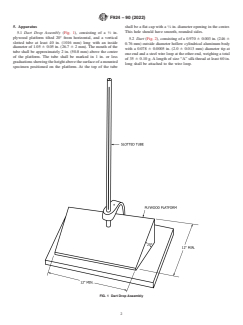
5.1 Dart Drop Assembly (Fig. 1), consisting of a ⁄2 in.
plywood platform tilted 20° from horizontal, and a vertical
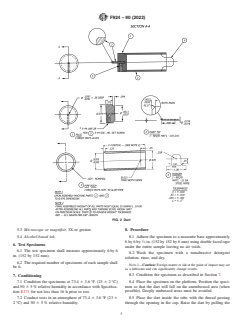
5.2 Dart (Fig. 2), consisting of a 0.970 6 0.003 in. (246 6
slotted tube at least 40 in. (1016 mm) long with an inside
0.76 mm) outside diameter hollow cylindrical aluminum body
diameter of 1.05 6 0.05 in. (26.7 6 2 mm). The mouth of the
with a 0.078 6 0.0005 in. (2.0 6 0.013 mm) diameter tip at
tube shall be approximately 2 in. (50.8 mm) above the center
one end and a steel wire loop at the other end, weighing a total
of the platform. The tube shall be marked in 1 in. or less
of 35 6 0.10 g. A length of size “A” silk thread at least 60 in.
graduations showing the height above the surface of a mo
...