

ASTM C1589/C1589M-18(2023)
(Practice)Standard Practice for Outdoor Weathering of Construction Seals and Sealants
General Information
- Abstract
SIGNIFICANCE AND USE
4.1 Tests conducted in accordance with this practice are used to evaluate the weatherability of construction seals and sealant materials when they are exposed to outdoor weather conditions. The weatherability of seals and sealants in actual outdoor use can be very different depending on the location because of differences in solar radiation, moisture, temperature, pollutants, and other factors. Sealant color may also affect weatherability.
4.2 This practice allows for three options: Option 1 – Procedure A in which the effect of movement during weathering is not considered; Option 2 – Procedure B in which specimens are weathered in conjunction with movement based on thermal changes. The applied strain is proportional to a combination of the temperature at the time the equipment is set up and subsequent thermal changes. This option closely mimics the actual movements that occur in many sealant installations, but is less repeatable than the movement in Procedure C; Option 3 – Procedure C in which the strain during weathering is manually applied. This procedure allows for excellent control and repeatability, but is less representative of movement in actual use conditions than the movement in Procedure B. Options 2 and 3 have been added to this practice based on peer reviewed scientific literature demonstrating that applied strain separately and in combination with other weathering stresses causes changes in the weatherability of sealants.
4.3 The type, frequency and amount of movement of sealants varies with location and may affect weatherability. It cannot be assumed, therefore, that results from one exposure in a single location will be useful for determining weatherability in a different location. Exposures in several locations with different climates (for example, solar radiation, moisture, temperature, pollutants, biological and other factors) that represent a broad range of anticipated service conditions are recommended.
4.4 It is strongly recommended tha...
SCOPE
1.1 This practice describes outdoor exposure procedures to be used as part of a test designed to determine the weatherability of building construction, seals and sealants.
Note 1: See Practice G24 for Exposures to Daylight Filtered Through Glass.
1.2 This practice includes three procedures for outdoor weathering. Procedure A exposes specimens to outdoor weathering without movement. Procedure B and Procedure C are, respectively, continuous natural and periodic manual techniques for subjecting specimens to the combination of cyclic movement and exposure to outdoor weathering.
1.3 This practice is limited to the method by which the construction seals or sealants are exposed to outdoor weathering as part of a test program. It refers to the types of evaluations to be performed following the outdoor exposure but does not describe the test methods.
1.4 Means of evaluation of the effects of weathering will depend on the intended use of the test material.
1.5 The values stated in either SI units or inch-pound units are to be regarded separately as standard. The values stated in each system are not necessarily exact equivalents; therefore, to ensure conformance with the standard, each system shall be used independently of the other, and values from the two systems shall not be combined.
1.6 This standard does not purport to address all of the safety concerns, if any, associated with its use. It is the responsibility of the user of this standard to establish appropriate safety, health, and environmental practices and determine the applicability of regulatory limitations prior to use.
1.7 This international standard was developed in accordance with internationally recognized principles on standardization established in the Decision on Principles for the Development of International Standards, Guides and Recommendations issued by the World Trade Organization Technical Barriers to Trade (TBT) Committee.
- Status
- Published
- Publication Date
- 31-Jan-2023
- Technical Committee
- C24 - Building Seals and Sealants
- Drafting Committee
- C24.40 - Weathering
Overview
ASTM C1589/C1589M-18(2023), titled "Standard Practice for Outdoor Weathering of Construction Seals and Sealants," is an internationally recognized ASTM standard that establishes procedures to evaluate the weatherability of construction sealants and seals when exposed to actual outdoor weather conditions. Developed in alignment with World Trade Organization (WTO) guidelines for global standards, this practice is essential for accurately assessing how building sealants perform over time in various climates, considering exposure to solar radiation, moisture, temperature shifts, and pollutants. The standard recognizes that real-world conditions can vary significantly and offers flexible procedures for a range of testing needs in construction materials testing.
Key Topics
Outdoor Weathering Evaluations
- Assess the performance and durability of construction seals and sealants under natural environmental stressors.
- Recognize the impact of variables such as solar radiation, temperature, moisture, atmospheric pollutants, and biological factors.
Test Procedures and Options
- Procedure A: Exposes test specimens to outdoor weathering with no movement. Suitable for baseline weatherability assessment.
- Procedure B: Subjects specimens to cyclic movement based on environmental temperature changes, simulating more realistic building joint conditions.
- Procedure C: Involves periodic manual movement of specimens for enhanced consistency and repeatability, though less representative of actual service conditions.
Test Site and Specimen Recommendations
- Use diverse climatological locations for comprehensive results.
- Encourage the use of control materials with known weatherability alongside test specimens.
- Ensure at least three replicates per test material to account for variability.
Limitations
- The practice focuses on exposure methods, not on performance evaluation tests, which are left to the user’s discretion based on the material’s intended application.
- Weatherability results are site-specific and may not predict outcomes in different locations or over the long term.
Applications
Who Should Use This Standard?
- Manufacturers of construction sealants
- Testing laboratories
- Building and construction material specifiers
- Quality assurance teams
- Product compliance professionals
Practical Value
- Confirms a product’s suitability for various climate conditions prior to market release or specification in construction projects.
- Provides comparative data on new versus control (reference) sealant materials, supporting R&D and product improvement.
- Aids in warranty, certification, and regulatory approval processes.
Real-World Use Cases
- Product Performance Verification: Compare weather durability across different sealant formulations.
- Site Suitability Studies: Assess sealant longevity for projects in areas with harsh climates (e.g., deserts, seashores, industrial zones).
- Quality Benchmarks: Establish performance baselines for value engineering and life-cycle costing.
- Compliance Documentation: Support claims related to sealant resistance to UV, moisture, and movement for building code conformance.
Related Standards
To ensure complete and accurate testing, ASTM C1589/C1589M references or aligns with several other ASTM standards and terminology documents in the field:
- ASTM C719: Adhesion and Cohesion of Elastomeric Joint Sealants under Cyclic Movement.
- ASTM C1135: Tensile Adhesion Properties of Structural Sealants.
- ASTM G7: Practice for Natural Weathering of Materials.
- ASTM G24: Conducting Exposures to Daylight Filtered Through Glass.
- ASTM G147: Conditioning and Handling of Nonmetallic Materials for Weathering.
- ASTM G178: Determining the Activation Spectrum of a Material.
- ASTM C717, E631, G113, E772: Terminology and definitions for consistency in building sealants and weathering tests.
By adhering to ASTM C1589/C1589M-18(2023), industry professionals ensure a robust, representative approach to testing outdoor weathering in construction seals and sealants, supporting confidence in material performance and compliance with international construction quality standards.
Relations
- Effective Date
- 01-May-2019
- Effective Date
- 01-Mar-2019
- Effective Date
- 01-Mar-2018
- Effective Date
- 01-Nov-2017
- Effective Date
- 01-Jun-2017
- Effective Date
- 01-Jan-2017
- Effective Date
- 15-Nov-2016
- Effective Date
- 01-Sep-2016
- Effective Date
- 01-Dec-2015
- Effective Date
- 01-Mar-2015
- Effective Date
- 01-Nov-2014
- Effective Date
- 15-Jul-2014
- Effective Date
- 01-May-2014
- Effective Date
- 01-Mar-2014
- Effective Date
- 01-Feb-2014
Get Certified
Connect with accredited certification bodies for this standard

DIBt (Deutsches Institut für Bautechnik)
German Institute for Building Technology.
DIN CERTCO
DIN Group product certification.

Aboma Certification B.V.
Specialized in construction, metal, and transport sectors.
Sponsored listings
Frequently Asked Questions
ASTM C1589/C1589M-18(2023) is a standard published by ASTM International. Its full title is "Standard Practice for Outdoor Weathering of Construction Seals and Sealants". This standard covers: SIGNIFICANCE AND USE 4.1 Tests conducted in accordance with this practice are used to evaluate the weatherability of construction seals and sealant materials when they are exposed to outdoor weather conditions. The weatherability of seals and sealants in actual outdoor use can be very different depending on the location because of differences in solar radiation, moisture, temperature, pollutants, and other factors. Sealant color may also affect weatherability. 4.2 This practice allows for three options: Option 1 – Procedure A in which the effect of movement during weathering is not considered; Option 2 – Procedure B in which specimens are weathered in conjunction with movement based on thermal changes. The applied strain is proportional to a combination of the temperature at the time the equipment is set up and subsequent thermal changes. This option closely mimics the actual movements that occur in many sealant installations, but is less repeatable than the movement in Procedure C; Option 3 – Procedure C in which the strain during weathering is manually applied. This procedure allows for excellent control and repeatability, but is less representative of movement in actual use conditions than the movement in Procedure B. Options 2 and 3 have been added to this practice based on peer reviewed scientific literature demonstrating that applied strain separately and in combination with other weathering stresses causes changes in the weatherability of sealants. 4.3 The type, frequency and amount of movement of sealants varies with location and may affect weatherability. It cannot be assumed, therefore, that results from one exposure in a single location will be useful for determining weatherability in a different location. Exposures in several locations with different climates (for example, solar radiation, moisture, temperature, pollutants, biological and other factors) that represent a broad range of anticipated service conditions are recommended. 4.4 It is strongly recommended tha... SCOPE 1.1 This practice describes outdoor exposure procedures to be used as part of a test designed to determine the weatherability of building construction, seals and sealants. Note 1: See Practice G24 for Exposures to Daylight Filtered Through Glass. 1.2 This practice includes three procedures for outdoor weathering. Procedure A exposes specimens to outdoor weathering without movement. Procedure B and Procedure C are, respectively, continuous natural and periodic manual techniques for subjecting specimens to the combination of cyclic movement and exposure to outdoor weathering. 1.3 This practice is limited to the method by which the construction seals or sealants are exposed to outdoor weathering as part of a test program. It refers to the types of evaluations to be performed following the outdoor exposure but does not describe the test methods. 1.4 Means of evaluation of the effects of weathering will depend on the intended use of the test material. 1.5 The values stated in either SI units or inch-pound units are to be regarded separately as standard. The values stated in each system are not necessarily exact equivalents; therefore, to ensure conformance with the standard, each system shall be used independently of the other, and values from the two systems shall not be combined. 1.6 This standard does not purport to address all of the safety concerns, if any, associated with its use. It is the responsibility of the user of this standard to establish appropriate safety, health, and environmental practices and determine the applicability of regulatory limitations prior to use. 1.7 This international standard was developed in accordance with internationally recognized principles on standardization established in the Decision on Principles for the Development of International Standards, Guides and Recommendations issued by the World Trade Organization Technical Barriers to Trade (TBT) Committee.
SIGNIFICANCE AND USE 4.1 Tests conducted in accordance with this practice are used to evaluate the weatherability of construction seals and sealant materials when they are exposed to outdoor weather conditions. The weatherability of seals and sealants in actual outdoor use can be very different depending on the location because of differences in solar radiation, moisture, temperature, pollutants, and other factors. Sealant color may also affect weatherability. 4.2 This practice allows for three options: Option 1 – Procedure A in which the effect of movement during weathering is not considered; Option 2 – Procedure B in which specimens are weathered in conjunction with movement based on thermal changes. The applied strain is proportional to a combination of the temperature at the time the equipment is set up and subsequent thermal changes. This option closely mimics the actual movements that occur in many sealant installations, but is less repeatable than the movement in Procedure C; Option 3 – Procedure C in which the strain during weathering is manually applied. This procedure allows for excellent control and repeatability, but is less representative of movement in actual use conditions than the movement in Procedure B. Options 2 and 3 have been added to this practice based on peer reviewed scientific literature demonstrating that applied strain separately and in combination with other weathering stresses causes changes in the weatherability of sealants. 4.3 The type, frequency and amount of movement of sealants varies with location and may affect weatherability. It cannot be assumed, therefore, that results from one exposure in a single location will be useful for determining weatherability in a different location. Exposures in several locations with different climates (for example, solar radiation, moisture, temperature, pollutants, biological and other factors) that represent a broad range of anticipated service conditions are recommended. 4.4 It is strongly recommended tha... SCOPE 1.1 This practice describes outdoor exposure procedures to be used as part of a test designed to determine the weatherability of building construction, seals and sealants. Note 1: See Practice G24 for Exposures to Daylight Filtered Through Glass. 1.2 This practice includes three procedures for outdoor weathering. Procedure A exposes specimens to outdoor weathering without movement. Procedure B and Procedure C are, respectively, continuous natural and periodic manual techniques for subjecting specimens to the combination of cyclic movement and exposure to outdoor weathering. 1.3 This practice is limited to the method by which the construction seals or sealants are exposed to outdoor weathering as part of a test program. It refers to the types of evaluations to be performed following the outdoor exposure but does not describe the test methods. 1.4 Means of evaluation of the effects of weathering will depend on the intended use of the test material. 1.5 The values stated in either SI units or inch-pound units are to be regarded separately as standard. The values stated in each system are not necessarily exact equivalents; therefore, to ensure conformance with the standard, each system shall be used independently of the other, and values from the two systems shall not be combined. 1.6 This standard does not purport to address all of the safety concerns, if any, associated with its use. It is the responsibility of the user of this standard to establish appropriate safety, health, and environmental practices and determine the applicability of regulatory limitations prior to use. 1.7 This international standard was developed in accordance with internationally recognized principles on standardization established in the Decision on Principles for the Development of International Standards, Guides and Recommendations issued by the World Trade Organization Technical Barriers to Trade (TBT) Committee.
ASTM C1589/C1589M-18(2023) is classified under the following ICS (International Classification for Standards) categories: 91.100.50 - Binders. Sealing materials. The ICS classification helps identify the subject area and facilitates finding related standards.
ASTM C1589/C1589M-18(2023) has the following relationships with other standards: It is inter standard links to ASTM C1135-19, ASTM C717-19, ASTM C717-18, ASTM C717-17a, ASTM G147-17, ASTM C717-17, ASTM C717-16a, ASTM C717-16, ASTM C1135-15, ASTM E631-15, ASTM E631-14, ASTM C719-14, ASTM C717-14a, ASTM G113-14, ASTM C717-14. Understanding these relationships helps ensure you are using the most current and applicable version of the standard.
ASTM C1589/C1589M-18(2023) is available in PDF format for immediate download after purchase. The document can be added to your cart and obtained through the secure checkout process. Digital delivery ensures instant access to the complete standard document.
Standards Content (Sample)
This international standard was developed in accordance with internationally recognized principles on standardization established in the Decision on Principles for the
Development of International Standards, Guides and Recommendations issued by the World Trade Organization Technical Barriers to Trade (TBT) Committee.
Designation: C1589/C1589M − 18 (Reapproved 2023)
Standard Practice for
Outdoor Weathering of Construction Seals and Sealants
This standard is issued under the fixed designation C1589/C1589M; the number immediately following the designation indicates the
year of original adoption or, in the case of revision, the year of last revision. A number in parentheses indicates the year of last
reapproval. A superscript epsilon (´) indicates an editorial change since the last revision or reapproval.
1. Scope 2. Referenced Documents
1.1 This practice describes outdoor exposure procedures to 2.1 ASTM Standards:
be used as part of a test designed to determine the weather- C717 Terminology of Building Seals and Sealants
ability of building construction, seals and sealants. C719 Test Method for Adhesion and Cohesion of Elasto-
NOTE 1—See Practice G24 for Exposures to Daylight Filtered Through
meric Joint Sealants Under Cyclic Movement (Hockman
Glass.
Cycle)
1.2 This practice includes three procedures for outdoor C1135 Test Method for Determining Tensile Adhesion Prop-
weathering. Procedure A exposes specimens to outdoor weath- erties of Structural Sealants
ering without movement. Procedure B and Procedure C are, C1735 Test Method for Measuring the Time Dependent
respectively, continuous natural and periodic manual tech- Modulus of Sealants Using Stress Relaxation
niques for subjecting specimens to the combination of cyclic E631 Terminology of Building Constructions
movement and exposure to outdoor weathering. E772 Terminology of Solar Energy Conversion
G7 Practice for Natural Weathering of Materials
1.3 This practice is limited to the method by which the
G24 Practice for Conducting Exposures to Daylight Filtered
construction seals or sealants are exposed to outdoor weather-
Through Glass
ing as part of a test program. It refers to the types of
G84 Practice for Measurement of Time-of-Wetness on Sur-
evaluations to be performed following the outdoor exposure
faces Exposed to Wetting Conditions as in Atmospheric
but does not describe the test methods.
Corrosion Testing
1.4 Means of evaluation of the effects of weathering will
G113 Terminology Relating to Natural and Artificial Weath-
depend on the intended use of the test material.
ering Tests of Nonmetallic Materials
1.5 The values stated in either SI units or inch-pound units G147 Practice for Conditioning and Handling of Nonmetal-
lic Materials for Natural and Artificial Weathering Tests
are to be regarded separately as standard. The values stated in
G169 Guide for Application of Basic Statistical Methods to
each system are not necessarily exact equivalents; therefore, to
ensure conformance with the standard, each system shall be Weathering Tests
G178 Practice for Determining the Activation Spectrum of a
used independently of the other, and values from the two
systems shall not be combined. Material (Wavelength Sensitivity to an Exposure Source)
Using the Sharp Cut-On Filter or Spectrographic Tech-
1.6 This standard does not purport to address all of the
nique
safety concerns, if any, associated with its use. It is the
responsibility of the user of this standard to establish appro-
3. Terminology
priate safety, health, and environmental practices and deter-
3.1 Definitions—Definitions are found in Terminologies
mine the applicability of regulatory limitations prior to use.
C717, G113, E631, and E772.
1.7 This international standard was developed in accor-
dance with internationally recognized principles on standard-
4. Significance and Use
ization established in the Decision on Principles for the
4.1 Tests conducted in accordance with this practice are
Development of International Standards, Guides and Recom-
used to evaluate the weatherability of construction seals and
mendations issued by the World Trade Organization Technical
sealant materials when they are exposed to outdoor weather
Barriers to Trade (TBT) Committee.
conditions. The weatherability of seals and sealants in actual
outdoor use can be very different depending on the location
This practice is under the jurisdiction of ASTM Committee C24 on Building
Seals and Sealants and is the direct responsibility of Subcommittee C24.40 on
Weathering. For referenced ASTM standards, visit the ASTM website, www.astm.org, or
Current edition approved Feb. 1, 2023. Published February 2023. Originally contact ASTM Customer Service at service@astm.org. For Annual Book of ASTM
approved in 2004. Last previous edition approved in 2018 as C1589/C1589M – 18. Standards volume information, refer to the standard’s Document Summary page on
DOI: 10.1520/C1589/C1589M-18R23. the ASTM website.
Copyright © ASTM International, 100 Barr Harbor Drive, PO Box C700, West Conshohocken, PA 19428-2959. United States
C1589/C1589M − 18 (2023)
because of differences in solar radiation, moisture, withstand the combined effects of climate and movement
temperature, pollutants, and other factors. Sealant color may encountered by seals and sealants in building construction
also affect weatherability. applications.
4.2 This practice allows for three options: Option 1 –
5. Test Sites and Exposure Racks
Procedure A in which the effect of movement during weather-
5.1 The test site shall conform to the requirements of
ing is not considered; Option 2 – Procedure B in which
Practice G7, and preferably, samples should be tested at a
specimens are weathered in conjunction with movement based
suitable number of climatologically different sites representing
on thermal changes. The applied strain is proportional to a
the variable conditions under which the construction seal or
combination of the temperature at the time the equipment is set
sealant will be used. Climatological variations within these
up and subsequent thermal changes. This option closely
areas may include those represented by desert, seashore (salt
mimics the actual movements that occur in many sealant
air), industrial locations, tropical, and subtropical regions, plus
installations, but is less repeatable than the movement in
areas exhibiting a wide range of solar radiant energy. The area
Procedure C; Option 3 – Procedure C in which the strain during
beneath and in the vicinity of the weathering racks shall be
weathering is manually applied. This procedure allows for
typical of the ground cover in that climatological area. In desert
excellent control and repeatability, but is less representative of
areas in which sand is the prevailing ground cover, coarse
movement in actual use conditions than the movement in
gravel is required to prevent abrasion and significant dust
Procedure B. Options 2 and 3 have been added to this practice
accretion due to wind-blown sand (Note 2). The ground cover
based on peer reviewed scientific literature demonstrating that
shall be low-cut grass in most temperate, tropical, and sub-
applied strain separately and in combination with other weath-
tropical areas.
ering stresses causes changes in the weatherability of sealants.
NOTE 2—Sand as a ground cover may be desirable where the abrasive
4.3 The type, frequency and amount of movement of effects of exposure to wind-blown sand is a part of the desired exposure.
sealants varies with location and may affect weatherability. It
5.2 Weathering test racks shall be located in cleared areas.
cannot be assumed, therefore, that results from one exposure in
The racks and hardware shall conform to the requirements of
a single location will be useful for determining weatherability
Practice G7 and shall provide for the attachment of specimens
in a different location. Exposures in several locations with
or holders of any appropriate width and length. The structural
different climates (for example, solar radiation, moisture,
members of the test racks shall not constitute a backing to the
temperature, pollutants, biological and other factors) that
specimens under test. Fasteners used to attach specimens to the
represent a broad range of anticipated service conditions are
test rack shall provide for secure attachment but allow speci-
recommended.
mens to expand or contract with thermal changes, moisture
absorption or desorption, or plasticizer loss.
4.4 It is strongly recommended that control materials of
similar composition and construction to the test specimens and
5.3 Unless otherwise specified, position the racks at 45°
with known weatherability be exposed along with the test
relative to horizontal, facing the equator. The angle of the
specimens for the purpose of comparing the performance of
exposure rack, and the orientation relative to the equator can
test materials to the controls. (See 6.2).
vary depending upon the in-service application of the material.
Consult Practice G7 for information on other exposure rack
4.5 The results of short-term exposure tests can provide an
orientations. If other rack orientations are used they must be
indication of relative outdoor performance, but they shall not
reported.
be used to predict the absolute long-term performance of a seal
or sealant material. The results of tests conducted for less than
6. Test Specimens
12 months will depend on the particular season of the year in
which they begin.
6.1 Follow the manufacturer’s instructions for mixing or
preparing, or both, materials to be tested. The specimens shall
4.6 Because of year-to-year climatatological variations, re-
be cured under standard conditions as defined in Terminology
sults from a single exposure test cannot be used to predict the
C717. As far as practical, test specimens shall simulate those
absolute rate at which a seal or sealant degrades. Several years
used in service conditions of an end-use application. When
of repeat exposures are needed to determine an average test
conditions of use are known, the specimen exposed will consist
result for a given location.
of seal or sealant material being evaluated plus suitable
4.7 Climatic and construction factors can impose cyclic
substrate or installation materials to conform to the projected
movement upon sealed joints in use. This movement can
practice. The effect of substrate or installation materials is
impact the effects of outdoor weathering and often causes types
highly significant and contributes to the degradation due to
of failure that are not produced by weathering without move-
reflectance, heat absorption, moisture retention, etc.
ment. Thus, the ability of building joint sealants to withstand
6.2 It is recommended that a similar material of known
temperature-induced movements of compression and expan-
performance under use conditions (a control) be exposed
sion is an important property.
simultaneously with the test specimen for evaluation of the
4.8 Outdoor weathering of specimens in combination with performance of the test materials relative to that of the control.
natural or forced cyclic movement during exposure can provide It is preferable to use two control materials, one with relatively
a more realistic assessment of the ability of a seal or sealant to poor weatherability and the other with good weatherability. It
C1589/C1589M − 18 (2023)
is strongly recommended that control materials and test mate- 9.6 Mount the specimens on racks for the prescribed time,
rials be of the same dimensions. solar radiant energy, or total UV radiant energy or narrow band
UV radiant energy.
6.3 The use of at least three replicate specimens of each
experimental and control material being tested is recommended
9.7 Establish a fixed procedure of cleaning, visual
in order to allow for variability. Consult Guide G169 for examination, conditioning, and testing of the specimens. This
performing statistical analysis. procedure will vary with materials, but it must be uniform in a
series of tests on one material to provide comparative results.
6.4 The total number of specimens will be determined by
the number of exposure periods, number of replicates exposed, 9.8 The face of the specimen shall not be masked for the
and the number of unexposed file specimens. When destructive
purpose of showing the effects of various exposure times on
tests are used to evaluate the effect of weathering, ensure that one panel. Misleading results can be obtained by this method
sufficient unexposed file specimens are retained to be tested
since the masked portion of the specimen is still exposed to
each time the exposed materials are tested. These unexposed temperature and humidity that will affect the results in many
file specimens shall be retained at conditions of 23.0 6 2°C.
cases.
They shall be covered with inert opaque wrapping to exclude
9.9 Unexposed file specimens shall be used for visual
light during the storage period.
comparison to exposed specimens and for destructive tests
6.5 Refer to Practice G147 for procedures on specimen
compared with those of exposed specimens at various exposure
identification, handling and conditioning.
stages.
9.10 Exposures and evaluations shall be planned to permit
7. Specimen Holders
reporting one of the following for the test material(s) and
7.1 Specimen holders shall be used to support the speci- control(s), if used:
mens. In no case shall the specimen holder constitute a backing
9.10.1 Change after a specified exposure,
for that portion of the material to be evaluated.
9.10.2 Amount of time for a specified change in properties
to occur, and
7.2 The specimen holders shall be constructed of a material
9.10.3 A record of measurements after various exposure
agreed upon by the mutual parties.
periods.
8. Instruments for Measuring Climatological Data
10. Exposure Procedures With and Without Movement
8.1 Instruments Used to Measure Ambient Temperature and
10.1 Procedure A—Outdoor Weathering Without Movement
Relative Humidity—Instrument and procedures used for mea-
10.1.1 Test Specimens:
surement of ambient temperature and relative humidity shall be
in accordance with Practice G7. 10.1.1.1 Test specimens may be of any size or shape that
can be mounted in a fixture, a holder or applied directly to the
8.2 Instruments Used to Measure Solar Radiation—
racks. The specimen dimensions can either be suited to the
Instrument and calibration procedures used for measurement of
methods of evaluating the effects of weathering on specific
total solar radiation, total solar ultraviolet radiation, or narrow
properties, or larger from which smaller specimens for evalu-
band solar ultraviolet radiation shall be in accordance with
ation are cut. The exposure test specimens shall be large
Practice G7.
enough to allow for removal of the mounting edges, which
would affect the evaluation of test results.
9. General Procedure
10.1.1.2 Test specimens can be made with any substrate.
9.1 Mark the test specimens to be exposed with an identi-
Standard substrates are glass, aluminum and concrete.
fying number, letter, or symbol so that they may be identified
10.1.2 Apparatus:
readily after exposure. The marking shall be such that there is
10.1.2.1 Test racks and hardware shall conform to the
no interference with either the exposure or the subsequent
requirements of Practice G7 and shall provide for the attach-
testing. (Preferably, mark both specimen and specimen holder
ment of specimens or holders of any convenient width and
on the side not exposed to weather, as extended exposure can
length. The structural members of the test racks shall not
obscure even deeply scribed marks.)
constitute a backing to the specimens under test.
9.2 Record the initial appearance and physical-property data
10.1.2.2 Specimen holders shall be used to support the
appropriate to the evaluation method used.
many sizes of specimens involved in this testing. The specimen
holders shall be constructed of a material agreed upon by the
9.3 Mount the test specimens in the holder or directly to the
mutual parties. Aluminum panels, glass, and marble shapes
exposure rack. It is convenient to group specimens to be
have been found suitable for static exposures. In no case shall
removed from exposure at the same time in one holder.
the specimen holder constitute a backing for that portion of the
9.4 Record a diagram of the test specimen holder layout,
material to be evaluated.
and record the date of installation and length of exposure
10.1.2.3 Fasteners used to attach specimens to the test rack
planned.
shall provide for secure attachment but allow specimens to
9.5 Ensure that the pyranometer is mounted at a tilt and expand or contract with thermal changes, moisture absorption
azimuth angle that is identical to that of the test specimens. or desorption, or plasticizer loss.
C1589/C1589M − 18 (2023)
10.2 Procedure B—Outdoor Weathering of Building Joint Instruments, 82, 025112 (2011). A detailed description of the
Sealants With Continuous Movement apparatus is also included in an ASTM Research Report. Note
10.2.1 Significance and Use: that the apparatus described is only for 25 % movement in
10.2.1.1 The ability of building joint sealants to withstand Gaithersburg, MD. The length of the pipe will differ for
daily and annual cycles of extension (tension) and compression different movement classes or a different location.
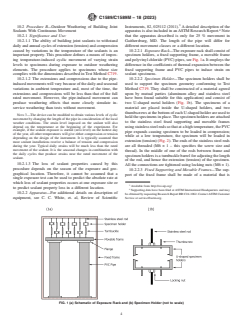
caused by variations in the temperature of the sealants is an 10.2.2.1 Exposure Rack—The exposure rack shall consist of
important property. This procedure defines a means of impos- specimen holders, a fixed supporting frame, a movable frame
ing temperature-induced cyclic movement of varying strain and polyvinyl chloride (PVC) pipes, see Fig. 1a. It employs the
levels to specimens during exposure to outdoor weathering difference in the coefficients of thermal expansion between the
elements. The procedure applies to specimens whose size fixed supporting frame and PVC pipes to induce strain on
complies with the dimensions described in Test Method C719. sealant specimens.
10.2.1.2 The extensions and compressions due to the pipe- 10.2.2.2 Specimen Holder—The specimen holders shall be
induced movements will vary because of the daily and seasonal used to support the specimen geometry conforming to Test
variations in ambient temperature and, most of the time, the Method C719. They shall be constructed of a material agreed
extensions and compressions will be less than that of the full upon by mutual parties (aluminum alloy and stainless steel
rated movement. However, the pipe-induced movement can have been found suitable for this application) and consist of
produce weathering effects that more closely simulate in- two U-shaped metal holders (Fig. 1b). The specimens of a
service weathering than tests without movement. material are placed inside the U-shaped holders, and two
thumbscrews at the bottom of each U-shaped holder are used to
NOTE 3—The device can be modified to obtain various levels of cyclic
hold the specimens in place. The specimen holders are attached
movement by changing the length of the pipe in consideration of the local
to the stainless steel fixed supporting and movable frames
weather conditions. The strain level imposed on the sealant will also
depend on the temperature at the beginning of the experiment. For
using stainless steel rods so that at a high temperature, the PVC
example, if the sealant exposure is started (zero level) on the hottest day
pipe expands causing specimen to be loaded in compression;
of the year, all other temperatures will give either compression or tension
while at a low temperature, the specimen will be loaded in
depending on the design of the instrument. It is typically assumed that
extension (tension) (Fig. 2). The ends of the stainless steel rods
most sealant installations receive a balance of tension and compression
are all threaded (M6 × 1 – this specifies the screw size and
during the year. Typical daily strains will be much less than the rated
movement of the sealant. It is the seasonal changes in combination with
thread). In the middle of one of the rods between frame and
the daily cycles that produce strains near the rated movement of the
specimen holders is a turnbuckle barrel for adjusting the length
sealant.
of the rod, and hence the extension (tension) of the specimen.
10.2.1.3 The loss of sealant properties caused by this
All the connections are tightened using locking nuts (M6 × 1).
procedure depends on the season of the exposure and geo-
10.2.2.3 Fixed Supporting and Movable Frames—The sup-
graphical location. Therefore, it cannot be assumed that a
port of the fixed frame shall be made of a material that is
single exposure test can be used to predict the absolute rate at
which loss of sealant properties occurs at one exposure site or
Available from http://rsi.aip.org/
to predict sealant property loss in a different location.
Supporting data have been filed at ASTM
...