

ASTM D4223/D4223M-20
(Practice)Standard Practices for Preparation of Test Specimens of Asphalt-Stabilized Soils
General Information
- Abstract
SIGNIFICANCE AND USE
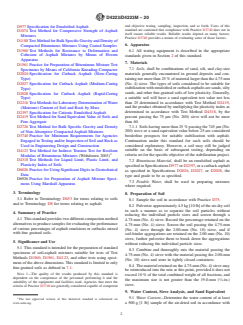
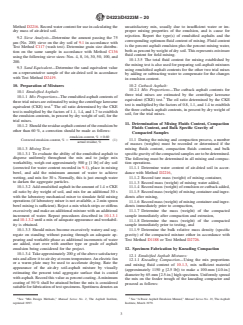
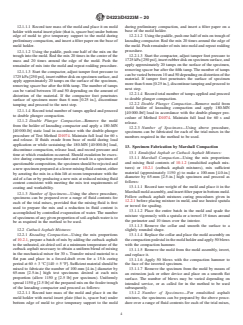
5.1 This standard is intended for the preparation of standard specimens of soil-asphalt mixtures suitable for tests of Test Methods D1560, D1561, D4123, and other tests using specimens of the above dimensions. This standard is limited to only fine-grained soils as defined in 7.1.
Note 1: The quality of the results produced by this standard is dependent on the competence of the personnel performing it and the suitability of the equipment and facilities used. Agencies that meet the criteria of Practice D3740 are generally considered capable of competent and objective testing, sampling, inspection, and so forth. Users of this standard are cautioned that compliance with Practice D3740 does not in itself ensure reliable results. Reliable results depend on many factors; Practice D3740 provides a means of evaluating some of those factors.
SCOPE
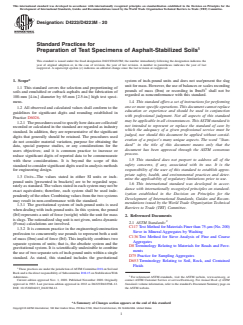
1.1 This standard covers the selection and proportioning of soils and emulsified or cutback asphalts and the fabrication of 100-mm [4-in.] diameter by 65-mm [2.5-in.] high test specimens.
1.2 All observed and calculated values shall conform to the guidelines for significant digits and rounding established in Practice D6026.
1.2.1 The procedures used to specify how data are collected/recorded or calculated in the standard are regarded as industry standard. In addition, they are representative of the significant digits that generally should be retained. The procedures used do not consider material variation, purpose for obtaining the data, special purpose studies, or any considerations for the users objectives; and it is common practice to increase or reduce significant digits of reported data to be commensurate with these considerations. It is beyond the scope of this standard to consider significant digits used in analysis methods for engineering design.
1.3 Units—The values stated in either SI units or inch-pound units [presented in brackets] are to be regarded separately as standard. The values stated in each system may not be exact equivalents; therefore, each system shall be used independently of the other. Combining values from the two systems may result in non-conformance with the standard.
1.3.1 The gravitational system of inch-pound units is used when dealing with inch-pound units. In this system, the pound (lbf) represents a unit of force (weight) while the unit for mass is slugs. The rationalized slug unit is not given, unless dynamic (F=ma) calculations are involved.
1.3.2 It is common practice in the engineering/construction profession to concurrently use pounds to represent both a unit of mass (lbm) and of force (lbf). This implicitly combines two separate systems of units; that is, the absolute system and the gravitational system. It is scientifically undesirable to combine the use of two separate sets of inch-pound units within a single standard. As stated, this standard includes the gravitational system of inch-pound units and does not use/present the slug unit for mass. However, the use of balances or scales recording pounds of mass (lbm) or recording in lbm/ft3 shall not be regarded as nonconformance with this standard.
1.4 This standard offers a set of instructions for performing one or more specific operations. This document cannot replace education or experience and should be used in conjunction with professional judgment. Not all aspects of this standard may be applicable in all circumstances. This ASTM standard is not intended to represent or replace the standard of care by which the adequacy of a given professional service must be judged, nor should this document be applied without consideration of a project's many unique aspects. The word “Standard” in the title of this document means only that the document has been approved through the ASTM consensus process.
1.5 This standard does not purport to address all of the safety concerns, if any, associated with its use. It is the responsibility of the user of this s...
- Status
- Published
- Publication Date
- 31-Oct-2020
- Technical Committee
- D18 - Soil and Rock
- Drafting Committee
- D18.15 - Stabilization With Admixtures
Buy Documents
ASTM D4223/D4223M-20 - Standard Practices for Preparation of Test Specimens of Asphalt-Stabilized Soils
REDLINE ASTM D4223/D4223M-20 - Standard Practices for Preparation of Test Specimens of Asphalt-Stabilized Soils
Overview
ASTM D4223/D4223M-20: Standard Practices for Preparation of Test Specimens of Asphalt-Stabilized Soils provides standardized procedures for preparing laboratory test specimens of soil-asphalt mixtures. Developed by ASTM International, this practice is designed specifically for fine-grained soils and is intended to support subsequent testing, including but not limited to tests such as ASTM D1560, D1561, and D4123. By following these practices, laboratories and engineers can ensure consistency, reliability, and repeatability when evaluating the performance of asphalt-stabilized soils.
Key Topics
- Soil Selection and Preparation: The standard details requirements for the selection of appropriate fine-grained soils, including specifications around particle size, composition, and suitability criteria such as sand equivalent values and plasticity index.
- Bituminous Materials: Guidance is provided for using both emulsified asphalts (per ASTM D977 or D2397) and cutback asphalts (per ASTM D2026, D2027, or D2028). These materials are combined with soils to produce stabilized mixtures for testing.
- Specimen Fabrication: The practice outlines two primary methods of compaction: kneading compaction and Marshall compaction. Instructions are provided for producing specimens with defined dimensions (100-mm [4-in.] diameter and 65-mm [2.5-in.] height) suitable for various performance tests.
- Data Recording and Reporting: The standard emphasizes careful measurement and documentation of mix constituents, compaction efforts, specimen dimensions, and other key properties in accordance with industry-standard practices for data significance and rounding (referring to ASTM D6026).
- Units and Measurement: All procedures can be performed using either SI or inch-pound units, but these systems should not be combined in a single process to ensure conformity with the standard.
Applications
ASTM D4223/D4223M-20 is widely used in:
- Geotechnical and Pavement Engineering: Preparing laboratory test specimens of asphalt-stabilized soils is crucial for mix design, quality control, and performance evaluation in road construction and maintenance.
- Research and Development: Laboratories and academic institutions rely on standard practices to ensure that results are comparable and repeatable across studies.
- Quality Assurance and Control: Construction and material testing agencies employ these practices to validate the suitability of soil-asphalt mixtures before field application.
- Product Evaluation: The standard supports testing of new or alternative soil and bituminous material combinations, allowing engineers to optimize mixture proportions for desired performance characteristics.
Related Standards
Several related ASTM standards complement the use of ASTM D4223/D4223M-20, including:
- ASTM D1560 & D1561: Methods for testing resistance to deformation and cohesion of asphalt mixtures.
- ASTM D4123: Method for indirect tension testing of bituminous mixtures.
- ASTM D977 & D2397: Specifications for emulsified asphalt.
- ASTM D2026, D2027, D2028: Specifications for cutback asphalt types.
- ASTM D2216: Test methods for soil moisture determination.
- ASTM D4318: Test methods for Atterberg limits (liquid and plastic limits, plasticity index).
- ASTM D6026: Guidelines for data significant digits and rounding in geotechnical data.
- ASTM D3740: Practice for evaluating agencies that test soils and rock for engineering design.
Practical Value
Adhering to ASTM D4223/D4223M-20 ensures that soil-asphalt specimens are prepared in a systematic, repeatable manner, thereby enhancing the accuracy of subsequent mechanical and performance testing. This in turn facilitates reliable selection and proportioning of soil and bituminous materials for infrastructure projects, ultimately supporting the longevity and safety of asphalt-stabilized roadways and other civil engineering works.
Keywords: asphalt stabilization, soil preparation, specimen fabrication, asphalt-stabilized soils, laboratory testing, fine-grained soils, ASTM standards, road construction quality control.
Relations
- Effective Date
- 15-Nov-2023
- Effective Date
- 01-Nov-2023
- Effective Date
- 01-Jan-2020
- Effective Date
- 01-Nov-2019
- Effective Date
- 01-Nov-2019
- Effective Date
- 01-Oct-2019
- Effective Date
- 01-Aug-2019
- Effective Date
- 01-May-2019
- Effective Date
- 01-Mar-2019
- Effective Date
- 15-Dec-2018
- Effective Date
- 15-Aug-2018
- Effective Date
- 01-Jul-2018
- Effective Date
- 01-Feb-2018
- Effective Date
- 15-Jul-2017
- Effective Date
- 15-Jun-2017
Buy Documents
ASTM D4223/D4223M-20 - Standard Practices for Preparation of Test Specimens of Asphalt-Stabilized Soils
REDLINE ASTM D4223/D4223M-20 - Standard Practices for Preparation of Test Specimens of Asphalt-Stabilized Soils
Get Certified
Connect with accredited certification bodies for this standard

Zavod za gradbeništvo Slovenije (ZAG) - Inšpekcija
ZAG inspection body for construction products, structures, and materials.
Sponsored listings
Frequently Asked Questions
ASTM D4223/D4223M-20 is a standard published by ASTM International. Its full title is "Standard Practices for Preparation of Test Specimens of Asphalt-Stabilized Soils". This standard covers: SIGNIFICANCE AND USE 5.1 This standard is intended for the preparation of standard specimens of soil-asphalt mixtures suitable for tests of Test Methods D1560, D1561, D4123, and other tests using specimens of the above dimensions. This standard is limited to only fine-grained soils as defined in 7.1. Note 1: The quality of the results produced by this standard is dependent on the competence of the personnel performing it and the suitability of the equipment and facilities used. Agencies that meet the criteria of Practice D3740 are generally considered capable of competent and objective testing, sampling, inspection, and so forth. Users of this standard are cautioned that compliance with Practice D3740 does not in itself ensure reliable results. Reliable results depend on many factors; Practice D3740 provides a means of evaluating some of those factors. SCOPE 1.1 This standard covers the selection and proportioning of soils and emulsified or cutback asphalts and the fabrication of 100-mm [4-in.] diameter by 65-mm [2.5-in.] high test specimens. 1.2 All observed and calculated values shall conform to the guidelines for significant digits and rounding established in Practice D6026. 1.2.1 The procedures used to specify how data are collected/recorded or calculated in the standard are regarded as industry standard. In addition, they are representative of the significant digits that generally should be retained. The procedures used do not consider material variation, purpose for obtaining the data, special purpose studies, or any considerations for the users objectives; and it is common practice to increase or reduce significant digits of reported data to be commensurate with these considerations. It is beyond the scope of this standard to consider significant digits used in analysis methods for engineering design. 1.3 Units—The values stated in either SI units or inch-pound units [presented in brackets] are to be regarded separately as standard. The values stated in each system may not be exact equivalents; therefore, each system shall be used independently of the other. Combining values from the two systems may result in non-conformance with the standard. 1.3.1 The gravitational system of inch-pound units is used when dealing with inch-pound units. In this system, the pound (lbf) represents a unit of force (weight) while the unit for mass is slugs. The rationalized slug unit is not given, unless dynamic (F=ma) calculations are involved. 1.3.2 It is common practice in the engineering/construction profession to concurrently use pounds to represent both a unit of mass (lbm) and of force (lbf). This implicitly combines two separate systems of units; that is, the absolute system and the gravitational system. It is scientifically undesirable to combine the use of two separate sets of inch-pound units within a single standard. As stated, this standard includes the gravitational system of inch-pound units and does not use/present the slug unit for mass. However, the use of balances or scales recording pounds of mass (lbm) or recording in lbm/ft3 shall not be regarded as nonconformance with this standard. 1.4 This standard offers a set of instructions for performing one or more specific operations. This document cannot replace education or experience and should be used in conjunction with professional judgment. Not all aspects of this standard may be applicable in all circumstances. This ASTM standard is not intended to represent or replace the standard of care by which the adequacy of a given professional service must be judged, nor should this document be applied without consideration of a project's many unique aspects. The word “Standard” in the title of this document means only that the document has been approved through the ASTM consensus process. 1.5 This standard does not purport to address all of the safety concerns, if any, associated with its use. It is the responsibility of the user of this s...
SIGNIFICANCE AND USE 5.1 This standard is intended for the preparation of standard specimens of soil-asphalt mixtures suitable for tests of Test Methods D1560, D1561, D4123, and other tests using specimens of the above dimensions. This standard is limited to only fine-grained soils as defined in 7.1. Note 1: The quality of the results produced by this standard is dependent on the competence of the personnel performing it and the suitability of the equipment and facilities used. Agencies that meet the criteria of Practice D3740 are generally considered capable of competent and objective testing, sampling, inspection, and so forth. Users of this standard are cautioned that compliance with Practice D3740 does not in itself ensure reliable results. Reliable results depend on many factors; Practice D3740 provides a means of evaluating some of those factors. SCOPE 1.1 This standard covers the selection and proportioning of soils and emulsified or cutback asphalts and the fabrication of 100-mm [4-in.] diameter by 65-mm [2.5-in.] high test specimens. 1.2 All observed and calculated values shall conform to the guidelines for significant digits and rounding established in Practice D6026. 1.2.1 The procedures used to specify how data are collected/recorded or calculated in the standard are regarded as industry standard. In addition, they are representative of the significant digits that generally should be retained. The procedures used do not consider material variation, purpose for obtaining the data, special purpose studies, or any considerations for the users objectives; and it is common practice to increase or reduce significant digits of reported data to be commensurate with these considerations. It is beyond the scope of this standard to consider significant digits used in analysis methods for engineering design. 1.3 Units—The values stated in either SI units or inch-pound units [presented in brackets] are to be regarded separately as standard. The values stated in each system may not be exact equivalents; therefore, each system shall be used independently of the other. Combining values from the two systems may result in non-conformance with the standard. 1.3.1 The gravitational system of inch-pound units is used when dealing with inch-pound units. In this system, the pound (lbf) represents a unit of force (weight) while the unit for mass is slugs. The rationalized slug unit is not given, unless dynamic (F=ma) calculations are involved. 1.3.2 It is common practice in the engineering/construction profession to concurrently use pounds to represent both a unit of mass (lbm) and of force (lbf). This implicitly combines two separate systems of units; that is, the absolute system and the gravitational system. It is scientifically undesirable to combine the use of two separate sets of inch-pound units within a single standard. As stated, this standard includes the gravitational system of inch-pound units and does not use/present the slug unit for mass. However, the use of balances or scales recording pounds of mass (lbm) or recording in lbm/ft3 shall not be regarded as nonconformance with this standard. 1.4 This standard offers a set of instructions for performing one or more specific operations. This document cannot replace education or experience and should be used in conjunction with professional judgment. Not all aspects of this standard may be applicable in all circumstances. This ASTM standard is not intended to represent or replace the standard of care by which the adequacy of a given professional service must be judged, nor should this document be applied without consideration of a project's many unique aspects. The word “Standard” in the title of this document means only that the document has been approved through the ASTM consensus process. 1.5 This standard does not purport to address all of the safety concerns, if any, associated with its use. It is the responsibility of the user of this s...
ASTM D4223/D4223M-20 is classified under the following ICS (International Classification for Standards) categories: 93.020 - Earthworks. Excavations. Foundation construction. Underground works. The ICS classification helps identify the subject area and facilitates finding related standards.
ASTM D4223/D4223M-20 has the following relationships with other standards: It is inter standard links to ASTM C117-23, ASTM D3740-23, ASTM D6926-20, ASTM D977-19ae1, ASTM D977-19a, ASTM D3740-19, ASTM D8-19, ASTM D977-19, ASTM D2216-19, ASTM D8-18c, ASTM D8-18b, ASTM D8-18a, ASTM D8-18, ASTM D8-17c, ASTM D8-17b. Understanding these relationships helps ensure you are using the most current and applicable version of the standard.
ASTM D4223/D4223M-20 is available in PDF format for immediate download after purchase. The document can be added to your cart and obtained through the secure checkout process. Digital delivery ensures instant access to the complete standard document.
Standards Content (Sample)
This international standard was developed in accordance with internationally recognized principles on standardization established in the Decision on Principles for the
Development of International Standards, Guides and Recommendations issued by the World Trade Organization Technical Barriers to Trade (TBT) Committee.
Designation: D4223/D4223M − 20
Standard Practices for
Preparation of Test Specimens of Asphalt-Stabilized Soils
This standard is issued under the fixed designation D4223/D4223M; the number immediately following the designation indicates the
year of original adoption or, in the case of revision, the year of last revision. A number in parentheses indicates the year of last
reapproval. A superscript epsilon (´) indicates an editorial change since the last revision or reapproval.
1. Scope* system of inch-pound units and does not use/present the slug
unitformass.However,theuseofbalancesorscalesrecording
1.1 This standard covers the selection and proportioning of
pounds of mass (lbm) or recording in lbm/ft shall not be
soils and emulsified or cutback asphalts and the fabrication of
regarded as nonconformance with this standard.
100-mm [4-in.] diameter by 65-mm [2.5-in.] high test speci-
mens. 1.4 This standard offers a set of instructions for performing
one or more specific operations. This document cannot replace
1.2 All observed and calculated values shall conform to the
education or experience and should be used in conjunction
guidelines for significant digits and rounding established in
with professional judgment. Not all aspects of this standard
Practice D6026.
may be applicable in all circumstances. This ASTM standard is
1.2.1 Theproceduresusedtospecifyhowdataarecollected/
not intended to represent or replace the standard of care by
recorded or calculated in the standard are regarded as industry
which the adequacy of a given professional service must be
standard. In addition, they are representative of the significant
judged, nor should this document be applied without consid-
digits that generally should be retained. The procedures used
eration of a project’s many unique aspects. The word “Stan-
do not consider material variation, purpose for obtaining the
dard” in the title of this document means only that the
data, special purpose studies, or any considerations for the
document has been approved through the ASTM consensus
users objectives; and it is common practice to increase or
process.
reduce significant digits of reported data to be commensurate
1.5 This standard does not purport to address all of the
with these considerations. It is beyond the scope of this
safety concerns, if any, associated with its use. It is the
standardtoconsidersignificantdigitsusedinanalysismethods
responsibility of the user of this standard to establish appro-
for engineering design.
priate safety, health, and environmental practices and deter-
1.3 Units—The values stated in either SI units or inch-
mine the applicability of regulatory limitations prior to use.
pound units [presented in brackets] are to be regarded sepa-
1.6 This international standard was developed in accor-
ratelyasstandard.Thevaluesstatedineachsystemmaynotbe
dance with internationally recognized principles on standard-
exact equivalents; therefore, each system shall be used inde-
ization established in the Decision on Principles for the
pendentlyoftheother.Combiningvaluesfromthetwosystems
Development of International Standards, Guides and Recom-
may result in non-conformance with the standard.
mendations issued by the World Trade Organization Technical
1.3.1 The gravitational system of inch-pound units is used
Barriers to Trade (TBT) Committee.
when dealing with inch-pound units. In this system, the pound
(lbf) represents a unit of force (weight) while the unit for mass
2. Referenced Documents
isslugs.Therationalizedslugunitisnotgiven,unlessdynamic
2.1 ASTM Standards:
(F=ma) calculations are involved.
C117Test Method for Materials Finer than 75-µm (No. 200)
1.3.2 It is common practice in the engineering/construction
Sieve in Mineral Aggregates by Washing
profession to concurrently use pounds to represent both a unit
C136Test Method for Sieve Analysis of Fine and Coarse
of mass (lbm) and of force (lbf). This implicitly combines two
Aggregates
separate systems of units; that is, the absolute system and the
D8Terminology Relating to Materials for Roads and Pave-
gravitational system. It is scientifically undesirable to combine
ments
theuseoftwoseparatesetsofinch-poundunitswithinasingle
D75Practice for Sampling Aggregates
standard. As stated, this standard includes the gravitational
D653Terminology Relating to Soil, Rock, and Contained
Fluids
ThesepracticesareunderthejurisdictionofASTMCommitteeD18onSoiland
Rock and is the direct responsibility of Subcommittee D18.15 on StabilizationWith
Admixtures. For referenced ASTM standards, visit the ASTM website, www.astm.org, or
Current edition approved Nov. 1, 2020. Published November 2020. Originally contact ASTM Customer Service at service@astm.org. For Annual Book of ASTM
approved in 1983. Last previous edition approved in 2012 as D4223/D4223M–12. Standards volume information, refer to the standard’s Document Summary page on
DOI: 10.1520/D4223_D4223M-12. the ASTM website.
*A Summary of Changes section appears at the end of this standard
Copyright © ASTM International, 100 Barr Harbor Drive, PO Box C700, West Conshohocken, PA 19428-2959. United States
D4223/D4223M − 20
and objective testing, sampling, inspection, and so forth. Users of this
D977Specification for Emulsified Asphalt
standard are cautioned that compliance with Practice D3740 does not in
D1074Test Method for Compressive Strength of Asphalt
itself ensure reliable results. Reliable results depend on many factors;
Mixtures
Practice D3740 provides a means of evaluating some of those factors.
D1188TestMethodforBulkSpecificGravityandDensityof
6. Apparatus
Compacted Bituminous Mixtures Using Coated Samples
D1560Test Methods for Resistance to Deformation and
6.1 All testing equipment is described in the appropriate
Cohesion of Asphalt Mixtures by Means of Hveem
standards given in Section 2 of this standard.
Apparatus
7. Materials
D1561Practice for Preparation of Bituminous Mixture Test
7.1 Soils, shall be combinations of sand, silt, and clay-size
Specimens by Means of California Kneading Compactor
materials generally encountered in ground deposits and con-
D2026 Specification for Cutback Asphalt (Slow-Curing
tainingnotmorethan25%ofmateriallargerthanthe4.75mm
Type)
(No. 4) sieve. The types of soils considered to be suitable for
D2027Specification for Cutback Asphalt (Medium-Curing
stabilizationwithemulsifiedorcutbackasphaltsaresands,silty
Type)
sands, and other fine-grained soils of low plasticity. Generally,
D2028Specification for Cutback Asphalt (Rapid-Curing
a suitable soil will have a sand equivalent test value not less
Type)
than 25 determined in accordance with Test Method D2419,
D2216Test Methods for Laboratory Determination ofWater
and the product obtained by multiplying the plasticity index as
(Moisture) Content of Soil and Rock by Mass
determined in accordance with Test Method D4318,bythe
D2397Specification for Cationic Emulsified Asphalt
percent passing the 75 µm (No. 200) sieve will not be more
D2419Test Method for Sand Equivalent Value of Soils and
than 60.
Fine Aggregate
7.1.1 Soils having more than 25% passing the 745 µm (No.
D2726Test Method for Bulk Specific Gravity and Density
200) sieve or a sand equivalent value below 25 are considered
of Non-Absorptive Compacted Asphalt Mixtures
borderline prospects for suitable stabilization with asphalt.
D3740Practice for Minimum Requirements for Agencies
Continuation under this standard for such soils should be
Engaged in Testing and/or Inspection of Soil and Rock as
considered exploratory. However, a soil may still be judged
Used in Engineering Design and Construction
suitable on the basis of subsequent testing, depending on
D4123Test Method for Indirect Tension Test for Resilient
criteriasetforthespecificobjectiveofthestabilizationproject.
Modulus of Bituminous Mixtures (Withdrawn 2003)
D4318Test Methods for Liquid Limit, Plastic Limit, and
7.2 Bituminous Material, shall be an emulsified asphalt as
Plasticity Index of Soils
specifiedinSpecificationsD977orD2397,oracutbackasphalt
D6026Practice for Using Significant Digits in Geotechnical
as specified in Specifications D2026, D2027,or D2028, the
Data
type and grade to be as specified.
D6926Practice for Preparation of Asphalt Mixture Speci-
7.3 Potable Water, shall be used in preparing mixtures
mens Using Marshall Apparatus
where required.
3. Terminology
8. Preparation of Soil
3.1 Refer to Terminology D653 for terms relating to soils
8.1 Sample the soil in accordance with Practice D75.
and to Terminology D8 for terms relating to asphalt.
8.2 Pulverizeapproximately4.5kg[10lb]oftheair-drysoil
in such a manner as to separate the soil particles without
4. Summary of Practice
reducing the individual particle sizes and screen through a
4.1 Thisstandardprovidestwodifferentcompactionmethod
4.75-mm (No. 4) sieve. Record the percentage retained on the
alternativestoproducesamplesforevaluatingtheperformance
4.75-mm (No. 4) sieve. Screen the soil passing the 4.75-mm
of various percentages of asphalt emulsions or cutbacks mixed
(No. 4) sieve through the 2.00-mm (No. 10) sieve, and if
with fine grained soils.
soil-binder aggregations are retained on the 2.00-mm (No. 10)
sieve, further pulverize them to break down the aggregations
5. Significance and Use
without reducing the individual particle sizes.
5.1 This standard is intended for the preparation of standard
8.3 Combine and thoroughly mix the material passing the
specimens of soil-asphalt mixtures suitable for tests of Test
4.75-mm (No. 4) sieve with the material passing the 2.00-mm
Methods D1560, D1561, D4123, and other tests using speci-
(No. 10) sieve and store in tightly closed containers.
mens of the above dimensions.This standard is limited to only
8.4 Thematerialretainedonthe4.75-mm(No.4)sievemay
fine-grained soils as defined in 7.1.
be reintroduced into the mix at this point, provided it does not
NOTE 1—The quality of the results produced by this standard is
exceed 10% of the total combined weight of all fractions, and
dependent on the competence of the personnel performing it and the
the maximum size is not greater than the 19.0-mm ( ⁄4-in.)
suitability of the equipment and facilities used. Agencies that meet the
sieve.
criteria of Practice D3740 are generally considered capable of competent
9. Water Content, Sieve Analysis, and Sand Equivalent
9.1 Water Content—Determine the water content of at least
The last approved version of this historical standard is referenced on
www.astm.org. a 500-g [1 lb] sample of the air-dried soil in accordance with
D4223/D4223M − 20
MethodD2216.Recordwatercontentforuseincalculatingthe unsatisfactory mix, usually due to insufficient water or im-
dry mass of air-dried soil. proper mixing properties of the emulsion, and is cause for
rejection. Report the type(s) of emulsified asphalts and the
9.2 Sieve Analysis—Determine the amount passing the 75
corresponding optimum fluid content of mixing. Fluid content
µm (No. 200) sieve on the dry soil of 9.1 in accordance with
is the percent asphalt emulsion plus the percent mixing water,
Test Method C117 (wash test). Determine grain size distribu-
bothaspercentbyweightofdrysoil.Thisrepresents minimum
tion on the same sample in accordance with Method C136
fluid content for field mixing.
using the following sieve sizes: Nos. 4, 8, 16, 30, 50, 100, and
10.1.3.5 The total fluid content for mixing established by
200.
the mixing test is also used for preparing soil-asphalt mixtures
9.3 Sand Equivalent—Determine the sand equivalent value
using emulsified asphalt contents for the other two trial mixes
on a representative sample of the air-dried soil in accordance
by adding or subtracting water to compensate for the changes
with Test Method D2419.
in emulsion content.
10.2 Cutback Asphalt:
10. Preparation of Mixtures
10.2.1 Mix Proportions—The cutback asphalt contents for
10.1 Emulsified Asphalt:
three trial mixes are estimated by the centrifuge kerosene
10.1.1 Mix Proportions—The emulsified asphalt contents of
equivalent (CKE) test. The oil ratio determined by the CKE
threetrialmixesareestimatedbyusingthecentrifugekerosene
test is multiplied by the factors of 0.8, 1.1, and 1.4 to establish
equivalent (CKE) test. The oil ratio determined by the CKE
the three cutback asphalt contents, in percent by dry weight of
test is multiplied by the factors of 1.1, 1.4, and 1.7 to establish
soil, for the trial mixes.
the emulsion contents, in percent by dry weight of soil, for the
trial mixes.
11. Determination of Mixing Fluids Content, Compaction
10.1.2 Shouldtheresidueasphaltcontentoftheemulsionbe
Fluids Content, and Bulk Specific Gravity of
other than 60%, a correction should be made as follows:
Compacted Samples
emulsioncontent,% 30.60
Correctedemulsioncontent,% 5 (1) 11.1 During the mixing and compaction process, a number
actualresidue,%
of masses (weights) must be recorded or determined if the
10.1.3 Mixing Test:
mixing
...
This document is not an ASTM standard and is intended only to provide the user of an ASTM standard an indication of what changes have been made to the previous version. Because
it may not be technically possible to adequately depict all changes accurately, ASTM recommends that users consult prior editions as appropriate. In all cases only the current version
of the standard as published by ASTM is to be considered the official document.
Designation: D4223/D4223M − 12 D4223/D4223M − 20
Standard PracticePractices for
Preparation of Test Specimens of Asphalt-Stabilized Soils
This standard is issued under the fixed designation D4223/D4223M; the number immediately following the designation indicates the
year of original adoption or, in the case of revision, the year of last revision. A number in parentheses indicates the year of last
reapproval. A superscript epsilon (´) indicates an editorial change since the last revision or reapproval.
1. Scope*
1.1 This practicestandard covers the selection and proportioning of soils and emulsified or cutback asphalts and the fabrication of
100-mm [4-in.] diameter by 65-mm [2.5-in.] high test specimens.
1.2 All observed and calculated values shall conform to the guidelines for significant digits and rounding established in Practice
D6026.
1.2.1 The procedures used to specify how data are collected/recorded or calculated in the standard are regarded as industry
standard. In addition, they are representative of the significant digits that generally should be retained. The procedures used do not
consider material variation, purpose for obtaining the data, special purpose studies, or any considerations for the users objectives;
and it is common practice to increase or reduce significant digits of reported data to be commensurate with these considerations.
It is beyond the scope of this standard to consider significant digits used in analysis methods for engineering design.
1.3 Units—The values stated in either SI units or inch-pound units [presented in brackets] are to be regarded separately as
standard. The values stated in each system may not be exact equivalents; therefore, each system shall be used independently of
the other. Combining values from the two systems may result in non-conformance with the standard.
1.3.1 The gravitational system of inch-pound units is used when dealing with inch-pound units. In this system, the pound (lbf)
represents a unit of force (weight) while the unit for mass is slugs. The rationalized slug unit is not given, unless dynamic (F=ma)
calculations are involved.
1.3.2 It is common practice in the engineering/construction profession to concurrently use pounds to represent both a unit of mass
(lbm) and of force (lbf). This implicitly combines two separate systems of units; that is, the absolute system and the gravitational
system. It is scientifically undesirable to combine the use of two separate sets of inch-pound units within a single standard. As
stated, this standard includes the gravitational system of inch-pound units and does not use/present the slug unit for mass. However,
the use of balances or scales recording pounds of mass (lbm) or recording in lbm/ft shall not be regarded as nonconformance with
this standard.
1.4 This practicestandard offers a set of instructions for performing one or more specific operations. This document cannot replace
education or experience and should be used in conjunction with professional judgment. Not all aspects of this practicestandard
may be applicable in all circumstances. This ASTM standard is not intended to represent or replace the standard of care by which
the adequacy of a given professional service must be judged, nor should this document be applied without consideration of a
project’s many unique aspects. The word “Standard” in the title of this document means only that the document has been approved
through the ASTM consensus process.
This practice isThese practices are under the jurisdiction of ASTM Committee D18 on Soil and Rock and is the direct responsibility of Subcommittee D18.15 on
Stabilization With Admixtures.
Current edition approved Jan. 1, 2012Nov. 1, 2020. Published February 2012November 2020. Originally approved in 1983. Last previous edition approved in 20062012
as D4223–99(2006).D4223/D4223M–12. DOI: 10.1520/D4223_D4223M-12.
*A Summary of Changes section appears at the end of this standard
Copyright © ASTM International, 100 Barr Harbor Drive, PO Box C700, West Conshohocken, PA 19428-2959. United States
D4223/D4223M − 20
1.5 This standard does not purport to address all of the safety concerns, if any, associated with its use. It is the responsibility
of the user of this standard to establish appropriate safety safety, health, and healthenvironmental practices and determine the
applicability of regulatory limitations prior to use.
1.6 This international standard was developed in accordance with internationally recognized principles on standardization
established in the Decision on Principles for the Development of International Standards, Guides and Recommendations issued
by the World Trade Organization Technical Barriers to Trade (TBT) Committee.
2. Referenced Documents
2.1 ASTM Standards:
C117 Test Method for Materials Finer than 75-μm (No. 200) Sieve in Mineral Aggregates by Washing
C136 Test Method for Sieve Analysis of Fine and Coarse Aggregates
D8 Terminology Relating to Materials for Roads and Pavements
D75 Practice for Sampling Aggregates
D653 Terminology Relating to Soil, Rock, and Contained Fluids
D977 Specification for Emulsified Asphalt
D1074 Test Method for Compressive Strength of Asphalt Mixtures
D1188 Test Method for Bulk Specific Gravity and Density of Compacted Bituminous Mixtures Using Coated Samples
D1559 Test Method for Resistance to Plastic Flow of Bituminous Mixtures Using Marshall Apparatus (Withdrawn 1998)
D1560 Test Methods for Resistance to Deformation and Cohesion of Asphalt Mixtures by Means of Hveem Apparatus
D1561 Practice for Preparation of Bituminous Mixture Test Specimens by Means of California Kneading Compactor
D2026 Specification for Cutback Asphalt (Slow-Curing Type)
D2027 Specification for Cutback Asphalt (Medium-Curing Type)
D2028 Specification for Cutback Asphalt (Rapid-Curing Type)
D2216 Test Methods for Laboratory Determination of Water (Moisture) Content of Soil and Rock by Mass
D2397 Specification for Cationic Emulsified Asphalt
D2419 Test Method for Sand Equivalent Value of Soils and Fine Aggregate
D2726 Test Method for Bulk Specific Gravity and Density of Non-Absorptive Compacted Asphalt Mixtures
D3740 Practice for Minimum Requirements for Agencies Engaged in Testing and/or Inspection of Soil and Rock as Used in
Engineering Design and Construction
D4123 Test Method for Indirect Tension Test for Resilient Modulus of Bituminous Mixtures (Withdrawn 2003)
D4318 Test Methods for Liquid Limit, Plastic Limit, and Plasticity Index of Soils
D6026 Practice for Using Significant Digits in Geotechnical Data
D6926 Practice for Preparation of Asphalt Mixture Specimens Using Marshall Apparatus
3. Terminology
3.1 Refer to Terminology D653 for terms relating to soils and to Terminology D8 for terms relating to asphalt.
4. Summary of Practice
4.1 This standard provides two different compaction method alternatives to produce samples for evaluating the performance of
various percentages of asphalt emulsions or cutbacks mixed with fine grained soils.
5. Significance and Use
5.1 This practicestandard is intended for the preparation of standard specimens of soil-asphalt mixtures suitable for tests of Test
Methods D1559, D1560, D1561, D4123, and other tests using specimens of the above dimensions. This practicestandard is limited
to only fine-grained soils as defined in 6.17.1.
NOTE 1—The quality of the results produced by this practicestandard is dependent on the competence of the personnel performing it and the suitability
of the equipment and facilities used. Agencies that meet the criteria of Practice D3740 are generally considered capable of competent and objective testing,
sampling, inspection, and so forth. Users of this practicestandard are cautioned that compliance with Practice D3740 does not in itself ensure reliable
results. Reliable results depend on many factors; Practice D3740 provides a means of evaluating some of those factors.
For referenced ASTM standards, visit the ASTM website, www.astm.org, or contact ASTM Customer Service at service@astm.org. For Annual Book of ASTM Standards
volume information, refer to the standard’s Document Summary page on the ASTM website.
The last approved version of this historical standard is referenced on www.astm.org.
D4223/D4223M − 20
4. Terminology
4.1 Refer to Terminology D653 for terms relating to soils and to Terminology D8 for terms relating to asphalt.
6. Apparatus
6.1 All testing equipment is described in the appropriate standards given in Section 2 of this practice.standard.
7. Materials
7.1 Soils, shall be combinations of sand, silt, and clay-size materials generally encountered in ground deposits and containing not
more than 25 % of material larger than the 4.75 mm (No. 4) sieve. The types of soils considered to be suitable for stabilization
with emulsified or cutback asphalts are sands, silty sands, and other fine-grained soils of low plasticity. Generally, a suitable soil
will have a sand equivalent test value not less than 25 determined in accordance with Test Method D2419, and the product obtained
by mutiplyingmultiplying the plasticity index as determined in accordance with Test Method D4318, by the percent passing the
75 μm (No. 200) sieve will not be more than 60.
7.1.1 Soils having more than 25 % passing the 745 μm (No. 200) sieve or a sand equivalent value below 25 are considered
borderline prospects for suitable stabilization with asphalt. Continuation under this practicestandard for such soils should be
considered exploratory. However, a soil may still be judged suitable on the basis of subsequent testing, depending on criteria set
for the specific objective of the stabilization project.
7.2 Bituminous Material, shall be an emulsified asphalt as specified in Specifications D977 or D2397, or a cutback asphalt as
specified in Specifications D2026, D2027, or D2028, the type and grade to be as specified.
7.3 Potable Water, shall be used in preparing mixtures where required.
8. Preparation of Soil
8.1 Sample the soil in accordance with Practice D75.
8.2 Pulverize approximately 4.5 kg [10 lb] of the air-dry soil in such a manner as to separate the soil particles without reducing
the individual particle sizes and screen through a 4.75-mm (No. 4) sieve. Record the percentage retained on the 4.75-mm (No. 4)
sieve. Screen the soil passing the 4.75-mm (No. 4) sieve through the 2.00-mm (No. 10) sieve, and if soil-binder aggregations are
retained on the 2.00-mm (No. 10) sieve, further pulverize them to break down the aggregations without reducing the individual
particle sizes.
8.3 Combine and thoroughly mix the material passing the 4.75-mm (No. 4) sieve with the material passing the 2.00-mm (No. 10)
sieve and store in tightly closed containers.
8.4 The material retained on the 4.75-mm (No. 4) sieve may be reintroduced into the mix at this point, provided it does not exceed
10 % of the total combined weight of all fractions, and the maximum size is not greater than the 19.0-mm ( ⁄4-in.) sieve.
9. Water Content, Sieve Analysis, and Sand Equivalent
9.1 Water Content—Determine the water content of at least a 500-g [1 lb] sample of the air-dried soil in accordance with Method
D2216. Record water content for use in calculating the dry mass of air-dried soil.
9.2 Sieve Analysis—Determine the amount passing the 75 μm (No. 200) sieve on the dry soil of 8.19.1 in accordance with Test
Method C117 (wash test). Determine grain size distribution on the same sample in accordance with Method C136 using the
following sieve sizes: Nos. 4, 8, 16, 30, 50, 100, and 200.
9.3 Sand Equivalent—Determine the sand equivalent value on a representative sample of the air-dried soil in accordance with Test
Method D2419.
D4223/D4223M − 20
10. Preparation of Mixtures
10.1 Emulsified Asphalt:
10.1.1 Mix Proportions—The emulsified asphalt contents of three trial mixes are estimated by using the centrifuge kerosene
equivalent (CKE) test. The oil ratio determined by the CKE test is multiplied by the factors of 1.1, 1.4, and 1.7 to establish the
emulsion contents, in percent by dry weight of soil, for the trial mixes.
10.1.2 Should the residue asphalt content of the emulsion be other than 60 %, a correction should be made as follows:
emulsion content,%30.60
Corrected emulsion content,%5 (1)
actual residue,%
10.1.3 Mixing Test:
10.1.3.1 To evaluate the ability of the emulsified asphalt to disperse uniformly throughout the mix and to judge mix workability,
weigh out approximately 500 g [1 lb] of dry soil (corrected for water content recorded in 8.19.1), place in mixing bowl, and add
the minimum amount of water to achieve wetting, and mix for 30 s. Normally, this is just enough water to darken the aggregate
particles.
10.1.3.2 Add emulsified asphalt in the amount of 1.4 × CKE oil ratio by dry weight of soil, and mix for an additional 30 s with
the laboratory mechanical mixer to simulate field mixing operations (if laboratory mixer is not available, a 2-min spoon bowl
mixing is sufficient). Reject a mix which strips or stiffens excessively and make an additional mixture with an additional increment
of water. Repeat procedures described in 9.1.3.110.1.3.1 and 9.1.3.210.1.3.2 until a mix of adequate appearance and workability
is obtained.
10.1.3.3 Should mixes become excessively watery and segregate on standing without passing through an adequate appearing and
workable phase as additional increments of water are added, start over with another type or grade of asphalt emulsion being
considered for the project.
10.1.3.4 Take approximately
...