

ASTM D4165-06(2020)e1
(Test Method)Standard Test Method for Cyanogen Chloride in Water
General Information
- Abstract
SIGNIFICANCE AND USE
5.1 The presence of cyanogen chloride in chlorinated sanitary and industrial effluents and therefore receiving waters is of concern because of its toxicity to aquatic life.
5.2 This test method provides an analytical procedure for measuring cyanogen chloride in water.
5.3 This test method is applicable for clean metal finishing and chlorinated sanitary and industrial effluents, and also can be used to establish process control of cyanide destruction by chlorination in waste water treatment facilities.
SCOPE
1.1 This test method covers the determination of cyanogen chloride in water. Cyanogen chloride is normally present only at very low concentrations; it is a very labile and sparsely soluble gaseous compound. Water samples may contain cyanogen chloride after the chlorination of waste waters containing cyanide or thiocyanate compounds.
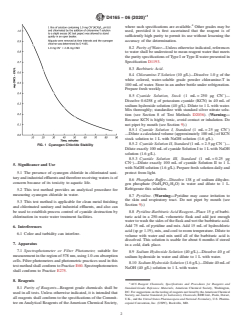
1.2 Cyanogen chloride is unstable. A quick test using a spot plate or comparator as soon as the sample is collected may be the best test, reducing the loss of cyanogen chloride during the time lapse between sampling and analysis. (See Fig. 1 for a typical decay curve for cyanogen chloride in a solution.)
FIG. 1 Cyanogen Chloride Stability
1.3 This test method has been used successfully with reagent water. The analyst is responsible for determining whether the test method is applicable to the water matrix being tested. Reference is made to Test Method D of Test Methods D2036 which is based on similar chemical reactions and has been evaluated by collaborative testing in this matrix.
1.4 The lower limit of detectability is 0.005 mg CN −/L.
1.5 The values stated in SI units are to be regarded as standard. No other units of measurement are included in this standard.
1.6 This standard does not purport to address all of the safety concerns, if any, associated with its use. It is the responsibility of the user of this standard to establish appropriate safety, health, and environmental practices and determine the applicability of regulatory limitations prior to use. Specific hazard statements are given in 8.5 and 8.7 and Section 9.
1.7 This international standard was developed in accordance with internationally recognized principles on standardization established in the Decision on Principles for the Development of International Standards, Guides and Recommendations issued by the World Trade Organization Technical Barriers to Trade (TBT) Committee.
- Status
- Published
- Publication Date
- 31-Dec-2019
- Technical Committee
- D19 - Water
- Drafting Committee
- D19.06 - Methods for Analysis for Organic Substances in Water

Overview
ASTM D4165-06(2020)e1 is an international standard developed by ASTM International, specifying the analytical method for determining cyanogen chloride in water. Cyanogen chloride is a labile, volatile, and sparsely soluble compound, often found at low concentrations in water following chlorination processes, especially when cyanide or thiocyanate compounds are present. Its detection and measurement are critical due to its high toxicity to aquatic life and potential human health concerns.
This test method provides laboratories, wastewater treatment operators, industrial facilities, and regulatory bodies with a reliable procedure to quantify cyanogen chloride, thereby supporting effective environmental monitoring and process control.
Key Topics
Scope and Applicability:
- Applies to the detection of cyanogen chloride in clean metal finishing, sanitary, and industrial water effluents
- Suitable for water matrices such as reagent water, with the responsibility on the analyst to verify suitability for other types
Analytical Method:
- Involves mixing the water sample with a pyridine-barbituric acid reagent, followed by spectrophotometric measurement at 578 nm
- Achieves a lower detection limit of 0.005 mg CN⁻/L
Sample Handling and Stability:
- Cyanogen chloride's instability requires immediate analysis after sampling to minimize loss; rapid spot tests are recommended at collection sites
- Preservation methods involve careful pH adjustment and cooling
Precision and Quality Control:
- The method demonstrates good single-operator precision using reagent water
- Ongoing quality assurance is required, including daily use of standards and duplicate analyses due to analyte instability
Safety and Environmental Practices:
- Handling of cyanogen chloride and associated reagents (e.g., potassium cyanide, pyridine) demands strict adherence to laboratory safety and disposal protocols
- The standard highlights the importance of compliance with local and international safety regulations
Applications
Wastewater and Effluent Monitoring:
- Essential for post-chlorination monitoring in wastewater treatment plants, particularly those employing cyanide destruction processes
- Supports regulatory compliance by measuring cyanogen chloride levels in discharge waters
Process Control:
- Assists industrial facilities, especially in metal finishing and chemical manufacturing, in monitoring and optimizing their treatment systems to limit toxic discharges
Environmental Protection:
- Facilitates the protection of aquatic ecosystems by providing reliable data on cyanogen chloride concentrations in receiving water bodies
- Useful for environmental agencies and researchers studying the fate and transport of chlorinated by-products in water
Related Standards
- ASTM D1129 – Terminology Relating to Water
- ASTM D1193 – Specification for Reagent Water
- ASTM D2036 – Test Methods for Cyanides in Water
- ASTM D3370 – Practices for Sampling Water from Flowing Process Streams
- ASTM D3856 – Guide for Management Systems in Laboratories Engaged in Analysis of Water
- ASTM D4210 – Practice for Intralaboratory Quality Control Procedures
- ASTM D5847 – Practice for Writing Quality Control Specifications for Water Analysis
- ASTM E60 – Practice for Analysis of Metals, Ores, and Related Materials by Spectrophotometry
- ASTM E275 – Practice for Describing and Measuring Performance of Ultraviolet and Visible Spectrophotometers
By following ASTM D4165-06(2020)e1, laboratories and industries ensure accurate, repeatable detection of cyanogen chloride in water, thus supporting compliance and safeguarding environmental and public health. For further relevant procedures and terminology, consult the related ASTM standards listed above.
Relations
- Effective Date
- 01-Jan-2020
- Effective Date
- 01-May-2020
- Refers
ASTM D3856-11 - Standard Guide for Management Systems in Laboratories Engaged in Analysis of Water - Effective Date
- 15-Nov-2011
- Effective Date
- 01-Dec-2010
- Effective Date
- 01-Mar-2010
- Effective Date
- 01-Oct-2009
- Refers
ASTM E275-08 - Describing and Measuring Performance of Ultraviolet and Visible Spectrophotometers - Effective Date
- 15-Oct-2008
- Effective Date
- 01-Oct-2008
- Effective Date
- 01-Dec-2007
- Effective Date
- 01-Sep-2006
- Effective Date
- 01-Sep-2006
- Effective Date
- 01-Mar-2006
- Effective Date
- 15-Feb-2006
- Effective Date
- 15-Feb-2006
- Effective Date
- 15-Feb-2006
Get Certified
Connect with accredited certification bodies for this standard

CIS Institut d.o.o.
Personal Protective Equipment (PPE) certification body. Notified Body NB-2890 for EU Regulation 2016/425 PPE.

Kiwa BDA Testing
Building and construction product certification.
Kmetijski inštitut Slovenije
Agricultural Institute of Slovenia. Soil testing, plant health, agricultural product analysis.
Sponsored listings
Frequently Asked Questions
ASTM D4165-06(2020)e1 is a standard published by ASTM International. Its full title is "Standard Test Method for Cyanogen Chloride in Water ". This standard covers: SIGNIFICANCE AND USE 5.1 The presence of cyanogen chloride in chlorinated sanitary and industrial effluents and therefore receiving waters is of concern because of its toxicity to aquatic life. 5.2 This test method provides an analytical procedure for measuring cyanogen chloride in water. 5.3 This test method is applicable for clean metal finishing and chlorinated sanitary and industrial effluents, and also can be used to establish process control of cyanide destruction by chlorination in waste water treatment facilities. SCOPE 1.1 This test method covers the determination of cyanogen chloride in water. Cyanogen chloride is normally present only at very low concentrations; it is a very labile and sparsely soluble gaseous compound. Water samples may contain cyanogen chloride after the chlorination of waste waters containing cyanide or thiocyanate compounds. 1.2 Cyanogen chloride is unstable. A quick test using a spot plate or comparator as soon as the sample is collected may be the best test, reducing the loss of cyanogen chloride during the time lapse between sampling and analysis. (See Fig. 1 for a typical decay curve for cyanogen chloride in a solution.) FIG. 1 Cyanogen Chloride Stability 1.3 This test method has been used successfully with reagent water. The analyst is responsible for determining whether the test method is applicable to the water matrix being tested. Reference is made to Test Method D of Test Methods D2036 which is based on similar chemical reactions and has been evaluated by collaborative testing in this matrix. 1.4 The lower limit of detectability is 0.005 mg CN −/L. 1.5 The values stated in SI units are to be regarded as standard. No other units of measurement are included in this standard. 1.6 This standard does not purport to address all of the safety concerns, if any, associated with its use. It is the responsibility of the user of this standard to establish appropriate safety, health, and environmental practices and determine the applicability of regulatory limitations prior to use. Specific hazard statements are given in 8.5 and 8.7 and Section 9. 1.7 This international standard was developed in accordance with internationally recognized principles on standardization established in the Decision on Principles for the Development of International Standards, Guides and Recommendations issued by the World Trade Organization Technical Barriers to Trade (TBT) Committee.
SIGNIFICANCE AND USE 5.1 The presence of cyanogen chloride in chlorinated sanitary and industrial effluents and therefore receiving waters is of concern because of its toxicity to aquatic life. 5.2 This test method provides an analytical procedure for measuring cyanogen chloride in water. 5.3 This test method is applicable for clean metal finishing and chlorinated sanitary and industrial effluents, and also can be used to establish process control of cyanide destruction by chlorination in waste water treatment facilities. SCOPE 1.1 This test method covers the determination of cyanogen chloride in water. Cyanogen chloride is normally present only at very low concentrations; it is a very labile and sparsely soluble gaseous compound. Water samples may contain cyanogen chloride after the chlorination of waste waters containing cyanide or thiocyanate compounds. 1.2 Cyanogen chloride is unstable. A quick test using a spot plate or comparator as soon as the sample is collected may be the best test, reducing the loss of cyanogen chloride during the time lapse between sampling and analysis. (See Fig. 1 for a typical decay curve for cyanogen chloride in a solution.) FIG. 1 Cyanogen Chloride Stability 1.3 This test method has been used successfully with reagent water. The analyst is responsible for determining whether the test method is applicable to the water matrix being tested. Reference is made to Test Method D of Test Methods D2036 which is based on similar chemical reactions and has been evaluated by collaborative testing in this matrix. 1.4 The lower limit of detectability is 0.005 mg CN −/L. 1.5 The values stated in SI units are to be regarded as standard. No other units of measurement are included in this standard. 1.6 This standard does not purport to address all of the safety concerns, if any, associated with its use. It is the responsibility of the user of this standard to establish appropriate safety, health, and environmental practices and determine the applicability of regulatory limitations prior to use. Specific hazard statements are given in 8.5 and 8.7 and Section 9. 1.7 This international standard was developed in accordance with internationally recognized principles on standardization established in the Decision on Principles for the Development of International Standards, Guides and Recommendations issued by the World Trade Organization Technical Barriers to Trade (TBT) Committee.
ASTM D4165-06(2020)e1 is classified under the following ICS (International Classification for Standards) categories: 13.060.50 - Examination of water for chemical substances. The ICS classification helps identify the subject area and facilitates finding related standards.
ASTM D4165-06(2020)e1 has the following relationships with other standards: It is inter standard links to ASTM D4165-06(2012), ASTM D1129-13(2020)e2, ASTM D3856-11, ASTM D3370-10, ASTM D1129-10, ASTM D2036-09, ASTM E275-08, ASTM D3370-08, ASTM D3370-07, ASTM D1129-06a, ASTM D1129-06ae1, ASTM D1193-06, ASTM D2036-06, ASTM D3856-95(2006), ASTM D1129-06. Understanding these relationships helps ensure you are using the most current and applicable version of the standard.
ASTM D4165-06(2020)e1 is available in PDF format for immediate download after purchase. The document can be added to your cart and obtained through the secure checkout process. Digital delivery ensures instant access to the complete standard document.
Standards Content (Sample)
This international standard was developed in accordance with internationally recognized principles on standardization established in the Decision on Principles for the
Development of International Standards, Guides and Recommendations issued by the World Trade Organization Technical Barriers to Trade (TBT) Committee.
´1
Designation: D4165 − 06 (Reapproved 2020)
Standard Test Method for
Cyanogen Chloride in Water
This standard is issued under the fixed designation D4165; the number immediately following the designation indicates the year of
original adoption or, in the case of revision, the year of last revision.Anumber in parentheses indicates the year of last reapproval.A
superscript epsilon (´) indicates an editorial change since the last revision or reapproval.
ε NOTE—Warning notes were editorially updated throughout in January 2020.
1. Scope mendations issued by the World Trade Organization Technical
Barriers to Trade (TBT) Committee.
1.1 This test method covers the determination of cyanogen
chloride in water. Cyanogen chloride is normally present only
2. Referenced Documents
at very low concentrations; it is a very labile and sparsely
soluble gaseous compound. Water samples may contain cya-
2.1 ASTM Standards:
nogen chloride after the chlorination of waste waters contain- D1129Terminology Relating to Water
ing cyanide or thiocyanate compounds.
D1193Specification for Reagent Water
D2036Test Methods for Cyanides in Water
1.2 Cyanogen chloride is unstable.Aquick test using a spot
D3370Practices for Sampling Water from Flowing Process
plate or comparator as soon as the sample is collected may be
Streams
the best test, reducing the loss of cyanogen chloride during the
D3856Guide for Management Systems in Laboratories
time lapse between sampling and analysis. (See Fig. 1 for a
Engaged in Analysis of Water
typical decay curve for cyanogen chloride in a solution.)
D4210Practice for Intralaboratory Quality Control Proce-
1.3 This test method has been used successfully with
dures and a Discussion on Reporting Low-Level Data
reagent water. The analyst is responsible for determining
(Withdrawn 2002)
whetherthetestmethodisapplicabletothewatermatrixbeing
D5789Practice for Writing Quality Control Specifications
tested. Reference is made to Test Method D of Test Methods
for Standard Test Methods for Organic Constituents
D2036 which is based on similar chemical reactions and has
(Withdrawn 2002)
been evaluated by collaborative testing in this matrix.
D5847Practice for Writing Quality Control Specifications
−
for Standard Test Methods for Water Analysis
1.4 The lower limit of detectability is 0.005 mg CN /L.
E60Practice for Analysis of Metals, Ores, and Related
1.5 The values stated in SI units are to be regarded as
Materials by Spectrophotometry
standard. No other units of measurement are included in this
E275PracticeforDescribingandMeasuringPerformanceof
standard.
Ultraviolet and Visible Spectrophotometers
1.6 This standard does not purport to address all of the
safety concerns, if any, associated with its use. It is the
3. Terminology
responsibility of the user of this standard to establish appro-
3.1 Definitions:
priate safety, health, and environmental practices and deter-
3.1.1 For definitions of terms used in this standard, refer to
mine the applicability of regulatory limitations prior to use.
Terminology D1129.
Specifichazardstatementsaregivenin8.5and8.7andSection
9.
4. Summary of Test Method
1.7 This international standard was developed in accor-
dance with internationally recognized principles on standard- 4.1 The water sample is mixed with a pyridine-barbituric
ization established in the Decision on Principles for the acid solution and the color produced is measured with a
Development of International Standards, Guides and Recom- spectrophotometer.
1 2
This test method is under the jurisdiction ofASTM Committee D19 on Water For referenced ASTM standards, visit the ASTM website, www.astm.org, or
andisthedirectresponsibilityofSubcommitteeD19.06onMethodsforAnalysisfor contact ASTM Customer Service at service@astm.org. For Annual Book of ASTM
Organic Substances in Water. Standards volume information, refer to the standard’s Document Summary page on
Current edition approved Jan. 1, 2020. Published January 2020. Originally the ASTM website.
approved in 1982. Last previous edition approved in 2012 as D4165–06 (2012). The last approved version of this historical standard is referenced on
DOI: 10.1520/D4165-06R20E01. www.astm.org.
Copyright © ASTM International, 100 Barr Harbor Drive, PO Box C700, West Conshohocken, PA 19428-2959. United States
´1
D4165 − 06 (2020)
where such specifications are available. Other grades may be
used, provided it is first ascertained that the reagent is of
sufficiently high purity to permit its use without lessening the
accuracy of the determination.
8.2 Purity of Water—Unless otherwise indicated, references
to water shall be understood to mean reagent water that meets
thepurityspecificationsofTypeIorTypeIIwaterpresentedin
Specification D1193.
8.3 Barbituric Acid.
8.4 Chloramine-T Solution (10 g/L)—Dissolve 1.0 g of the
white colored, water-soluble grade powder chloramine-T in
100 mL of water. Store in an amber bottle under refrigeration.
Prepare fresh weekly.
−
8.5 Cyanide Solution, Stock (1 mL = 250 µg CN )—
Dissolve 0.6258 g of potassium cyanide (KCN) in 40 mL of
sodium hydroxide solution (40 g/L). Dilute to 1 L with water.
Mix thoroughly; standardize with standard silver nitrate solu-
tion (see Section 8 of Test Methods D2036). (Warning—
Because KCN is highly toxic, avoid contact or inhalation. Do
not pipet by mouth (see Section 9).)
−
8.5.1 Cyanide Solution I, Standard (1 mL=25 µg CN )
—Diluteacalculatedvolume(approximately100mL)ofKCN
stock solution to 1 L with NaOH solution (1.6 g/L).
−
8.5.2 Cyanide Solution II, Standard(1mL=2.5µgCN )—
FIG. 1 Cyanogen Chloride Stability
Diluteexactly100mLofcyanideSolutionIto1LwithNaOH
solution (1.6 g/L).
8.5.3 Cyanide Solution III, Standard (1 mL=0.25 µg
−
CN )—Dilute exactly 100 mL of cyanide Solution II to 1 L
5. Significance and Use
withNaOHsolution(1.6g/L).Preparefreshsolutiondailyand
5.1 The presence of cyanogen chloride in chlorinated sani-
protect from light.
taryandindustrialeffluentsandthereforereceivingwatersisof
8.6 Phosphate Buffer—Dissolve 138 g of sodium dihydro-
concern because of its toxicity to aquatic life.
gen phosphate (NaH PO ·H O) in water and dilute to 1 L.
2 4 2
Refrigerate this solution.
5.2 This test method provides an analytical procedure for
measuring cyanogen chloride in water.
8.7 Pyridine. (Warning—Pyridine may cause irritation to
the skin and respiratory tract. Do not pipet by mouth (see
5.3 This test method is applicable for clean metal finishing
Section 9).)
and chlorinated sanitary and industrial effluents, and also can
8.8 Pyridine-Barbituric Acid Reagent—Place 15 g of barbi-
be used to establish process control of cyanide destruction by
turic acid in a 250-mL volumetric flask and add just enough
chlorination in waste water treatment facilities.
watertowashthesidesoftheflaskandwetthebarbituricacid.
Add 75 mL of pyridine and mix. Add 15 mL of hydrochloric
6. Interferences
acid (sp gr 1.19), mix, and cool to room temperature. Dilute to
6.1 Color and turbidity can interfere.
volume with water and mix until all of the barbituric acid is
dissolved. This solution is usable for about 6 months if stored
7. Apparatus
in a cold, dark place.
7.1 Spectrophotometer or Filter Photometer, suitable for
8.9 Sodium Hydroxide Solution (40 g/L)—Dissolve 40 g of
measurementintheregionof578nm,using1.0-cmabsorption
sodium hydroxide in water and dilute to 1 L with water.
cells. Filter photometers and photometric practices used in this
8.10 Sodium Hydroxide Solution(1.6g/L)—Dilute40mLof
testmethodshallconformtoPracticeE60.Spectrophotometers
NaOH (40 g/L) solution to 1 L with water.
shall conform to Practice E275.
8. Reagents
ACS Reagent Chemicals, Specifications and Procedures for Reagents and
Standard-Grade Reference Materials, American Chemical Society, Washington,
8.1 Purity of Reagents—Reagent grade chemicals shall be
DC. For suggestions on the testing of reagents not listed by theAmerican Chemical
used in all tests. Unless otherwise indicated, it is
...