

ASTM D4501-01(2023)
(Test Method)Standard Test Method for Shear Strength of Adhesive Bonds Between Rigid Substrates by the Block-Shear Method
General Information
- Abstract
SIGNIFICANCE AND USE
5.1 This test method provides an estimate of the shear strength of an adhesive on various machinable and nonmachinable substrate materials. It is particularly applicable for testing bonds between ceramic, glass, magnet moldings, and plastic parts with one flat face where machining would be difficult or impractical.
SCOPE
1.1 This test method describes a procedure and fixture used to determine shear strengths of adhesives used to bond materials with moduli higher than the modulus of the adhesive. The size and shape of the specimens are variable within the physical restraints of the fixture.
1.2 The values stated in SI units are to be regarded as the standard.
1.3 This standard does not purport to address all of the safety concerns, if any, associated with its use. It is the responsibility of the user of this standard to establish appropriate safety, health, and environmental practices and determine the applicability of regulatory limitations prior to use.
1.4 This international standard was developed in accordance with internationally recognized principles on standardization established in the Decision on Principles for the Development of International Standards, Guides and Recommendations issued by the World Trade Organization Technical Barriers to Trade (TBT) Committee.
- Status
- Published
- Publication Date
- 31-Dec-2022
- Technical Committee
- D14 - Adhesives
- Drafting Committee
- D14.40 - Adhesives for Plastics
Overview
ASTM D4501-01(2023) is an internationally recognized test method developed by ASTM International for evaluating the shear strength of adhesive bonds between rigid substrates using the block-shear method. This standard provides a consistent procedure for assessing the ability of adhesives to bond materials with higher elastic moduli than the adhesives themselves. It is especially applicable to rigid materials, including ceramic, glass, plastic, and magnetic moldings, where conventional machining or other specimen preparation methods may be impractical.
By following this standard, laboratories and quality control teams can estimate adhesive performance in applications where shear strength is a critical design parameter.
Key Topics
- Shear Strength Test Method: The standard details a systematic approach to measuring the maximum force required to shear apart specimens joined by adhesives.
- Applicable Substrates: Especially suitable for ceramic, glass, magnet moldings, plastics, metals, and other rigid substrates with one flat face.
- Variable Specimen Sizes: The procedure accommodates a range of specimen shapes and dimensions within the fixture’s physical limits.
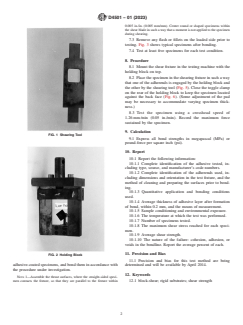
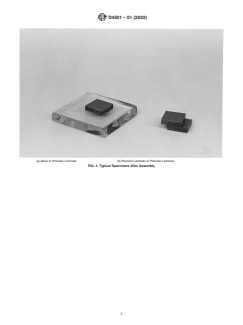
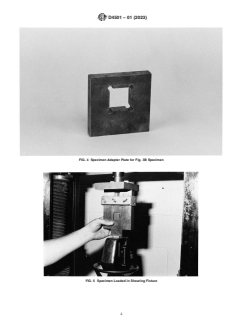
- Testing Procedure: Involves bonding blocks or plates, then loading them in a calibrated shearing fixture, applying force until failure occurs.
- Fixture Requirements: Utilizes a specific shearing fixture and force-calibrated testing machine per ASTM E4.
- Reporting: Specifies detailed information to be recorded after testing, including quantitative results, adhesive and substrate identification, bonding conditions, environmental exposures, and failure assessment.
- International Compliance: Developed in line with WTO TBT Committee principles, ensuring global acceptance and relevance.
Applications
ASTM D4501-01(2023) is essential for industries such as:
- Automotive: For evaluating adhesive bonds in composite, plastic, or glass components where machining specimens is challenging.
- Aerospace: Useful for quality verification of adhesive joints in high-strength, rigid substrates such as ceramics and specialty plastics.
- Electronics: Applicable to bonding and assessing components involving magnet moldings or glass to laminates.
- Manufacturing R&D: Enables research teams to screen new adhesives or substrate combinations by comparing shear strength performance.
- Quality Control and Certification: Provides a standardized means for suppliers and manufacturers to verify adhesive strength, supporting compliance and product reliability.
This standard is particularly valuable where substrates are difficult to machine, offering a practical and repeatable method for testing adhesive strength in real-world, production-sized parts.
Related Standards
- ASTM D907: Standard Terminology of Adhesives, providing definitions and common language for adhesive testing.
- ASTM E4: Practices for Force Calibration and Verification of Testing Machines, ensuring the accuracy of test equipment used in shear strength measurements.
- ISO Adhesive Test Methods: Comparable international standards for measuring adhesive shear strength between rigid substrates.
Practical Value
Using ASTM D4501-01(2023) ensures consistency, reliability, and comparability of shear strength data across different laboratories and industries. Adhering to this standard aids in product development, quality assurance, and compliance with international requirements. The procedure’s adaptability for various substrate types-especially in challenging, non-machinable materials-makes it a valuable reference point for the adhesive industry and all sectors where rigid substrate bonding is critical.
Keywords: shear strength, adhesive bonds, rigid substrates, block-shear method, ASTM D4501, quality control, adhesive testing, ceramic, glass, magnet moldings, plastics, ISO standards
Relations
- Effective Date
- 01-Jun-2014
- Effective Date
- 01-Jul-2012
- Effective Date
- 01-May-2012
- Effective Date
- 01-Dec-2011
- Effective Date
- 01-Jan-2011
- Effective Date
- 01-Jun-2010
- Effective Date
- 01-Nov-2009
- Effective Date
- 01-Apr-2009
- Effective Date
- 01-Dec-2008
- Effective Date
- 01-Oct-2008
- Effective Date
- 15-Aug-2008
- Effective Date
- 01-Mar-2008
- Effective Date
- 01-Jan-2007
- Effective Date
- 01-Dec-2006
- Effective Date
- 01-Apr-2005
Get Certified
Connect with accredited certification bodies for this standard

DIN CERTCO
DIN Group product certification.

Smithers Quality Assessments
US management systems and product certification.
Sponsored listings
Frequently Asked Questions
ASTM D4501-01(2023) is a standard published by ASTM International. Its full title is "Standard Test Method for Shear Strength of Adhesive Bonds Between Rigid Substrates by the Block-Shear Method". This standard covers: SIGNIFICANCE AND USE 5.1 This test method provides an estimate of the shear strength of an adhesive on various machinable and nonmachinable substrate materials. It is particularly applicable for testing bonds between ceramic, glass, magnet moldings, and plastic parts with one flat face where machining would be difficult or impractical. SCOPE 1.1 This test method describes a procedure and fixture used to determine shear strengths of adhesives used to bond materials with moduli higher than the modulus of the adhesive. The size and shape of the specimens are variable within the physical restraints of the fixture. 1.2 The values stated in SI units are to be regarded as the standard. 1.3 This standard does not purport to address all of the safety concerns, if any, associated with its use. It is the responsibility of the user of this standard to establish appropriate safety, health, and environmental practices and determine the applicability of regulatory limitations prior to use. 1.4 This international standard was developed in accordance with internationally recognized principles on standardization established in the Decision on Principles for the Development of International Standards, Guides and Recommendations issued by the World Trade Organization Technical Barriers to Trade (TBT) Committee.
SIGNIFICANCE AND USE 5.1 This test method provides an estimate of the shear strength of an adhesive on various machinable and nonmachinable substrate materials. It is particularly applicable for testing bonds between ceramic, glass, magnet moldings, and plastic parts with one flat face where machining would be difficult or impractical. SCOPE 1.1 This test method describes a procedure and fixture used to determine shear strengths of adhesives used to bond materials with moduli higher than the modulus of the adhesive. The size and shape of the specimens are variable within the physical restraints of the fixture. 1.2 The values stated in SI units are to be regarded as the standard. 1.3 This standard does not purport to address all of the safety concerns, if any, associated with its use. It is the responsibility of the user of this standard to establish appropriate safety, health, and environmental practices and determine the applicability of regulatory limitations prior to use. 1.4 This international standard was developed in accordance with internationally recognized principles on standardization established in the Decision on Principles for the Development of International Standards, Guides and Recommendations issued by the World Trade Organization Technical Barriers to Trade (TBT) Committee.
ASTM D4501-01(2023) is classified under the following ICS (International Classification for Standards) categories: 83.180 - Adhesives. The ICS classification helps identify the subject area and facilitates finding related standards.
ASTM D4501-01(2023) has the following relationships with other standards: It is inter standard links to ASTM E4-14, ASTM D907-12a, ASTM D907-12, ASTM D907-11a, ASTM D907-11, ASTM E4-10, ASTM E4-09a, ASTM E4-09, ASTM E4-08, ASTM D907-08b, ASTM D907-08a, ASTM D907-08, ASTM E4-07, ASTM D907-06, ASTM D907-05e1. Understanding these relationships helps ensure you are using the most current and applicable version of the standard.
ASTM D4501-01(2023) is available in PDF format for immediate download after purchase. The document can be added to your cart and obtained through the secure checkout process. Digital delivery ensures instant access to the complete standard document.
Standards Content (Sample)
This international standard was developed in accordance with internationally recognized principles on standardization established in the Decision on Principles for the
Development of International Standards, Guides and Recommendations issued by the World Trade Organization Technical Barriers to Trade (TBT) Committee.
Designation: D4501 − 01 (Reapproved 2023)
Standard Test Method for
Shear Strength of Adhesive Bonds Between Rigid
Substrates by the Block-Shear Method
This standard is issued under the fixed designation D4501; the number immediately following the designation indicates the year of
original adoption or, in the case of revision, the year of last revision. A number in parentheses indicates the year of last reapproval. A
superscript epsilon (´) indicates an editorial change since the last revision or reapproval.
1. Scope 4. Summary of Test Method
1.1 This test method describes a procedure and fixture used 4.1 In this test method, blocks, plates, or disks are bonded
to determine shear strengths of adhesives used to bond mate- together, and the maximum force to shear them apart is
rials with moduli higher than the modulus of the adhesive. The determined.
size and shape of the specimens are variable within the
physical restraints of the fixture. 5. Significance and Use
5.1 This test method provides an estimate of the shear
1.2 The values stated in SI units are to be regarded as the
standard. strength of an adhesive on various machinable and nonmachin-
able substrate materials. It is particularly applicable for testing
1.3 This standard does not purport to address all of the
bonds between ceramic, glass, magnet moldings, and plastic
safety concerns, if any, associated with its use. It is the
parts with one flat face where machining would be difficult or
responsibility of the user of this standard to establish appro-
impractical.
priate safety, health, and environmental practices and deter-
mine the applicability of regulatory limitations prior to use.
6. Apparatus
1.4 This international standard was developed in accor-
6.1 Testing Machine, conforming to the requirements of
dance with internationally recognized principles on standard-
ization established in the Decision on Principles for the Practices E4, with a capacity of not less than 44 kN
(10 000 lbf) in tension.
Development of International Standards, Guides and Recom-
mendations issued by the World Trade Organization Technical
6.2 Shearing Fixture—Perform the tests by using a shearing
Barriers to Trade (TBT) Committee.
fixture consisting of a holding block and a shearing tool (Figs.
1 and 2).The holding block can accommodate specimens up to
2. Referenced Documents
80 mm by 80 mm by 13 mm (3 in. by 3 in. by ⁄2 in.). For small
2.1 ASTM Standards:
specimens as shown in Fig. 3B, an adapter plate (Fig. 4) can be
D907 Terminology of Adhesives
inserted into the holding block to keep the shearing blade
E4 Practices for Force Calibration and Verification of Test-
within its guides and to locate the specimen under the clamp.
ing Machines
The shearing blade can accommodate specimens up to 30 mm
2.2 ASTM Adjuncts:
1 1 1
by 30 mm by 13 mm (1 ⁄8 in. by 1 ⁄8 in. by ⁄2 in.).
Shearing Fixture Drawings
7. Test Specimens
3. Terminology
7.1 Test specimens can be any size within the limits of the
3.1 Many terms used in this test method are defined in
shearingfixturecapacity,asgivenin6.2.Suggestedsizesareas
Terminology D907.
follows:
7.1.1 Metal Blocks—25 mm by 25 mm by 6 mm (1 in. by
This test method is under the jurisdiction of ASTM Committee D14 on
1 in. by ⁄4 in.).
AdhesivesandisthedirectresponsibilityofSubcommitteeD14.40onAdhesivesfor
7.1.2 Ferrite or Ceramic Blocks—25 mm by 18 mm by 13
Plastics.
3 1
mm (1 in. by ⁄4 in. by ⁄2 in.).
Current edition approved Jan. 1, 2023. Published January 2023. Originally
approved in 1985. Last previous edition approved in 2014 as D4501 – 01 (2014).
7.1.3 Wood or Plastic Blocks—25 mm by 25 mm by 13 mm
DOI: 10.1520/D4501-01R23.
(1 in. by 1 in. by ⁄2 in.).
For referenced ASTM standards, visit the ASTM website, www.astm.org, or
7.1.4 Glass Plates—75 mm by 75 mm by 13 mm (3 in. by
contact ASTM Customer Service at service@astm.org. For Annual Book of ASTM
Standards volume information, refer to the standard’s Document Summary page on 3 in. by ⁄2 in.).
the ASTM website.
3 7.2 Prepare the adhesive and apply in accordance with the
Detailed drawings of the fixture are available from ASTM International
Headquarters. Order Adjunct No. ADJD4501. Original adjunct produced in 1985. recommendations of the adhesive manufacturer. Assemble the
Copyright © AS
...