


kSIST FprEN 50117-9-1:2026
(Main)Coaxial cables - Part 9-1: Sectional specification for coaxial cables for analogue and digital signal transmission - Indoor drop cables for systems operating at 5 MHz - 1 000 MHz
Coaxial cables - Part 9-1: Sectional specification for coaxial cables for analogue and digital signal transmission - Indoor drop cables for systems operating at 5 MHz - 1 000 MHz
This part of the EN 50117 series which is a sectional specification applies to coaxial indoor drop cables for analogue and digital one and two way signal transmission, e.g. for cable networks for television signals, sound signals and interactive services in accordance with EN 60728 1:2014, EN 60728 1 1:2014, EN 60728 101:2017, EN 60728 10:2014, EN 50173 1:2018 and EN 50173 4:2018. This also includes the transmission of BCT signals provided by a CATV, MATV or SMATV cable network.
The purpose of this document is to specify the applicable test methods and requirements for the electrical, mechanical and environmental characteristics and for fire performance of the cables.
Koaxiale Kabel - Teil 9-1: Rahmenspezifikation für koaxiale Kabel für analoge und digitale Signalübertragung - Innenkabel für Systeme im Bereich von 5 MHz - 1 000 MHz
Câbles coaxiaux - Partie 9-1: Spécification intermédiaire pour câbles coaxiaux pour la transmission de signaux analogiques et numériques - Câbles de raccordement à usage intérieur pour les systèmes fonctionnant entre 5 MHz et 1 000 MHz
La présente partie de la série EN 50117 qui est une spécification intermédiaire s’applique aux câbles coaxiaux de raccordement à usage intérieur pour la transmission unidirectionnelle ou bidirectionnelle de signaux analogiques et numériques, par exemple pour les réseaux de distribution par câbles pour signaux de télévision, signaux de radiodiffusion sonore et services interactifs, conformément aux normes EN 60728 1:2014, EN 60728 1 1:2014, EN 60728 101:2017, EN 60728 10:2014, EN 50173 1:2018 et EN 50173 4:2018. Cela inclut également la transmission de signaux BCT (Technologies de communication et de télédiffusion) fournis par un réseau de distribution par câble (CATV, MATV ou SMATV).
Le présent document est destiné à spécifier les méthodes d’essai et les exigences applicables pour les caractéristiques électriques, mécaniques et d’environnement et pour les performances de tenue au feu des câbles.
Koaksialni kabli - 9-1. del: Področna specifikacija za koaksialne kable za analogni in digitalni prenos signala - Notranji priključni kabli za sisteme, ki delujejo v območju od 5 MHz do 1000 MHz
General Information
- Status
- Not Published
- Public Enquiry End Date
- 31-Jan-2021
- Technical Committee
- MOC - Mobile Communications
- Current Stage
- 5020 - Formal vote (FV) (Adopted Project)
- Start Date
- 23-Feb-2026
- Due Date
- 13-Apr-2026
- Completion Date
- 24-Feb-2026
Relations
- Effective Date
- 07-May-2019
Overview
kSIST FprEN 50117-9-1:2026 is a draft European Standard developed by CLC/SC 46XA, part of the wider EN 50117 series, that specifies the requirements and test methods for coaxial indoor drop cables used for both analogue and digital signal transmission within the frequency range of 5 MHz to 1 000 MHz. These cables are integral components of cable networks delivering TV, sound signals, and interactive services in residential and commercial environments.
The standard harmonizes the design, construction, safety, and performance testing of coaxial cables used in CATV (Cable Television), MATV (Master Antenna TV), and SMATV (Satellite Master Antenna TV) networks. It supports compliance with the essential requirements of the EU Low Voltage Directive (LVD 2014/35/EU) and relevant Construction Products Regulation (CPR) fire safety classifications.
Key Topics
- Scope and Compliance: kSIST FprEN 50117-9-1:2026 applies to coaxial indoor drop cables for one-way or two-way signal transmission in cable networks, in line with EN 60728 and EN 50173 standards.
- Cable Construction & Materials: Specifies requirements for inner conductors, dielectric insulation, outer conductors or screens (including screening classes A+, A, B, and C), and sheath materials (PVC, Halogen-Free Flame Retardant).
- Electrical Performance:
- Designed for frequencies from 5 MHz up to 1 000 MHz.
- Attenuation, characteristic impedance, return loss, transfer impedance, and screening attenuation are addressed for signal quality.
- Mechanical & Environmental Requirements: Standards for crush resistance, bending, abrasion, and endurance ensure durability and reliability during installation and service life.
- Fire Performance: Cables must meet fire safety classes under CPR, with specific tests outlined to assess flame retardance.
- Marking and Identification: Clear sheath markings and labeling requirements ensure cables can be easily identified for compliance and traceability.
Applications
kSIST FprEN 50117-9-1:2026 is particularly relevant for:
- Cable TV Networks (CATV): Ensures reliable transmission of audio/video signals and interactive services.
- MATV and SMATV Installations: Serves multi-dwelling units (MDUs) and commercial properties needing robust internal distribution of television and data services.
- Broadband and Interactive Services: Supports high-speed internet and two-way communication where broadband cable infrastructure is deployed.
- In-Building Cabling: Used in residential, commercial, and hospitality environments for internal signal distribution from distribution points to end users.
- Compliant with Safety Regulations: Aligns with LVD and CPR, ensuring safe installations in accordance with European market regulations.
By adhering to this standard, manufacturers and installers guarantee performance, safety, and interoperability of cables for high-quality signal transmission in indoor environments.
Related Standards
Integration with related standards ensures a holistic approach to cable network safety, performance, and compatibility:
- EN 50117-1:2019: Generic specification for coaxial cables.
- EN 60728 Series: Covers cable network system performance and RF cabling requirements.
- EN 50173-1:2018 & EN 50173-4:2018: Generic cabling systems for IT, including residential settings.
- EN 50289 Series: Test methods for communication cables, focusing on mechanical and environmental performance.
- IEC 62153 Series: Test methods for electromagnetic compatibility of metallic communication cables.
Practical Value
Standardizing coaxial indoor drop cables using kSIST FprEN 50117-9-1:2026 delivers:
- Consistent and Reliable Signal Quality in modern multimedia and broadband applications.
- Safety Assurance through rigorous mechanical, electrical, and fire performance criteria.
- Regulatory Compliance for products entering the European market, supporting CE marking and CPR fire classification.
- Supply Chain Traceability via standardized marking and labeling.
- Future-Ready Networks by enabling performance for both analogue and new digital services within the 5 MHz – 1000 MHz spectrum.
Applying this standard enables installers, manufacturers, and system integrators to deliver secure, high-performing, and regulation-compliant cable systems for a wide array of indoor signal transmission needs.

Get Certified
Connect with accredited certification bodies for this standard

ANCE
Mexican certification and testing association.

Intertek Slovenia
Intertek testing, inspection, and certification services in Slovenia.

LNE (Laboratoire National de Métrologie et d'Essais)
French national laboratory for metrology and testing.
Sponsored listings
Frequently Asked Questions
kSIST FprEN 50117-9-1:2026 is a draft published by the Slovenian Institute for Standardization (SIST). Its full title is "Coaxial cables - Part 9-1: Sectional specification for coaxial cables for analogue and digital signal transmission - Indoor drop cables for systems operating at 5 MHz - 1 000 MHz". This standard covers: This part of the EN 50117 series which is a sectional specification applies to coaxial indoor drop cables for analogue and digital one and two way signal transmission, e.g. for cable networks for television signals, sound signals and interactive services in accordance with EN 60728 1:2014, EN 60728 1 1:2014, EN 60728 101:2017, EN 60728 10:2014, EN 50173 1:2018 and EN 50173 4:2018. This also includes the transmission of BCT signals provided by a CATV, MATV or SMATV cable network. The purpose of this document is to specify the applicable test methods and requirements for the electrical, mechanical and environmental characteristics and for fire performance of the cables.
This part of the EN 50117 series which is a sectional specification applies to coaxial indoor drop cables for analogue and digital one and two way signal transmission, e.g. for cable networks for television signals, sound signals and interactive services in accordance with EN 60728 1:2014, EN 60728 1 1:2014, EN 60728 101:2017, EN 60728 10:2014, EN 50173 1:2018 and EN 50173 4:2018. This also includes the transmission of BCT signals provided by a CATV, MATV or SMATV cable network. The purpose of this document is to specify the applicable test methods and requirements for the electrical, mechanical and environmental characteristics and for fire performance of the cables.
kSIST FprEN 50117-9-1:2026 is classified under the following ICS (International Classification for Standards) categories: 33.120.10 - Coaxial cables. Waveguides. The ICS classification helps identify the subject area and facilitates finding related standards.
kSIST FprEN 50117-9-1:2026 has the following relationships with other standards: It is inter standard links to SIST EN 50117-9-1:2019. Understanding these relationships helps ensure you are using the most current and applicable version of the standard.
kSIST FprEN 50117-9-1:2026 is associated with the following European legislation: EU Directives/Regulations: 2014/35/EU; Standardization Mandates: M/511. When a standard is cited in the Official Journal of the European Union, products manufactured in conformity with it benefit from a presumption of conformity with the essential requirements of the corresponding EU directive or regulation.
kSIST FprEN 50117-9-1:2026 is available in PDF format for immediate download after purchase. The document can be added to your cart and obtained through the secure checkout process. Digital delivery ensures instant access to the complete standard document.
Standards Content (Sample)
SLOVENSKI STANDARD
oSIST prEN 50117-9-1:2021
01-januar-2021
Koaksialni kabli - 9-1. del: Področna specifikacija za koaksialne kable za analogni
in digitalni prenos signala - Notranji priključni kabli za sisteme, ki delujejo v
območju od 5 MHz do 1000 MHz
Coaxial cables - Part 9-1: Sectional specification for coaxial cables for analogue and
digital signal transmission - Indoor drop cables for systems operating at 5 MHz - 1 000
MHz
Koaxiale Kabel - Teil 9-1: Rahmenspezifikation für koaxiale Kabel für analoge und
digitale Signalübertragung - Innenkabel für Systeme im Bereich von 5 MHz - 1 000 MHz
Câbles coaxiaux - Partie 9-1: Spécification intermédiaire pour câbles coaxiaux pour la
transmission de signaux analogiques et numériques - Câbles de raccordement à usage
intérieur pour les systèmes fonctionnant entre 5 MHz et 1 000 MHz
Ta slovenski standard je istoveten z: prEN 50117-9-1
ICS:
33.120.10 Koaksialni kabli. Valovodi Coaxial cables. Waveguides
oSIST prEN 50117-9-1:2021 en
2003-01.Slovenski inštitut za standardizacijo. Razmnoževanje celote ali delov tega standarda ni dovoljeno.
oSIST prEN 50117-9-1:2021
oSIST prEN 50117-9-1:2021
EUROPEAN STANDARD DRAFT
prEN 50117-9-1
NORME EUROPÉENNE
EUROPÄISCHE NORM
November 2020
ICS Will supersede EN 50117-9-1:2019 and all of its
amendments and corrigenda (if any)
English Version
Coaxial cables - Part 9-1: Sectional specification for coaxial
cables for analogue and digital signal transmission - Indoor drop
cables for systems operating at 5 MHz - 1 000 MHz
Câbles coaxiaux - Partie 9-1: Spécification intermédiaire Koaxiale Kabel - Teil 9-1: Rahmenspezifikation für koaxiale
pour câbles coaxiaux pour la transmission de signaux Kabel für analoge und digitale Signalübertragung -
analogiques et numériques - Câbles de raccordement à Innenkabel für Systeme im Bereich von 5 MHz - 1 000 MHz
usage intérieur pour les systèmes fonctionnant entre 5 MHz
et 1 000 MHz
This draft European Standard is submitted to CENELEC members for enquiry.
Deadline for CENELEC: 2021-02-19.
It has been drawn up by CLC/SC 46XA.
If this draft becomes a European Standard, CENELEC members are bound to comply with the CEN/CENELEC Internal Regulations which
stipulate the conditions for giving this European Standard the status of a national standard without any alteration.
This draft European Standard was established by CENELEC in three official versions (English, French, German).
A version in any other language made by translation under the responsibility of a CENELEC member into its own language and notified to
the CEN-CENELEC Management Centre has the same status as the official versions.
CENELEC members are the national electrotechnical committees of Austria, Belgium, Bulgaria, Croatia, Cyprus, the Czech Republic,
Denmark, Estonia, Finland, France, Germany, Greece, Hungary, Iceland, Ireland, Italy, Latvia, Lithuania, Luxembourg, Malta, the
Netherlands, Norway, Poland, Portugal, Republic of North Macedonia, Romania, Serbia, Slovakia, Slovenia, Spain, Sweden, Switzerland,
Turkey and the United Kingdom.
Recipients of this draft are invited to submit, with their comments, notification of any relevant patent rights of which they are aware and to
provide supporting documentation.
Warning : This document is not a European Standard. It is distributed for review and comments. It is subject to change without notice and
shall not be referred to as a European Standard.
European Committee for Electrotechnical Standardization
Comité Européen de Normalisation Electrotechnique
Europäisches Komitee für Elektrotechnische Normung
CEN-CENELEC Management Centre: Rue de la Science 23, B-1040 Brussels
© 2020 CENELEC All rights of exploitation in any form and by any means reserved worldwide for CENELEC Members.
Project: 69504 Ref. No. prEN 50117-9-1 E
oSIST prEN 50117-9-1:2021
prEN 50117-9-1:2020 (E)
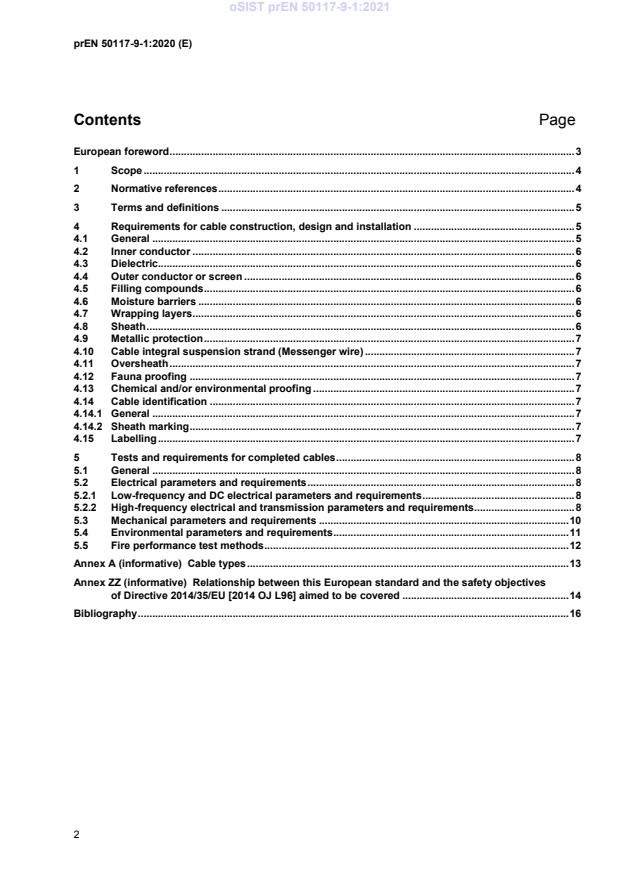
Contents Page
European foreword . 3
1 Scope . 4
2 Normative references . 4
3 Terms and definitions . 5
4 Requirements for cable construction, design and installation . 5
4.1 General . 5
4.2 Inner conductor . 6
4.3 Dielectric. 6
4.4 Outer conductor or screen . 6
4.5 Filling compounds . 6
4.6 Moisture barriers . 6
4.7 Wrapping layers . 6
4.8 Sheath . 6
4.9 Metallic protection . 7
4.10 Cable integral suspension strand (Messenger wire) . 7
4.11 Oversheath . 7
4.12 Fauna proofing . 7
4.13 Chemical and/or environmental proofing . 7
4.14 Cable identification . 7
4.14.1 General . 7
4.14.2 Sheath marking . 7
4.15 Labelling . 7
5 Tests and requirements for completed cables . 8
5.1 General . 8
5.2 Electrical parameters and requirements . 8
5.2.1 Low-frequency and DC electrical parameters and requirements . 8
5.2.2 High-frequency electrical and transmission parameters and requirements . 8
5.3 Mechanical parameters and requirements . 10
5.4 Environmental parameters and requirements . 11
5.5 Fire performance test methods . 12
Annex A (informative) Cable types . 13
Annex ZZ (informative) Relationship between this European standard and the safety objectives
of Directive 2014/35/EU [2014 OJ L96] aimed to be covered . 14
Bibliography . 16
oSIST prEN 50117-9-1:2021
prEN 50117-9-1:2020 (E)
European foreword
This document (prEN 50117-9-1:2020) has been prepared by CLC/SC 46XA “Coaxial cables” of
CLC/TC 46X “Communication cables”.
This document is currently submitted to the Enquiry.
The following dates are proposed:
• latest date by which the existence of (doa) dor + 6 months
this document has to be announced
at national level
• latest date by which this document has to be (dop) dor + 12 months
implemented at national level by publication of
an identical national standard or by
endorsement
• latest date by which the national standards (dow) dor + 36 months
conflicting with this document have to (to be confirmed or
be withdrawn modified when voting)
This document will supersede EN 50117-9-1:2019 and all of its amendments and corrigenda (if any).
This document has been prepared under a mandate given to CENELEC by the European Commission and
the European Free Trade Association, and supports essential requirements of EU Directive(s).
For the relationship with the EU Directive 2014/35/EU see informative Annex ZZ, which is an integral part of
this document.
This document covers the Principle Elements of the Safety Objectives for Electrical Equipment Designed for
Use within Certain Voltage Limits (LVD - 2014/35/EU).
All materials used for cables according to this document are expected to fulfil the requirements of the current
REACH Regulation and ROHS Directives.
oSIST prEN 50117-9-1:2021
prEN 50117-9-1:2020 (E)
1 Scope
This part of the EN 50117 series which is a sectional specification applies to coaxial indoor drop cables for
analogue and digital one and two way signal transmission, e.g. for cable networks for television signals,
sound signals and interactive services in accordance with EN 60728-1:2014, EN 60728-1-1:2014,
EN 60728-101:2017, EN 60728-10:2014, EN 50173-1:2018 and EN 50173-4:2018. This includes also the
transmission of BCT signals provided by a CATV, MATV or SMATV cable network.
The purpose of this document is to specify the applicable test methods and requirements for the electrical,
mechanical and environmental characteristics and for fire performance of the cables.
2 Normative references
The following documents are referred to in the text in such a way that some or all of their content constitutes
requirements of this document. For dated references, only the edition cited applies. For undated references,
the latest edition of the referenced document (including any amendments) applies.
EN 50117-1:2019, Coaxial cables - Part 1: Generic specification
EN 50289-3-9:2001, Communication cables - Specifications for test methods - Part 3-9: Mechanical test
methods - Bending tests
EN 50290-1-2:2004, Communication cables - Part 1-2: Definitions
EN 50290-2-1:2005, Communication cables - Part 2-1: Common design rules and construction
EN 50290-2-22:2001, Communication cables - Part 2-22: Common design rules and construction - PVC
sheathing compounds
EN 50290-2-27:2002, Communication cables - Part 2-27: Common design rules and construction - Halogen
free flame retardant thermoplastic sheathing compounds
EN 50290-2-37:2016, Communication cables - Part 2-37: Common design rules and construction -
Polyethylene insulation for coaxial cables
EN 50290-2-38:2016, Communication cables - Part 2-38: Common design rules and construction -
Polypropylene insulation for coaxial cables
EN 50290-4-1:2014, Communication cables - Part 4-1: General considerations for the use of cables -
Environmental conditions and safety aspects
EN 50290-4-2:2014, Communication cables - Part 4-2: General considerations for the use of cables - Guide
to use
EN 60728-1:2014, Cable networks for television signals, sound signals and interactive services - Part 1:
System performance of forward paths (IEC 60728-1:2014)
EN 62153-1-1:2004, Metallic communication cables test methods - Part 1-1: Electrical - Measurement of the
pulse/step return loss in the frequency domain using the Inverse Discrete Fourier Transformation (IDFT)
(IEC 62153-1-1:2003)
IEC 61196-1-112:2006, Coaxial communication cables - Part 1-112: Electrical test methods - Test for return
loss (uniformity of impedance)
IEC 61196-1-115:2006, Coaxial communication cables - Part 1-115: Electrical test methods - Test for
regularity of impedance (pulse/step function return loss)
IEC 62153-4-3:2013, Metallic communication cable test methods - Part 4-3: Electromagnetic compatibility
(EMC) - Surface transfer impedance - Triaxial method
oSIST prEN 50117-9-1:2021
prEN 50117-9-1:2020 (E)
IEC 62153-4-4:2015, Metallic communication cable test methods - Part 4-4: Electromagnetic compatibility
(EMC) - Test method for measuring of the screening attenuation as up to and above 3 GHz, triaxial method
3 Terms and definitions
For the purposes of this document, the terms and definitions given in EN 50290-1-2:2004, EN 50117-1:2019,
EN 60728-1:2014 and the following apply.
ISO and IEC maintain terminological databases for use in standardization at the following addresses:
— ISO Online browsing platform: available at https://www.iso.org/obp
— IEC Electropedia: available at http://www.electropedia.org/
3.1
drop cable
coaxial cable which is used to connect from:
a) subscriber tap or a directional coupler to a system outlet,
b) subscriber tap to a subscriber splitter,
c) subscriber splitter to a system outlet
3.2
indoor drop cable
drop cable for indoor application
4 Requirements for cable construction, design and installation
4.1 General
Cables according to this document are designed for an operating temperature range from −40 °C to
1)
+70 °C and at frequencies between 5 MHz and 1 000 MHz.
When designing the cable, consideration should be given to the maximum admissible current stated in the
detail specification. It is assumed that the raise of temperature of the inner conductor when submitted to the
maximum current under nominal ambient conditions does not affect the mechanical and electrical properties
of the cable.
Cables according to this document may be operated at voltages > 50 V AC or > 75 V DC according to the
detail specification of the manufacturer. However, these cables are not intended for direct connection to the
mains electricity supply or other low impedance sources.
Cables according to this document shall be designed and constructed according to EN 50290-2-1:2005,
Communication cables Part 2-1: Common design rules and construction and according to
EN 50290-4-1:2014, Communication cables - Part 4-1: General considerations for the use of cables -
Environmental conditions and safety aspects Compliance with the essential requirements of the LVD is
described in subclause 4.2.2 of EN 50290-4-1 .
The use of cables according to this document including delivery, storage and installation shall be in
accordance with EN 50290-4-2:2014, Communication cables - Part 4-2: General considerations for the use
of cables - Guide to use, unless otherwise specified.
1) This value is valid for applications without ampacity only, see also Table A.1 concerning max. DC current.
2) EN 50290-4-1:2014, 4.2.2 requires the use raw materials according to EN 50290-2-xx series, design
according to EN 50290-2-1 and dielectric tests according to EN 50289-1-3 and to EN 50290-2-1. Voltage
withstanding tests shall be performed between conductors and between the conductors or screen and the
outer surface of the sheath.
oSIST prEN 50117-9-1:2021
prEN 50117-9-1:2020 (E)
When designed and constructed in accordance with EN 50290-2-1:2005 and EN 50117-1:2019 and
submitted to spark testing, (see 5.1.2.5 in Table 1), CATV cables according to this document may be
installed together with Low Voltage cables.
Moreover, the tests according to Clause 5 of this document shall be performed after environmental and
ageing tests. In addition, the raw materials of these cables are defined in the EN 50290 series.
This ensures sufficient stability of the cables related to this characteristic for its life cycle.
Thus these cables are considered safe when:
— they are used for their intended purpose and applications;
— they are used under voltages and currents that do not exceed the limits given in the relevant detail
specification.
All cables covered by this document do not fall under the scope of the RED or the EMC Directive.
Nevertheless, transfer impedance and screening attenuation according to 5.1.3.6 and 5.1.3.7 in Table 2 shall
be specified in the relevant detail specification, if the intended application of the cable is the use in
combination with equipment under the RED or the EMC Directive, see also EN 50290-4-1:2014, 4.2.1.
4.2 Inner conductor
The conductor shall meet the requirements of EN 50117-1:2019, 4.2 and shall be solid and may be plain or
metal coated. Dimensions shall be in accordance with the detail specification.
There shall be no joint made subsequent to the last drawing operation.
In case of metal coated conductor, consideration shall be taken for the compatibility of the connector.
4.3 Dielectric
The dielectric material(s) shall be in accordance with EN 50117-1:2019, 4.3 and shall consist of polyolefin
materials, with EN 50290-2-37:2016 (polyethylene), EN 50290-2-38:2016 (polypropylene). Dimensions shall
be in accordance with the detail specification.
Unless otherwise specified, the nominal diameter over the dielectric should be one of the preferred values,
namely 3,7 mm, 4,8 mm and 7,2 mm.
4.4 Outer conductor or screen
The construction and material of the outer conductor (or screen) shall meet the requirements of
EN 50117-1:2019, 4.4 items b), f) or g). Where option b) is used, a double braid layer is required.
For braid constructions or helically wound wires, the braid angle shall be between 15° and 45°. The coverage
factor shall be greater than or equal to 65 %, or, when the cab
...
Questions, Comments and Discussion
Ask us and Technical Secretary will try to provide an answer. You can facilitate discussion about the standard in here.
Loading comments...