

SIST EN ISO 80369-6:2025
(Main)Small bore connectors for liquids and gases in healthcare applications - Part 6: Connectors for neural applications (ISO 80369-6:2025)
General Information
- Abstract
NOTE Clause A.2 contains guidance or rationale for this clause.
This document specifies requirements for small-bore connectors intended to be used for connections in neural applications.
This document does not specify requirements for the medical devices or accessories that use these connectors. Such requirements are given in particular standards for specific medical devices or accessories.
- Status
- Published
- Public Enquiry End Date
- 01-Nov-2023
- Publication Date
- 24-Sep-2025
- Technical Committee
- VAZ - Healthcare
- Current Stage
- 6060 - National Implementation/Publication (Adopted Project)
- Start Date
- 13-Jun-2025
- Due Date
- 18-Aug-2025
- Completion Date
- 25-Sep-2025

Overview
EN ISO 80369-6:2025 (ISO 80369-6:2025) defines requirements for small-bore connectors for neural applications used in healthcare. The standard covers design, materials, dimensional tolerances and performance requirements for connectors intended for connections in neural sites (spine, intrathecal/subarachnoid space, brain ventricles, epidural/epidural spaces). It applies to the connector interfaces themselves and does not define requirements for the medical devices or accessories that use these connectors.
Key topics and technical requirements
- Non‑interconnectability: Connectors are designed to reduce misconnections with other medical fluid/gas systems (see ISO 80369-1 for overarching requirements).
- Materials requirements: Specifies acceptable materials and references applicable mechanical property standards (updated to include parts of the ISO 527 series).
- Dimensions and tolerances: Normative dimensional specifications and tolerances are given (Annex B) along with reference connector designs for testing (Annex C).
- Performance requirements: Includes tests and pass/fail criteria for:
- Positive pressure leakage (pressure decay and falling-drop methods - Annex F)
- Sub‑atmospheric pressure air leakage (Annex G)
- Stress cracking resistance
- Resistance to separation under axial loads and unscrewing
- Resistance to overriding (mechanical integrity and secure connection)
- Test methods and annexes: Normative test methods and reference connectors are provided (Annexes B, C, F, G). Informative Annex A provides rationale/guidance; Annex D offers assessment guidance for devices with these connections; Annex E references IMDRF essential principles.
Practical applications and who uses it
- Medical device manufacturers designing neural catheters, infusion sets, cerebrospinal fluid drains, intrathecal ports and anesthesia delivery systems use this standard to:
- Ensure connector compatibility, safety and regulatory readiness
- Define product specifications and testing protocols
- Regulatory bodies, testing laboratories and notified bodies use EN ISO 80369-6:2025 to assess connector conformity and to verify performance claims.
- Hospital procurement, clinicians and biomedical engineers can use the standard to understand connector safety attributes and reduce misconnections in neural procedures.
Related standards
- ISO 80369-1 (general non-interconnectability requirements)
- ISO 80369-20:2024 (series test methods referenced)
- ISO 527 series (material mechanical property testing)
For implementation or purchase, consult your national standards body, CEN/CENELEC national members or ISO.
Relations
- Effective Date
- 01-Sep-2025
- Effective Date
- 28-Jan-2026
- Effective Date
- 28-Jan-2026
- Effective Date
- 28-Jan-2026
- Effective Date
- 28-Jan-2026
- Effective Date
- 28-Jan-2026
- Effective Date
- 10-Feb-2026
Get Certified
Connect with accredited certification bodies for this standard

BSI Group
BSI (British Standards Institution) is the business standards company that helps organizations make excellence a habit.

TÜV Rheinland
TÜV Rheinland is a leading international provider of technical services.

TÜV SÜD
TÜV SÜD is a trusted partner of choice for safety, security and sustainability solutions.
Sponsored listings
Frequently Asked Questions
SIST EN ISO 80369-6:2025 is a standard published by the Slovenian Institute for Standardization (SIST). Its full title is "Small bore connectors for liquids and gases in healthcare applications - Part 6: Connectors for neural applications (ISO 80369-6:2025)". This standard covers: NOTE Clause A.2 contains guidance or rationale for this clause. This document specifies requirements for small-bore connectors intended to be used for connections in neural applications. This document does not specify requirements for the medical devices or accessories that use these connectors. Such requirements are given in particular standards for specific medical devices or accessories.
NOTE Clause A.2 contains guidance or rationale for this clause. This document specifies requirements for small-bore connectors intended to be used for connections in neural applications. This document does not specify requirements for the medical devices or accessories that use these connectors. Such requirements are given in particular standards for specific medical devices or accessories.
SIST EN ISO 80369-6:2025 is classified under the following ICS (International Classification for Standards) categories: 11.040.25 - Syringes, needles an catheters. The ICS classification helps identify the subject area and facilitates finding related standards.
SIST EN ISO 80369-6:2025 has the following relationships with other standards: It is inter standard links to SIST EN ISO 80369-6:2016, SIST-TP CEN ISO/TR 6026:2023, kSIST FprEN 13121-3:2026, oSIST prEN 13364-1:2026, SIST-TP CEN/TR 17993:2023, SIST-V CEN/CLC Guide 10:2024, SIST EN ISO 80369-6:2025. Understanding these relationships helps ensure you are using the most current and applicable version of the standard.
SIST EN ISO 80369-6:2025 is available in PDF format for immediate download after purchase. The document can be added to your cart and obtained through the secure checkout process. Digital delivery ensures instant access to the complete standard document.
Standards Content (Sample)
SLOVENSKI STANDARD
01-november-2025
Nadomešča:
SIST EN ISO 80369-6:2016
Priključki z majhnim premerom za tekočine in pline za uporabo v zdravstvu - 6. del:
Priključki za nevronsko uporabo (ISO 80369-6:2025)
Small bore connectors for liquids and gases in healthcare applications - Part 6:
Connectors for neural applications (ISO 80369-6:2025)
Verbindungsstücke mit kleinem Durchmesser für Flüssigkeiten und Gase in
medizinischen Anwendungen - Teil 6: Verbindungsstücke für neurale Anwendungen
(ISO 80369-6:2025)
Raccords de petite taille pour liquides et gaz utilisés dans le domaine de la santé - Partie
6: Raccords pour applications neurales (ISO 80369-6:2025)
Ta slovenski standard je istoveten z: EN ISO 80369-6:2025
ICS:
11.040.25 Injekcijske brizge, igle in Syringes, needles an
katetri catheters
2003-01.Slovenski inštitut za standardizacijo. Razmnoževanje celote ali delov tega standarda ni dovoljeno.
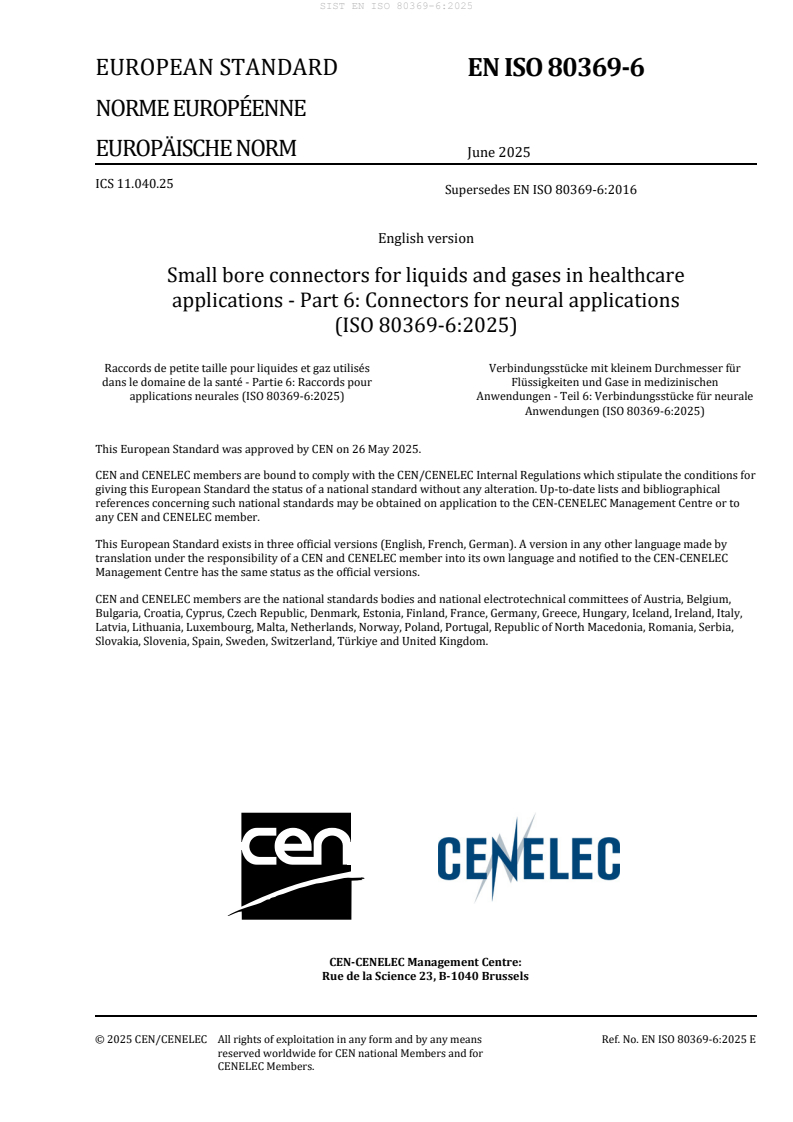
EUROPEAN STANDARD EN ISO 80369-6
NORME EUROPÉENNE
EUROPÄISCHE NORM
June 2025
ICS 11.040.25
Supersedes EN ISO 80369-6:2016
English version
Small bore connectors for liquids and gases in healthcare
applications - Part 6: Connectors for neural applications
(ISO 80369-6:2025)
Raccords de petite taille pour liquides et gaz utilisés Verbindungsstücke mit kleinem Durchmesser für
dans le domaine de la santé - Partie 6: Raccords pour Flüssigkeiten und Gase in medizinischen
applications neurales (ISO 80369-6:2025) Anwendungen - Teil 6: Verbindungsstücke für neurale
Anwendungen (ISO 80369-6:2025)
This European Standard was approved by CEN on 26 May 2025.
CEN and CENELEC members are bound to comply with the CEN/CENELEC Internal Regulations which stipulate the conditions for
giving this European Standard the status of a national standard without any alteration. Up-to-date lists and bibliographical
references concerning such national standards may be obtained on application to the CEN-CENELEC Management Centre or to
any CEN and CENELEC member.
This European Standard exists in three official versions (English, French, German). A version in any other language made by
translation under the responsibility of a CEN and CENELEC member into its own language and notified to the CEN-CENELEC
Management Centre has the same status as the official versions.
CEN and CENELEC members are the national standards bodies and national electrotechnical committees of Austria, Belgium,
Bulgaria, Croatia, Cyprus, Czech Republic, Denmark, Estonia, Finland, France, Germany, Greece, Hungary, Iceland, Ireland, Italy,
Latvia, Lithuania, Luxembourg, Malta, Netherlands, Norway, Poland, Portugal, Republic of North Macedonia, Romania, Serbia,
Slovakia, Slovenia, Spain, Sweden, Switzerland, Türkiye and United Kingdom.
CEN-CENELEC Management Centre:
Rue de la Science 23, B-1040 Brussels
© 2025 CEN/CENELEC All rights of exploitation in any form and by any means
Ref. No. EN ISO 80369-6:2025 E
reserved worldwide for CEN national Members and for
CENELEC Members.
Contents Page
European foreword . 3
European foreword
This document (EN ISO 80369-6:2025) has been prepared by Technical Committee ISO/TC 210 "Quality
management and corresponding general aspects for products with a health purpose including medical
devices" in collaboration with Technical Committee CEN-CENELEC/ JTC 3 “Quality management and
corresponding general aspects for medical devices” the secretariat of which is held by NEN.
This European Standard shall be given the status of a national standard, either by publication of an
identical text or by endorsement, at the latest by December 2025, and conflicting national standards
shall be withdrawn at the latest by December 2025.
Attention is drawn to the possibility that some of the elements of this document may be the subject of
patent rights. CEN-CENELEC shall not be held responsible for identifying any or all such patent rights.
This document supersedes EN ISO 80369-6:2016.
Any feedback and questions on this document should be directed to the users’ national standards
body/national committee. A complete listing of these bodies can be found on the CEN and CENELEC
websites.
According to the CEN-CENELEC Internal Regulations, the national standards organizations of the
following countries are bound to implement this European Standard: Austria, Belgium, Bulgaria,
Croatia, Cyprus, Czech Republic, Denmark, Estonia, Finland, France, Germany, Greece, Hungary, Iceland,
Ireland, Italy, Latvia, Lithuania, Luxembourg, Malta, Netherlands, Norway, Poland, Portugal, Republic of
North Macedonia, Romania, Serbia, Slovakia, Slovenia, Spain, Sweden, Switzerland, Türkiye and the
United Kingdom.
Endorsement notice
The text of ISO 80369-6:2025 has been approved by CEN-CENELEC as EN ISO 80369-6:2025 without
any modification.
International
Standard
ISO 80369-6
Second edition
Small bore connectors for
2025-05
liquids and gases in healthcare
applications —
Part 6:
Connectors for neural applications
Raccords de petite taille pour liquides et gaz utilisés dans le
domaine de la santé —
Partie 6: Raccords pour applications neurales
Reference number
ISO 80369-6:2025(en) © ISO 2025
ISO 80369-6:2025(en)
© ISO 2025
All rights reserved. Unless otherwise specified, or required in the context of its implementation, no part of this publication may
be reproduced or utilized otherwise in any form or by any means, electronic or mechanical, including photocopying, or posting on
the internet or an intranet, without prior written permission. Permission can be requested from either ISO at the address below
or ISO’s member body in the country of the requester.
ISO copyright office
CP 401 • Ch. de Blandonnet 8
CH-1214 Vernier, Geneva
Phone: +41 22 749 01 11
Email: copyright@iso.org
Website: www.iso.org
Published in Switzerland
ii
ISO 80369-6:2025(en)
Contents Page
Foreword .iv
Introduction .vi
1 Scope . 1
2 Normative references . 1
3 Terms and definitions . 2
4 Non-interconnectability requirements . 2
5 Materials requirements . 2
6 Dimensions and tolerances . 2
7 Performance requirements . . 3
7.1 Positive pressure leakage .3
7.1.1 General .3
7.1.2 Leakage by pressure decay .3
7.1.3 Falling drop positive pressure liquid leakage .3
7.2 Sub-atmospheric pressure air leakage.3
7.3 Stress cracking .3
7.4 Resistance to separation from axial load .4
7.5 Resistance to separation from unscrewing .4
7.6 Resistance to overriding .4
Annex A (informative) Rationale and guidance . 5
Annex B (normative) Dimensions and tolerances . . 7
Annex C (normative) Reference connectors for testing small-bore connectors for neural
applications .16
Annex D (informative) Assessment of medical devices and their attributes with connections
within this application .22
Annex E (informative) Reference to the IMDRF essential principles .23
Annex F (normative) Leakage by pressure decay test method .24
Annex G (normative) Subatmospheric-pressure air leakage test method .27
Annex H (informative) Alphabetized index of defined terms .30
Bibliography .31
iii
ISO 80369-6:2025(en)
Foreword
ISO (the International Organization for Standardization) is a worldwide federation of national standards
bodies (ISO member bodies). The work of preparing International Standards is normally carried out through
ISO technical committees. Each member body interested in a subject for which a technical committee
has been established has the right to be represented on that committee. International organizations,
governmental and non-governmental, in liaison with ISO, also take part in the work. ISO collaborates closely
with the International Electrotechnical Commission (IEC) on all matters of electrotechnical standardization.
The procedures used to develop this document and those intended for its further maintenance are described
in the ISO/IEC Directives, Part 1. In particular, the different approval criteria needed for the different types
of ISO document should be noted. This document was drafted in accordance with the editorial rules of the
ISO/IEC Directives, Part 2 (see www.iso.org/directives).
ISO draws attention to the possibility that the implementation of this document may involve the use of (a)
patent(s). ISO takes no position concerning the evidence, validity or applicability of any claimed patent
rights in respect thereof. As of the date of publication of this document, ISO had not received notice of (a)
patent(s) which may be required to implement this document. However, implementers are cautioned that
this may not represent the latest information, which may be obtained from the patent database available at
www.iso.org/patents. ISO shall not be held responsible for identifying any or all such patent rights.
Any trade name used in this document is information given for the convenience of users and does not
constitute an endorsement.
For an explanation of the voluntary nature of standards, the meaning of ISO specific terms and expressions
related to conformity assessment, as well as information about ISO’s adherence to the World Trade
Organization (WTO) principles in the Technical Barriers to Trade (TBT), see www.iso.org/iso/foreword.html.
This document was prepared by Technical Committee ISO/TC 210, Quality management and corresponding
general aspects for products with a health purpose including medical devices, in collaboration with Technical
Committee IEC/SC 62D, Particular medical equipment, software, and systems, and with the European
Committee for Standardization (CEN) Technical Committee CEN/CLC/JTC 3, Quality management and
corresponding general aspects for medical devices, in accordance with the Agreement on technical cooperation
between ISO and CEN (Vienna Agreement).
This second edition cancels and replaces the first edition (ISO 80369-6:2016), which has been technically
revised.
The main changes are as follows:
— To ensure inclusive wording, the word “male” was replaced by “cone” and “female” replaced by “socket”
throughout the document.
— Compared to the first edition of this document, the word “neuraxial” has been replaced with “neural”
throughout the document.
— The materials requirements of Clause 5 were updated to include all applicable parts of the ISO 527 series.
— All performance requirements of the first edition of this document utilized ISO 80369-20:2015. This
second edition references ISO 80369-20:2024. To retain the backward compatibility with the first edition
of this document, two of the ISO 80369-20:2015 test methods were migrated into this document as
Annex F and Annex G. Several informative passages related to these methods were similarly migrated into
Annex A. Performance requirements 7.1.2 and 7.2 now reference the test methods of Annex F and Annex G,
respectively. All other performance requirements reference the test methods of ISO 80369-20:2024.
— Tolerances of several connector dimensions in Annex B were modified. All changes are deemed backwards
compatible, except for the pitch “p” which is now a dimensional requirement only and radius “r2” of
Figure B.1, which is now normative. The figures were updated for clarity.
iv
ISO 80369-6:2025(en)
— Annex C reference connector figures and dimensions were reviewed and modified to increase tolerances.
All reference connectors manufactured to the requirements of the first edition of this document also
conform to the modified figures of this document. The figures were updated for clarity.
— Annexes E and F of the first edition of this document were removed as the small-bore connectors defined
in this document have been verified against usability and design requirements.
— Annex G of the first edition of this document and all Clause 4 references to non-interconnectability,
including all residual misconnections / misconnection analysis, were moved to ISO 80369-1:—, Annex E.
— Annex H of the first edition of this document was removed as this content is included in ISO 80369-1:—,
Annex B.
— Annex J of the first edition of this document is now Annex H.
— Remaining Annexes were renumbered accordingly.
— The bibliography was revised to cite only documents and standards that are referenced informatively in
this document.
A list of all parts in the ISO and IEC 80369 series can be found on the ISO website.
Any feedback or questions on this document should be directed to the user’s national standards body. A
complete listing of these bodies can be found at www.iso.org/members.html.
v
ISO 80369-6:2025(en)
Introduction
The small-bore connectors specified in this document conform with the non-interconnectability requirements
of ISO 80369-1:—.
This document includes design and performance requirements for small-bore connectors for neural
applications. Neural applications involve the use of medical devices intended to administer medications
to neural sites, wound infiltration anaesthesia delivery, and other regional anaesthesia procedures or to
monitor or remove cerebro-spinal fluid for therapeutic or diagnostic purposes.
NOTE 1 Sites for the neural application include the spine, intrathecal or subarachnoid space, ventricles of the brain,
and the epidural, extradural, or peridural space. Neural application anaesthetics can be administered regionally
affecting a large part of the body, such as a limb, and include plexus blocks, such as the brachial plexus blocks or single
nerve blocks. Neural application procedures include continuous infusion of wounds with local anaesthetic agents.
NOTE 2 For the purposes of this document, local anaesthesia injected hypodermically is not considered a neural
application.
EXAMPLES Intended administration includes intrathecal chemotherapy, local anaesthetics, radiological contrast
agents, antibiotics, analgesics.
It is possible that the small-bore connectors specified in this document are not suitable for some medical
devices within this application.
In this document, the conjunctive “or” is used as an “inclusive or” so a statement is true if any combination of
the conditions is true.
In this document, the following verbal forms are used:
— “shall” indicates a requirement;
— “should” means that conformance with a requirement or a test is recommended but is not mandatory for
conformance with this document;
— “may” indicates a permission;
— “can” indicates a possibility or a capability.
This document uses italic type to distinguish defined terms from the rest of the text. It is important for the
correct understanding of this document that those defined terms are identifiable throughout the text of this
document. A list of the terms in italics is given in Annex H.
Annex A contains guidance and rationale for specific clauses and subclauses in this document.
vi
International Standard ISO 80369-6:2025(en)
Small bore connectors for liquids and gases in healthcare
applications —
Part 6:
Connectors for neural applications
1 Scope
NOTE Clause A.2 contains guidance or rationale for this clause.
This document specifies requirements for small-bore connectors intended to be used for connections in
neural applications.
This document does not specify requirements for the medical devices or accessories that use these connectors.
Such requirements are given in particular standards for specific medical devices or accessories.
2 Normative references
The following documents are referred to in the text in such a way that some or all of their content constitutes
requirements of this document. For dated references, only the edition cited applies. For undated references,
the latest edition of the referenced document (including any amendments) applies.
ISO 178, Plastics — Determination of flexural properties
ISO 527-1:2019, Plastics — Determination of tensile properties — Part 1: General principles
ISO 527-2:2012, Plastics — Determination of tensile properties — Part 2: Test conditions for moulding and
extrusion plastics
ISO 527-5:2021, Plastics — Determination of tensile properties — Part 5: Test conditions for unidirectional
fibre-reinforced plastic composites
ISO 6892-1, Metallic materials — Tensile testing — Part 1: Method of test at room temperature
ISO 14971:2019, Medical devices — Application of risk management to medical devices
1)
ISO 80369-1:— , Small-bore connectors for liquids and gases in healthcare applications — Part 1: General
requirements
ISO 80369-7:2021, Small-bore connectors for liquids and gases in healthcare applications — Part 7: Connectors
for intravascular or hypodermic applications
ISO 80369-20:2024, Small-bore connectors for liquids and gases in healthcare applications — Part 20: Common
test methods
ASTM D638-14, Standard Test Method for Tensile Properties of Plastics
ASTM D790-17, Standard Test Methods for Flexural Properties of Unreinforced and Reinforced Plastics and
Electrical Insulating Materials
1) Third edition under preparation. Stage at the time of publication: ISO/FDIS 80369-1:2025. The previous edition is
ISO 80369-1:2018.
ISO 80369-6:2025(en)
3 Terms and definitions
2)
For the purposes of this document, the terms and definitions given in ISO 14971:2019, ISO 80369-1:— ,
ISO 80369-7:2021, and the following apply.
ISO and IEC maintain terminology databases for use in standardization at the following addresses:
— ISO Online browsing platform: available at https:// www .iso .org/ obp
— IEC Electropedia: available at https:// www .electropedia .org
3.1
auxiliary dimension
dimensions derived from other dimensions given for information purposes only
[SOURCE: ISO 10209:2022, 3.3.2]
3.2
lock connector
connector with a locking mechanism
3.3
slip connector
connector without a locking mechanism
4 Non-interconnectability requirements
Small-bore connectors of medical devices or accessories intended for use in neural applications made in
conformance with this document shall be in accordance with ISO 80369-1:—.
NOTE 1 An assessment of medical devices and their attributes with connections within this application is given in
informative Annex D.
NOTE 2 A summary of the assessment of the design of connectors for this application is given in ISO 80369-1:—,
Annex E.
NOTE 3 This document has been prepared to support the essential principles for medical device or accessories
incorporating neural application small-bore connectors according to the International Medical Device Regulators
Forum (IMDRF). A summary is included in informative Annex E.
5 Materials requirements
NOTE Clause A.2 contains rationale for this requirement.
The design features of neural small-bore connectors necessary to ensure non-interconnectable characteristics
shall be made of materials with a nominal modulus of elasticity either in flexure or in tension greater than
950 MPa. Design features, other than those necessary to ensure non-interconnectable characteristics, may be
excluded from this requirement.
Check conformity by applying the tests of ASTM D638-14, ISO 527-1:2019, ISO 527-2:2012, ISO 527-5:2021,
ASTM D790-17, ISO 178, or, for metallic materials, the tests of ISO 6892-1.
6 Dimensions and tolerances
Neural small-bore connectors shall be in accordance with the dimensions and tolerances given in:
— Figure B.1 and Table B.1 for an N1 cone slip connector;
2) Third edition under preparation. Stage at the time of publication: ISO/FDIS 80369-1:2025. The previous edition is
ISO 80369-1:2018.
ISO 80369-6:2025(en)
— Figure B.2 and Table B.2 for an N2 cone lock connector;
— Figure B.3 and Table B.3 for an N2 cone lock connector with rotatable collar;
— Figure B.4 and Table B.4 for an N2 socket lock connector;
— Figure B.5 and Table B.5 for an N2 socket lock connector with lugs.
Check conformity by confirming the relevant dimensions specified in Annex B, for the appropriate
Figure and Table.
7 Performance requirements
7.1 Positive pressure leakage
7.1.1 General
Neural small-bore connectors shall be evaluated for leakage using either the leakage by pressure decay test
method or the positive pressure liquid leakage test method.
7.1.2 Leakage by pressure decay
Neural small-bore connectors evaluated for fluid leakage performance with the leakage by pressure decay
test method shall not exceed a leakage rate of 0,005 Pa·m /s while being subjected to an applied pressure of
between 300 kPa and 330 kPa over a hold period between 15 s and 20 s using air as the medium.
Check conformance by applying the tests of Annex F, while using the leakage reference connector specified
in Annex C (Figures C.1, C.2 and C.4, as appropriate). A greater applied pressure may be used.
7.1.3 Falling drop positive pressure liquid leakage
Neural small-bore connectors evaluated for fluid leakage performance with the positive pressure liquid
leakage test method shall show no signs of leakage, sufficient to form a falling drop of water, over a hold
period of 30 s to 35 s while being subjected to an applied pressure of between 300 kPa and 330 kPa.
Check conformance by applying the tests of ISO 80369-20:2024, Annex C, while using the leakage reference
connector specified in Annex C (Figures C.1, C.2 and C.4, as appropriate). A greater applied pressure may be used.
7.2 Sub-atmospheric pressure air leakage
Neural small-bore connectors shall not exceed a leakage rate of 0,005 Pa·m /s while being subjected to an applied
sub-atmospheric pressure of between 80,0 kPa and 88,0 kPa over a hold period of between 15 s and 20 s.
Check conformance by applying the tests of Annex G, while using the leakage reference connector specified in
Annex C (Figures C.1, C.2 and C.4, as appropriate). A greater applied sub-atmospheric pressure may be used.
7.3 Stress cracking
Neural small-bore connectors shall meet the requirements of 7.1 after being subjected to the stresses
specified in ISO 80369-20:2024, Annex E.
Check conformance by applying the tests of ISO 80369-20:2024, Annex E, while using the stress cracking
reference connector specified in Annex C (Figures C.1, C.2 and C.4, as appropriate).
ISO 80369-6:2025(en)
7.4 Resistance to separation from axial load
Neural small-bore connectors shall not separate from the reference connector over a hold period between
10 s and 15 s while being subjected to a disconnection applied axial force between:
a) 23 N and 25 N for a slip connector;
b) 32 N and 35 N for a lock connector.
Check conformance by applying the tests of ISO 80369-20:2024, Annex F, while using the resistance to
separation from axial load reference connector specified in Annex C (Figures C.2, C.3 and C.5, as appropriate).
A greater disconnection applied axial force or a longer hold period may be used.
7.5 Resistance to separation from unscrewing
Neural lock connectors shall not separate from the reference connector for a hold period between 10 s and
15 s while being subjected to an unscrewing torque of between 0,018 N·m to 0,020 N·m.
Check conformance by applying the tests of ISO 80369-20:2024, Annex G, while using the resistance to
separation from unscrewing reference connector specified in Annex C (Figures C.1 and C.4, as appropriate).
A greater applied unscrewing torque or a longer hold period may be used.
7.6 Resistance to overriding
Neural small-bore connectors shall not override the threads or lugs of the reference connector while being
subjected to an applied torque of between 0,15 N·m to 0,17 N·m over a hold period between 5 s and 10 s.
Check conformance by applying the tests of ISO 80369-20:2024, Annex H, while using the resistance to
overriding reference connector specified in Annex C (Figures C.3 and C.5, as appropriate). A greater applied
torque or a longer hold period may be used.
ISO 80369-6:2025(en)
Annex A
(informative)
Rationale and guidance
A.1 General guidance
This Annex provides rationale for some requirements of this document and is intended for those who
are familiar with the subject of this document but who have not participated in its development. An
understanding of the rationale underlying these requirements is considered essential for their proper
application. Furthermore, as clinical practice and technology change, it is believed that a rationale for the
present requirements will facilitate any revision of this document necessitated by those developments.
A.2 Rationale for particular clauses and subclauses
A.2.1 Clause 1: Scope
In 2000, a Task Group of the European standards organization CEN proposed a strategy to reduce incidents
of accidental misconnection of patient therapy lines by using a series of non-interconnectable connectors,
differentiated by design, for use in different medical applications. The strategy reserves the use of Luer
connectors solely for use in medical devices used to access the vascular system or for hypodermic syringes
so that they can achieve their intended function. The connectors of this document are reserved for neural
applications.
Manufacturers and responsible organizations are encouraged to report their experience with the small-bore
connectors specified in this document to the user’s national standards body, so that it can consider this
feedback during the revision of the relevant part of the ISO and IEC 80369 series. A complete listing of these
bodies can be found at www .iso .org/ members .html.
A.2.2 Clause 5: Materials requirements
The minimum value of the nominal flexural or tensile modulus of 950 MPa was chosen for neural applications
predominantly due to current use of polypropylenes for syringe manufacturing. Usability testing, in several
cases, demonstrated misconnections with other small-bore connectors of the ISO and IEC 80369 series when
using low modulus materials. Manufacturers should choose the highest modulus material possible for those
parts of their medical device forming the small-bore connector, with preference to be 1 500 MPa or higher
wherever possible.
A.2.3 Annex F: Leakage by pressure decay test method
This pressure decay test method is identical to the normative Leakage by pressure decay test method of the
withdrawn ISO 80369-20:2015, Annex B.
A.2.4 Clause F.2: Test conditions
Temperature and humidity preconditioning requirements have been added for hygroscopic materials, as
these materials are known to absorb moisture from surrounding gases and liquids, which can alter physical
characteristics, dimensions, and performance of connectors.
The temperature range specified for testing is identical to that specified in the withdrawn ISO 80369-20:2015.
ISO 80369-6:2025(en)
A.2.5 Formula (F.1)
Formula (F.1) utilized in this test method is derived from ISO 594-1:1986, Annex A. The following paragraphs
are a discussion of the derivation of Formula (F.1) and practicalities of the usage of this formula.
Formula (F.1) yields a leakage index as opposed to a mo
...