

SIST ISO 155:1999
(Main)Belt drives -- Pulleys -- Limiting values for adjustment of centres
General Information
- Abstract
- Status
- Published
- Publication Date
- 30-Nov-1999
- Technical Committee
- DTN - Lift and transport appliances
- Current Stage
- 6060 - National Implementation/Publication (Adopted Project)
- Start Date
- 01-Dec-1999
- Due Date
- 01-Dec-1999
- Completion Date
- 01-Dec-1999
Buy Documents



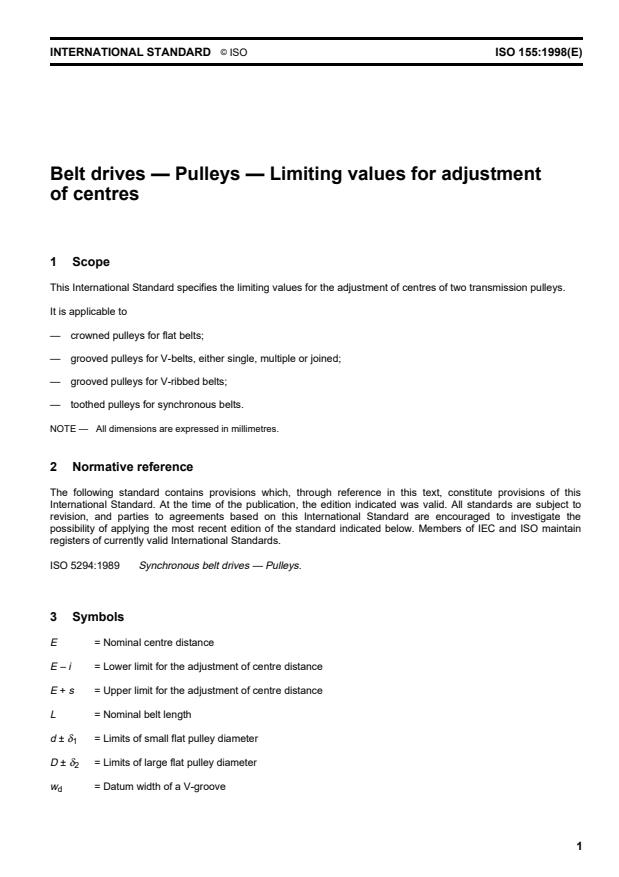
ISO 155:1998 - Belt drives — Pulleys — Limiting values for adjustment of centres Released:7/16/1998

ISO 155:1998 - Transmissions par courroies — Poulies — Limites de réglage d'entraxe Released:7/16/1998
Overview
SIST ISO 155:1999 sets international guidelines for belt drives by specifying the limiting values for the adjustment of centre distances between two transmission pulleys. This standard applies to various pulley designs used in mechanical power transmission, including flat belt pulleys, V-belt pulleys, V-ribbed belt pulleys, and synchronous belt pulleys. By recommending consistent adjustment limits, the standard supports optimal performance, reliability, and safety in belt-driven power transmission systems.
Key Topics
Types of Pulleys Covered:
- Crowned pulleys for flat belts
- Grooved pulleys for single, multiple, or joined V-belts
- Grooved pulleys for V-ribbed belts
- Toothed pulleys for synchronous belts
Adjustment of Centre Distance:
- Specifies the permissible range for adjusting the distance between pulley centres
- Limits expressed as minimum and maximum values relative to the nominal centre distance
- Factors include mechanical tolerances, belt elasticity, installation slack, and operational take-up requirements
Dimensional Considerations:
- All relevant measurements are standardized in millimetres
- Reference values for pulley diameters, groove pitch, effective and datum widths
- Accommodates factors like pulley crowning, belt material properties, and manufacturing tolerances
Symbols and Factors:
- E: Nominal centre distance
- i: Lower (slack-off) limit factor
- s: Upper (take-up) limit factor
- Additional parameters for belt and pulley dimensions and tolerances
Applications
SIST ISO 155:1999 is a foundational standard for a wide range of industries where belt drives are integral to machinery and equipment. Typical application areas include:
- Industrial Automation: Conveyor systems, packaging machines, and assembly lines utilize standardized pulley adjustment limits for reliable operation.
- Manufacturing Equipment: Machine tools, textile machinery, and material handling devices benefit from precise belt drive alignment and centre adjustment.
- HVAC Systems: Fans, compressors, and pumps in heating, ventilation, and air conditioning depend on correct belt tension and alignment for efficiency.
- Automotive & Transportation: Ensures uniformity in auxiliary drives, reducing maintenance downtime and optimizing performance.
By adhering to the adjustment limits specified in this standard, designers and manufacturers can:
- Ensure Proper Belt Tension: Prevent belt slippage, excessive wear, or premature failure.
- Facilitate Easy Installation: Allow for initial slack-off and subsequent tension adjustment.
- Maintain Operational Efficiency: Accommodate material properties such as elastic extension during use.
Related Standards
To ensure comprehensive compliance and broader optimization of belt-driven systems, organizations should also refer to these related standards:
- ISO 22:1991: Flat transmission belts and corresponding pulleys - dimensions and tolerances
- ISO 4183:1995: Classical and narrow V-belts - grooved pulleys (datum system)
- ISO 4184:1992: Classical and narrow V-belts - length in datum system
- ISO 5290:1993 and ISO 5291:1993: Grooved pulleys for joined V-belts (effective system)
- ISO 5294:1989: Synchronous belt drives - pulleys
- ISO 5296-1:1989 & ISO 5296-2:1989: Synchronous belt drives - belt pitch codes
- ISO 9982:1998: Pulleys and V-ribbed belts for industrial applications - profiles and dimensions
Practical Value
Implementation of SIST ISO 155:1999 supports standardized mechanical design, reduces error during installation and maintenance, and helps prolong the service life of both belts and pulleys. By precisely defining adjustment limits for centre distances, this standard aids in achieving operational excellence for belt drive systems across diverse equipment and industrial sectors.
Relations
- Effective Date
- 12-May-2008
Buy Documents
ISO 155:1998 - Belt drives — Pulleys — Limiting values for adjustment of centres Released:7/16/1998
ISO 155:1998 - Transmissions par courroies — Poulies — Limites de réglage d'entraxe Released:7/16/1998
Frequently Asked Questions
SIST ISO 155:1999 is a standard published by the Slovenian Institute for Standardization (SIST). Its full title is "Belt drives -- Pulleys -- Limiting values for adjustment of centres". This standard covers: Belt drives -- Pulleys -- Limiting values for adjustment of centres
Belt drives -- Pulleys -- Limiting values for adjustment of centres
SIST ISO 155:1999 is classified under the following ICS (International Classification for Standards) categories: 21.220.10 - Belt drives and their components. The ICS classification helps identify the subject area and facilitates finding related standards.
SIST ISO 155:1999 has the following relationships with other standards: It is inter standard links to ISO 155:1989. Understanding these relationships helps ensure you are using the most current and applicable version of the standard.
SIST ISO 155:1999 is available in PDF format for immediate download after purchase. The document can be added to your cart and obtained through the secure checkout process. Digital delivery ensures instant access to the complete standard document.
Standards Content (Sample)
SLOVENSKI STANDARD
01-december-1999
Jermenski pogoni - Jermenice - Mejne vrednosti za nastavitve medosnih razmikov
Belt drives -- Pulleys -- Limiting values for adjustment of centres
Transmissions par courroies -- Poulies -- Limites de réglage d'entraxe
Ta slovenski standard je istoveten z: ISO 155:1998
ICS:
21.220.10 Jermenski pogoni in njihovi Belt drives and their
deli components
2003-01.Slovenski inštitut za standardizacijo. Razmnoževanje celote ali delov tega standarda ni dovoljeno.
INTERNATIONAL ISO
STANDARD 155
Third edition
1998-07-15
Belt drives — Pulleys — Limiting values for
adjustment of centres
Transmissions par courroies — Poulies — Limites de réglage d’entraxe
A
Reference number
Foreword
ISO (the International Organization for Standardization) is a worldwide
federation of national standards bodies (ISO member bodies). The work of
preparing International Standards is normally carried out through ISO
technical committees. Each member body interested in a subject for which
a technical committee has been established has the right to be represented
on that committee. International organizations, governmental and non-
governmental, in liaison with ISO, also take part in the work. ISO
collaborates closely with the International Electrotechnical Commission
(IEC) on all matters of electrotechnical standardization.
Draft International Standards adopted by the technical committees are
circulated to the member bodies for voting. Publication as an International
Standard requires approval by at least 75 % of the member bodies casting
a vote.
International Standard ISO 155 was prepared by Technical Committee
ISO/TC 41, Pulleys and belts (including veebelts), Subcommittee SC 1,
Veebelts and grooved pulleys.
This third edition cancels and replaces the second edition (ISO 155:1989),
which has been technically revised. In particular, the grooved pulleys for
V-ribbed belts have been added.
Annex A of this International Standard is for information only.
© ISO 1998
All rights reserved. Unless otherwise specified, no part of this publication may be reproduced
or utilized in any form or by any means, electronic or mechanical, including photocopying and
microfilm, without permission in writing from the publisher.
International Organization for Standardization
Case postale 56 • CH-1211 Genève 20 • Switzerland
Internet iso@iso.ch
Printed in Switzerland
ii
©
INTERNATIONAL STANDARD ISO ISO 155:1998(E)
Belt drives — Pulleys — Limiting values for adjustment
of centres
1 Scope
This International Standard specifies the limiting values for the adjustment of centres of two transmission pulleys.
It is applicable to
— crowned pulleys for flat belts;
— grooved pulleys for V-belts, either single, multiple or joined;
— grooved pulleys for V-ribbed belts;
— toothed pulleys for synchronous belts.
NOTE — All dimensions are expressed in millimetres.
2 Normative reference
The following standard contains provisions which, through reference in this text, constitute provisions of this
International Standard. At the time of the publication, the edition indicated was valid. All standards are subject to
revision, and parties to agreements based on this International Standard are encouraged to investigate the
possibility of applying the most recent edition of the standard indicated below. Members of IEC and ISO maintain
registers of currently valid International Standards.
ISO 5294:1989 Synchronous belt drives — Pulleys.
3 Symbols
E = Nominal centre distance
E – i = Lower limit for the adjustment of centre distance
E + s = Upper limit for the adjustment of centre distance
= Nominal belt length
L
d ± d = Limits of small flat pulley diameter
D ± d = Limits of large flat pulley diameter
w = Datum width of a V-groove
d
©
ISO
W = Effective width of a V-groove
e
e = Groove pitch of a V-ribbed pulley
p = Pitch of synchronous belt teeth
b
4 Specifications
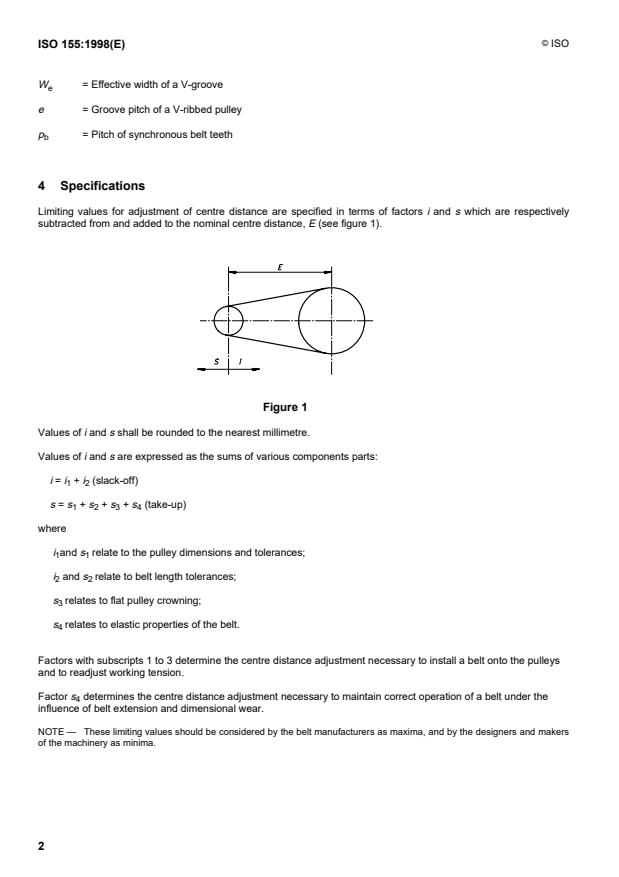
Limiting values for adjustment of centre distance are specified in terms of factors i and s which are respectively
subtracted f
...
INTERNATIONAL ISO
STANDARD 155
Third edition
1998-07-15
Belt drives — Pulleys — Limiting values for
adjustment of centres
Transmissions par courroies — Poulies — Limites de réglage d’entraxe
A
Reference number
Foreword
ISO (the International Organization for Standardization) is a worldwide
federation of national standards bodies (ISO member bodies). The work of
preparing International Standards is normally carried out through ISO
technical committees. Each member body interested in a subject for which
a technical committee has been established has the right to be represented
on that committee. International organizations, governmental and non-
governmental, in liaison with ISO, also take part in the work. ISO
collaborates closely with the International Electrotechnical Commission
(IEC) on all matters of electrotechnical standardization.
Draft International Standards adopted by the technical committees are
circulated to the member bodies for voting. Publication as an International
Standard requires approval by at least 75 % of the member bodies casting
a vote.
International Standard ISO 155 was prepared by Technical Committee
ISO/TC 41, Pulleys and belts (including veebelts), Subcommittee SC 1,
Veebelts and grooved pulleys.
This third edition cancels and replaces the second edition (ISO 155:1989),
which has been technically revised. In particular, the grooved pulleys for
V-ribbed belts have been added.
Annex A of this International Standard is for information only.
© ISO 1998
All rights reserved. Unless otherwise specified, no part of this publication may be reproduced
or utilized in any form or by any means, electronic or mechanical, including photocopying and
microfilm, without permission in writing from the publisher.
International Organization for Standardization
Case postale 56 • CH-1211 Genève 20 • Switzerland
Internet iso@iso.ch
Printed in Switzerland
ii
©
INTERNATIONAL STANDARD ISO ISO 155:1998(E)
Belt drives — Pulleys — Limiting values for adjustment
of centres
1 Scope
This International Standard specifies the limiting values for the adjustment of centres of two transmission pulleys.
It is applicable to
— crowned pulleys for flat belts;
— grooved pulleys for V-belts, either single, multiple or joined;
— grooved pulleys for V-ribbed belts;
— toothed pulleys for synchronous belts.
NOTE — All dimensions are expressed in millimetres.
2 Normative reference
The following standard contains provisions which, through reference in this text, constitute provisions of this
International Standard. At the time of the publication, the edition indicated was valid. All standards are subject to
revision, and parties to agreements based on this International Standard are encouraged to investigate the
possibility of applying the most recent edition of the standard indicated below. Members of IEC and ISO maintain
registers of currently valid International Standards.
ISO 5294:1989 Synchronous belt drives — Pulleys.
3 Symbols
E = Nominal centre distance
E – i = Lower limit for the adjustment of centre distance
E + s = Upper limit for the adjustment of centre distance
= Nominal belt length
L
d ± d = Limits of small flat pulley diameter
D ± d = Limits of large flat pulley diameter
w = Datum width of a V-groove
d
©
ISO
W = Effective width of a V-groove
e
e = Groove pitch of a V-ribbed pulley
p = Pitch of synchronous belt teeth
b
4 Specifications
Limiting values for adjustment of centre distance are specified in terms of factors i and s which are respectively
subtracted from and added to the nominal centre distance, E (see figure 1).
Figure 1
Values of i and s shall be rounded to the nearest millimetre.
Values of i and s are expressed as the sums of various components parts:
i = i + i (slack-off)
1 2
s = s + s + s + s (take-up)
1 2 3 4
where
i and s relate to the pulley dimensions and tolerances;
1 1
i and s relate to belt length tolerances;
2 2
s relates to flat pulley crowning;
...
NORME ISO
INTERNATIONALE 155
Troisième édition
1998-07-15
Transmissions par courroies — Poulies —
Limites de réglage d’entraxe
Belt drives — Pulleys — Limiting values for adjustment of centres
A
Numéro de référence
Avant-propos
L'ISO (Organisation internationale de normalisation) est une fédération
mondiale d'organismes nationaux de normalisation (comités membres de
l'ISO). L'élaboration des Normes internationales est en général confiée aux
comités techniques de l'ISO. Chaque comité membre intéressé par une
étude a le droit de faire partie du comité technique créé à cet effet. Les
organisations internationales, gouvernementales et non gouvernementales,
en liaison avec l'ISO, participent également aux travaux. L'ISO collabore
étroitement avec la Commission électrotechnique internationale (CEI) en
ce qui concerne la normalisation électrotechnique.
Les projets de Normes internationales adoptés par les comités techniques
sont soumis aux comités membres pour vote. Leur publication comme
Normes internationales requiert l'approbation de 75 % au moins des
comités membres votants.
La Norme internationale ISO 155 a été élaborée par le comité technique
ISO/TC 41, Poulies et courroies (y compris les courroies trapézoïdales),
sous-comité SC 1, Courroies trapézoïdales et poulies à gorges.
Cette troisième édition annule et remplace la deuxième édition
(ISO 155:1989), dont elle constitue une révision technique. En particulier,
les poulies à gorges pour courroies striées ont été ajoutées.
L'annexe A de la présente Norme internationale est donnée uniquement à
titre d'information.
© ISO 1998
Droits de reproduction réservés. Sauf prescription différente, aucune partie de cette publi-
cation ne peut être reproduite ni utilisée sous quelque forme que ce soit et par aucun pro-
cédé, électronique ou mécanique, y compris la photocopie et les microfilms, sans l'accord
écrit de l'éditeur.
Organisation internationale de normalisation
Case postale 56 • CH-1211 Genève 20 • Suisse
Internet iso@iso.ch
Imprimé en Suisse
ii
©
NORME INTERNATIONALE ISO ISO 155:1998(F)
Transmissions par courroies — Poulies — Limites
de réglage d’entraxe
1 Domaine d'application
La présente Norme internationale prescrit les limites de réglage de l'entraxe des deux poulies d'une transmission.
Elle est applicable aux
— poulies bombées pour courroies plates;
— poulies à gorges pour courroies trapézoïdales, individuelles, multiples ou jumelées;
— poulies à gorges pour courroies striées;
— poulies dentées pour courroies synchrones.
NOTE — Toutes les dimensions sont exprimées en millimètres.
2 Référence normative
La norme suivante contient des dispositions qui, par suite de la référence qui en est faite, constituent des
dispositions valables pour la présente Norme internationale. Au moment de la publication, l’édition indiquée était en
vigueur. Toute norme est sujette à révision et les parties prenantes des accords fondés sur la présente Norme
internationale sont invitées à rechercher la possibilité d'appliquer l’édition la plus récente de la norme indiquée
ci-après. Les membres de la CEI et de l'ISO possèdent le registre des Normes internationales en vigueur à un
moment donné.
ISO 5294:1989, Transmissions synchrones par courroies — Poulies.
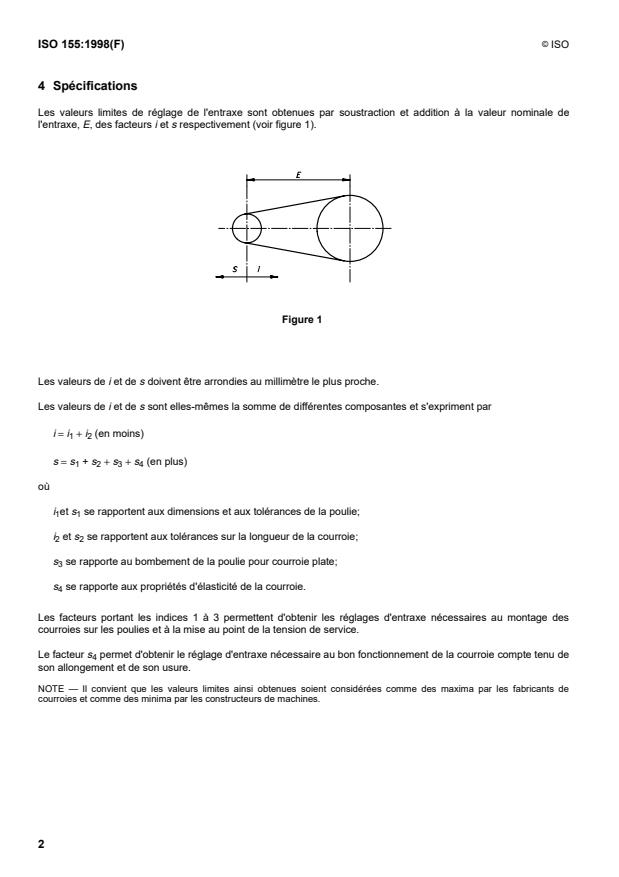
3 Symboles
E = Entraxe nominal
E – i = Limite inférieure de réglage de l’entraxe
E + s = Limite supérieure de réglage de l’entraxe
L = Longueur nominale de la courroie
d ± d = Diamètres limites de la petite poulie pour courroie plate
D ± d = Diamètres limites de la grande poulie pour courroie plate
w = Largeur de référence d’une gorge trapézoïdale
d
w = Largeur effective d’une gorge trapézoïdale
e
e = Pas de gorges d’une poulie striée
p = Pas d’une courroie synchrone
b
©
4 Spécifications
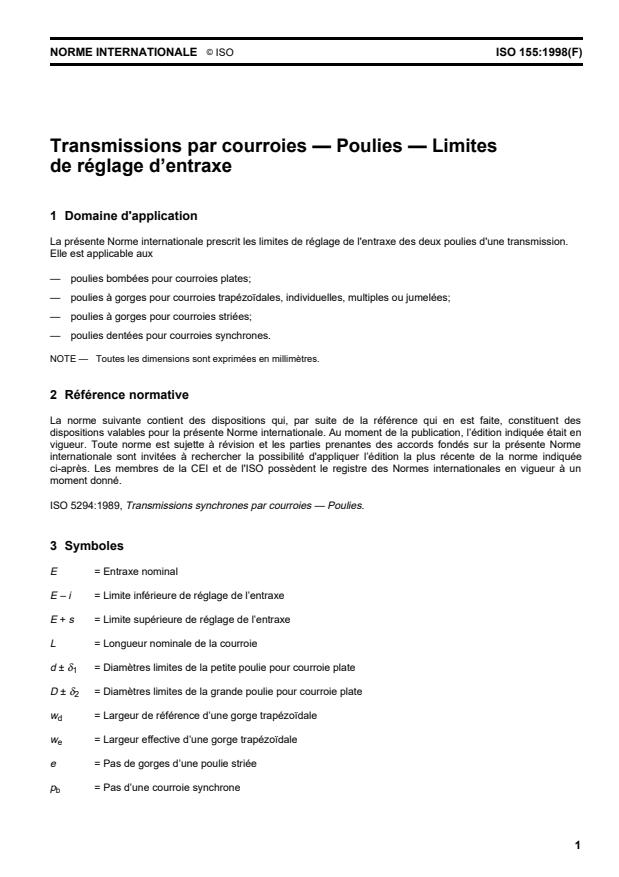
Les valeurs limites de réglage de l'entraxe sont obtenues par soustraction et addition à la valeur nominale de
l'entraxe, E, des facteurs i et s respectivement (voir figure 1).
Figure 1
Les valeurs de i et de s doivent être arrondies au millimètre le plus proche.
Les valeurs de i et de s sont elles-mêmes la somme de différentes composantes et s'expriment par
i = i + i (en moins)
1 2
+ (en plus)
s = s s + s + s
1 2 3 4
où
et se rapportent aux dimensions et aux tolérances de la poulie;
i s
1 1
et se rapportent aux tolérances sur la longueur de la courroie;
i s
2 2
se rapporte au bombement de la poulie pour courroie plate;
s
se rapporte aux propriétés d'élasticité de la courroie.
s
Les facteurs portant les indices 1 à 3 per
...