

oSIST prEN 13940-2:2010
(Main)Health informatics - System of concepts to support continuity of care - Part 2: Health care process and workflow
General Information
- Abstract
The purpose of this European Standard is to enable communication at the semantic level between information systems in health care. This part standard complements Part 1. Its specific purpose is to define a system of concepts enabling the management, including communication, of the necessary information about the core process of health care provision to an individual subject of care and the corresponding workflow, so as to support its continuity, taking into consideration decision processes, quality control, and resource management. It provides the terminology for planning, delivery and follow-up of those activities that form the overall process.
This part standard applies a process modelling technique to identify the process objects, activities and sub-processes. It also takes into consideration the resource aspects, the responsibilities of health care providers, and means for patients' participation. Whenever continuity of health care delivery implies social interventions as part of, or in support to, the process towards health recovery, these are to be mentioned wherever relevant in the process and workflow; but addressing those social interventions in depth is not part of the scope of this European Standard.
- Status
- Not Published
- Public Enquiry End Date
- 02-Jan-2011
- Technical Committee
- ITC - Information technology
- Current Stage
- 98 - Abandoned project (Adopted Project)
- Start Date
- 18-Jul-2025
- Due Date
- 23-Jul-2025
- Completion Date
- 18-Jul-2025



Overview
The European Standard oSIST prEN 13940-2:2010, developed by CEN Technical Committee 251 on Health Informatics, defines a comprehensive system of concepts to support the continuity of care in health care environments. This Part 2 of the series focuses on the health care process and workflow, providing semantic-level communication frameworks for information systems involved in patient care.
The standard complements Part 1 (Basic Concepts) by detailing the core processes, activities, workflows, resource management, quality control, and decision-making aspects necessary to support seamless and continuous care provision to individual patients. Its semantic clarity aims to enhance interoperability among health IT systems, support clinicians and care providers, and improve health care delivery outcomes.
Key Topics
Health Care Process Definition
The standard uses process modelling techniques to identify and describe health care processes, including activities, sub-processes, inputs, and outputs. It emphasizes clinical and administrative workflows essential to patient-centered care.Workflow and Continuity of Care
It highlights the importance of managing patient information flow and transitions within and across care settings to guarantee care continuity, facilitating effective communication among health care providers and supporting shared responsibility.Resource and Quality Management
Concepts related to health care resource allocation, provider responsibilities, and quality control mechanisms are articulated, enabling improved planning, delivery, and follow-up of care services.Patient Participation and Social Interventions
While the standard mentions social interventions as part of comprehensive care, it limits the scope to their integration within health care workflows, without delving into social care specifics.Terminology for Care Activities
Detailed terminology covers initial contact, referral, investigation, treatment activities, scheduling (appointments, commitments), adverse event management, and discharge reporting.Process Evaluation
It defines metrics and concepts for process evaluation, enabling the measurement and continuous improvement of health care effectiveness and efficiency.
Applications
Health Informatics Systems Integration
oSIST prEN 13940-2:2010 provides standardized vocabulary and models that health IT developers and vendors can incorporate to ensure semantic interoperability across electronic health records (EHRs), hospital information systems, and other clinical applications.Health Care Process Optimization
Organizations can apply the standard’s framework to map and analyze their clinical workflows, identify bottlenecks, and implement quality management strategies aimed at improving patient outcomes and reducing costs.Decision Support and Quality Control
By structuring care processes and resource management, the standard supports clinical decision-making, quality assurance, and compliance with health care regulations.Continuity of Care Enhancement
Enables clinicians, care managers, and funding bodies to understand and optimize care pathways, referrals, and transitions between care providers, ensuring seamless patient experience and treatment continuity.Patient-Centered Care Models
Facilitates better inclusion of patient participation and communication within care workflows, supporting personalized and coordinated health services.
Related Standards
EN 13940-1: Basic Concepts
Complements Part 2 by providing foundational definitions and conceptual frameworks essential to understanding and implementing continuity of care systems.HL7 and ISO Health Informatics Standards
oSIST prEN 13940-2:2010 aligns with international health informatics standards aimed at interoperability and data exchange, such as HL7 FHIR and ISO/TC 215 series.Care Pathway and Workflow Models
The standard references existing clinical process models like the Danish EHR model, SAMBA model, and Swedish Generic Process model, further supporting standardized workflow descriptions.Quality Management Standards in Health Care
Interfaces with broader quality and patient safety standards to ensure comprehensive care process evaluation and resource management.
Keywords: Health informatics, continuity of care, health care process, workflow, health IT interoperability, clinical pathways, health care quality management, resource allocation, patient-centered care, health care standards, oSIST prEN 13940-2:2010, CEN health informatics standards
Get Certified
Connect with accredited certification bodies for this standard

BSI Group
BSI (British Standards Institution) is the business standards company that helps organizations make excellence a habit.

NYCE
Mexican standards and certification body.
Sponsored listings
Frequently Asked Questions
oSIST prEN 13940-2:2010 is a draft published by the Slovenian Institute for Standardization (SIST). Its full title is "Health informatics - System of concepts to support continuity of care - Part 2: Health care process and workflow". This standard covers: The purpose of this European Standard is to enable communication at the semantic level between information systems in health care. This part standard complements Part 1. Its specific purpose is to define a system of concepts enabling the management, including communication, of the necessary information about the core process of health care provision to an individual subject of care and the corresponding workflow, so as to support its continuity, taking into consideration decision processes, quality control, and resource management. It provides the terminology for planning, delivery and follow-up of those activities that form the overall process. This part standard applies a process modelling technique to identify the process objects, activities and sub-processes. It also takes into consideration the resource aspects, the responsibilities of health care providers, and means for patients' participation. Whenever continuity of health care delivery implies social interventions as part of, or in support to, the process towards health recovery, these are to be mentioned wherever relevant in the process and workflow; but addressing those social interventions in depth is not part of the scope of this European Standard.
The purpose of this European Standard is to enable communication at the semantic level between information systems in health care. This part standard complements Part 1. Its specific purpose is to define a system of concepts enabling the management, including communication, of the necessary information about the core process of health care provision to an individual subject of care and the corresponding workflow, so as to support its continuity, taking into consideration decision processes, quality control, and resource management. It provides the terminology for planning, delivery and follow-up of those activities that form the overall process. This part standard applies a process modelling technique to identify the process objects, activities and sub-processes. It also takes into consideration the resource aspects, the responsibilities of health care providers, and means for patients' participation. Whenever continuity of health care delivery implies social interventions as part of, or in support to, the process towards health recovery, these are to be mentioned wherever relevant in the process and workflow; but addressing those social interventions in depth is not part of the scope of this European Standard.
oSIST prEN 13940-2:2010 is classified under the following ICS (International Classification for Standards) categories: 01.040.35 - Information technology (Vocabularies); 35.240.80 - IT applications in health care technology. The ICS classification helps identify the subject area and facilitates finding related standards.
oSIST prEN 13940-2:2010 is available in PDF format for immediate download after purchase. The document can be added to your cart and obtained through the secure checkout process. Digital delivery ensures instant access to the complete standard document.
Standards Content (Sample)
SLOVENSKI STANDARD
01-december-2010
Zdravstvena informatika - Sistem pojmov za podporo neprekinjeni oskrbi - 2. del:
Proces zdravstevene oskrbe in potek dela
Health informatics - System of concepts to support continuity of care - Part 2: Health care
process and workflow
Medizinische Informatik - Begriffssystem zur Unterstützung der Versorgungskontinuität -
Teil 2: Gesundheitsfürsorge-Prozess und Arbeitsablauf
Informatique de la santé - Système de concepts en appui de la continuité des soins -
Partie 2: Processus de soins et flux des tâches
Ta slovenski standard je istoveten z: prEN 13940-2
ICS:
01.040.35 Informacijska tehnologija. Information technology.
Pisarniški stroji (Slovarji) Office machines
(Vocabularies)
35.240.80 Uporabniške rešitve IT v IT applications in health care
zdravstveni tehniki technology
2003-01.Slovenski inštitut za standardizacijo. Razmnoževanje celote ali delov tega standarda ni dovoljeno.
EUROPEAN STANDARD
DRAFT
NORME EUROPÉENNE
EUROPÄISCHE NORM
October 2010
ICS 01.040.35; 35.240.80
English Version
Health informatics - System of concepts to support continuity of
care - Part 2: Health care process and workflow
Informatique de la santé - Système de concepts en appui Medizinische Informatik - Begriffssystem zur Unterstützung
de la continuité des soins - Partie 2: Processus de soins et der Versorgungskontinuität - Teil 2: Gesundheitsfürsorge-
flux des tâches Prozess und Arbeitsablauf
This draft European Standard is submitted to CEN members for enquiry. It has been drawn up by the Technical Committee CEN/TC 251.
If this draft becomes a European Standard, CEN members are bound to comply with the CEN/CENELEC Internal Regulations which
stipulate the conditions for giving this European Standard the status of a national standard without any alteration.
This draft European Standard was established by CEN in three official versions (English, French, German). A version in any other language
made by translation under the responsibility of a CEN member into its own language and notified to the CEN Management Centre has the
same status as the official versions.
CEN members are the national standards bodies of Austria, Belgium, Bulgaria, Croatia, Cyprus, Czech Republic, Denmark, Estonia,
Finland, France, Germany, Greece, Hungary, Iceland, Ireland, Italy, Latvia, Lithuania, Luxembourg, Malta, Netherlands, Norway, Poland,
Portugal, Romania, Slovakia, Slovenia, Spain, Sweden, Switzerland and United Kingdom.
Recipients of this draft are invited to submit, with their comments, notification of any relevant patent rights of which they are aware and to
provide supporting documentation.
Warning : This document is not a European Standard. It is distributed for review and comments. It is subject to change without notice and
shall not be referred to as a European Standard.
EUROPEAN COMMITTEE FOR STANDARDIZATION
COMITÉ EUROPÉEN DE NORMALISATION
EUROPÄISCHES KOMITEE FÜR NORMUNG
Management Centre: Avenue Marnix 17, B-1000 Brussels
© 2010 CEN All rights of exploitation in any form and by any means reserved Ref. No. prEN 13940-2:2010: E
worldwide for CEN national Members.
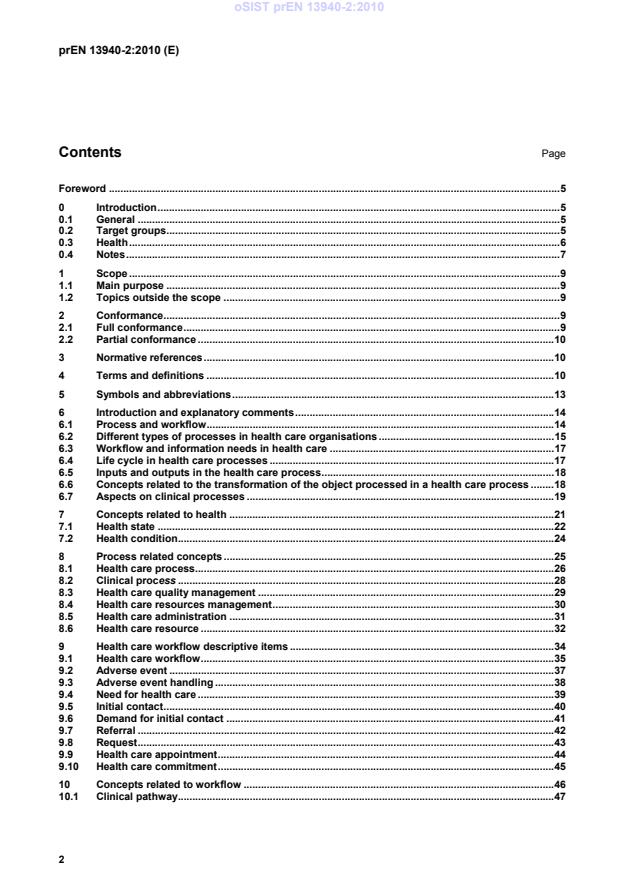
Contents Page
Foreword . 5
0 Introduction . 5
0.1 General . 5
0.2 Target groups . 5
0.3 Health . 6
0.4 Notes . 7
1 Scope . 9
1.1 Main purpose . 9
1.2 Topics outside the scope . 9
2 Conformance . 9
2.1 Full conformance . 9
2.2 Partial conformance . 10
3 Normative references . 10
4 Terms and definitions . 10
5 Symbols and abbreviations . 13
6 Introduction and explanatory comments . 14
6.1 Process and workflow . 14
6.2 Different types of processes in health care organisations . 15
6.3 Workflow and information needs in health care . 17
6.4 Life cycle in health care processes . 17
6.5 Inputs and outputs in the health care process . 18
6.6 Concepts related to the transformation of the object processed in a health care process . 18
6.7 Aspects on clinical processes . 19
7 Concepts related to health . 21
7.1 Health state . 22
7.2 Health condition . 24
8 Process related concepts . 25
8.1 Health care process. 26
8.2 Clinical process . 28
8.3 Health care quality management . 29
8.4 Health care resources management . 30
8.5 Health care administration . 31
8.6 Health care resource . 32
9 Health care workflow descriptive items . 34
9.1 Health care workflow . 35
9.2 Adverse event . 37
9.3 Adverse event handling . 38
9.4 Need for health care . 39
9.5 Initial contact . 40
9.6 Demand for initial contact . 41
9.7 Referral . 42
9.8 Request . 43
9.9 Health care appointment . 44
9.10 Health care commitment . 45
10 Concepts related to workflow . 46
10.1 Clinical pathway . 47
10.2 Health care investigating activity . 48
10.3 Health care treatment activity . 49
10.4 Health care activities repository . 50
11 Data and information management . 51
11.1 Discharge report . 52
11.2 Discharge summary . 53
12 Concepts related to process evaluation . 54
12.1 Health care process evaluation . 55
Annex A (informative) Examples of process modelling . 57
A.1 The Danish EHR Model . 57
A.2 The SAMBA Model . 58
A.3 The Nursing Process Model . 59
A.4 The Swedish Generic Process Model for Health Care . 60
Annex B (informative) Contextual framework for traceability of concepts in this standard . 61
B.1 Introduction . 61
B.2 Strategy for traceability of concepts . 61
B.3 The generic clinical process model . 62
B.4 The workflow model based on the generic clinical process . 64
B.5 Information areas for concepts to be identified . 70
Annex C (normative) Terms defined in Part 1 of this European standard (EN 13940 1:2007) . 72
Bibliography . 77
Table of Figures
Figure 1 ― General schematic representation of a process, with inputs, nested activities/processes,
management, resource supply and outputs, at different levels of detail . 14
Figure 2 ― Information areas and the relation between clinical process and other areas . 17
Figure 3 ― Comprehensive UML diagram of concepts related to health . 21
Figure 4 ― Health state (UML representation). 23
Figure 5 ― Health condition (UML representation) . 25
Figure 6 ― Comprehensive UML diagram of process related concepts . 25
Figure 7 ― Health care process (UML representation) . 27
Figure 8 ― Clinical process (UML representation) . 28
Figure 9 ― Health care quality management (UML representation) . 29
Figure 10 ― Health care resources management (UML representation) . 30
Figure 11 ― Health care administration (UML representation) . 31
Figure 12 ― Health care resources (UML representation) . 32
Figure 13 ― Point of care (UML representation) . 33
Figure 14 ― Comprehensive UML diagram of health care workflow descriptive items . 34
Figure 15 ― Health care workflow (UML representation) . 36
Figure 16 ― Adverse event (UML representation) . 38
Figure 17 ― Adverse event handling (UML representation) . 38
Figure 18 ― Need for health care (UML representation) . 39
Figure 19 ― Initial contact (UML representation) . 40
Figure 20 ― Demand for initial contact (UML representation) . 41
Figure 21 ― Referral (UML representation) . 42
Figure 22 ― Request (UML representation) . 43
Figure 23 ― Health care appointment (UML representation) . 44
Figure 24 ― Health care commitment (UML representation) . 45
Figure 25 ― Comprehensive UML diagram of concepts related to workflow . 46
Figure 26 ― Clinical pathway (UML representation) . 47
Figure 27 ― Health care investigating activity (UML representation) . 48
Figure 28 ― Health care treatment activity (UML representation) . 49
Figure 29 ― Health care activities repository (UML representation) . 50
Figure 30 ― Comprehensive UML diagram of data and information management . 51
Figure 31 ― Discharge report (UML representation) . 52
Figure 32 ― Discharge summary (UML representation) . 53
Figure 33 ― Comprehensive UML diagram of concepts related to process evaluation . 54
Figure 34 ― Health care process evaluation (UML representation) . 55
Figure 35 ― Clinical process outcome evaluation (UML representation) . 56
Foreword
This document (prEN 13940-2:2010) has been prepared by Technical Committee CEN/TC 251 “Health
informatics”, the secretariat of which is held by NEN.
This document is currently submitted to the CEN Enquiry.
The two-part standard 13940 under the general heading Health informatics – System of concepts to support
Continuity of care" consists of the following parts:
Part 1: Basic concepts.
Part 2: Health care process and workflow.
0 Introduction
0.1 General
Continuity of care is increasingly invoked nowadays as one of the most important issues in health care. What
is in perspective is both an improvement of the quality of care, and a reduction of costs. Continuity of care is
now seen as prerequisite to improve at the same time efficacy, effectiveness and efficiency of health care.
Thus there is a need for clinicians, private and public health care providers, health managers, and funding
organisations to base their decisions, in terms of re-organisation of services, on a good understanding of the
concepts involved.
This European Standard defines the classes of concepts and their descriptive terms, regarding all processes
of care, especially considering patient-centred continuity of care, shared care and seamless care.
Continuity of care depends on the effective transfer and linkage of data and information about both the
clinical situation and the health care provided to a subject of care, between different parties involved in the
process, within the framework of ethical, professional and legal rules. The description and formalisation of
continuity of care in information systems implies that the related concepts and descriptive terms be defined,
so establishing a common conceptual framework across national, cultural and professional barriers.
This part standard defines a set of concepts reflecting phenomena that are basically part of the processes in
health care concerning an individual subject of care. The health care process reflects the interaction between
the subject of care and health care professionals in general. The clinical process is defined by a clinical
context to cover the continuity aspects from the subject of care perspective. The actual focus of that process
is the health state of a subject of care. This document focuses the concepts related to the health care and
the clinical processes as well as the workflow of the clinical process. This second part of the two-part
standard supplements the first part from this perspective. With the aim to further clarify and give traceability
to the concepts, this document also includes an informative part with generic models of the clinical process
and the workflow of that process.
0.2 Target groups
The system of concepts and the terms defined in this European Standard are designed to support the
management of health care related information over time and the delivery of care by different health care
actors who are working together. This includes primary care professionals and teams, health care funding
organisations, managers, patients, secondary and tertiary health care providers, and community care teams.
This harmonised system of concepts will be used to facilitate clinical and administrative decision making, and
to enhance relationships between health care professionals and their patients.
Among other applications, the content of this European Standard should have importance for the
development of well designed clinical networks, either at regional — possibly cross-border —, or at local
level, either including hospital settings or not; it will help the correct management of personal health data. It
provides a clear conceptual framework to establish the terms of reference of health information systems, to
be used for tenders.
The system of concept as well as the process and workflow descriptions are meant as tools for the
development of information systems. They may also be used for business analysis as a basis for
organisational decisions and more widely in organisational developments that are not inherently tied to the
use of ICT.
0.3 Health
In 1948 WHO defined health as “. a state of complete physical, mental and social well-being and not merely
the absence of disease or infirmity”. We interpret this definition as being the one of 'good health', which
means that any harm to the physical, mental or social condition of a person has the effect that health is no
longer present. This definition by WHO does not include any incompleteness of "health", meaning that the
presence of any disease or (health) problem, calling or not for health care activities causes the subject of
care not to possess health. To our eyes, WHO defines something that most people would consider to be
"good health" or even "best possible health", the ultimate target for any intervention meant to restore,
maintain or stabilise an individual's or a population's welfare. In 1986 WHO made two amendments to the
above definition: “resource for everyday life, not the objective of living”, and “health is a positive concept
emphasising social and personal resources, as well as physical capacities”. Thus health still includes several
quality perspectives and is not just inherent characteristics of an individual.
In ICF (the International Classification of Functioning, Disability and Health) of WHO, the concept of health is
described in a more specified way. The theoretical model in ICF identifies five health components; body
function, body structure, activity and participation, personal and environmental factors respectively. And it is
noteworthy that in the introduction of an article published on Saturday 22 March 2003 in the Health Care
Financing Review1, Tevfik Bedirhan Üstün et al. also write: "The health state of a person can be described in
terms of capacity to carry out a set of tasks or actions. In addition, the health state also includes changes in
body functions and/or structures arising from a health condition. The impact of the health state on a person's
life can be understood by measuring performance of tasks and actions in the person's real-life or actual
environment. The full picture of the health experience can further be appreciated by taking into cognisance
the value that people place on levels of functioning in given domains in association with a health condition.
Plainly, the concept of functional status is integral to health and its achievement. Two individuals with
identical diagnoses may have utterly different levels of functioning that determine their actual health status."
In this European Standard, the word “health” is not used as an isolated term designating any concept within
the scope of the standard. The word "health" is merely used as prefix in several terms. The meaning of this
prefix is that the concept represented by the term has to do with the subject's of care health state or health
condition, often in relation to a health care/clinical process. To describe, for example, a body function, a
mental state, a degree of general well-being, and causes for interventions in the domain of health care, this
European Standard uses the terms "health state", "health condition" and "health issue". The health state is a
concept reflecting a holistic view of the health of a human being. The health condition is a perception of an
aspect or part of the health state and it may be good or bad. The health issue is the reason for the request
for health care and it may or may not encompass a disease but it is always subject to assessment with
respect to whether health care activities are needed, including medical statements, immunisation and other
activities performed for a person in good health state.
"WHO's ICF and functional status information in health records", Health Care Financ Rev. 2003 Spring;24(3):77-88.
0.4 Notes
0.4.1 General
These notes apply to this European Standard in general.
0.4.2 Subject of care
In this European Standard, 'subject of care' refers to an individual. It is assumed that in those cases where a
health care activity addresses a group of more than one individual (e.g. a family, a community), and where a
single health record is used to capture the health care activities provided to the group, each individual within
the group will be referenced explicitly within that health record.
0.4.3 Health care versus social care
Health care as well as social care has the objective to restore, maintain, and keep health in the WHO sense.
Health care is not limited to clinical activities with influence on body function or body structure. All kinds of
activities having the potential to influence any one of the five components of health mentioned in ICF can be
part of health care. Activities interacting with intellectual functions may have the purpose to improve the
health state; such activities include informative and supportive talk as well as psychotherapy. Provision of a
walking cane may be an act of rehabilitation and is considered to be within the scope of health care. In social
care oral information as well as provision of physical aid may contribute to the restoration of health. There is
an obvious overlap between health care activities and social care activities. This standard is focussed on the
part of health care that does not include social care. The role of the subject of care is defined out from that
health care domain and the terms chosen are from that sector. However many of the concepts are relevant
for the social care sector and in the cooperation of the different domains of health care this standard should
be applicable, though it is not the primary aim of this standard to directly be applied in social care.
0.4.4 Description and display of concepts
This European Standard aims to identify and describe concepts important to continuity of care, and to
establish a system of concepts that is to be used when setting up information systems, especially when
dealing with health record communication. The primary focus of the standard is terminology and ontology.
Descriptions framed in tables having the same pattern of rubrics are systematically provided for all the
concepts presented in Clauses 7 to 12. Whenever not felt relevant to a given concept, some of these rubrics
may intentionally be left blank. In the headings of these tables, the names of those concepts that are purely
abstract constructs and therefore are not instantiable but through their specialisation, are shown in italic
characters.
Examples are provided wherever felt relevant and necessary. However, in general, examples for
superordinate concepts are to be sought at the level of the corresponding subordinate concepts.
In order to help the readers understand more easily the relationships between these concepts, diagrams
have been introduced based on UML conventions. Thus, for each one of the concepts described in Clauses
6 to 11, a subset of the general and comprehensive diagram is provided as an illustrative part of the
monograph, showing only its direct relationships with other concepts belonging to the current system of
concepts.
Diagrams providing partial views of the system of concepts are also proposed at the beginning of each one
of Clauses 6 to 11. These diagrams are focused on the topic addressed in the corresponding clause. For
instance: actors, or health data management. For a better clarity, they only show the relationships between
the concepts defined in that clause and, except for Clause 6, all relationships between those concepts and
concepts defined in other clauses of this European Standard. For Clause 6 the relationship with a number of
concepts that are not defined in this standard is shown. For clarity of reading, concepts defined in the clause
the diagram is a part of are shown in white. Concepts defined in other clauses of the standard are shown in
grey, concepts defined in part 1 (see EN 13940-1) are shown in yellow while concepts not defined in this
standard is light grey, without frames.
The purpose of using UML diagrams in this European Standard is to highlight the relationships between
concepts. Their attributes, which actually do not belong to the field of concept modelling, are not addressed
in this European Standard. This means that additional attributes may be felt useful or necessary in the
course of implementation, without conformance with the current European Standard being at stake.
Besides, there are related features and other related entities which may be considered as concepts in their
own right. They are usually of a generic nature, and do not belong to the system of concepts which is the
focus of this European Standard. As a consequence, they are not described any further. An example of this
is: a subject of care may have an undefined number of addresses, and an address may be associated with
an undefined number of subjects of care. The resolution of this 'many to many' relationship is not within the
scope of this European Standard.
In order to differentiate them both from normal attributes and from concepts with which direct relationships
are explicitly mentioned, these features are shown apart, in a rubric called "features or related entities not
described in this document".
0.4.5 Concept modelling vs. information modelling
[The concepts designated by terms printed in italic in this sub-section are defined in ISO 1087:2002].
Concept modelling may be used for two purposes. The main purpose is to graphically describe a concept
system within a subject field. This description can clarify the relationships between the concepts, and
illustrate some of their definitions. The other purpose is to let a concept modelling tool set up a data base
organising the concept system, in order to keep track of its concepts and relationships, as well as check its
consistency.
Information modelling has the purpose of organising the information objects, each one representing
knowledge about a concept. There is however additional information in an information model about the
properties of the information objects, shown as attributes to the objects, and operations describing behaviour
of the objects.
All concepts have the same degree of integrity, and in a concept model all concepts should be modelled in
the same way. In UML this means that a concept is represented by a class. There are no attributes or
operations in the classes. A characteristic of a concept is also a concept, and its function as characteristic is
therefore modelled as a relation to the core concept. Relations may be generic making the specific concept
inherit all characteristics of its generic concept. The specific concept has additional characteristics modelled
as concepts associated to the specific concept.
Beside associative relations and generic relations there are partitive relations describing partitive concepts
being parts of a comprehensive concepts.
If a relation between two concepts denotes an essential characteristic of the core concept, this relation can
probably be used when the core concept is to be textually defined. Also concepts not being characteristics of
another concept may be related, and it may be clarifying to show this relation graphically. Equally, not all
characteristics used in a definition have to be shown in the graph.
In an information model a lot of information objects should be added. They are often modelled as attributes.
The relations between the information objects, drawn as classes in the UML are often the same as in the
concept model. Some related concepts are not necessary to show as classes of their own, and they may
then be represented as attributes of their class. Even some characteristics of concepts may be better
represented as attributes than as separate classes in the information model. The information model needs to
be a robust template for a data model, which can be used in the creation of a data base keeping information
of those objects which have been conceptually analysed in the concept model.
In this European Standard concepts are described in text and models. The models comply with the principles
described here above. The tables list the relationships of each concept, but they also list those attributes that
are considered important to be included in an information model though they are not necessary to describe
the concept system.
0.4.6 Frequent use of the term 'care' instead of 'health care'
The scope of this European Standard regards topics related to continuity of health care. However, in this
document the shorter term 'care' is often used and is to be understood as a synonym for the longer term
'health care'. Examples of this are: 'continuity of care', 'subject of care', 'episode of care', 'period of care',
'care plan'. Would the concepts hereby described be used in another context, the complete phrase 'health
care' might have to be systematically used wherever relevant in order to provide full consistency in that
context.
1 Scope
1.1 Main purpose
This part standard supplements Part 1(EN 13940-1). Its specific purpose is to define a system of concepts
for the provision of care in clinical processes to an individual subject of care and the corresponding workflow.
Furthermore the concepts aim to enable the management, including communication, so as to support
continuity of care, taking into consideration data handling, decision making, quality control, and resource
management. It provides the terminology for planning, delivery and follow-up of the activities and health
conditions that form the overall health care and clinical process. An additional aim is to enable the reuse of
clinical data for other purposes than the direct care of an individual subject of care at group level for follow up
and knowledge management.
This part standard identifies the most common objects processed that can be identified in clinical processes.
It also takes into consideration the resource aspects, the responsibilities of health care providers and means
for subject’s of care participation. Whenever continuity of health care delivery implies social interventions as
part of, or in support to, the health care process towards health recovery, these are to be mentioned
wherever relevant in the process and workflow descriptions; but addressing those social interventions in
depth is not within the scope of this European Standard.
1.2 Topics outside the scope
This European Standard does not mean to be prescriptive with regard to the performance or not of any
health care activities or to the clinical content of the specific processes of health care; neither does it
prescribe a specific method or language for process modelling.
2 Conformance
2.1 Full conformance
In order to be declared fully conformant with the current European standard, an information system shall:
1. implement all the concepts which the current European standard defines in its normative provisions;
2. implement all the relationships between these concepts, as defined in this European standard,
including their relationship type;
3. keep the multiplicity of these relationships within the intervals defined by this European standard.
Additionally:
4. Whenever any term used in this European standard to designate a concept is used in the description
of the information system, it shall refer to the same concept, and therefore bear the same meaning.
5. Symmetrically, if a term other than the one used in this European standard is proposed to designate
a concept which would nevertheless strictly match the same description as per this European
standard, its synonymy shall be explicitly stated.
This requirement applies particularly to all languages other than English, French, and German, in
which this European standard is officially translated.
2.2 Partial conformance
Partial conformance shall only be declared if the parts of this European standard with which the conformance
of an information system is claimed are precisely and accurately stated.
3 Normative references
The following referenced documents are indispensable for the application of this document. For dated
references, only the edition cited applies. For undated references, the latest edition of the referenced
document (including any amendments) applies.
EN 13940-1, Health informatics – System of concepts to support continuity of care – Part 1: Basic concepts
ISO 704, Terminology work – Principles and methods
ISO 10241, International terminology standards – Preparation and layout
ISO/TR 24156, Guidelines for using UML notation in terminology work
EN-ISO 9000:2005, Quality management systems – Fundamentals and vocabulary
EN-ISO 9001:2008, Quality management systems – Requirements
CEN/TS 15524, Health services – Quality management systems – Guide for the use of ISO 9001:2000
4 Terms and definitions
For the purposes of this document, the terms and definitions given in ISO 1087-1, EN 12264 and EN 13940-
1 and the following apply.
4.1
commitment
acceptance of a request or of an assignment
4.2
consent
agreement, approval, or permission as to some act or purpose given voluntarily by a competent person
[ISO 18308:2009]
4.3
unintended event
phenomenon which is not part of the normal course of a process but may influence it
NOTE 1 An unintended event can be either expected or unexpected.
NOTE 2 activities in a process are deliberate and have its purpose(s). In an ideal situation purposes are always
fulfilled. If an activity in whatever other process has an impact on the process currently analysed, the effect of this activity
is perceived by the current process as an unintended event. Then the course of the process may deviate from the
expected one. Such an exception from the desired course may prove negative or positive in comparison to the desired
process outcome.
EXAMPLES Surgical complication (anatomy and tissue reacts in an unexpected manner), electric failure,
contamination in a medicinal product, hardware failure, spontaneous recovery when the patient is awaiting therapy.
4.4
health care activity management
actions to organise, allocate resources and schedule health care activities in a care plan
4.5
health care assessment activity
action, based on knowledge and information, to create an opinion related to health conditions and/or health
care activities
4.6
health care evaluation activity
action where the result or effect of a health care activity is analysed and compared to what was expected
4.7
health care investigating activity
health care activity with the intention to clarify one or several health conditions of a subject of care
4.8
health care planning activity
action aiming to include and/or change health care activities in a care plan
4.9
knowledge
facts, information, and skills acquired through experience, reasoning or education
4.10
medical device
any instrument, apparatus, implement, machine, appliance, implant, in vitro reagent or calibrator, software,
material or other similar or related article, intended by the manufacturer to be used, alone or in combination,
for human beings for one or more of the specific purpose(s) of
• diagnosis, prevention, monitoring, treatment or alleviation of disease,
• diagnosis, monitoring, treatment, alleviation of or compensation for an injury,
• investigation, replacement, modification, or support of the anatomy or of a physiological process,
• supporting or sustaining life,
• control of conception,
• disinfection of medical devices,
• providing information for medical purposes by means of in vitro examination of specimens derived from
the human body, and which does not achieve its primary intended action in or on the human body by
pharmacological, immunological or metabolic means, but which may be assisted in its function by such
means
[EN ISO 14971:2009]
NOTE 1 This definition has been developed by the Global Harmonization Task Force (GHTF)
NOTE 2 Products, which could be considered to be medical devices in some jurisdictions but for which there is not
yet a harmonized approach, are:
• aids for disabled/handicapped people,
• devices for the treatment/diagnosis of diseases and injuries in animals,
• accessories for medical devices (see Note 3),
• disinfection substances,
• devices incorporating animal and human tissues which can meet the requirements of the above definition but
are subject to different controls.
NOTE 3 Accessories intended specifically by manufacturers to be used together with a “parent” medical device to
enable that medical device to achieve its intended purpose, should be subject to this International Standard.
NOTE 4 The definition is recursive as the term appears in the sixth bullet point, which means that it does not comply
with terminological rules according to ISO 704. The meaning is simply, that a device used for service of a medical device
is included in the definition.
4.11
process
set of interrelated or interacting activities which transforms inputs into outputs
[ISO 9000:2000, 3.4.1]
NOTE Inputs to a process are generally outputs of other processes. In that sense, because their output can be used
as an input to another process, activities may sometimes be considered as resources in a process.
4.12
quality in health care
degree to which health care fulfil requirements related to defined quality characteristics
Note Quality is
...