

SIST EN 302 217-4-1 V1.4.1:2010
(Main)Fixed Radio Systems - Characteristics and requirements for point-to-point equipment and antennas - Part 4-1: System-dependent requirements for antennas
General Information
- Abstract
The present document summarizes all requirements for single main beam, linear polarization, directional antennas to be adopted in conjunction with Point-to-Point (PP) systems operating in the frequency range 1 GHz to 86 GHz. Single polarization antennas, dual polarization antennas, dual band/single polarized antennas and dual band/dual polarization antennas are considered. Description and limits for parameters relevant to essential requirements under article 3.2 of the R&TTE Directive [1] are given in EN 302 217-4-2 [4]. For other parameters and general information that does not affect the R&TTE Directive [1] "essential requirements" mentioned above, description and limits are set out in the present document. There are a number of different antenna types for various applications, the principles by which they are classified are given in clause 5. The present document does not cover aspects related to test procedures and test conditions, which are covered by the scope of EN 301 126-3-1 [2]. Guidance on the definition of radio parameters relevant to the essential requirements under article 3.2 of the R&TTE Directive [1] for DFRS may be found in TR 101 506 [i.1].
- Status
- Published
- Publication Date
- 21-Feb-2010
- Technical Committee
- SPN - Services and Protocols for Networks
- Current Stage
- 6060 - National Implementation/Publication (Adopted Project)
- Start Date
- 04-Feb-2010
- Due Date
- 11-Apr-2010
- Completion Date
- 22-Feb-2010
Buy Documents

ETSI EN 302 217-4-1 V1.4.1 (2009-09) - Fixed Radio Systems; Characteristics and requirements for point-to-point equipment and antennas; Part 4-1: System-dependent requirements for antennas

ETSI EN 302 217-4-1 V1.4.1 (2010-01) - Fixed Radio Systems; Characteristics and requirements for point-to-point equipment and antennas; Part 4-1: System-dependent requirements for antennas

Overview
SIST EN 302 217-4-1 V1.4.1:2010 specifies the system-dependent requirements for antennas used in fixed radio point-to-point (PP) systems operating in the frequency range of 1 GHz to 86 GHz. The standard, published by SIST (Slovenian Institute for Standardization) and aligned with ETSI EN 302 217-4-1, provides essential guidelines related to the characteristics and performance of directional antennas with a single main beam and linear polarization, covering single and dual polarization as well as dual band antenna configurations.
This document serves as a reference for the selection, classification, and deployment of PP antennas, ensuring network compatibility and conformance with regulatory requirements, particularly those under Article 3.2 of the R&TTE Directive.
Key Topics
Frequency Coverage: Antenna requirements are defined for systems operating across frequency bands from 1 GHz to 86 GHz, subdivided into several band segments for technical clarity.
Antenna Types Supported:
- Single polarization
- Dual polarization
- Dual band/single polarized
- Dual band/dual polarization
Classification Criteria:
- Radiation Pattern Envelope (RPE) Classes: Antennas are classified into RPE classes (1 to 4) based on their directional characteristics and side-lobe levels.
- Cross-Polar Discrimination (XPD) Categories: Performance categories for cross-polar discrimination are outlined, directly impacting network interference and link quality.
Key Parameters:
- RPE and XPD specifications relevant to essential regulatory requirements
- Guidelines for antenna gain as it affects system performance and frequency planning
- Mechanical and environmental guidelines (e.g., wind ratings, operational temperature, labelling)
Parameter Limits: Distinction between requirements essential for regulatory compliance (covered in EN 302 217-4-2) and additional parameters aiding practical deployment (as detailed within this standard).
Applications
The requirements and classifications provided in SIST EN 302 217-4-1 V1.4.1:2010 have practical value across several domains:
- Microwave Backhaul: Ensuring reliable high-capacity wireless connections between network nodes in mobile networks.
- Wireless Internet Service Providers (WISPs): Facilitating the deployment of robust fixed point-to-point links in urban, suburban, and rural environments.
- Private and Industrial Networks: Supporting secure and interference-resistant communications for utilities, transportation, and enterprise connectivity.
- Frequency Coordination and Spectrum Management: Assisting regulators and network planners in minimizing interference and optimizing spectrum usage.
- Equipment Procurement and Tendering: Serving as a technical reference for specifying and evaluating antennas in procurement processes.
By following this standard, organizations enhance the efficiency, reliability, and regulatory compliance of their fixed radio systems while streamlining interoperability and co-existence with other systems.
Related Standards
For comprehensive antenna and system conformance, the following standards should be reference alongside SIST EN 302 217-4-1:
- EN 302 217-4-2: Details parameter limits for antennas relating to the essential requirements under the R&TTE Directive.
- EN 301 126-3-1: Defines test procedures and conformance testing for PP antennas.
- EN 302 217-1: Provides an overview and system-independent common characteristics for fixed radio systems and antennas.
- EN 302 217-2-2 / EN 302 217-2-1: Covers digital systems operating in co-ordinated bands.
- ITU-R Recommendation F.699: Supplies reference radiation patterns for fixed wireless system antennas to support coordination studies and interference assessment.
Adhering to these related standards ensures full compliance and optimal integration of antenna systems within modern fixed radio networks.
Keywords: fixed radio systems, point-to-point antennas, directional antenna requirements, RPE, XPD, microwave backhaul, antenna specification, regulatory compliance, antenna gain, frequency planning, SIST EN 302 217-4-1, ETSI standards, telecommunications antennas.
Buy Documents
ETSI EN 302 217-4-1 V1.4.1 (2009-09) - Fixed Radio Systems; Characteristics and requirements for point-to-point equipment and antennas; Part 4-1: System-dependent requirements for antennas
ETSI EN 302 217-4-1 V1.4.1 (2010-01) - Fixed Radio Systems; Characteristics and requirements for point-to-point equipment and antennas; Part 4-1: System-dependent requirements for antennas
Get Certified
Connect with accredited certification bodies for this standard

ANCE
Mexican certification and testing association.

Intertek Slovenia
Intertek testing, inspection, and certification services in Slovenia.

LNE (Laboratoire National de Métrologie et d'Essais)
French national laboratory for metrology and testing.
Sponsored listings
Frequently Asked Questions
SIST EN 302 217-4-1 V1.4.1:2010 is a standard published by the Slovenian Institute for Standardization (SIST). Its full title is "Fixed Radio Systems - Characteristics and requirements for point-to-point equipment and antennas - Part 4-1: System-dependent requirements for antennas". This standard covers: The present document summarizes all requirements for single main beam, linear polarization, directional antennas to be adopted in conjunction with Point-to-Point (PP) systems operating in the frequency range 1 GHz to 86 GHz. Single polarization antennas, dual polarization antennas, dual band/single polarized antennas and dual band/dual polarization antennas are considered. Description and limits for parameters relevant to essential requirements under article 3.2 of the R&TTE Directive [1] are given in EN 302 217-4-2 [4]. For other parameters and general information that does not affect the R&TTE Directive [1] "essential requirements" mentioned above, description and limits are set out in the present document. There are a number of different antenna types for various applications, the principles by which they are classified are given in clause 5. The present document does not cover aspects related to test procedures and test conditions, which are covered by the scope of EN 301 126-3-1 [2]. Guidance on the definition of radio parameters relevant to the essential requirements under article 3.2 of the R&TTE Directive [1] for DFRS may be found in TR 101 506 [i.1].
The present document summarizes all requirements for single main beam, linear polarization, directional antennas to be adopted in conjunction with Point-to-Point (PP) systems operating in the frequency range 1 GHz to 86 GHz. Single polarization antennas, dual polarization antennas, dual band/single polarized antennas and dual band/dual polarization antennas are considered. Description and limits for parameters relevant to essential requirements under article 3.2 of the R&TTE Directive [1] are given in EN 302 217-4-2 [4]. For other parameters and general information that does not affect the R&TTE Directive [1] "essential requirements" mentioned above, description and limits are set out in the present document. There are a number of different antenna types for various applications, the principles by which they are classified are given in clause 5. The present document does not cover aspects related to test procedures and test conditions, which are covered by the scope of EN 301 126-3-1 [2]. Guidance on the definition of radio parameters relevant to the essential requirements under article 3.2 of the R&TTE Directive [1] for DFRS may be found in TR 101 506 [i.1].
SIST EN 302 217-4-1 V1.4.1:2010 is classified under the following ICS (International Classification for Standards) categories: 33.060.30 - Radio relay and fixed satellite communications systems; 33.120.40 - Aerials. The ICS classification helps identify the subject area and facilitates finding related standards.
SIST EN 302 217-4-1 V1.4.1:2010 is associated with the following European legislation: EU Directives/Regulations: TRRTP124. When a standard is cited in the Official Journal of the European Union, products manufactured in conformity with it benefit from a presumption of conformity with the essential requirements of the corresponding EU directive or regulation.
SIST EN 302 217-4-1 V1.4.1:2010 is available in PDF format for immediate download after purchase. The document can be added to your cart and obtained through the secure checkout process. Digital delivery ensures instant access to the complete standard document.
Standards Content (Sample)
Final draft ETSI EN 302 217-4-1 V1.4.1 (2009-09)
European Standard (Telecommunications series)
Fixed Radio Systems;
Characteristics and requirements
for point-to-point equipment and antennas;
Part 4-1: System-dependent requirements for antennas
2 Final draft ETSI EN 302 217-4-1 V1.4.1 (2009-09)
Reference
REN/ATTM-04011
Keywords
antenna, DFRS, DRRS, FWA, point-to-point,
transmission
ETSI
650 Route des Lucioles
F-06921 Sophia Antipolis Cedex - FRANCE
Tel.: +33 4 92 94 42 00 Fax: +33 4 93 65 47 16
Siret N° 348 623 562 00017 - NAF 742 C
Association à but non lucratif enregistrée à la
Sous-Préfecture de Grasse (06) N° 7803/88
Important notice
Individual copies of the present document can be downloaded from:
http://www.etsi.org
The present document may be made available in more than one electronic version or in print. In any case of existing or
perceived difference in contents between such versions, the reference version is the Portable Document Format (PDF).
In case of dispute, the reference shall be the printing on ETSI printers of the PDF version kept on a specific network drive
within ETSI Secretariat.
Users of the present document should be aware that the document may be subject to revision or change of status.
Information on the current status of this and other ETSI documents is available at
http://portal.etsi.org/tb/status/status.asp
If you find errors in the present document, please send your comment to one of the following services:
http://portal.etsi.org/chaircor/ETSI_support.asp
Copyright Notification
No part may be reproduced except as authorized by written permission.
The copyright and the foregoing restriction extend to reproduction in all media.
© European Telecommunications Standards Institute 2009.
All rights reserved.
TM TM TM TM
DECT , PLUGTESTS , UMTS , TIPHON , the TIPHON logo and the ETSI logo are Trade Marks of ETSI registered
for the benefit of its Members.
TM
3GPP is a Trade Mark of ETSI registered for the benefit of its Members and of the 3GPP Organizational Partners.
LTE™ is a Trade Mark of ETSI currently being registered
for the benefit of its Members and of the 3GPP Organizational Partners.
GSM® and the GSM logo are Trade Marks registered and owned by the GSM Association.
ETSI
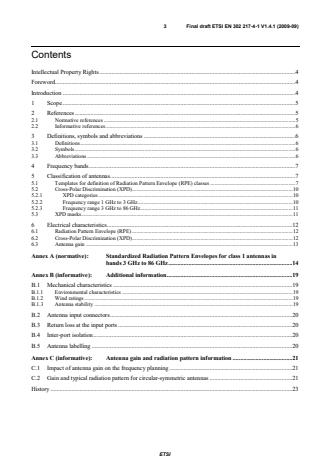
3 Final draft ETSI EN 302 217-4-1 V1.4.1 (2009-09)
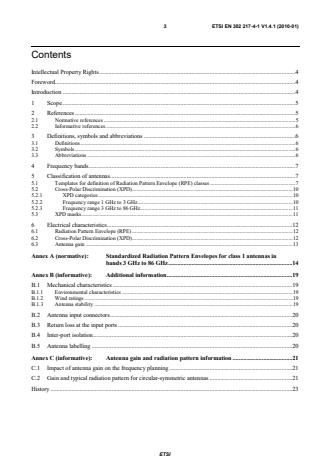
Contents
Intellectual Property Rights . 4
Foreword . 4
Introduction . 4
1 Scope . 5
2 References . 5
2.1 Normative references . 5
2.2 Informative references . 6
3 Definitions, symbols and abbreviations . 6
3.1 Definitions . 6
3.2 Symbols . 6
3.3 Abbreviations . 6
4 Frequency bands . 7
5 Classification of antennas . 7
5.1 Templates for definition of Radiation Pattern Envelope (RPE) classes . 7
5.2 Cross-Polar Discrimination (XPD) . 10
5.2.1 XPD categories . 10
5.2.2 Frequency range 1 GHz to 3 GHz . 10
5.2.3 Frequency range 3 GHz to 86 GHz . 11
5.3 XPD masks . 11
6 Electrical characteristics . 12
6.1 Radiation Pattern Envelope (RPE) . 12
6.2 Cross-Polar Discrimination (XPD) . 12
6.3 Antenna gain . 13
Annex A (normative): Standardized Radiation Pattern Envelopes for class 1 antennas in
bands 3 GHz to 86 GHz . 14
Annex B (informative): Additional information . 19
B.1 Mechanical characteristics . 19
B.1.1 Environmental characteristics . 19
B.1.2 Wind ratings . 19
B.1.3 Antenna stability . 19
B.2 Antenna input connectors . 20
B.3 Return loss at the input ports . 20
B.4 Inter-port isolation . 20
B.5 Antenna labelling . 20
Annex C (informative): Antenna gain and radiation pattern information . 21
C.1 Impact of antenna gain on the frequency planning . 21
C.2 Gain and typical radiation pattern for circular-symmetric antennas . 21
History . 23
ETSI
4 Final draft ETSI EN 302 217-4-1 V1.4.1 (2009-09)
Intellectual Property Rights
IPRs essential or potentially essential to the present document may have been declared to ETSI. The information
pertaining to these essential IPRs, if any, is publicly available for ETSI members and non-members, and can be found
in ETSI SR 000 314: "Intellectual Property Rights (IPRs); Essential, or potentially Essential, IPRs notified to ETSI in
respect of ETSI standards", which is available from the ETSI Secretariat. Latest updates are available on the ETSI Web
server (http://webapp.etsi.org/IPR/home.asp).
Pursuant to the ETSI IPR Policy, no investigation, including IPR searches, has been carried out by ETSI. No guarantee
can be given as to the existence of other IPRs not referenced in ETSI SR 000 314 (or the updates on the ETSI Web
server) which are, or may be, or may become, essential to the present document.
Foreword
This European Standard (Telecommunications series) has been produced by ETSI Technical Committee Access,
Terminals, Transmission and Multiplexing (ATTM), and is now submitted for the ETSI standards One-step Approval
Procedure.
The present document is part 4-1 of a multi-part deliverable covering the Fixed Radio Systems; Characteristics and
requirements for point-to-point equipment and antennas. Full details of the entire series can be found in part 1 [3].
Proposed national transposition dates
Date of latest announcement of this EN (doa): 3 months after ETSI publication
Date of latest publication of new National Standard
or endorsement of this EN (dop/e): 6 months after doa
Date of withdrawal of any conflicting National Standard (dow): 6 months after doa
Introduction
The purpose of the present document is to define antenna parameters, which are relevant to Fixed Radio Systems (FRS),
including those considered essential for conformity to the R&TTE Directive [1]. Limits are set out in
EN 302 217-4-2 [4].
Additional parameters appropriate to system implementation may be subject to agreement between the equipment
purchaser and supplier. Further guidance is provided in annex B.
ETSI
5 Final draft ETSI EN 302 217-4-1 V1.4.1 (2009-09)
1 Scope
The present document summarizes all requirements for single main beam, linear polarization, directional antennas to be
adopted in conjunction with Point-to-Point (PP) systems operating in the frequency range 1 GHz to 86 GHz.
Single polarization antennas, dual polarization antennas, dual band/single polarized antennas and dual band/dual
polarization antennas are considered.
Description and limits for parameters relevant to essential requirements under article 3.2 of the R&TTE Directive [1]
are given in EN 302 217-4-2 [4].
For other parameters and general information that does not affect the R&TTE Directive [1] "essential requirements"
mentioned above, description and limits are set out in the present document.
There are a number of different antenna types for various applications, the principles by which they are classified are
given in clause 5.
The present document does not cover aspects related to test procedures and test conditions, which are covered by the
scope of EN 301 126-3-1 [2].
Guidance on the definition of radio parameters relevant to the essential requirements under article 3.2 of the
R&TTE Directive [1] for DFRS may be found in TR 101 506 [i.1].
2 References
References are either specific (identified by date of publication and/or edition number or version number) or non-
specific.
• For a specific reference, subsequent revisions do not apply.
• Non-specific reference may be made only to a complete document or a part thereof and only in the following
cases:
- if it is accepted that it will be possible to use all future changes of the referenced document for the
purposes of the referring document;
- for informative references.
Referenced documents which are not found to be publicly available in the expected location might be found at
http://docbox.etsi.org/Reference.
NOTE: While any hyperlinks included in this clause were valid at the time of publication ETSI cannot guarantee
their long term validity.
2.1 Normative references
The following referenced documents are indispensable for the application of the present document. For dated
references, only the edition cited applies. For non-specific references, the latest edition of the referenced document
(including any amendments) applies.
[1] Directive 1999/5/EC of the European Parliament and of the Council of 9 March 1999 on radio
equipment and telecommunications terminal equipment and the mutual recognition of their
conformity (R&TTE Directive).
[2] ETSI EN 301 126-3-1: "Fixed Radio Systems; Conformance testing; Part 3-1: Point-to-Point
antennas; Definitions, general requirements and test procedures".
[3] ETSI EN 302 217-1: "Fixed Radio Systems; Characteristics and requirements for point-to-point
equipment and antennas; Part 1: Overview and system-independent common characteristics".
ETSI
6 Final draft ETSI EN 302 217-4-1 V1.4.1 (2009-09)
[4] ETSI EN 302 217-4-2: "Fixed Radio Systems; Characteristics and requirements for point-to-point
equipment and antennas; Part 4-2: Antennas; Harmonized EN covering the essential requirements
of article 3.2 of the R&TTE Directive ".
[5] IEC 60154-1: "Flanges for waveguides. Part 1: General requirements".
[6] IEC 60154-2: "Flanges for waveguides. Part 2: Relevant specifications for flanges for ordinary
rectangular waveguides".
[7] IEC 60169-1: "Radio-frequency connectors. Part 1: General requirements and measuring
methods".
2.2 Informative references
The following referenced documents are not essential to the use of the present document but they assist the user with
regard to a particular subject area. For non-specific references, the latest version of the referenced document (including
any amendments) applies.
[i.1] ETSI TR 101 506: "Fixed Radio Systems; Generic definitions, terminology and applicability of
essential requirements under the article 3.2 of 1999/05/EC Directive to Fixed Radio Systems".
[i.2] ETSI EN 302 217-2-2: "Fixed Radio Systems; Characteristics and requirements for point-to-point
equipment and antennas; Part 2-2: Digital systems operating in frequency bands where frequency
co-ordination is applied; Harmonized EN covering the essential requirements of article 3.2 of the
R&TTE Directive".
[i.3] ETSI TR 102 243-1: "Fixed Radio Systems; Representative values for transmitter power and
antenna gain to support inter- and intra-compatibility and sharing analysis; Part 1: Digital point-to-
point systems".
[i.4] ETSI EN 302 217-2-1: "Fixed Radio Systems; Characteristics and requirements for point-to-point
equipment and antennas; Part 2-1: System-dependent requirements for digital systems operating in
frequency bands where frequency co-ordination is applied".
[i.5] ITU-R Recommendation F.699: "Reference radiation patterns for fixed wireless system antennas
for use in coordination studies and interference assessment in the frequency range from 100 MHz
to about 70 GHz".
3 Definitions, symbols and abbreviations
3.1 Definitions
For the purposes of the present document, the terms and definitions given in EN 302 217-1 [3] apply.
3.2 Symbols
For the purposes of the present document, the symbols given in EN 302 217-1 [3] apply.
3.3 Abbreviations
For the purposes of the present document, the abbreviations given in EN 302 217-1 [3] apply.
ETSI
7 Final draft ETSI EN 302 217-4-1 V1.4.1 (2009-09)
4 Frequency bands
The present document defines the characteristics and requirements of antennas in the frequency range from 1 GHz to
86 GHz.
For technical commonalities that range is here divided into sub-ranges as follows:
Range 0: 1 GHz to 3 GHz;
Range 1: 3 GHz to 14 GHz;
Range 2: 14 GHz to 20 GHz;
Range 3: 20 GHz to 24 GHz;
Range 4: 24 GHz to 30 GHz;
Range 5: 30 GHz to 47 GHz;
Range 6: 47 GHz to 66 GHz;
Range 7: 66 GHz to 86 GHz.
5 Classification of antennas
Antenna classification presented in the present document is based on RPE and XPD parameters.
5.1 Templates for definition of Radiation Pattern Envelope
(RPE) classes
The RPE directional characteristic (co-polar and cross-polar) impacts the interference situation in the network planning
and a trade-off between a highly demanding RPE and the cost/size/weight of the antennas, compatible with the
constraints given by present and future networks is then advisable.
With respect to the Radiation Pattern Envelope (RPE), four classes (RPE classes 1 to 4) have been identified according
maximum co-polar limit templates for any actual RPE mask in significant range of off-axis azimuth angles. The
templates for subdivision in those classes are also depending on given frequency ranges of operation according to
figures 1 to 3 and table 1.
Figures 1 to 3 are intended only as templates for defining subdivision of antennas in directivity classes; actual
limits options for declaration of conformance to essential requirements under article 3.2 of the R&TTE
Directive [1] are defined only in EN 302 217-2-2 [i.2].
When more than one actual standardized RPE falls within the same class template, a sub-class indicative (A, B, C, etc.)
will be used according their more demanding RPE limit in angles closer to the intended direction.
NOTE: Figures 1 to 3 report limit templates for any actual RPE mask of classes 2, 3 and 4 antennas; class 1
antennas are defined as those which actual RPE mask exceeds class 2 limit template.
ETSI
8 Final draft ETSI EN 302 217-4-1 V1.4.1 (2009-09)
Class 2
Class 3
Class 4
-5
-10
-15
-20
-25
-30
-35
0 102030405060 708090 100 110 120 130 140 150 160 170 180
Angle of azimuth relative to main beam axis (degrees)
Figure 1: Co-polar limit templates for actual RPE masks of antenna classes
in the range 1 GHz to 3 GHz (see table 1)
Class 2
Class 3
-5
Class 4
-10
-15
-20
-25
-30
-35
0 10 20 30 40 50 60 70 80 90 100 110 120 130 140 150 160 170 180
Angle of azimuth relative to main beam axis (degrees)
Figure 2: Co-polar limit templates for actual RPE masks of antenna classes
in the range 3 GHz to 30 GHz (see table 1)
ETSI
Maximum Gain (dBi)
Maximum Gain (dBi)
9 Final draft ETSI EN 302 217-4-1 V1.4.1 (2009-09)
5 Class 2
Class 3
-5 Class 4
-10
-15
-20
-25
-30
-35
0 10203040506070 8090 100 110 120 130 140 150 160 170 180
Angle of azimuth relative to main beam axis (degrees)
Figure 3: Co-polar limit templates for actual RPE masks of antenna classes
in the range 30 GHz to 66 GHz (see table 1)
Class 2
Class 3
-5 Class 4
-10
-15
-20
-25
-30
-35
0 10203040506070 8090 100 110 120 130 140 150 160 170 180
Angle of azimuth relative to main beam axis (degrees)
Figure 4: Co-polar limit templates for actual RPE masks of antenna classes
in the range 66 GHz to 86 GHz (see table 1)
ETSI
Maximum Gain (dBi) Maximum Gain (dBi)
10 Final draft ETSI EN 302 217-4-1 V1.4.1 (2009-09)
Table 1: Corner points of co-polar limits for actual RPE masks (see figures 1, 2, 3 and 4)
RPE Co-polar maximum limit templates for actual RPEs
classes
Range 1 GHz to 3 GHz Range 30 GHz to 66 GHz
Range 3 GHz to 30 GHz Range 66 GHz to 86 GHz
(se
...
European Standard (Telecommunications series)
Fixed Radio Systems;
Characteristics and requirements
for point-to-point equipment and antennas;
Part 4-1: System-dependent requirements for antennas
2 ETSI EN 302 217-4-1 V1.4.1 (2010-01)
Reference
REN/ATTM-04011
Keywords
antenna, DFRS, DRRS, FWA, point-to-point,
transmission
ETSI
650 Route des Lucioles
F-06921 Sophia Antipolis Cedex - FRANCE
Tel.: +33 4 92 94 42 00 Fax: +33 4 93 65 47 16
Siret N° 348 623 562 00017 - NAF 742 C
Association à but non lucratif enregistrée à la
Sous-Préfecture de Grasse (06) N° 7803/88
Important notice
Individual copies of the present document can be downloaded from:
http://www.etsi.org
The present document may be made available in more than one electronic version or in print. In any case of existing or
perceived difference in contents between such versions, the reference version is the Portable Document Format (PDF).
In case of dispute, the reference shall be the printing on ETSI printers of the PDF version kept on a specific network drive
within ETSI Secretariat.
Users of the present document should be aware that the document may be subject to revision or change of status.
Information on the current status of this and other ETSI documents is available at
http://portal.etsi.org/tb/status/status.asp
If you find errors in the present document, please send your comment to one of the following services:
http://portal.etsi.org/chaircor/ETSI_support.asp
Copyright Notification
No part may be reproduced except as authorized by written permission.
The copyright and the foregoing restriction extend to reproduction in all media.
© European Telecommunications Standards Institute 2010.
All rights reserved.
TM TM TM TM
DECT , PLUGTESTS , UMTS , TIPHON , the TIPHON logo and the ETSI logo are Trade Marks of ETSI registered
for the benefit of its Members.
TM
3GPP is a Trade Mark of ETSI registered for the benefit of its Members and of the 3GPP Organizational Partners.
LTE™ is a Trade Mark of ETSI currently being registered
for the benefit of its Members and of the 3GPP Organizational Partners.
GSM® and the GSM logo are Trade Marks registered and owned by the GSM Association.
ETSI
3 ETSI EN 302 217-4-1 V1.4.1 (2010-01)
Contents
Intellectual Property Rights . 4
Foreword . 4
Introduction . 4
1 Scope . 5
2 References . 5
2.1 Normative references . 5
2.2 Informative references . 6
3 Definitions, symbols and abbreviations . 6
3.1 Definitions . 6
3.2 Symbols . 6
3.3 Abbreviations . 6
4 Frequency bands . 7
5 Classification of antennas . 7
5.1 Templates for definition of Radiation Pattern Envelope (RPE) classes . 7
5.2 Cross-Polar Discrimination (XPD) . 10
5.2.1 XPD categories . 10
5.2.2 Frequency range 1 GHz to 3 GHz . 10
5.2.3 Frequency range 3 GHz to 86 GHz . 11
5.3 XPD masks . 11
6 Electrical characteristics . 12
6.1 Radiation Pattern Envelope (RPE) . 12
6.2 Cross-Polar Discrimination (XPD) . 12
6.3 Antenna gain . 13
Annex A (normative): Standardized Radiation Pattern Envelopes for class 1 antennas in
bands 3 GHz to 86 GHz . 14
Annex B (informative): Additional information . 19
B.1 Mechanical characteristics . 19
B.1.1 Environmental characteristics . 19
B.1.2 Wind ratings . 19
B.1.3 Antenna stability . 19
B.2 Antenna input connectors . 20
B.3 Return loss at the input ports . 20
B.4 Inter-port isolation . 20
B.5 Antenna labelling . 20
Annex C (informative): Antenna gain and radiation pattern information . 21
C.1 Impact of antenna gain on the frequency planning . 21
C.2 Gain and typical radiation pattern for circular-symmetric antennas . 21
History . 23
ETSI
4 ETSI EN 302 217-4-1 V1.4.1 (2010-01)
Intellectual Property Rights
IPRs essential or potentially essential to the present document may have been declared to ETSI. The information
pertaining to these essential IPRs, if any, is publicly available for ETSI members and non-members, and can be found
in ETSI SR 000 314: "Intellectual Property Rights (IPRs); Essential, or potentially Essential, IPRs notified to ETSI in
respect of ETSI standards", which is available from the ETSI Secretariat. Latest updates are available on the ETSI Web
server (http://webapp.etsi.org/IPR/home.asp).
Pursuant to the ETSI IPR Policy, no investigation, including IPR searches, has been carried out by ETSI. No guarantee
can be given as to the existence of other IPRs not referenced in ETSI SR 000 314 (or the updates on the ETSI Web
server) which are, or may be, or may become, essential to the present document.
Foreword
This European Standard (Telecommunications series) has been produced by ETSI Technical Committee Access,
Terminals, Transmission and Multiplexing (ATTM).
The present document is part 4-1 of a multi-part deliverable covering the Fixed Radio Systems; Characteristics and
requirements for point-to-point equipment and antennas. Full details of the entire series can be found in part 1 [3].
National transposition dates
Date of adoption of this EN: 18 January 2010
Date of latest announcement of this EN (doa): 30 April 2010
Date of latest publication of new National Standard
or endorsement of this EN (dop/e): 31 October 2010
Date of withdrawal of any conflicting National Standard (dow): 31 October 2010
Introduction
The purpose of the present document is to define antenna parameters, which are relevant to Fixed Radio Systems (FRS),
including those considered essential for conformity to the R&TTE Directive [1]. Limits are set out in
EN 302 217-4-2 [4].
Additional parameters appropriate to system implementation may be subject to agreement between the equipment
purchaser and supplier. Further guidance is provided in annex B.
ETSI
5 ETSI EN 302 217-4-1 V1.4.1 (2010-01)
1 Scope
The present document summarizes all requirements for single main beam, linear polarization, directional antennas to be
adopted in conjunction with Point-to-Point (PP) systems operating in the frequency range 1 GHz to 86 GHz.
Single polarization antennas, dual polarization antennas, dual band/single polarized antennas and dual band/dual
polarization antennas are considered.
Description and limits for parameters relevant to essential requirements under article 3.2 of the R&TTE Directive [1]
are given in EN 302 217-4-2 [4].
For other parameters and general information that does not affect the R&TTE Directive [1] "essential requirements"
mentioned above, description and limits are set out in the present document.
There are a number of different antenna types for various applications, the principles by which they are classified are
given in clause 5.
The present document does not cover aspects related to test procedures and test conditions, which are covered by the
scope of EN 301 126-3-1 [2].
Guidance on the definition of radio parameters relevant to the essential requirements under article 3.2 of the
R&TTE Directive [1] for DFRS may be found in TR 101 506 [i.1].
2 References
References are either specific (identified by date of publication and/or edition number or version number) or non-
specific.
• For a specific reference, subsequent revisions do not apply.
• Non-specific reference may be made only to a complete document or a part thereof and only in the following
cases:
- if it is accepted that it will be possible to use all future changes of the referenced document for the
purposes of the referring document;
- for informative references.
Referenced documents which are not found to be publicly available in the expected location might be found at
http://docbox.etsi.org/Reference.
NOTE: While any hyperlinks included in this clause were valid at the time of publication ETSI cannot guarantee
their long term validity.
2.1 Normative references
The following referenced documents are indispensable for the application of the present document. For dated
references, only the edition cited applies. For non-specific references, the latest edition of the referenced document
(including any amendments) applies.
[1] Directive 1999/5/EC of the European Parliament and of the Council of 9 March 1999 on radio
equipment and telecommunications terminal equipment and the mutual recognition of their
conformity (R&TTE Directive).
[2] ETSI EN 301 126-3-1: "Fixed Radio Systems; Conformance testing; Part 3-1: Point-to-Point
antennas; Definitions, general requirements and test procedures".
[3] ETSI EN 302 217-1: "Fixed Radio Systems; Characteristics and requirements for point-to-point
equipment and antennas; Part 1: Overview and system-independent common characteristics".
ETSI
6 ETSI EN 302 217-4-1 V1.4.1 (2010-01)
[4] ETSI EN 302 217-4-2: "Fixed Radio Systems; Characteristics and requirements for point-to-point
equipment and antennas; Part 4-2: Antennas; Harmonized EN covering the essential requirements
of article 3.2 of the R&TTE Directive ".
[5] IEC 60154-1: "Flanges for waveguides. Part 1: General requirements".
[6] IEC 60154-2: "Flanges for waveguides. Part 2: Relevant specifications for flanges for ordinary
rectangular waveguides".
[7] IEC 60169-1: "Radio-frequency connectors. Part 1: General requirements and measuring
methods".
2.2 Informative references
The following referenced documents are not essential to the use of the present document but they assist the user with
regard to a particular subject area. For non-specific references, the latest version of the referenced document (including
any amendments) applies.
[i.1] ETSI TR 101 506: "Fixed Radio Systems; Generic definitions, terminology and applicability of
essential requirements under the article 3.2 of 1999/05/EC Directive to Fixed Radio Systems".
[i.2] ETSI EN 302 217-2-2: "Fixed Radio Systems; Characteristics and requirements for point-to-point
equipment and antennas; Part 2-2: Digital systems operating in frequency bands where frequency
co-ordination is applied; Harmonized EN covering the essential requirements of article 3.2 of the
R&TTE Directive".
[i.3] ETSI TR 102 243-1: "Fixed Radio Systems; Representative values for transmitter power and
antenna gain to support inter- and intra-compatibility and sharing analysis; Part 1: Digital point-to-
point systems".
[i.4] ETSI EN 302 217-2-1: "Fixed Radio Systems; Characteristics and requirements for point-to-point
equipment and antennas; Part 2-1: System-dependent requirements for digital systems operating in
frequency bands where frequency co-ordination is applied".
[i.5] ITU-R Recommendation F.699: "Reference radiation patterns for fixed wireless system antennas
for use in coordination studies and interference assessment in the frequency range from 100 MHz
to about 70 GHz".
3 Definitions, symbols and abbreviations
3.1 Definitions
For the purposes of the present document, the terms and definitions given in EN 302 217-1 [3] apply.
3.2 Symbols
For the purposes of the present document, the symbols given in EN 302 217-1 [3] apply.
3.3 Abbreviations
For the purposes of the present document, the abbreviations given in EN 302 217-1 [3] apply.
ETSI
7 ETSI EN 302 217-4-1 V1.4.1 (2010-01)
4 Frequency bands
The present document defines the characteristics and requirements of antennas in the frequency range from 1 GHz to
86 GHz.
For technical commonalities that range is here divided into sub-ranges as follows:
Range 0: 1 GHz to 3 GHz;
Range 1: 3 GHz to 14 GHz;
Range 2: 14 GHz to 20 GHz;
Range 3: 20 GHz to 24 GHz;
Range 4: 24 GHz to 30 GHz;
Range 5: 30 GHz to 47 GHz;
Range 6: 47 GHz to 66 GHz;
Range 7: 66 GHz to 86 GHz.
5 Classification of antennas
Antenna classification presented in the present document is based on RPE and XPD parameters.
5.1 Templates for definition of Radiation Pattern Envelope
(RPE) classes
The RPE directional characteristic (co-polar and cross-polar) impacts the interference situation in the network planning
and a trade-off between a highly demanding RPE and the cost/size/weight of the antennas, compatible with the
constraints given by present and future networks is then advisable.
With respect to the Radiation Pattern Envelope (RPE), four classes (RPE classes 1 to 4) have been identified according
maximum co-polar limit templates for any actual RPE mask in significant range of off-axis azimuth angles. The
templates for subdivision in those classes are also depending on given frequency ranges of operation according to
figures 1 to 3 and table 1.
Figures 1 to 3 are intended only as templates for defining subdivision of antennas in directivity classes; actual
limits options for declaration of conformance to essential requirements under article 3.2 of the R&TTE
Directive [1] are defined only in EN 302 217-2-2 [i.2].
When more than one actual standardized RPE falls within the same class template, a sub-class indicative (A, B, C, etc.)
will be used according their more demanding RPE limit in angles closer to the intended direction.
NOTE: Figures 1 to 3 report limit templates for any actual RPE mask of classes 2, 3 and 4 antennas; class 1
antennas are defined as those which actual RPE mask exceeds class 2 limit template.
ETSI
8 ETSI EN 302 217-4-1 V1.4.1 (2010-01)
Class 2
Class 3
Class 4
-5
-10
-15
-20
-25
-30
-35
0 102030405060 708090 100 110 120 130 140 150 160 170 180
Angle of azimuth relative to main beam axis (degrees)
Figure 1: Co-polar limit templates for actual RPE masks of antenna classes
in the range 1 GHz to 3 GHz (see table 1)
Class 2
Class 3
-5
Class 4
-10
-15
-20
-25
-30
-35
0 10 20 30 40 50 60 70 80 90 100 110 120 130 140 150 160 170 180
Angle of azimuth relative to main beam axis (degrees)
Figure 2: Co-polar limit templates for actual RPE masks of antenna classes
in the range 3 GHz to 30 GHz (see table 1)
ETSI
Maximum Gain (dBi)
Maximum Gain (dBi)
9 ETSI EN 302 217-4-1 V1.4.1 (2010-01)
Class 2
Class 3
Class 4
-5
-10
-15
-20
-25
-30
-35
0 10203040506070 8090 100 110 120 130 140 150 160 170 180
Angle of azimuth relative to main beam axis (degrees)
Figure 3: Co-polar limit templates for actual RPE masks of antenna classes
in the range 30 GHz to 66 GHz (see table 1)
Class 2
Class 3
-5 Class 4
-10
-15
-20
-25
-30
-35
0 10203040506070 8090 100 110 120 130 140 150 160 170 180
Angle of azimuth relative to main beam axis (degrees)
Figure 4: Co-polar limit templates for actual RPE masks of antenna classes
in the range 66 GHz to 86 GHz (see table 1)
ETSI
Maximum Gain (dBi) Maximum Gain (dBi)
10 ETSI EN 302 217-4-1 V1.4.1 (2010-01)
Table 1: Corner points of co-polar limits for actual RPE masks (see figures 1, 2, 3 and 4)
RPE Co-polar maximum limit templates for actual RPEs
classes
Range 1 GHz to 3 GHz Range 30 GHz to 66 GHz
Range 3 GHz to 30 GHz Range 66 GHz to 86 GHz
(see
(see note 2) (see note 3
...
2003-01.Slovenski inštitut za standardizacijo. Razmnoževanje celote ali delov tega standarda ni dovoljeno.Fixed Radio Systems - Characteristics and requirements for point-to-point equipment and antennas - Part 4-1: System-dependent requirements for antennas33.120.40AnteneAerials33.060.30Radiorelejni in fiksni satelitski komunikacijski sistemiRadio relay and fixed satellite communications systemsICS:Ta slovenski standard je istoveten z:EN 302 217-4-1 Version 1.4.1SIST EN 302 217-4-1 V1.4.1:2010en01-marec-2010SIST EN 302 217-4-1 V1.4.1:2010SLOVENSKI
STANDARD
ETSI ETSI EN 302 217-4-1 V1.4.1 (2010-01)2
Reference REN/ATTM-04011 Keywords antenna, DFRS, DRRS, FWA, point-to-point, transmission ETSI 650 Route des Lucioles F-06921 Sophia Antipolis Cedex - FRANCE
Tel.: +33 4 92 94 42 00
Fax: +33 4 93 65 47 16
Siret N° 348 623 562 00017 - NAF 742 C Association à but non lucratif enregistrée à la Sous-Préfecture de Grasse (06) N° 7803/88
Important notice Individual copies of the present document can be downloaded from: http://www.etsi.org The present document may be made available in more than one electronic version or in print. In any case of existing or perceived difference in contents between such versions, the reference version is the Portable Document Format (PDF). In case of dispute, the reference shall be the printing on ETSI printers of the PDF version kept on a specific network drive within ETSI Secretariat. Users of the present document should be aware that the document may be subject to revision or change of status. Information on the current status of this and other ETSI documents is available at http://portal.etsi.org/tb/status/status.asp If you find errors in the present document, please send your comment to one of the following services: http://portal.etsi.org/chaircor/ETSI_support.asp Copyright Notification No part may be reproduced except as authorized by written permission. The copyright and the foregoing restriction extend to reproduction in all media.
© European Telecommunications Standards Institute 2010. All rights reserved.
DECTTM, PLUGTESTSTM, UMTSTM, TIPHONTM, the TIPHON logo and the ETSI logo are Trade Marks of ETSI registered for the benefit of its Members. 3GPPTM is a Trade Mark of ETSI registered for the benefit of its Members and of the 3GPP Organizational Partners. LTE™ is a Trade Mark of ETSI currently being registered for the benefit of its Members and of the 3GPP Organizational Partners. GSM® and the GSM logo are Trade Marks registered and owned by the GSM Association. SIST EN 302 217-4-1 V1.4.1:2010
ETSI ETSI EN 302 217-4-1 V1.4.1 (2010-01)3 Contents Intellectual Property Rights . 4 Foreword . 4 Introduction . 4 1 Scope . 5 2 References . 5 2.1 Normative references . 5 2.2 Informative references . 6 3 Definitions, symbols and abbreviations . 6 3.1 Definitions . 6 3.2 Symbols . 6 3.3 Abbreviations . 6 4 Frequency bands . 7 5 Classification of antennas . 7 5.1 Templates for definition of Radiation Pattern Envelope (RPE) classes . 7 5.2 Cross-Polar Discrimination (XPD) . 10 5.2.1 XPD categories . 10 5.2.2 Frequency range 1 GHz to 3 GHz . 10 5.2.3 Frequency range 3 GHz to 86 GHz . 11 5.3 XPD masks . 11 6 Electrical characteristics . 12 6.1 Radiation Pattern Envelope (RPE) . 12 6.2 Cross-Polar Discrimination (XPD) . 12 6.3 Antenna gain . 13 Annex A (normative): Standardized Radiation Pattern Envelopes for class 1 antennas in bands 3 GHz to 86 GHz . 14 Annex B (informative): Additional information . 19 B.1 Mechanical characteristics . 19 B.1.1 Environmental characteristics . 19 B.1.2 Wind ratings . 19 B.1.3 Antenna stability . 19 B.2 Antenna input connectors . 20 B.3 Return loss at the input ports . 20 B.4 Inter-port isolation . 20 B.5 Antenna labelling . 20 Annex C (informative): Antenna gain and radiation pattern information . 21 C.1 Impact of antenna gain on the frequency planning . 21 C.2 Gain and typical radiation pattern for circular-symmetric antennas . 21 History . 23
ETSI ETSI EN 302 217-4-1 V1.4.1 (2010-01)4 Intellectual Property Rights IPRs essential or potentially essential to the present document may have been declared to ETSI. The information pertaining to these essential IPRs, if any, is publicly available for ETSI members and non-members, and can be found in ETSI SR 000 314: "Intellectual Property Rights (IPRs); Essential, or potentially Essential, IPRs notified to ETSI in respect of ETSI standards", which is available from the ETSI Secretariat. Latest updates are available on the ETSI Web server (http://webapp.etsi.org/IPR/home.asp). Pursuant to the ETSI IPR Policy, no investigation, including IPR searches, has been carried out by ETSI. No guarantee can be given as to the existence of other IPRs not referenced in ETSI SR 000 314 (or the updates on the ETSI Web server) which are, or may be, or may become, essential to the present document. Foreword This European Standard (Telecommunications series) has been produced by ETSI Technical Committee Access, Terminals, Transmission and Multiplexing (ATTM). The present document is part 4-1 of a multi-part deliverable covering the Fixed Radio Systems; Characteristics and requirements for point-to-point equipment and antennas. Full details of the entire series can be found in part 1 [3].
National transposition dates Date of adoption of this EN: 18 January 2010 Date of latest announcement of this EN (doa): 30 April 2010 Date of latest publication of new National Standard or endorsement of this EN (dop/e):
31 October 2010 Date of withdrawal of any conflicting National Standard (dow): 31 October 2010
Introduction The purpose of the present document is to define antenna parameters, which are relevant to Fixed Radio Systems (FRS), including those considered essential for conformity to the R&TTE Directive [1]. Limits are set out in EN 302 217-4-2 [4]. Additional parameters appropriate to system implementation may be subject to agreement between the equipment purchaser and supplier. Further guidance is provided in annex B. SIST EN 302 217-4-1 V1.4.1:2010
ETSI ETSI EN 302 217-4-1 V1.4.1 (2010-01)5 1 Scope The present document summarizes all requirements for single main beam, linear polarization, directional antennas to be adopted in conjunction with Point-to-Point (PP) systems operating in the frequency range 1 GHz to 86 GHz. Single polarization antennas, dual polarization antennas, dual band/single polarized antennas and dual band/dual polarization antennas are considered. Description and limits for parameters relevant to essential requirements under article 3.2 of the R&TTE Directive [1] are given in EN 302 217-4-2 [4]. For other parameters and general information that does not affect the R&TTE Directive [1] "essential requirements" mentioned above, description and limits are set out in the present document. There are a number of different antenna types for various applications, the principles by which they are classified are given in clause 5. The present document does not cover aspects related to test procedures and test conditions, which are covered by the scope of EN 301 126-3-1 [2]. Guidance on the definition of radio parameters relevant to the essential requirements under article 3.2 of the R&TTE Directive [1] for DFRS may be found in TR 101 506 [i.1]. 2 References References are either specific (identified by date of publication and/or edition number or version number) or non-specific. • For a specific reference, subsequent revisions do not apply. • Non-specific reference may be made only to a complete document or a part thereof and only in the following cases: - if it is accepted that it will be possible to use all future changes of the referenced document for the purposes of the referring document; - for informative references. Referenced documents which are not found to be publicly available in the expected location might be found at http://docbox.etsi.org/Reference. NOTE: While any hyperlinks included in this clause were valid at the time of publication ETSI cannot guarantee their long term validity. 2.1 Normative references The following referenced documents are indispensable for the application of the present document. For dated references, only the edition cited applies. For non-specific references, the latest edition of the referenced document (including any amendments) applies. [1] Directive 1999/5/EC of the European Parliament and of the Council of 9 March 1999 on radio equipment and telecommunications terminal equipment and the mutual recognition of their conformity (R&TTE Directive). [2] ETSI EN 301 126-3-1: "Fixed Radio Systems; Conformance testing; Part 3-1: Point-to-Point antennas; Definitions, general requirements and test procedures". [3] ETSI EN 302 217-1: "Fixed Radio Systems; Characteristics and requirements for point-to-point equipment and antennas; Part 1: Overview and system-independent common characteristics". SIST EN 302 217-4-1 V1.4.1:2010
ETSI ETSI EN 302 217-4-1 V1.4.1 (2010-01)6 [4] ETSI EN 302 217-4-2: "Fixed Radio Systems; Characteristics and requirements for point-to-point equipment and antennas; Part 4-2: Antennas; Harmonized EN covering the essential requirements of article 3.2 of the R&TTE Directive ". [5] IEC 60154-1: "Flanges for waveguides. Part 1: General requirements". [6] IEC 60154-2: "Flanges for waveguides. Part 2: Relevant specifications for flanges for ordinary rectangular waveguides". [7] IEC 60169-1: "Radio-frequency connectors. Part 1: General requirements and measuring methods". 2.2 Informative references The following referenced documents are not essential to the use of the present document but they assist the user with regard to a particular subject area. For non-specific references, the latest version of the referenced document (including any amendments) applies. [i.1] ETSI TR 101 506: "Fixed Radio Systems; Generic definitions, terminology and applicability of essential requirements under the article 3.2 of 1999/05/EC Directive to Fixed Radio Systems". [i.2] ETSI EN 302 217-2-2: "Fixed Radio Systems; Characteristics and requirements for point-to-point equipment and antennas; Part 2-2: Digital systems operating in frequency bands where frequency co-ordination is applied; Harmonized EN covering the essential requirements of article 3.2 of the R&TTE Directive". [i.3] ETSI TR 102 243-1: "Fixed Radio Systems; Representative values for transmitter power and antenna gain to support inter- and intra-compatibility and sharing analysis; Part 1: Digital point-to-point systems". [i.4] ETSI EN 302 217-2-1: "Fixed Radio Systems; Characteristics and requirements for point-to-point equipment and antennas; Part 2-1: System-dependent requirements for digital systems operating in frequency bands where frequency co-ordination is applied". [i.5] ITU-R Recommendation F.699: "Reference radiation patterns for fixed wireless system antennas for use in coordination studies and interference assessment in the frequency range from 100 MHz to about 70 GHz". 3 Definitions, symbols and abbreviations 3.1 Definitions For the purposes of the present document, the terms and definitions given in EN 302 217-1 [3] apply. 3.2 Symbols For the purposes of the present document, the symbols given in EN 302 217-1 [3] apply. 3.3 Abbreviations For the purposes of the present document, the abbreviations given in EN 302 217-1 [3] apply. SIST EN 302 217-4-1 V1.4.1:2010
ETSI ETSI EN 302 217-4-1 V1.4.1 (2010-01)7 4 Frequency bands The present document defines the characteristics and requirements of antennas in the frequency range from 1 GHz to 86 GHz. For technical commonalities that range is here divided into sub-ranges as follows: Range 0: 1 GHz to 3 GHz; Range 1: 3 GHz to 14 GHz; Range 2: 14 GHz to 20 GHz; Range 3: 20 GHz to 24 GHz; Range 4: 24 GHz to 30 GHz; Range 5: 30 GHz to 47 GHz; Range 6: 47 GHz to 66 GHz; Range 7: 66 GHz to 86 GHz. 5 Classification of antennas Antenna classification presented in the present document is based on RPE and XPD parameters. 5.1 Templates for definition of Radiation Pattern Envelope (RPE) classes The RPE directional characteristic (co-polar and cross-polar) impacts the interference situation in the network planning and a trade-off between a highly demanding RPE and the cost/size/weight of the antennas, compatible with the constraints given by present and future networks is then advisable. With respect to the Radiation Pattern Envelope (RPE), four classes (RPE classes 1 to 4) have been identified according maximum co-polar limit templates for any actual RPE mask in significant range of off-axis azimuth angles. The templates for subdivision in those classes are also depending on given frequency ranges of operation according to figures 1 to 3 and table 1. Figures 1 to 3 are intended only as templates for defining subdivision of antennas in directivity classes; actual limits options for declaration of conformance to essential requirements under article 3.2 of the R&TTE Directive [1] are defined only in EN 302 217-2-2 [i.2]. When more than one actual standardized RPE falls within the same class template, a sub-class indicative (A, B, C, etc.) will be used according their more demanding RPE limit in angles closer to the intended direction. NOTE: Figures 1 to 3 report limit templates for any actual RPE mask of classes 2, 3 and 4 antennas; class 1 antennas are defined as those which actual RPE mask exceeds class 2 limit template. SIST EN 302 217-4-1 V1.4.1:2010
ETSI ETSI EN 302 217-4-1 V1.4.1 (2010-01)8 -35-30-25-20-15-10-50510150102030405060708090100110120130140150160170180Angle of azimuth relative to main beam axis (degrees)Maximum Gain (dBi)Class 2Class 3Class 4 Figure 1: Co-polar limit templates for actual RPE masks of antenna classes
in the range 1 GHz to 3 GHz (see table 1) -35-30-25-20-15-10-50510150102030405060708090100110120130140150160170180Angle of azimuth relative to main beam axis (degrees)Maximum Gain (dBi)Class 2Class 3Class 4 Figure 2: Co-polar limit templates for actual RPE masks of antenna classes
in the range 3 GHz to 30 GHz (see table 1) SIST EN 302 217-4-1 V1.4.1:2010
ETSI ETSI EN 302 217-4-1 V1.4.1 (2010-01)9 -35-30-25-20-15-10-50510150102030405060708090100110120130140150160170180Angle of azimuth relative to main beam axis (degrees)Maximum Gain (dBi)Class 2Class 3Class 4 Figure 3: Co-polar limit templates for actual RPE masks of antenna classes
in the range 30 GHz to 66 GHz (see table 1) -35-30-25-20-15-10-50510150102030405060708090100110120130140150160170180Angle of azimuth relative to main beam axis (degrees)Maximum Gain (dBi)Class 2Cl
...